
Electif 621 EBusiness and mBusiness Antoine Harfouche Session

Electif 621 E-Business and m-Business Antoine Harfouche
Session 3 Pillars of the e-Business and m-Business models
THE IMPACT OF SIS ON FIRM’S BUSINESS MODELS II
The Web and the value innovation • Value Propositions • Customer value co-creation • Co-creation in e-communities • Social Media
The impact of SIS on the Pillars of the Business Model ISI impact on the value innovation
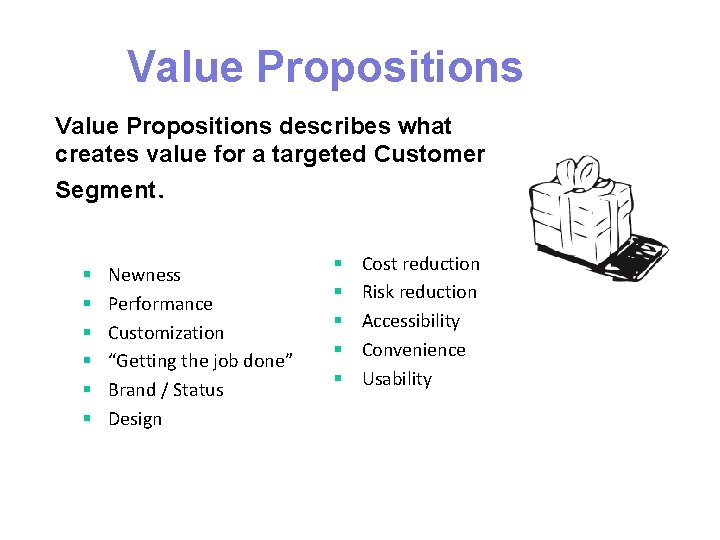
Value Propositions describes what creates value for a targeted Customer Segment. § § § Newness Performance Customization “Getting the job done” Brand / Status Design § § § Cost reduction Risk reduction Accessibility Convenience Usability
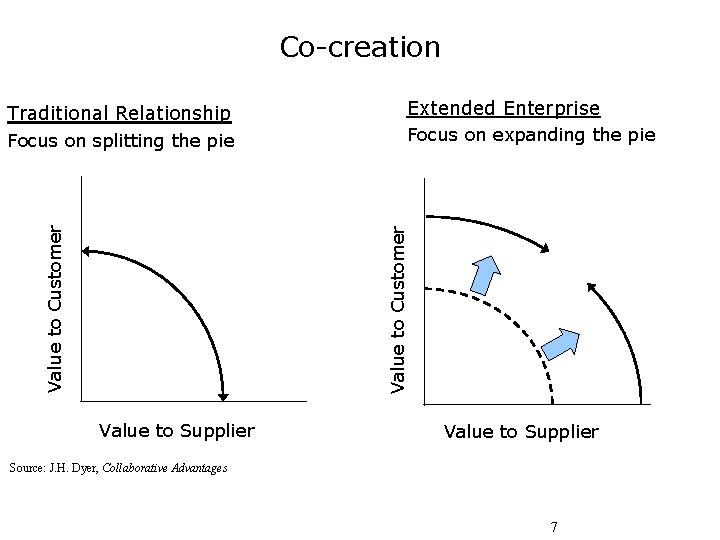
Co-creation Traditional Relationship Focus on expanding the pie Value to Customer Focus on splitting the pie Extended Enterprise Value to Supplier Source: J. H. Dyer, Collaborative Advantages 7
Customer value co-creation
Co-creation • Co-creation relates to the value received by the customer through usage, consumption or experience. (Lusch & Vargo 2006). • Occurs whenever consumers interact with companies or products and thereby have an active role in the shaping of their experience and ultimately value perception. 9
Co-creation of Value • Co-creation between firms and customers, as well as production and consumption, is about tapping successfully into the collective intelligence of consumers. • Co-creation is an active, creative and social process 10
• Co-creation is important because it is: 1. Creative: co-creation is a form of collaborative creativity, that’s initiated by firms to enable innovation with, rather than simply for their customers. 2. A rich mix: co-creation draws on a combination of management and marketing approaches, the psychoanalytic tradition, and processes related to innovation, knowledge and group decision-making. 3. A facilitated process: co-creation thrives on fantasy, play and creativity, but the role of the facilitator or facilitating organisation is often overlooked. 11
4. All about relationships: we stress the importance of focusing on the quality of the interactions between people rather than on technologies per se 5. A learning process: we need to intertwine knowledge and processes in an overall co-creation framework, rather than just enabling co-creativity, if we want to achieve wider organisational impact. From ‘Co-creation: New pathways to value, An overview’, by Nick Coates, Research Director, Promise, 2009. 12
1. Connections: interactions between people, such as companies and customers, not interactions between consumers and products only. 2. Collaboration, rather than just involvement. 3. Co-creativity, not simply co-construction or coproduction. • Co-creation can be seen as a comingtogether of aspects of marketing and management theory, psychology and techniques derived from group decisionmaking, innovation and knowledge processes. 14
Co-creation in ecommunities
Complementary Perspective: Communities of Practice • “Communities of practice are groups of people who share a concern, a set of problems, or a passion about a topic, and who deepen their knowledge and expertise in this area by interacting on an ongoing basis” (Wenger et al. , 2002, p. 4) – Or…unique types of networks in which a shared practice binds members together • Practice: – Includes shared participation in a task, job, or profession, and can extend beyond work to include hobbies, a shared passion about a topic, or a common set of concerns (Brown & Duguid, 2000, 2001).
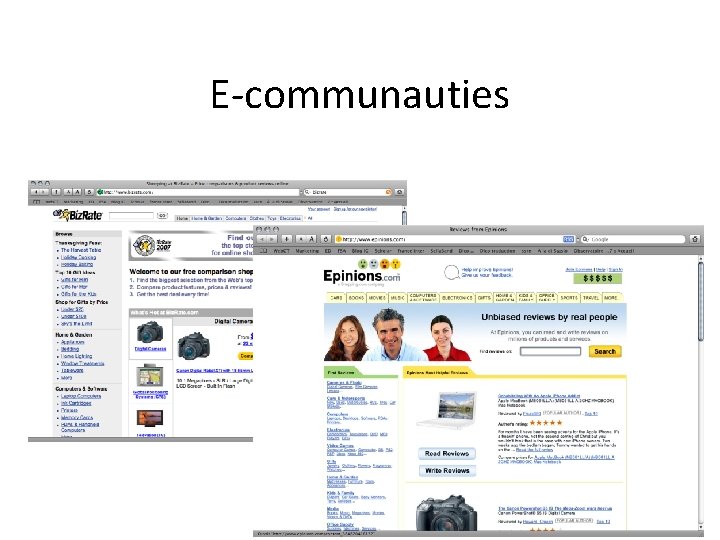
E-communauties
Virtual communities • Building virtual Communities – Internet ideal for gathering people with similar ideas/tasks (communities). – Communities form at web sites in chat rooms, bulletin boards, and distributed e-mail lists. – If a firm builds/maintains the “watering hole” where community gathers, can build relationship with them.
Exemplar Blog/Brand Communities • Nike Blog – The Art of Speed • Red Hat Blog [http: //blogs. redhat. com/] – Road show and executive blogs • Channel 9 - Microsoft [http: //channel 9. msdn. com/] – Microsoft employees and developers talking, learning, and listening globally. • General Motors Blogs [http: //smallblock. gmblogs. com/] – Community for small block enthusiasts • Google Blog – Insight into the news, technology, and culture of Google.
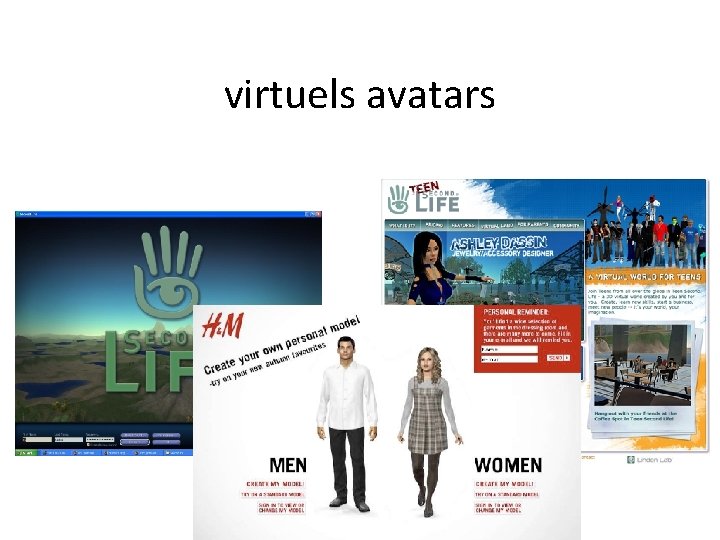
virtuels avatars

Social Media
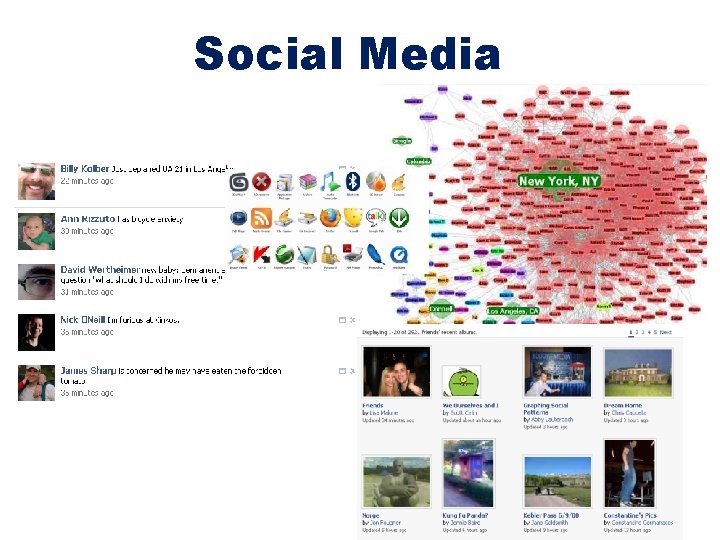
Social Media
Web 2. 0 • The popular term for advanced Internet technology and applications, including blogs, wikis, RSS, and social bookmarking. • One of the most significant differences between Web 2. 0 and the traditional www (World Wide Web) is greater collaboration among Internet users and other users, content providers, and enterprises.
REPRESENTATIVE CHARACTERISTICS OF WEB 2. 0 – The ability to tap into the collective intelligence of users – Data is made available in new or neverintended ways – Web 2. 0 relies on user-generated and usercontrolled content and data

Marketing Your Web Site Traditional Marketing • Television • Radio • Newspapers • Magazines • Billboards • Direct Mail • Word-of-Mouth Internet Marketing • Video sharing web sites • Blogs, Micro-blogs • Social Networks • Widgets • Search Advertising • Direct Email • Word-of-mouth
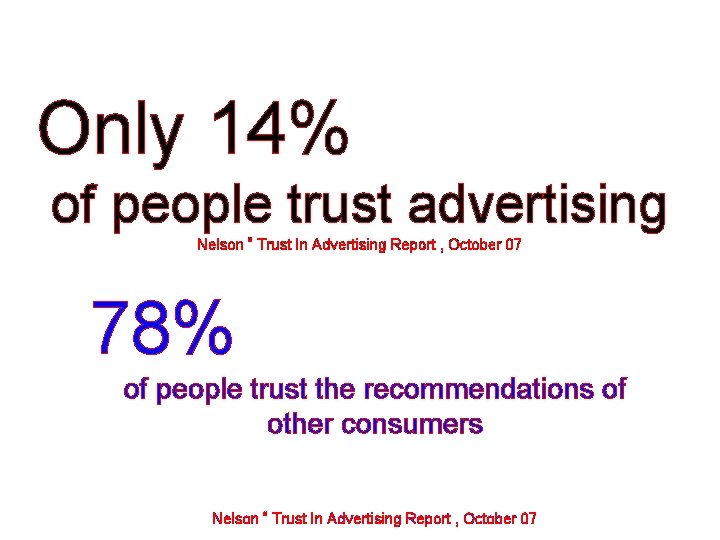
Only 14% of people trust advertising Nelson “ Trust In Advertising Report , October 07 78% of people trust the recommendations of other consumers Nelson “ Trust In Advertising Report , October 07
THE WEB 2. 0 REVOLUTION, SOCIAL MEDIA, AND INDUSTRY DISRUPTORS – Users can access applications entirely through a browser – An architecture of participation encourages users to add value to the application – A major emphasis on social networks and computing – Strong support of information sharing and collaboration – Rapid and continuous creation of new business models
WEB 2. 0 COMPANIES AND NEW BUSINESS MODELS • social media The online platforms and tools that people use to share opinions, experiences, insights, perceptions, and various media, including photos, videos, and music, with each other.
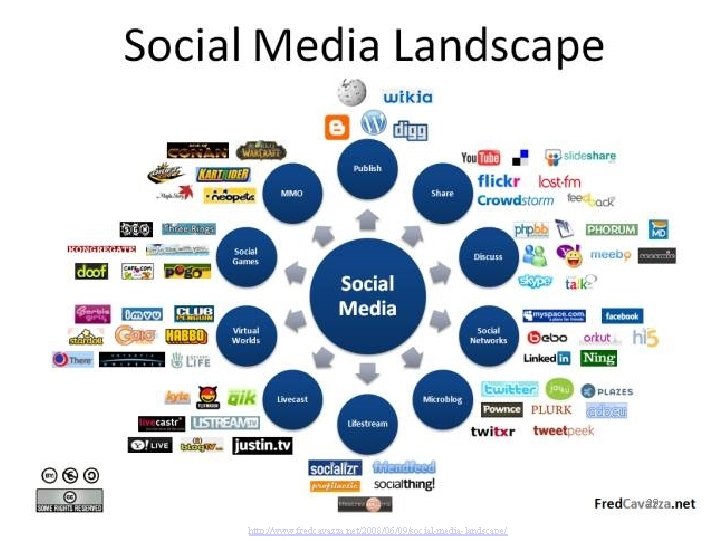
29 http: //www. fredcavazza. net/2008/06/09/social-media-landscape/
Social Networks • A social network is a social structure made of nodes which are generally individuals or organizations. It indicates the ways in which they are connected through various social familiarities ranging from casual acquaintance to close familial bonds. • The term was first coined in 1954 by J. A. Barnes (in: Class and Committees in a Norwegian Island Parish, "Human Relations"). • The maximum size of social networks tends to be around 150 people and the average size around 124 (Hill and Dunbar, 2002).
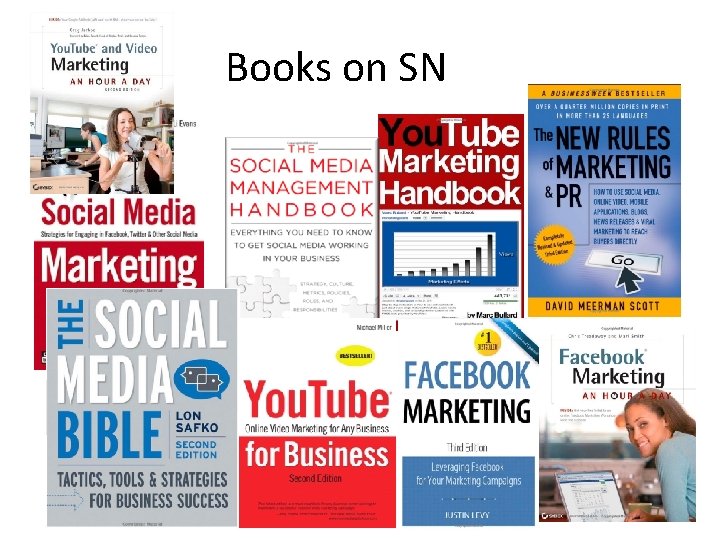
Books on SN
• INDUSTRY AND MARKET DISRUPTORS Disruptors Companies that introduce a significant change in their industries, thus causing a disruption in normal business operations.
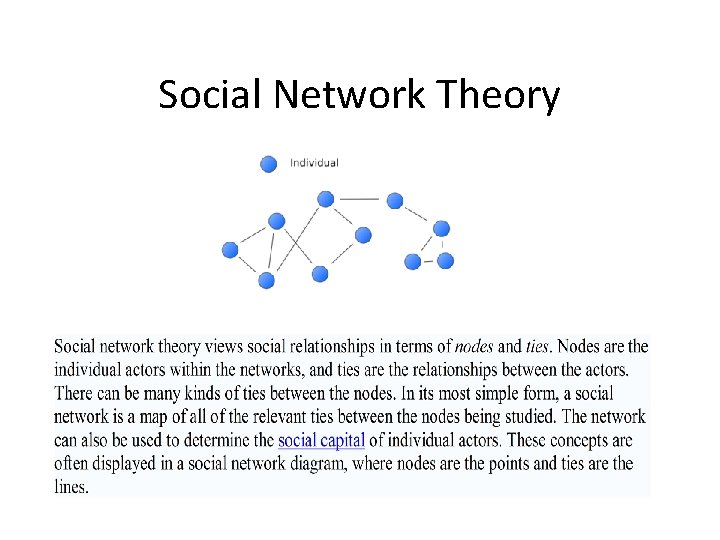
Social Network Theory
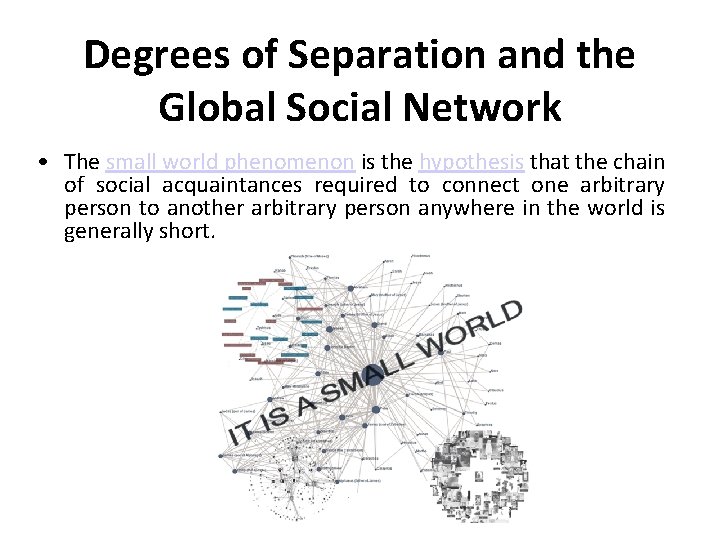
Degrees of Separation and the Global Social Network • The small world phenomenon is the hypothesis that the chain of social acquaintances required to connect one arbitrary person to another arbitrary person anywhere in the world is generally short.
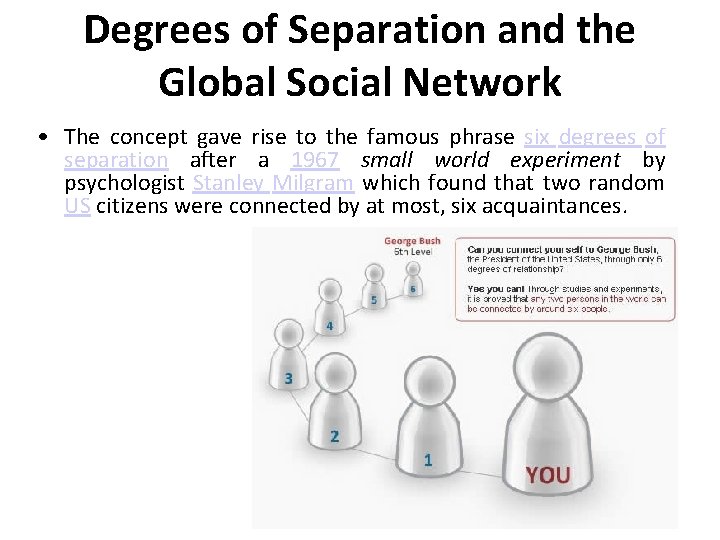
Degrees of Separation and the Global Social Network • The concept gave rise to the famous phrase six degrees of separation after a 1967 small world experiment by psychologist Stanley Milgram which found that two random US citizens were connected by at most, six acquaintances.
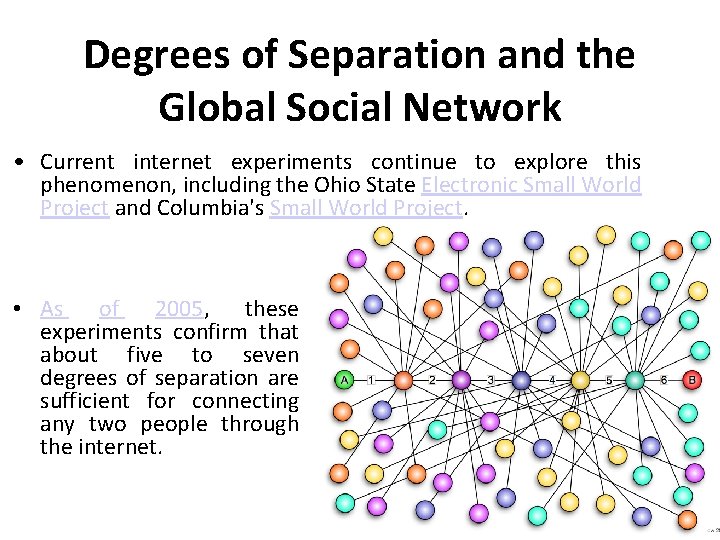
Degrees of Separation and the Global Social Network • Current internet experiments continue to explore this phenomenon, including the Ohio State Electronic Small World Project and Columbia's Small World Project. • As of 2005, these experiments confirm that about five to seven degrees of separation are sufficient for connecting any two people through the internet.
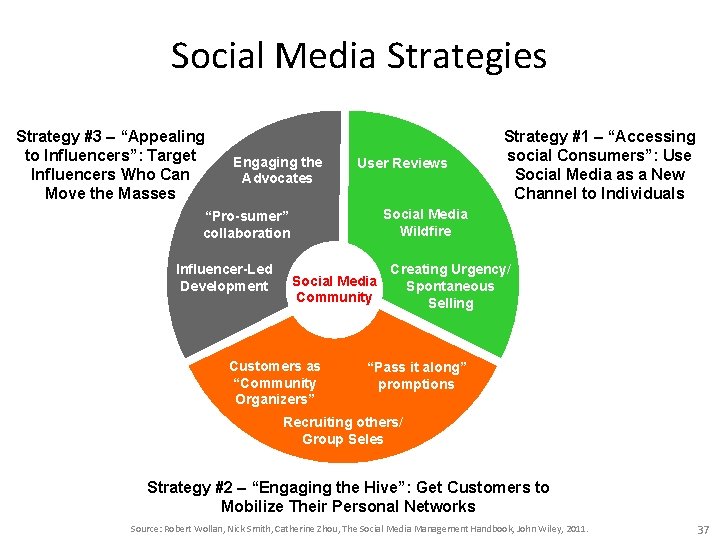
Social Media Strategies Strategy #3 – “Appealing to Influencers”: Target Influencers Who Can Move the Masses Engaging the Advocates User Reviews Social Media Wildfire “Pro-sumer” collaboration Influencer-Led Development Strategy #1 – “Accessing social Consumers”: Use Social Media as a New Channel to Individuals Social Media Community Creating Urgency/ Spontaneous Selling Policies Customers as “Community Organizers” “Pass it along” promptions Recruiting others/ Group Seles Strategy #2 – “Engaging the Hive”: Get Customers to Mobilize Their Personal Networks Source: Robert Wollan, Nick Smith, Catherine Zhou, The Social Media Management Handbook, John Wiley, 2011. 37
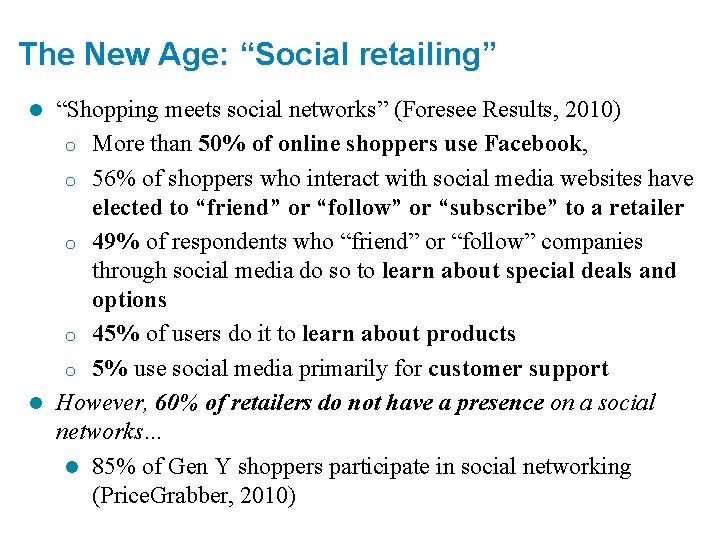
The New Age: “Social retailing” “Shopping meets social networks” (Foresee Results, 2010) o More than 50% of online shoppers use Facebook, o 56% of shoppers who interact with social media websites have elected to “friend” or “follow” or “subscribe” to a retailer o 49% of respondents who “friend” or “follow” companies through social media do so to learn about special deals and options o 45% of users do it to learn about products o 5% use social media primarily for customer support l However, 60% of retailers do not have a presence on a social networks… l 85% of Gen Y shoppers participate in social networking (Price. Grabber, 2010) l

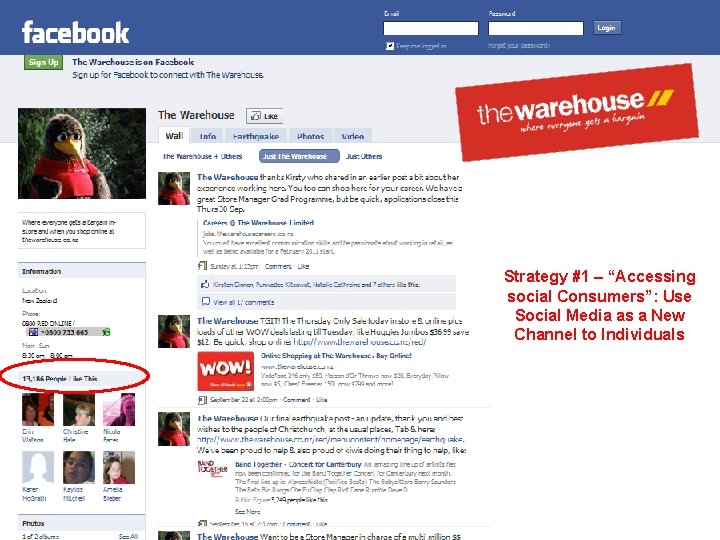
Strategy #1 – “Accessing social Consumers”: Use Social Media as a New Channel to Individuals
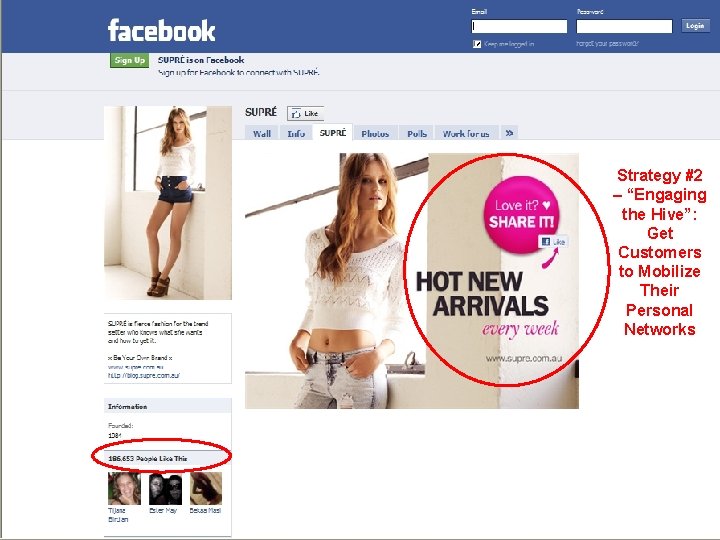
Strategy #2 – “Engaging the Hive”: Get Customers to Mobilize Their Personal Networks

What is Social Media? Does it take the place of “in person” networking or meetings? Social media consists of online marketing with photos, video, podcasts, audio, chat rooms, discussions, blogs, surveys, etc. All of these help engage conversation and allows your message to go “viral” on social networks such as Facebook, Twitter, Linkedin, Plaxo, You. Tube, Flicker, Stumble. Upon, Digg, and so many others. Traditional marketing does not allow for interaction or participation towards content or creation. Social media supplements “in person” networking or meetings, but does not replace it.
Study: Collective action in an electronic No. P • Social capital (SC): – A theory that provides a link b/w social structure and action – Def’n: “Social relations that are accessed or mobilized for purposive action” (Lin, 2001, p. 29) • Wasko and Faraj (2005) hypothesize that social capital positively influences individual knowledge contributions to an electronic No. P • Sample: Members of a U. S. legal professional association using an electronic message board • Structural capital operationalized as centrality based on messages posted to a discussion thread • Results: A user’s network centrality predicted volume of contributions
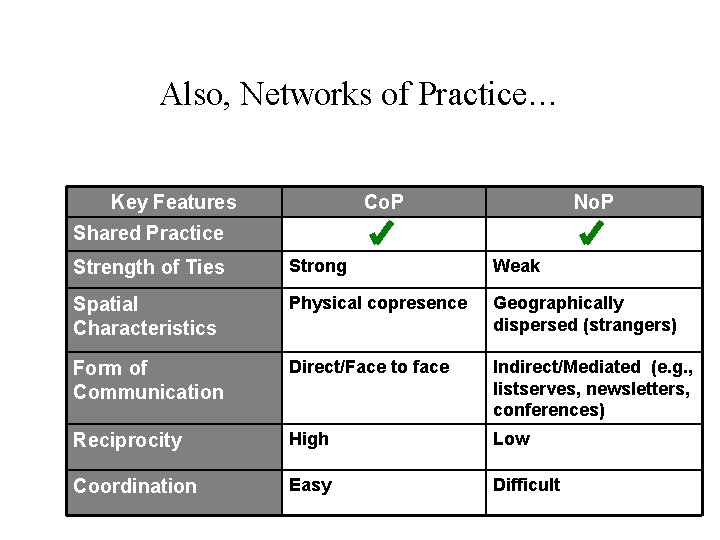
Also, Networks of Practice… Key Features Co. P No. P Shared Practice Strength of Ties Strong Weak Spatial Characteristics Physical copresence Geographically dispersed (strangers) Form of Communication Direct/Face to face Indirect/Mediated (e. g. , listserves, newsletters, conferences) Reciprocity High Low Coordination Easy Difficult
Conceptual Similarities between Networks, Co. Ps/No. Ps, and SC • Cohen and Prusak (2001) describe networks and communities as “the source and shape of social capital in organizations, the primary manifestation of cooperative connections between people” (p. 55). • Community and social capital constructs are “conceptual cousins” (Putnam, 2000, p. 21). • Mutual engagement in a Co. P “identifies a condition that is similar to connection in a network but describes such relations as grounded in common interest and activity, rather than mere interaction” (Iverson and Mc. Phee, 2002, p. 262).
Systems for Collaboration and Teamwork • Social business – Use of social networking platforms, internal and external – Engage employees, customers, and suppliers – Goal is to deepen interactions and expedite information sharing – “Conversations” – Requires information transparency • Driving the exchange of information without intervention from executives or others
Value Chain to Identify potential coproduction and co-creation
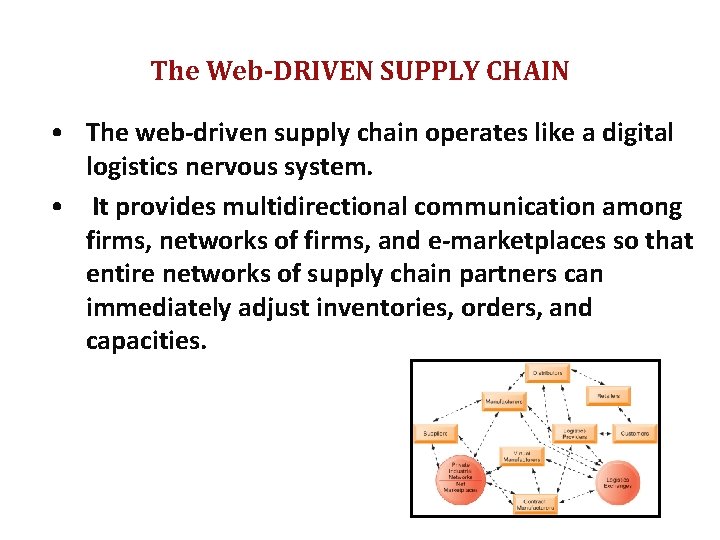
The Web-DRIVEN SUPPLY CHAIN • The web-driven supply chain operates like a digital logistics nervous system. • It provides multidirectional communication among firms, networks of firms, and e-marketplaces so that entire networks of supply chain partners can immediately adjust inventories, orders, and capacities. 49
What is Value Chain? • Represents how a business creates customer value by examining contributions of different internal activities to that value • Divides a business into a set of activities within the business – Starts with inputs a firm receives – Finishes with firm’s products or services and after-sales service to customers • Allows for better identification of a firm’s strengths and weaknesses since the business is viewed as a process
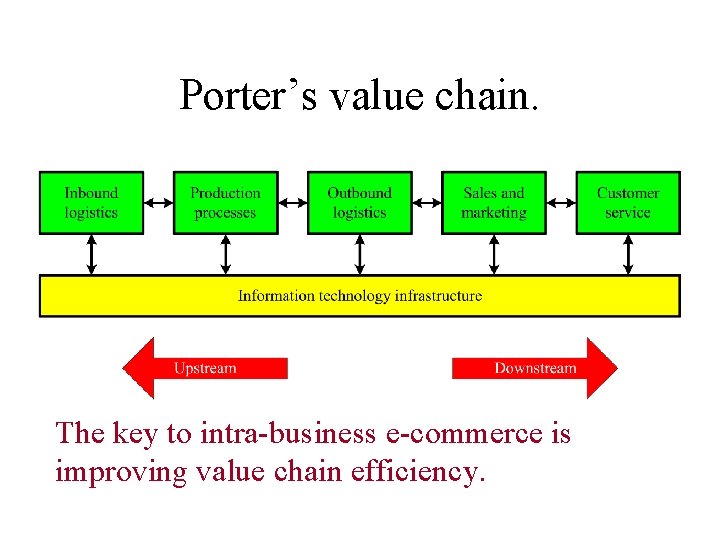
Porter’s value chain. The key to intra-business e-commerce is improving value chain efficiency.
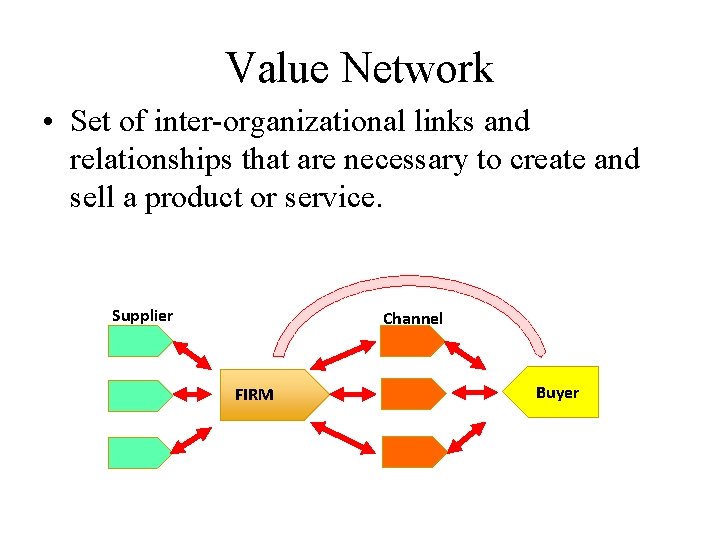
Value Network • Set of inter-organizational links and relationships that are necessary to create and sell a product or service. Supplier Channel FIRM Buyer
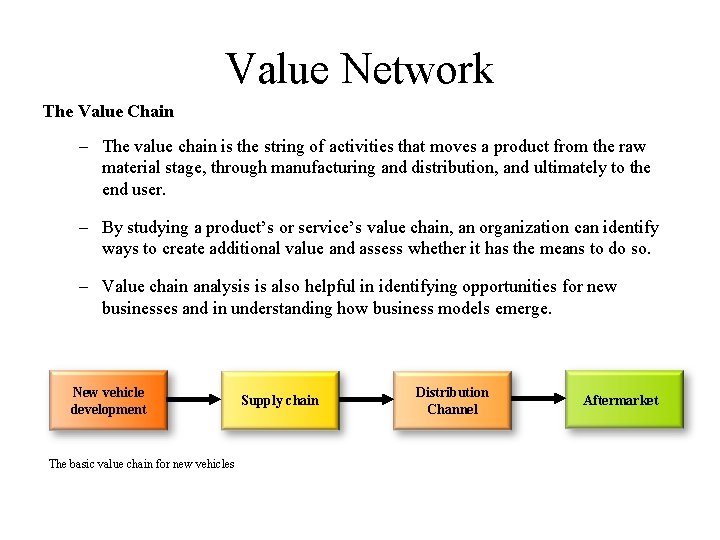
Value Network The Value Chain – The value chain is the string of activities that moves a product from the raw material stage, through manufacturing and distribution, and ultimately to the end user. – By studying a product’s or service’s value chain, an organization can identify ways to create additional value and assess whether it has the means to do so. – Value chain analysis is also helpful in identifying opportunities for new businesses and in understanding how business models emerge. New vehicle development The basic value chain for new vehicles Supply chain Distribution Channel Aftermarket
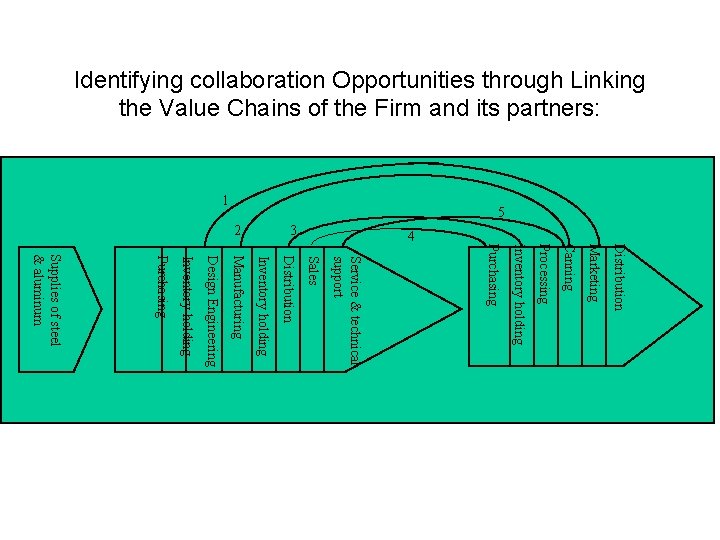
Identifying collaboration Opportunities through Linking the Value Chains of the Firm and its partners: 5 1 Distribution Marketing Canning Processing Inventory holding Supplies of steel & aluminum Purchasing Inventory holding Design Engineering Manufacturing Inventory holding Distribution Sales Service & technical support Purchasing 4 3 2
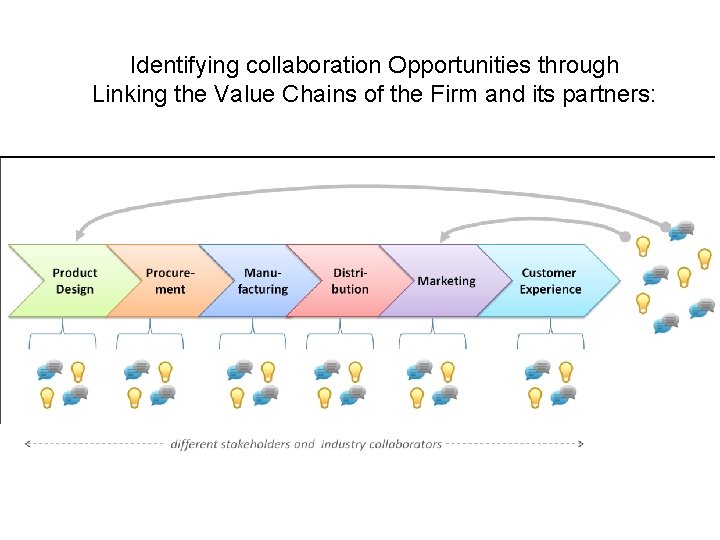
Identifying collaboration Opportunities through Linking the Value Chains of the Firm and its partners: 5 1 Distribution Marketing Canning Processing Inventory holding Supplies of steel & aluminum Purchasing Inventory holding Design Engineering Manufacturing Inventory holding Distribution Sales Service & technical support Purchasing 4 3 2
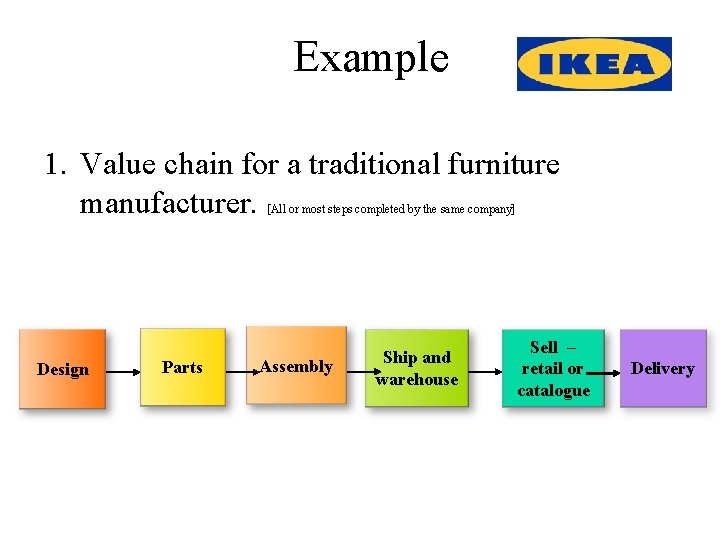
Example 1. Value chain for a traditional furniture manufacturer. [All or most steps completed by the same company] Design Parts Assembly Ship and warehouse Sell – retail or catalogue Delivery
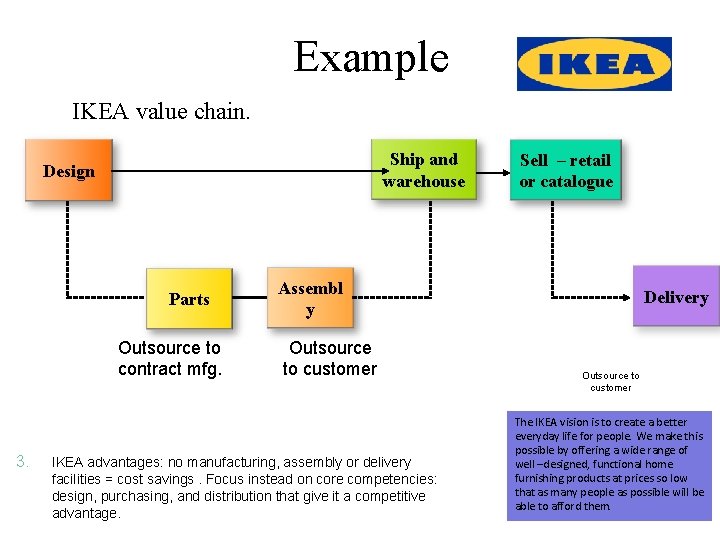
Example IKEA value chain. Ship and warehouse Design Parts Outsource to contract mfg. 3. Sell – retail or catalogue Assembl y Outsource to customer IKEA advantages: no manufacturing, assembly or delivery facilities = cost savings. Focus instead on core competencies: design, purchasing, and distribution that give it a competitive advantage. Delivery Outsource to customer The IKEA vision is to create a better everyday life for people. We make this possible by offering a wide range of well –designed, functional home furnishing products at prices so low that as many people as possible will be able to afford them.
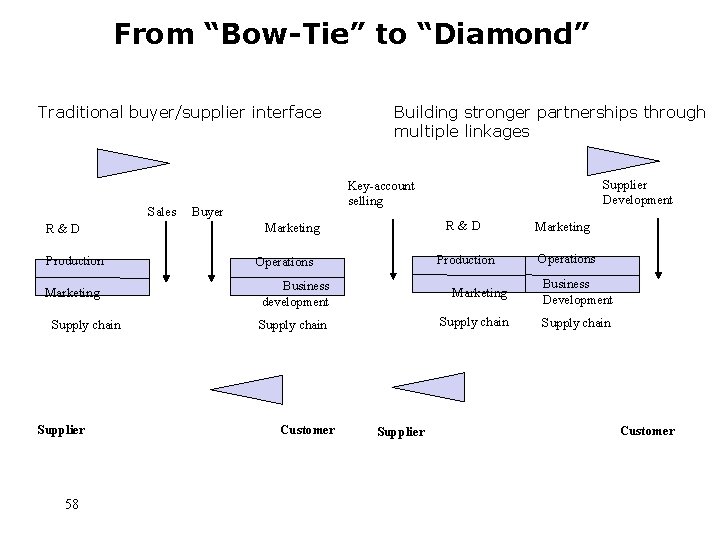
From “Bow-Tie” to “Diamond” Traditional buyer/supplier interface Sales R&D Production Marketing Supply chain Supplier 58 Building stronger partnerships through multiple linkages Supplier Development Key-account selling Buyer R&D Marketing Production Operations Marketing Operations Business development Marketing Business Development Supply chain Customer Supplier Customer
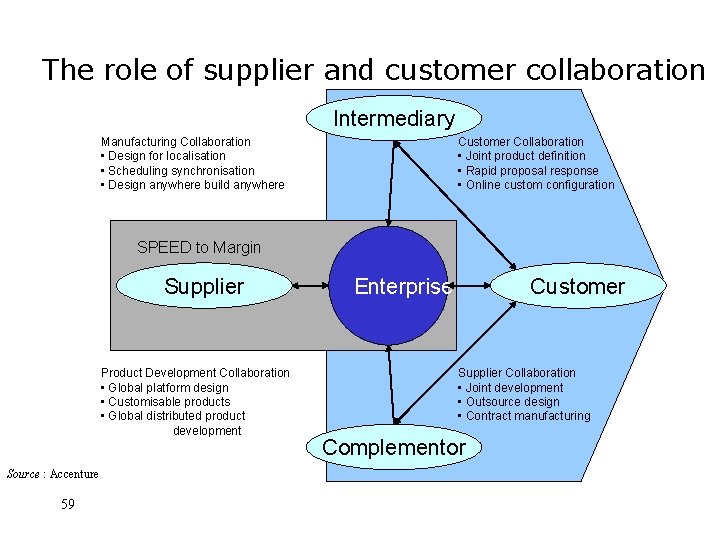
The role of supplier and customer collaboration Intermediary Manufacturing Collaboration • Design for localisation • Scheduling synchronisation • Design anywhere build anywhere Customer Collaboration • Joint product definition • Rapid proposal response • Online custom configuration SPEED to Margin Supplier Product Development Collaboration • Global platform design • Customisable products • Global distributed product development Source : Accenture 59 Enterprise Customer Supplier Collaboration • Joint development • Outsource design • Contract manufacturing Complementor
- Slides: 59