
ELECE 8423 Smart Grid Methods for Fault Location
![Overall Structure of a Fault Location System [5] Substation Measurement device . . .](https://slidetodoc.com/presentation_image_h2/382ba24cac3a3720fd4f55b8a0bc6685/image-3.jpg "Overall Structure of a Fault Location System [5] Substation Measurement device . . .")
![Fault Location and Fault Area Location Inputs and Outputs [6] 07. 02. 2018 Page](https://slidetodoc.com/presentation_image_h2/382ba24cac3a3720fd4f55b8a0bc6685/image-4.jpg "Fault Location and Fault Area Location Inputs and Outputs [6] 07. 02. 2018 Page")
![Impedance Based Fault Location Methods [1] • Fault location is proportional to the impedance](https://slidetodoc.com/presentation_image_h2/382ba24cac3a3720fd4f55b8a0bc6685/image-5.jpg "Impedance Based Fault Location Methods [1] • Fault location is proportional to the impedance")
![Fault Location Utilizing Wide Area Monitoring Systems in Combination with Artificial Intelligence [11] •](https://slidetodoc.com/presentation_image_h2/382ba24cac3a3720fd4f55b8a0bc6685/image-8.jpg "Fault Location Utilizing Wide Area Monitoring Systems in Combination with Artificial Intelligence [11] •")
![Fault Location and Protection Challenges Introduced by Distributed Generation • Bi-directional power-flow [5, 12]](https://slidetodoc.com/presentation_image_h2/382ba24cac3a3720fd4f55b8a0bc6685/image-9.jpg "Fault Location and Protection Challenges Introduced by Distributed Generation • Bi-directional power-flow [5, 12]")
![Source Material Used [1] S. S. Gururajapathy, H. Mokhlis, H. A. Illias: Fault location](https://slidetodoc.com/presentation_image_h2/382ba24cac3a3720fd4f55b8a0bc6685/image-11.jpg "Source Material Used [1] S. S. Gururajapathy, H. Mokhlis, H. A. Illias: Fault location")
- Slides: 12
ELEC-E 8423 - Smart Grid Methods for Fault Location and Detection in Smart Grids April 10, 2018 Seppo Borenius, Muhammed Tuncag 10. 4. 2018
Methods for Fault Location and Detection in Smart Grids - Introduction • Fault [1, 2]: • Shunt fault • line-to-ground fault (short circuit between line and ground) or line-to-line fault (short circuit between two lines) or a combination of these • • • Single-line-to-ground fault is the most common fault in distribution networks [3] Series fault, e. g. an open connector “Fault location is a process aimed at locating the occurred fault with the highest possible accuracy. A fault locator is mainly the supplementary protection equipment, which apply fault-location algorithms for estimating distance to fault. A fault-location function (fault locator) can be implemented e. g. into protective-relays, digital fault recorders (DFRs), stand-alone fault locators, separate fault locators or post-fault analysis programs. ” [4] • “Fault locators are used for pinpointing the fault position accurately and not only for indication of the general area (defined by a protective zone) where a fault occurred – which is the case with protective relays. ” [4] 10. 4. 2018 Page 2
Overall Structure of a Fault Location System [5] Substation Measurement device . . . Load DG = Distributed generation SCADA = Supervisory Control and Data Acquisition AMI = Advanced Metering Infrastructure DG Collected information through SCADA, AMI, and other monitoring systems Distribution management system Switching status Voltage and current measurements Load data Topology processor State estimator Power network topology Fault location system 10. 4. 2018 Page 3
Fault Location and Fault Area Location Inputs and Outputs [6] 07. 02. 2018 Page 4
Impedance Based Fault Location Methods [1] • Fault location is proportional to the impedance Vf = voltage during fault, I f = current during fault, Z l = line impedance per unit length, f d= Fault distance from measurement node 10. 4. 2018 Page 5
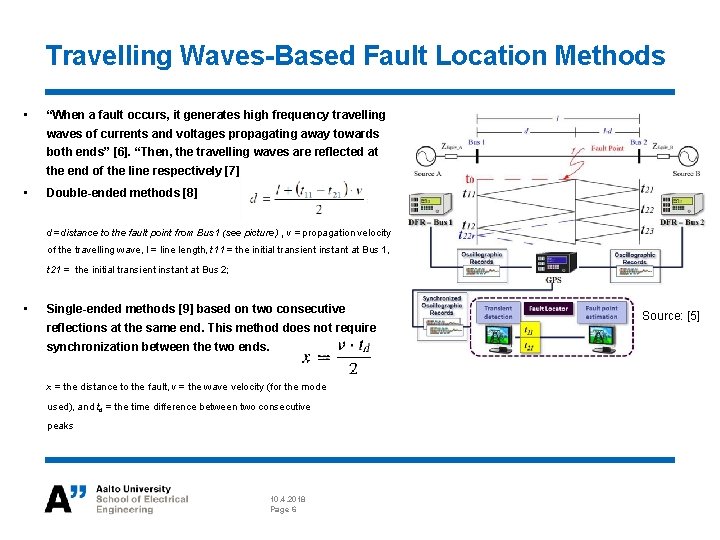
Travelling Waves-Based Fault Location Methods • “When a fault occurs, it generates high frequency travelling waves of currents and voltages propagating away towards both ends” [6]. “Then, the travelling waves are reflected at the end of the line respectively [7] • Double-ended methods [8] d= distance to the fault point from Bus 1 (see picture) , v = propagation velocity of the travelling wave, l = line length, t 11 = the initial transient instant at Bus 1, t 21 = the initial transient instant at Bus 2; • Single-ended methods [9] based on two consecutive reflections at the same end. This method does not require synchronization between the two ends. x = the distance to the fault, v = the wave velocity (for the mode used), and td = the time difference between two consecutive peaks 10. 4. 2018 Page 6 Source: [5]
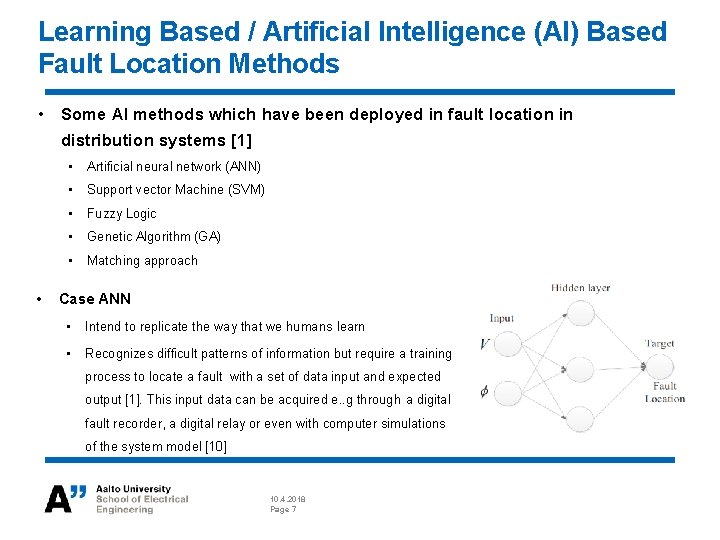
Learning Based / Artificial Intelligence (AI) Based Fault Location Methods • Some AI methods which have been deployed in fault location in distribution systems [1] • • Artificial neural network (ANN) • Support vector Machine (SVM) • Fuzzy Logic • Genetic Algorithm (GA) • Matching approach Case ANN • Intend to replicate the way that we humans learn • Recognizes difficult patterns of information but require a training process to locate a fault with a set of data input and expected output [1]. This input data can be acquired e. . g through a digital fault recorder, a digital relay or even with computer simulations of the system model [10] 10. 4. 2018 Page 7
Fault Location Utilizing Wide Area Monitoring Systems in Combination with Artificial Intelligence [11] • Phasor Measurement Units (PMUs) are power systems devices which are capable of measuring phasor values of voltage and current with time references provided by GPS • Major Components of a Wide Area Monitoring System (WAMS) are PMUs, Phasor Data Concentrators (PDC), Super-Phasor Data Concentrator (SPDC) and communications network. • In [11] WAMS and ANN technologies were combined: WAMS collects the data (phasors etc) and a trained ANN identifies if the system is in faulted condition and localizes the fault. The ANN system is very powerful in identifying the faulty pattern and classifying the fault by patter recognition. GPS = Global Positioning System ANN = Artificial Neural Networks 10. 4. 2018 Page 8
Fault Location and Protection Challenges Introduced by Distributed Generation • Bi-directional power-flow [5, 12] • Numerous sources for fault current make protection and fault location more complex • Case auto reclosure [11]: Auto reclosure unsuccessful since the distributed generator keeps feeding current and maintains the arc. • Limited fault currents due to power electronics which is often used to connect renewable generation to the power grid [12, 13] • Difficult to detect for protection applications. Line differential protection could be a potential solution. It requires a communication channel between he ends of the line. Currently this is implemented as optical fiber but going forward it could also be a 5 G link. [12] 10. 4. 2018 Page 9
Methods for Fault Location and Detection in Smart Grids - Conclusions • Integration of distributed, intermittent generation and microgrids, which can be operated either in grid connected mode or stand-alone modes, complicate fault location [6] • Evolving smart grids will be providing better measurement (PMUs, WAMS, AMI, …) and communications (4 G, 5 G, …) infrastructure. Fault location algorithms can utilize this to provide better results [6] • Accelerating utilization of information technology, big data and artificial intelligence providing new opportunities for fast fault location and detection in complex networks, also for those containing distributed, intermittent generation PMU = Phasor Measurement Unit WAMS = Wide Area Monitoring System AMI = Advance Metering Infrastructure 10. 4. 2018 Page 10
Source Material Used [1] S. S. Gururajapathy, H. Mokhlis, H. A. Illias: Fault location and detection techniques in power distribution systems with distributed generation: A review, Renewable and Sustainable Energy Reviews 74, 2017, 949– 95 [2] Jorma Elovaara, Liisa Haarla: Sähköverkit I, Otatieto 2011, 520 pages. [3] E. Lakervi, E. J. Holmes: Electricity Distribution Network Design, Institute of Engineering and Technology, London 2007. [4] Murari Mohan Saha, Jan Izykowksi: “Fault Location on Power Networks”, Springer-Verlag London Limited, 2010, 431 pages. [5] Biswarup Das: Power Distribution Automation, The Institute of Engineering and technology, London, 2016, 339 pages. [6] A. Bahmanyar, S. Jamali, A. Estebsari, E. Bompard: “A comparision framework for distribution system outage and fault location methods”, Electric Power System Research 145, 2017, 19 -34 [7] Mohd Rafi Adzman: “Earth Fault Distance Computation Methods Based on Transients in Power Distribution Systems”, Doctotal Dissertation, Aalto University, 2014. [8] F. V. Lopes, D. Fernandes Jr. , W. L. A. Neves: Fault Location on Transmission Lines Based on Travelling Waves, International Conference on Power Systems Transients (IPST 2011) in Delft, the Netherlands June 14 -17, 2011 [9] Fernando H. Magnago, Ali Abur: Fault location using wavelets, IEEE Transactions of Power Delivery, 1997 [10] Arturo Suman Bretas, Luciano Pires, Miguel Moreto, and Rodrigo Hartstein Salim: A BP Neural Network Based Technique for HIF Detection and Location on Distribution Systems with Distributed Generation, International Conference of Intelligent Computing 2006. [11] D. Deveraj, M. Krishna Paramathma, I. Rajalakshmi: Simulation And Implementation of Phasor Measurement Unit for Wide Area Monitorin System, IEEE International Conference on Intelligent Techniques in Control, Optimization and Signal Processing, 2017. [12] Kari Mäki, Pertti Järventausta, Sami Repo: Tuulivoimaan perustuvan hajautetun sähköntuotannon vaikutus sähköverkon suojaukseen, Tampereen Teknillinen Yliopisto, 2003. [13] Gargi Bag, Linus Thrybom, Petri Hovila: Challenges and opportunities of 5 G in power grids, 24 th International Conference on Electricity Distribution, Glasgow 2017. 10. 4. 2018 Page 11
Methods for Fault Location and Detection in Smart Grids Thank you! 10. 4. 2018 Page 12