
ELECE 8423 Smart Grid Demand response in power
- Slides: 10
ELEC-E 8423 - Smart Grid Demand response in power system energy balance management Miika Suutala Emil Lindström 16. 3. 2021
Introduction Intermittent & distributed renewable generation introduces new challenges for energy utilization • High hourly/daily variance in available power → Undesired mismatch between supply and demand Demand response as a possible solution 07. 02. 2018 Page 2
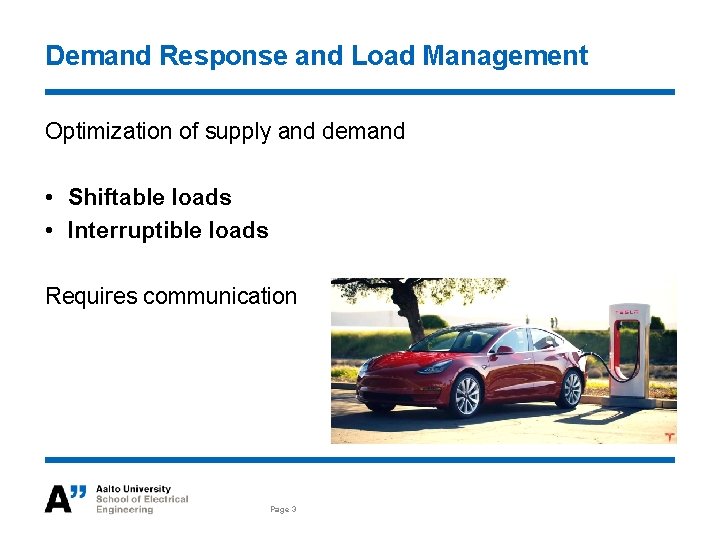
Demand Response and Load Management Optimization of supply and demand • Shiftable loads • Interruptible loads Requires communication Page 3
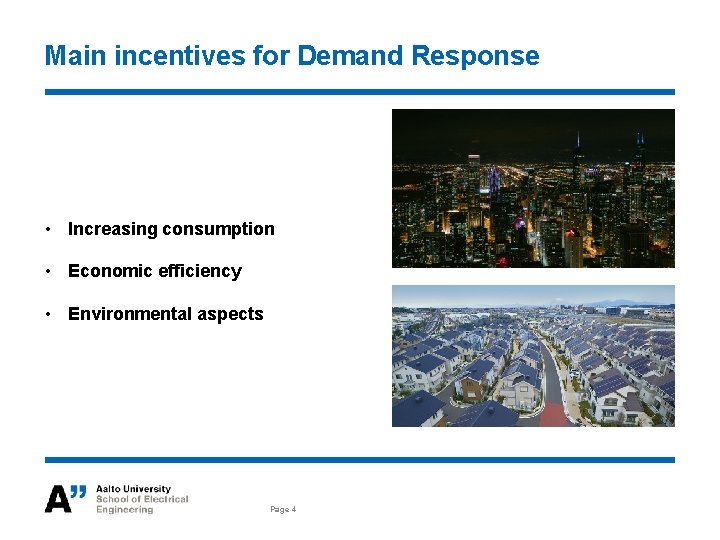
Main incentives for Demand Response • Increasing consumption • Economic efficiency • Environmental aspects Page 4
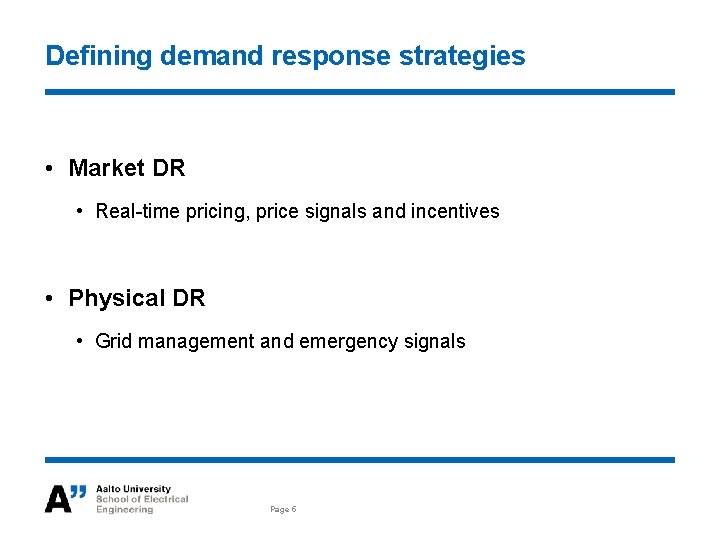
Defining demand response strategies • Market DR • Real-time pricing, price signals and incentives • Physical DR • Grid management and emergency signals Page 5
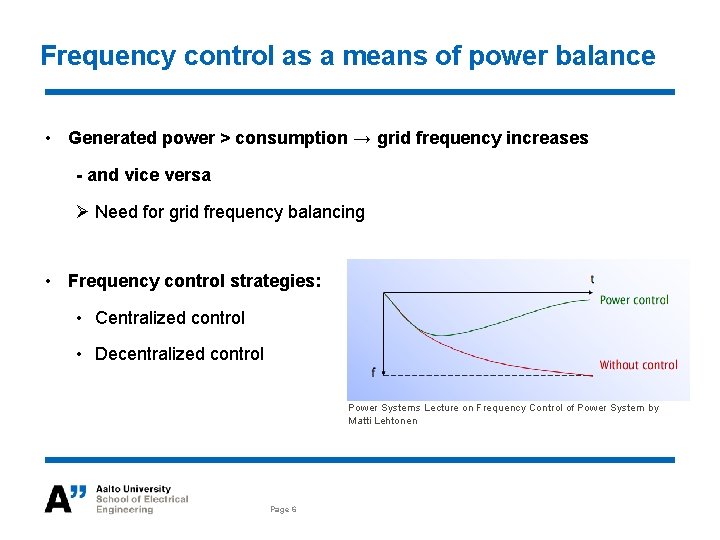
Frequency control as a means of power balance • Generated power > consumption → grid frequency increases - and vice versa Ø Need for grid frequency balancing • Frequency control strategies: • Centralized control • Decentralized control Power Systems Lecture on Frequency Control of Power System by Matti Lehtonen Page 6
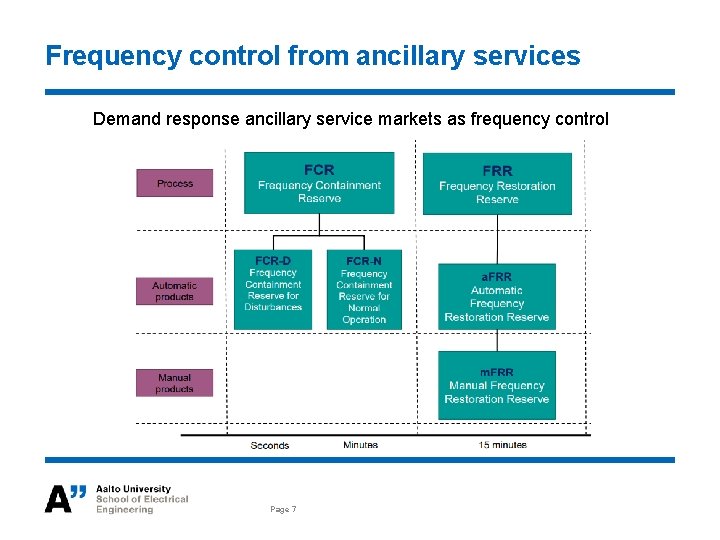
Frequency control from ancillary services Demand response ancillary service markets as frequency control Page 7
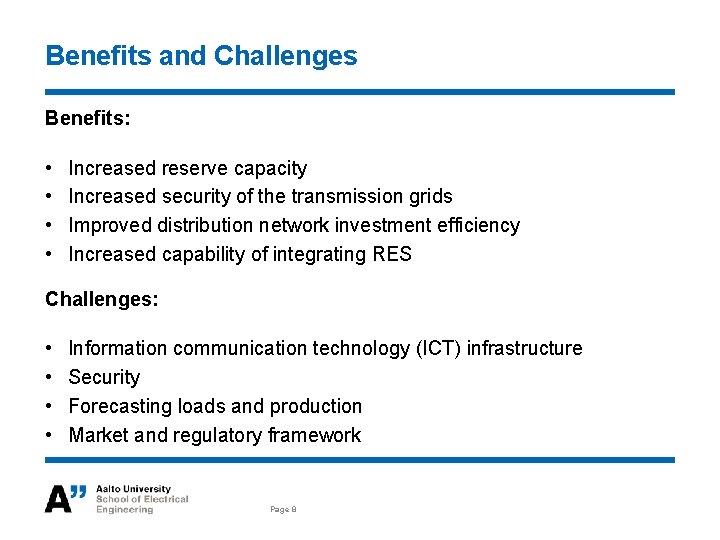
Benefits and Challenges Benefits: • • Increased reserve capacity Increased security of the transmission grids Improved distribution network investment efficiency Increased capability of integrating RES Challenges: • • Information communication technology (ICT) infrastructure Security Forecasting loads and production Market and regulatory framework Page 8
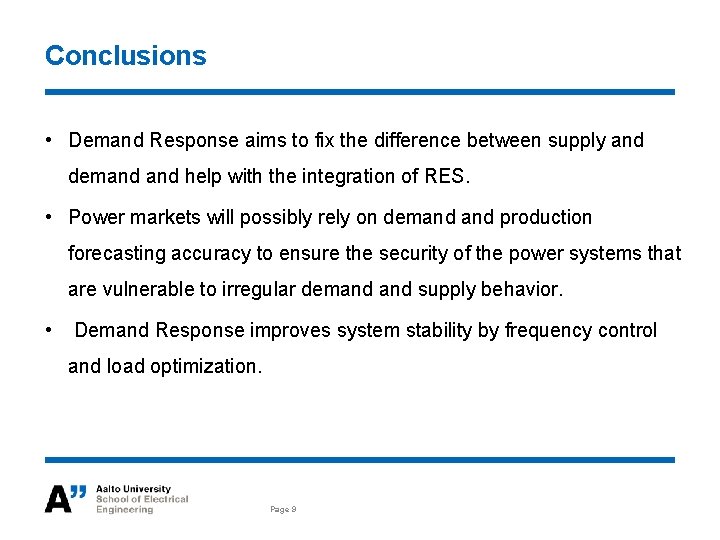
Conclusions • Demand Response aims to fix the difference between supply and demand help with the integration of RES. • Power markets will possibly rely on demand production forecasting accuracy to ensure the security of the power systems that are vulnerable to irregular demand supply behavior. • Demand Response improves system stability by frequency control and load optimization. Page 9
Source material used Palensky, P. & Dietrich, P. 2011. Demand Side Management: Demand Response, Intelligent Energy Systems, and Smart Loads. IEEE Transactions on Industrial Informatics, vol. 7(3), pp. 381 -388. Strbac G. P. 2008. Demand side management: Benefits and challenges. Science Direct, Energy Policy, vol. 36(12), pp. 4419 -4426. Available: https: //doi. org/10. 1016/j. enpol. 2008. 09. 030. O’Connell, N. & Pinson, P. & Madsen, H. & O’Malley, P. 2014. Benefits and challenges of electrical demand response: A critical review. Science Direct, Renewable and Sustainable Energy Reviews, vol. 39, pp. 686 -699. Available: https: //doi. org/10. 1016/j. rser. 2014. 07. 098. Lu, S. & Samaan, N. & Diao, R. & Elizondo, M. & Jin, C. & Mayhorn, E. & Zhang, Y. & Kirkham, H. 2011. Centralized and decentralized control for demand response. ISGT 2011 Anaheim, CA, USA. pp. 1 -8. DOI: 10. 1109/ISGT. 2011. 5759191. Giovanelli, C. & Kilkki, O. & Sierla, S. & Seilonen, I. & Vyatkin, V. 2019. Task allocation algorithm for energy resources providing frequency containment reserves. IEEE Transactions on Industrial Informatics, vol. 15(2). pp. 677 -688. Available: DOI: 10. 1109/TII. 2018. 2821676. Reserves and balancing power, Fingrid, viewed on 14 March 2021. https: //www. fingrid. fi/en/electricitymarket/reserves_and_balancing/#reserve-obligations-and-procurement-sources. Page 10