
ELECE 8423 Smart Grid Demand response in distribution
ELEC-E 8423 - Smart Grid Demand response in distribution grid congestion management Mikko Haapamäki Sini Huhtinen 27. 04. 2021
Introduction The importance of congestion management in distribution grids becomes more crucial as distributed production and electricity demand increases. Especially the growing loads by electric vehicles (EV) / heat pump-systems will increase congestion in grids. Grid congestion ● Caused by uncoordinated operation of distributed generation units and controllable electric loads. ● Distribution System operator’s (DSO) job is to resolve these issues. Demand response (DR) ● The changes in the end-users’ electricity usage from their normal consumption patterns. ● Increase in distributed batteries (e. g. in EVs) provide potential reserve for future DR systems. Terms: Distributed generation (DG), retail electricity provider (REP), dynamic tariffs (DT), daily power-based network tariffs (DPT), home energy management system (HEMS)
Body of the presentation • What is demand response? • What causes congestion in distribution grids? • Congestion management strategies • DR in distribution grid congestion management • Market-based mechanisms • Case example • Conclusions • Sources

Demand response (DR) ● Changes in the end-users’ electricity usage from their normal consumption patterns ○ High electricity prices → low electricity prices ○ Flattening demand peaks results better grid reliability ● Three general actions by which customer response achieved ○ Reducing consumption during critical peak periods ○ Shifting consumption patterns from peak periods to off-peak periods ○ Utilising distributed generation (DG)
Congestion in distribution grid ● Large amount of electricity moving through the distribution line cause the line to heat up. ○ Reaching a critical temperature in the line will cut the power, possibly causing damages ● Causes ○ Grid load being higher than the available capacity ○ Uncoordinated operation of electric loads (e. g. EV’s and heat pumps) ○ Large amounts of DG connected to the grid
Congestion Management Strategies 1. Switch Operation 1. Direct load control (DR) 1. Market-based mechanisms (DR) 1. (In the long run: strengthening the network = large investments, network is not used in the most efficient way)
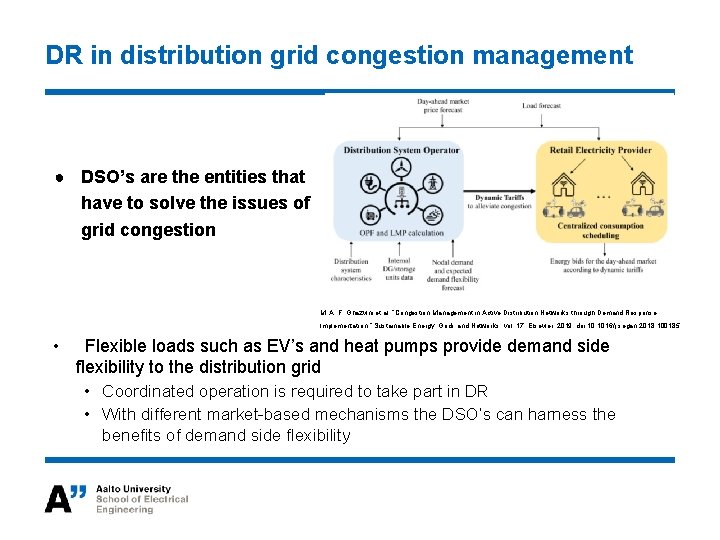
DR in distribution grid congestion management ● DSO’s are the entities that have to solve the issues of grid congestion M. A. F. Ghazvini et al. “Congestion Management in Active Distribution Networks through Demand Response Implementation. ” Sustainable Energy, Grids and Networks, vol. 17, Elsevier, 2019, doi: 10. 1016/j. segan. 2018. 100185. • Flexible loads such as EV’s and heat pumps provide demand side flexibility to the distribution grid • Coordinated operation is required to take part in DR • With different market-based mechanisms the DSO’s can harness the benefits of demand side flexibility
Market-based mechanisms 1/2 Market-based methods send signals to electricity retailers and consumers to shift loads by offering incentives or tariffs. Different mechanisms can be combined to alleviate congestion in the grid Different market-based mechanisms: Tariffs: dynamic tariffs, daily power-based network tariffs, energy tariffs, capacity tariffs, peak and tier tariffs etc. . . Distribution capacity market Intra-day shadow price Flexibility service market
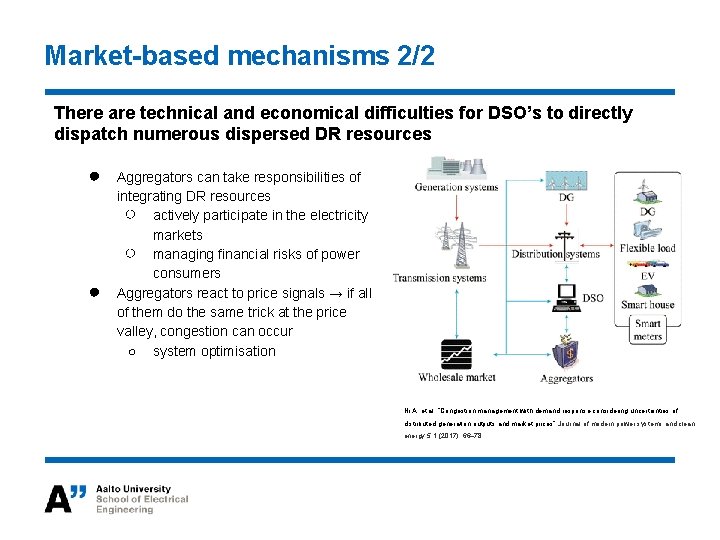
Market-based mechanisms 2/2 There are technical and economical difficulties for DSO’s to directly dispatch numerous dispersed DR resources ● ● Aggregators can take responsibilities of integrating DR resources ○ actively participate in the electricity markets ○ managing financial risks of power consumers Aggregators react to price signals → if all of them do the same trick at the price valley, congestion can occur ○ system optimisation Ni A. et al. “Congestion management with demand response considering uncertainties of distributed generation outputs and market prices” Journal of modern power systems and clean energy 5. 1 (2017): 66– 78.
Case example: Ghazvini et al. (2019) ● DSO’s could use market-based mechanisms to alleviate congestion in the distribution grid. ○ Coordinated HEMS controlled and monitored by retail electricity provider (REP) ● DSO implements dynamic tariffs (DT) and daily power-based network tariffs (DPT) ○ case study reveals that DT’s cannot individually avoid the congestion occurrenced ● REP reacts to the DSO’s implemented tariffs (DT & DPT) and adjusts the loads via HEMS
Conclusions • Distribution grid congestion is caused by uncontrolled operation of both distributed generation and controllable electric loads. • With the help of DR, we are able to alleviate the grid congestion without the need of large grid infrastructure projects. • Most effective strategies are market-based mechanisms, as they cause least discomfort to the customers, as well as enable the customers and DG’s to participate in distribution network energy planning.
Source material used ● K. P. Swain and M. De, "Congestion Management Using Demand Response in Smart Distribution System, " 2019 IEEE Region 10 Symposium (TENSYMP), 2019, pp. 485 -490. ● M. A. F. Ghazvini et al. “Congestion Management in Active Distribution Networks through Demand Response Implementation. ” Sustainable Energy, Grids and Networks, vol. 17, Elsevier, 2019, doi: 10. 1016/j. segan. 2018. 100185. ● M. H. Albadi and E. F. El-Saadany, "Demand Response in Electricity Markets: An Overview, " 2007 IEEE Power Engineering Society General Meeting, 2007, pp. 1 -5, doi: 10. 1109/PES. 2007. 385728. ● A. Stawska et al. “Demand response: For congestion management or for grid balancing? ” Energy Policy, Volume 148, Part A, 2021, doi: 10. 1016/j. enpol. 2020. 111920. ● Ni A. et al. “Congestion management with demand response considering uncertainties of distributed generation outputs and market prices” Journal of modern power systems and clean energy 5. 1 (2017): 66– 78.
- Slides: 12