
ELEC 5200 0016200 001 Computer Architecture and Design
![Instructions Load and store instructions Example: C code: A[12] = h + A[8]; MIPS](https://slidetodoc.com/presentation_image_h2/1e0f30a6b6bc93af392d4de0c45192ae/image-14.jpg "Instructions Load and store instructions Example: C code: A[12] = h + A[8]; MIPS")
![Our First Example Can we figure out the code of subroutine? swap(int v[], int](https://slidetodoc.com/presentation_image_h2/1e0f30a6b6bc93af392d4de0c45192ae/image-15.jpg "Our First Example Can we figure out the code of subroutine? swap(int v[], int")
![Our First Example Now figure out the code: swap(int v[], int k); { int](https://slidetodoc.com/presentation_image_h2/1e0f30a6b6bc93af392d4de0c45192ae/image-18.jpg "Our First Example Now figure out the code: swap(int v[], int k); { int")
![Example: Loop in C (p. 74) while ( save[i] == k ) i +=](https://slidetodoc.com/presentation_image_h2/1e0f30a6b6bc93af392d4de0c45192ae/image-37.jpg "Example: Loop in C (p. 74) while ( save[i] == k ) i +=")
- Slides: 60
ELEC 5200 -001/6200 -001 Computer Architecture and Design Spring 2015 Instruction Set Architecture (Chapter 2) Vishwani D. Agrawal James J. Danaher Professor Department of Electrical and Computer Engineering Auburn University, Auburn, AL 36849 http: //www. eng. auburn. edu/~vagrawal@eng. auburn. edu Spr 2015, Jan 26. . . ELEC 5200 -001/6200 -001 Lecture 3 1
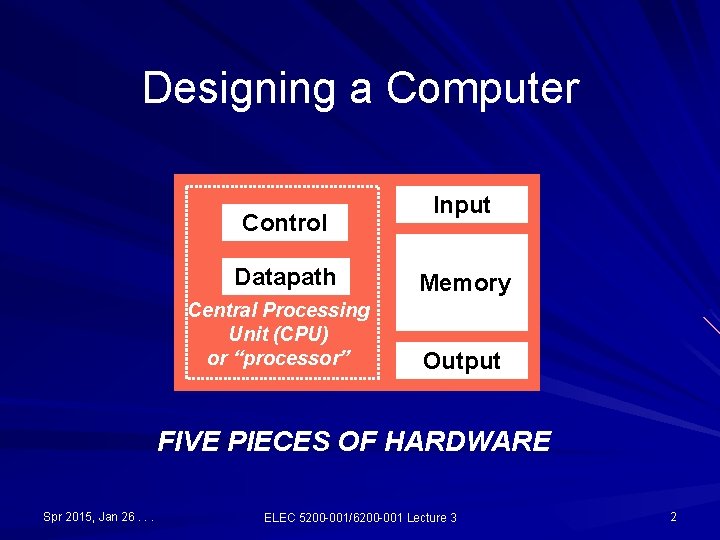
Designing a Computer Control Datapath Central Processing Unit (CPU) or “processor” Input Memory Output FIVE PIECES OF HARDWARE Spr 2015, Jan 26. . . ELEC 5200 -001/6200 -001 Lecture 3 2
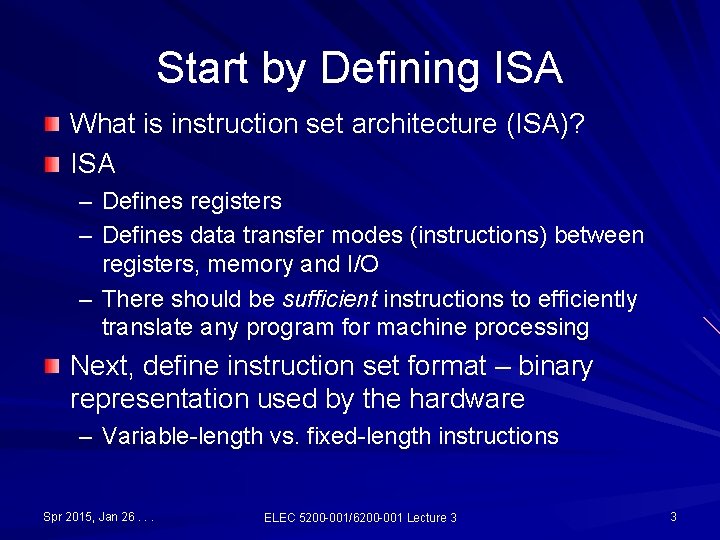
Start by Defining ISA What is instruction set architecture (ISA)? ISA – Defines registers – Defines data transfer modes (instructions) between registers, memory and I/O – There should be sufficient instructions to efficiently translate any program for machine processing Next, define instruction set format – binary representation used by the hardware – Variable-length vs. fixed-length instructions Spr 2015, Jan 26. . . ELEC 5200 -001/6200 -001 Lecture 3 3
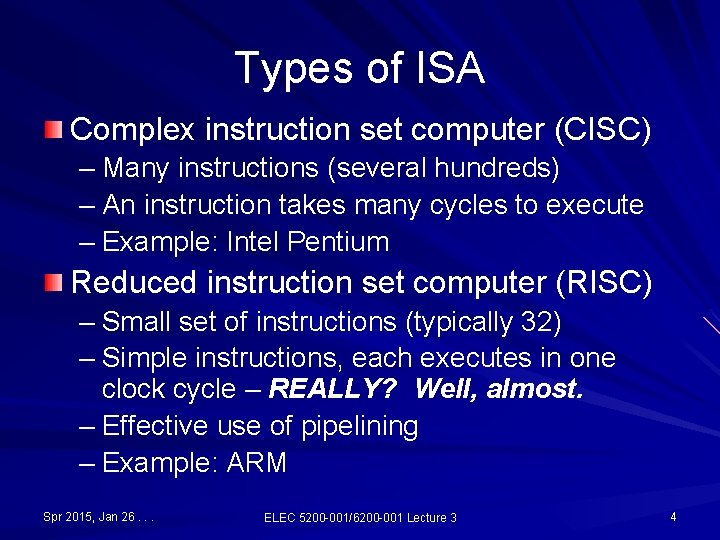
Types of ISA Complex instruction set computer (CISC) – Many instructions (several hundreds) – An instruction takes many cycles to execute – Example: Intel Pentium Reduced instruction set computer (RISC) – Small set of instructions (typically 32) – Simple instructions, each executes in one clock cycle – REALLY? Well, almost. – Effective use of pipelining – Example: ARM Spr 2015, Jan 26. . . ELEC 5200 -001/6200 -001 Lecture 3 4
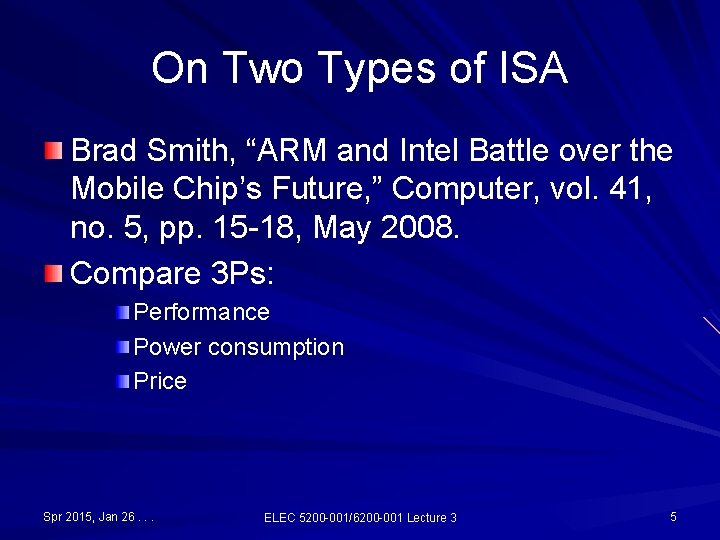
On Two Types of ISA Brad Smith, “ARM and Intel Battle over the Mobile Chip’s Future, ” Computer, vol. 41, no. 5, pp. 15 -18, May 2008. Compare 3 Ps: Performance Power consumption Price Spr 2015, Jan 26. . . ELEC 5200 -001/6200 -001 Lecture 3 5
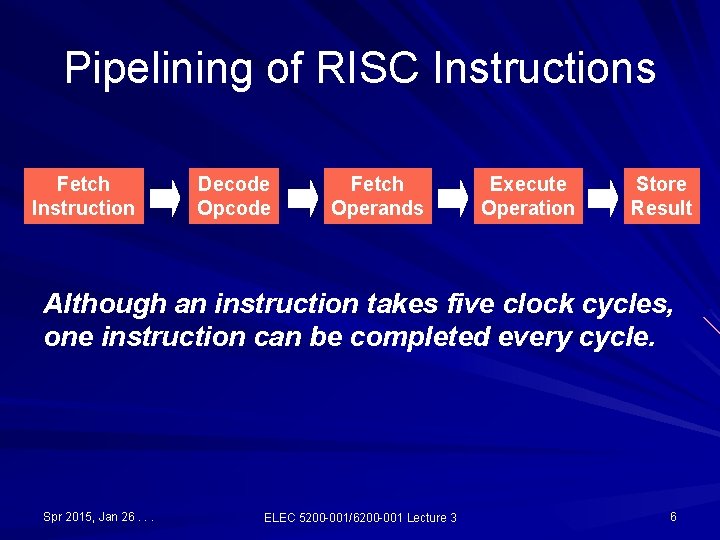
Pipelining of RISC Instructions Fetch Instruction Decode Opcode Fetch Operands Execute Operation Store Result Although an instruction takes five clock cycles, one instruction can be completed every cycle. Spr 2015, Jan 26. . . ELEC 5200 -001/6200 -001 Lecture 3 6
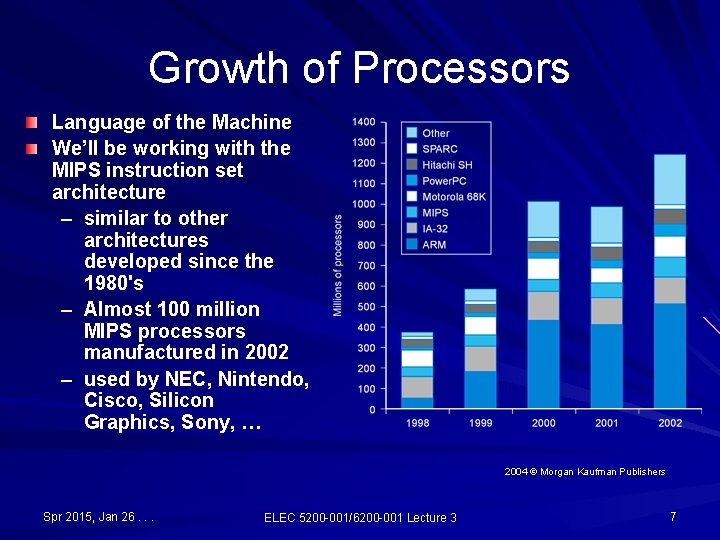
Growth of Processors Language of the Machine We’ll be working with the MIPS instruction set architecture – similar to other architectures developed since the 1980's – Almost 100 million MIPS processors manufactured in 2002 – used by NEC, Nintendo, Cisco, Silicon Graphics, Sony, … 2004 © Morgan Kaufman Publishers Spr 2015, Jan 26. . . ELEC 5200 -001/6200 -001 Lecture 3 7
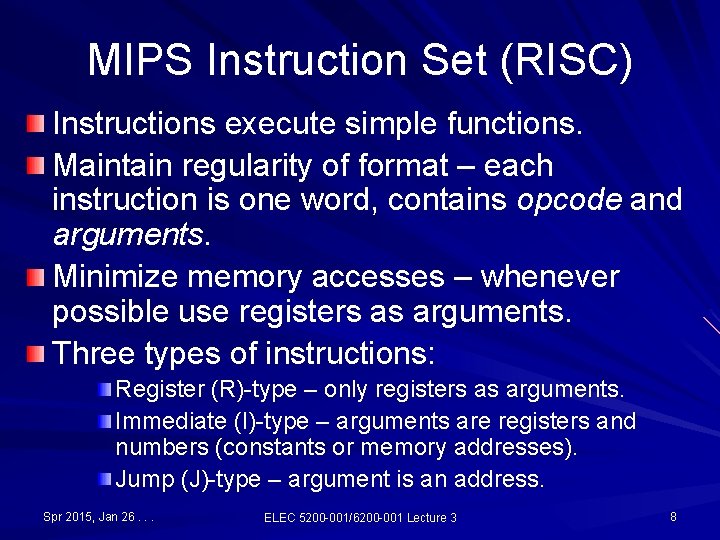
MIPS Instruction Set (RISC) Instructions execute simple functions. Maintain regularity of format – each instruction is one word, contains opcode and arguments. Minimize memory accesses – whenever possible use registers as arguments. Three types of instructions: Register (R)-type – only registers as arguments. Immediate (I)-type – arguments are registers and numbers (constants or memory addresses). Jump (J)-type – argument is an address. Spr 2015, Jan 26. . . ELEC 5200 -001/6200 -001 Lecture 3 8
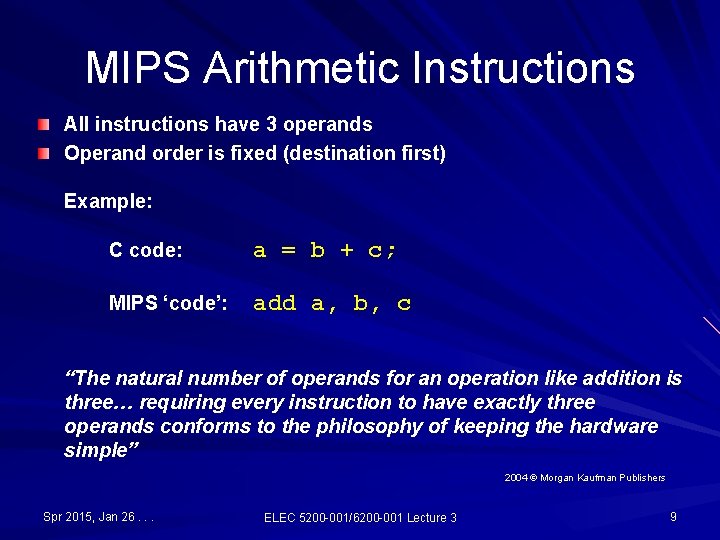
MIPS Arithmetic Instructions All instructions have 3 operands Operand order is fixed (destination first) Example: C code: a = b + c; MIPS ‘code’: add a, b, c “The natural number of operands for an operation like addition is three… requiring every instruction to have exactly three operands conforms to the philosophy of keeping the hardware simple” 2004 © Morgan Kaufman Publishers Spr 2015, Jan 26. . . ELEC 5200 -001/6200 -001 Lecture 3 9
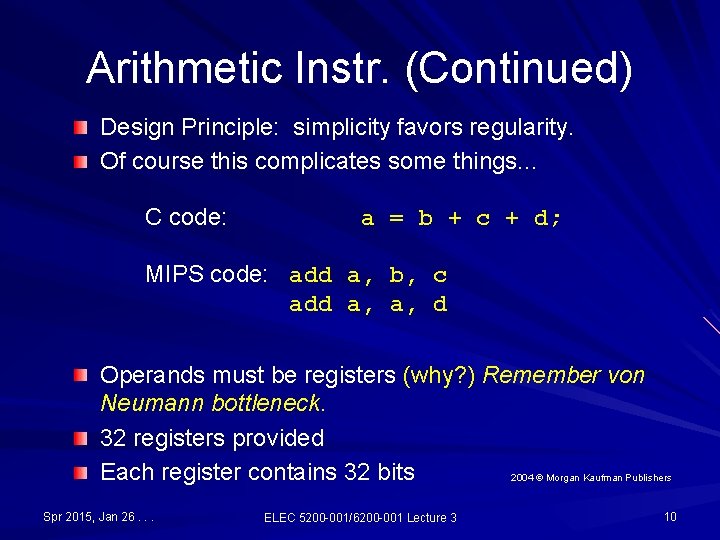
Arithmetic Instr. (Continued) Design Principle: simplicity favors regularity. Of course this complicates some things. . . C code: a = b + c + d; MIPS code: add a, b, c add a, a, d Operands must be registers (why? ) Remember von Neumann bottleneck. 32 registers provided Each register contains 32 bits 2004 © Morgan Kaufman Publishers Spr 2015, Jan 26. . . ELEC 5200 -001/6200 -001 Lecture 3 10
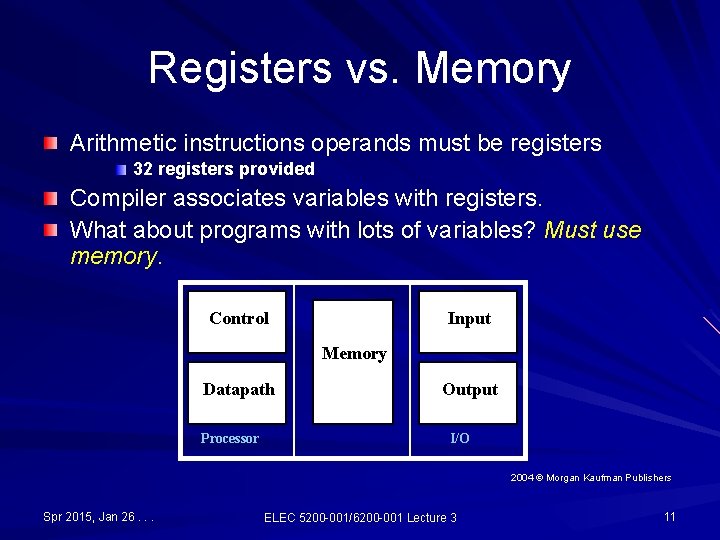
Registers vs. Memory Arithmetic instructions operands must be registers 32 registers provided Compiler associates variables with registers. What about programs with lots of variables? Must use memory. Control Input Memory Datapath Processor Output I/O 2004 © Morgan Kaufman Publishers Spr 2015, Jan 26. . . ELEC 5200 -001/6200 -001 Lecture 3 11
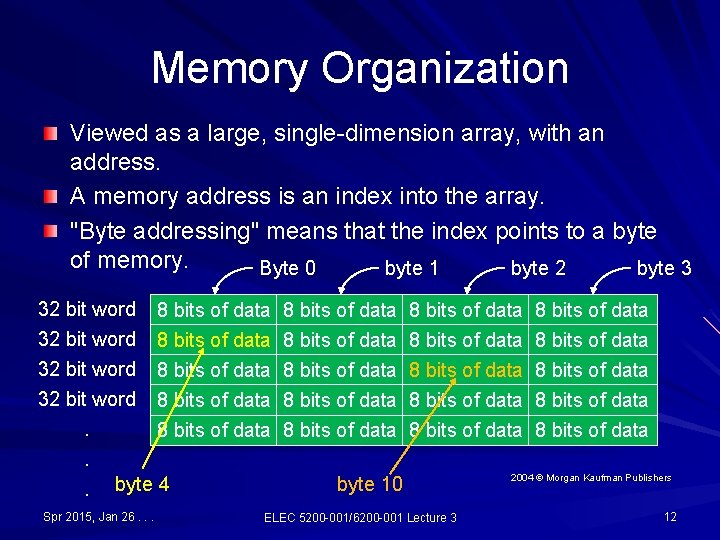
Memory Organization Viewed as a large, single-dimension array, with an address. A memory address is an index into the array. "Byte addressing" means that the index points to a byte of memory. Byte 0 byte 1 byte 2 byte 3 32 bit word. . . 8 bits of data 8 bits of data byte 4 Spr 2015, Jan 26. . . 8 bits of data 8 bits of data 8 bits of data byte 10 ELEC 5200 -001/6200 -001 Lecture 3 8 bits of data 8 bits of data 2004 © Morgan Kaufman Publishers 12
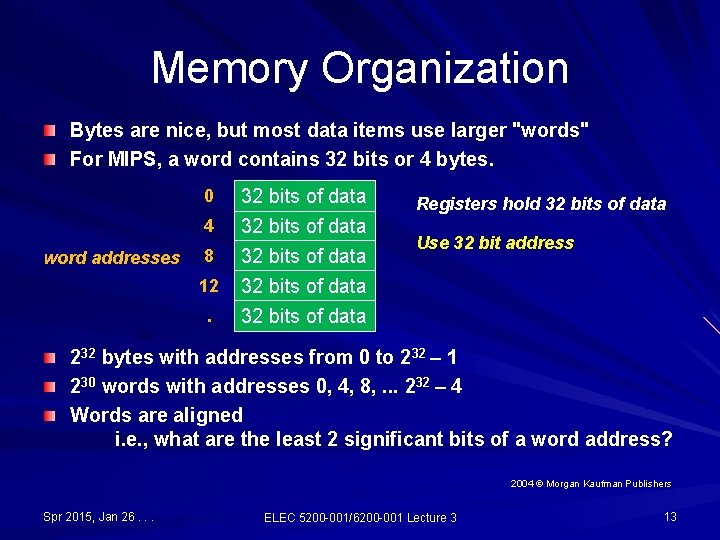
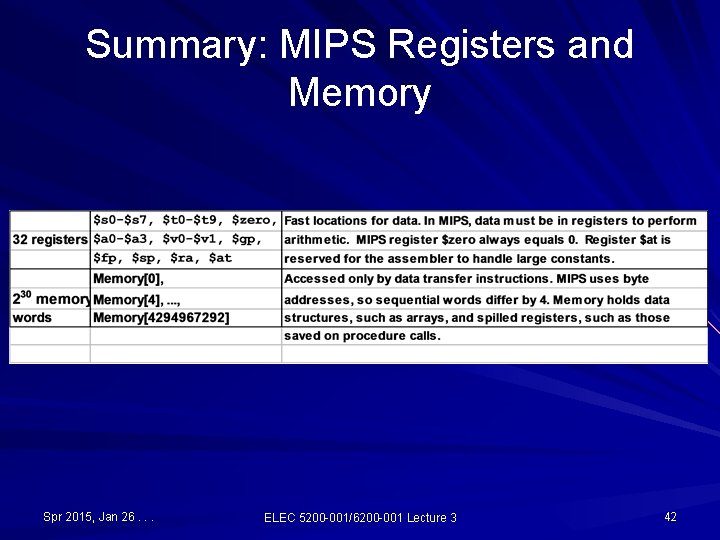
Memory Organization Bytes are nice, but most data items use larger "words" For MIPS, a word contains 32 bits or 4 bytes. 0 4 word addresses 8 12 . . 32 bits of data 32 bits of data Registers hold 32 bits of data Use 32 bit address 232 bytes with addresses from 0 to 232 – 1 230 words with addresses 0, 4, 8, . . . 232 – 4 Words are aligned i. e. , what are the least 2 significant bits of a word address? 2004 © Morgan Kaufman Publishers Spr 2015, Jan 26. . . ELEC 5200 -001/6200 -001 Lecture 3 13
Instructions Load and store instructions Example: C code: A[12] = h + A[8]; MIPS code: lw $t 0, 32($s 3) #addr of A in reg s 3 add $t 0, $s 2, $t 0 #h in reg s 2 sw $t 0, 48($s 3) Can refer to registers by name (e. g. , $s 2, $t 2) instead of number Store word has destination last Remember arithmetic operands are registers, not memory! Can’t write: add 48($s 3), $s 2, 32($s 3) 2004 © Morgan Kaufman Publishers Spr 2015, Jan 26. . . ELEC 5200 -001/6200 -001 Lecture 3 14
Our First Example Can we figure out the code of subroutine? swap(int v[], int k); { int temp; temp = v[k] = v[k+1]; v[k+1] = temp; } swap: sll $2, add $2, lw $15, lw $16, sw $15, jr $31 $5, 2 $4, $2 0($2) 4($2) Initially, k is in reg 5; base address of v is in reg 4; return addr is in reg 31 2004 © Morgan Kaufman Publishers Spr 2015, Jan 26. . . ELEC 5200 -001/6200 -001 Lecture 3 15
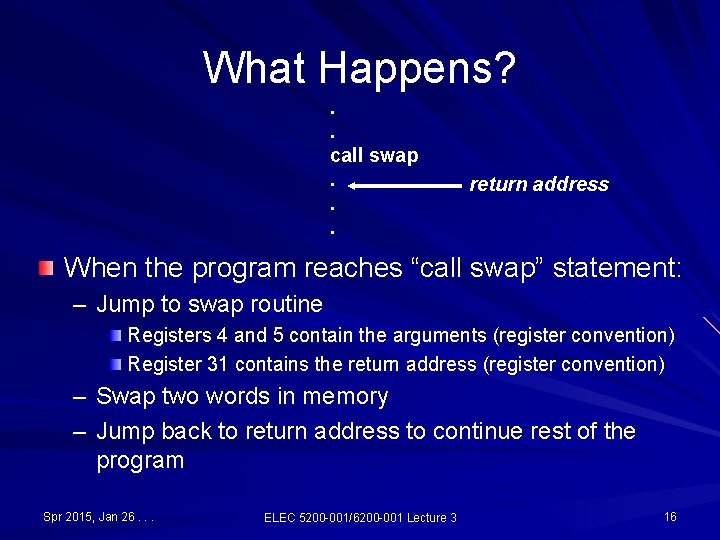
What Happens? . . call swap. . . return address When the program reaches “call swap” statement: – Jump to swap routine Registers 4 and 5 contain the arguments (register convention) Register 31 contains the return address (register convention) – Swap two words in memory – Jump back to return address to continue rest of the program Spr 2015, Jan 26. . . ELEC 5200 -001/6200 -001 Lecture 3 16
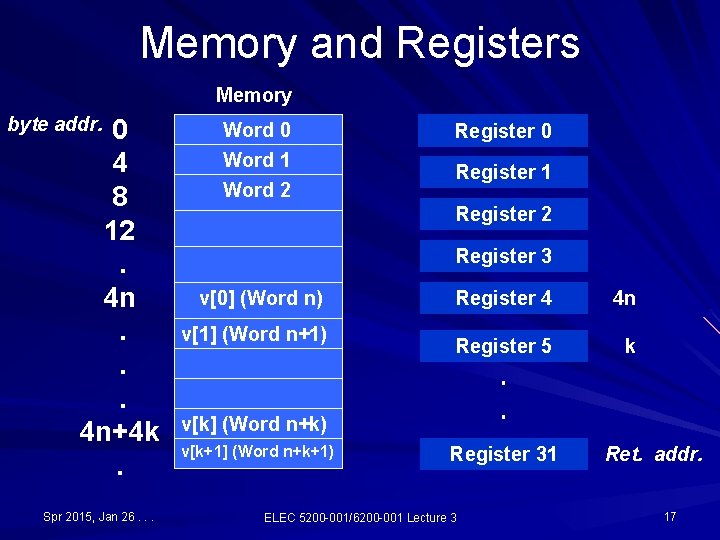
Memory and Registers Memory byte addr. 0 4 8 12. 4 n. . . 4 n+4 k. Spr 2015, Jan 26. . . Word 0 Register 0 Word 1 Word 2 Register 1 Register 2 Register 3 v[0] (Word n) v[1] (Word n+1) Register 4 4 n Register 5 k . . v[k] (Word n+k) v[k+1] (Word n+k+1) Register 31 ELEC 5200 -001/6200 -001 Lecture 3 Ret. addr. 17
Our First Example Now figure out the code: swap(int v[], int k); { int temp; temp = v[k] = v[k+1]; v[k+1] = temp; } swap: sll $2, add $2, lw $15, lw $16, sw $15, jr $31 $5, 2 $4, $2 0($2) 4($2) 2004 © Morgan Kaufman Publishers Spr 2015, Jan 26. . . ELEC 5200 -001/6200 -001 Lecture 3 18
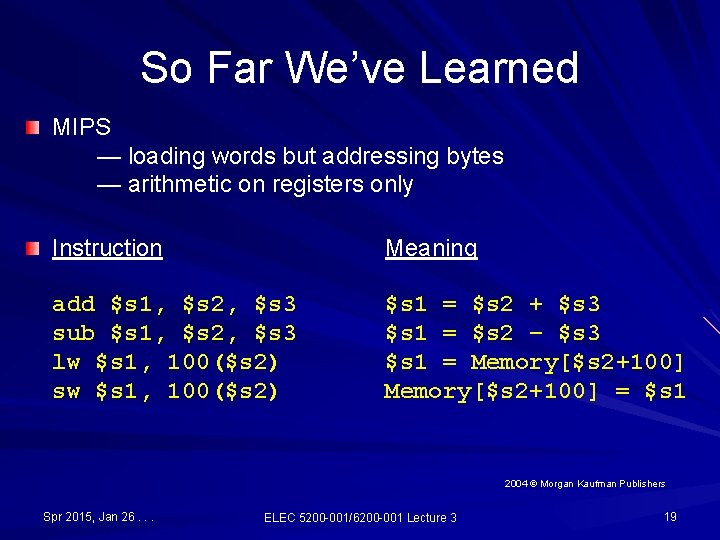
So Far We’ve Learned MIPS — loading words but addressing bytes — arithmetic on registers only Instruction Meaning add $s 1, $s 2, $s 3 sub $s 1, $s 2, $s 3 lw $s 1, 100($s 2) sw $s 1, 100($s 2) $s 1 = $s 2 + $s 3 $s 1 = $s 2 – $s 3 $s 1 = Memory[$s 2+100] = $s 1 2004 © Morgan Kaufman Publishers Spr 2015, Jan 26. . . ELEC 5200 -001/6200 -001 Lecture 3 19
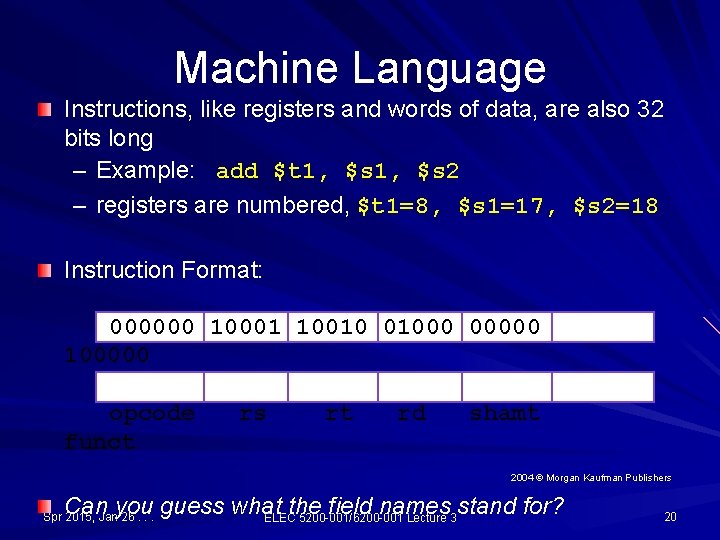
Machine Language Instructions, like registers and words of data, are also 32 bits long – Example: add $t 1, $s 2 – registers are numbered, $t 1=8, $s 1=17, $s 2=18 Instruction Format: 000000 10001 10010 01000 00000 100000 opcode funct rs rt rd shamt 2004 © Morgan Kaufman Publishers Can you guess what the field names stand for? ELEC 5200 -001/6200 -001 Lecture 3 Spr 2015, Jan 26. . . 20
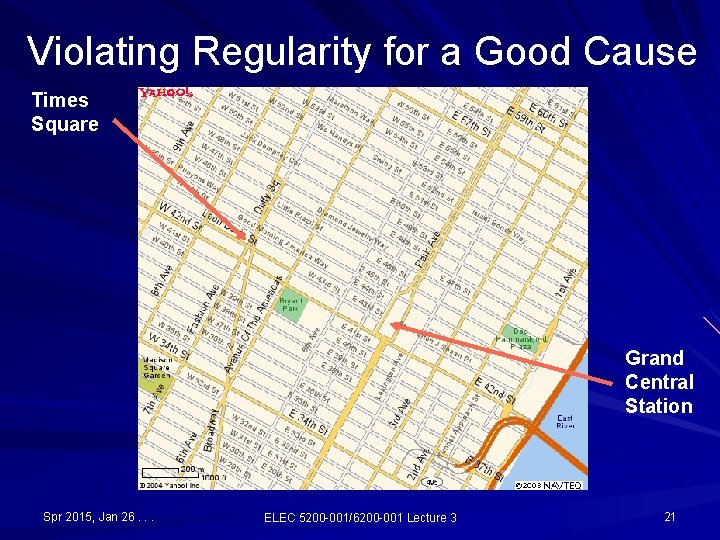
Violating Regularity for a Good Cause Times Square Grand Central Station Spr 2015, Jan 26. . . ELEC 5200 -001/6200 -001 Lecture 3 21
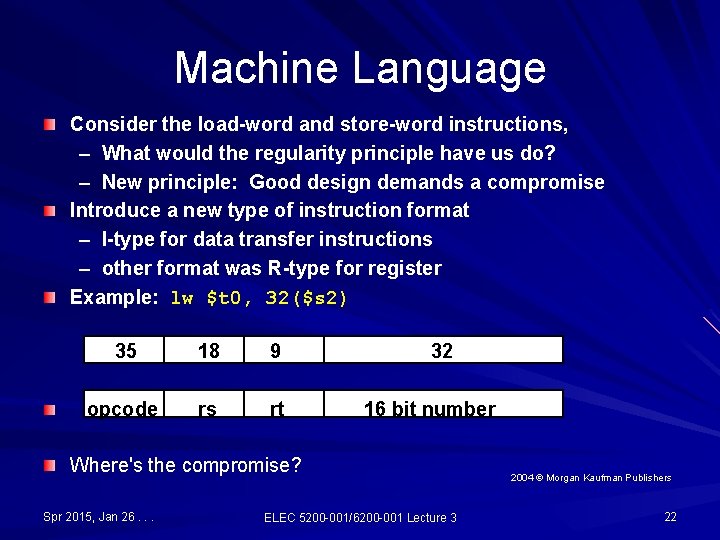
Machine Language Consider the load-word and store-word instructions, – What would the regularity principle have us do? – New principle: Good design demands a compromise Introduce a new type of instruction format – I-type for data transfer instructions – other format was R-type for register Example: lw $t 0, 32($s 2) 35 18 9 opcode rs rt 32 16 bit number Where's the compromise? Spr 2015, Jan 26. . . ELEC 5200 -001/6200 -001 Lecture 3 2004 © Morgan Kaufman Publishers 22
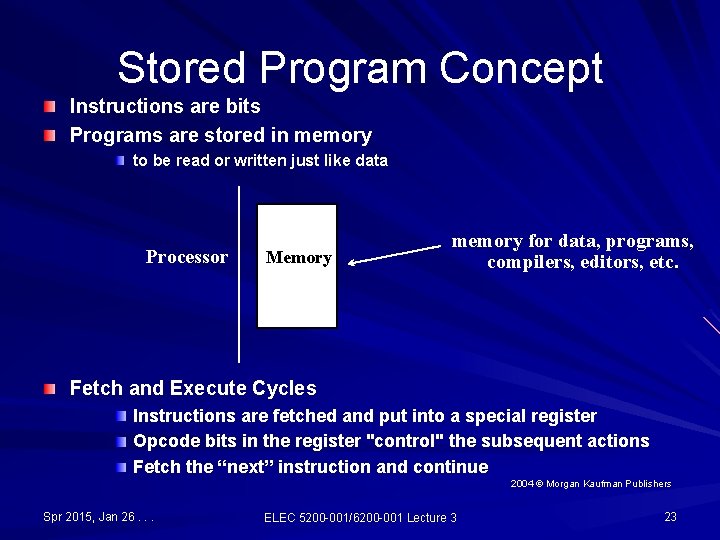
Stored Program Concept Instructions are bits Programs are stored in memory to be read or written just like data Processor Memory memory for data, programs, compilers, editors, etc. Fetch and Execute Cycles Instructions are fetched and put into a special register Opcode bits in the register "control" the subsequent actions Fetch the “next” instruction and continue 2004 © Morgan Kaufman Publishers Spr 2015, Jan 26. . . ELEC 5200 -001/6200 -001 Lecture 3 23
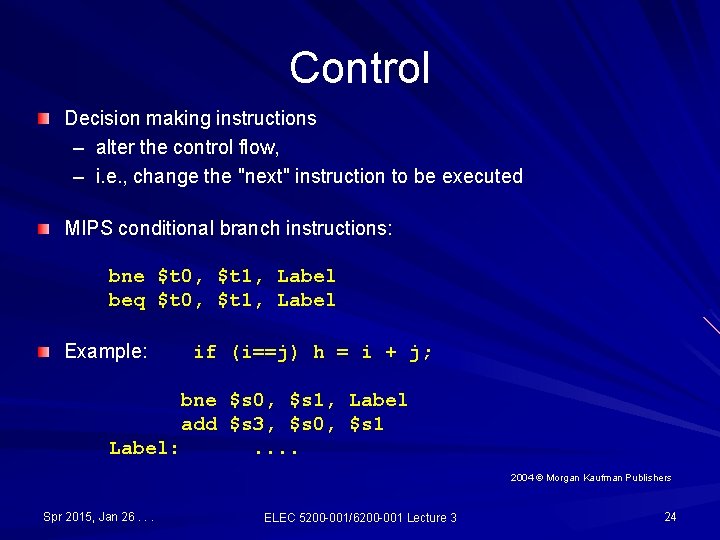
Control Decision making instructions – alter the control flow, – i. e. , change the "next" instruction to be executed MIPS conditional branch instructions: bne $t 0, $t 1, Label beq $t 0, $t 1, Label Example: if (i==j) h = i + j; bne $s 0, $s 1, Label add $s 3, $s 0, $s 1 Label: . . 2004 © Morgan Kaufman Publishers Spr 2015, Jan 26. . . ELEC 5200 -001/6200 -001 Lecture 3 24
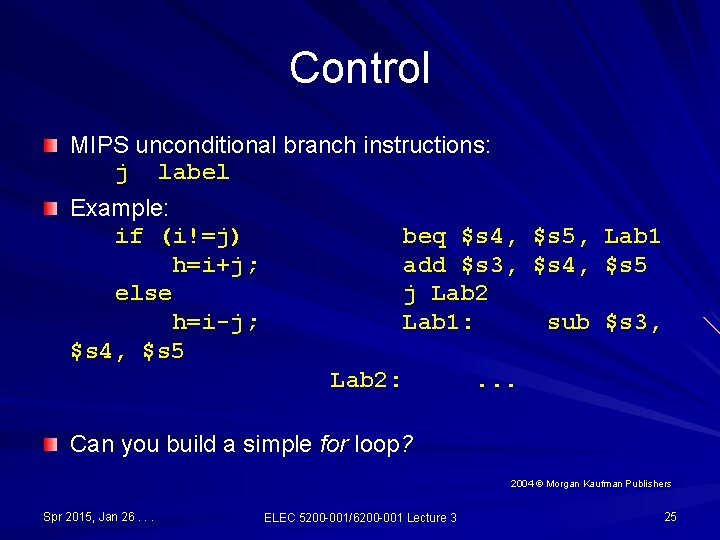
Control MIPS unconditional branch instructions: j label Example: if (i!=j) h=i+j; else h=i-j; $s 4, $s 5 beq $s 4, $s 5, Lab 1 add $s 3, $s 4, $s 5 j Lab 2 Lab 1: sub $s 3, Lab 2: . . . Can you build a simple for loop? 2004 © Morgan Kaufman Publishers Spr 2015, Jan 26. . . ELEC 5200 -001/6200 -001 Lecture 3 25
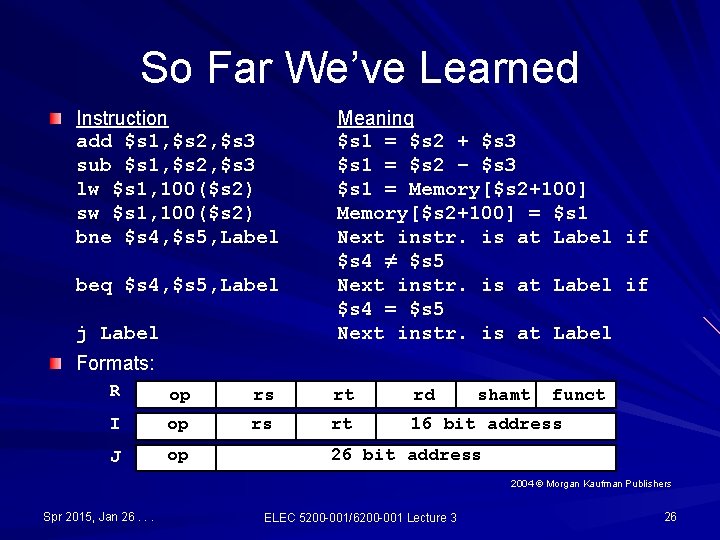
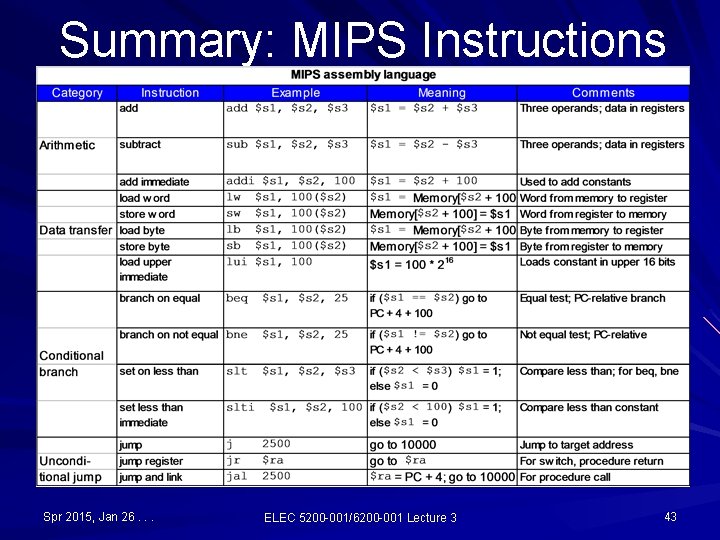
So Far We’ve Learned Instruction add $s 1, $s 2, $s 3 sub $s 1, $s 2, $s 3 lw $s 1, 100($s 2) sw $s 1, 100($s 2) bne $s 4, $s 5, Label beq $s 4, $s 5, Label j Label Meaning $s 1 = $s 2 + $s 3 $s 1 = $s 2 – $s 3 $s 1 = Memory[$s 2+100] = $s 1 Next instr. is at Label if $s 4 ≠ $s 5 Next instr. is at Label if $s 4 = $s 5 Next instr. is at Label Formats: R op rs rt rd I op rs rt 16 bit address J op shamt funct 26 bit address 2004 © Morgan Kaufman Publishers Spr 2015, Jan 26. . . ELEC 5200 -001/6200 -001 Lecture 3 26
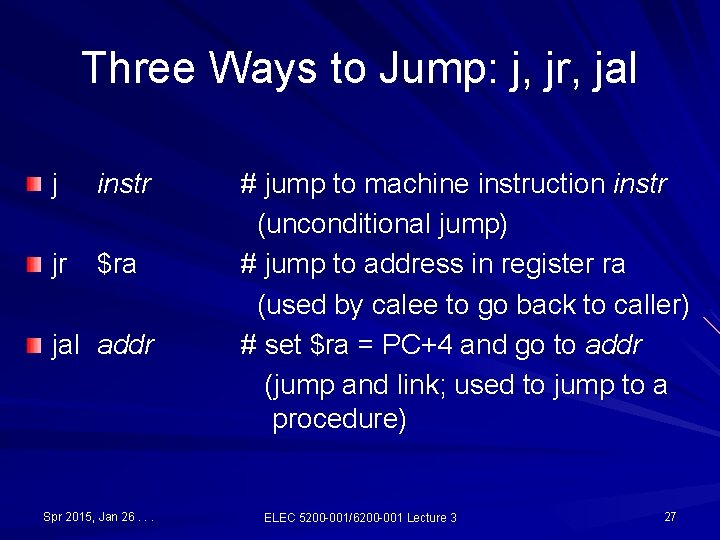
Three Ways to Jump: j, jr, jal j instr jr $ra jal addr Spr 2015, Jan 26. . . # jump to machine instruction instr (unconditional jump) # jump to address in register ra (used by calee to go back to caller) # set $ra = PC+4 and go to addr (jump and link; used to jump to a procedure) ELEC 5200 -001/6200 -001 Lecture 3 27
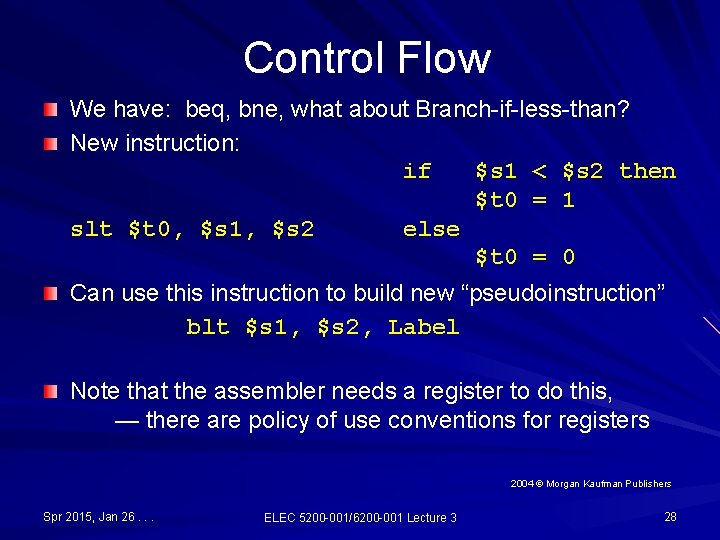
Control Flow We have: beq, bne, what about Branch-if-less-than? New instruction: if $s 1 < $s 2 then $t 0 = 1 slt $t 0, $s 1, $s 2 else $t 0 = 0 Can use this instruction to build new “pseudoinstruction” blt $s 1, $s 2, Label Note that the assembler needs a register to do this, — there are policy of use conventions for registers 2004 © Morgan Kaufman Publishers Spr 2015, Jan 26. . . ELEC 5200 -001/6200 -001 Lecture 3 28
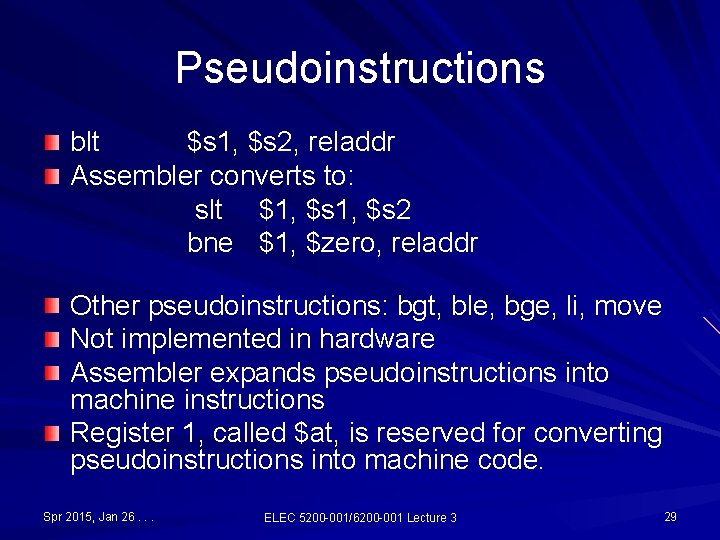
Pseudoinstructions blt $s 1, $s 2, reladdr Assembler converts to: slt $1, $s 2 bne $1, $zero, reladdr Other pseudoinstructions: bgt, ble, bge, li, move Not implemented in hardware Assembler expands pseudoinstructions into machine instructions Register 1, called $at, is reserved for converting pseudoinstructions into machine code. Spr 2015, Jan 26. . . ELEC 5200 -001/6200 -001 Lecture 3 29
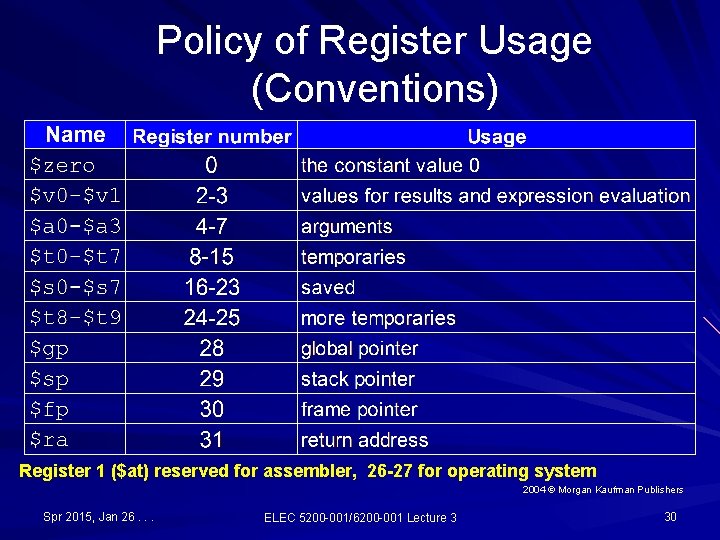
Policy of Register Usage (Conventions) Register 1 ($at) reserved for assembler, 26 -27 for operating system 2004 © Morgan Kaufman Publishers Spr 2015, Jan 26. . . ELEC 5200 -001/6200 -001 Lecture 3 30
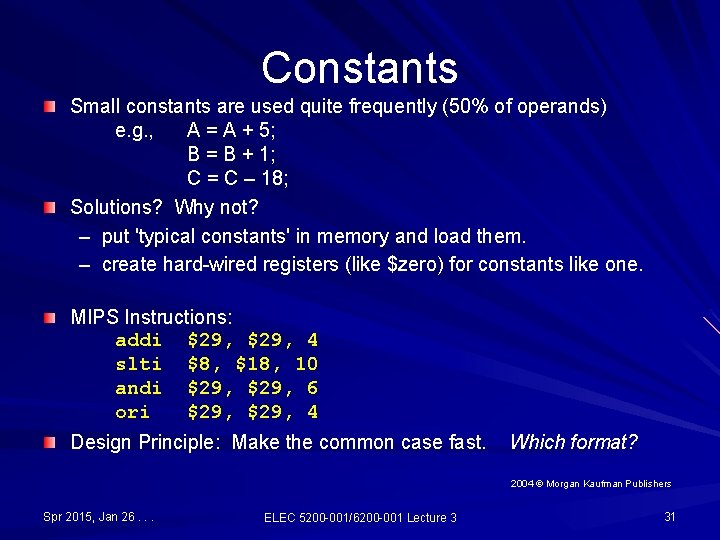
Constants Small constants are used quite frequently (50% of operands) e. g. , A = A + 5; B = B + 1; C = C – 18; Solutions? Why not? – put 'typical constants' in memory and load them. – create hard-wired registers (like $zero) for constants like one. MIPS Instructions: addi $29, 4 slti $8, $18, 10 andi $29, 6 ori $29, 4 Design Principle: Make the common case fast. Which format? 2004 © Morgan Kaufman Publishers Spr 2015, Jan 26. . . ELEC 5200 -001/6200 -001 Lecture 3 31
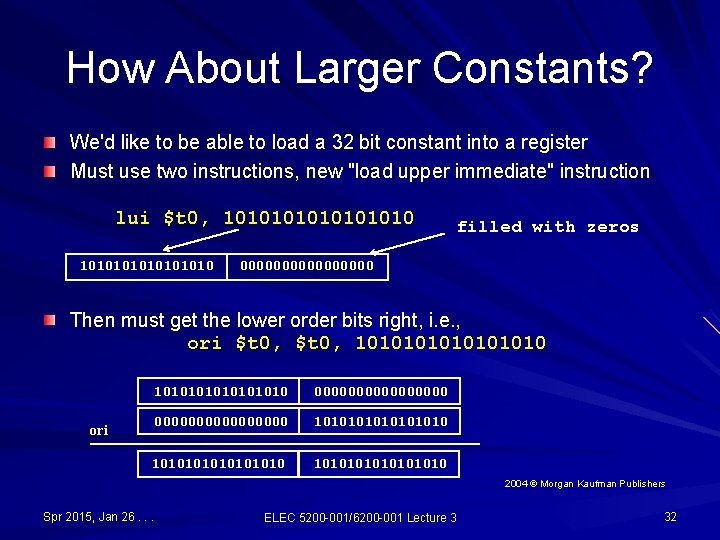
How About Larger Constants? We'd like to be able to load a 32 bit constant into a register Must use two instructions, new "load upper immediate" instruction lui $t 0, 1010101010101010 filled with zeros 00000000 Then must get the lower order bits right, i. e. , ori $t 0, 10101010 ori 10101010 0000000000000000 1010101010101010 2004 © Morgan Kaufman Publishers Spr 2015, Jan 26. . . ELEC 5200 -001/6200 -001 Lecture 3 32
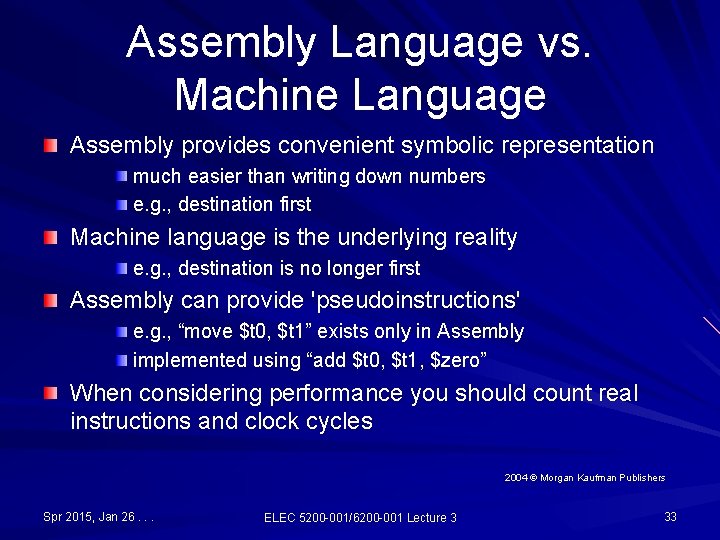
Assembly Language vs. Machine Language Assembly provides convenient symbolic representation much easier than writing down numbers e. g. , destination first Machine language is the underlying reality e. g. , destination is no longer first Assembly can provide 'pseudoinstructions' e. g. , “move $t 0, $t 1” exists only in Assembly implemented using “add $t 0, $t 1, $zero” When considering performance you should count real instructions and clock cycles 2004 © Morgan Kaufman Publishers Spr 2015, Jan 26. . . ELEC 5200 -001/6200 -001 Lecture 3 33
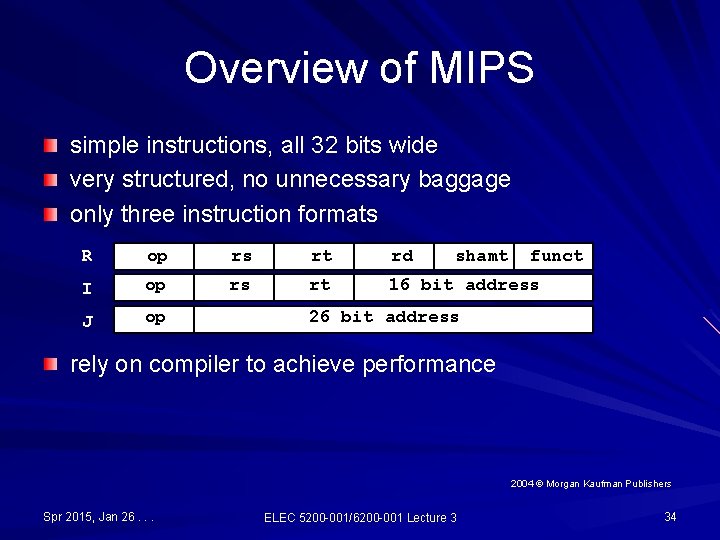
Overview of MIPS simple instructions, all 32 bits wide very structured, no unnecessary baggage only three instruction formats R op rs rt rd I op rs rt 16 bit address J op shamt funct 26 bit address rely on compiler to achieve performance 2004 © Morgan Kaufman Publishers Spr 2015, Jan 26. . . ELEC 5200 -001/6200 -001 Lecture 3 34
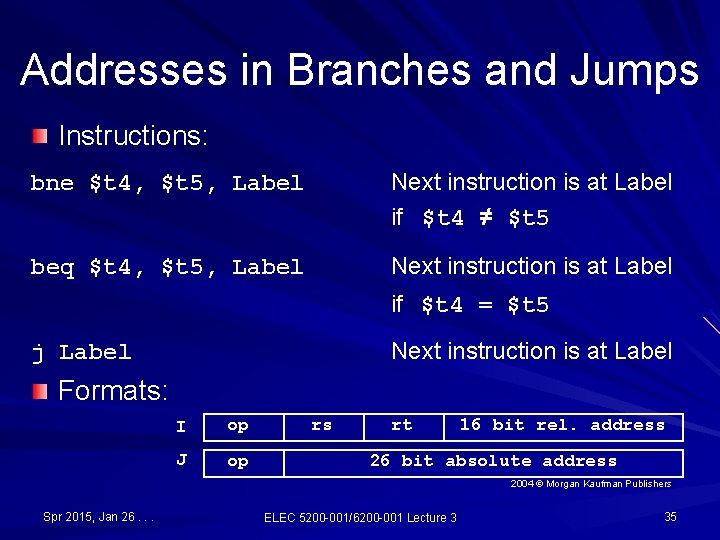
Addresses in Branches and Jumps Instructions: bne $t 4, $t 5, Label Next instruction is at Label if $t 4 ≠ $t 5 beq $t 4, $t 5, Label Next instruction is at Label if $t 4 = $t 5 Next instruction is at Label j Label Formats: I op J op rs rt 16 bit rel. address 26 bit absolute address 2004 © Morgan Kaufman Publishers Spr 2015, Jan 26. . . ELEC 5200 -001/6200 -001 Lecture 3 35
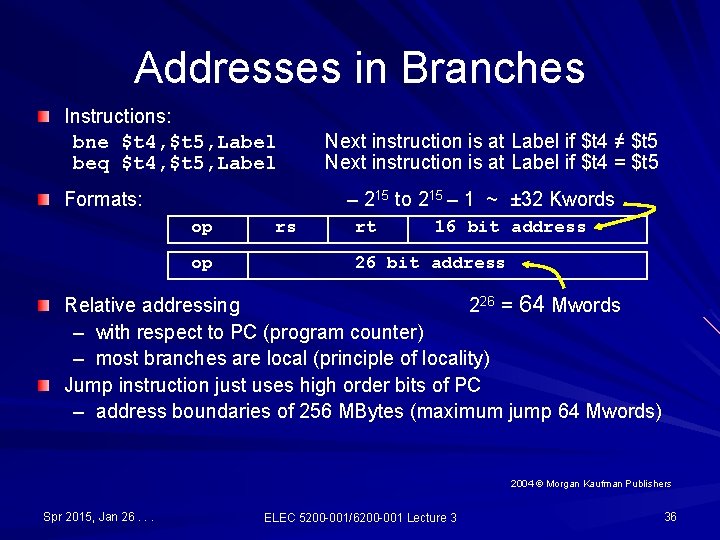
Addresses in Branches Instructions: bne $t 4, $t 5, Label beq $t 4, $t 5, Label Formats: Next instruction is at Label if $t 4 ≠ $t 5 Next instruction is at Label if $t 4 = $t 5 – 215 to 215 – 1 ~ ± 32 Kwords op op rs rt 16 bit address 26 bit address Relative addressing 226 = 64 Mwords – with respect to PC (program counter) – most branches are local (principle of locality) Jump instruction just uses high order bits of PC – address boundaries of 256 MBytes (maximum jump 64 Mwords) 2004 © Morgan Kaufman Publishers Spr 2015, Jan 26. . . ELEC 5200 -001/6200 -001 Lecture 3 36
Example: Loop in C (p. 74) while ( save[i] == k ) i += 1; Given a value for k, set i to the index of element in array save [ ] that does not equal k. Spr 2015, Jan 26. . . ELEC 5200 -001/6200 -001 Lecture 3 37
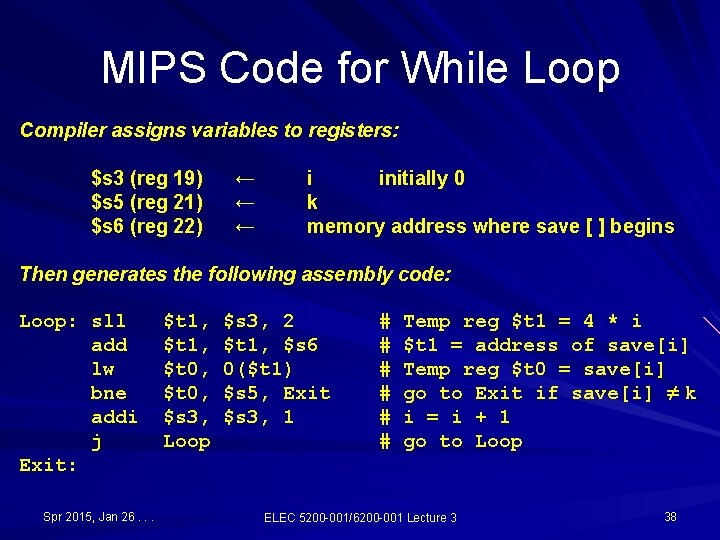
MIPS Code for While Loop Compiler assigns variables to registers: $s 3 (reg 19) $s 5 (reg 21) $s 6 (reg 22) ← ← ← i initially 0 k memory address where save [ ] begins Then generates the following assembly code: Loop: sll add lw bne addi j Exit: Spr 2015, Jan 26. . . $t 1, $t 0, $s 3, Loop $s 3, 2 $t 1, $s 6 0($t 1) $s 5, Exit $s 3, 1 # # # Temp reg $t 1 = 4 * i $t 1 = address of save[i] Temp reg $t 0 = save[i] go to Exit if save[i] ≠ k i = i + 1 go to Loop ELEC 5200 -001/6200 -001 Lecture 3 38
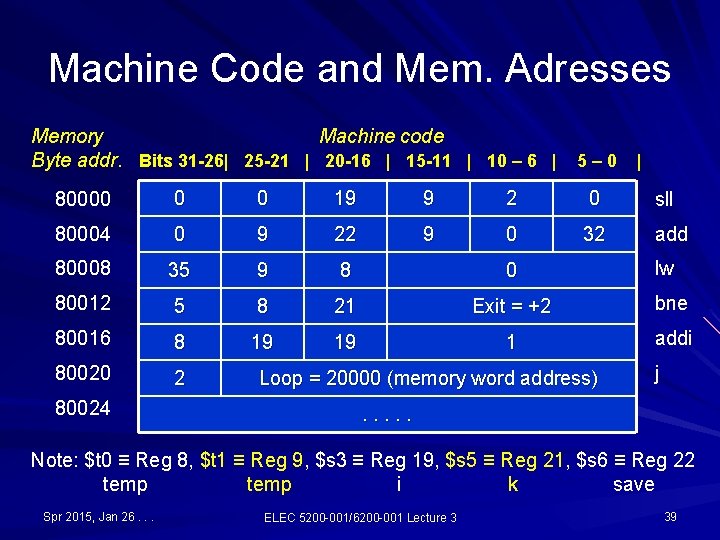
Machine Code and Mem. Adresses Memory Machine code Byte addr. Bits 31 -26| 25 -21 | 20 -16 | 15 -11 | 10 – 6 | 5 – 0 | 80000 0 0 19 9 2 0 sll 80004 0 9 22 9 0 32 add 80008 35 9 8 0 80012 5 8 21 Exit = +2 bne 80016 8 19 19 1 addi 80020 2 80024 Loop = 20000 (memory word address) lw j . . . Note: $t 0 ≡ Reg 8, $t 1 ≡ Reg 9, $s 3 ≡ Reg 19, $s 5 ≡ Reg 21, $s 6 ≡ Reg 22 temp i k save Spr 2015, Jan 26. . . ELEC 5200 -001/6200 -001 Lecture 3 39
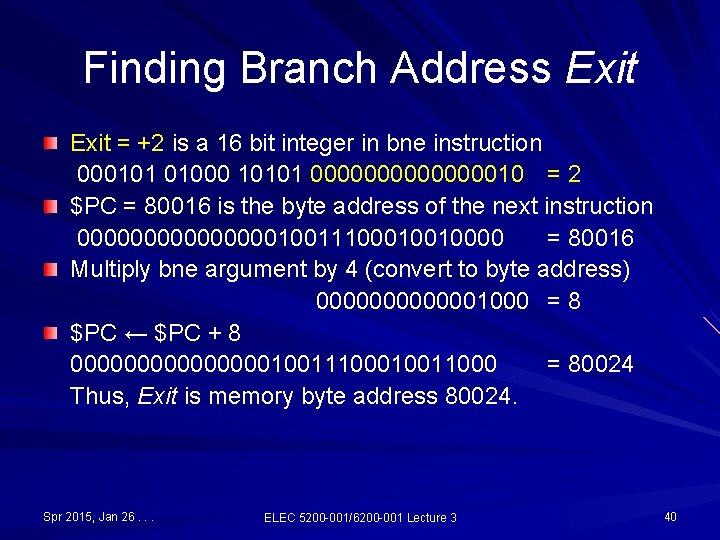
Finding Branch Address Exit = +2 is a 16 bit integer in bne instruction 000101 01000 10101 000000010 = 2 $PC = 80016 is the byte address of the next instruction 0000000010011100010010000 = 80016 Multiply bne argument by 4 (convert to byte address) 0000001000 = 8 $PC ← $PC + 8 0000000010011100010011000 = 80024 Thus, Exit is memory byte address 80024. Spr 2015, Jan 26. . . ELEC 5200 -001/6200 -001 Lecture 3 40
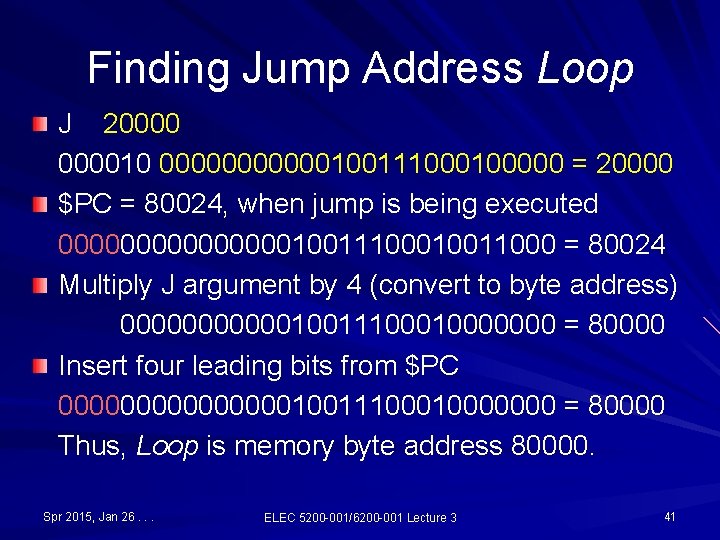
Finding Jump Address Loop J 2000010 00000010011100000 = 20000 $PC = 80024, when jump is being executed 0000000010011100010011000 = 80024 Multiply J argument by 4 (convert to byte address) 0000001001110000000 = 80000 Insert four leading bits from $PC 000000001001110000000 = 80000 Thus, Loop is memory byte address 80000. Spr 2015, Jan 26. . . ELEC 5200 -001/6200 -001 Lecture 3 41
Summary: MIPS Registers and Memory Spr 2015, Jan 26. . . ELEC 5200 -001/6200 -001 Lecture 3 42
Summary: MIPS Instructions Spr 2015, Jan 26. . . ELEC 5200 -001/6200 -001 Lecture 3 43
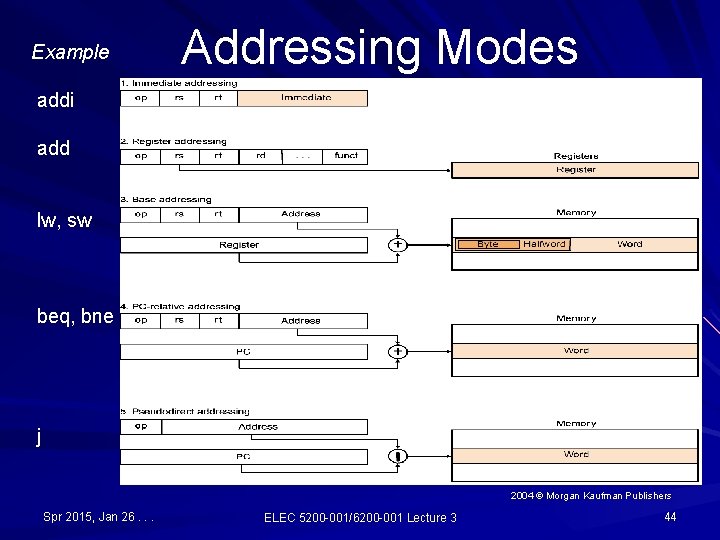
Example Addressing Modes addi add lw, sw beq, bne j 2004 © Morgan Kaufman Publishers Spr 2015, Jan 26. . . ELEC 5200 -001/6200 -001 Lecture 3 44
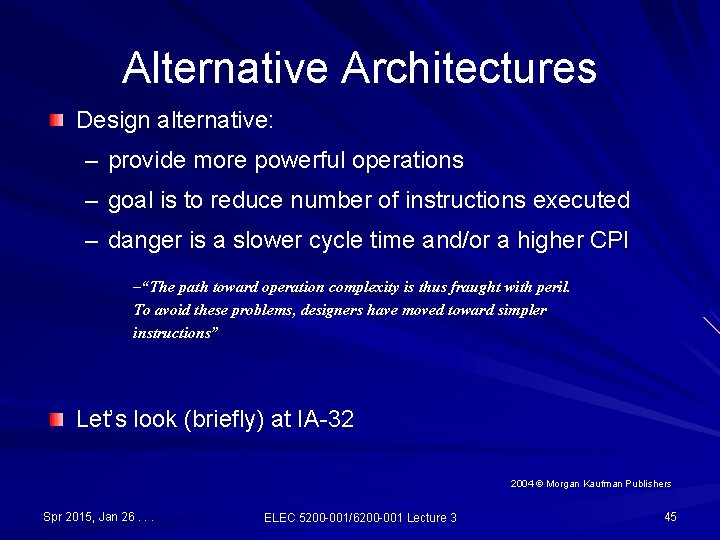
Alternative Architectures Design alternative: – provide more powerful operations – goal is to reduce number of instructions executed – danger is a slower cycle time and/or a higher CPI –“The path toward operation complexity is thus fraught with peril. To avoid these problems, designers have moved toward simpler instructions” Let’s look (briefly) at IA-32 2004 © Morgan Kaufman Publishers Spr 2015, Jan 26. . . ELEC 5200 -001/6200 -001 Lecture 3 45
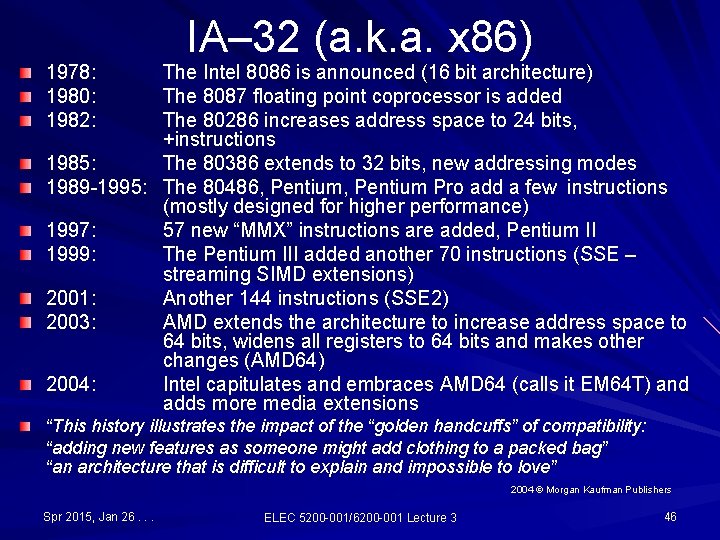
1978: 1980: 1982: IA– 32 (a. k. a. x 86) The Intel 8086 is announced (16 bit architecture) The 8087 floating point coprocessor is added The 80286 increases address space to 24 bits, +instructions 1985: The 80386 extends to 32 bits, new addressing modes 1989 -1995: The 80486, Pentium Pro add a few instructions (mostly designed for higher performance) 1997: 57 new “MMX” instructions are added, Pentium II 1999: The Pentium III added another 70 instructions (SSE – streaming SIMD extensions) 2001: Another 144 instructions (SSE 2) 2003: AMD extends the architecture to increase address space to 64 bits, widens all registers to 64 bits and makes other changes (AMD 64) 2004: Intel capitulates and embraces AMD 64 (calls it EM 64 T) and adds more media extensions “This history illustrates the impact of the “golden handcuffs” of compatibility: “adding new features as someone might add clothing to a packed bag” “an architecture that is difficult to explain and impossible to love” 2004 © Morgan Kaufman Publishers Spr 2015, Jan 26. . . ELEC 5200 -001/6200 -001 Lecture 3 46
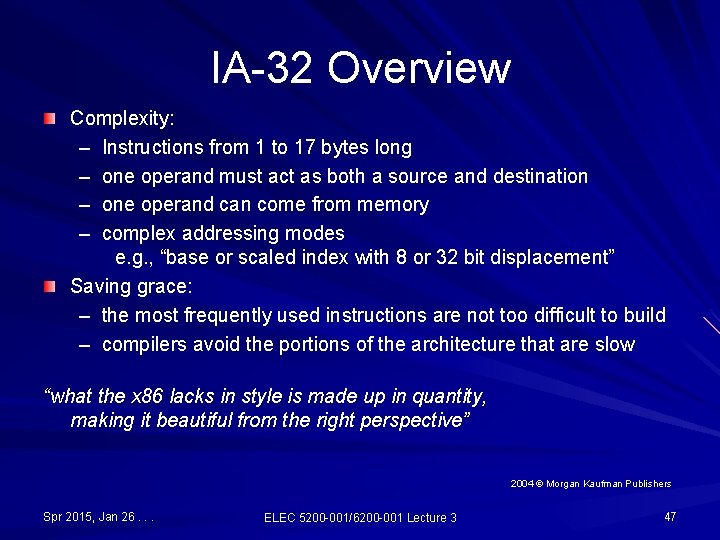
IA-32 Overview Complexity: – Instructions from 1 to 17 bytes long – one operand must act as both a source and destination – one operand can come from memory – complex addressing modes e. g. , “base or scaled index with 8 or 32 bit displacement” Saving grace: – the most frequently used instructions are not too difficult to build – compilers avoid the portions of the architecture that are slow “what the x 86 lacks in style is made up in quantity, making it beautiful from the right perspective” 2004 © Morgan Kaufman Publishers Spr 2015, Jan 26. . . ELEC 5200 -001/6200 -001 Lecture 3 47
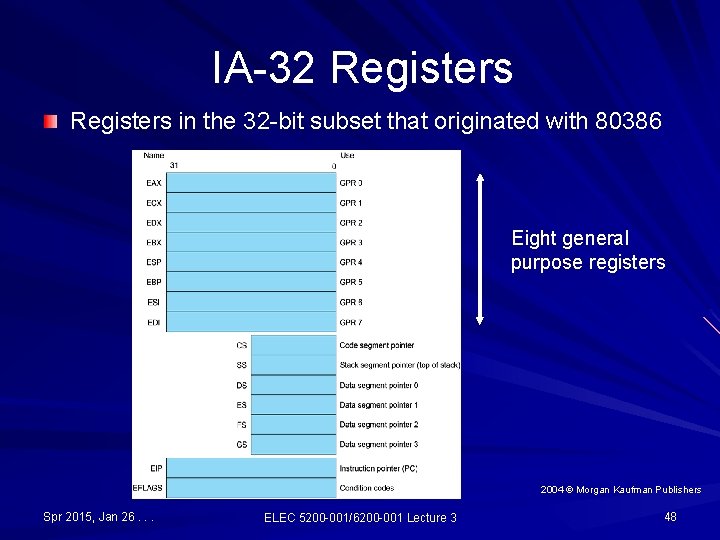
IA-32 Registers in the 32 -bit subset that originated with 80386 Eight general purpose registers 2004 © Morgan Kaufman Publishers Spr 2015, Jan 26. . . ELEC 5200 -001/6200 -001 Lecture 3 48
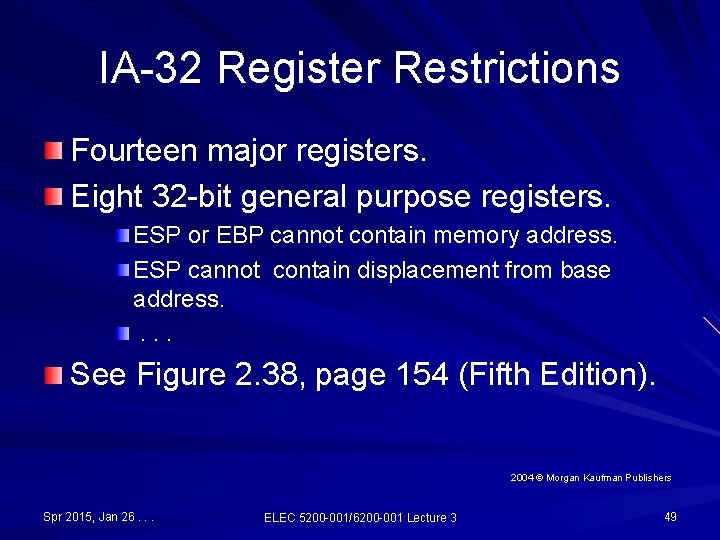
IA-32 Register Restrictions Fourteen major registers. Eight 32 -bit general purpose registers. ESP or EBP cannot contain memory address. ESP cannot contain displacement from base address. . See Figure 2. 38, page 154 (Fifth Edition). 2004 © Morgan Kaufman Publishers Spr 2015, Jan 26. . . ELEC 5200 -001/6200 -001 Lecture 3 49
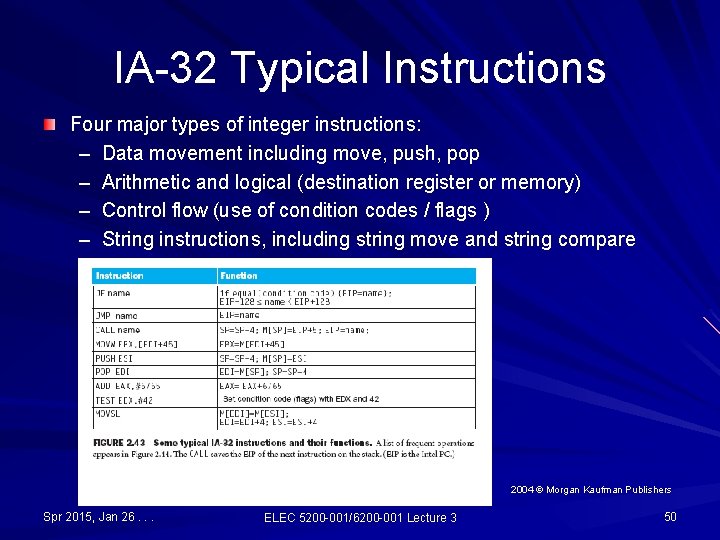
IA-32 Typical Instructions Four major types of integer instructions: – Data movement including move, push, pop – Arithmetic and logical (destination register or memory) – Control flow (use of condition codes / flags ) – String instructions, including string move and string compare 2004 © Morgan Kaufman Publishers Spr 2015, Jan 26. . . ELEC 5200 -001/6200 -001 Lecture 3 50
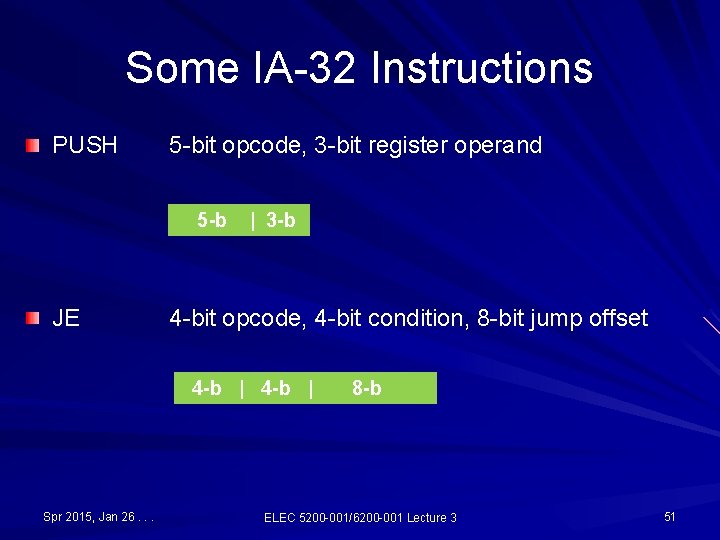
Some IA-32 Instructions PUSH 5 -bit opcode, 3 -bit register operand 5 -b JE | 3 -b 4 -bit opcode, 4 -bit condition, 8 -bit jump offset 4 -b | Spr 2015, Jan 26. . . 8 -b ELEC 5200 -001/6200 -001 Lecture 3 51
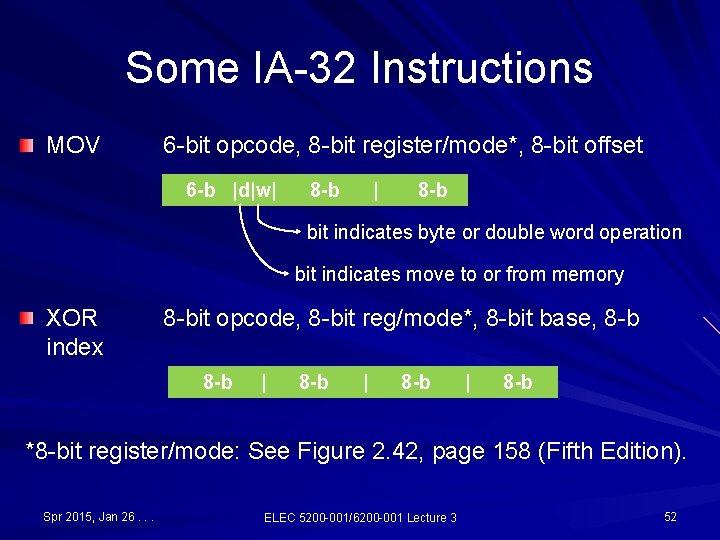
Some IA-32 Instructions MOV 6 -bit opcode, 8 -bit register/mode*, 8 -bit offset 6 -b |d|w| 8 -b bit indicates byte or double word operation bit indicates move to or from memory XOR index 8 -bit opcode, 8 -bit reg/mode*, 8 -bit base, 8 -b | 8 -b *8 -bit register/mode: See Figure 2. 42, page 158 (Fifth Edition). Spr 2015, Jan 26. . . ELEC 5200 -001/6200 -001 Lecture 3 52
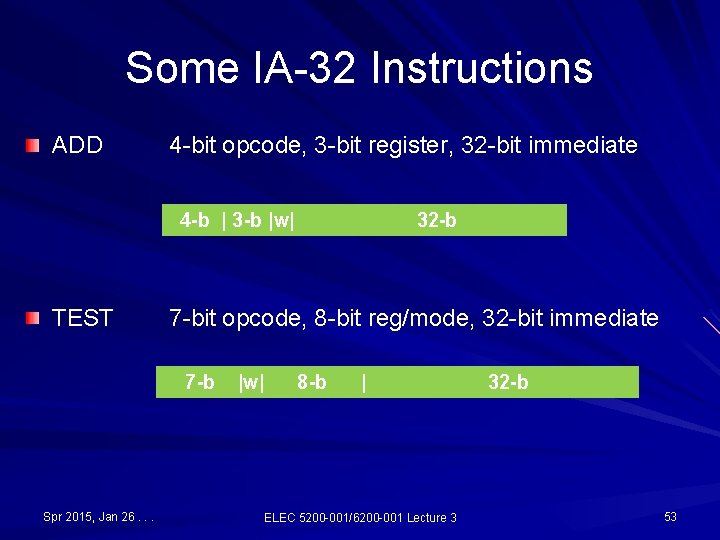
Some IA-32 Instructions ADD 4 -bit opcode, 3 -bit register, 32 -bit immediate 4 -b | 3 -b |w| TEST 7 -bit opcode, 8 -bit reg/mode, 32 -bit immediate 7 -b Spr 2015, Jan 26. . . 32 -b |w| 8 -b | ELEC 5200 -001/6200 -001 Lecture 3 32 -b 53
Additional References IA-32, IA-64 (CISC) A. S. Tanenbaum, Structured Computer Organization, Fifth Edition, Upper Saddle River, New Jersey: Pearson Prentice. Hall, 2006, Chapter 5. ARM (RISC) D. Seal, ARM Architecture Reference Manual, Second Edition, Addison-Wesley Professional, 2000. SPARC (Scalable Processor Architecture) Power. PC V. C. Hamacher, Z. G. Vranesic and S. G. Zaky, Computer Organization, Fourth Edition, New York: Mc. Graw-Hill, 1996. Spr 2015, Jan 26. . . ELEC 5200 -001/6200 -001 Lecture 3 54
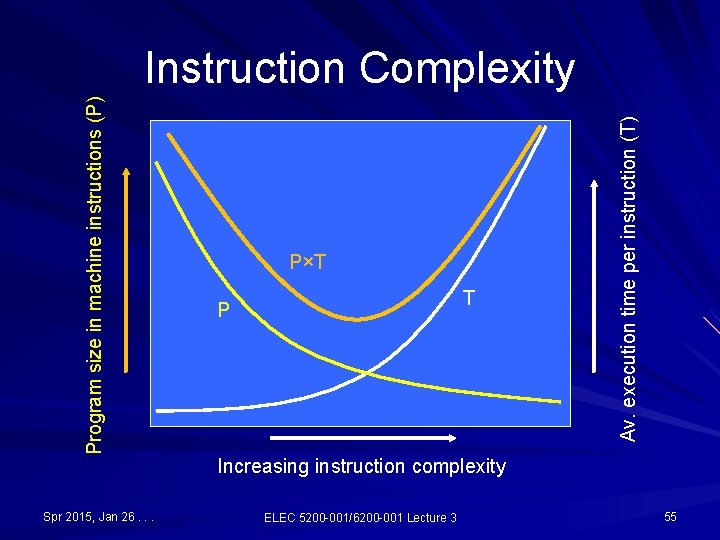
Spr 2015, Jan 26. . . P×T T P Av. execution time per instruction (T) Program size in machine instructions (P) Instruction Complexity Increasing instruction complexity ELEC 5200 -001/6200 -001 Lecture 3 55
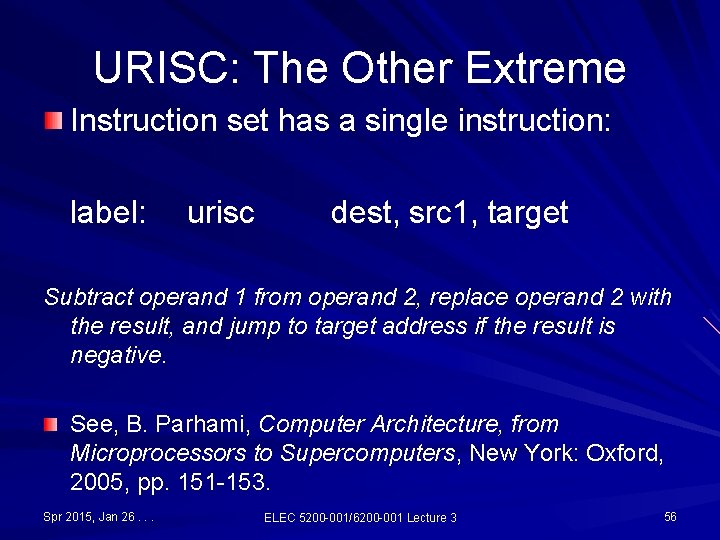
URISC: The Other Extreme Instruction set has a single instruction: label: urisc dest, src 1, target Subtract operand 1 from operand 2, replace operand 2 with the result, and jump to target address if the result is negative. See, B. Parhami, Computer Architecture, from Microprocessors to Supercomputers, New York: Oxford, 2005, pp. 151 -153. Spr 2015, Jan 26. . . ELEC 5200 -001/6200 -001 Lecture 3 56
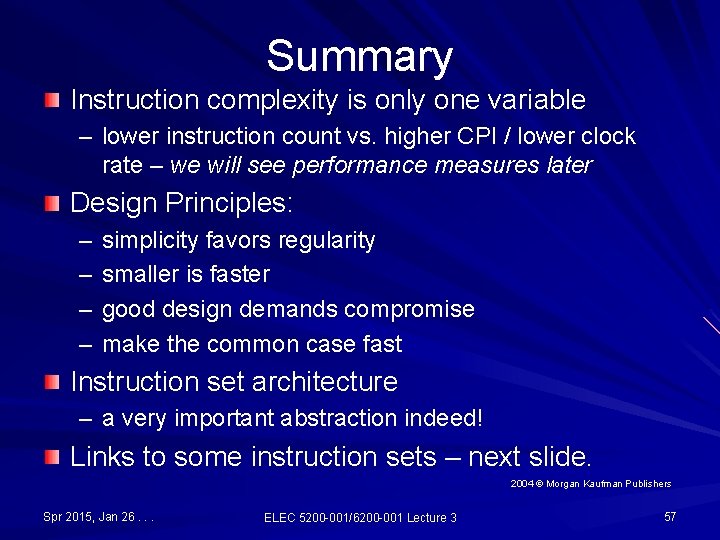
Summary Instruction complexity is only one variable – lower instruction count vs. higher CPI / lower clock rate – we will see performance measures later Design Principles: – – simplicity favors regularity smaller is faster good design demands compromise make the common case fast Instruction set architecture – a very important abstraction indeed! Links to some instruction sets – next slide. 2004 © Morgan Kaufman Publishers Spr 2015, Jan 26. . . ELEC 5200 -001/6200 -001 Lecture 3 57
Some Instruction Sets MIPS http: //www. d. umn. edu/~gshute/mips/MIPS. html ARM http: //simplemachines. it/doc/arm_inst. pdf IA 32/64 http: //brokenthorn. com/Resources/OSDev. X 86. html Power. PC http: //pds. twi. tudelft. nl/vakken/in 101/labcourse/instruction-set/ SPARC http: //www. cs. unm. edu/~maccabe/classes/341/labman/node 9 Spr 2015, Jan 26. . . ELEC 5200 -001/6200 -001 Lecture 3 58
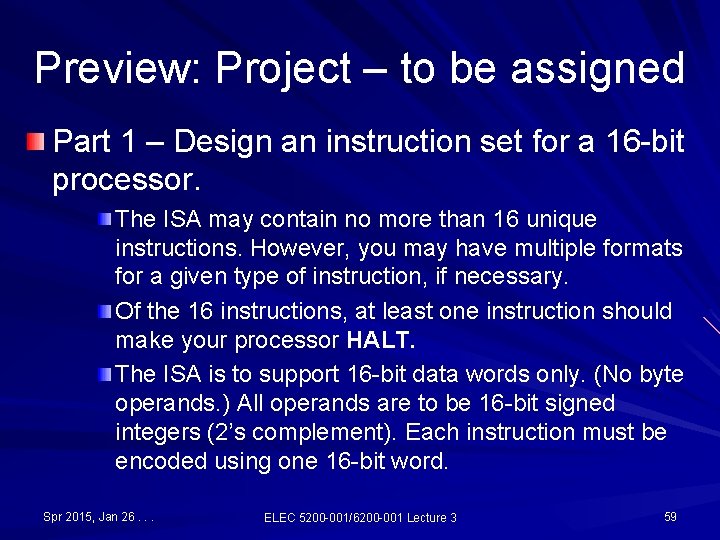
Preview: Project – to be assigned Part 1 – Design an instruction set for a 16 -bit processor. The ISA may contain no more than 16 unique instructions. However, you may have multiple formats for a given type of instruction, if necessary. Of the 16 instructions, at least one instruction should make your processor HALT. The ISA is to support 16 -bit data words only. (No byte operands. ) All operands are to be 16 -bit signed integers (2’s complement). Each instruction must be encoded using one 16 -bit word. Spr 2015, Jan 26. . . ELEC 5200 -001/6200 -001 Lecture 3 59
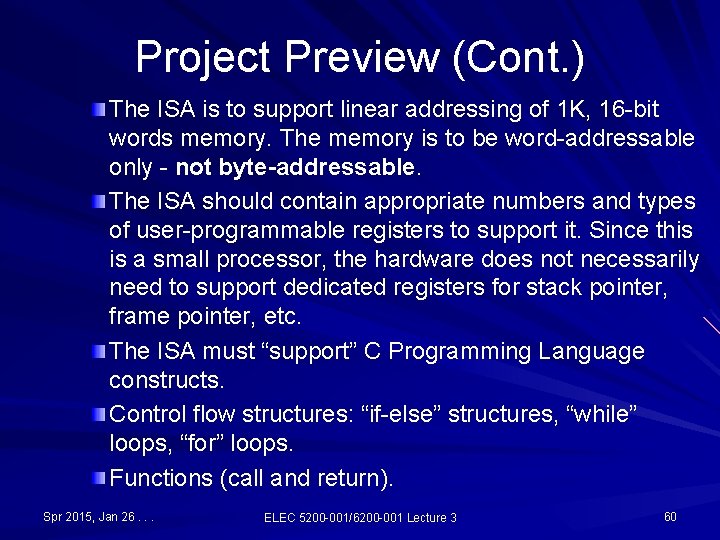
Project Preview (Cont. ) The ISA is to support linear addressing of 1 K, 16 -bit words memory. The memory is to be word-addressable only - not byte-addressable. The ISA should contain appropriate numbers and types of user-programmable registers to support it. Since this is a small processor, the hardware does not necessarily need to support dedicated registers for stack pointer, frame pointer, etc. The ISA must “support” C Programming Language constructs. Control flow structures: “if-else” structures, “while” loops, “for” loops. Functions (call and return). Spr 2015, Jan 26. . . ELEC 5200 -001/6200 -001 Lecture 3 60