
Elearning and the e University Professor Robin Mason
E-learning and the e. University Professor Robin Mason Institute of Educational Technology The Open University Milton Keynes Stirling oct 97 dp/rm p. 1

Why an e-University? Pshowcasing the best of UK higher education Pattracting foreign students to study in the UK Pimpetus to UK HE to develop elearning capability Psecure a UK presence in the e-learning marketplace Stirling oct 97 dp/rm p. 2
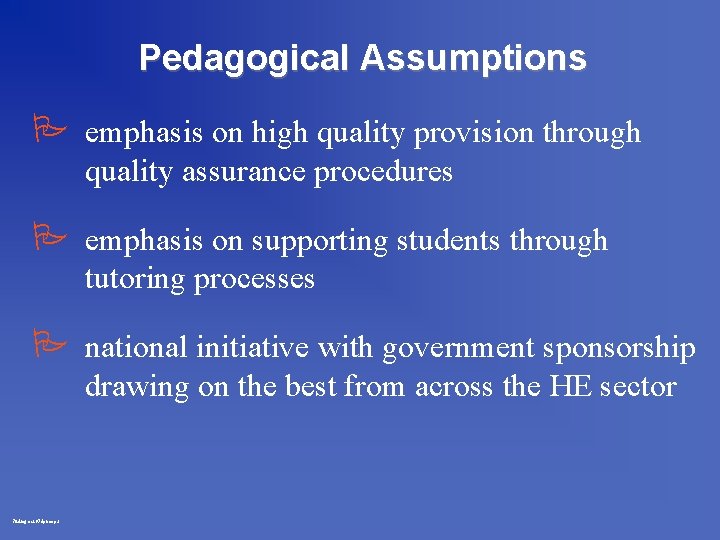
Pedagogical Assumptions P emphasis on high quality provision through quality assurance procedures P emphasis on supporting students through tutoring processes P national initiative with government sponsorship drawing on the best from across the HE sector Stirling oct 97 dp/rm p. 3
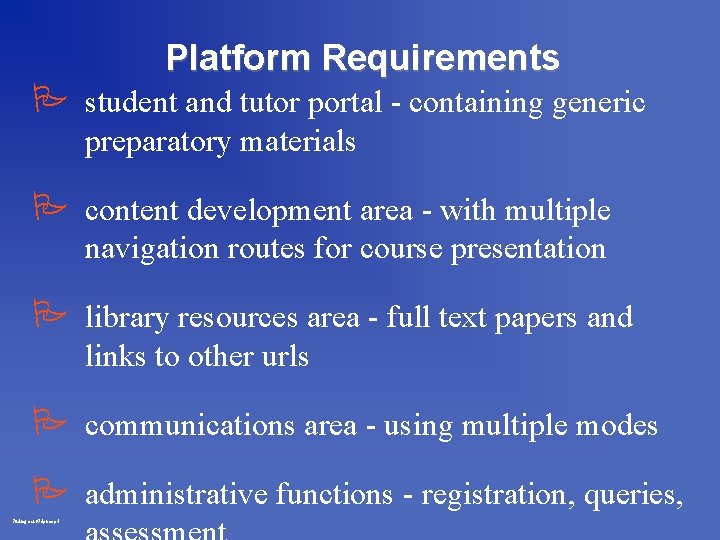
Platform Requirements P student and tutor portal - containing generic preparatory materials P content development area - with multiple navigation routes for course presentation P library resources area - full text papers and links to other urls P communications area - using multiple modes P administrative functions - registration, queries, Stirling oct 97 dp/rm p. 4

Communication Modes P asynchronous threaded discussion P synchronous webcasts, chatting, ‘audiographics’ P comment facility on course content P email Stirling oct 97 dp/rm p. 5
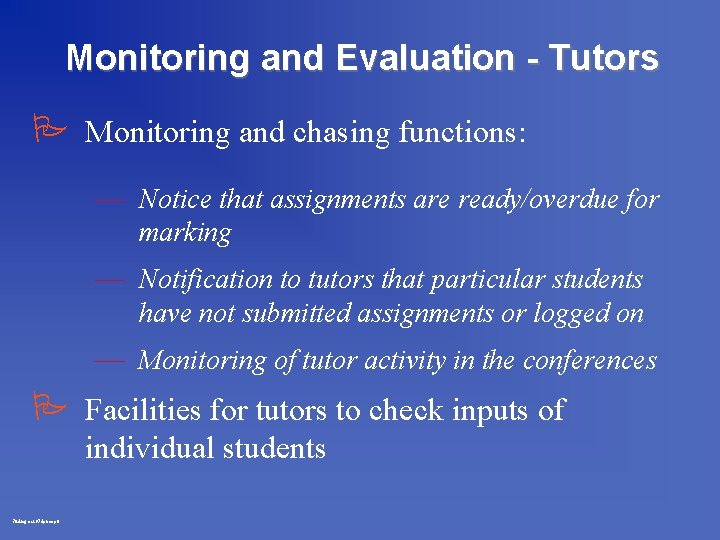
Monitoring and Evaluation - Tutors P Monitoring and chasing functions: — Notice that assignments are ready/overdue for marking — Notification to tutors that particular students have not submitted assignments or logged on — Monitoring of tutor activity in the conferences P Facilities for tutors to check inputs of individual students Stirling oct 97 dp/rm p. 6

Monitoring and Evaluation - Students P Questionnaire forms for surveys P Dynamic course calendar with reminders of assignment dates P Computer-generated user data P Easy feedback mechanisms for student comments on course content Stirling oct 97 dp/rm p. 7
Institutional Research P understanding the impact of learning objects on learning outcomes P investigating cultural differences in using e. U courses P relation between tutor support and retention P impact of different models of online courses Stirling oct 97 dp/rm p. 8
Research on the Pedagogy of e. Learning P learning to e-learn skills P development of online community and connectivity P learning from the success of online games P impact of modularization of learning opportunities Stirling oct 97 dp/rm p. 9

Research on the Technology of e. Learning P virtual presence and the use of existing bandwidth P methods for reducing communication overload P role of mobile devices in online courses P tracking devices for informal learning Stirling oct 97 dp/rm p. 10
Research on Access and Development P methodologies and support functions most appropriate for disadvantaged learners P technologies for attracting and retaining students in remote areas P basic infrastructures needed to support webbased courses and psychological readiness for virtual learning P contribution of the e. U to sustainable Stirling oct 97 dp/rm p. 11
Research on Organisational Learning P Meshing online courses with ongoing learning processes in organisations e. g. informal knowledge sharing, communities of practice, apprenticeship and on-the-job training P Effectiveness of conventional pedagogies in promoting knowledge sharing in the workplace - What are the potential roles of story and performance simulation? Stirling oct 97 dp/rm p. 12
E-Learning Research Community P aim to raise the profile of e-learning research P pull-through of e-learning research into practice P contribute to a co-ordinated e-learning research agenda Stirling oct 97 dp/rm p. 13

Stirling oct 97 dp/rm p. 14
- Slides: 14