
Elder Abuse Lidia Vognar MD MHS c MD
Elder Abuse Lidia Vognar, MD MHS c. MD Asst Professor, Geriatric Medicine, Brown University VA Medical Center, Providence, RI Phone: 401 -273 -7100 Email: Lidia. Vognar@va. gov End the Silence
Background/ Disclosures: • Geriatrician at VA, Care New England, Lifespan • Educator at Brown University • Former Hospice Medical Director at VNA Home and Hospice • No Disclosures
Objectives: • With this presentation, we aim to identify elder abuse barriers at a national level • With this presentation, we aim to identify elder abuse barriers at a state level • With this presentation, we aim to give a healthcare professionals view on elder abuse
Elder Abuse
Elder Abuse : Statistics • There are presently about 39 million individuals over the age of 65; the U. S. Census Bureau projects that more than 62 million Americans will be 65 or older in 2025 (Mc. Coy and Hansen, 2004) • According to the best available estimates, between 1 and 2 million Americans age 65 or older have been injured, exploited, or otherwise mistreated by someone on whom they depended for care or protection. (Elder Mistreatment: Abuse, Neglect and Exploitation in an Aging America. 2003. Washington, DC: National Research Council Panel to Review Risk and Prevalence of Elder Abuse and Neglect. ) • It is estimated that for every one case of elder abuse, neglect, exploitation, or self neglect reported to authorities, about five more go unreported. (National Elder Abuse Incidence Study. 1998. Washington, DC: National Center on Elder Abuse at American Public Human Services Association. ) • Most common is neglect, active and passive, followed by financial exploitation
Why should we care? • Victims of elder abuse have a higher 10 year mortality and morbidity than elders who have not been mistreated (Mosqueda, Lachs , 2004) • Elder abuse is associated with higher utilization of ED services and higher hospitalization rates (Dong, 2013) • Elder abuse has an estimated contribution of more than 5. 3 billion dollars to the annual healthcare expenditure in the United States (Choo, 2013) • A clinician who sees between 20 and 40 patients daily, could encounter at least one victim of elder mistreatment (Halphen, 2009) • Healthcare professionals were responsible for submitting 11. 1% of elder abuse reports; physicians accounted for only 1. 0% of reported cases (National APS survey)
Why are we so bad at this? • Lack of sufficient knowledge on elder abuse definition, types, risk factors, signs and symptoms, and the reporting process • Survey of almost 400 family and internal medicine physicians (Kennedy R, 2005): -63% had never asked their patients about elder abuse -98% said there should be more education on elder mistreatment -80% felt they had not been trained to diagnose elder mistreatment • Elder abuse is part of one of the 26 Minimum Geriatric competencies for Internal medicine and Family medicine residents but exposure greatly varies from program to program
Barrier #1: Elder Abuse: Definition • According to most state law: elder abuse is any knowing, intentional, or non-intentional act by a caregiver or any other person that causes harm or a serious risk of harm to a vulnerable adult. • According to WHO: elder abuse is acts of omission or commission by a person who stands in a trust relationship that result in harm or threatened harm to the health and or welfare of an older adult
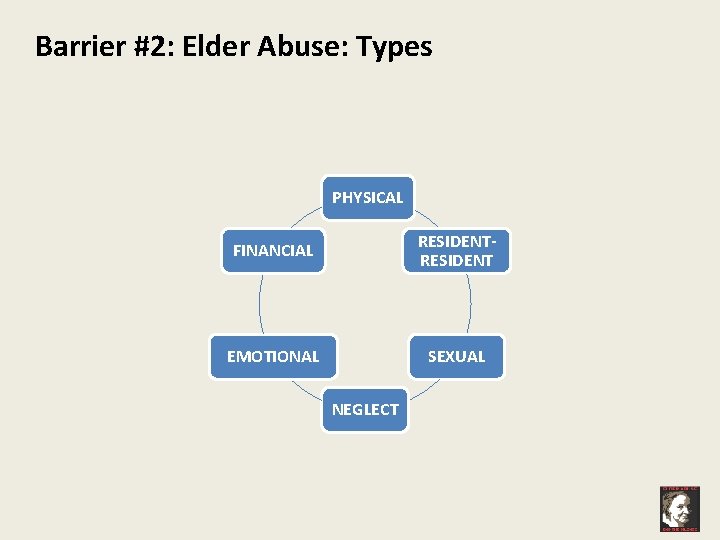
Barrier #2: Elder Abuse: Types PHYSICAL FINANCIAL RESIDENT EMOTIONAL SEXUAL NEGLECT
Elder Abuse: Neglect • Neglect: failure to fulfill a caretaking obligation Active Neglect: willful failure to provide care Passive Neglect: non-willful failure to provide care Self-neglect: failure of elder to care for themselves • Signs: -Poor personal hygiene/ malodorous -Hoarding -Misuse of medication -Infrequent changing of incontinence briefs, soiled clothing -Malnutrition, dehydration -Pressure ulcers, bruising, poor oral hygiene
Barrier #3: Elder Abuse: Risk Factors • Isolation of caregiver-elder • History of abuse in either • Abuser dependent on elder • Mental illness in either • Substance abuse in either • Caregiver’s perceived distress • Change in level of care needed for elder • Dementia/ behavioral disturbance
Barrier #4: Elder Abuse: Screening Modified Hwaleck- Sengstock Elder Abuse Screening Test: • Are you afraid of anyone in your family or home? • Has anyone close to you tried to hurt or harm you recently? • Has anyone close to you called you names or put you down or made you feel bad recently? • Does someone in your family make you stay in bed or tell you’re sick when you know you aren’t? • Has anyone forced you to do things you didn’t want to do? • Has anyone taken things that belong to you without your OK?
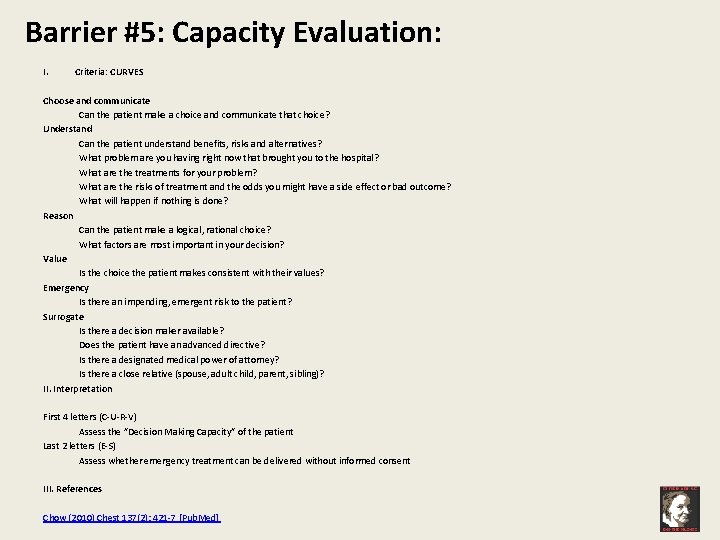
Barrier #5: Capacity Evaluation: I. Criteria: CURVES Choose and communicate Can the patient make a choice and communicate that choice? Understand Can the patient understand benefits, risks and alternatives? What problem are you having right now that brought you to the hospital? What are the treatments for your problem? What are the risks of treatment and the odds you might have a side effect or bad outcome? What will happen if nothing is done? Reason Can the patient make a logical, rational choice? What factors are most important in your decision? Value Is the choice the patient makes consistent with their values? Emergency Is there an impending, emergent risk to the patient? Surrogate Is there a decision maker available? Does the patient have an advanced directive? Is there a designated medical power of attorney? Is there a close relative (spouse, adult child, parent, sibling)? II. Interpretation First 4 letters (C-U-R-V) Assess the ”Decision Making Capacity” of the patient Last 2 letters (E-S) Assess whether emergency treatment can be delivered without informed consent III. References Chow (2010) Chest 137(2): 421 -7 [Pub. Med]
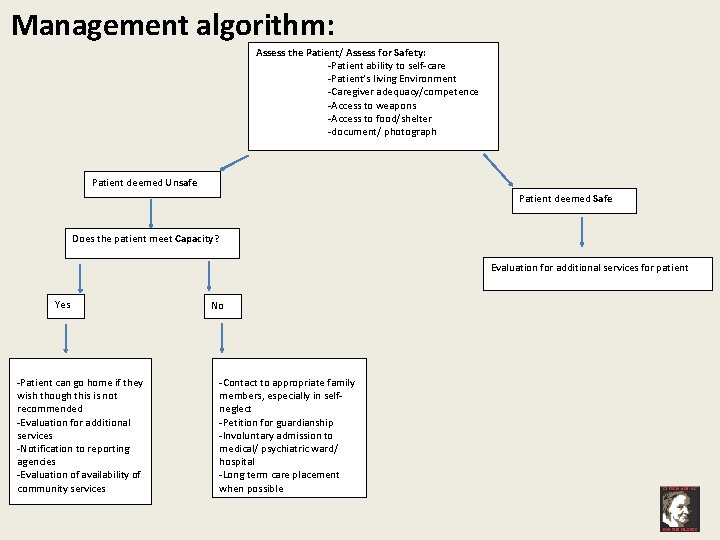
Management algorithm: Assess the Patient/ Assess for Safety: -Patient ability to self-care -Patient’s living Environment -Caregiver adequacy/competence -Access to weapons -Access to food/shelter -document/ photograph Patient deemed Unsafe Patient deemed Safe Does the patient meet Capacity? Evaluation for additional services for patient Yes -Patient can go home if they wish though this is not recommended -Evaluation for additional services -Notification to reporting agencies -Evaluation of availability of community services No -Contact to appropriate family members, especially in selfneglect -Petition for guardianship -Involuntary admission to medical/ psychiatric ward/ hospital -Long term care placement when possible
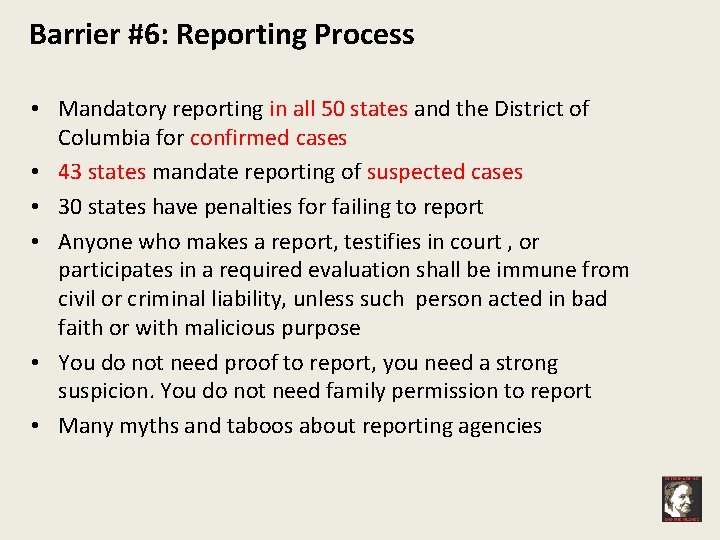
Barrier #6: Reporting Process • Mandatory reporting in all 50 states and the District of Columbia for confirmed cases • 43 states mandate reporting of suspected cases • 30 states have penalties for failing to report • Anyone who makes a report, testifies in court , or participates in a required evaluation shall be immune from civil or criminal liability, unless such person acted in bad faith or with malicious purpose • You do not need proof to report, you need a strong suspicion. You do not need family permission to report • Many myths and taboos about reporting agencies
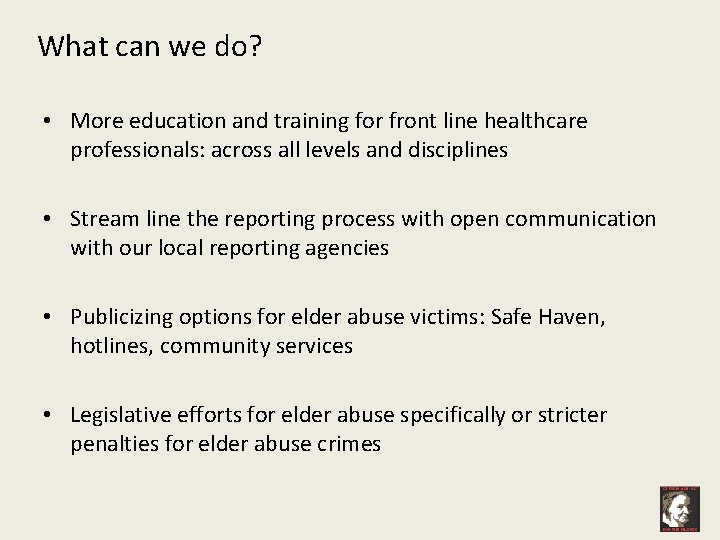
What can we do? • More education and training for front line healthcare professionals: across all levels and disciplines • Stream line the reporting process with open communication with our local reporting agencies • Publicizing options for elder abuse victims: Safe Haven, hotlines, community services • Legislative efforts for elder abuse specifically or stricter penalties for elder abuse crimes
Elder Abuse: Other Resources • Administration on Aging www. aoa. gov • Center of Excellence in Elder Abuse and neglect www. centeronelderabuse. org • National Association on State Units on Aging www. nausa. org • ABA Commission on Law and Aging www. abanet. org • National Center on Elder Abuse (NCEA) www. centeronelderabuse. org • Department of Justice www. justice. gov/elderjustice • National Committee for the Prevention of Elder Abuse www. preventelderabuse. org
Let’s all find the inspiration and strength within ourselves to give our mistreated elders a voice. Thank You End the Silence
- Slides: 18