
ELDER ABUSE Awareness and Prevention ELDER ABUSE Total
ELDER ABUSE Awareness and Prevention
ELDER ABUSE • Total scope of the problem is unknown • Elders reluctant to report mistreatment • Only one in 6 cases are reported • Abusers may be spouses, family members, personal acquaintances, or professionals in positions of trust
ELDER ABUSE • What is elder abuse? • Intentional or neglectful acts by a caregiver or • “trusted” individual that lead to, or may lead to, harm of a vulnerable elder Types – physical abuse; neglect; emotional or psychological abuse; verbal abuse and threats; financial abuse and exploitation; sexual abuse; and abandonment. Also self-neglect
ELDER ABUSE • Who is at risk? • Anybody at home • Nursing Homes • Other institutions • All socio-economic groups • All cultures and races • Women • Those with dementia, mental health and substance abuse issues
PREVALENCE AND INCIDENCE • No official numbers because: • Definitions of abuse vary • State statistics vary widely – no uniform reporting system • Comprehensive national data are not collected
WHAT DO STUDIES SAY? • Between 1 and 2 million Americans age 65 or older have been injured, exploited, or mistreated by someone they depended on for care • Frequency of elder abuse range from 2% to 10% based on various sampling, survey methods and case definitions
WHAT DO STUDIES SAY? • Elder abuse in domestic settings suggest 1 in 14 incidents excluding incidents of selfneglect, come to the attention of the authorities • Reporting of financial exploitation – 1 in 25 cases – at least 5 million financial abuse victims each year
DEFINITIONS – Pennsylvania Code • Abuse – infliction of injury, unreasonable confinement, intimidation or punishment with resulting physical harm or pain or mental anguish, or deprivation by an individual, including a caretaker, of goods or services that are necessary to attain or maintain physical, mental and psychosocial well-being. The term includes:

DEFINITIONS • Verbal abuse – any use of oral, written ore gestured language that willfully includes disparaging and derogatory terms to residents or their families, or within their hearing distance , regardless of their age, ability to comprehend or disability. Examples include: • Threats of harm
DEFINITIONS • Saying things to frighten a resident – “never see • • • your family again”. Sexual abuse – includes sexual harassment, sexual coercion or sexual assault. Physical abuse – includes hitting, slapping, pinching and kicking. The term also applies to controlling through corporal punishment. Mental abuse – includes humiliation, harassment, threats of punishment or deprivation

DEFINITIONS • Involuntary seclusion – separation of a resident from other residents or from his room or confinement to his room (with/without roommates) against the resident’s will, or the will of the resident’s legal representatives. Emergency or short term monitored separation from other residents will not be considered

DEFINITIONS • Involuntary seclusion continued – involuntary • seclusion and may be permitted if used for a limited period of time as a therapeutic intervention to reduce agitation until professional staff can develop a plan of care to meet the resident’s needs. Neglect – the deprivation by a caretaker of goods or services which are necessary to maintain physical or mental health

WARNING SIGNS OF ABUSE • Physical abuse – slap marks, unexplained bruises, most pressure marks, and certain types of burns or blisters such as cigarette burns • Neglect – pressure ulcers, filth, a lack of medical care, malnutrition or dehydration • Emotional abuse – withdrawal from normal activities, unexplained changes
WARNING SIGNS OF ABUSE • Emotional abuse continued – in alertness, or • • other unusual behavioral changes Sexual abuse – bruises around the breasts or genital area and unexplained sexually transmitted diseases Financial Abuse/Exploitation – sudden change in finances an accounts, checks written as “loans” or “gifts”, and loss of property
ABUSE IN NURSING HOMES • Again – no reliable data on prevalence of abuse or neglect in nursing homes or residential long-term care • Piecemeal evidence suggest the problem is serious and widespread • Much information is based on individual stories or focus interviews with residents and families
ABUSE IN NURSING HOMES • Atlanta Long Term Care (LTC) Ombudsman Program – 80 residents in 23 nursing homes in Georgia interviewed. 44% of residents reported that they had been abused. 48% had been treated roughly.
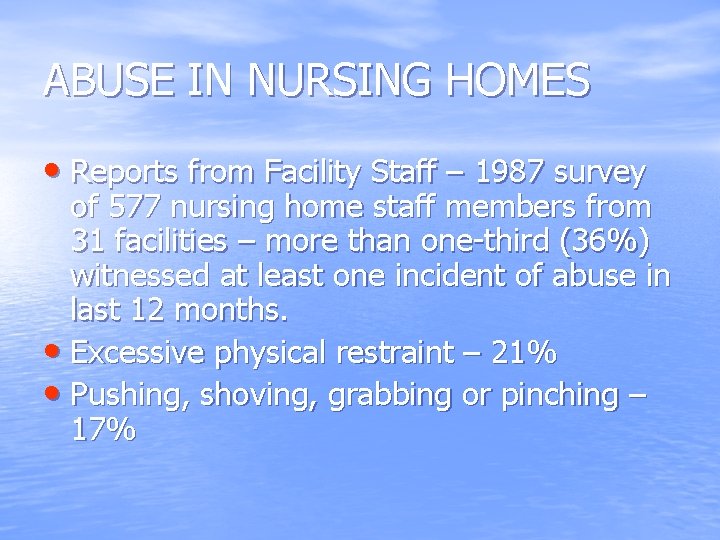
ABUSE IN NURSING HOMES • Reports from Facility Staff – 1987 survey of 577 nursing home staff members from 31 facilities – more than one-third (36%) witnessed at least one incident of abuse in last 12 months. • Excessive physical restraint – 21% • Pushing, shoving, grabbing or pinching – 17%
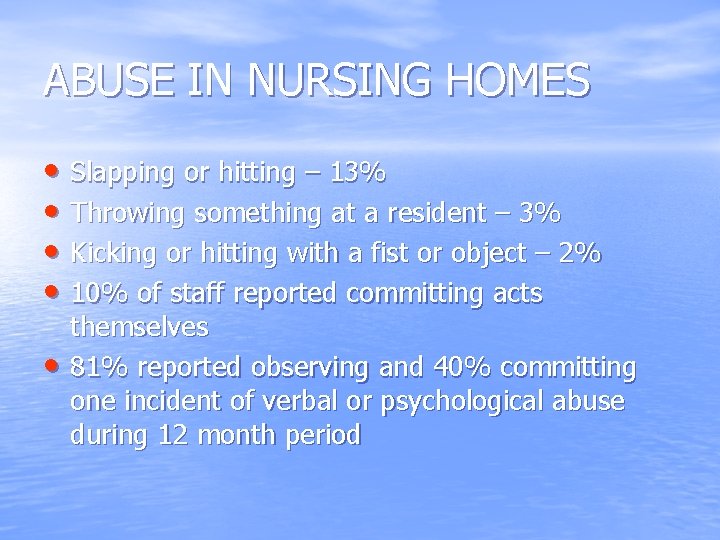
ABUSE IN NURSING HOMES • Slapping or hitting – 13% • Throwing something at a resident – 3% • Kicking or hitting with a fist or object – 2% • 10% of staff reported committing acts • themselves 81% reported observing and 40% committing one incident of verbal or psychological abuse during 12 month period
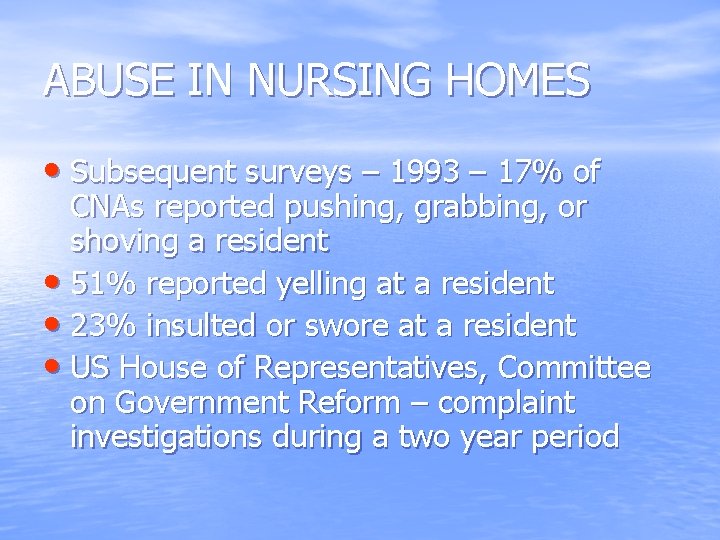
ABUSE IN NURSING HOMES • Subsequent surveys – 1993 – 17% of CNAs reported pushing, grabbing, or shoving a resident • 51% reported yelling at a resident • 23% insulted or swore at a resident • US House of Representatives, Committee on Government Reform – complaint investigations during a two year period
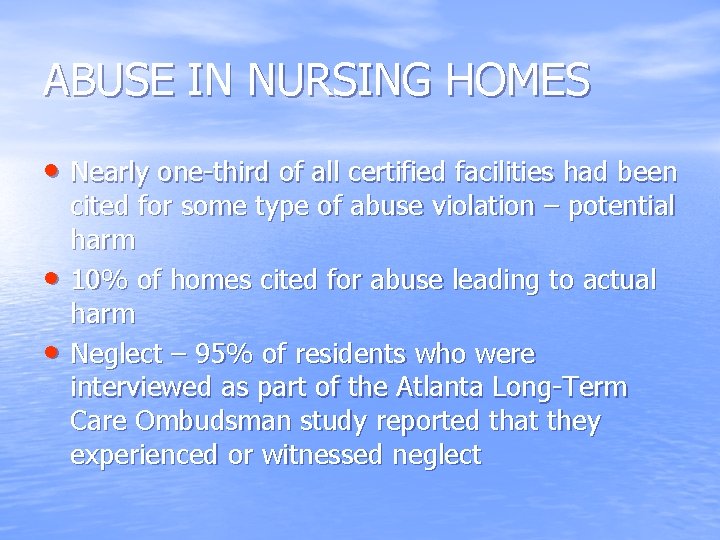
ABUSE IN NURSING HOMES • Nearly one-third of all certified facilities had been • • cited for some type of abuse violation – potential harm 10% of homes cited for abuse leading to actual harm Neglect – 95% of residents who were interviewed as part of the Atlanta Long-Term Care Ombudsman study reported that they experienced or witnessed neglect
PREVENTION OF ABUSE AND NEGLECT IN LONG TERM CARE SETTINGS • Combination of strategies: • Coordination between law enforcement, • • regulatory, adult protection, and nursing home advocacy groups Education and training of staff in interpersonal caregiver skills Assure compliance with federal requirements concerning hiring of abusive nurse aides
PREVENTION OF ABUSE • Improve work conditions – adequate staffing, enhanced communication • Promote environments conducive to good care • Strict enforcement of mandatory reporting, as well as educate professionals and the public • Improve support for nurse aides
PREVENTION OF ABUSE • Assure that hiring practices include screening of prospective employees – criminal background checks, history of substance abuse and domestic violence, reactions to abusive residents, work ethics, and ability to manage anger and stress
REFERENCES • National Center on Elder Abuse (NCEA) (2005). • • Fact Sheet: 15 Questions and Answers About Elder Abuse retrieved November 23, 2009 from www. ncea. aoa. gov Long-Term Care Ombudsman website retrieved November 23, 2009 from www. ltcombudsman. org/static_pages/help. cfm www. eldercare. gov
- Slides: 24