
ELC 2320 Testing of R L C Series

- Slides: 10
ELC 2320 Testing of R, L, C Series Circuit to Better Understand Phasor Analysis and Second-Order Response by Comparing Theory Calculations with Measurements MG, 2021_0421 • Seven tests were made. • The AC capacitor is approximately 500 micro. F. • Individual inductors are 150 micro. H. The combinations used are: 5 series inductors, 3 series inductors, and 2 parallel inductors. • Testing voltage is at approximately 10 Vac (rms, 60 Hz). • Series resistors, either 1 ohm or 0. 1 ohm, measure current (I = V/R).
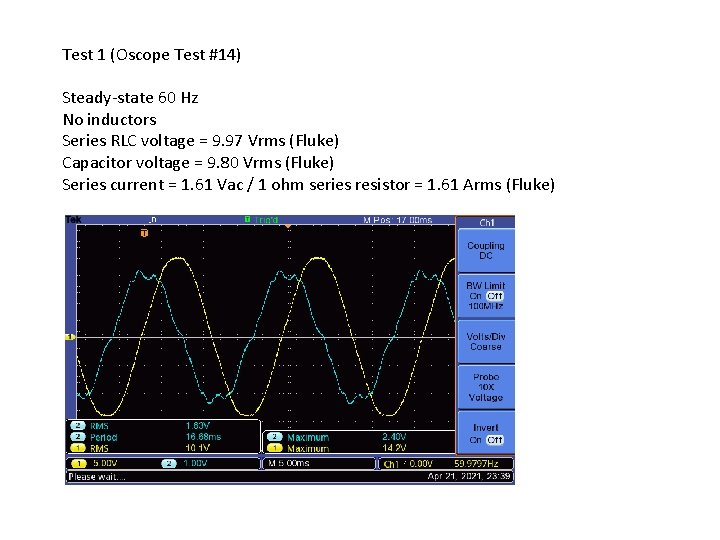
Test 1 (Oscope Test #14) Steady-state 60 Hz No inductors Series RLC voltage = 9. 97 Vrms (Fluke) Capacitor voltage = 9. 80 Vrms (Fluke) Series current = 1. 61 Vac / 1 ohm series resistor = 1. 61 Arms (Fluke)
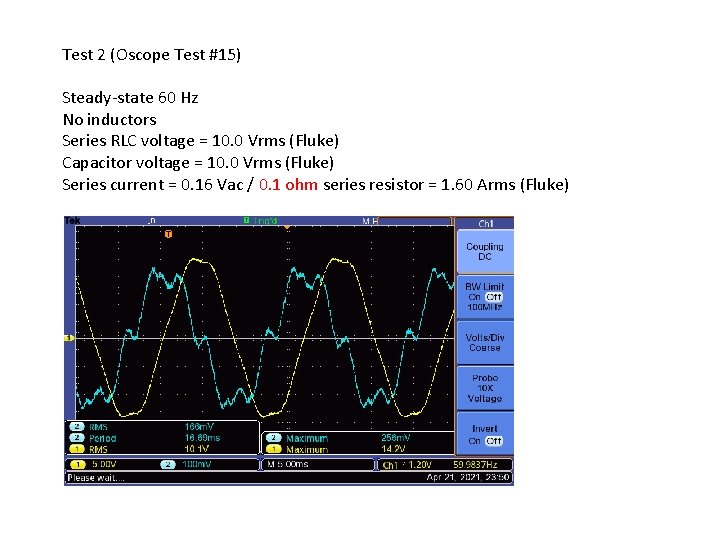
Test 2 (Oscope Test #15) Steady-state 60 Hz No inductors Series RLC voltage = 10. 0 Vrms (Fluke) Capacitor voltage = 10. 0 Vrms (Fluke) Series current = 0. 16 Vac / 0. 1 ohm series resistor = 1. 60 Arms (Fluke)
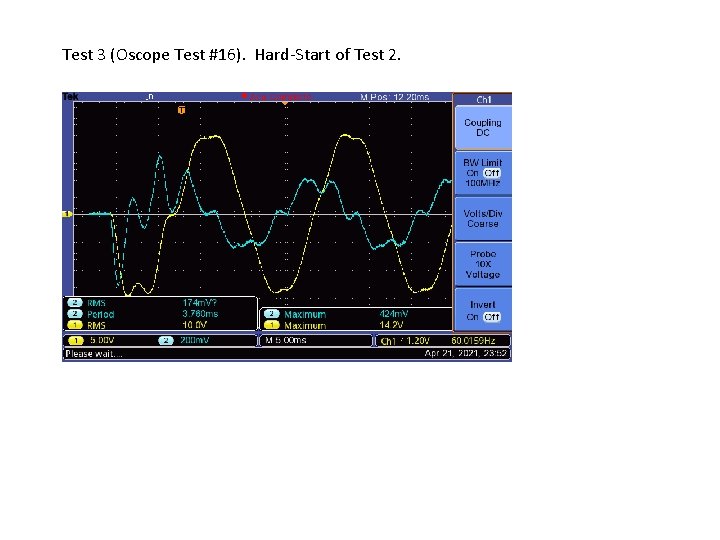
Test 3 (Oscope Test #16). Hard-Start of Test 2.
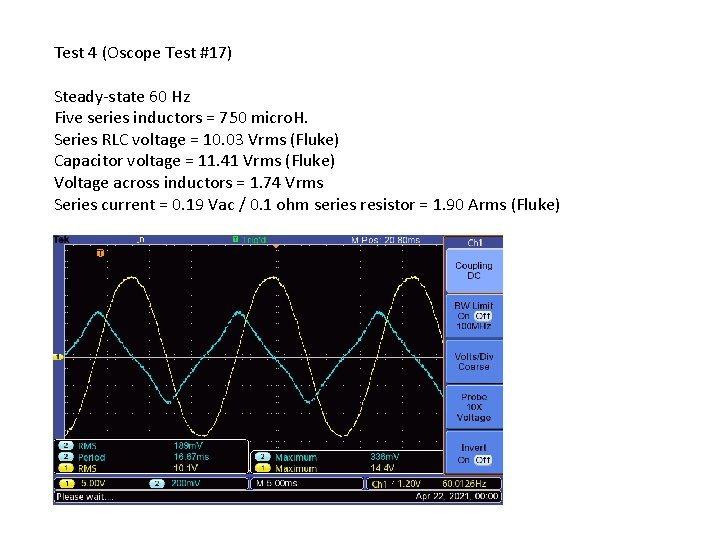
Test 4 (Oscope Test #17) Steady-state 60 Hz Five series inductors = 750 micro. H. Series RLC voltage = 10. 03 Vrms (Fluke) Capacitor voltage = 11. 41 Vrms (Fluke) Voltage across inductors = 1. 74 Vrms Series current = 0. 19 Vac / 0. 1 ohm series resistor = 1. 90 Arms (Fluke)
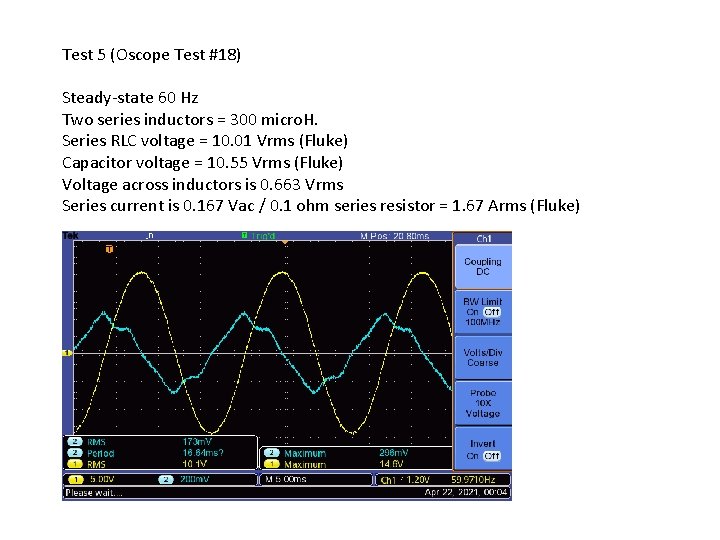
Test 5 (Oscope Test #18) Steady-state 60 Hz Two series inductors = 300 micro. H. Series RLC voltage = 10. 01 Vrms (Fluke) Capacitor voltage = 10. 55 Vrms (Fluke) Voltage across inductors is 0. 663 Vrms Series current is 0. 167 Vac / 0. 1 ohm series resistor = 1. 67 Arms (Fluke)
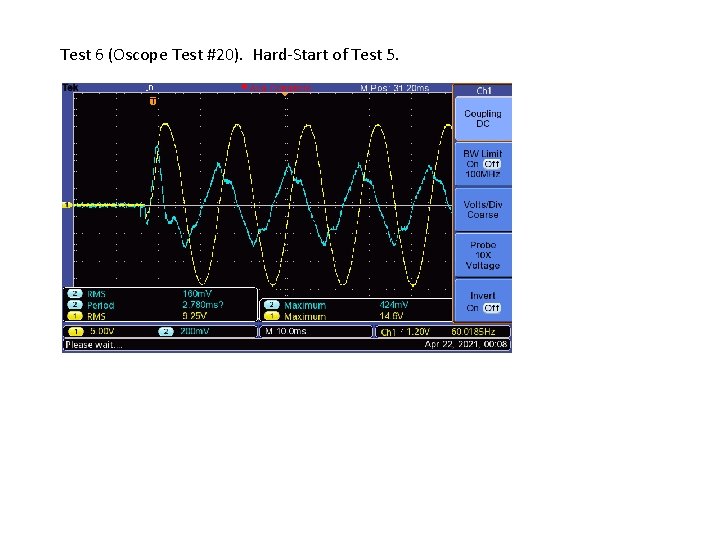
Test 6 (Oscope Test #20). Hard-Start of Test 5.
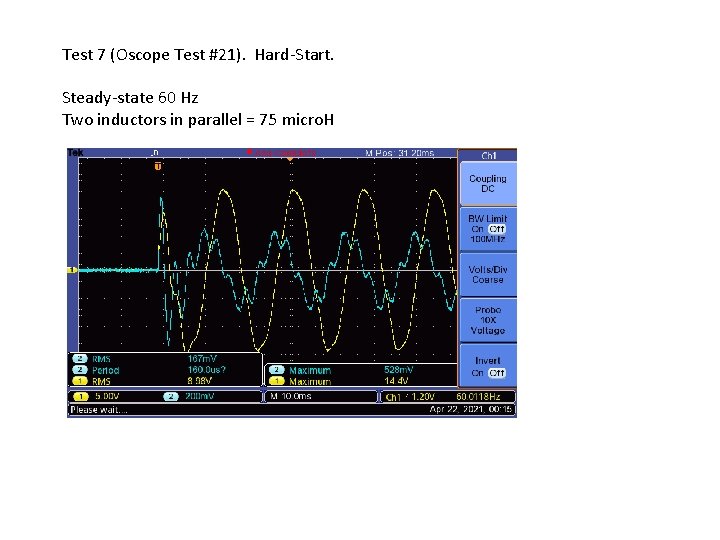
Test 7 (Oscope Test #21). Hard-Start. Steady-state 60 Hz Two inductors in parallel = 75 micro. H
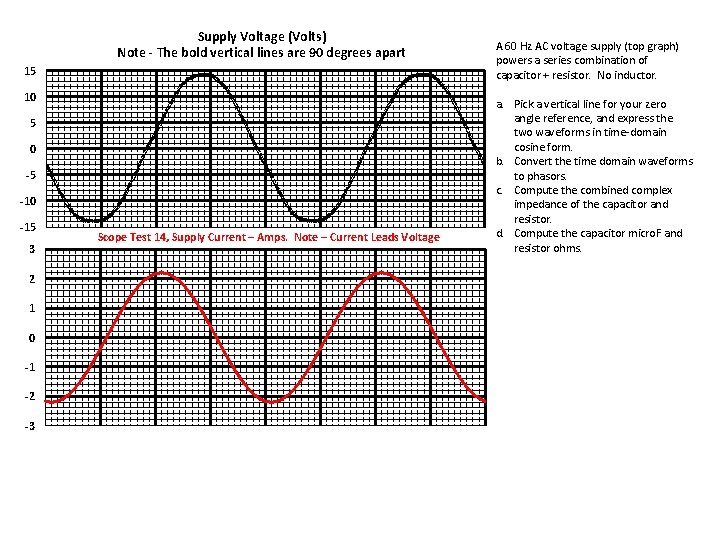
Supply Voltage (Volts) Note - The bold vertical lines are 90 degrees apart A 60 Hz AC voltage supply (top graph) powers a series combination of capacitor + resistor. No inductor. 15 10 5 0 -5 -10 -15 3 0 Scope Test 180 14, Supply 270 Current – Amps. Note – Current 540 Leads Voltage 90 360 450 630 0 90 a. Pick a vertical line for your zero angle reference, and express the two waveforms in time-domain cosine form. b. Convert the time domain waveforms to phasors. c. Compute the combined complex impedance of the capacitor and resistor. d. Compute the capacitor micro. F and 720 resistor ohms. 2 1 0 -1 -2 -3 180 270 360 450 540 630 720
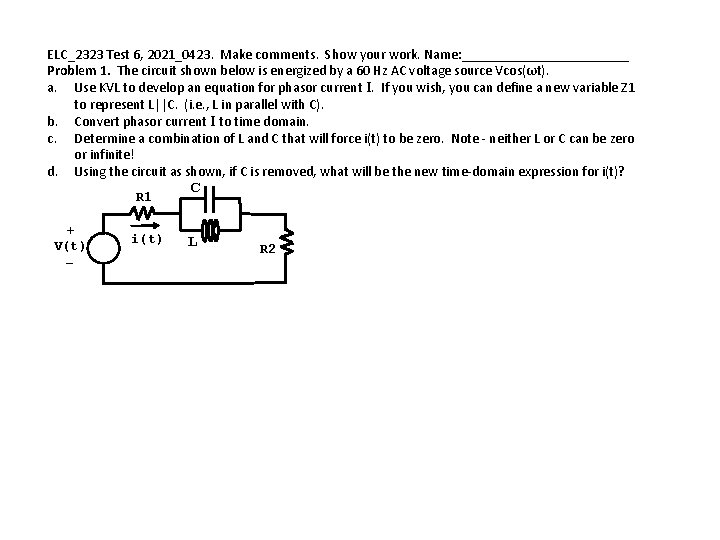
ELC_2323 Test 6, 2021_0423. Make comments. Show your work. Name: ____________ Problem 1. The circuit shown below is energized by a 60 Hz AC voltage source Vcos(ωt). a. Use KVL to develop an equation for phasor current I. If you wish, you can define a new variable Z 1 to represent L||C. (i. e. , L in parallel with C). b. Convert phasor current I to time domain. c. Determine a combination of L and C that will force i(t) to be zero. Note - neither L or C can be zero or infinite! d. Using the circuit as shown, if C is removed, what will be the new time-domain expression for i(t)? R 1 + V(t) − i(t) C L R 2