
ELASTICITY Elasticity is the concept economists use to




- Slides: 24
ELASTICITY Elasticity is the concept economists use to describe the steepness or flatness of curves or functions. In general, elasticity measures the responsiveness of one variable to changes in another variable. Elasticity
PRICE ELASTICITY OF DEMAND Measures the responsiveness of quantity demanded to changes in a good’s own price. The price elasticity of demand is the percent change in quantity demanded divided by the percent change in price that caused the change in quantity demanded. Elasticity
LOTS OF ELASTICITIES! THERE ARE LOTS OF WAYS TO COMPUTE ELASTICITIES. SO BEWARE! THE DEVIL IS IN THE DETAILS. MOST OF THE AMBIGUITY IS DUE TO THE MANY WAYS YOU CAN COMPUTE A PERCENTAGE CHANGE. BE ALERT HERE. IT’S NOT DIFFICULT, BUT CARE IS NEEDED. Elasticity
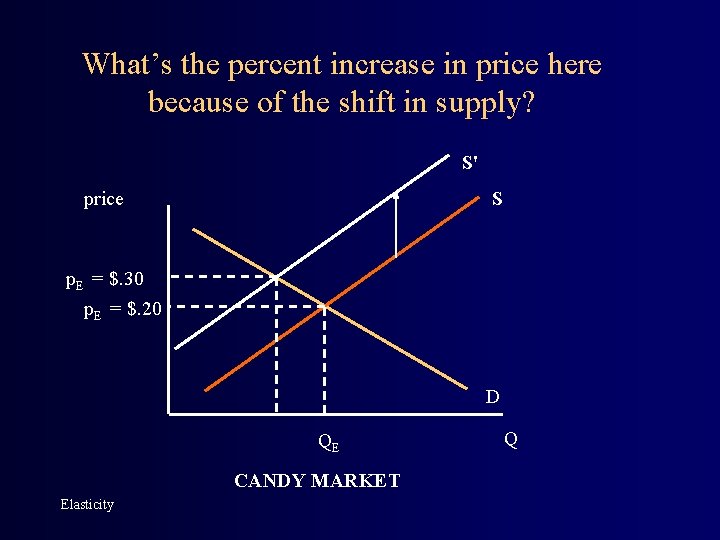
What’s the percent increase in price here because of the shift in supply? S' price S p. E = $. 30 p. E = $. 20 D QE CANDY MARKET Elasticity Q
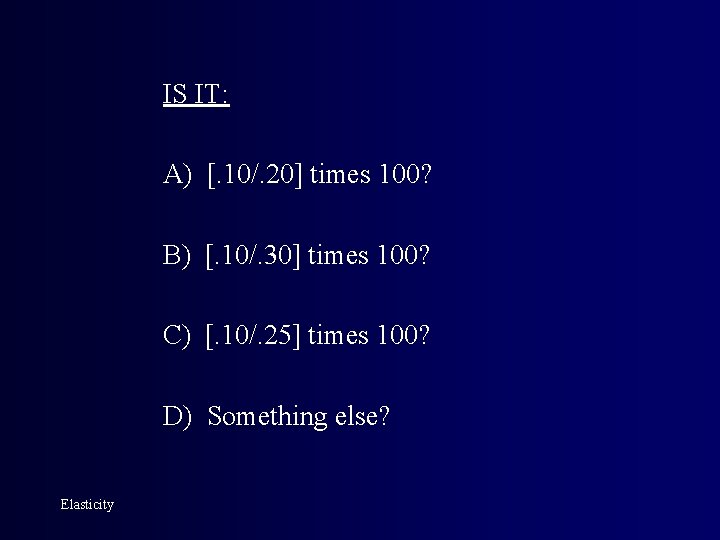
IS IT: A) [. 10/. 20] times 100? B) [. 10/. 30] times 100? C) [. 10/. 25] times 100? D) Something else? Elasticity
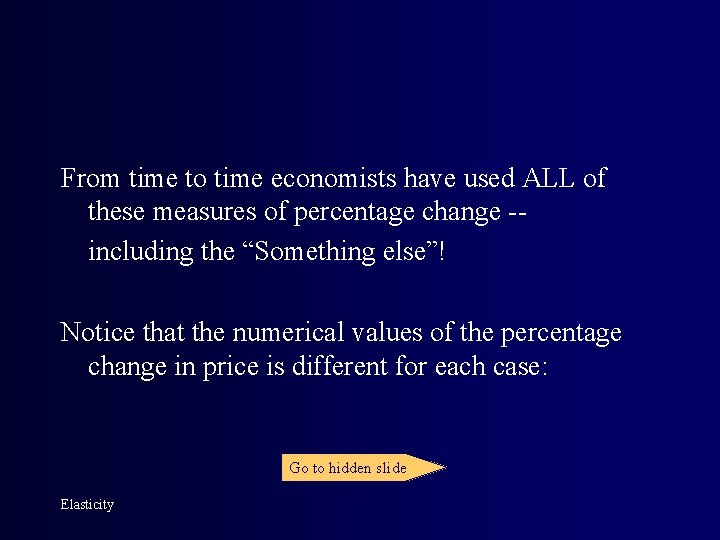
From time to time economists have used ALL of these measures of percentage change -including the “Something else”! Notice that the numerical values of the percentage change in price is different for each case: Go to hidden slide Elasticity
Economists usually use the “midpoint” formula (option C), above) to compute elasticity in cases like this in order to eliminate the ambiguity that arises if we don’t know whether price increased or decreased. Elasticity
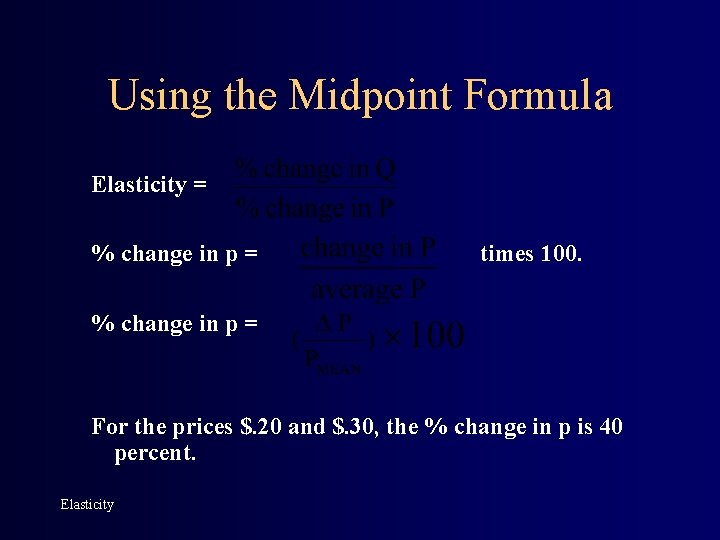
Using the Midpoint Formula Elasticity = % change in p = times 100. % change in p = For the prices $. 20 and $. 30, the % change in p is 40 percent. Elasticity
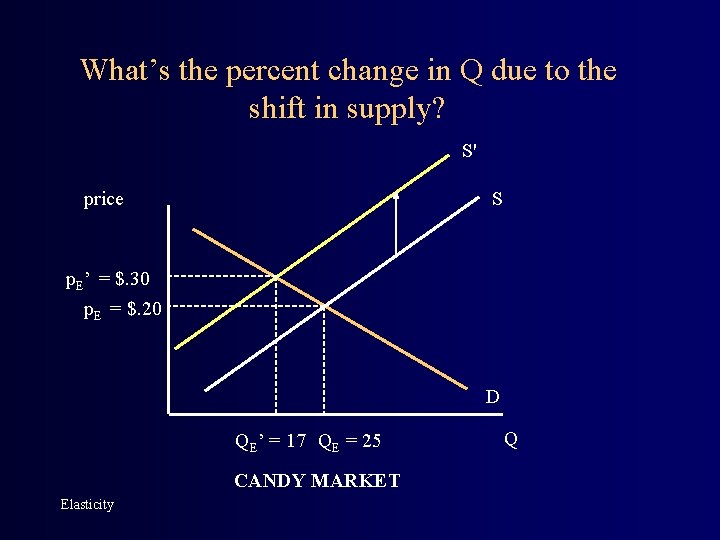
What’s the percent change in Q due to the shift in supply? S' price S p. E’ = $. 30 p. E = $. 20 D QE’ = 17 QE = 25 CANDY MARKET Elasticity Q
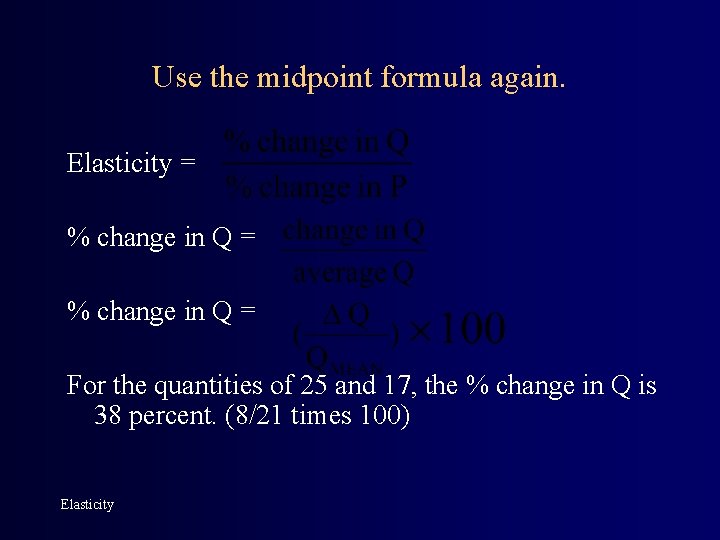
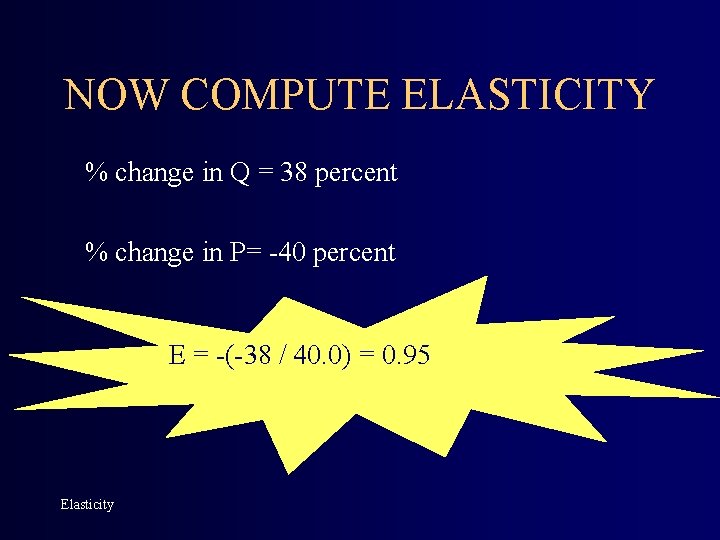
Use the midpoint formula again. Elasticity = % change in Q = For the quantities of 25 and 17, the % change in Q is 38 percent. (8/21 times 100) Elasticity
NOW COMPUTE ELASTICITY % change in Q = 38 percent % change in P= -40 percent E = -(-38 / 40. 0) = 0. 95 Elasticity
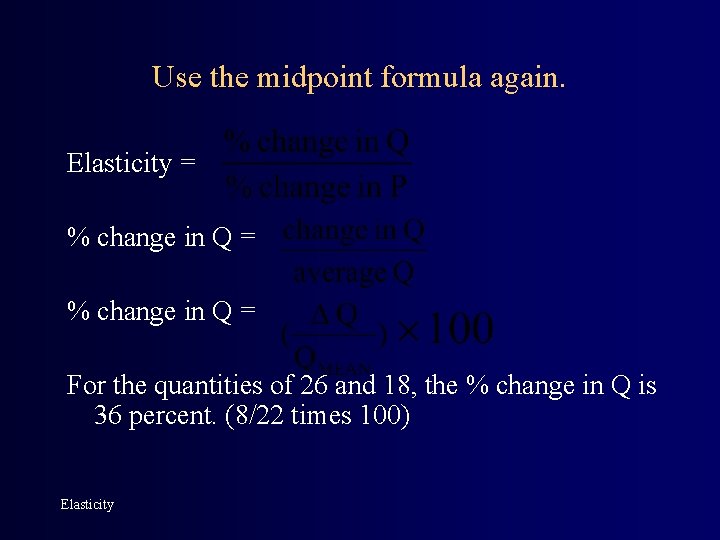
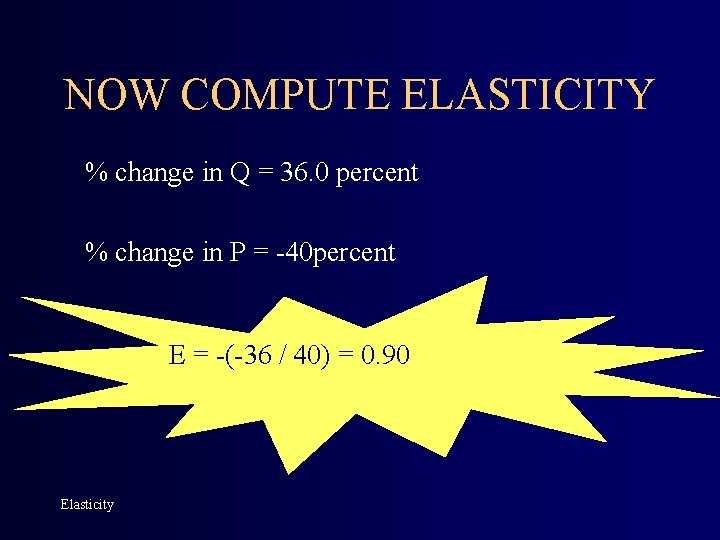
Use the midpoint formula again. Elasticity = % change in Q = For the quantities of 26 and 18, the % change in Q is 36 percent. (8/22 times 100) Elasticity
NOW COMPUTE ELASTICITY % change in Q = 36. 0 percent % change in P = -40 percent E = -(-36 / 40) = 0. 90 Elasticity
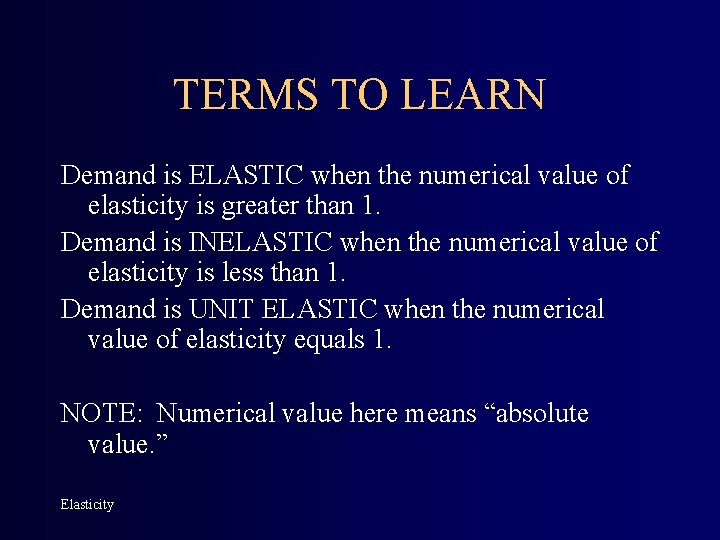
TERMS TO LEARN Demand is ELASTIC when the numerical value of elasticity is greater than 1. Demand is INELASTIC when the numerical value of elasticity is less than 1. Demand is UNIT ELASTIC when the numerical value of elasticity equals 1. NOTE: Numerical value here means “absolute value. ” Elasticity
FACTS ABOUT ELASTICITY It’s always a ratio of percentage changes. That means it is a pure number -- there are no units of measurement on elasticity. Price elasticity of demand is computed along a demand curve. Elasticity is not the same as slope. Elasticity
DETERMINANTS OF DEMAND ELASTICITY The more substitutes there available for a good, the more elastic the demand for it will tend to be. [Related to the idea of necessities and luxuries. Necessities tend to have few substitutes. ] The smaller (narrower) the market boundaries, the more elastic the demand will tend to be. The longer the time period involved, the more elastic the demand will tend to be. Elasticity
OTHER ELASTICITY MEASURES In principle, you can compute the elasticity between any two variables. Income elasticity of demand Cross price elasticity of demand Elasticity of supply Elasticity
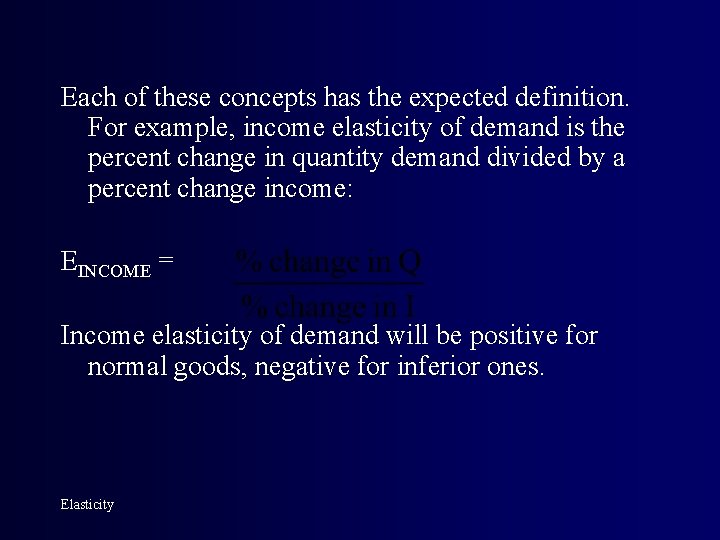
Each of these concepts has the expected definition. For example, income elasticity of demand is the percent change in quantity demand divided by a percent change income: EINCOME = Income elasticity of demand will be positive for normal goods, negative for inferior ones. Elasticity
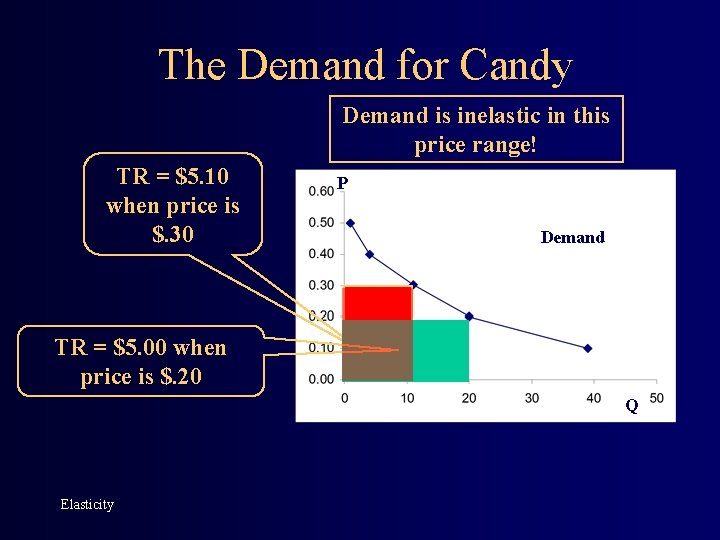
There is an important relationship between what happens to consumers’ spending on a good and elasticity when there is a change in price. Spending on a good = P Q. Because demand curves are negatively sloped, a reduction in P causes Q to rise and the net effect on PQ is uncertain, and depends on the elasticity of demand. Elasticity
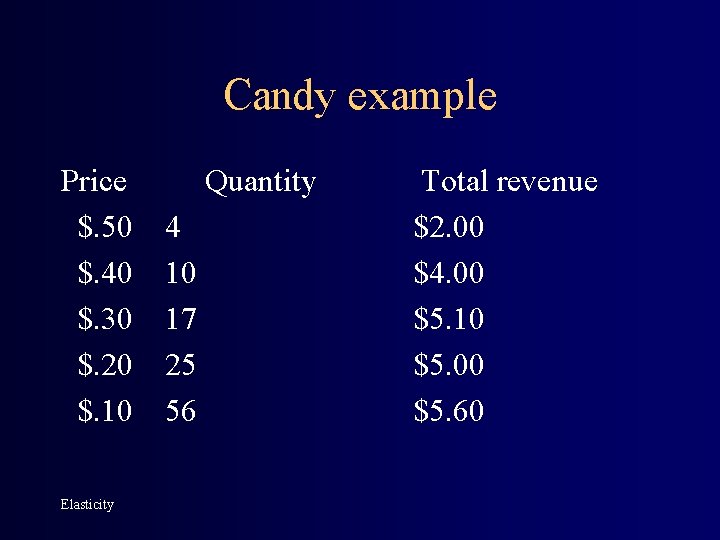
Candy example Price $. 50 $. 40 $. 30 $. 20 $. 10 Elasticity Quantity 4 10 17 25 56 Total revenue $2. 00 $4. 00 $5. 10 $5. 00 $5. 60
The Demand for Candy Demand is inelastic in this price range! TR = $5. 10 when price is $. 30 P Demand TR = $5. 00 when price is $. 20 Q Elasticity
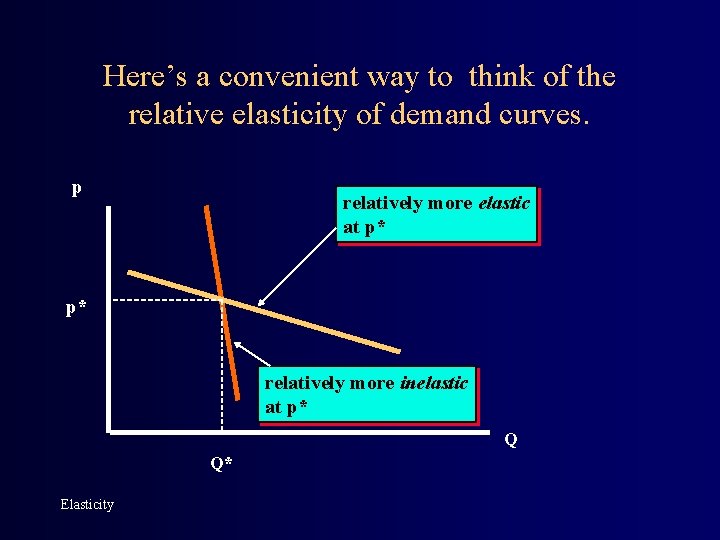
Here’s a convenient way to think of the relative elasticity of demand curves. p relatively more elastic at p* p* relatively more inelastic at p* Q Q* Elasticity
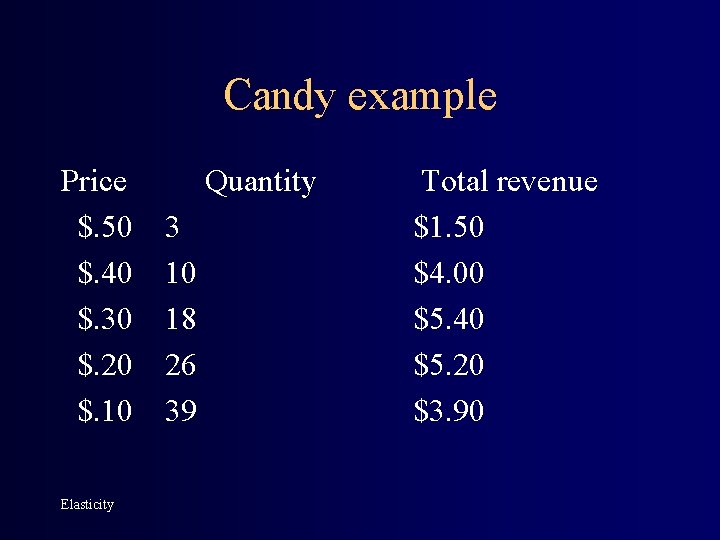
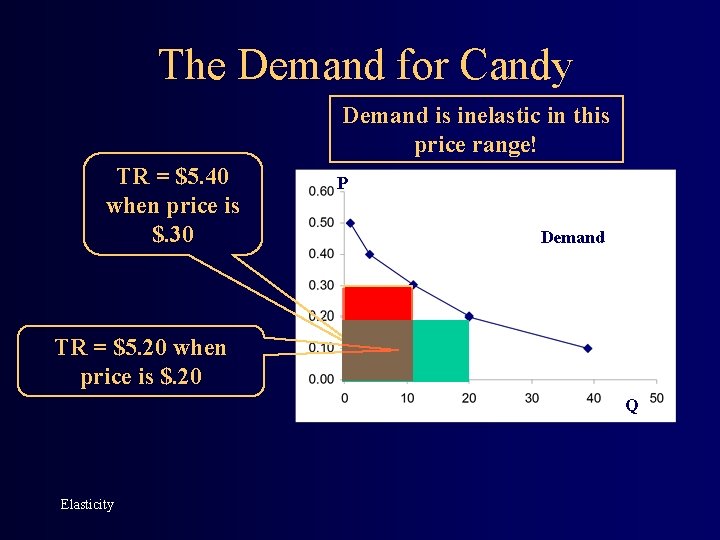
Candy example Price $. 50 $. 40 $. 30 $. 20 $. 10 Elasticity Quantity 3 10 18 26 39 Total revenue $1. 50 $4. 00 $5. 40 $5. 20 $3. 90
The Demand for Candy Demand is inelastic in this price range! TR = $5. 40 when price is $. 30 P Demand TR = $5. 20 when price is $. 20 Q Elasticity