
Elastic Springs Robert Hooke found that the extension
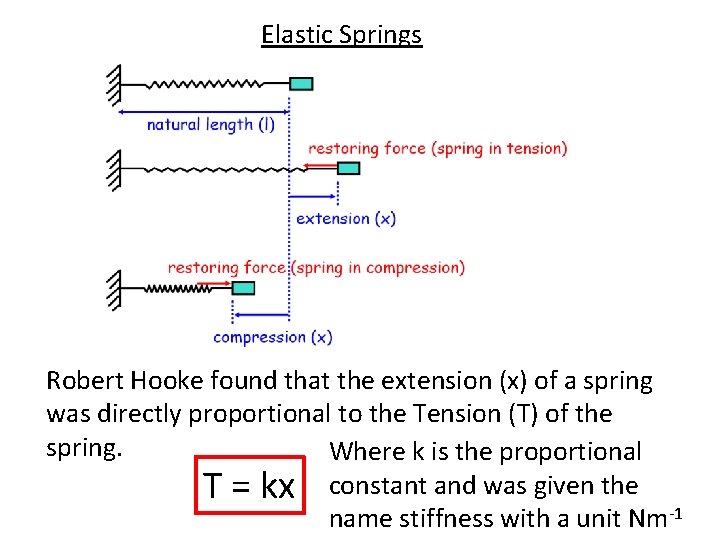
Elastic Springs Robert Hooke found that the extension (x) of a spring was directly proportional to the Tension (T) of the spring. Where k is the proportional T = kx constant and was given the name stiffness with a unit Nm-1
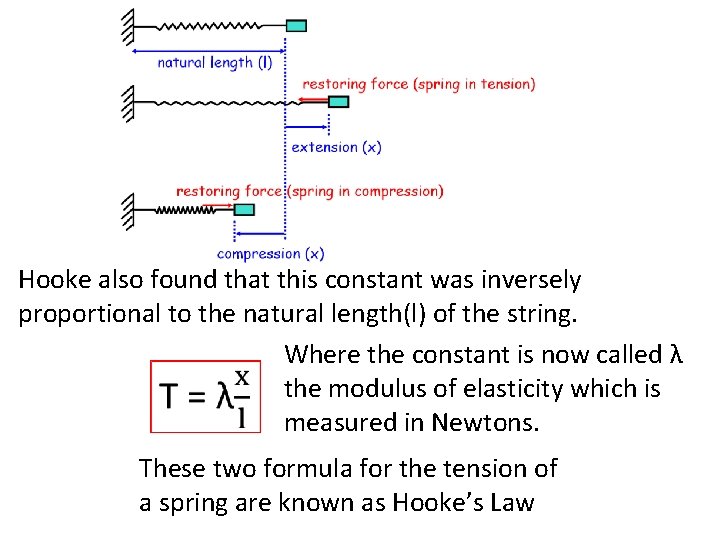
Hooke also found that this constant was inversely proportional to the natural length(l) of the string. Where the constant is now called λ the modulus of elasticity which is measured in Newtons. These two formula for the tension of a spring are known as Hooke’s Law
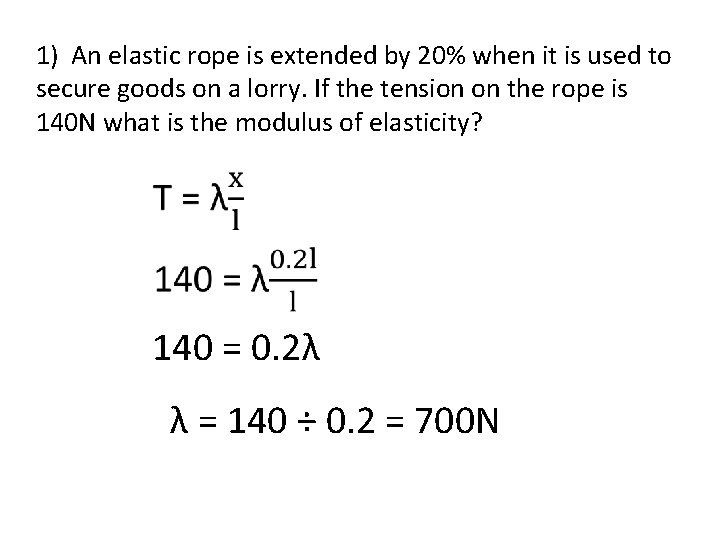
1) An elastic rope is extended by 20% when it is used to secure goods on a lorry. If the tension on the rope is 140 N what is the modulus of elasticity? 140 = 0. 2λ λ = 140 ÷ 0. 2 = 700 N
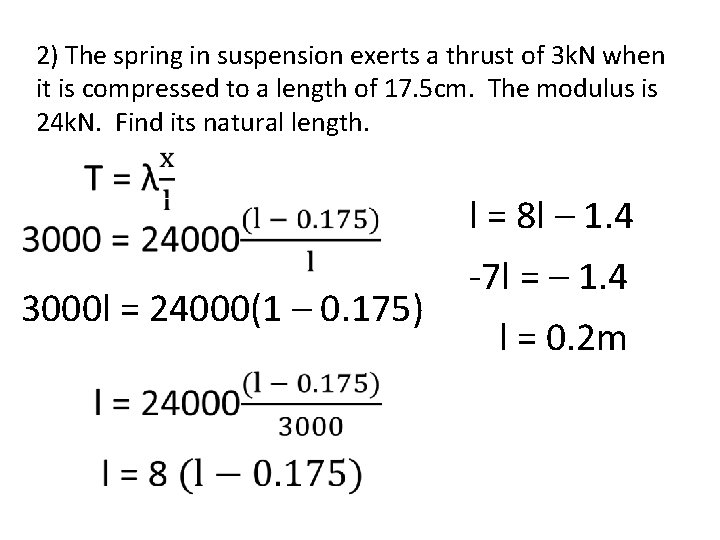
2) The spring in suspension exerts a thrust of 3 k. N when it is compressed to a length of 17. 5 cm. The modulus is 24 k. N. Find its natural length. l = 8 l – 1. 4 3000 l = 24000(1 – 0. 175) -7 l = – 1. 4 l = 0. 2 m
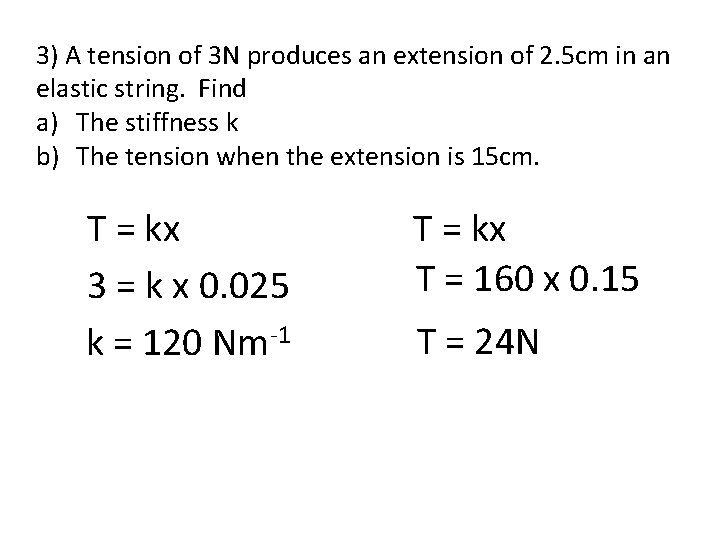
3) A tension of 3 N produces an extension of 2. 5 cm in an elastic string. Find a) The stiffness k b) The tension when the extension is 15 cm. T = kx 3 = k x 0. 025 k = 120 Nm-1 T = kx T = 160 x 0. 15 T = 24 N
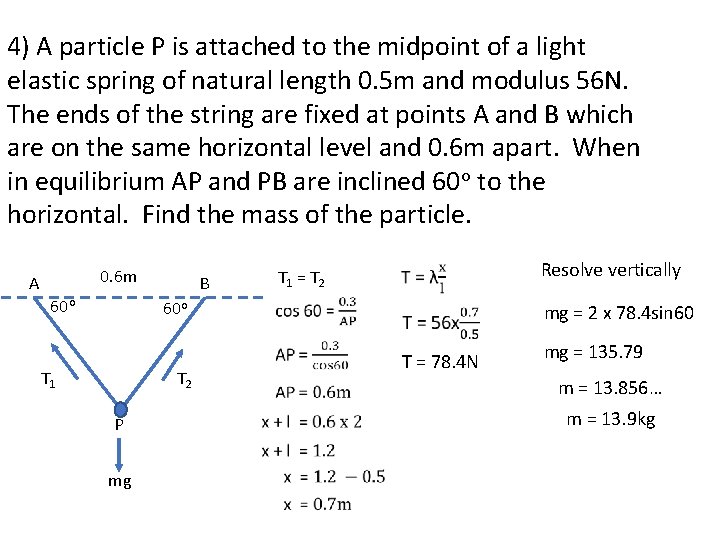
4) A particle P is attached to the midpoint of a light elastic spring of natural length 0. 5 m and modulus 56 N. The ends of the string are fixed at points A and B which are on the same horizontal level and 0. 6 m apart. When in equilibrium AP and PB are inclined 60 o to the horizontal. Find the mass of the particle. 0. 6 m A 60 o B Resolve vertically T 1 = T 2 60 o T 1 T 2 P mg mg = 2 x 78. 4 sin 60 T = 78. 4 N mg = 135. 79 m = 13. 856… m = 13. 9 kg
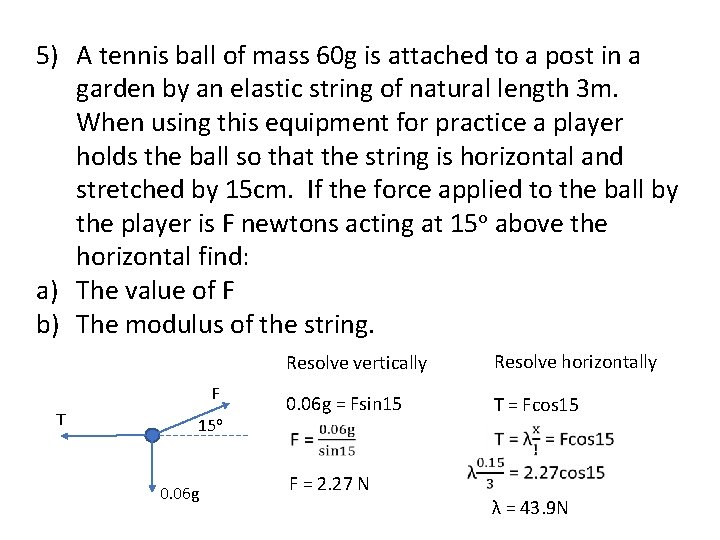
5) A tennis ball of mass 60 g is attached to a post in a garden by an elastic string of natural length 3 m. When using this equipment for practice a player holds the ball so that the string is horizontal and stretched by 15 cm. If the force applied to the ball by the player is F newtons acting at 15 o above the horizontal find: a) The value of F b) The modulus of the string. F T 15 o 0. 06 g Resolve vertically Resolve horizontally 0. 06 g = Fsin 15 T = Fcos 15 F = 2. 27 N λ = 43. 9 N
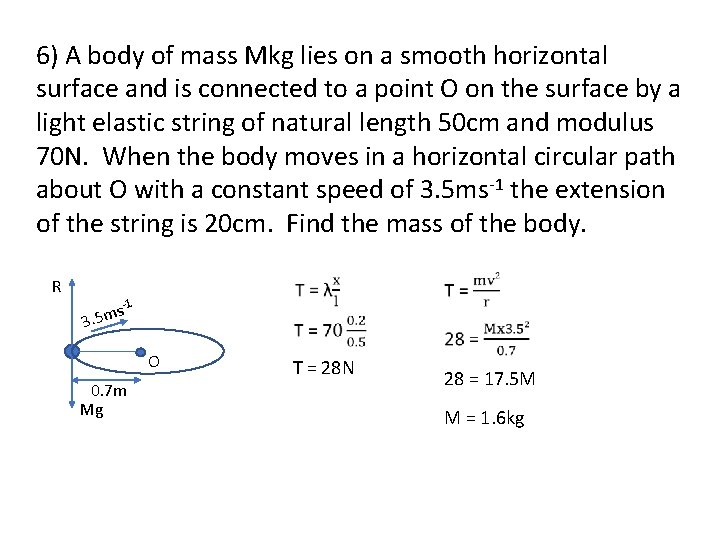
6) A body of mass Mkg lies on a smooth horizontal surface and is connected to a point O on the surface by a light elastic string of natural length 50 cm and modulus 70 N. When the body moves in a horizontal circular path about O with a constant speed of 3. 5 ms-1 the extension of the string is 20 cm. Find the mass of the body. R -1 s 3. 5 m O 0. 7 m Mg T = 28 N 28 = 17. 5 M M = 1. 6 kg
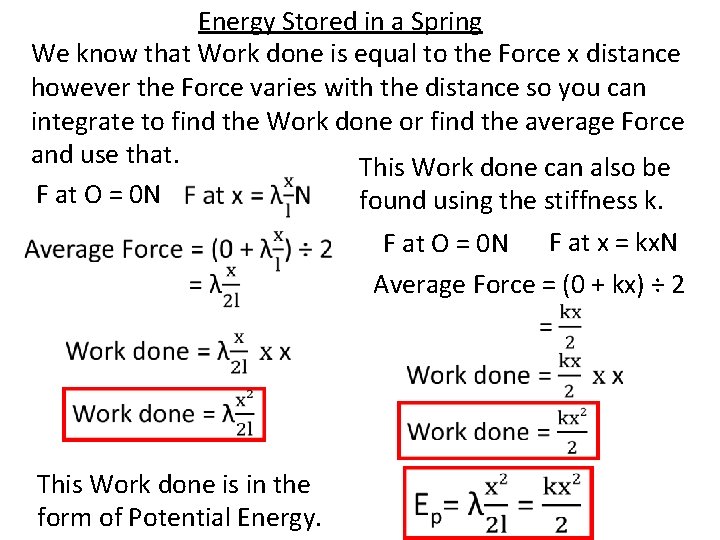
Energy Stored in a Spring We know that Work done is equal to the Force x distance however the Force varies with the distance so you can integrate to find the Work done or find the average Force and use that. This Work done can also be F at O = 0 N found using the stiffness k. F at O = 0 N F at x = kx. N Average Force = (0 + kx) ÷ 2 This Work done is in the form of Potential Energy.
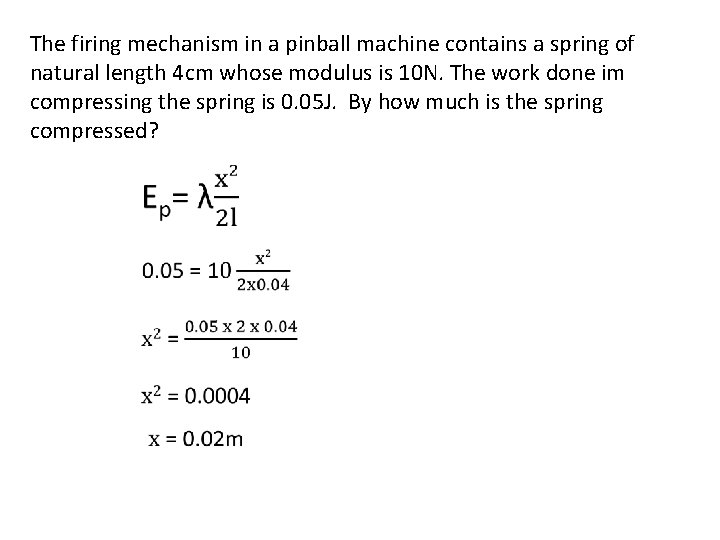
The firing mechanism in a pinball machine contains a spring of natural length 4 cm whose modulus is 10 N. The work done im compressing the spring is 0. 05 J. By how much is the spring compressed?
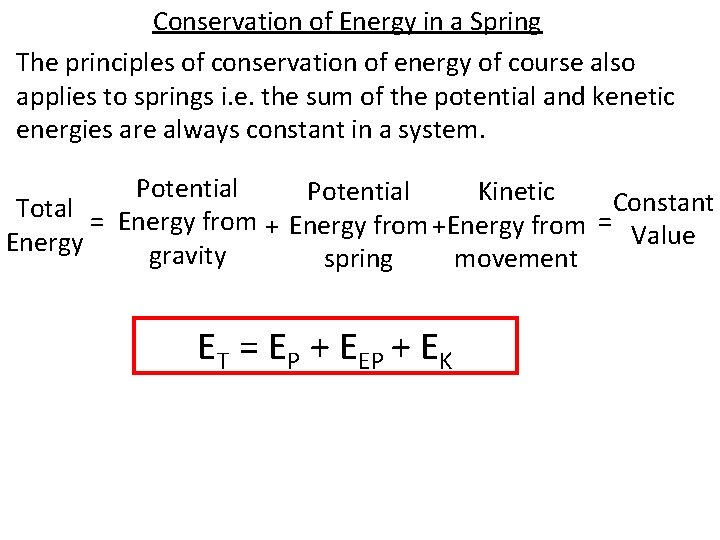
Conservation of Energy in a Spring The principles of conservation of energy of course also applies to springs i. e. the sum of the potential and kenetic energies are always constant in a system. Potential Kinetic Constant Total = Energy from + Energy from = Value Energy gravity spring movement ET = EP + EK
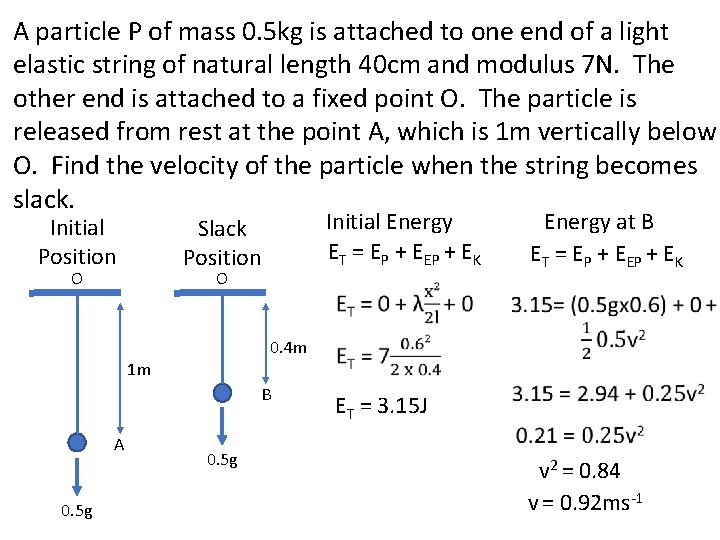
A particle P of mass 0. 5 kg is attached to one end of a light elastic string of natural length 40 cm and modulus 7 N. The other end is attached to a fixed point O. The particle is released from rest at the point A, which is 1 m vertically below O. Find the velocity of the particle when the string becomes slack. Initial Position Initial Energy ET = EP + EK Slack Position O O 0. 4 m 1 m B A 0. 5 g Energy at B ET = EP + EK 0. 5 g ET = 3. 15 J v 2 = 0. 84 v = 0. 92 ms-1
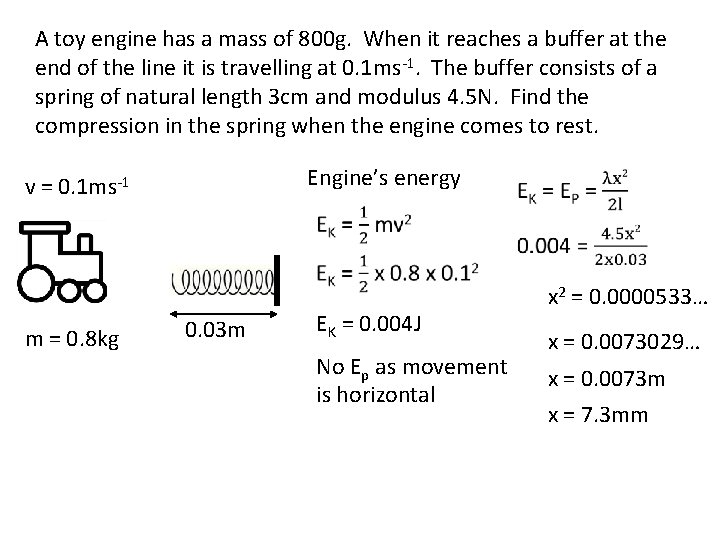
A toy engine has a mass of 800 g. When it reaches a buffer at the end of the line it is travelling at 0. 1 ms-1. The buffer consists of a spring of natural length 3 cm and modulus 4. 5 N. Find the compression in the spring when the engine comes to rest. Engine’s energy v = 0. 1 ms-1 m = 0. 8 kg 0. 03 m EK = 0. 004 J No Ep as movement is horizontal x 2 = 0. 0000533… x = 0. 0073029… x = 0. 0073 m x = 7. 3 mm
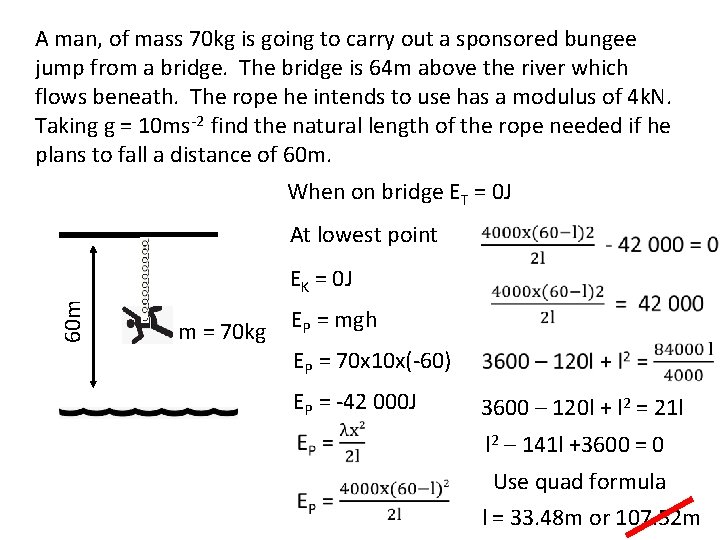
A man, of mass 70 kg is going to carry out a sponsored bungee jump from a bridge. The bridge is 64 m above the river which flows beneath. The rope he intends to use has a modulus of 4 k. N. Taking g = 10 ms-2 find the natural length of the rope needed if he plans to fall a distance of 60 m. When on bridge ET = 0 J At lowest point 60 m EK = 0 J m = 70 kg EP = mgh EP = 70 x 10 x(-60) EP = -42 000 J 3600 – 120 l + l 2 = 21 l l 2 – 141 l +3600 = 0 Use quad formula l = 33. 48 m or 107. 52 m
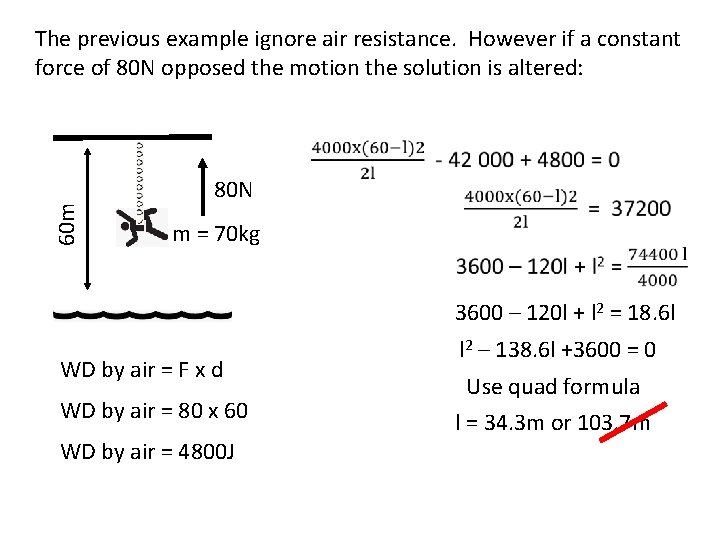
60 m The previous example ignore air resistance. However if a constant force of 80 N opposed the motion the solution is altered: 80 N m = 70 kg 3600 – 120 l + l 2 = 18. 6 l WD by air = F x d WD by air = 80 x 60 WD by air = 4800 J l 2 – 138. 6 l +3600 = 0 Use quad formula l = 34. 3 m or 103. 7 m
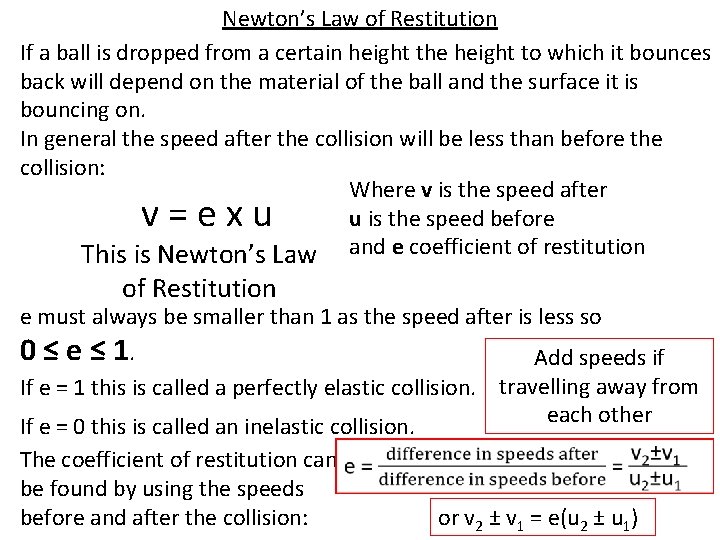
Newton’s Law of Restitution If a ball is dropped from a certain height the height to which it bounces back will depend on the material of the ball and the surface it is bouncing on. In general the speed after the collision will be less than before the collision: Where v is the speed after u is the speed before This is Newton’s Law and e coefficient of restitution v=exu of Restitution e must always be smaller than 1 as the speed after is less so 0 ≤ e ≤ 1. Add speeds if If e = 1 this is called a perfectly elastic collision. travelling away from each other If e = 0 this is called an inelastic collision. The coefficient of restitution can be found by using the speeds before and after the collision: or v 2 ± v 1 = e(u 2 ± u 1)
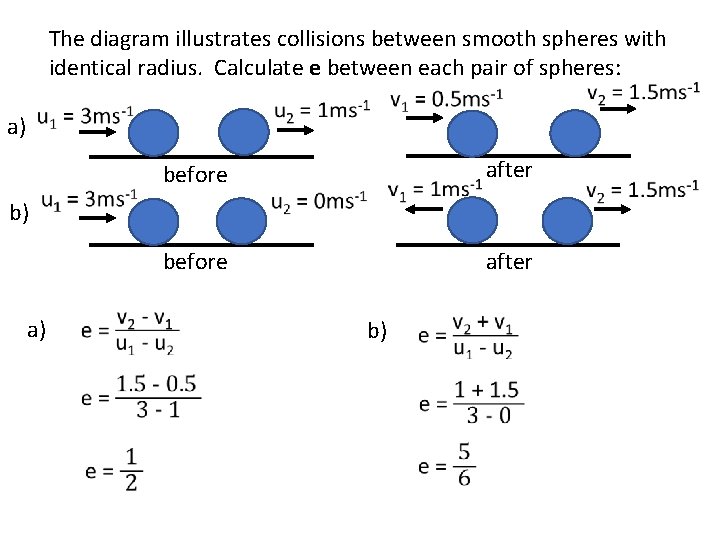
The diagram illustrates collisions between smooth spheres with identical radius. Calculate e between each pair of spheres: a) before after b) a) b)
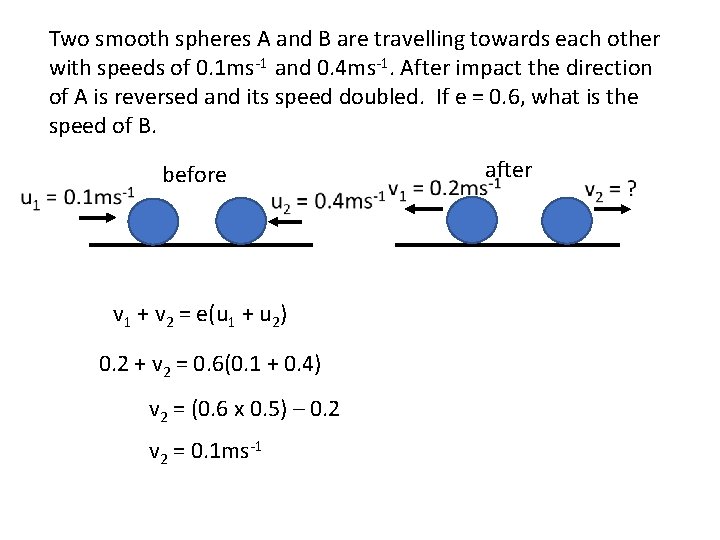
Two smooth spheres A and B are travelling towards each other with speeds of 0. 1 ms-1 and 0. 4 ms-1. After impact the direction of A is reversed and its speed doubled. If e = 0. 6, what is the speed of B. before v 1 + v 2 = e(u 1 + u 2) 0. 2 + v 2 = 0. 6(0. 1 + 0. 4) v 2 = (0. 6 x 0. 5) – 0. 2 v 2 = 0. 1 ms-1 after
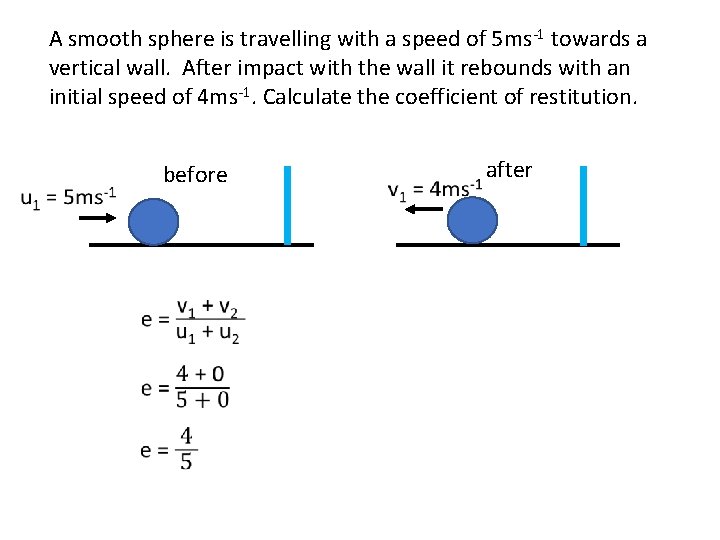
A smooth sphere is travelling with a speed of 5 ms-1 towards a vertical wall. After impact with the wall it rebounds with an initial speed of 4 ms-1. Calculate the coefficient of restitution. before after
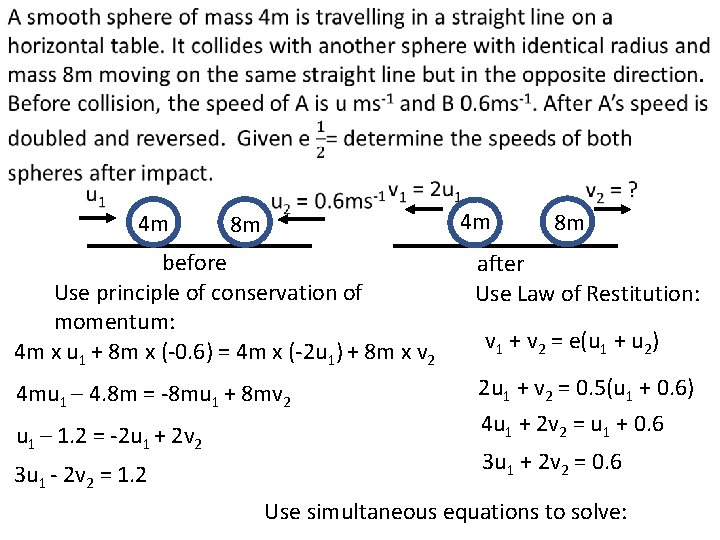
4 m 4 m 8 m 8 m before Use principle of conservation of momentum: 4 m x u 1 + 8 m x (-0. 6) = 4 m x (-2 u 1) + 8 m x v 2 after Use Law of Restitution: 4 mu 1 – 4. 8 m = -8 mu 1 + 8 mv 2 2 u 1 + v 2 = 0. 5(u 1 + 0. 6) u 1 – 1. 2 = -2 u 1 + 2 v 2 3 u 1 - 2 v 2 = 1. 2 v 1 + v 2 = e(u 1 + u 2) 4 u 1 + 2 v 2 = u 1 + 0. 6 3 u 1 + 2 v 2 = 0. 6 Use simultaneous equations to solve:
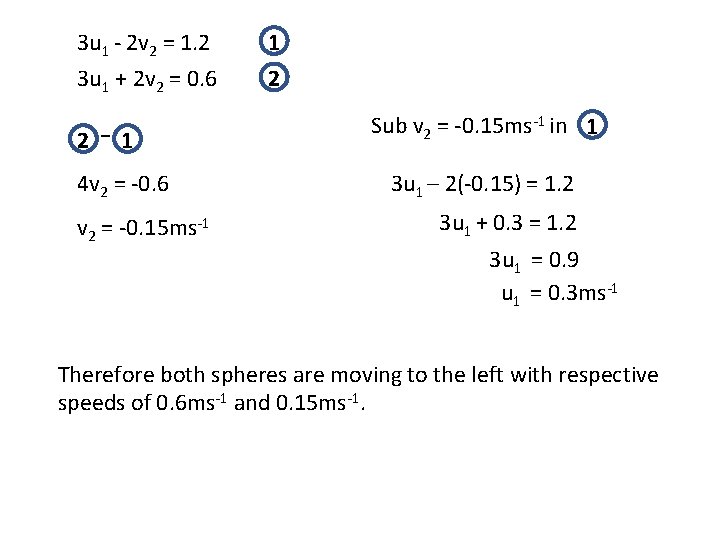
3 u 1 - 2 v 2 = 1. 2 1 3 u 1 + 2 v 2 = 0. 6 2 -1 Sub v 2 = -0. 15 ms-1 in 1 4 v 2 = -0. 6 3 u 1 – 2(-0. 15) = 1. 2 2 v 2 = -0. 15 ms-1 3 u 1 + 0. 3 = 1. 2 3 u 1 = 0. 9 u 1 = 0. 3 ms-1 Therefore both spheres are moving to the left with respective speeds of 0. 6 ms-1 and 0. 15 ms-1.
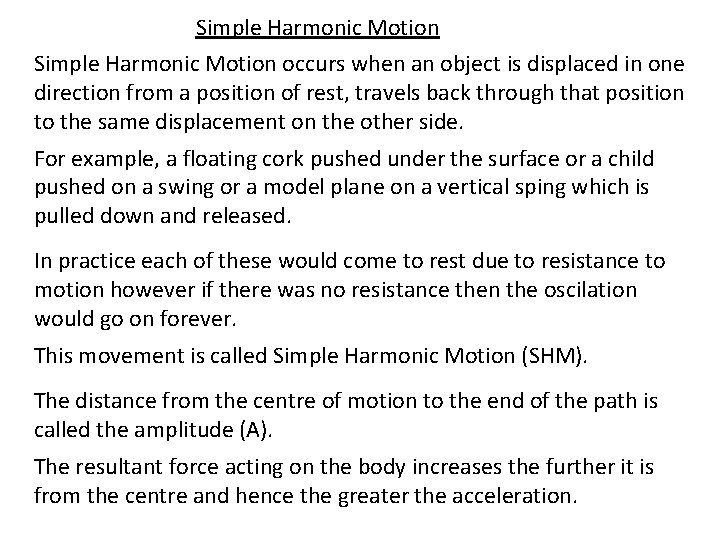
Simple Harmonic Motion occurs when an object is displaced in one direction from a position of rest, travels back through that position to the same displacement on the other side. For example, a floating cork pushed under the surface or a child pushed on a swing or a model plane on a vertical sping which is pulled down and released. In practice each of these would come to rest due to resistance to motion however if there was no resistance then the oscilation would go on forever. This movement is called Simple Harmonic Motion (SHM). The distance from the centre of motion to the end of the path is called the amplitude (A). The resultant force acting on the body increases the further it is from the centre and hence the greater the acceleration.
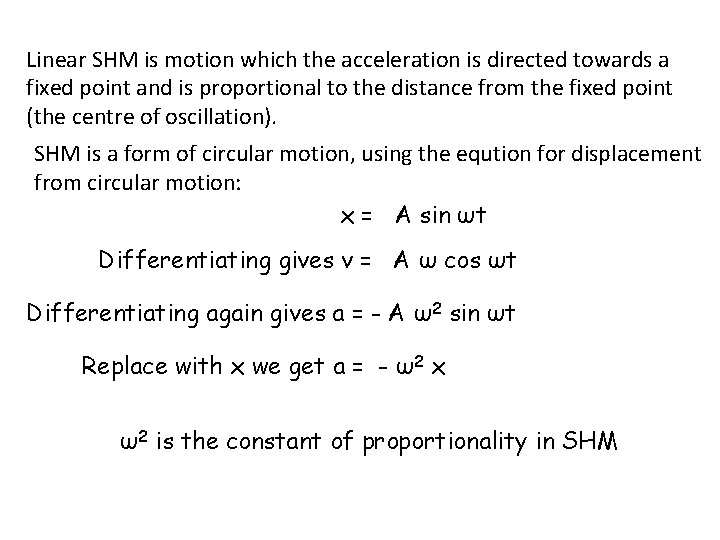
Linear SHM is motion which the acceleration is directed towards a fixed point and is proportional to the distance from the fixed point (the centre of oscillation). SHM is a form of circular motion, using the eqution for displacement from circular motion: x = A sin ωt Differentiating gives v = A ω cos ωt Differentiating again gives a = - A ω2 sin ωt Replace with x we get a = - ω2 x ω2 is the constant of proportionality in SHM
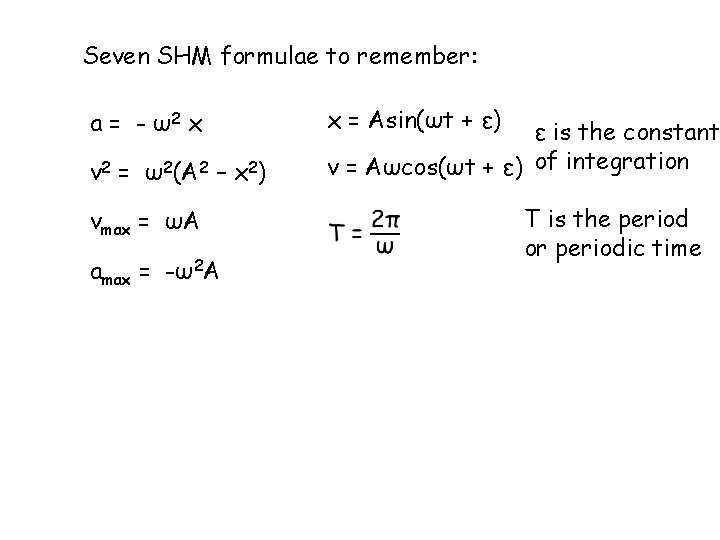
Seven SHM formulae to remember: a = - ω2 x v 2 = ω2(A 2 – x 2) vmax = ωA amax = -ω2 A x = Asin(ωt + ε) ε is the constant v = Aωcos(ωt + ε) of integration T is the period or periodic time
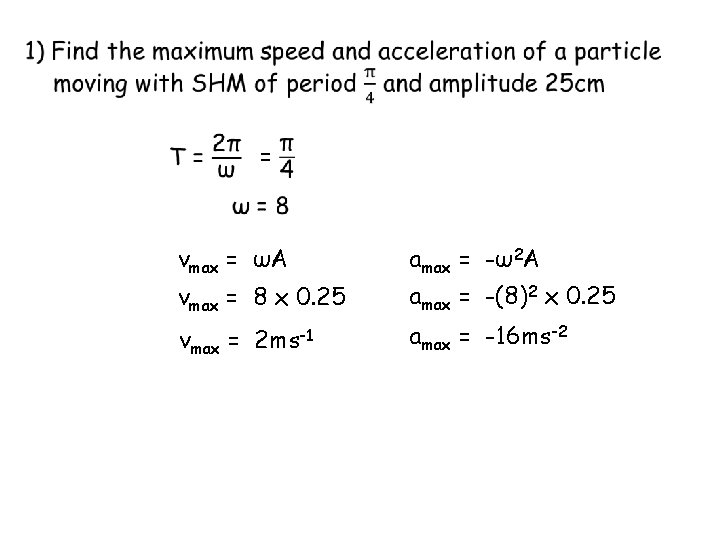
vmax = ωA amax = -ω2 A vmax = 8 x 0. 25 amax = -(8)2 x 0. 25 vmax = 2 ms-1 amax = -16 ms-2
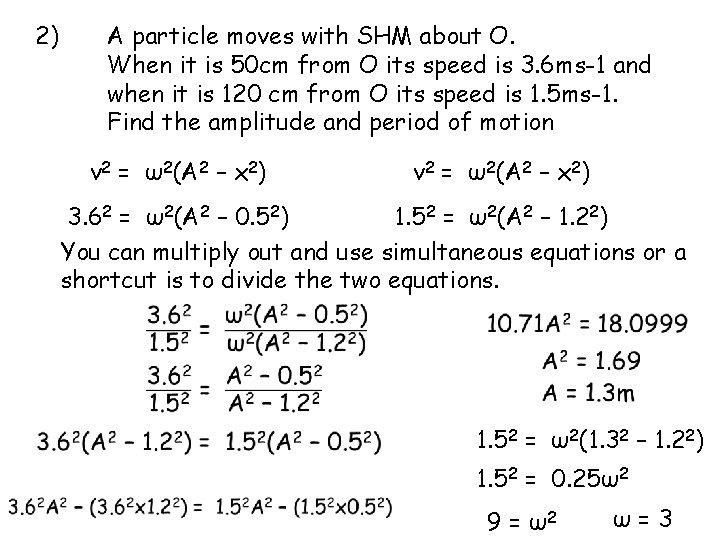
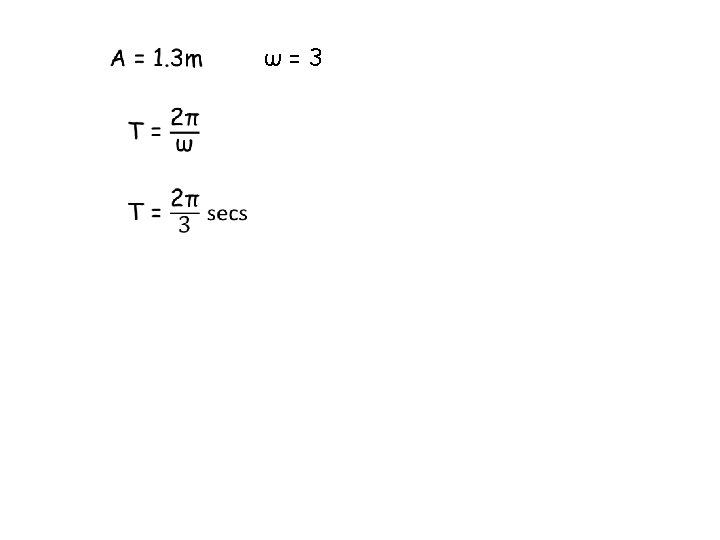
2) A particle moves with SHM about O. When it is 50 cm from O its speed is 3. 6 ms-1 and when it is 120 cm from O its speed is 1. 5 ms-1. Find the amplitude and period of motion v 2 = ω2(A 2 – x 2) 3. 62 = ω2(A 2 – 0. 52) 1. 52 = ω2(A 2 – 1. 22) You can multiply out and use simultaneous equations or a shortcut is to divide the two equations. 1. 52 = ω2(1. 32 – 1. 22) 1. 52 = 0. 25ω2 9 = ω2 ω=3
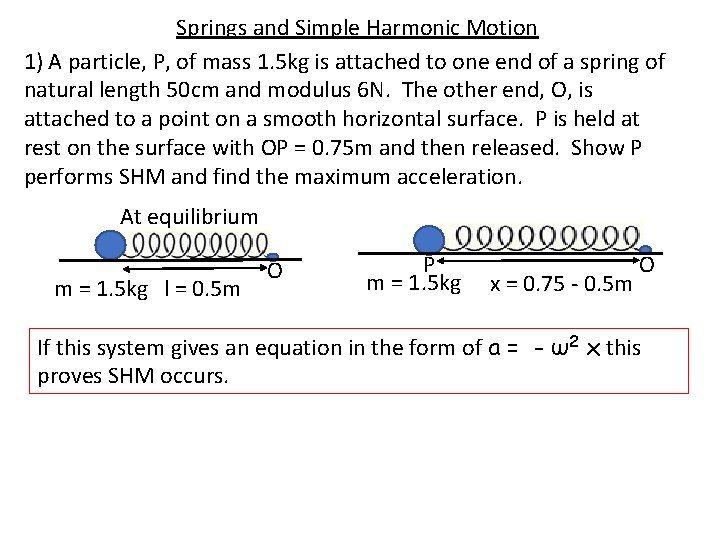
Springs and Simple Harmonic Motion 1) A particle, P, of mass 1. 5 kg is attached to one end of a spring of natural length 50 cm and modulus 6 N. The other end, O, is attached to a point on a smooth horizontal surface. P is held at rest on the surface with OP = 0. 75 m and then released. Show P performs SHM and find the maximum acceleration. At equilibrium m = 1. 5 kg l = 0. 5 m O P m = 1. 5 kg x = 0. 75 - 0. 5 m O If this system gives an equation in the form of a = - ω2 x this proves SHM occurs.
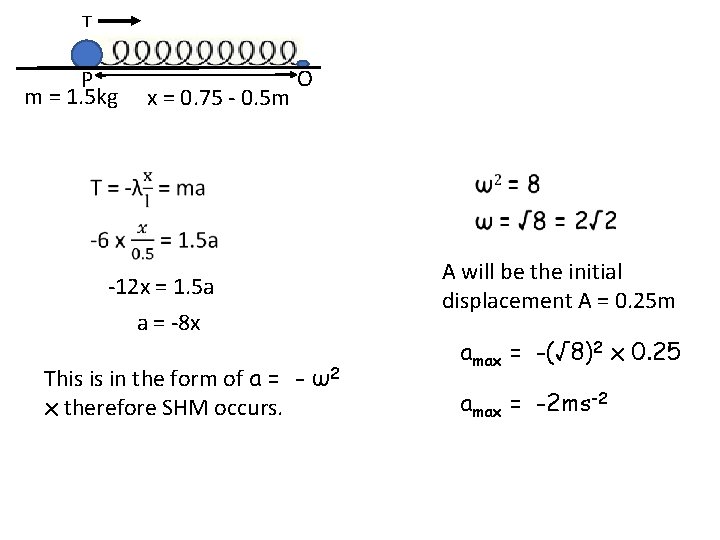
T P m = 1. 5 kg x = 0. 75 - 0. 5 m O -12 x = 1. 5 a a = -8 x This is in the form of a = - ω2 x therefore SHM occurs. A will be the initial displacement A = 0. 25 m amax = -(√ 8)2 x 0. 25 amax = -2 ms-2
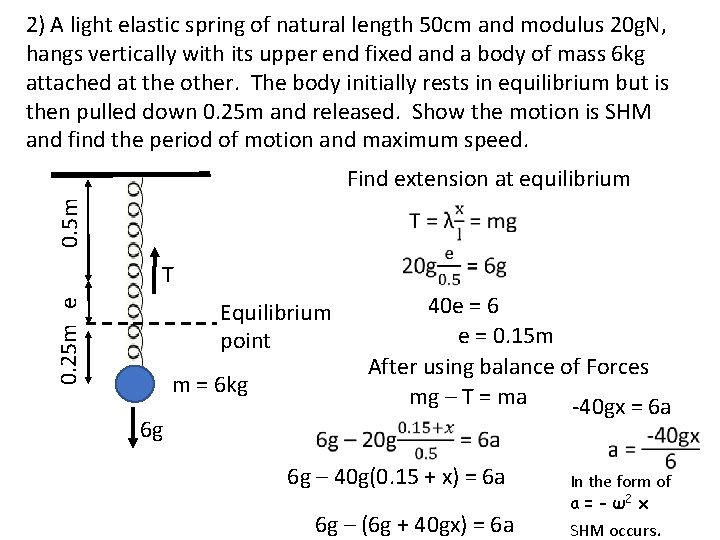
2) A light elastic spring of natural length 50 cm and modulus 20 g. N, hangs vertically with its upper end fixed and a body of mass 6 kg attached at the other. The body initially rests in equilibrium but is then pulled down 0. 25 m and released. Show the motion is SHM and find the period of motion and maximum speed. 0. 5 m Find extension at equilibrium T 0. 25 m e Equilibrium point m = 6 kg 6 g 40 e = 6 e = 0. 15 m After using balance of Forces mg – T = ma -40 gx = 6 a 6 g – 40 g(0. 15 + x) = 6 a 6 g – (6 g + 40 gx) = 6 a In the form of a = - ω2 x SHM occurs.
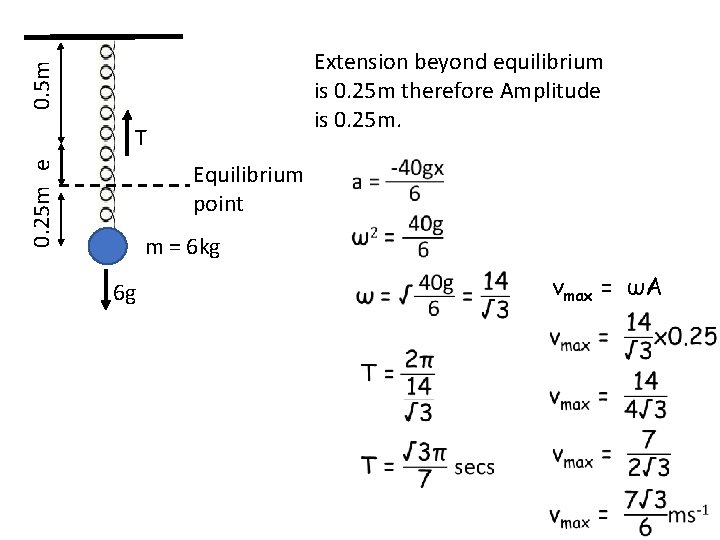
0. 5 m Extension beyond equilibrium is 0. 25 m therefore Amplitude is 0. 25 m. T 0. 25 m e Equilibrium point m = 6 kg 6 g vmax = ωA
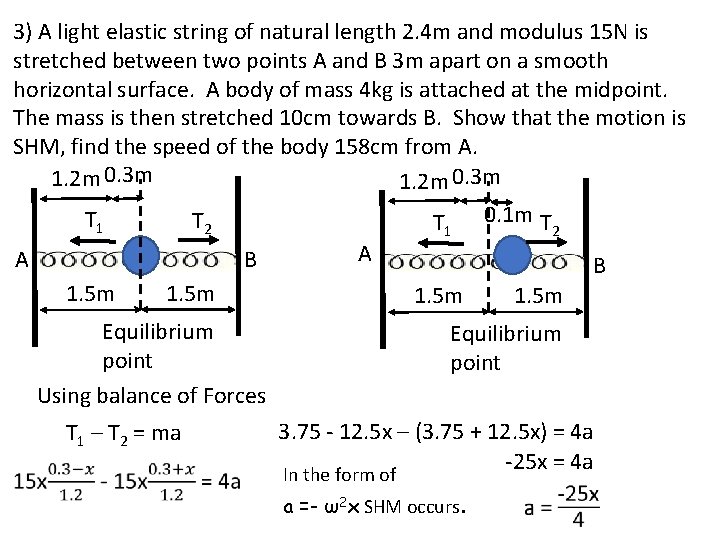
3) A light elastic string of natural length 2. 4 m and modulus 15 N is stretched between two points A and B 3 m apart on a smooth horizontal surface. A body of mass 4 kg is attached at the midpoint. The mass is then stretched 10 cm towards B. Show that the motion is SHM, find the speed of the body 158 cm from A. 1. 2 m 0. 3 m 0. 1 m T T 1 T 2 T A B 1. 5 m A 1. 5 m 2 B 1. 5 m Equilibrium point Using balance of Forces T 1 – T 2 = ma 1 1. 5 m Equilibrium point 3. 75 - 12. 5 x – (3. 75 + 12. 5 x) = 4 a -25 x = 4 a In the form of a =- ω2 x SHM occurs.
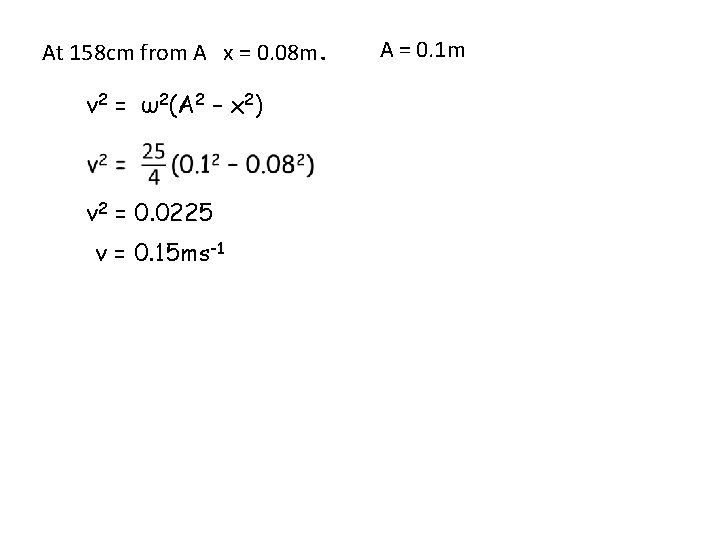
At 158 cm from A x = 0. 08 m. v 2 = ω2(A 2 – x 2) v 2 = 0. 0225 v = 0. 15 ms-1 A = 0. 1 m
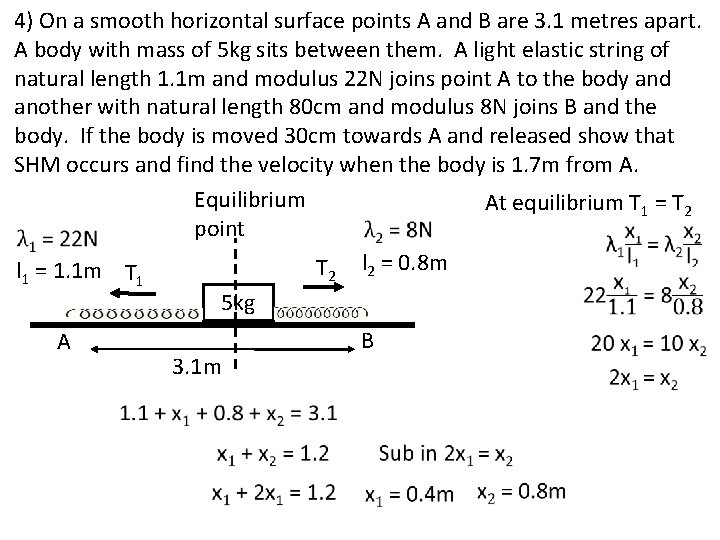
4) On a smooth horizontal surface points A and B are 3. 1 metres apart. A body with mass of 5 kg sits between them. A light elastic string of natural length 1. 1 m and modulus 22 N joins point A to the body and another with natural length 80 cm and modulus 8 N joins B and the body. If the body is moved 30 cm towards A and released show that SHM occurs and find the velocity when the body is 1. 7 m from A. Equilibrium At equilibrium T 1 = T 2 point T 2 l 2 = 0. 8 m l = 1. 1 m T 1 1 A 5 kg 3. 1 m B
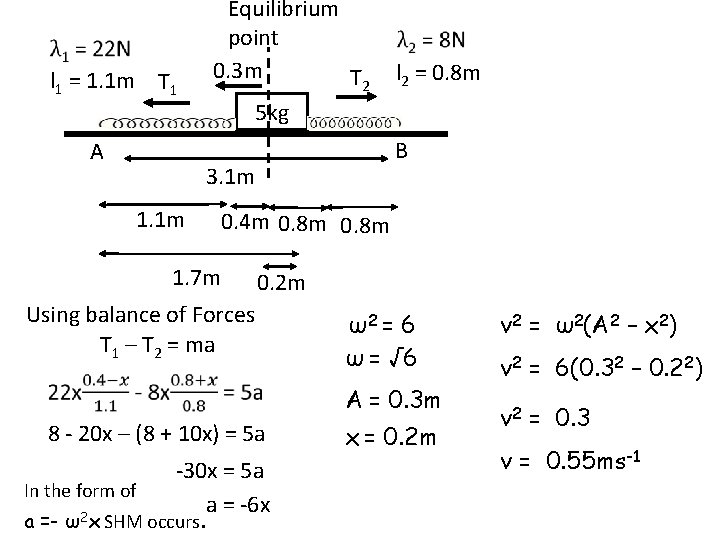
Equilibrium point 0. 3 m T 2 5 kg l 1 = 1. 1 m T 1 A B 3. 1 m 1. 1 m l 2 = 0. 8 m 0. 4 m 0. 8 m 1. 7 m 0. 2 m Using balance of Forces T 1 – T 2 = ma ω2 = 6 ω = √ 6 A = 0. 3 m 8 - 20 x – (8 + 10 x) = 5 a In the form of -30 x = 5 a a = -6 x a =- ω2 x SHM occurs. x = 0. 2 m v 2 = ω2(A 2 – x 2) v 2 = 6(0. 32 – 0. 22) v 2 = 0. 3 v = 0. 55 ms-1
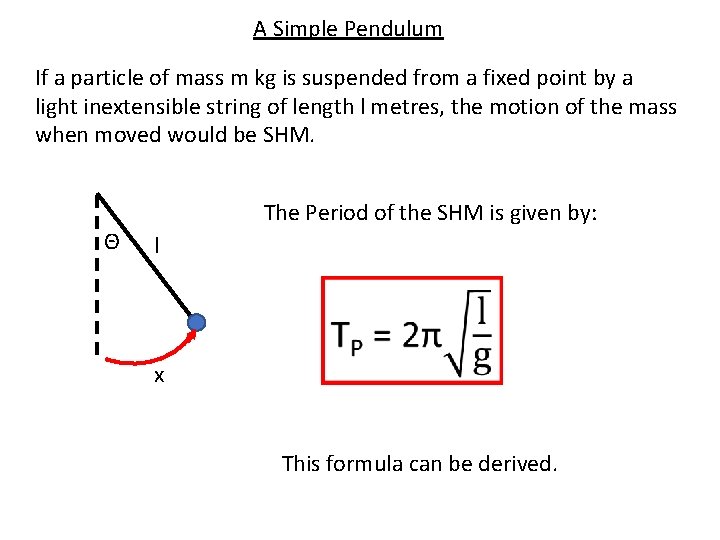
A Simple Pendulum If a particle of mass m kg is suspended from a fixed point by a light inextensible string of length l metres, the motion of the mass when moved would be SHM. Θ The Period of the SHM is given by: l x This formula can be derived.
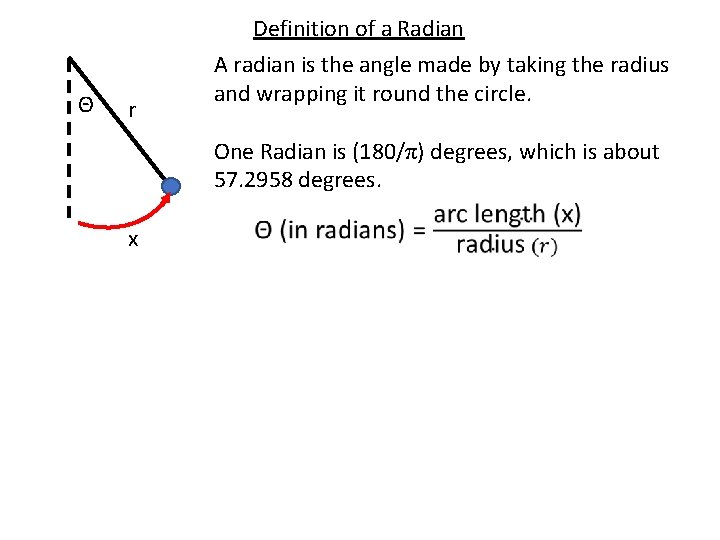
Definition of a Radian Θ r A radian is the angle made by taking the radius and wrapping it round the circle. One Radian is (180/π) degrees, which is about 57. 2958 degrees. x
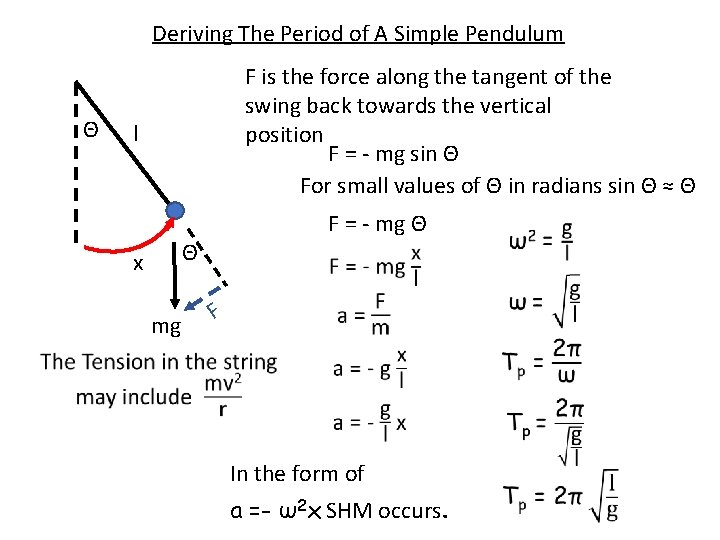
Deriving The Period of A Simple Pendulum Θ F is the force along the tangent of the swing back towards the vertical position F = - mg sin Θ For small values of Θ in radians sin Θ ≈ Θ l F = - mg Θ Θ x mg F In the form of a =- ω2 x SHM occurs.


- Slides: 40