
Elastic Buckling Behavior of Beams CE 579 Structural
Elastic Buckling Behavior of Beams CE 579 - Structural Stability and Design
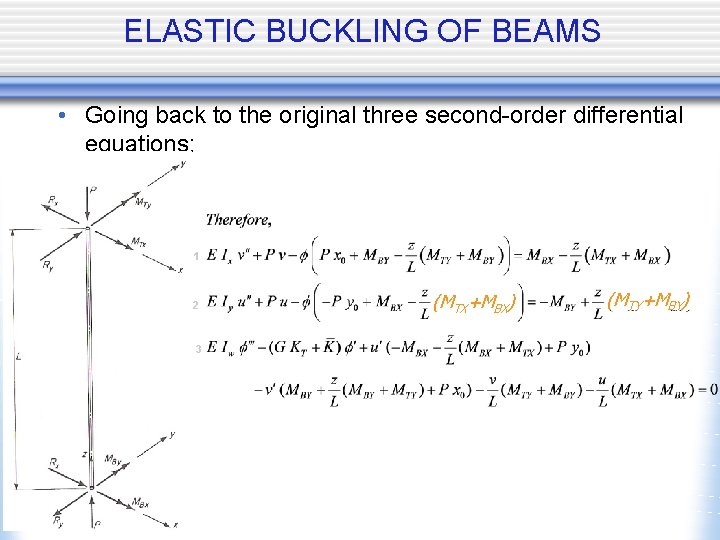
ELASTIC BUCKLING OF BEAMS • Going back to the original three second-order differential equations: 1 2 3 (MTX+MBX) (MTY+MBY)
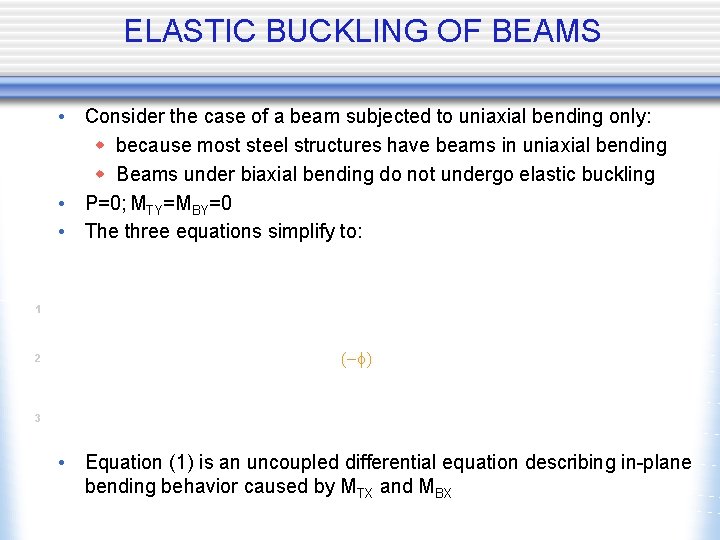
ELASTIC BUCKLING OF BEAMS • Consider the case of a beam subjected to uniaxial bending only: w because most steel structures have beams in uniaxial bending w Beams under biaxial bending do not undergo elastic buckling • P=0; MTY=MBY=0 • The three equations simplify to: 1 2 (- ) 3 • Equation (1) is an uncoupled differential equation describing in-plane bending behavior caused by MTX and MBX
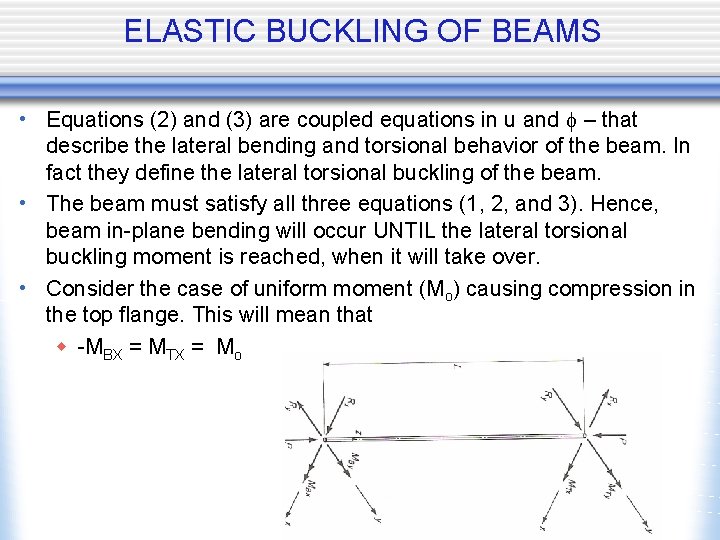
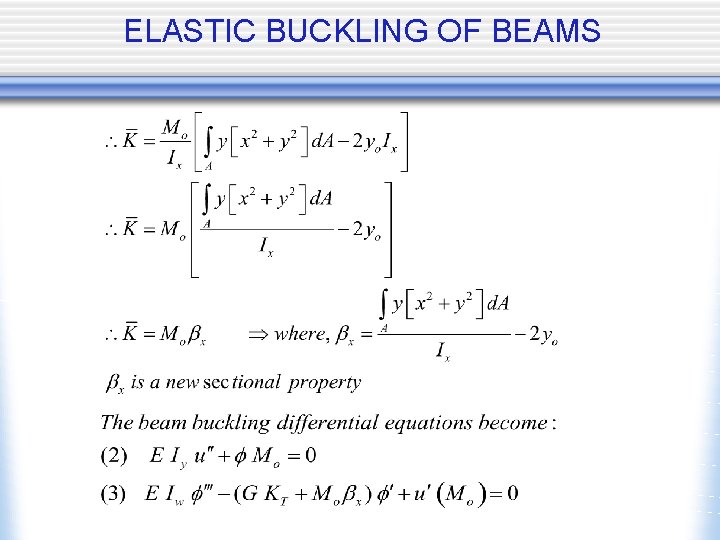
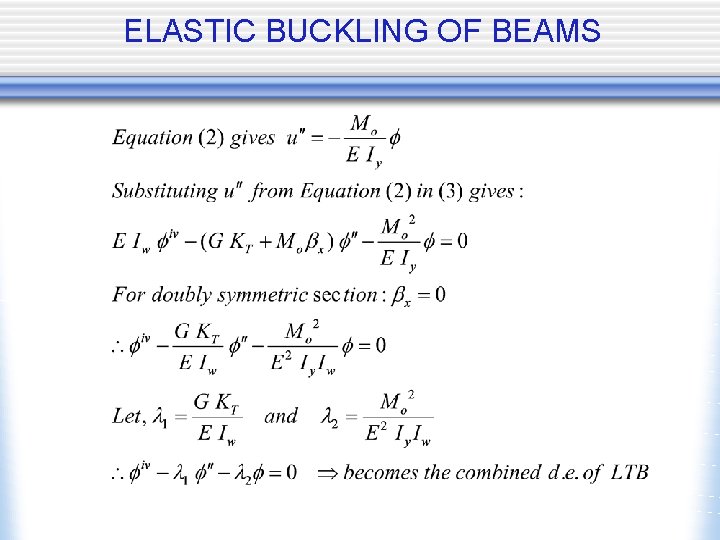
ELASTIC BUCKLING OF BEAMS • Equations (2) and (3) are coupled equations in u and – that describe the lateral bending and torsional behavior of the beam. In fact they define the lateral torsional buckling of the beam. • The beam must satisfy all three equations (1, 2, and 3). Hence, beam in-plane bending will occur UNTIL the lateral torsional buckling moment is reached, when it will take over. • Consider the case of uniform moment (Mo) causing compression in the top flange. This will mean that w -MBX = MTX = Mo
Uniform Moment Case • For this case, the differential equations (2 and 3) will become:
ELASTIC BUCKLING OF BEAMS
ELASTIC BUCKLING OF BEAMS
ELASTIC BUCKLING OF BEAMS
ELASTIC BUCKLING OF BEAMS • Assume simply supported boundary conditions for the beam:
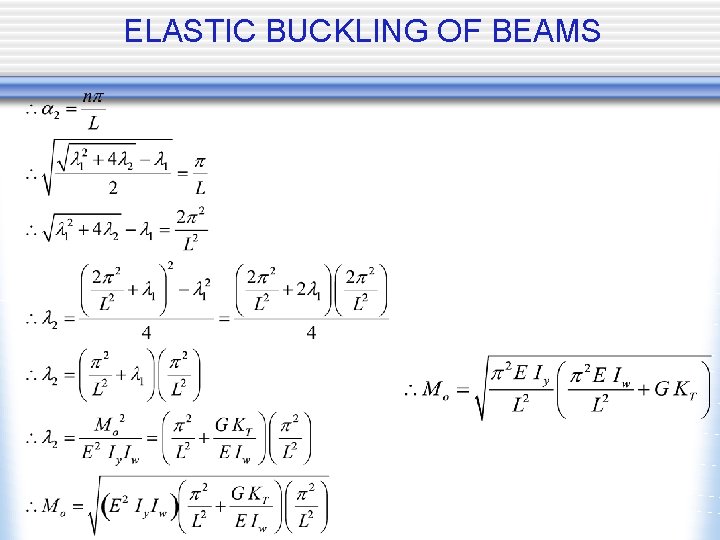
ELASTIC BUCKLING OF BEAMS
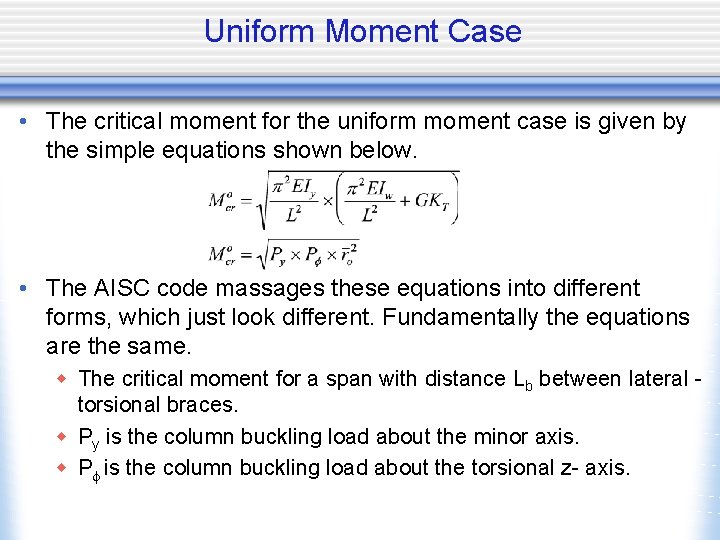
Uniform Moment Case • The critical moment for the uniform moment case is given by the simple equations shown below. • The AISC code massages these equations into different forms, which just look different. Fundamentally the equations are the same. w The critical moment for a span with distance Lb between lateral torsional braces. w Py is the column buckling load about the minor axis. w P is the column buckling load about the torsional z- axis.
Non-uniform moment • The only case for which the differential equations can be solved analytically is the uniform moment. • For almost all other cases, we will have to resort to numerical methods to solve the differential equations. • Of course, you can also solve the uniform moment case using numerical methods
What numerical method to use • What we have is a problem where the governing differential equations are known. w The solution and some of its derivatives are known at the boundary. w This is an ordinary differential equation and a boundary value problem. • We will solve it using the finite difference method. w The FDM converts the differential equation into algebraic equations. w Develop an FDM mesh or grid (as it is more correctly called) in the structure. w Write the algebraic form of the d. e. at each point within the grid. w Write the algebraic form of the boundary conditions. w Solve all the algebraic equations simultaneously.
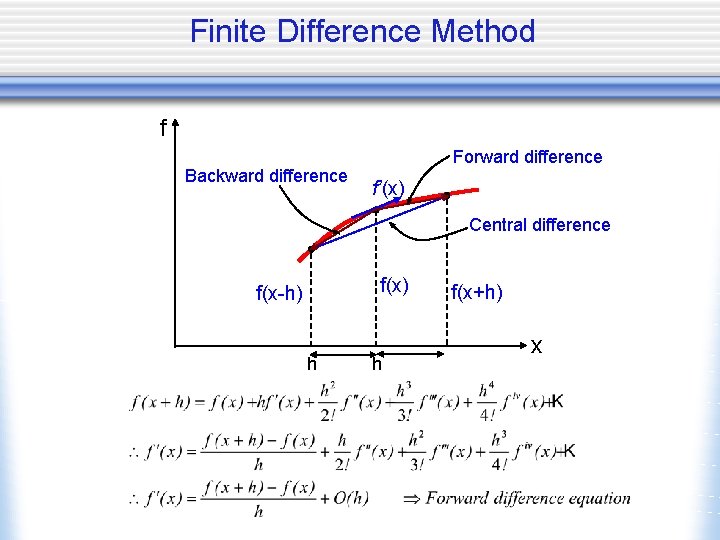
Finite Difference Method f Backward difference Forward difference f’(x) Central difference f(x) f(x-h) h h f(x+h) x
Finite Difference Method
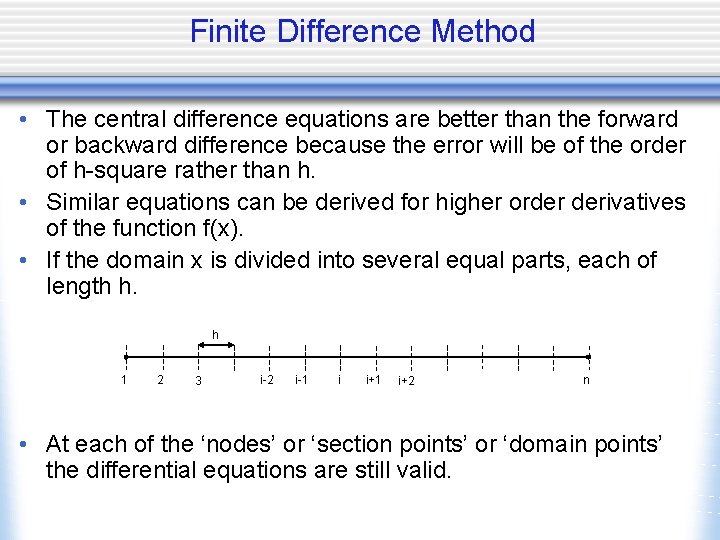
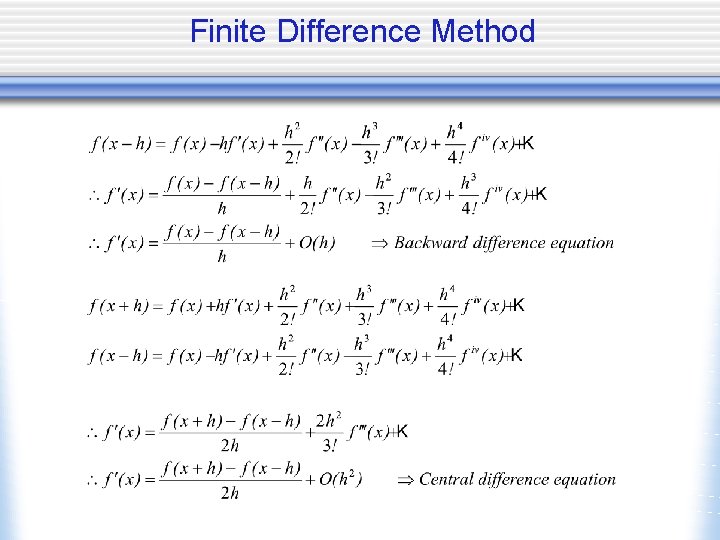
Finite Difference Method • The central difference equations are better than the forward or backward difference because the error will be of the order of h-square rather than h. • Similar equations can be derived for higher order derivatives of the function f(x). • If the domain x is divided into several equal parts, each of length h. h 1 2 3 i-2 i-1 i i+1 i+2 n • At each of the ‘nodes’ or ‘section points’ or ‘domain points’ the differential equations are still valid.
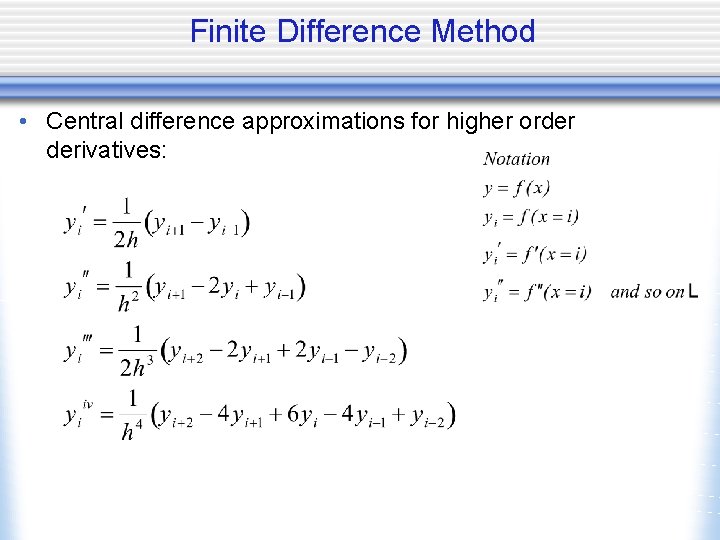
Finite Difference Method • Central difference approximations for higher order derivatives:
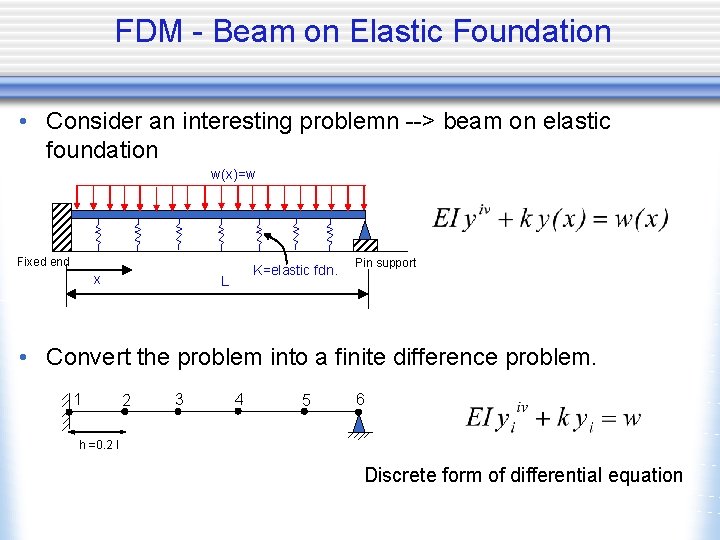
FDM - Beam on Elastic Foundation • Consider an interesting problemn --> beam on elastic foundation w(x)=w Fixed end x K=elastic fdn. L Pin support • Convert the problem into a finite difference problem. 1 2 3 4 5 6 h =0. 2 l Discrete form of differential equation
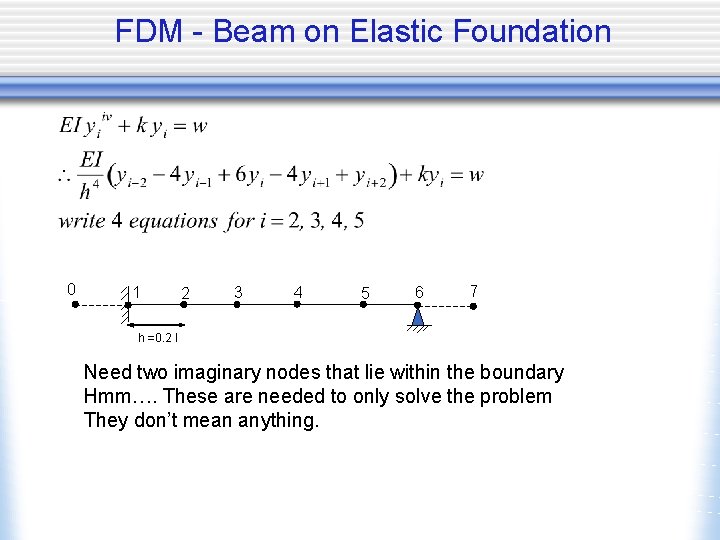
FDM - Beam on Elastic Foundation 0 1 2 3 4 5 6 7 h =0. 2 l Need two imaginary nodes that lie within the boundary Hmm…. These are needed to only solve the problem They don’t mean anything.
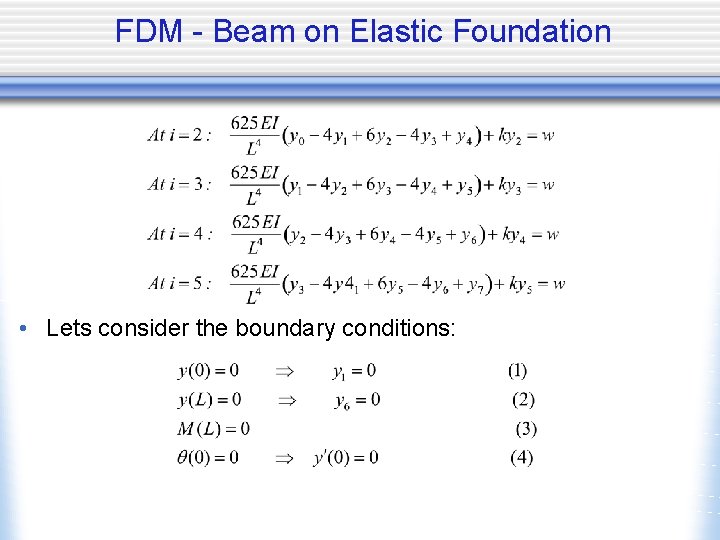
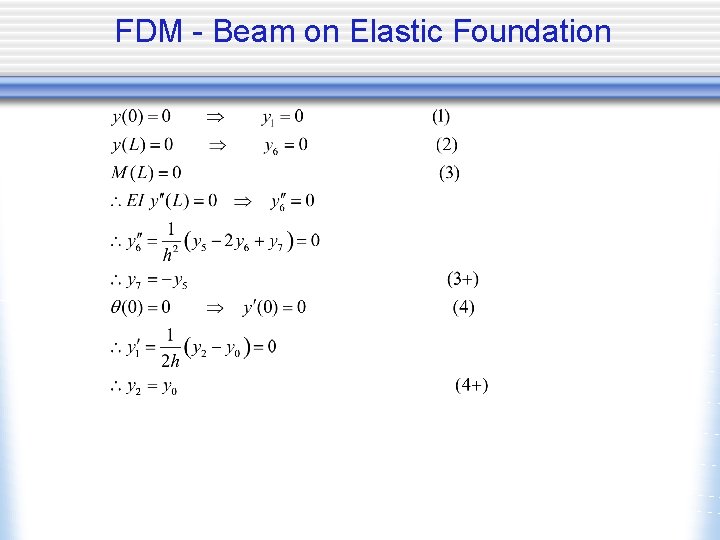
FDM - Beam on Elastic Foundation • Lets consider the boundary conditions:
FDM - Beam on Elastic Foundation
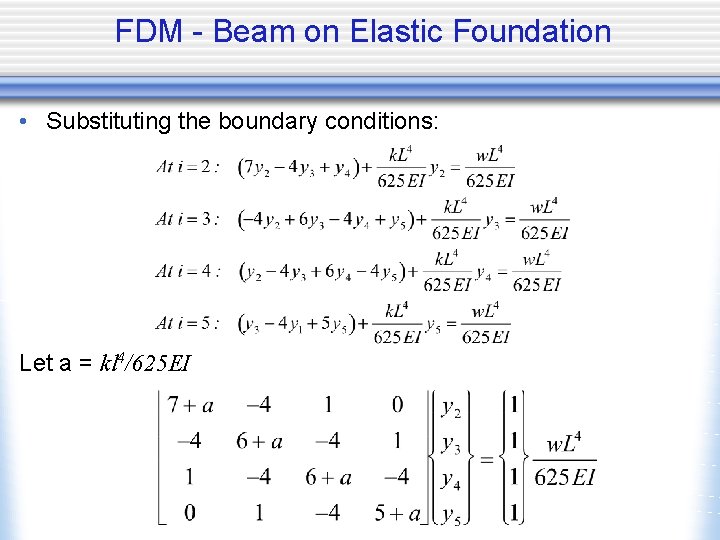
FDM - Beam on Elastic Foundation • Substituting the boundary conditions: Let a = kl 4/625 EI
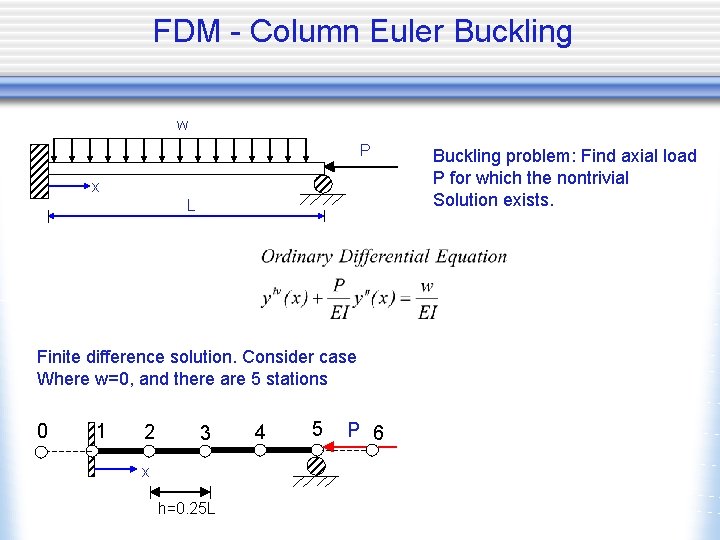
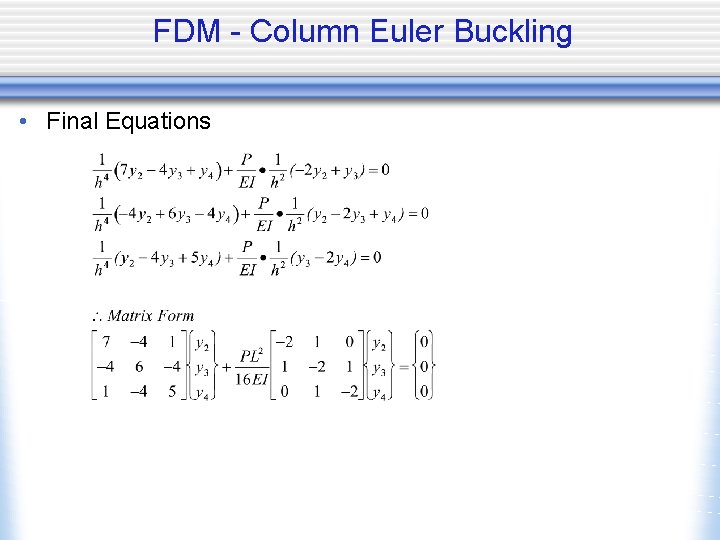
FDM - Column Euler Buckling w P x L Finite difference solution. Consider case Where w=0, and there are 5 stations 0 1 2 3 x h=0. 25 L 4 5 P 6 Buckling problem: Find axial load P for which the nontrivial Solution exists.
FDM - Euler Column Buckling
FDM - Column Euler Buckling • Final Equations
![FDM - Euler Buckling Problem • [A]{y}+ [B]{y}={0} w How to find P? Solve](http://slidetodoc.com/presentation_image/20a1f348bdb2eb975ac44ce892483c30/image-26.jpg "FDM - Euler Buckling Problem • [A]{y}+ [B]{y}={0} w How to find P? Solve")
FDM - Euler Buckling Problem • [A]{y}+ [B]{y}={0} w How to find P? Solve the eigenvalue problem. • Standard Eigenvalue Problem w [A]{y}= {y} § Where, = eigenvalue and {y} = eigenvector w Can be simplified to [A- I]{y}={0} w Nontrivial solution for {y} exists if and only if | A- I|=0 w One way to solve the problem is to obtain the characteristic polynomial from expanding | A- I|=0 w Solving the polynomial will give the value of w Substitute the value of to get the eigenvector {y} w This is not the best way to solve the problem, and will not work for more than 4 or 5 th order polynomial
![FDM - Euler Buckling Problem • • For solving Buckling Eigenvalue Problem [A]{y} +](http://slidetodoc.com/presentation_image/20a1f348bdb2eb975ac44ce892483c30/image-27.jpg "FDM - Euler Buckling Problem • • For solving Buckling Eigenvalue Problem [A]{y} +")
FDM - Euler Buckling Problem • • For solving Buckling Eigenvalue Problem [A]{y} + [B]{y}={0} [A+ B]{y}={0} Therefore, det |A+ B|=0 can be used to solve for
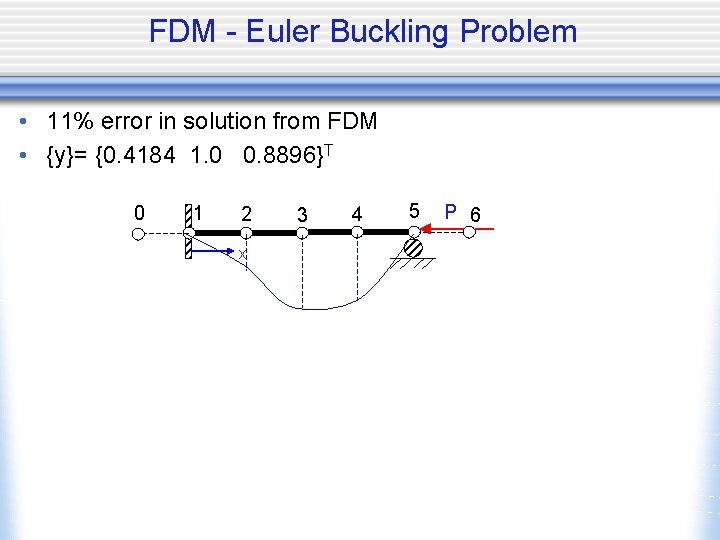
FDM - Euler Buckling Problem • 11% error in solution from FDM • {y}= {0. 4184 1. 0 0. 8896}T 0 1 2 x 3 4 5 P 6
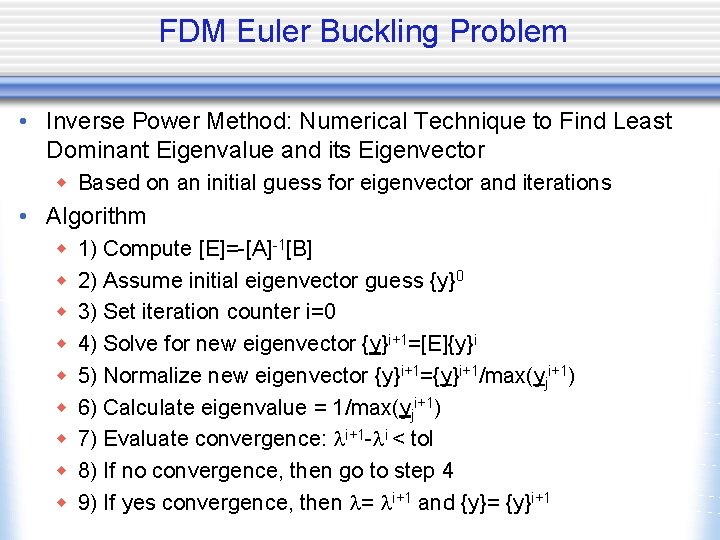
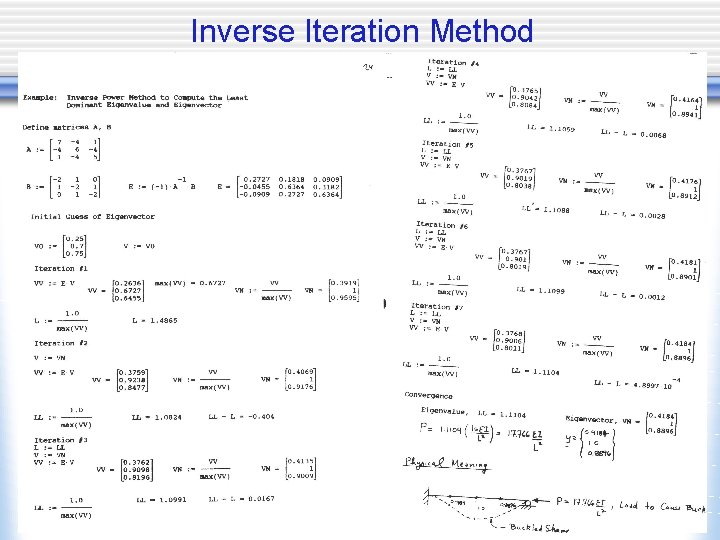
FDM Euler Buckling Problem • Inverse Power Method: Numerical Technique to Find Least Dominant Eigenvalue and its Eigenvector w Based on an initial guess for eigenvector and iterations • Algorithm w w w w w 1) Compute [E]=-[A]-1[B] 2) Assume initial eigenvector guess {y}0 3) Set iteration counter i=0 4) Solve for new eigenvector {y}i+1=[E]{y}i 5) Normalize new eigenvector {y}i+1={y}i+1/max(yji+1) 6) Calculate eigenvalue = 1/max(yji+1) 7) Evaluate convergence: i+1 - i < tol 8) If no convergence, then go to step 4 9) If yes convergence, then = i+1 and {y}= {y}i+1
Inverse Iteration Method




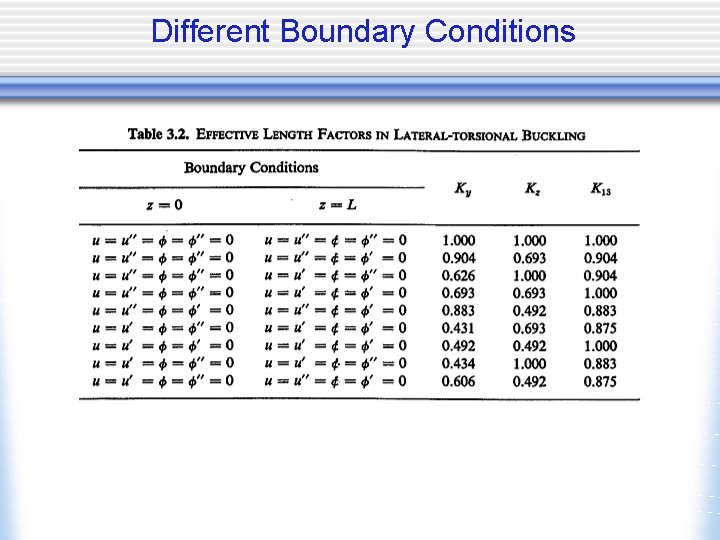
Different Boundary Conditions
Beams with Non-Uniform Loading • Let Mocr be the lateral-torsional buckling moment for the case of uniform moment. • If the applied moments are non-uniform (but varying linearly, i. e. , there are no loads along the length) w Numerically solve the differential equation using FDM and the Inverse Iteration process for eigenvalues w Alternately, researchers have already done these numerical solution for a variety of linear moment diagrams w The results from the numerical analyses were used to develop a simple equation that was calibrated to give reasonable results.
Beams with Non-uniform Loading • Salvadori in the 1970 s developed the equation below based on the regression analysis of numerical results with a simple equation w Mcr = Cb Mocr w Critical moment for non-uniform loading = Cb x critical moment for uniform moment.
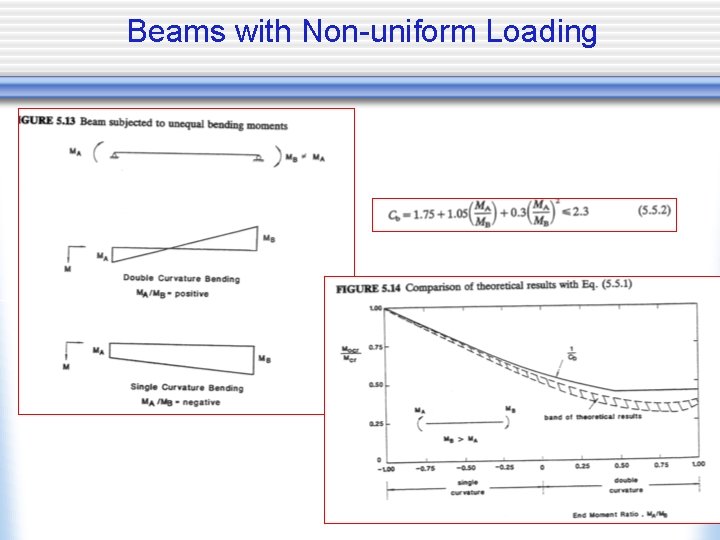
Beams with Non-uniform Loading
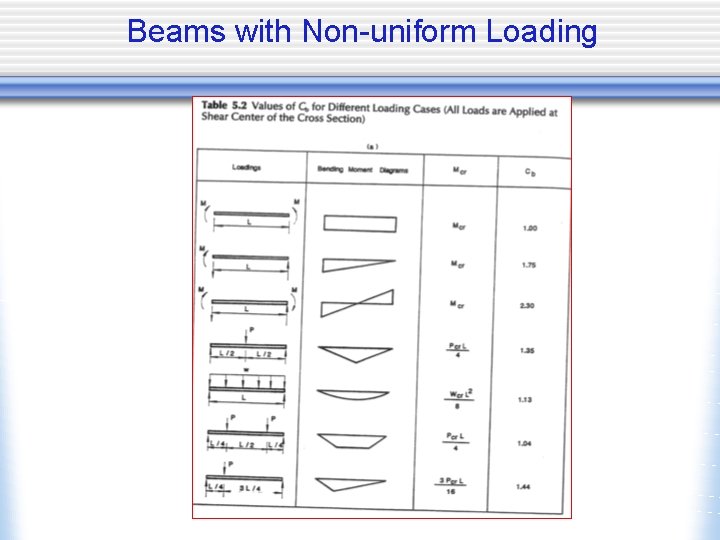
Beams with Non-uniform Loading
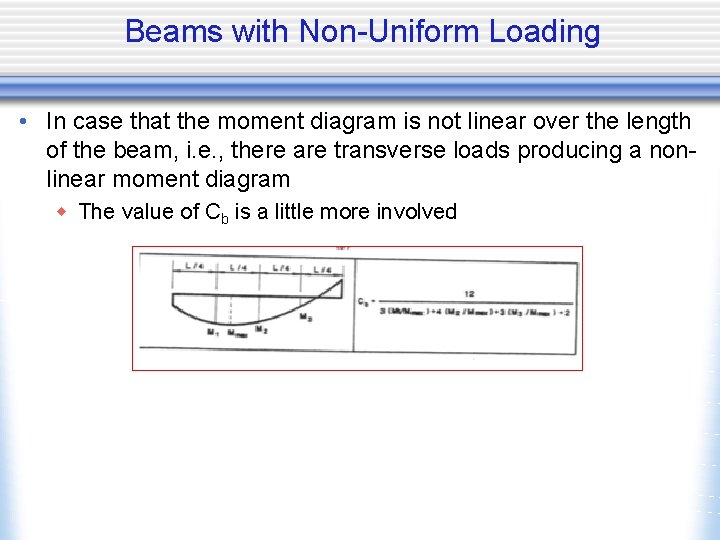
Beams with Non-Uniform Loading • In case that the moment diagram is not linear over the length of the beam, i. e. , there are transverse loads producing a nonlinear moment diagram w The value of Cb is a little more involved
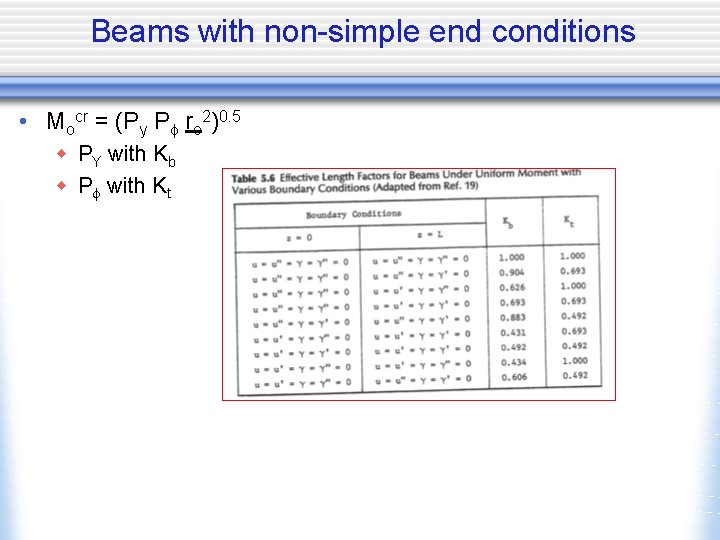
Beams with non-simple end conditions • Mocr = (Py P ro 2)0. 5 w PY with Kb w P with Kt
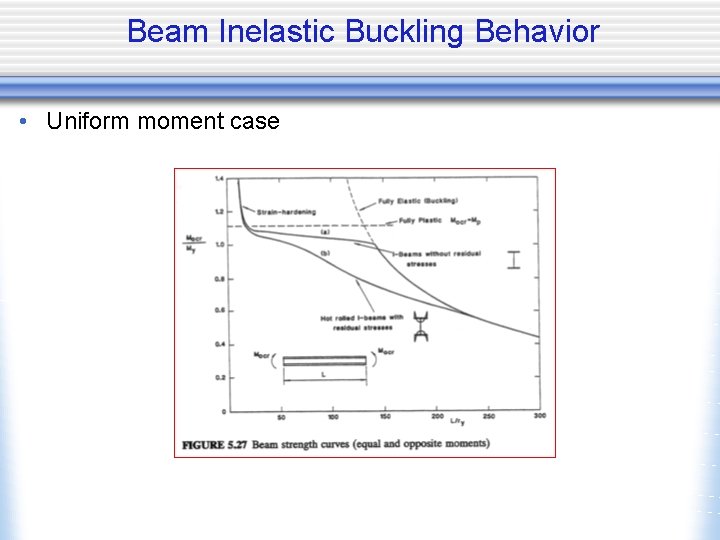
Beam Inelastic Buckling Behavior • Uniform moment case
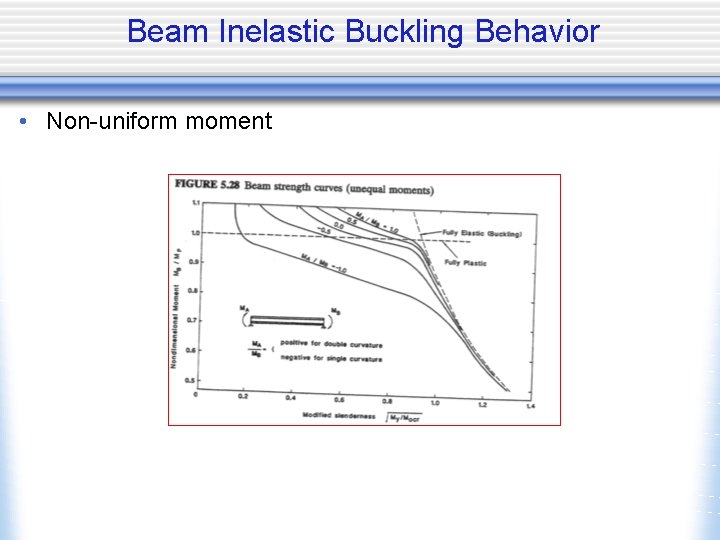
Beam Inelastic Buckling Behavior • Non-uniform moment
Beam In-plane Behavior • Section capacity Mp • Section M- behavior
Beam Design Provisions CHAPTER F in AISC Specifications
- Slides: 45