
Elastic Buckling Behavior of Beams CE 579 Structural
Elastic Buckling Behavior of Beams CE 579 - Structural Stability and Design Amit H. Varma Ph. No. (765) 496 3419 Email: ahvarma@purdue. edu Office hours: M-W-F 9: 00 -11: 30 a. m.

ELASTIC BUCKLING OF BEAMS n Going back to the original three second-order differential equations: 1 2 3 (MTX+MBX) (MTY+MBY)
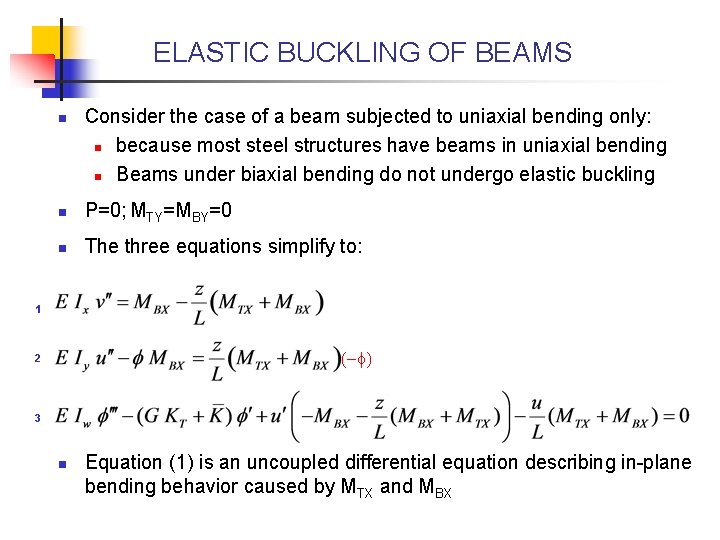
ELASTIC BUCKLING OF BEAMS n Consider the case of a beam subjected to uniaxial bending only: n because most steel structures have beams in uniaxial bending n Beams under biaxial bending do not undergo elastic buckling n P=0; MTY=MBY=0 n The three equations simplify to: 1 (- ) 2 3 n Equation (1) is an uncoupled differential equation describing in-plane bending behavior caused by MTX and MBX
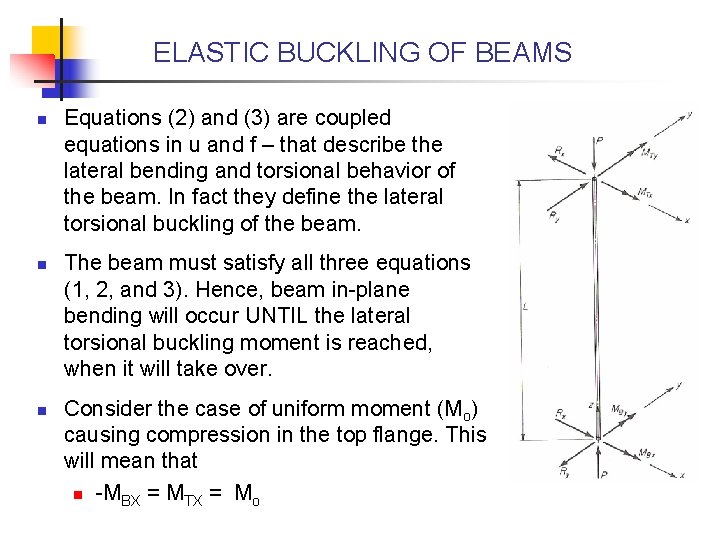
ELASTIC BUCKLING OF BEAMS n n n Equations (2) and (3) are coupled equations in u and f – that describe the lateral bending and torsional behavior of the beam. In fact they define the lateral torsional buckling of the beam. The beam must satisfy all three equations (1, 2, and 3). Hence, beam in-plane bending will occur UNTIL the lateral torsional buckling moment is reached, when it will take over. Consider the case of uniform moment (Mo) causing compression in the top flange. This will mean that n -MBX = MTX = Mo
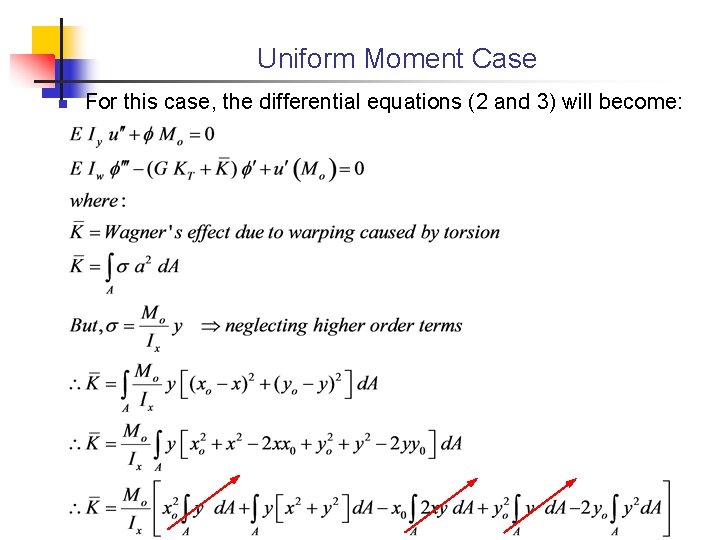
Uniform Moment Case n For this case, the differential equations (2 and 3) will become:

ELASTIC BUCKLING OF BEAMS
ELASTIC BUCKLING OF BEAMS

ELASTIC BUCKLING OF BEAMS

ELASTIC BUCKLING OF BEAMS n Assume simply supported boundary conditions for the beam:
ELASTIC BUCKLING OF BEAMS

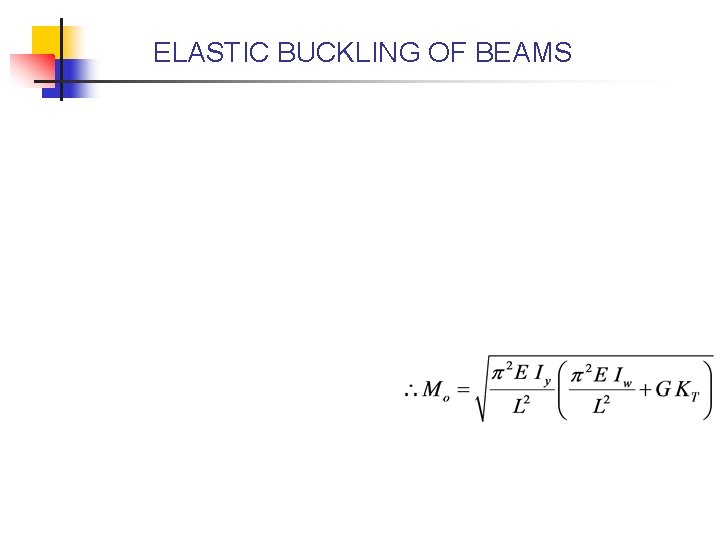
Uniform Moment Case n n The critical moment for the uniform moment case is given by the simple equations shown below. The AISC code massages these equations into different forms, which just look different. Fundamentally the equations are the same. n The critical moment for a span with distance Lb between lateral torsional braces. n Py is the column buckling load about the minor axis. n P is the column buckling load about the torsional z- axis.
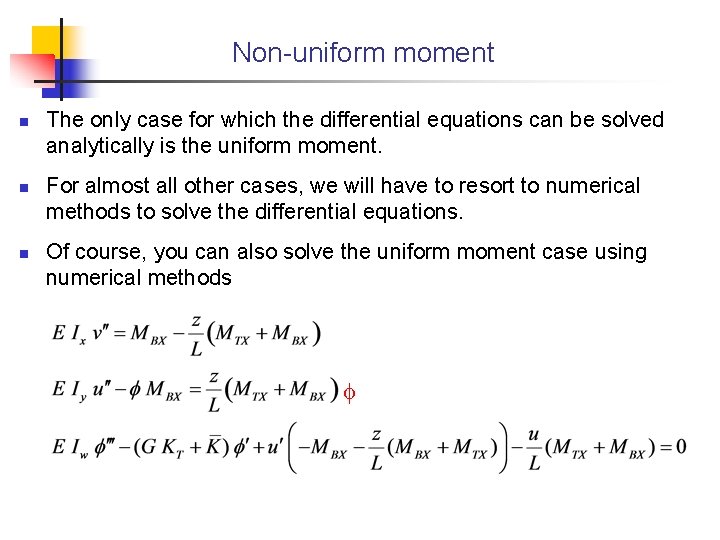
Non-uniform moment n n n The only case for which the differential equations can be solved analytically is the uniform moment. For almost all other cases, we will have to resort to numerical methods to solve the differential equations. Of course, you can also solve the uniform moment case using numerical methods
What numerical method to use n n What we have is a problem where the governing differential equations are known. n The solution and some of its derivatives are known at the boundary. n This is an ordinary differential equation and a boundary value problem. We will solve it using the finite difference method. n The FDM converts the differential equation into algebraic equations. n Develop an FDM mesh or grid (as it is more correctly called) in the structure. n Write the algebraic form of the d. e. at each point within the grid. n Write the algebraic form of the boundary conditions. n Solve all the algebraic equations simultaneously.

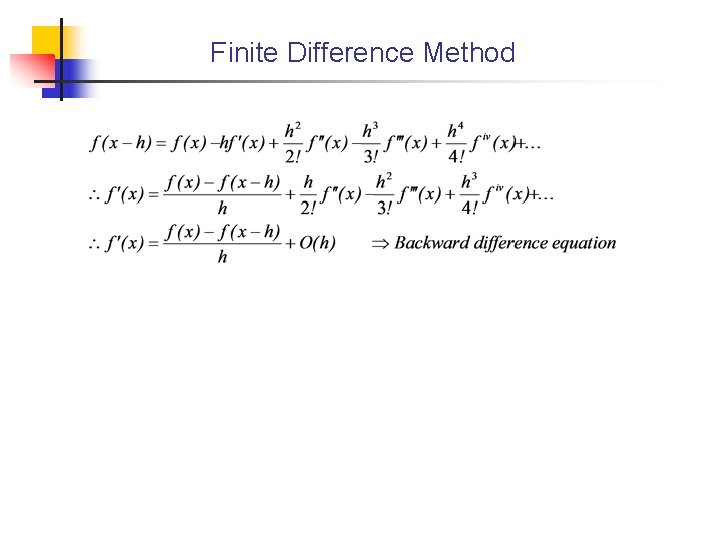
Finite Difference Method f Backward difference Forward difference f’(x) Central difference f(x) f(x-h) h h f(x+h) x
Finite Difference Method
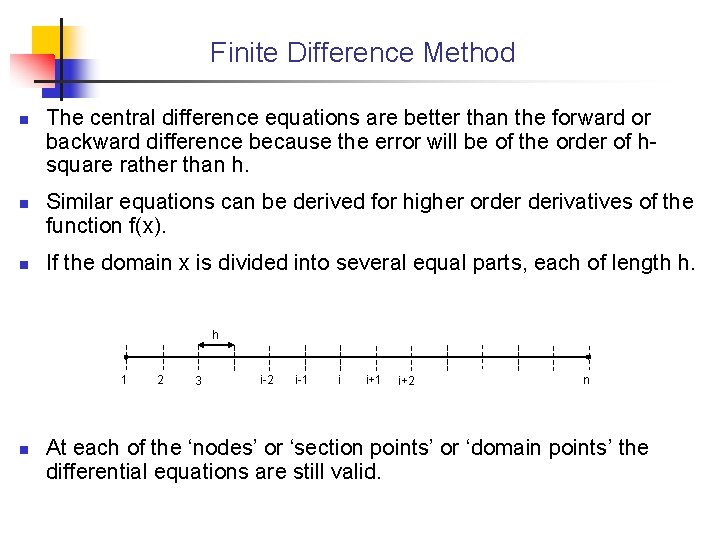
Finite Difference Method n n n The central difference equations are better than the forward or backward difference because the error will be of the order of hsquare rather than h. Similar equations can be derived for higher order derivatives of the function f(x). If the domain x is divided into several equal parts, each of length h. h 1 n 2 3 i-2 i-1 i i+1 i+2 n At each of the ‘nodes’ or ‘section points’ or ‘domain points’ the differential equations are still valid.

Finite Difference Method n Central difference approximations for higher order derivatives:

FDM - Beam on Elastic Foundation n Consider an interesting problem --> beam on elastic foundation w(x)=w Fixed end x n K=elastic fdn. L Pin support Convert the problem into a finite difference problem. 1 2 3 4 5 6 h =0. 2 l Discrete form of differential equation
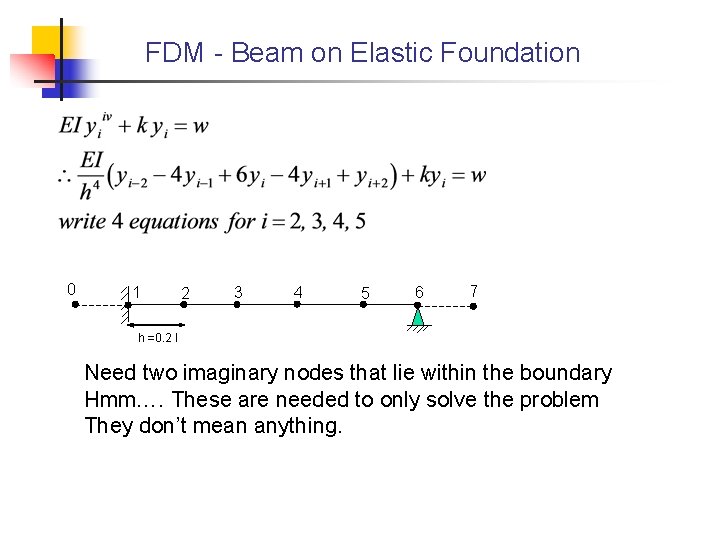
FDM - Beam on Elastic Foundation 0 1 2 3 4 5 6 7 h =0. 2 l Need two imaginary nodes that lie within the boundary Hmm…. These are needed to only solve the problem They don’t mean anything.
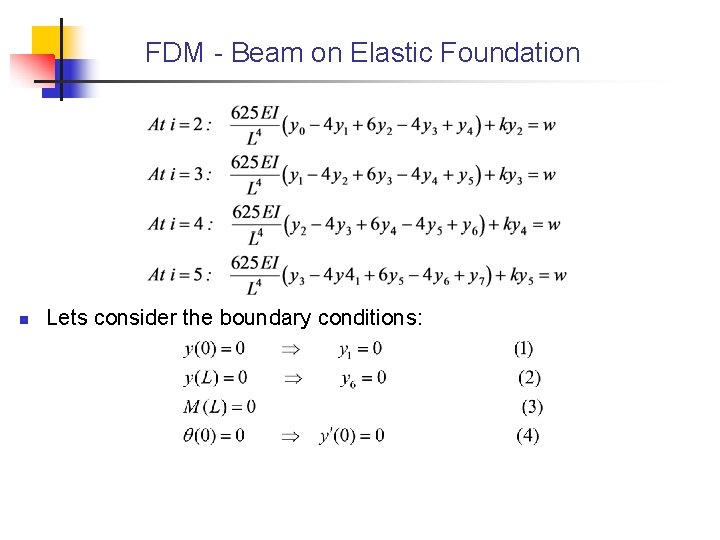
FDM - Beam on Elastic Foundation n Lets consider the boundary conditions:
FDM - Beam on Elastic Foundation
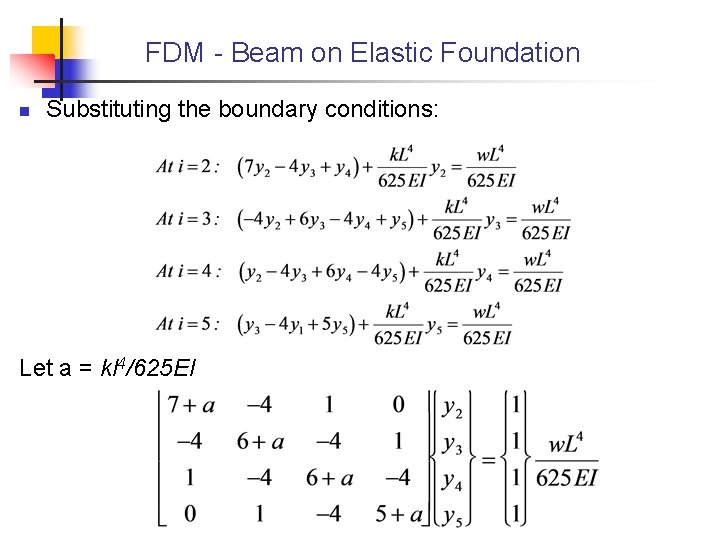
FDM - Beam on Elastic Foundation n Substituting the boundary conditions: Let a = kl 4/625 EI
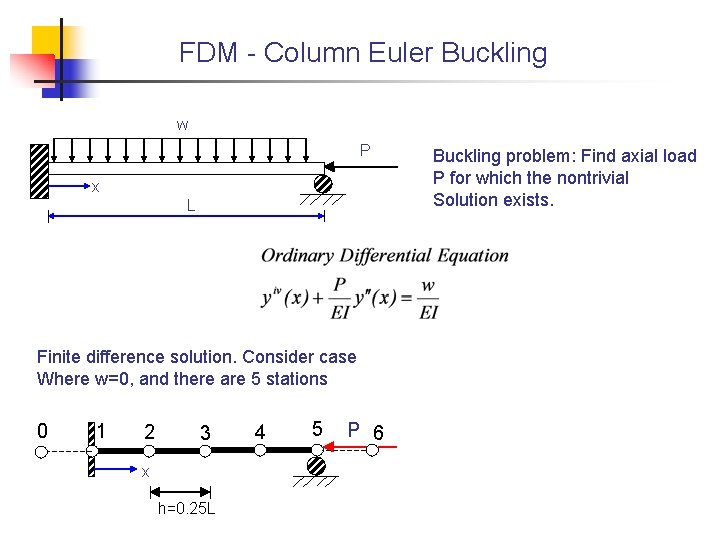
FDM - Column Euler Buckling w P x L Finite difference solution. Consider case Where w=0, and there are 5 stations 0 1 2 3 x h=0. 25 L 4 5 P 6 Buckling problem: Find axial load P for which the nontrivial Solution exists.
FDM - Euler Column Buckling
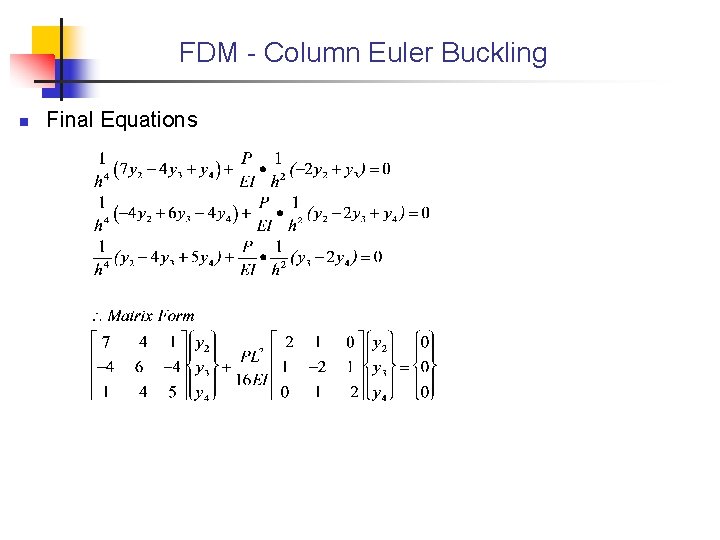
FDM - Column Euler Buckling n Final Equations
![FDM - Euler Buckling Problem n [A]{y}+ [B]{y}={0} n n How to find P?](http://slidetodoc.com/presentation_image/5a95e9c28df6ff59c79af3738c310252/image-26.jpg "FDM - Euler Buckling Problem n [A]{y}+ [B]{y}={0} n n How to find P?")
FDM - Euler Buckling Problem n [A]{y}+ [B]{y}={0} n n How to find P? Solve the eigenvalue problem. Standard Eigenvalue Problem n [A]{y}= {y} n n n n Where, = eigenvalue and {y} = eigenvector Can be simplified to [A- I]{y}={0} Nontrivial solution for {y} exists if and only if | A- I|=0 One way to solve the problem is to obtain the characteristic polynomial from expanding | A- I|=0 Solving the polynomial will give the value of Substitute the value of to get the eigenvector {y} This is not the best way to solve the problem, and will not work for more than 4 or 5 th order polynomial
![FDM - Euler Buckling Problem n For solving Buckling Eigenvalue Problem n [A]{y} +](http://slidetodoc.com/presentation_image/5a95e9c28df6ff59c79af3738c310252/image-27.jpg "FDM - Euler Buckling Problem n For solving Buckling Eigenvalue Problem n [A]{y} +")
FDM - Euler Buckling Problem n For solving Buckling Eigenvalue Problem n [A]{y} + [B]{y}={0} n [A+ B]{y}={0} n Therefore, det |A+ B|=0 can be used to solve for
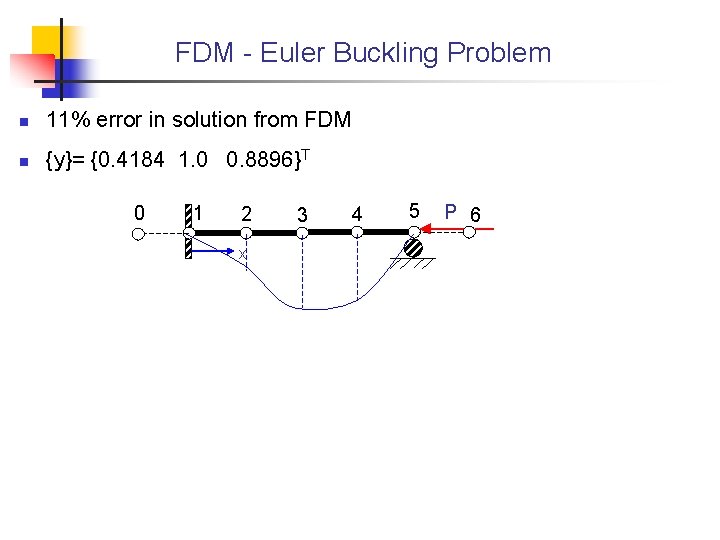
FDM - Euler Buckling Problem n 11% error in solution from FDM n {y}= {0. 4184 1. 0 0. 8896}T 0 1 2 x 3 4 5 P 6
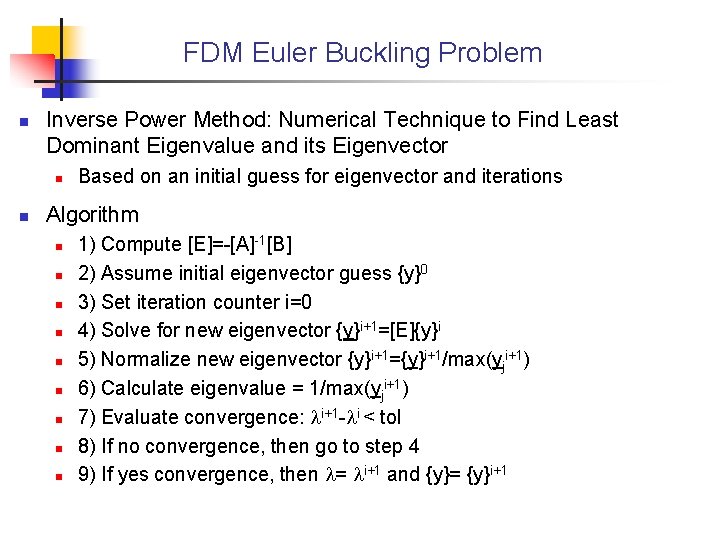
FDM Euler Buckling Problem n Inverse Power Method: Numerical Technique to Find Least Dominant Eigenvalue and its Eigenvector n n Based on an initial guess for eigenvector and iterations Algorithm n n n n n 1) Compute [E]=-[A]-1[B] 2) Assume initial eigenvector guess {y}0 3) Set iteration counter i=0 4) Solve for new eigenvector {y}i+1=[E]{y}i 5) Normalize new eigenvector {y}i+1={y}i+1/max(yji+1) 6) Calculate eigenvalue = 1/max(yji+1) 7) Evaluate convergence: i+1 - i < tol 8) If no convergence, then go to step 4 9) If yes convergence, then = i+1 and {y}= {y}i+1
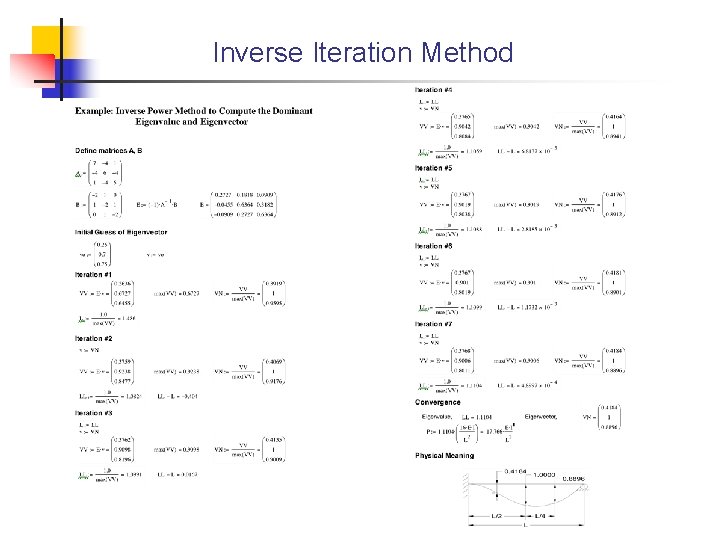
Inverse Iteration Method
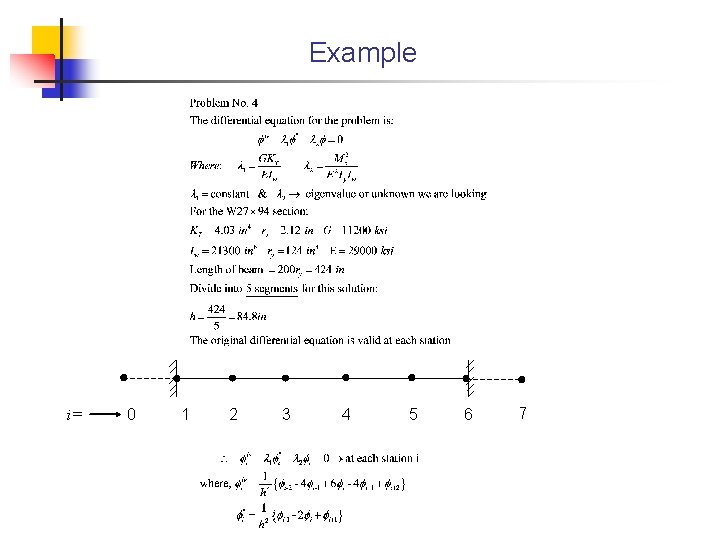
Example i= 0 1 2 3 4 5 6 7
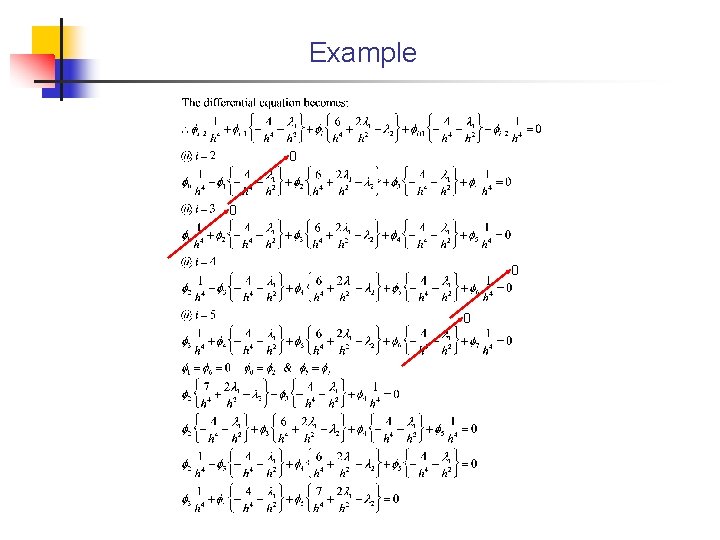
Example 0 0
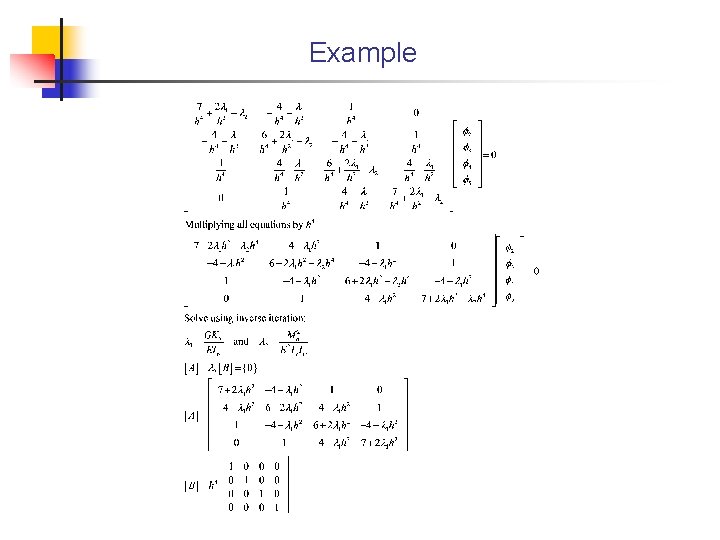
Example
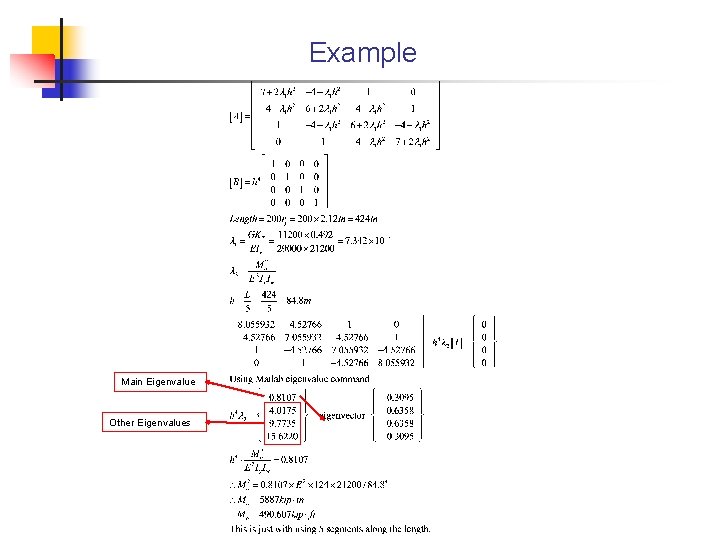
Example Main Eigenvalue Other Eigenvalues
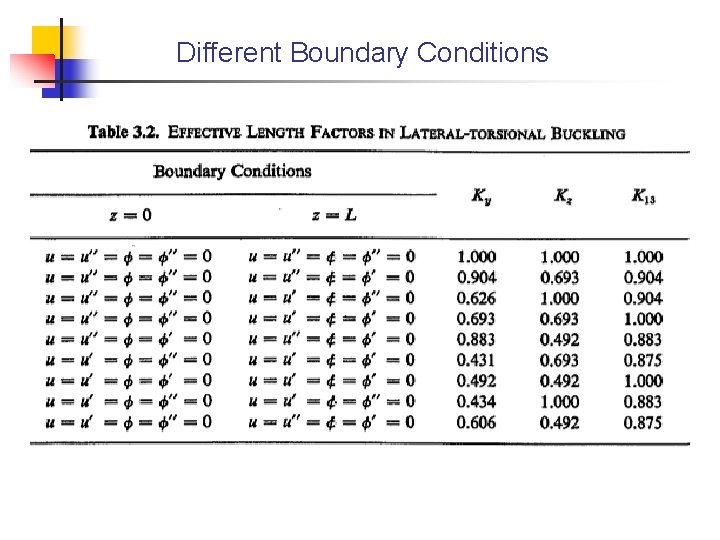
Different Boundary Conditions
Beams with Non-Uniform Loading n n Let Mocr be the lateral-torsional buckling moment for the case of uniform moment. If the applied moments are non-uniform (but varying linearly, i. e. , there are no loads along the length) n Numerically solve the differential equation using FDM and the Inverse Iteration process for eigenvalues n Alternately, researchers have already done these numerical solution for a variety of linear moment diagrams n The results from the numerical analyses were used to develop a simple equation that was calibrated to give reasonable results.
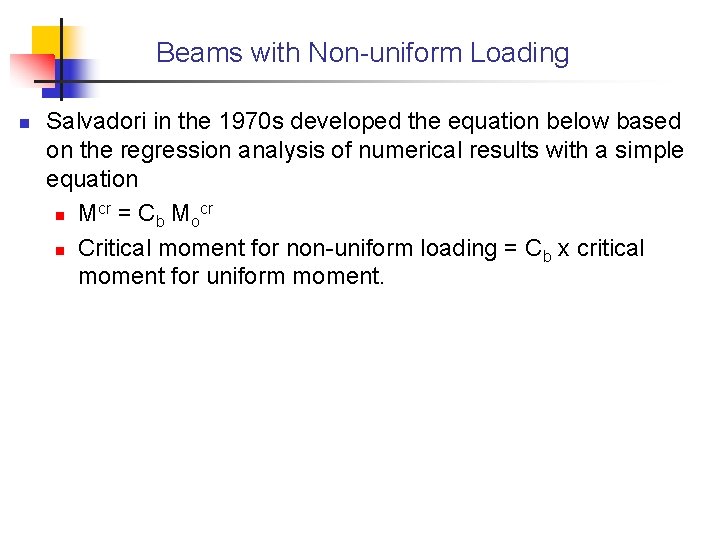
Beams with Non-uniform Loading n Salvadori in the 1970 s developed the equation below based on the regression analysis of numerical results with a simple equation cr cr n M = C b Mo n Critical moment for non-uniform loading = Cb x critical moment for uniform moment.
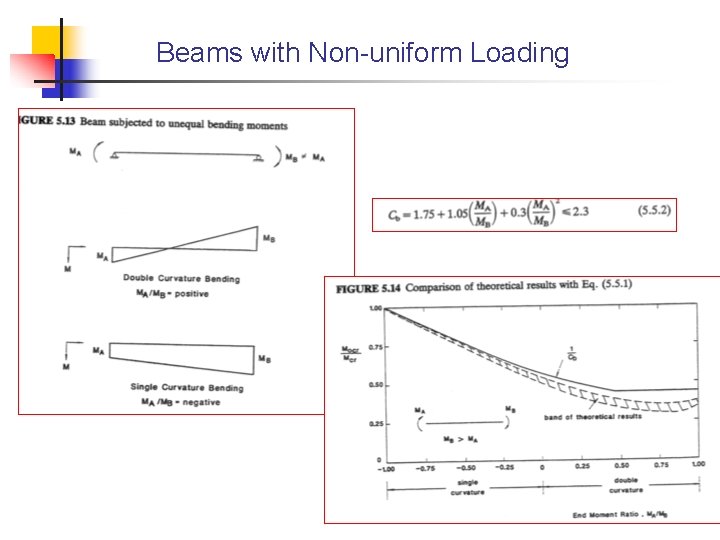
Beams with Non-uniform Loading
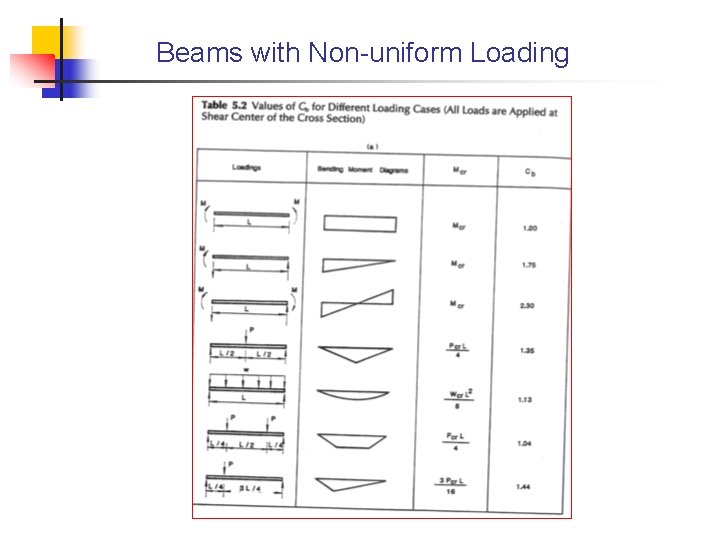
Beams with Non-uniform Loading
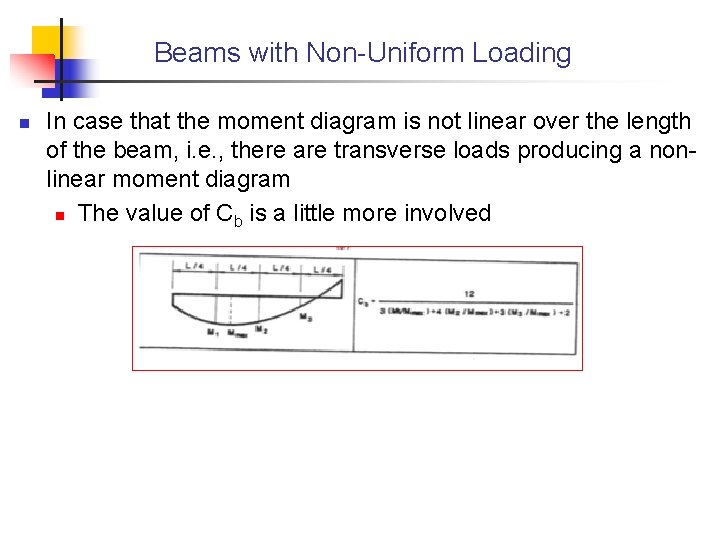
Beams with Non-Uniform Loading n In case that the moment diagram is not linear over the length of the beam, i. e. , there are transverse loads producing a nonlinear moment diagram n The value of Cb is a little more involved
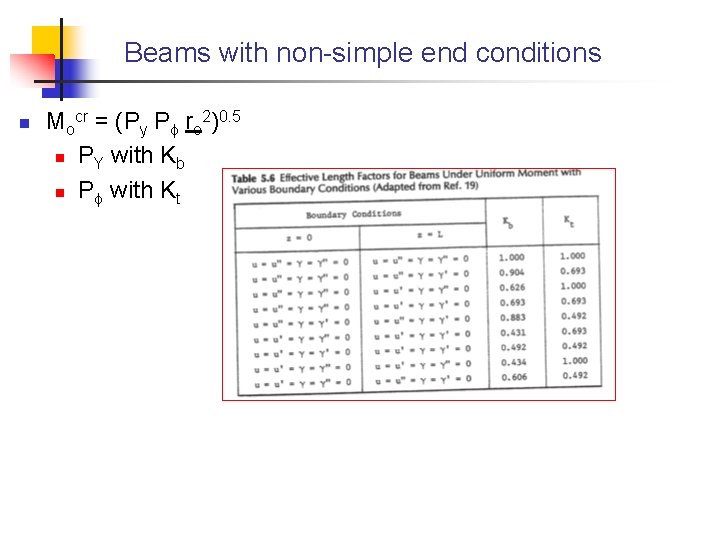
Beams with non-simple end conditions n Mocr = (Py P ro 2)0. 5 n PY with Kb n P with Kt
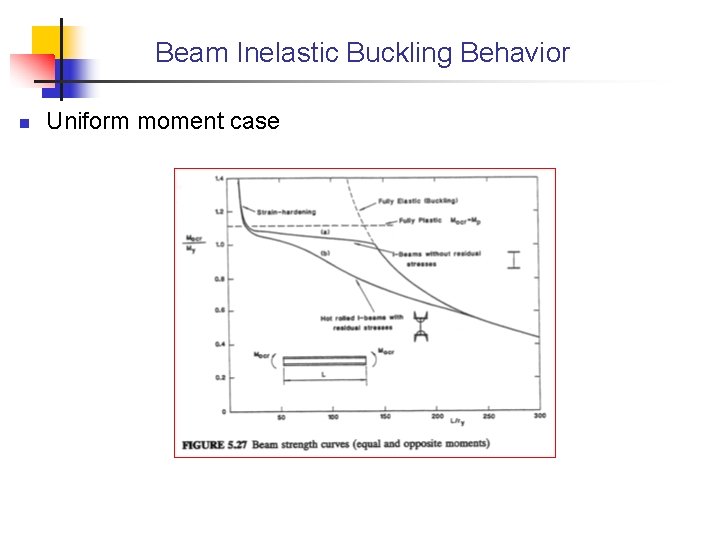
Beam Inelastic Buckling Behavior n Uniform moment case
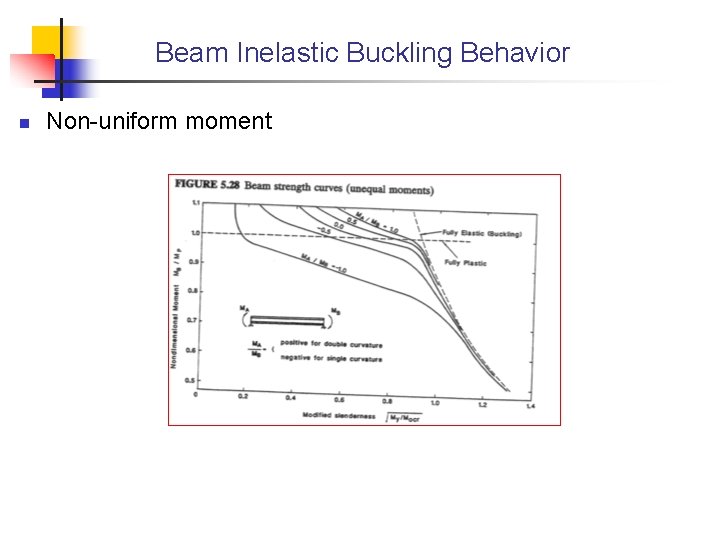
Beam Inelastic Buckling Behavior n Non-uniform moment
Beam In-plane Behavior n Section capacity Mp n Section M- behavior

Beam Design Provisions CHAPTER F in AISC Specifications
- Slides: 45