
El Mtodo de la Matrix de Transferencia Pedro

- Slides: 40
El Método de la Matrix de Transferencia Pedro Pereyra Padilla Area de Física Teórica y Materia Condensada Universidad Autónoma Metropolitana-Azcapotzalco, México D. F. Resumen Presentaremos una introducción al Método de la Matriz de Transferencia (MMT) y algunas aplicaciones en la teoría del transporte electrónico cuántico y en la opto-electrónica
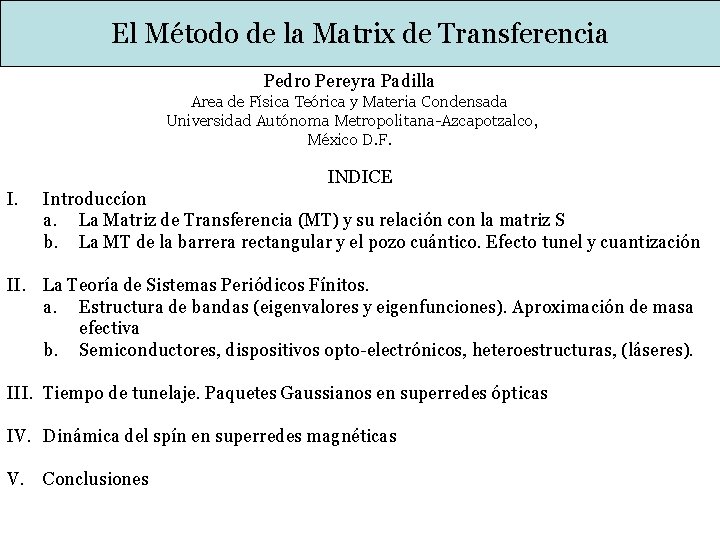
El Método de la Matrix de Transferencia Pedro Pereyra Padilla Area de Física Teórica y Materia Condensada Universidad Autónoma Metropolitana-Azcapotzalco, México D. F. INDICE I. Introduccíon a. La Matriz de Transferencia (MT) y su relación con la matriz S b. La MT de la barrera rectangular y el pozo cuántico. Efecto tunel y cuantización II. La Teoría de Sistemas Periódicos Fínitos. a. Estructura de bandas (eigenvalores y eigenfunciones). Aproximación de masa efectiva b. Semiconductores, dispositivos opto-electrónicos, heteroestructuras, (láseres). III. Tiempo de tunelaje. Paquetes Gaussianos en superredes ópticas IV. Dinámica del spín en superredes magnéticas V. Conclusiones
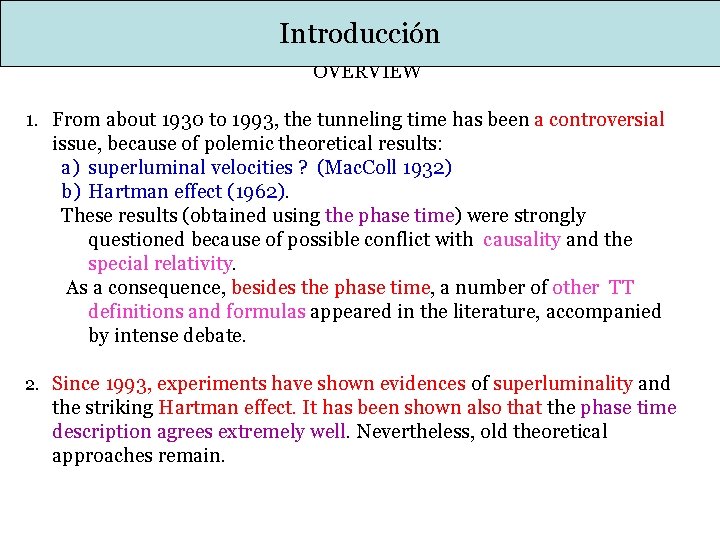
Introducción OVERVIEW 1. From about 1930 to 1993, the tunneling time has been a controversial issue, because of polemic theoretical results: a) superluminal velocities ? (Mac. Coll 1932) b) Hartman effect (1962). These results (obtained using the phase time) were strongly questioned because of possible conflict with causality and the special relativity. As a consequence, besides the phase time, a number of other TT definitions and formulas appeared in the literature, accompanied by intense debate. 2. Since 1993, experiments have shown evidences of superluminality and the striking Hartman effect. It has been shown also that the phase time description agrees extremely well. Nevertheless, old theoretical approaches remain.
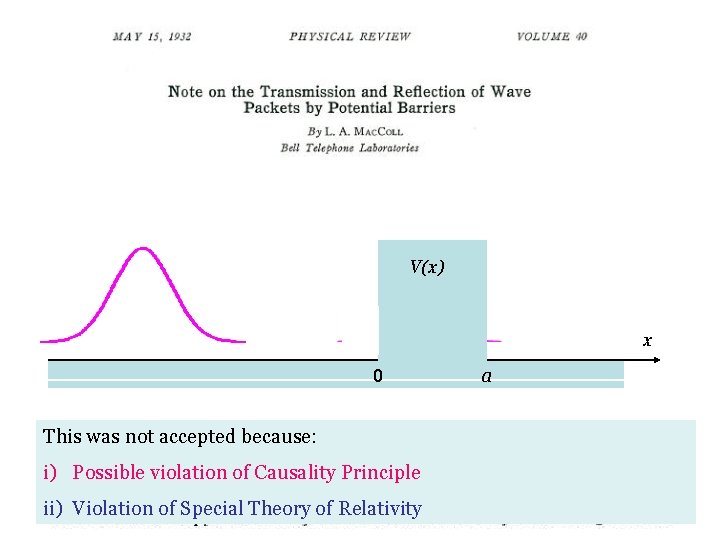
V(x) x 0 This was not accepted because: i) Possible violation of Causality Principle ii) Violation of Special Theory of Relativity a
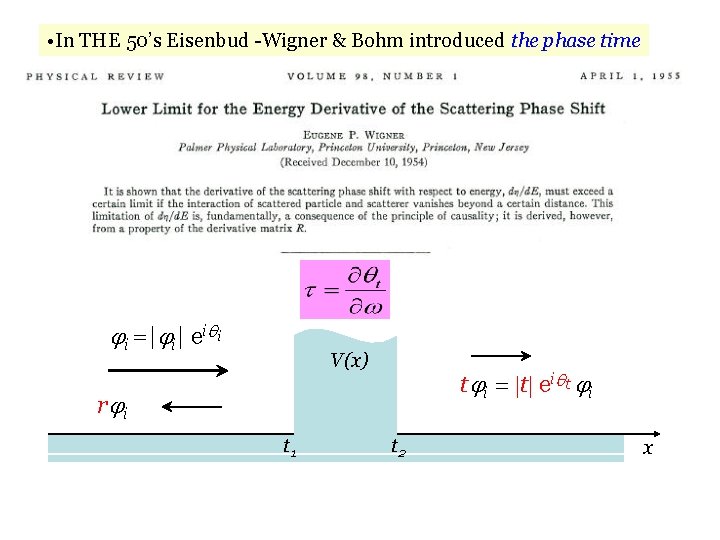
• In THE 50’s Eisenbud -Wigner & Bohm introduced the phase time ji =|ji| eiqi V(x) tji = |t| eiqt ji r ji t 1 t 2 x
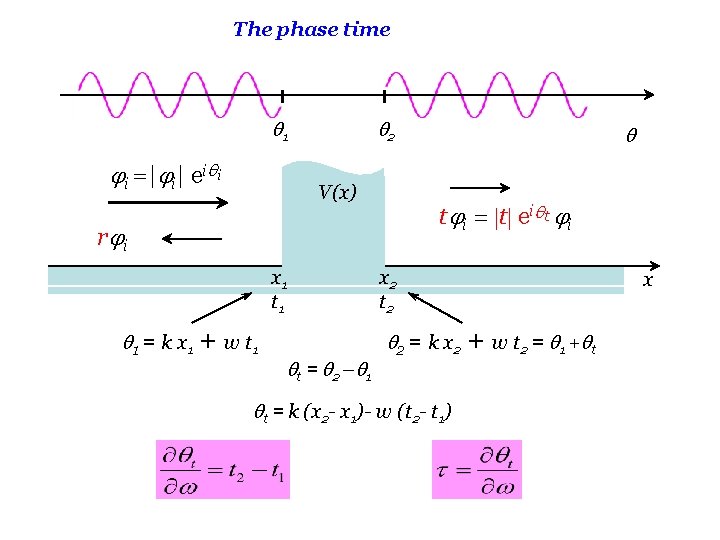
The phase time q 1 ji =|ji| eiqi q 2 V(x) tji = |t| eiqt ji r ji x 1 t 1 q 1 = k x 1 + w t 1 q t = q 2 –q 1 q x 2 t 2 q 2 = k x 2 qt = k (x 2 - x 1)- w (t 2 - t 1) x + w t 2 = q 1 +q t
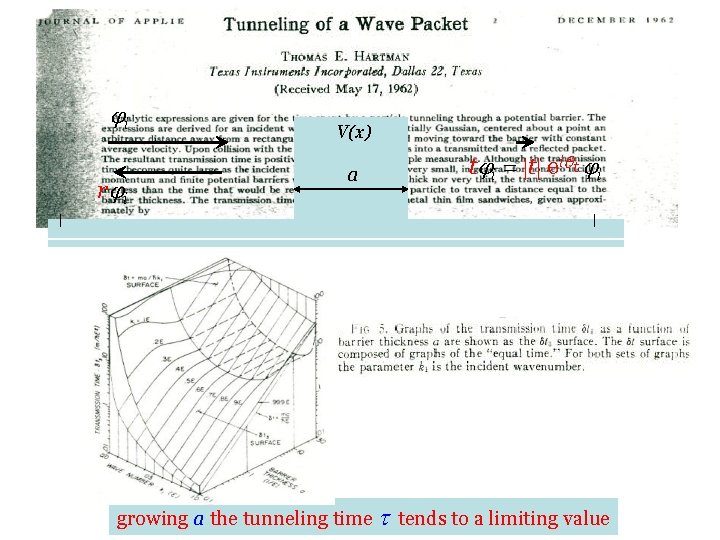
ji r ji V(x) a tji = |t| eiqt ji growing a the tunneling time t tends to a limiting value x
other TT definitions and formulas appeared in the literature, accompanied by intense debates.
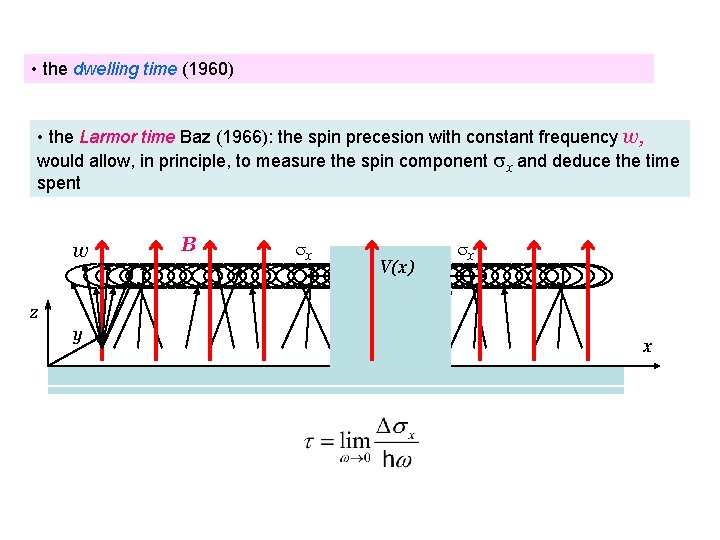
• the dwelling time (1960) • the Larmor time Baz (1966): the spin precesion with constant frequency w, would allow, in principle, to measure the spin component sx and deduce the time spent w B sx V(x) sx z y x
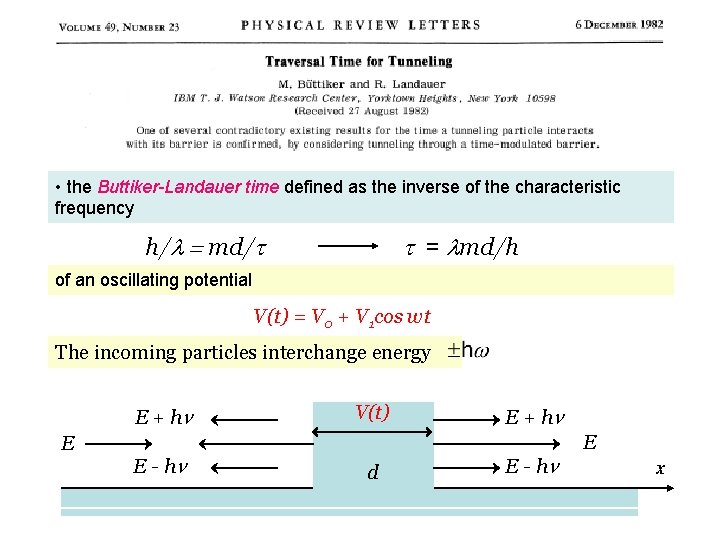
• the Buttiker-Landauer time defined as the inverse of the characteristic frequency h/l = md/t t = lmd/h of an oscillating potential V(t) = V 0 + V 1 cos wt The incoming particles interchange energy E + hn E E - hn V(t) d E + hn E - hn E x
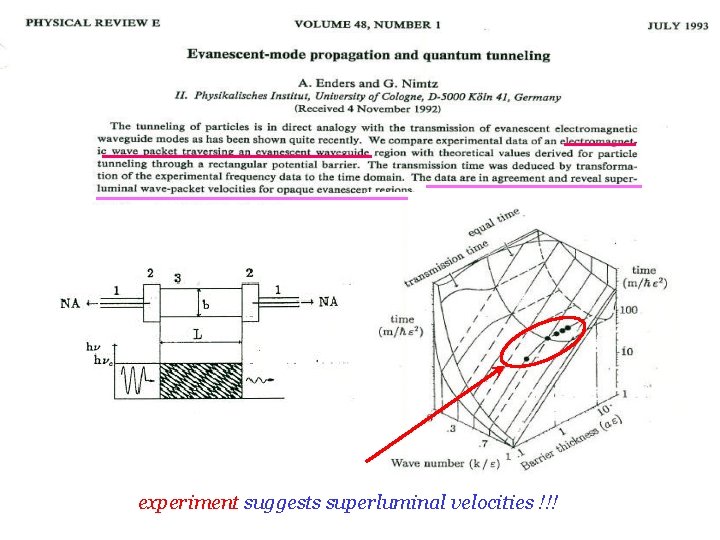
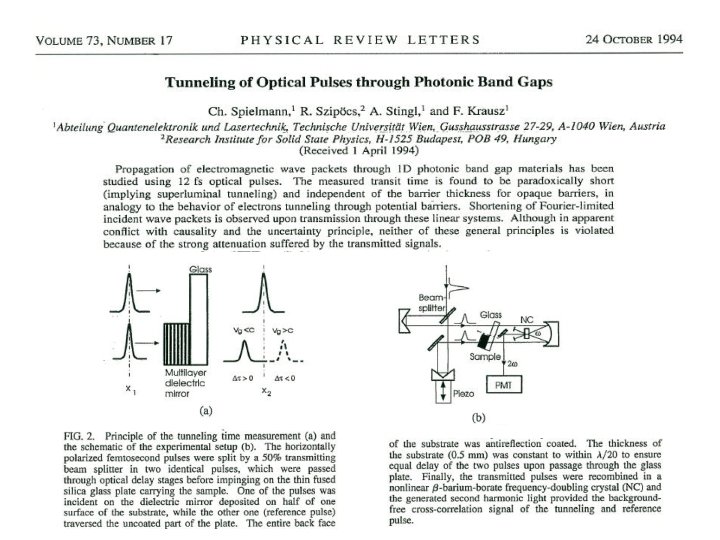
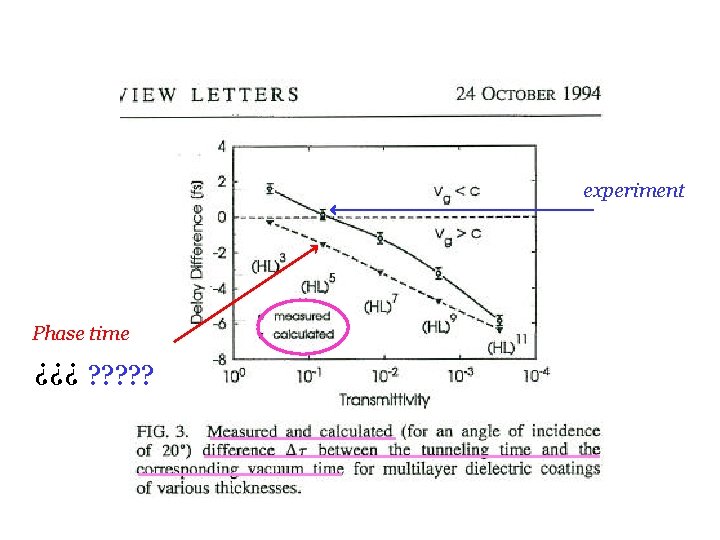
experiment suggests superluminal velocities !!!
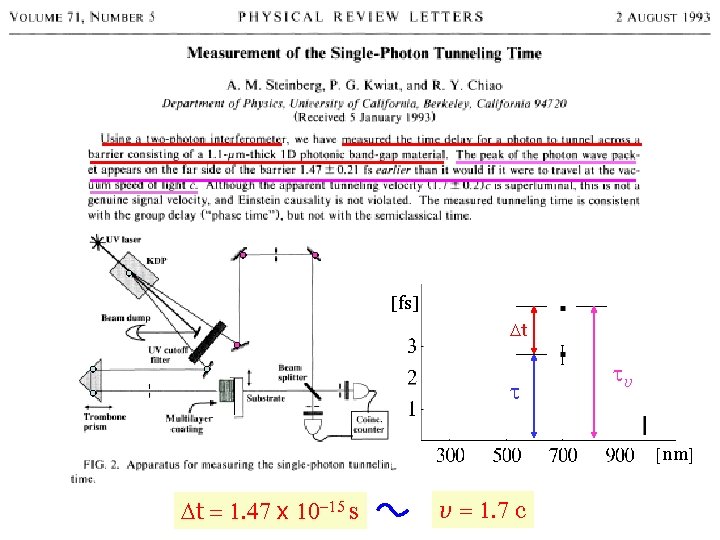
[fs] Dt t tv [nm] Dt = 1. 47 x 10 -15 s v = 1. 7 c
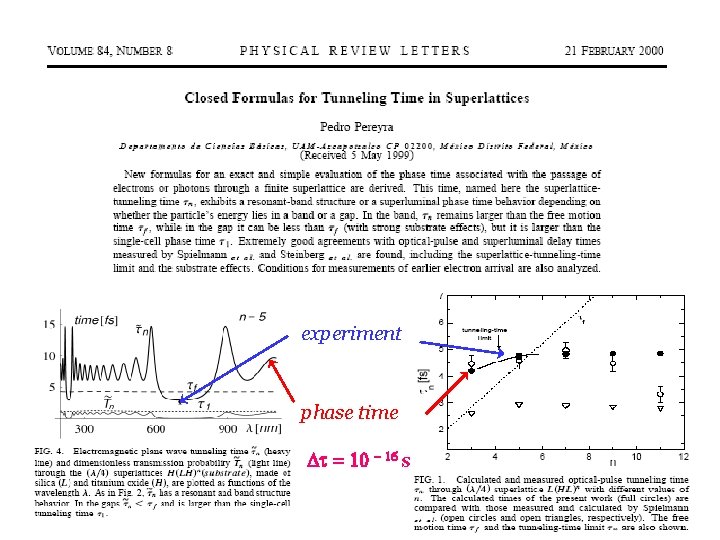
experiment Phase time ¿¿¿ ? ? ?
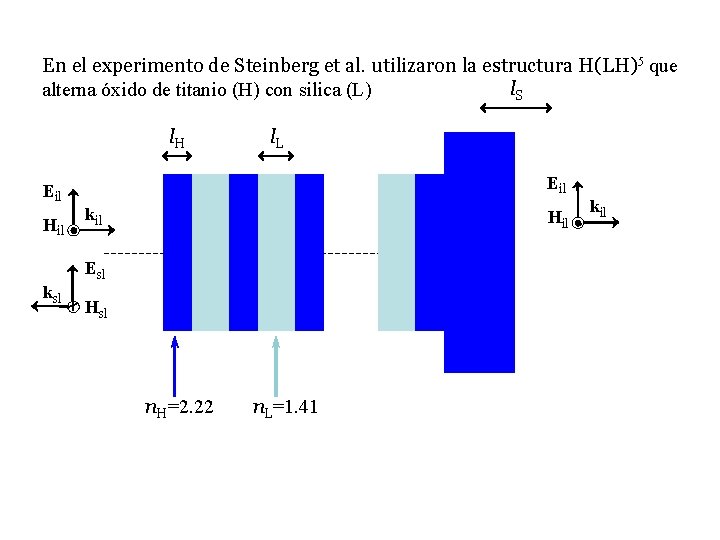
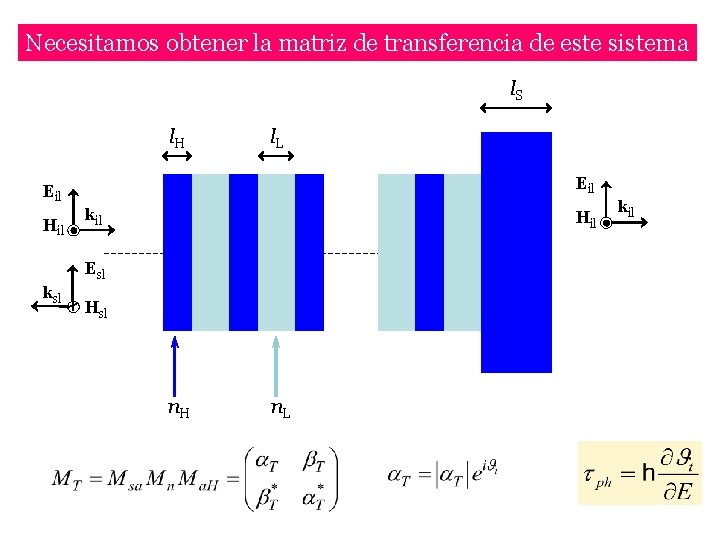
En el experimento de Steinberg et al. utilizaron la estructura H(LH)5 que l. S alterna óxido de titanio (H) con silica (L) l. H l. L Eil Hil kil Hil Esl ksl x H sl n. H=2. 22 n. L=1. 41 kil
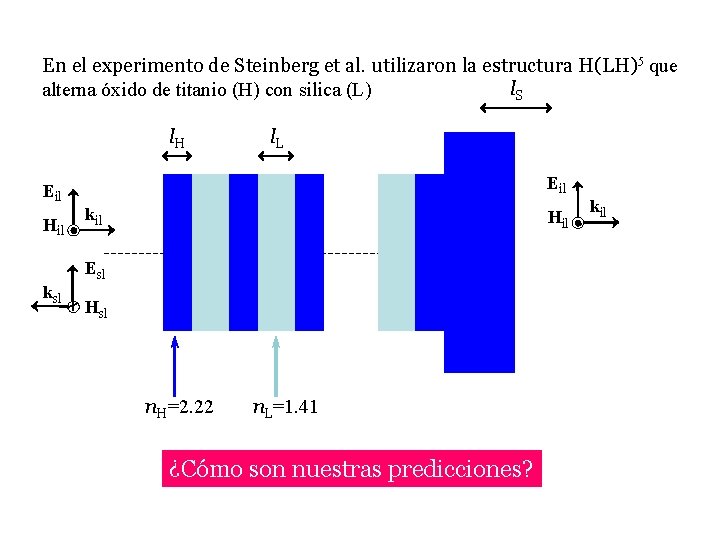
En el experimento de Steinberg et al. utilizaron la estructura H(LH)5 que l. S alterna óxido de titanio (H) con silica (L) l. H l. L Eil Hil kil Hil Esl ksl x H sl n. H=2. 22 n. L=1. 41 ¿Cómo son nuestras predicciones? kil
Necesitamos obtener la matriz de transferencia de este sistema l. S l. H l. L Eil Hil kil Hil Esl ksl x H sl n. H n. L kil
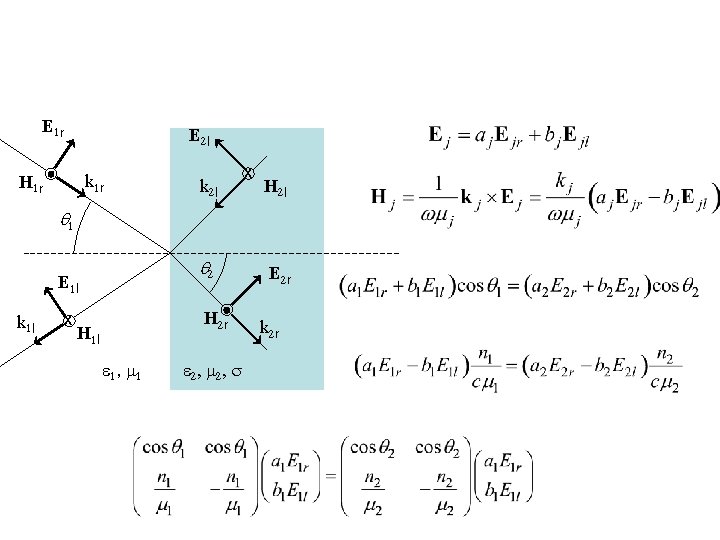
E 1 r E 2 l k 1 r H 1 r k 2 l x H 2 l q 1 q 2 E 1 l k 1 l x H 2 r H 1 l e 1 , m 1 e 2 , m 2 , s E 2 r k 2 r
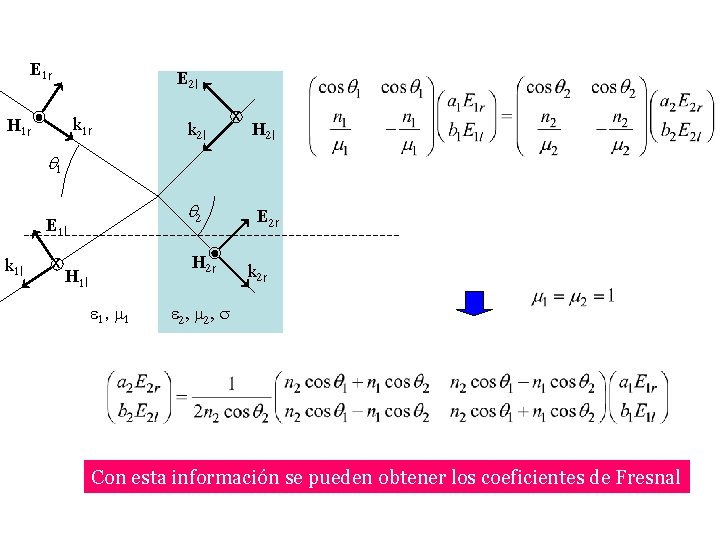
E 1 r E 2 l k 1 r H 1 r k 2 l x H 2 l q 1 q 2 E 1 l k 1 l x H 2 r H 1 l e 1 , m 1 E 2 r k 2 r e 2 , m 2 , s Con esta información se pueden obtener los coeficientes de Fresnal
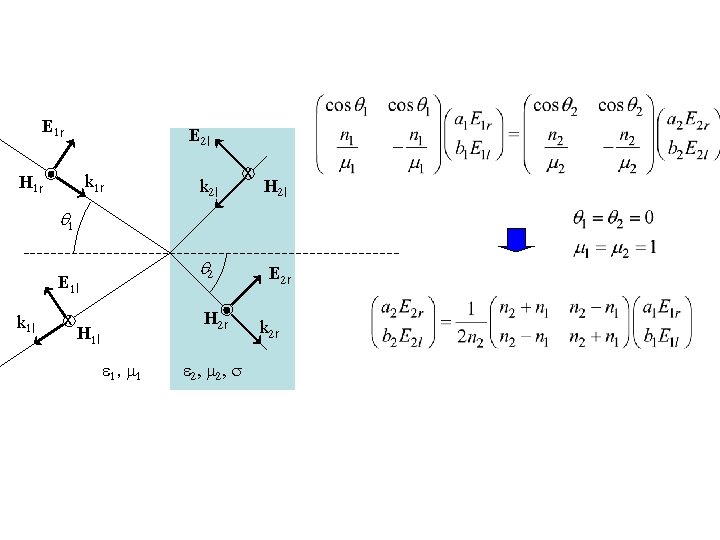
E 1 r E 2 l k 1 r H 1 r k 2 l x H 2 l q 1 q 2 E 1 l k 1 l x H 2 r H 1 l e 1 , m 1 e 2 , m 2 , s E 2 r k 2 r
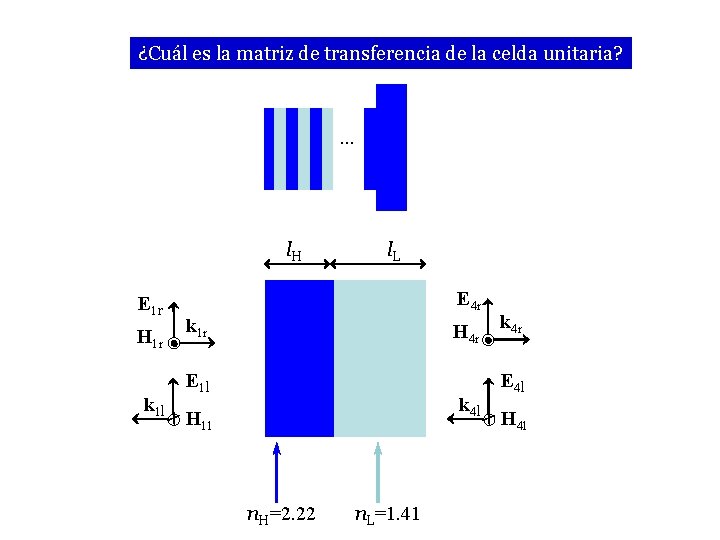
¿Cuál es la matriz de transferencia de la celda unitaria? … l. H E 1 r H 1 r k 1 l x l. L E 4 r k 1 r H 4 r E 1 l k 4 l x H 1 l n. H=2. 22 n. L=1. 41 k 4 r E 4 l H 4 l
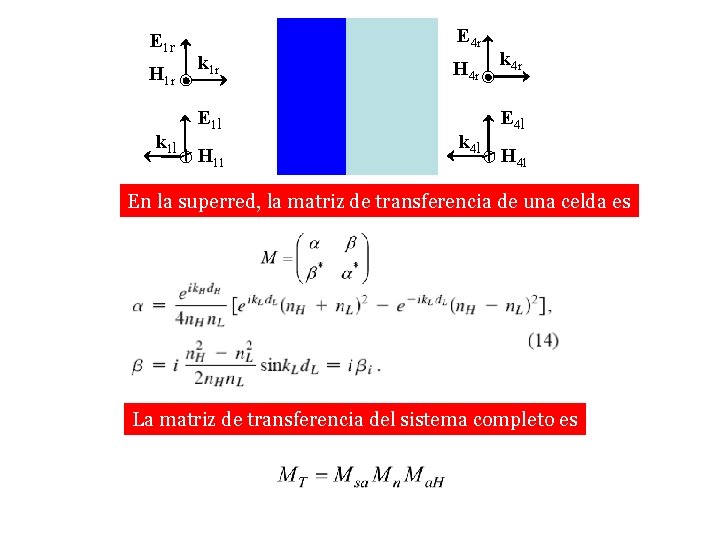
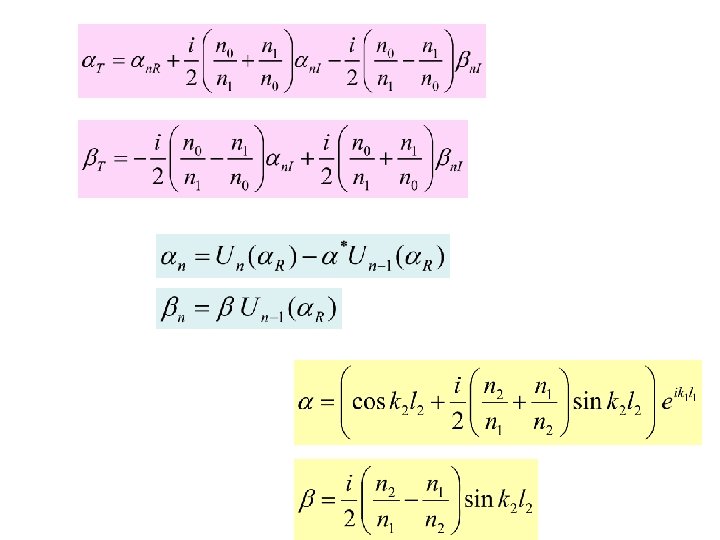
E 1 r H 1 r k 1 l x E 4 r k 1 r E 1 l H 4 r k 4 l x k 4 r E 4 l H 4 l En la superred, la matriz de transferencia de una celda es La matriz de transferencia del sistema completo es
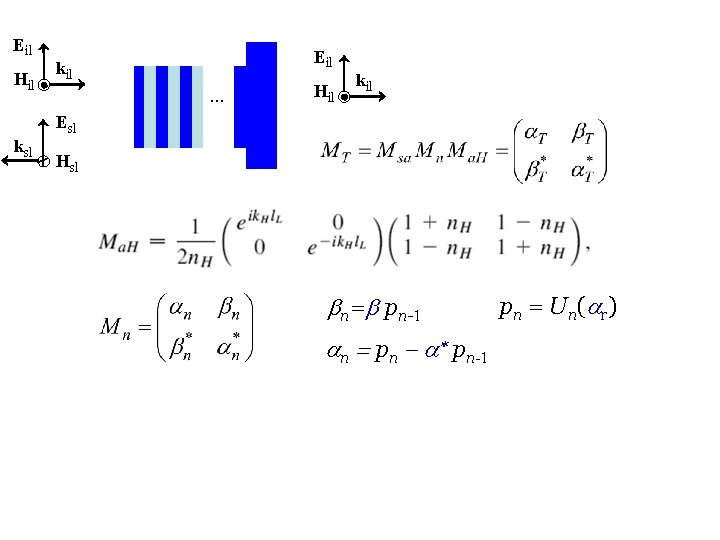
Eil Hil Eil kil … Hil kil Esl ksl x H sl bn=b pn-1 an = pn - a* pn-1 pn = Un(ar)
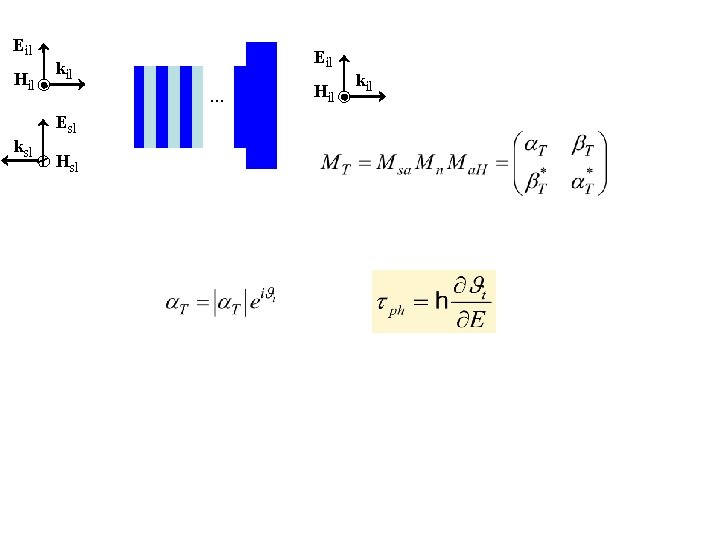
Eil Hil … Esl ksl Eil kil x H sl Hil kil
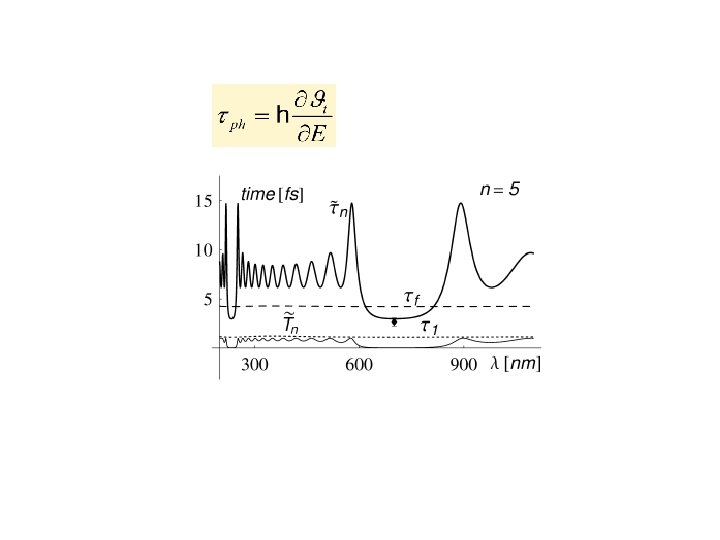
experiment phase time Dt = 10 - 16 s
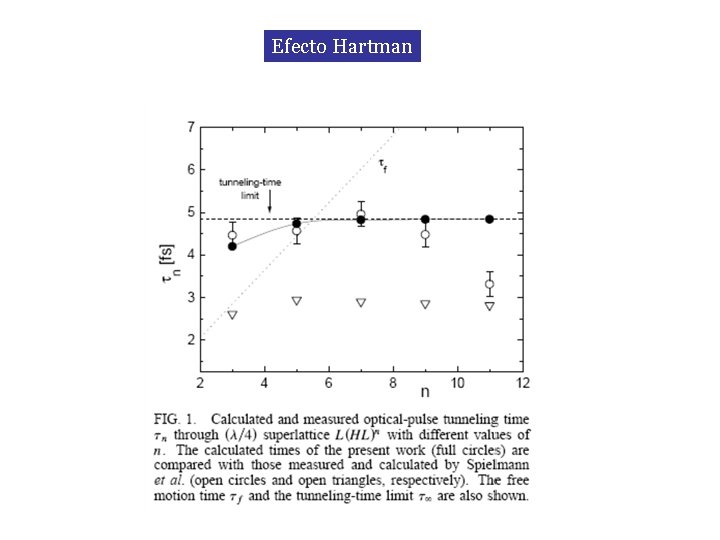
Efecto Hartman
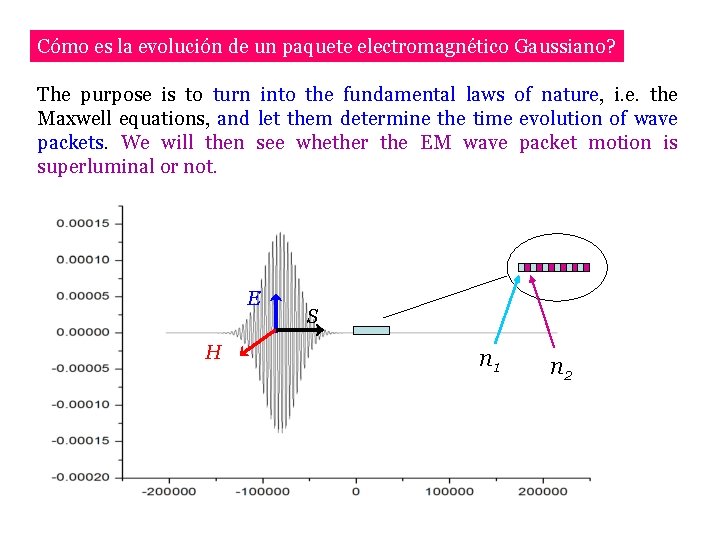
Cómo es la evolución de un paquete electromagnético Gaussiano? The purpose is to turn into the fundamental laws of nature, i. e. the Maxwell equations, and let them determine the time evolution of wave packets. We will then see whether the EM wave packet motion is superluminal or not. E H S n 1 n 2
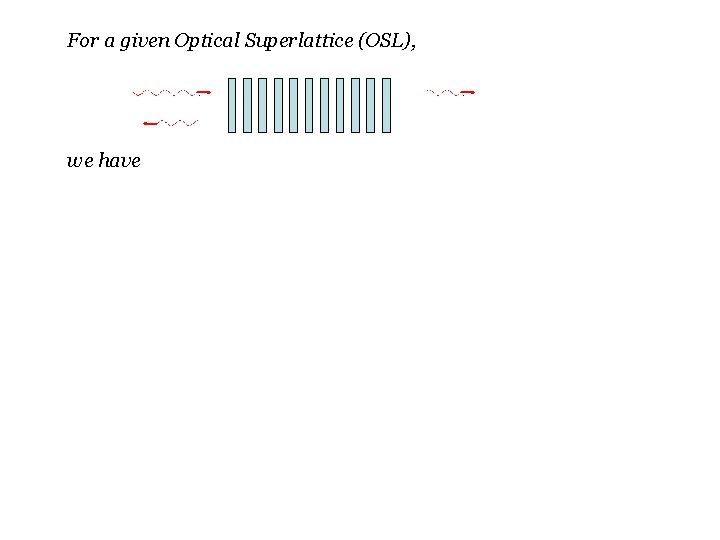
For a given Optical Superlattice (OSL), we have
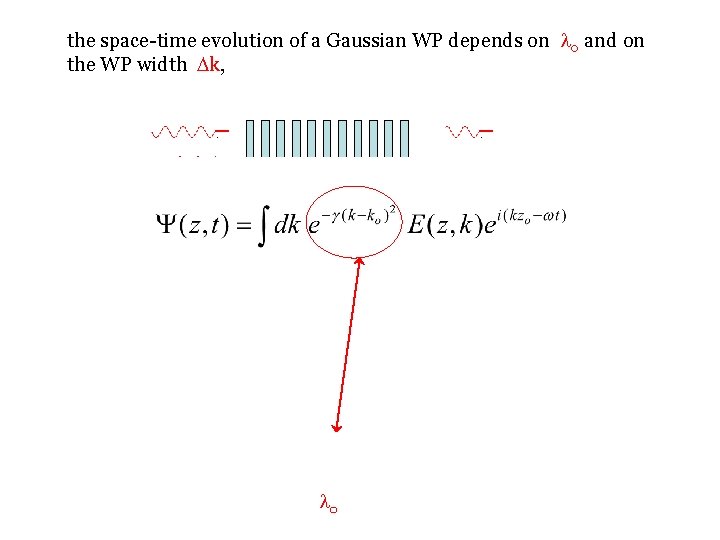
the space-time evolution of a Gaussian WP depends on lo and on the WP width Dk, lo
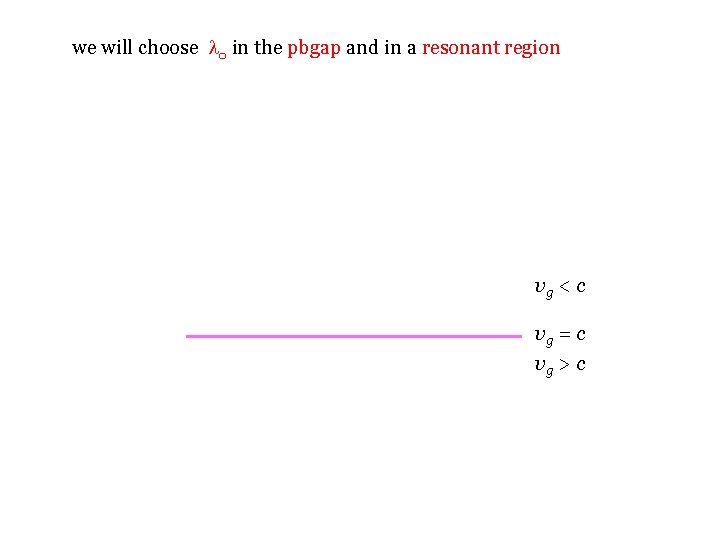
we will choose lo in the pbgap and in a resonant region vg < c vg = c vg > c
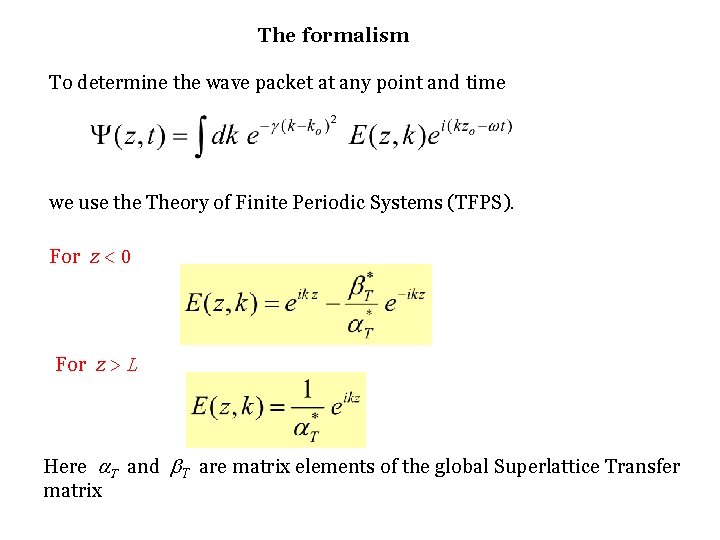
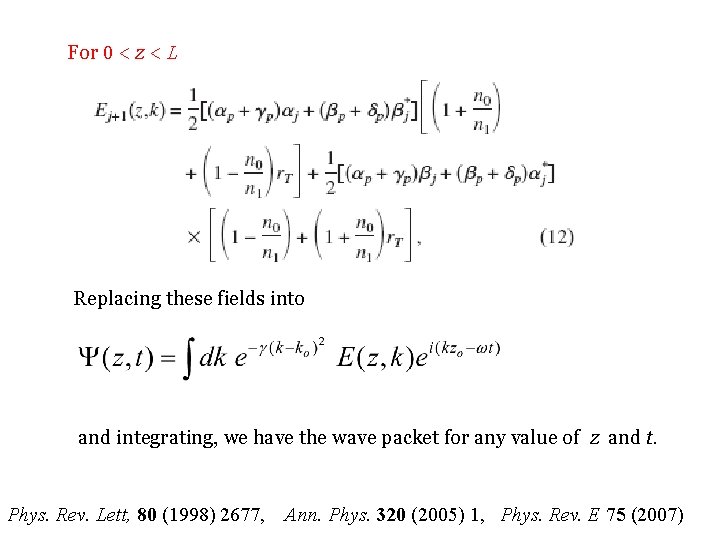
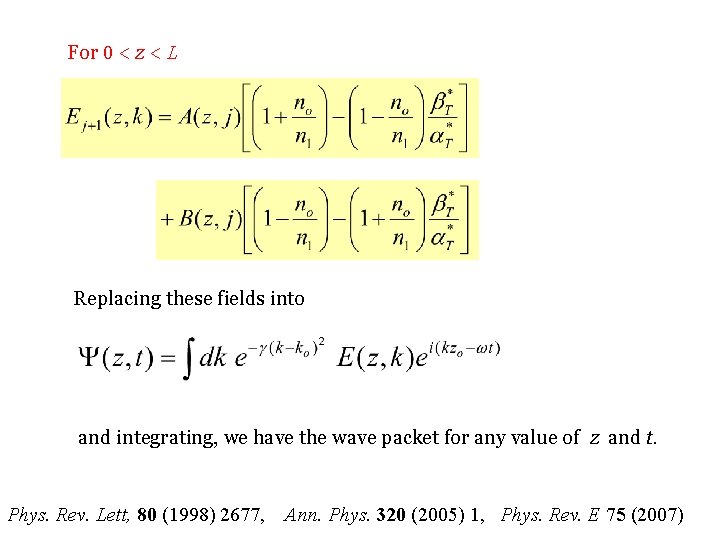
The formalism To determine the wave packet at any point and time we use the Theory of Finite Periodic Systems (TFPS). For z < 0 For z > L Here a. T and b. T are matrix elements of the global Superlattice Transfer matrix
For 0 < z < L Replacing these fields into and integrating, we have the wave packet for any value of z and t. Phys. Rev. Lett, 80 (1998) 2677, Ann. Phys. 320 (2005) 1, Phys. Rev. E 75 (2007)
For 0 < z < L Replacing these fields into and integrating, we have the wave packet for any value of z and t. Phys. Rev. Lett, 80 (1998) 2677, Ann. Phys. 320 (2005) 1, Phys. Rev. E 75 (2007)
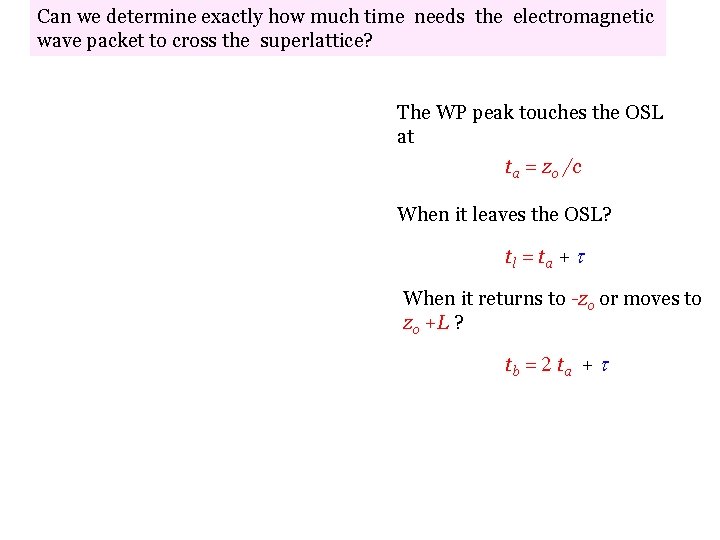
Can we determine exactly how much time needs the electromagnetic wave packet to cross the superlattice? The WP peak touches the OSL at ta = zo /c When it leaves the OSL? tl = ta + t When it returns to -zo or moves to zo +L ? tb = 2 ta + t
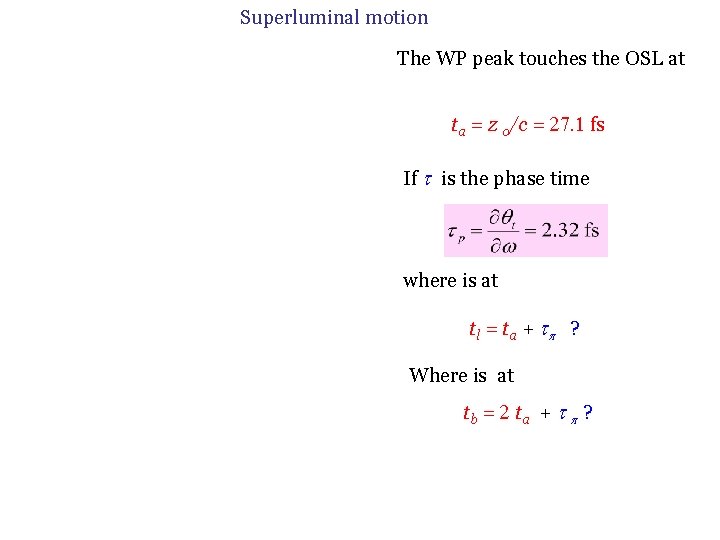
Superluminal motion The WP peak touches the OSL at ta = z o/c = 27. 1 fs If t is the phase time where is at tl = ta + t p ? Where is at tb = 2 ta + t p ?
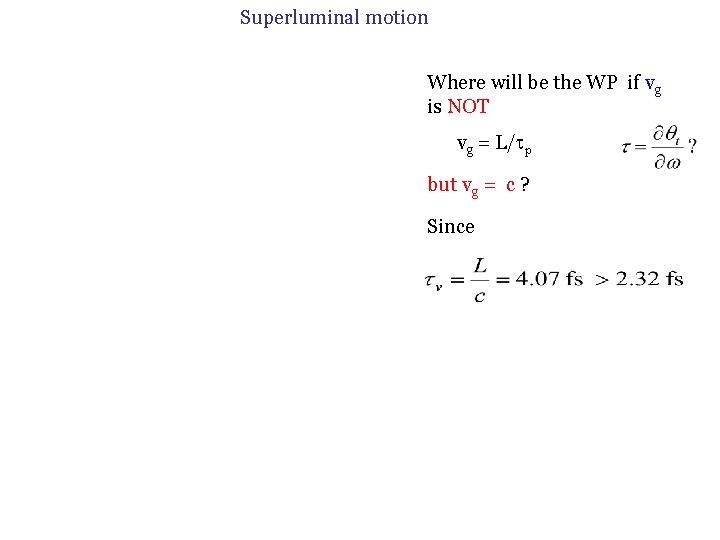
Superluminal motion Where will be the WP if vg is NOT vg = L/tp but vg = c ? Since
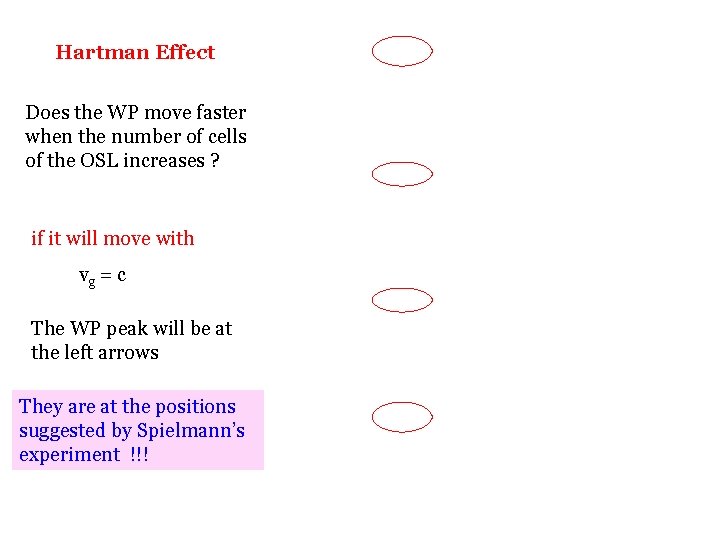
Hartman Effect Does the WP move faster when the number of cells of the OSL increases ? if it will move with vg = c The WP peak will be at the left arrows They are at the positions suggested by Spielmann’s experiment !!!