
El Minia University Faculty of Engineering Environmental Engineering
- Slides: 11
El- Minia University Faculty of Engineering Environmental Engineering 216 Civil Eng Prof. Dr. Mohsen Hashem 2020 – 2021 first semester Tel 01007104549
Brief Plan Deals with the basics of: Scheduled highlights the principles of environmental engineering , pollution sources and systems engineering to control the waste solids and wastewater collection and treatment. The decision also includes modular design wastewater treatment and reuse.
After the decision is expected to enable the student to: 1 - Familiarity with the principles of environmental engineering and pollution sources and their ill effects. 2 - Acquisition of student behaviors preservation of the environment. 3 - Knowledge of control systems in waste and rainwater sewage and methods of treatment and re-use. 4 - The modular design sewage treatment.
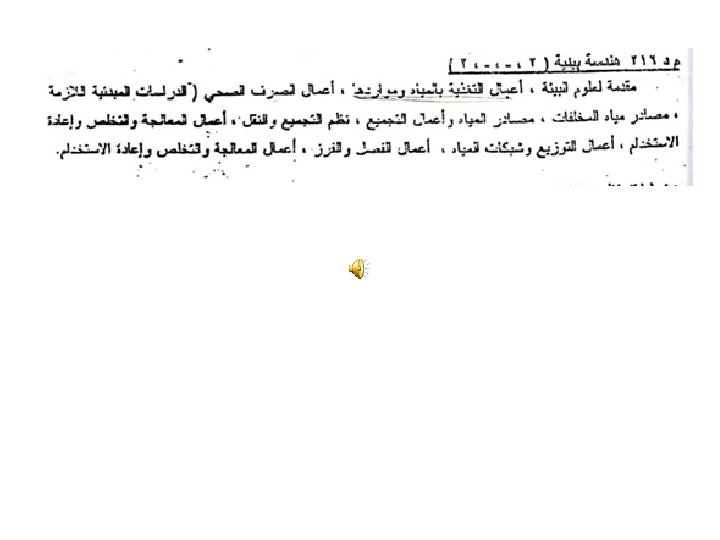
Topics This course covers: Principles of Environmental Engineering and sources of pollution - air pollution and regulations Engineering - Control Systems in waste solids - Water Quality - wastewater collection and design sewage - water treatment processes - processes of wastewater treatment - preliminary design of the various units - reuse wastewater.
Courses of Study Environmental Engineering is most closely related to civil and chemical engineering. It requires knowledge in many fields of science, including physics, chemistry, hydrology, geology, and biology. Undergraduate students working toward a degree in Environmental Engineering will take courses that cover these fields including microbiology, organic chemistry, microbiology, hydrology, engineering geology and others.
1 - 1 WHAT IS ENVIRONMENTAL ENGINEERING? Environmental engineers apply science and engineering principles to develop systems that protect human health and welfare and minimize the adverse effects of human activities on the environment. Environmental engineering involves: • Providing safe, palatable and ample water supplies • Reducing emissions of pollutants by developing engineered systems for treating air, water and hazardous wastes. • Predicting the transport and effects of contaminants through all media (air, water, land) in natural environments • Managing and remediating sites contaminated by improper disposal of hazardous materials • Protecting public health through application of engineering principles
We live at a time when no part of the natural environment is untouched by human activities. Although we have made great strides in addressing many of the natural resources and environmental problems caused by human activities, growth in the world population and rising standards of living continue to stress the natural environment and generate a spectrum of environmental problems that need to be addressed. Environmental engineers are called upon to understand, arrange, and manipulate the biological, chemical, ecological, economic, hydrological, physical, and social processes that take place in our environment in an effort to balance our material needs with the desire for sustainable environmental quality.
Using the principles of biology and chemistry, environmental engineers develop solutions to environmental problems. They are involved in water and air pollution control, recycling, waste disposal, and public health issues. Environmental engineers conduct hazardous-waste management studies in which they evaluate the significance of the hazard, offer analysis on treatment and containment, and develop regulations to prevent mishaps.
1 -2 Environmental Engineers Requirements Environmental engineers should be creative, inquisitive, analytical, and detail oriented. They must have a strong grasp of mathematics, including algebra, geometry, trigonometry, and calculus; sciences, such as biology, chemistry, and physics; and computer systems. Abilities to work as part of a team and to communicate well also will be important as environmental engineers' jobs become more diversified and require interaction with specialists outside engineering. To hone these skills, recommended coursework includes English, writing, social studies, and humanities.
1 -3 Environmental Engineers Concerning They design municipal water supply and industrial wastewater treatment systems. They conduct research on proposed environmental projects, analyze scientific data, and perform quality control checks. They provide legal and financial consulting on matters related to the environment. Environmental engineers are concerned with local and worldwide environmental issues. They study and attempt to minimize the effects of acid rain, global warming, automobile emissions, and ozone depletion. They also are involved in the protection of wildlife. Many environmental engineers work as consultants, helping their clients to comply with regulations and to clean up hazardous sites. Review Questions 1 - Define Environmental Engineering? 2 - What are the requirements for Environmental Engineering? 3 - List some of the environmental Engineer concerning?