
Ekaterina Gruzdeva Nikolai Vakhtin Language obsolescence in polysynthetic
Ekaterina Gruzdeva, Nikolai Vakhtin Language obsolescence in polysynthetic languages Based on chapter written for: Handbook of Polysynthesis. Ed. by Michael Fortescue, Marianne Mithun, and Nicholas Evans, Oxford UP. In press
Questions • what happens, at different linguistic levels, to a polysynthetic language when it falls out of use, becomes obsolescent and is gradually replaced by a dominant language • how the changes that take place in decaying polysynthetic languages can be distinguished from (a) those changes that occur in all obsolescent languages regardless of their type, and (b) changes in “healthy” polysynthetic languages
Polysynthetic languages and polysynthetic features • complex morphological structure: polysynthetic word forms are characterized by numerous morphological ‘slots’ and a large inventory of bound morphemes; • head-marking (or double marking) type of inflection: – nominal forms usually bear possessive marking; – verbal forms typically contain pronominal markers, as well as various integrated adverbial elements; these features allow verbal forms to be used as sentence equivalents; • incorporation: adjectives are incorporated into nominal forms and nouns are incorporated into verbal forms (Fortescue 1994, 2007)
Language obsolescence and language attrition • Language obsolescence (= language loss, shift, death, decay, attrition, decline, contraction, deacquisition • first vs. second language (order of acquisition) • dominant vs. recessive language (level of usage)

Stages of attrition • early stage: attrition hard to diagnose, natural contact changes, (i) convergence or ‘negative borrowing’; (ii) interference or ‘positive borrowing’ (Romaine 1995; Sasse 1992) • terminal stage: radical reduction and total disintegration of the recessive language: not particularly interesting from a linguistic point of view • Focus of this lecture: middle stage of language obsolescence structural changes that go beyond “normal” contact-induced changes
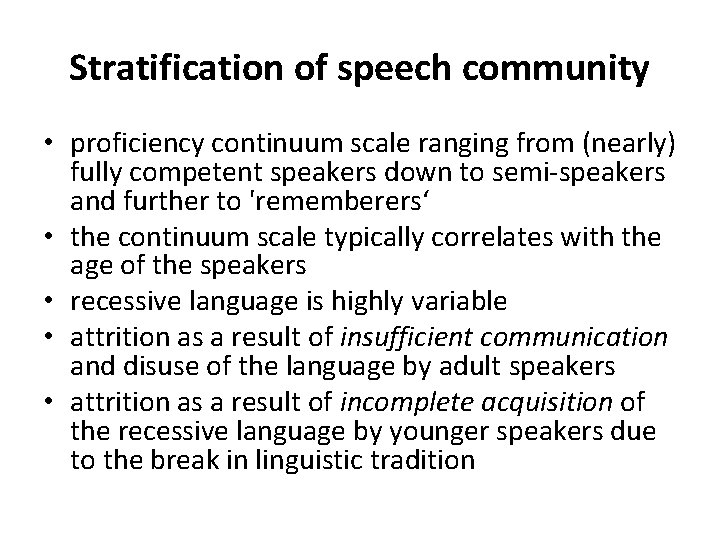
Stratification of speech community • proficiency continuum scale ranging from (nearly) fully competent speakers down to semi-speakers and further to 'rememberers‘ • the continuum scale typically correlates with the age of the speakers • recessive language is highly variable • attrition as a result of insufficient communication and disuse of the language by adult speakers • attrition as a result of incomplete acquisition of the recessive language by younger speakers due to the break in linguistic tradition
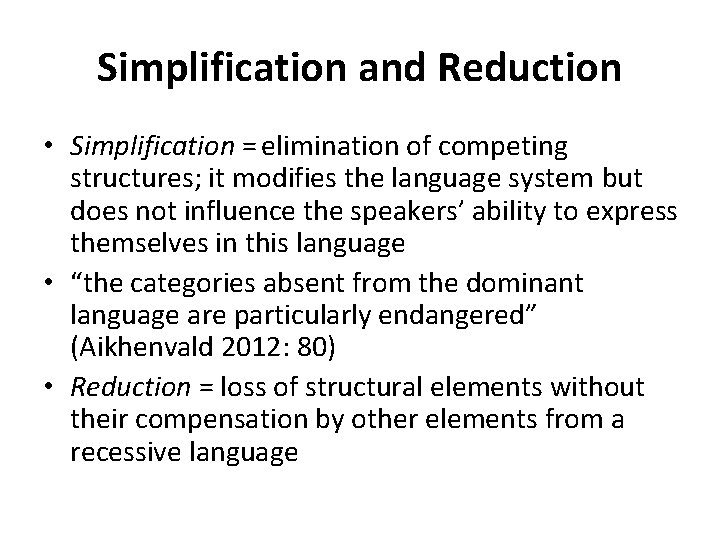
Simplification and Reduction • Simplification = elimination of competing structures; it modifies the language system but does not influence the speakers’ ability to express themselves in this language • “the categories absent from the dominant language are particularly endangered” (Aikhenvald 2012: 80) • Reduction = loss of structural elements without their compensation by other elements from a recessive language
Two answers to the questions • contrast between language change in “healthy” and decaying languages is in the quantity of change and in its speed • specific feature of a polysynthetic language is that here all changes will be accompanied by changes in the morphological structure of verbs
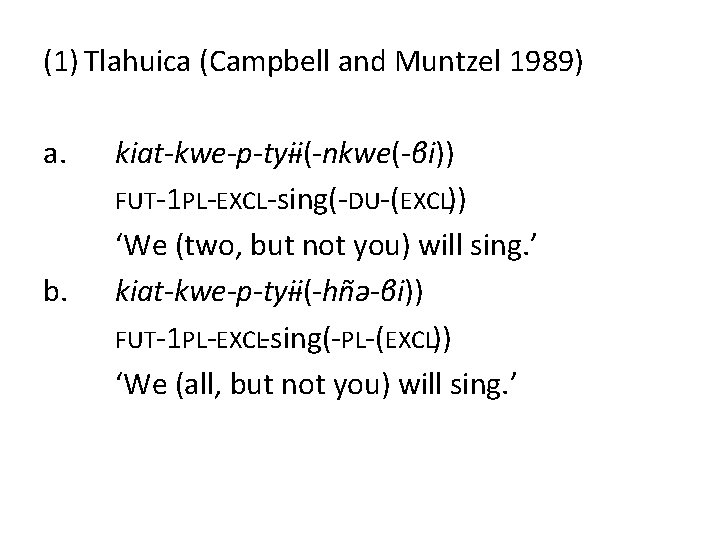
(1) Tlahuica (Campbell and Muntzel 1989) a. b. kiat-kwe-p-tyɨɨ(-nkwe(-βi)) FUT-1 PL-EXCL-sing(-DU-(EXCL)) ‘We (two, but not you) will sing. ’ kiat-kwe-p-tyɨɨ(-hñə-βi)) FUT-1 PL-EXCL-sing(-PL-(EXCL)) ‘We (all, but not you) will sing. ’
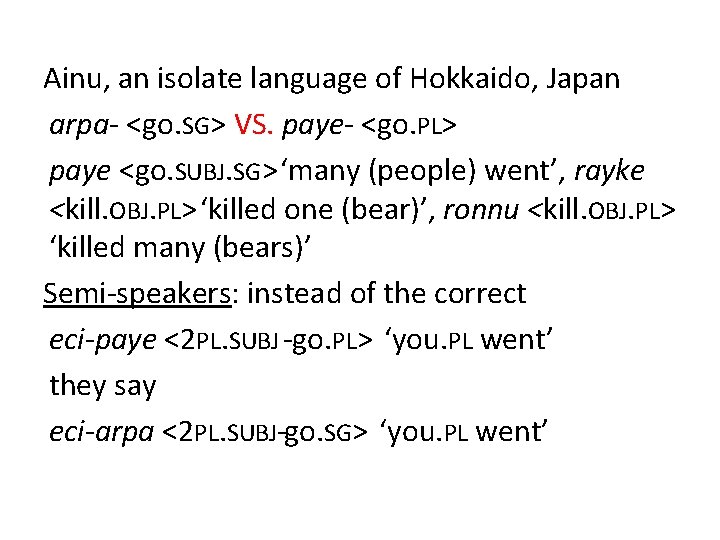
Ainu, an isolate language of Hokkaido, Japan arpa- <go. SG> VS. paye- <go. PL> paye <go. SUBJ. SG> ‘many (people) went’, rayke <kill. OBJ. PL> ‘killed one (bear)’, ronnu <kill. OBJ. PL> ‘killed many (bears)’ Semi-speakers: instead of the correct eci-paye <2 PL. SUBJ -go. PL> ‘you. PL went’ they say eci-arpa <2 PL. SUBJ-go. SG> ‘you. PL went’
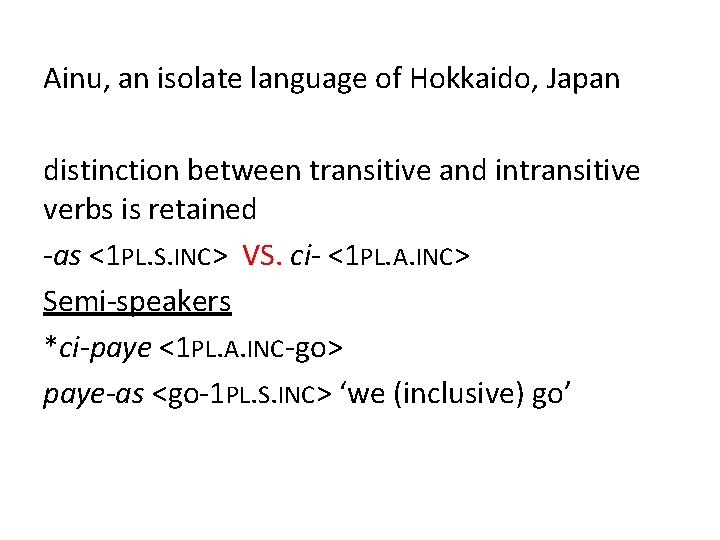
Ainu, an isolate language of Hokkaido, Japan distinction between transitive and intransitive verbs is retained -as <1 PL. S. INC > VS. ci- <1 PL. A. INC > Semi-speakers *ci-paye <1 PL. A. INC -go> paye-as <go-1 PL. S. INC > ‘we (inclusive) go’
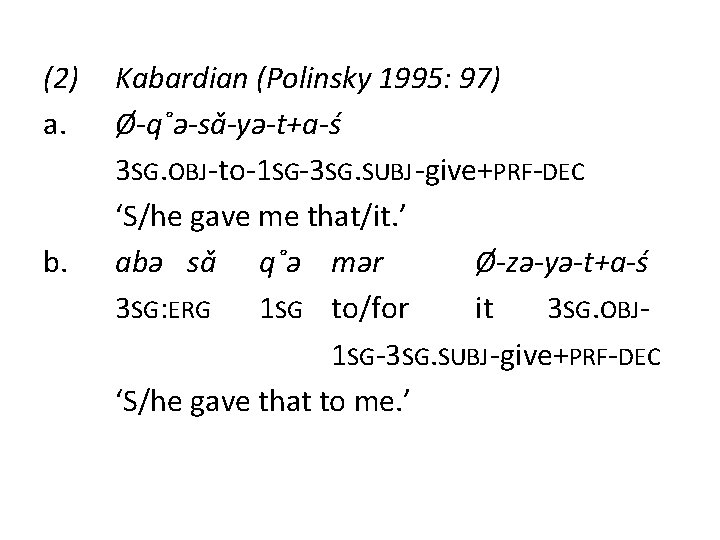
(2) a. b. Kabardian (Polinsky 1995: 97) Ø-q˚ǝ-sǎ-yǝ-t+a-ś 3 SG. OBJ -to-1 SG-3 SG. SUBJ -give+PRF-DEC ‘S/he gave me that/it. ’ abǝ sǎ q˚ǝ mǝr Ø-zǝ-yǝ-t+a-ś 3 SG: ERG 1 SG to/for it 3 SG. OBJ 1 SG-3 SG. SUBJ -give+PRF-DEC ‘S/he gave that to me. ’
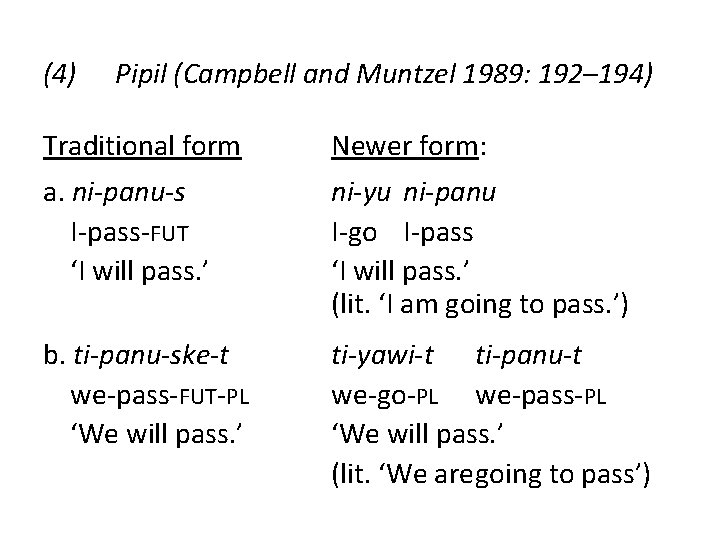
(4) Pipil (Campbell and Muntzel 1989: 192– 194) Traditional form Newer form: a. ni-panu-s I-pass-FUT ‘I will pass. ’ ni-yu ni-panu I-go I-pass ‘I will pass. ’ (lit. ‘I am going to pass. ’) b. ti-panu-ske-t we-pass-FUT-PL ‘We will pass. ’ ti-yawi-t ti-panu-t we-go-PL we-pass-PL ‘We will pass. ’ (lit. ‘We aregoing to pass’)
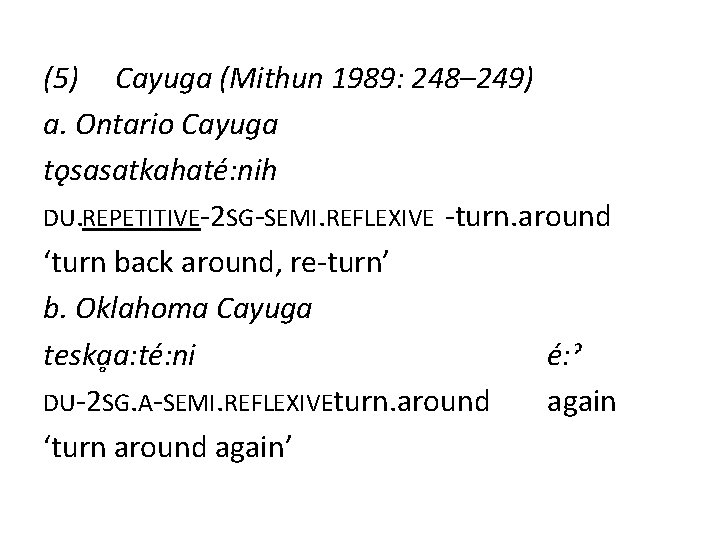
(5) Cayuga (Mithun 1989: 248– 249) a. Ontario Cayuga tǫsasatkahaté: nih DU. REPETITIVE-2 SG-SEMI. REFLEXIVE -turn. around ‘turn back around, re-turn’ b. Oklahoma Cayuga teskḁa: té: ni é: ˀ DU-2 SG. A-SEMI. REFLEXIVE-turn. around again ‘turn around again’
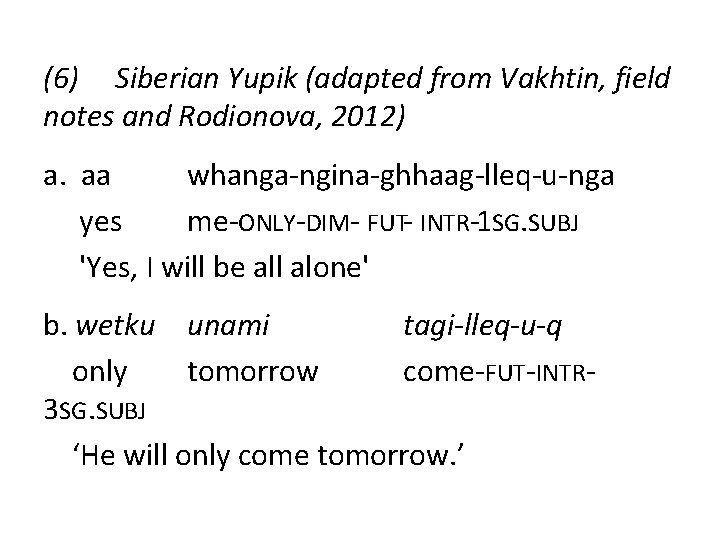
(6) Siberian Yupik (adapted from Vakhtin, field notes and Rodionova, 2012) a. aa whanga-ngina-ghhaag-lleq-u-nga yes me-ONLY-DIM- FUT- INTR-1 SG. SUBJ 'Yes, I will be all alone' b. wetku unami tagi-lleq-u-q only tomorrow come-FUT-INTR 3 SG. SUBJ ‘He will only come tomorrow. ’
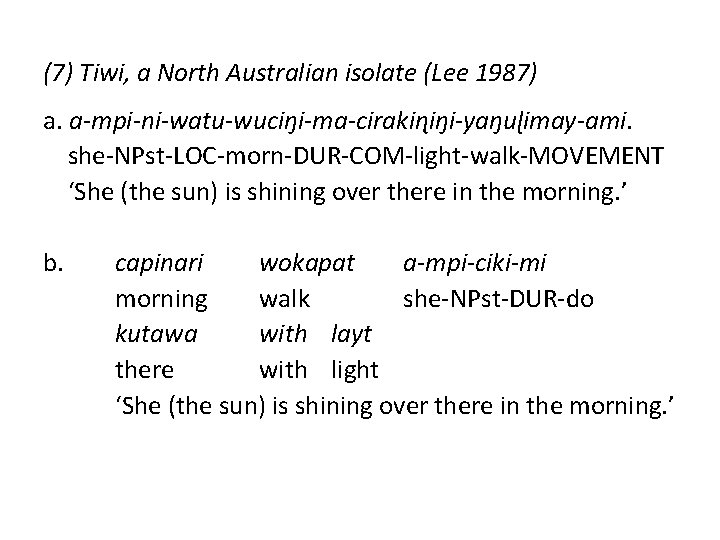
(7) Tiwi, a North Australian isolate (Lee 1987) a. a-mpi-ni-watu-wuciŋi-ma-cirakiɳiŋi-yaŋuɭimay-ami. she-NPst-LOC-morn-DUR-COM-light-walk-MOVEMENT ‘She (the sun) is shining over there in the morning. ’ b. capinari wokapat a-mpi-ciki-mi morning walk she-NPst-DUR-do kutawa with layt there with light ‘She (the sun) is shining over there in the morning. ’
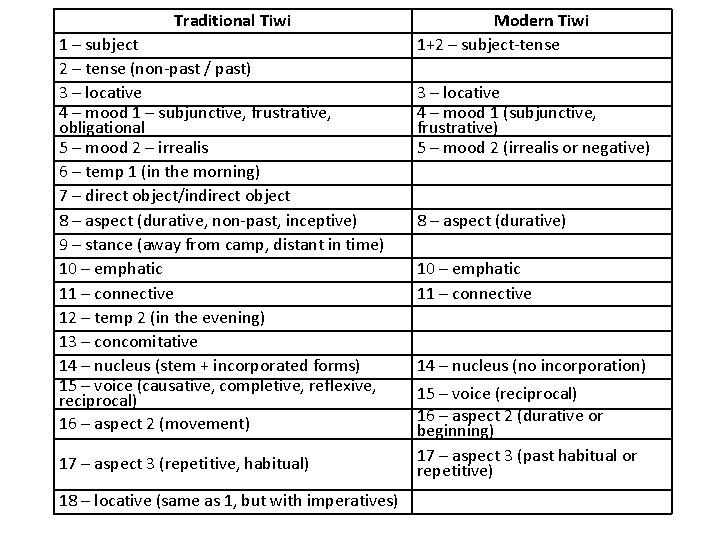
Traditional Tiwi 1 – subject 2 – tense (non-past / past) 3 – locative 4 – mood 1 – subjunctive, frustrative, obligational 5 – mood 2 – irrealis 6 – temp 1 (in the morning) 7 – direct object/indirect object 8 – aspect (durative, non-past, inceptive) 9 – stance (away from camp, distant in time) 10 – emphatic 11 – connective 12 – temp 2 (in the evening) 13 – concomitative 14 – nucleus (stem + incorporated forms) 15 – voice (causative, completive, reflexive, reciprocal) 16 – aspect 2 (movement) Modern Tiwi 1+2 – subject-tense 3 – locative 4 – mood 1 (subjunctive, frustrative) 5 – mood 2 (irrealis or negative) 8 – aspect (durative) 10 – emphatic 11 – connective 14 – nucleus (no incorporation) 17 – aspect 3 (repetitive, habitual) 15 – voice (reciprocal) 16 – aspect 2 (durative or beginning) 17 – aspect 3 (past habitual or repetitive) 18 – locative (same as 1, but with imperatives)
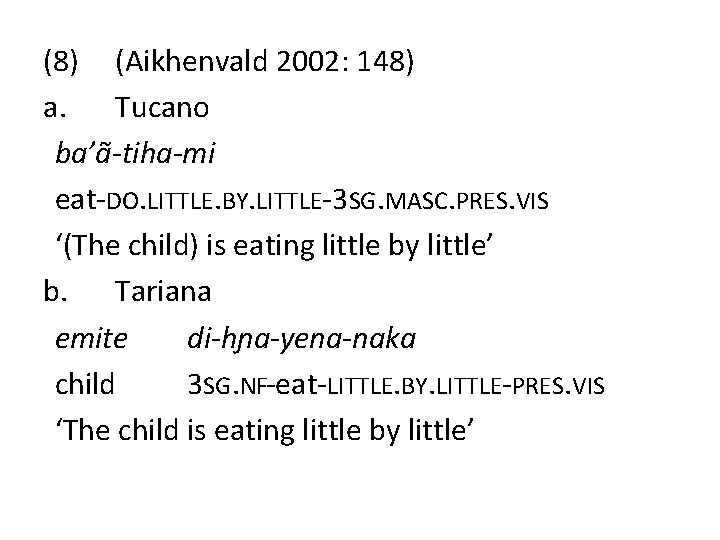
(8) (Aikhenvald 2002: 148) a. Tucano ba’ã-tiha-mi eat-DO. LITTLE. BY. LITTLE-3 SG. MASC. PRES. VIS ‘(The child) is eating little by little’ b. Tariana еmite di-hɲa-yena-naka child 3 SG. NF-eat-LITTLE. BY. LITTLE-PRES. VIS ‘The child is eating little by little’
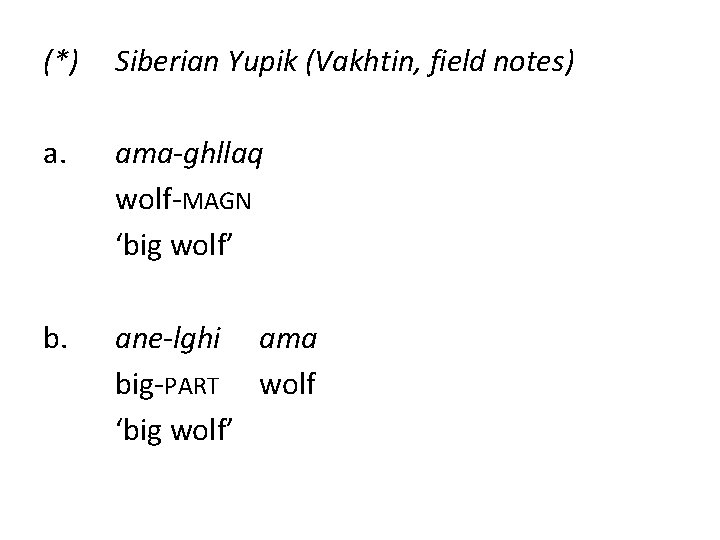
(*) Siberian Yupik (Vakhtin, field notes) a. ama-ghllaq wolf-MAGN ‘big wolf’ b. ane-lghi ama big-PART wolf ‘big wolf’
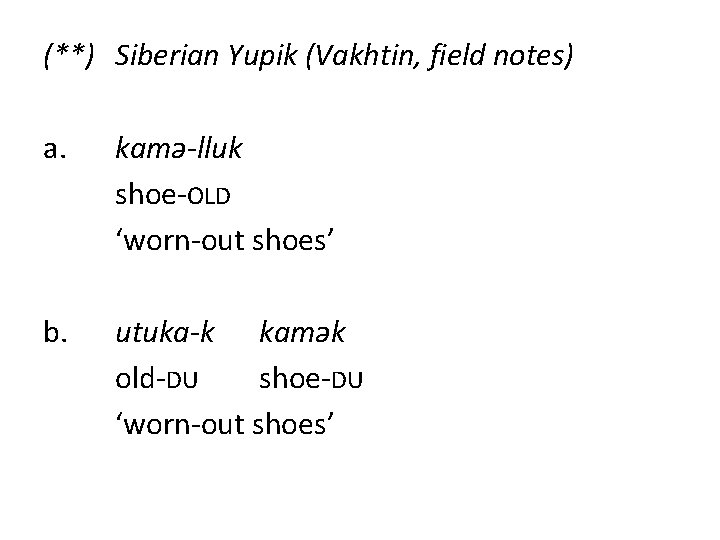
(**) Siberian Yupik (Vakhtin, field notes) a. kamə-lluk shoe-OLD ‘worn-out shoes’ b. utuka-k kamək old-DU shoe-DU ‘worn-out shoes’
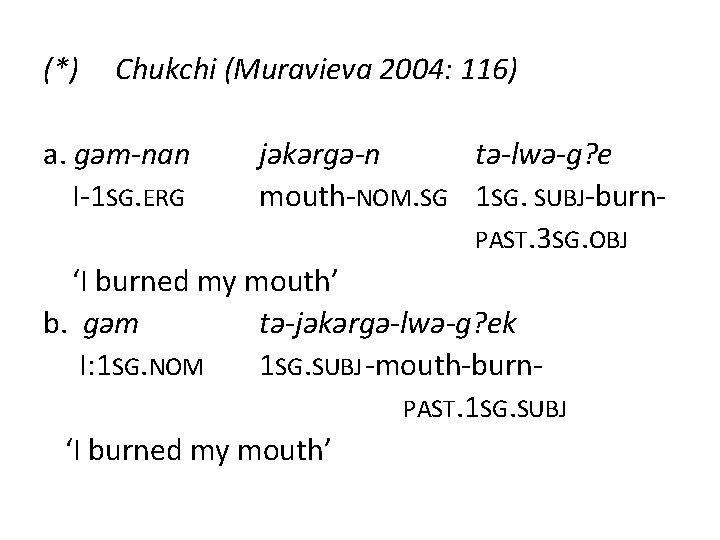
(*) Chukchi (Muravieva 2004: 116) a. gǝm-nan I-1 SG. ERG jǝkǝrgǝ-n tǝ-lwǝ-g? e mouth-NOM. SG 1 SG. SUBJ-burn. PAST. 3 SG. OBJ ‘I burned my mouth’ b. gǝm tǝ-jǝkǝrgǝ-lwǝ-g? ek I: 1 SG. NOM 1 SG. SUBJ -mouth-burn. PAST. 1 SG. SUBJ ‘I burned my mouth’
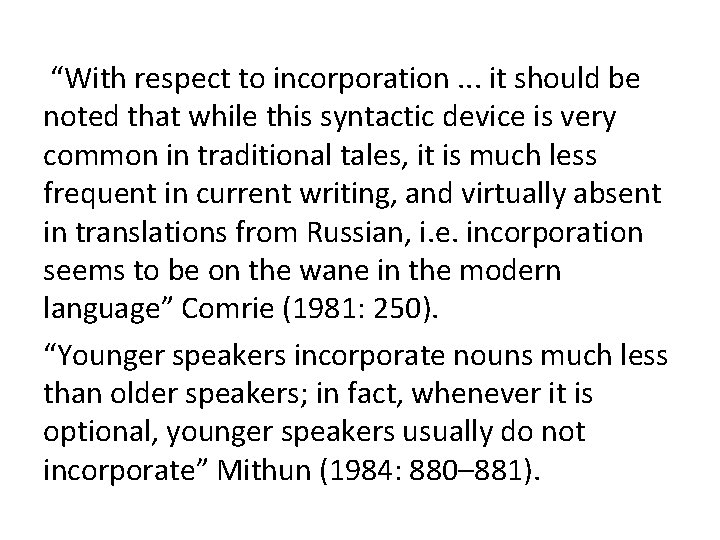
“With respect to incorporation. . . it should be noted that while this syntactic device is very common in traditional tales, it is much less frequent in current writing, and virtually absent in translations from Russian, i. e. incorporation seems to be on the wane in the modern language” Comrie (1981: 250). “Younger speakers incorporate nouns much less than older speakers; in fact, whenever it is optional, younger speakers usually do not incorporate” Mithun (1984: 880– 881).
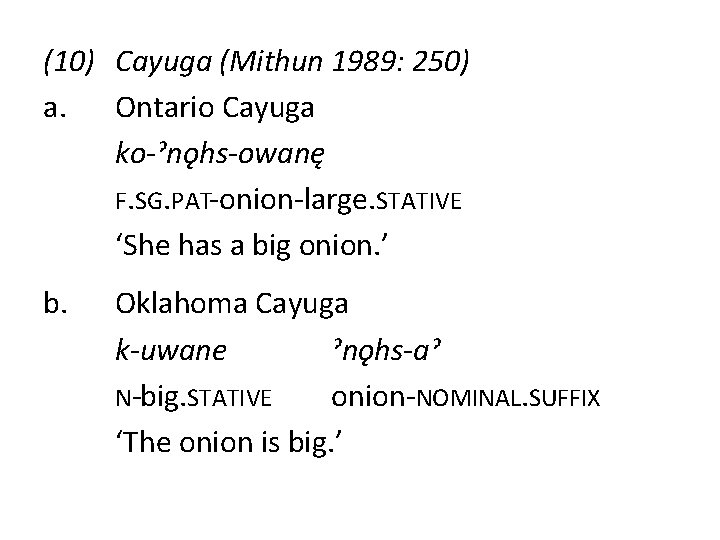
(10) Cayuga (Mithun 1989: 250) a. Ontario Cayuga ko-ˀnǫhs-owanę F. SG. PAT-onion-large. STATIVE ‘She has a big onion. ’ b. Oklahoma Cayuga k-uwane ˀnǫhs-aˀ N-big. STATIVE onion-NOMINAL. SUFFIX ‘The onion is big. ’
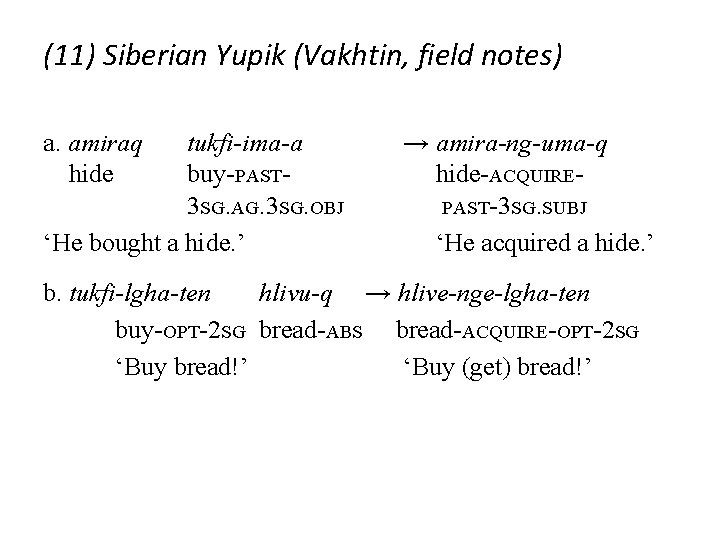
(11) Siberian Yupik (Vakhtin, field notes) a. amiraq hide tukfi-ima-a buy-PAST 3 SG. AG. 3 SG. OBJ ‘He bought a hide. ’ → amira-ng-uma-q hide-ACQUIREPAST-3 SG. SUBJ ‘He acquired a hide. ’ b. tukfi-lgha-ten hlivu-q → hlive-nge-lgha-ten buy-OPT-2 SG bread-ABS bread-ACQUIRE-OPT-2 SG ‘Buy bread!’ ‘Buy (get) bread!’
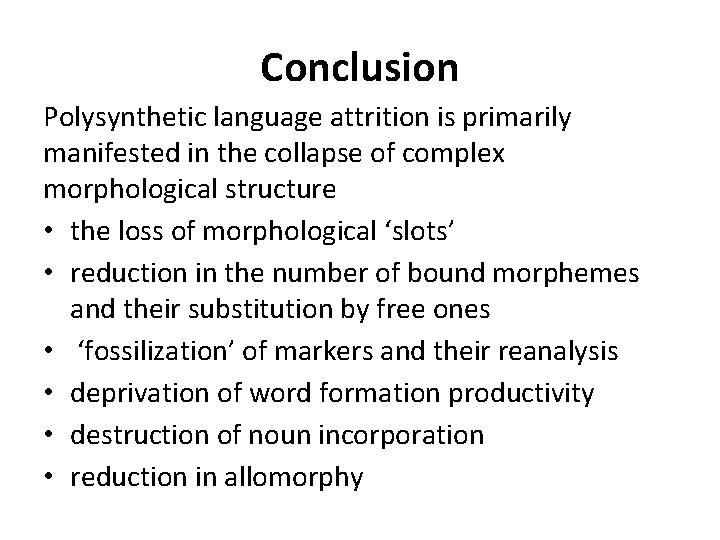
Conclusion Polysynthetic language attrition is primarily manifested in the collapse of complex morphological structure • the loss of morphological ‘slots’ • reduction in the number of bound morphemes and their substitution by free ones • ‘fossilization’ of markers and their reanalysis • deprivation of word formation productivity • destruction of noun incorporation • reduction in allomorphy
Conclusion Polysynthetic language families show evidence of having remained polysynthetic over a long period of time despite typological pressure from other languages (Fortescue 1992: 245, fn. 5) “…in the end, however, what is most striking about the Oklahoma speakers is not the minor ways in which they differ from Ontario speakers; it is, instead, their nearly complete retention of an amazingly complex morphological and phonological system, under such limited opportunities to use it” Mithun (1989: 257).
Conclusion • Any change in a language system is seen “as halting or delaying a shift” • Any language strives to survive, all changes that occur in its structure can be interpreted as means of resistance • The closer a recessive polysynthetic language becomes to the dominant language the more chances it has of survival • “The life” of a polysynthetic language may be significantly prolonged in a new, less polysynthetic or even non-polysynthetic, hypostasis.
Thank you for your attention From both of us
- Slides: 28