
EJSCREEN Environmental Justice Screening Tool 1 Background EPAs

EJSCREEN: Environmental Justice Screening Tool 1
Background ♦ EPA’s new tool for EJ screening and mapping ♦ Web-based GIS tool and data for EPA and the public ♦ Plan EJ 2014 announced EPA’s plan to create a new, nationally consistent EJ screening tool ♦ Builds upon NEJAC report on EJ screening, and prior work across EPA programs and Regions ♦ Peer reviewed by experts on geospatial tools and EJ 2
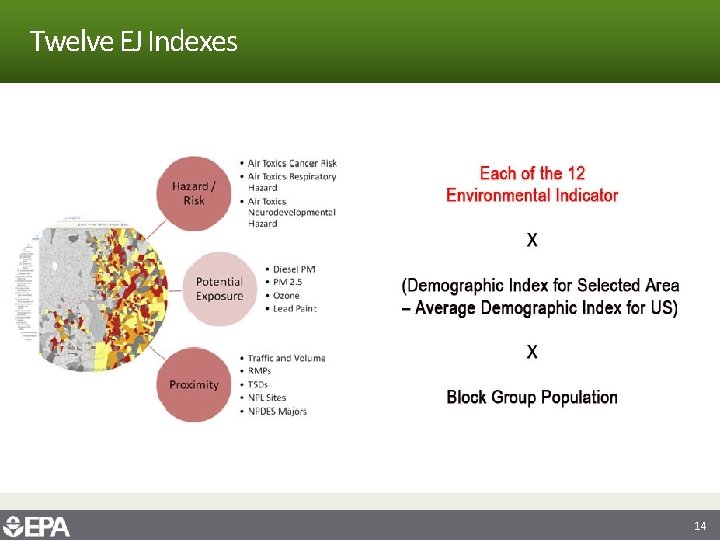
Combines environmental & demographic data ♦ EJSCREEN provides: » 1. environmental indicators » 2. demographic indicators (predictors of health status and of potential vulnerability to environment) and combines them as an index… » 3. “EJ index” for each environmental factor, in each location. 3
Key Features ♦ 12 different environmental factors, including several new or improved metrics (e. g. , traffic score) ♦ Updated demographics – every 1 year, not every 10 years ♦ A consistent, quantified approach to EJ, not just “overlays” – numerical indexes that combine environmental and demographic indicators ♦ Accessible and transparent to anyone with a web browser ♦ Standard printable reports and bar graphs ♦ Higher resolution maps – 3 times as many data points ♦ A wealth of additional data maps; can add more from the Web ♦ Raw data downloads will also be available 4
Using EJSCREEN ♦ A tool for everyone » Available to all EJ stakeholders and general public › But no requirement that state/tribal/stakeholders use it » Basis for further dialogue ♦ EPA uses EJSCREEN in various contexts » Outreach and engagement » Many aspects of environmental programs » Geographically-based initiatives ♦ What does EJ screening show? » Helps show which places may be candidates for further review – where to take a closer look, where to start. 5
Important Notes About How EPA Uses EJSCREEN ♦ Tool and data to be shared with States, Tribes, public, etc. ♦ Highlights areas that may be candidates for further review ♦ Pre-decisional screening tool ♦ Does not direct final outcomes ♦ Baseline screening should be supplemented with local information and experience ♦ Should not be used to label areas as “EJ community” 6
Caveats ♦ Demographic and environmental indicators for a single block group may have high uncertainty ♦ Small differences may not be true or meaningful ones ♦ EJSCREEN does not cover all environmental issues. ♦ Other local data and concerns may be very important. 7
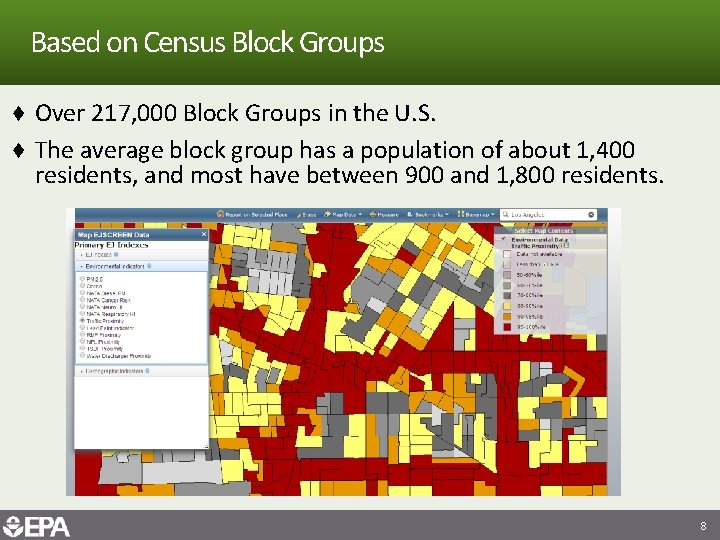
Based on Census Block Groups ♦ Over 217, 000 Block Groups in the U. S. ♦ The average block group has a population of about 1, 400 residents, and most have between 900 and 1, 800 residents. 8
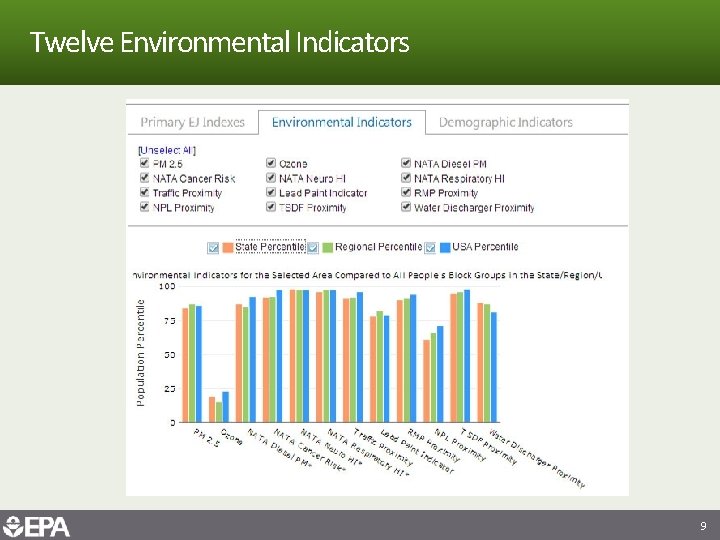
Twelve Environmental Indicators 9
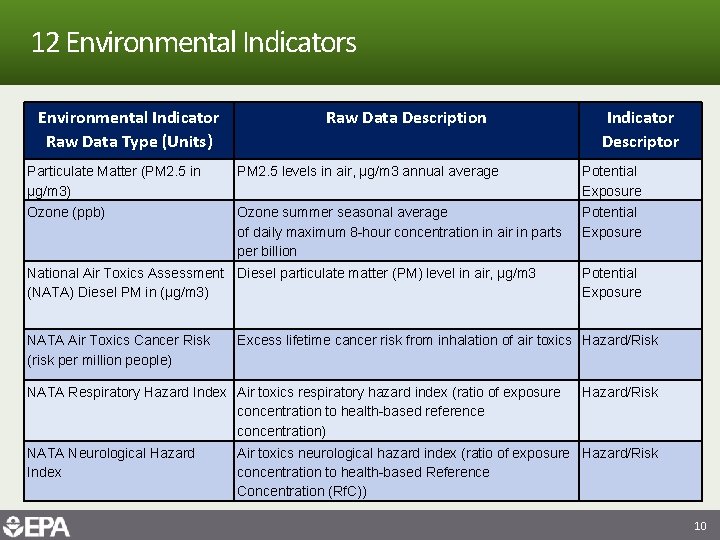
12 Environmental Indicators Environmental Indicator Raw Data Type (Units) Raw Data Description Indicator Descriptor Particulate Matter (PM 2. 5 in µg/m 3) PM 2. 5 levels in air, µg/m 3 annual average Potential Exposure Ozone (ppb) Ozone summer seasonal average of daily maximum 8 -hour concentration in air in parts per billion Potential Exposure National Air Toxics Assessment Diesel particulate matter (PM) level in air, µg/m 3 (NATA) Diesel PM in (µg/m 3) NATA Air Toxics Cancer Risk (risk per million people) Excess lifetime cancer risk from inhalation of air toxics Hazard/Risk NATA Respiratory Hazard Index Air toxics respiratory hazard index (ratio of exposure concentration to health-based reference concentration) NATA Neurological Hazard Index Potential Exposure Hazard/Risk Air toxics neurological hazard index (ratio of exposure Hazard/Risk concentration to health-based Reference Concentration (Rf. C)) 10
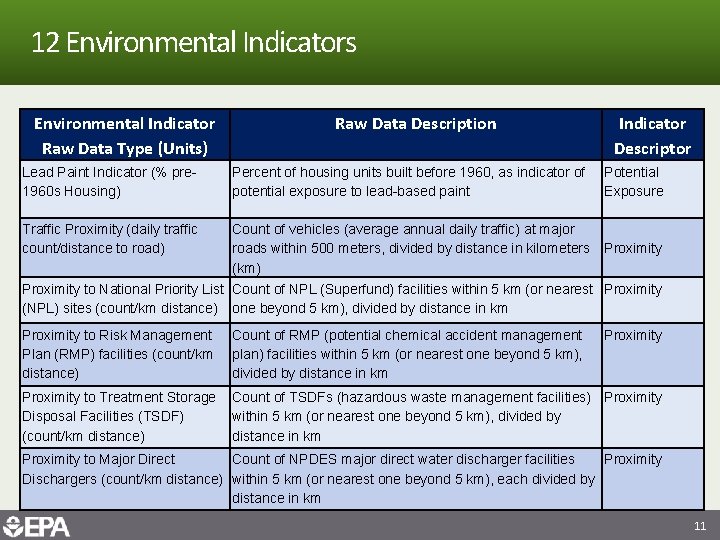
12 Environmental Indicators Environmental Indicator Raw Data Type (Units) Raw Data Description Indicator Descriptor Lead Paint Indicator (% pre 1960 s Housing) Percent of housing units built before 1960, as indicator of potential exposure to lead-based paint Potential Exposure Traffic Proximity (daily traffic count/distance to road) Count of vehicles (average annual daily traffic) at major roads within 500 meters, divided by distance in kilometers (km) Proximity to National Priority List Count of NPL (Superfund) facilities within 5 km (or nearest Proximity (NPL) sites (count/km distance) one beyond 5 km), divided by distance in km Proximity to Risk Management Plan (RMP) facilities (count/km distance) Count of RMP (potential chemical accident management plan) facilities within 5 km (or nearest one beyond 5 km), divided by distance in km Proximity to Treatment Storage Disposal Facilities (TSDF) (count/km distance) Count of TSDFs (hazardous waste management facilities) Proximity within 5 km (or nearest one beyond 5 km), divided by distance in km Proximity to Major Direct Count of NPDES major direct water discharger facilities Proximity Dischargers (count/km distance) within 5 km (or nearest one beyond 5 km), each divided by distance in km 11
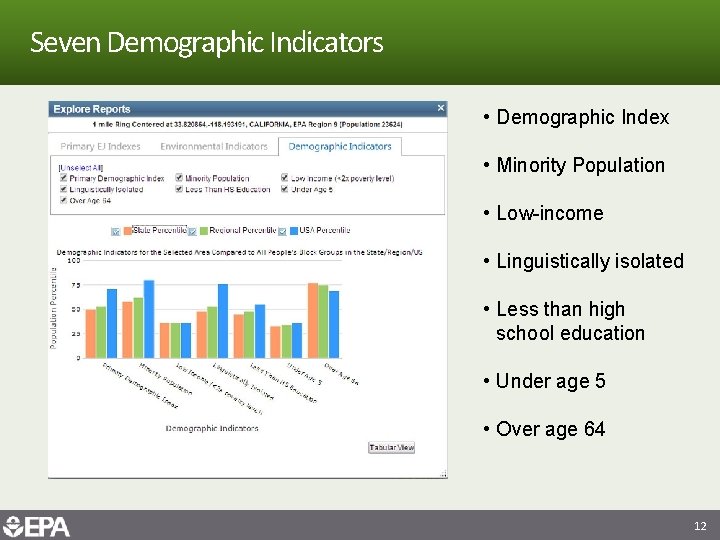
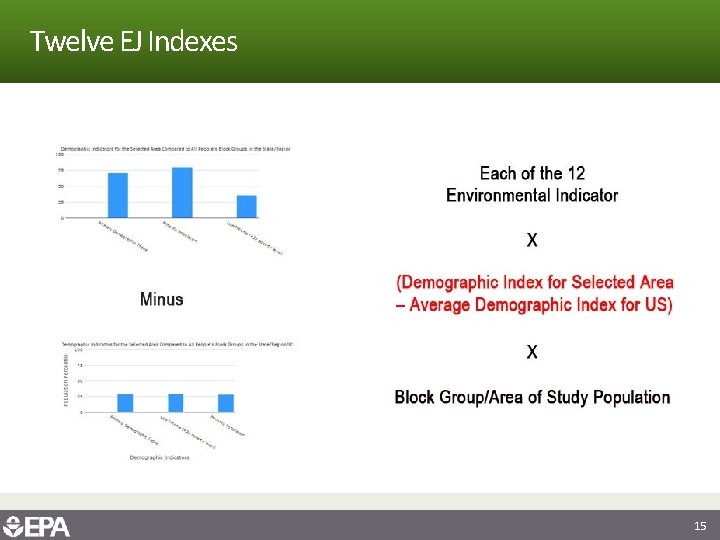
Seven Demographic Indicators • Demographic Index • Minority Population • Low-income • Linguistically isolated • Less than high school education • Under age 5 • Over age 64 12
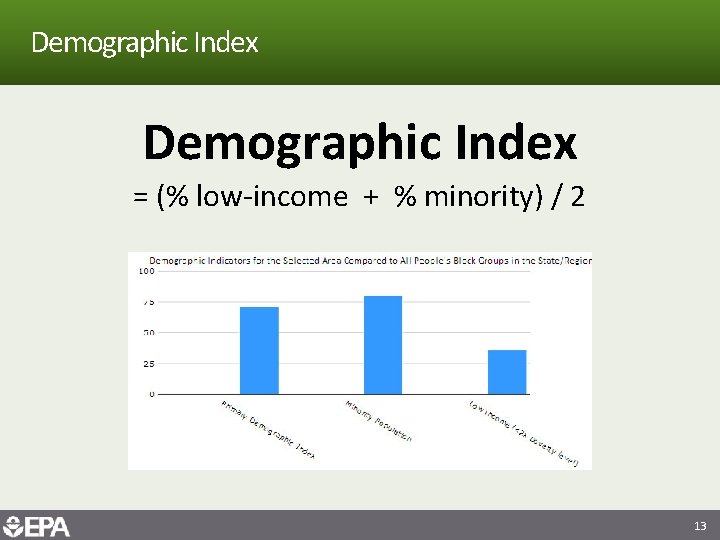
Demographic Index = (% low-income + % minority) / 2 13
Twelve EJ Indexes 14
Twelve EJ Indexes 15
Twelve EJ Indexes 16
What does the EJ Index mean? ♦ The EJ index combines environmental and demographic data ♦ It shows how much a block group contributes to the nation’s overall disparity (between demographic groups) in that environmental indicator. ♦ In other words, » Nationwide overall, the average low-income and/or minority individual in the US has a higher lead paint indicator score than the rest of the US population. » The EJ index shows how much this block group contributes to that disparity. » If the block groups with the highest EJ index values (for lead paint) were “cleaned up” first, that would be the fastest way to reduce the disparity in average lead paint scores. 17
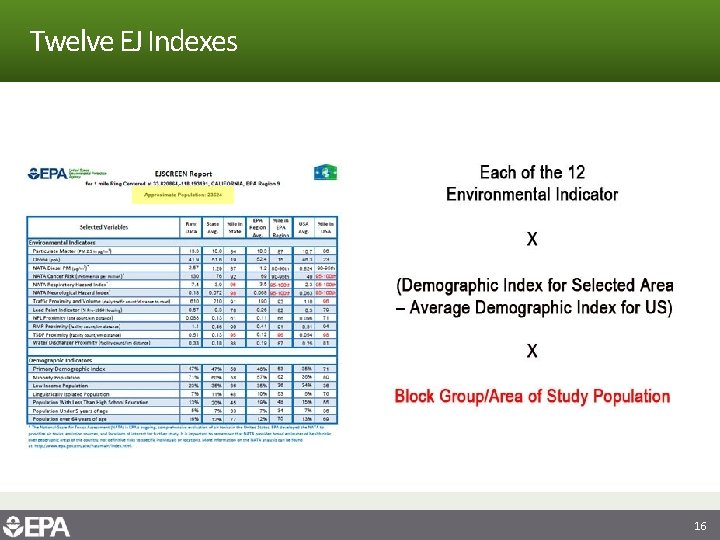
Maps – Drilling down to explore one indicator at a time ♦ A Report: Gives you all the indicators at once, for a single, specified location (e. g. within 1 mile of a facility) » e. g. , looking at all the indicators for residents nearby ♦ A Map: Gives you one indicator at a time, for each of the block groups within a wider area (e. g. across several miles) » e. g. , for a single indicator like lead paint, exploring and prioritizing hot-spots, or drilling down from a report to compare neighborhoods or small communities 18
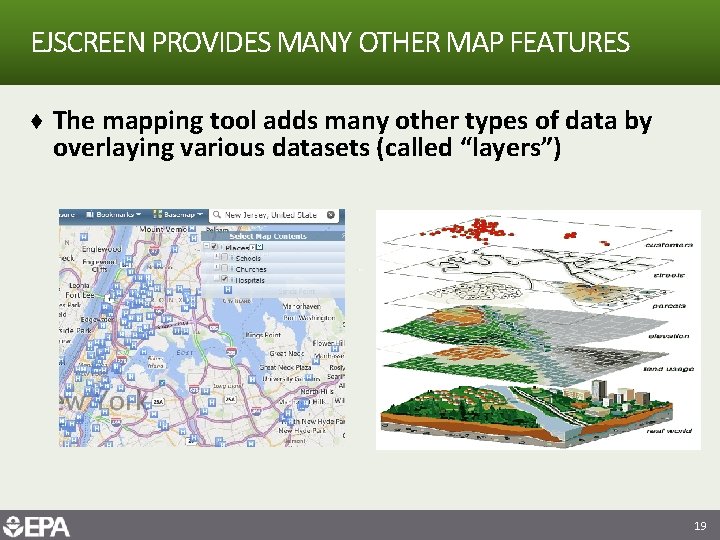
EJSCREEN PROVIDES MANY OTHER MAP FEATURES ♦ The mapping tool adds many other types of data by overlaying various datasets (called “layers”) 19
EJSCREEN Overview Questions? 20
- Slides: 20