
Eisenhower The Cold War 1949 The Soviet Union
- Slides: 23
Eisenhower & The Cold War
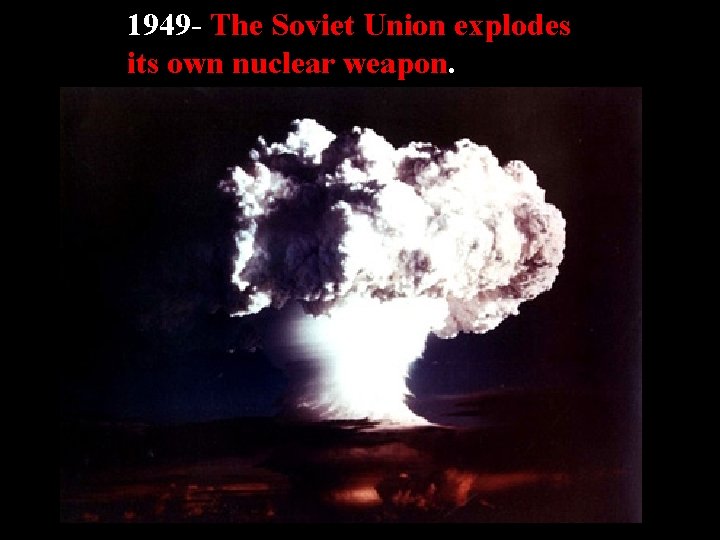
1949 - The Soviet Union explodes its own nuclear weapon.
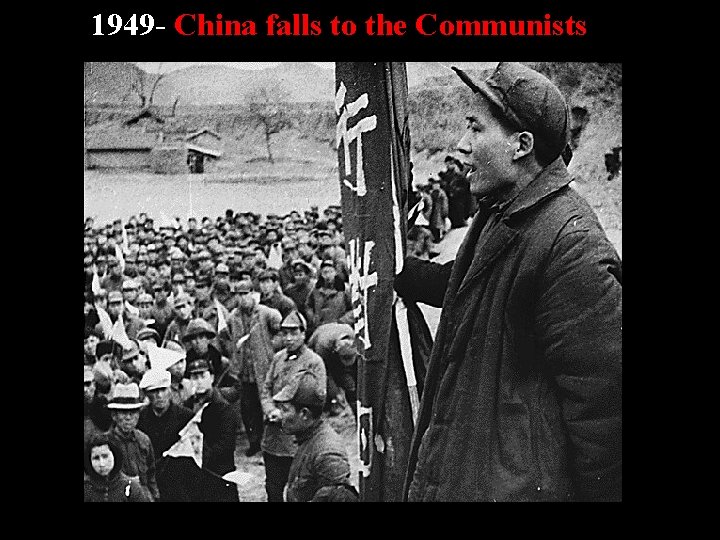
1949 - China falls to the Communists
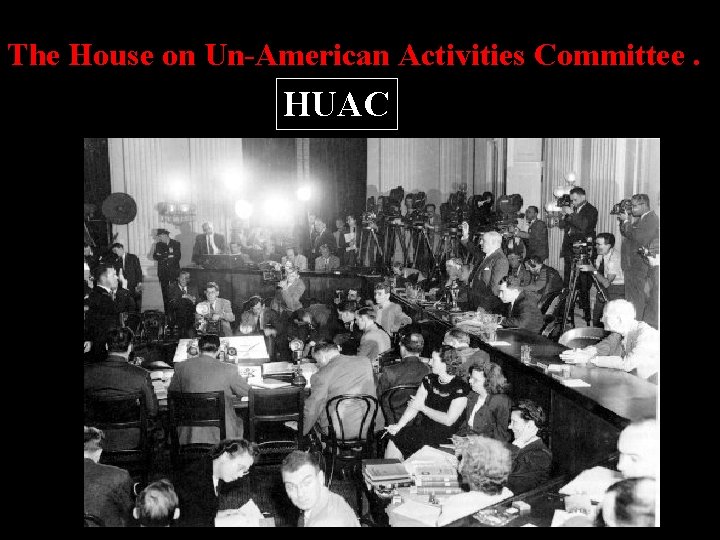
The House on Un-American Activities Committee. HUAC
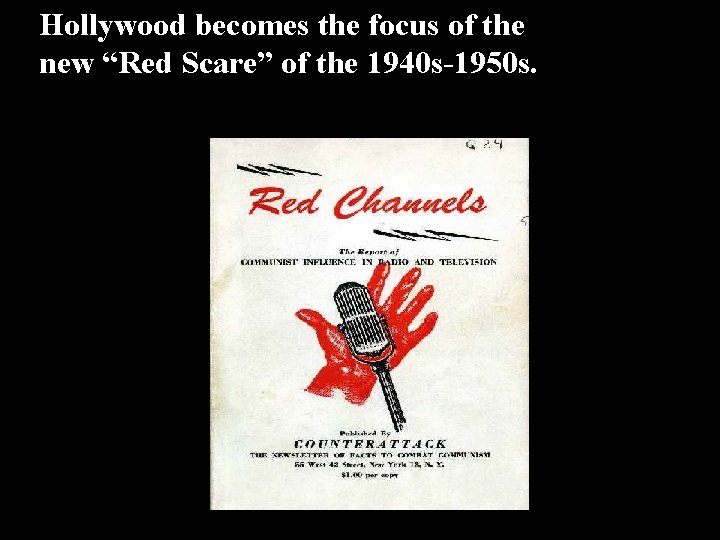
Hollywood becomes the focus of the new “Red Scare” of the 1940 s-1950 s.
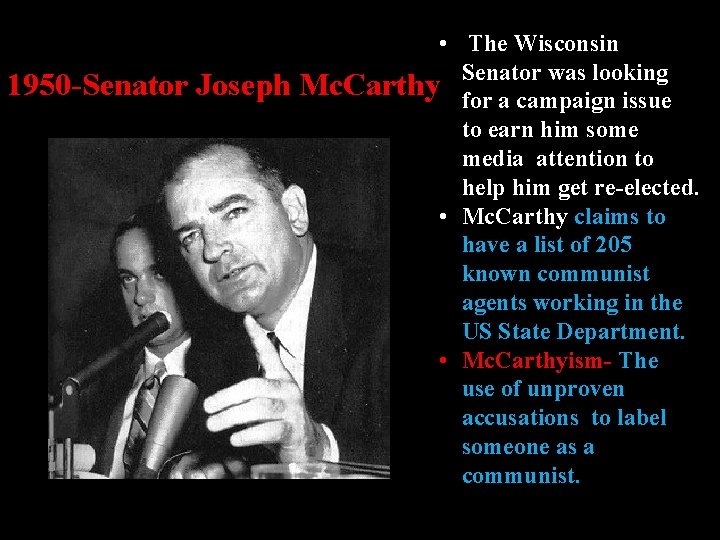
1950 -Senator Joseph • The Wisconsin Senator was looking Mc. Carthy for a campaign issue to earn him some media attention to help him get re-elected. • Mc. Carthy claims to have a list of 205 known communist agents working in the US State Department. • Mc. Carthyism- The use of unproven accusations to label someone as a communist.
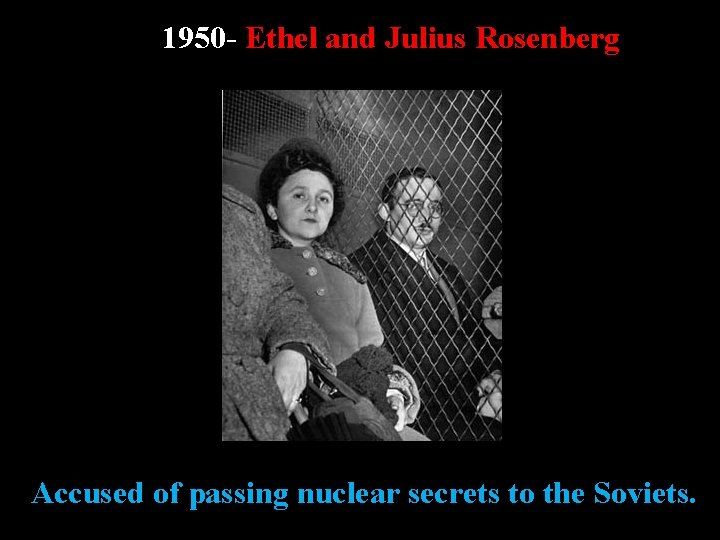
1950 - Ethel and Julius Rosenberg Accused of passing nuclear secrets to the Soviets.
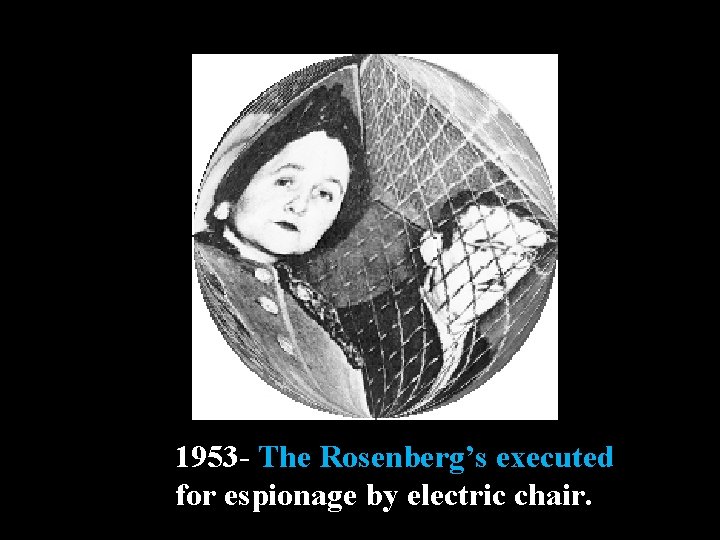
1953 - The Rosenberg’s executed for espionage by electric chair.
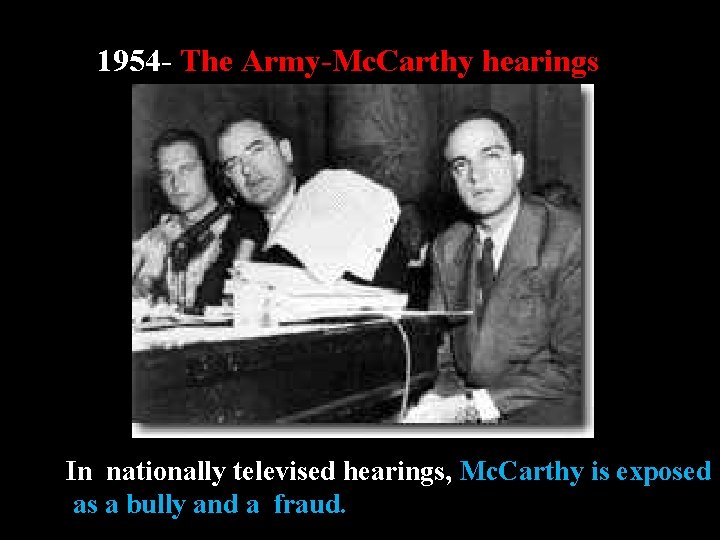
1954 - The Army-Mc. Carthy hearings In nationally televised hearings, Mc. Carthy is exposed as a bully and a fraud.
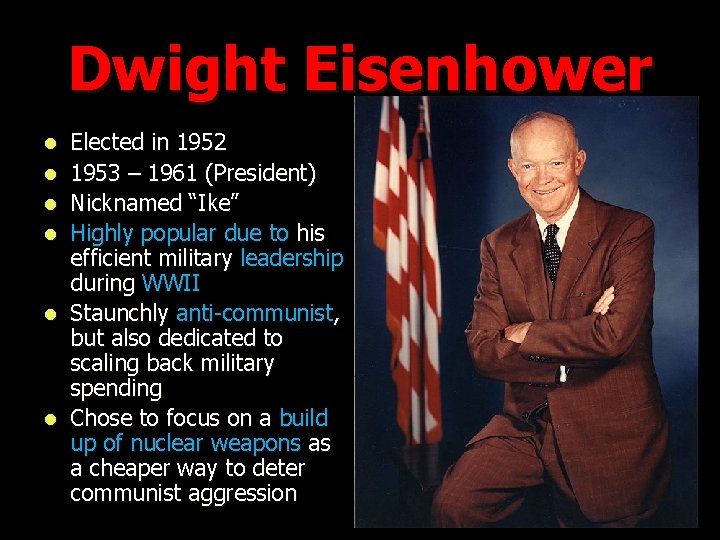
Dwight Eisenhower l l l Elected in 1952 1953 – 1961 (President) Nicknamed “Ike” Highly popular due to his efficient military leadership during WWII Staunchly anti-communist, but also dedicated to scaling back military spending Chose to focus on a build up of nuclear weapons as a cheaper way to deter communist aggression
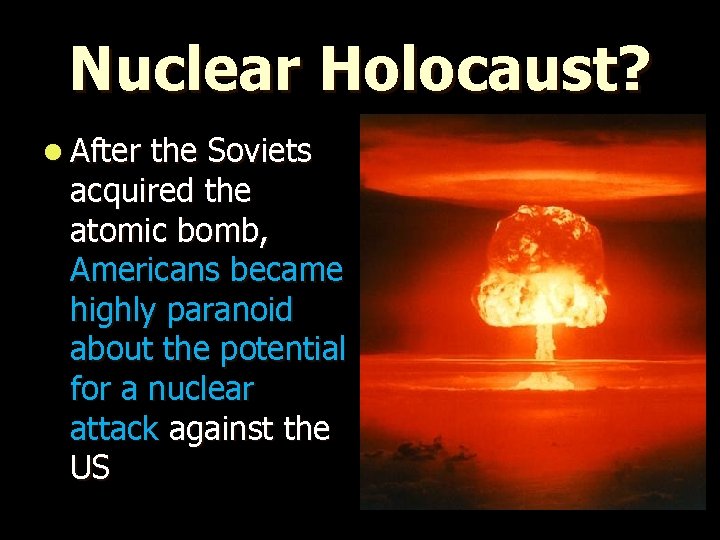
Nuclear Holocaust? l After the Soviets acquired the atomic bomb, Americans became highly paranoid about the potential for a nuclear attack against the US
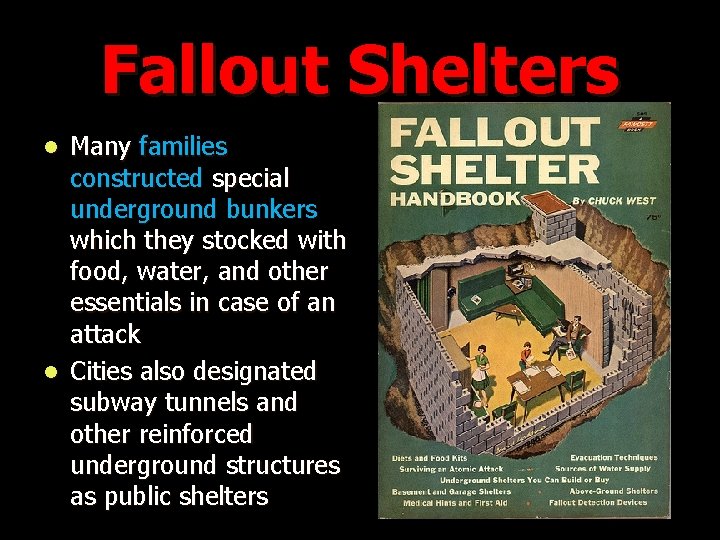
Fallout Shelters Many families constructed special underground bunkers which they stocked with food, water, and other essentials in case of an attack l Cities also designated subway tunnels and other reinforced underground structures as public shelters l
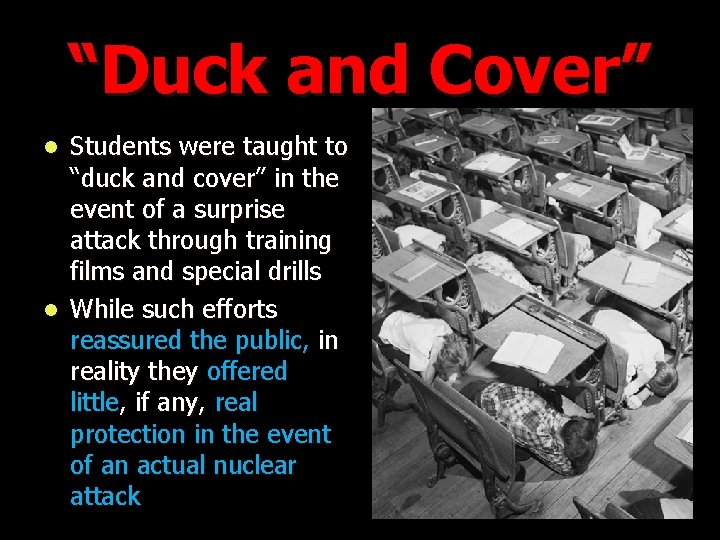
“Duck and Cover” Students were taught to “duck and cover” in the event of a surprise attack through training films and special drills l While such efforts reassured the public, in reality they offered little, if any, real protection in the event of an actual nuclear attack l
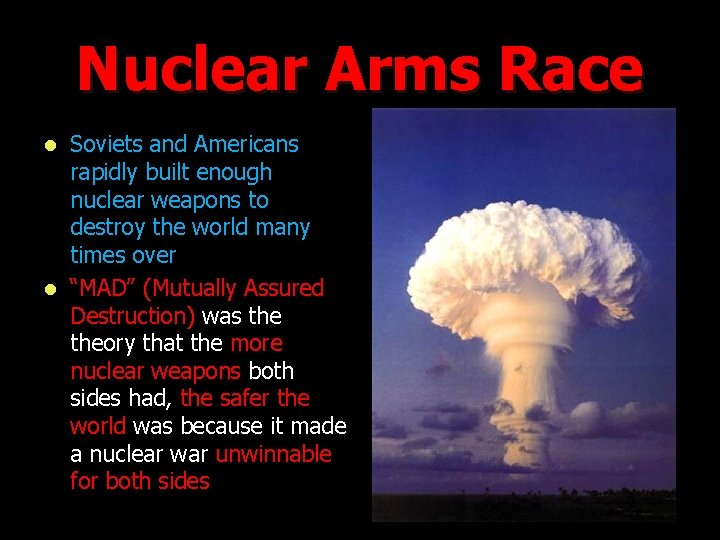
Nuclear Arms Race Soviets and Americans rapidly built enough nuclear weapons to destroy the world many times over l “MAD” (Mutually Assured Destruction) was theory that the more nuclear weapons both sides had, the safer the world was because it made a nuclear war unwinnable for both sides l
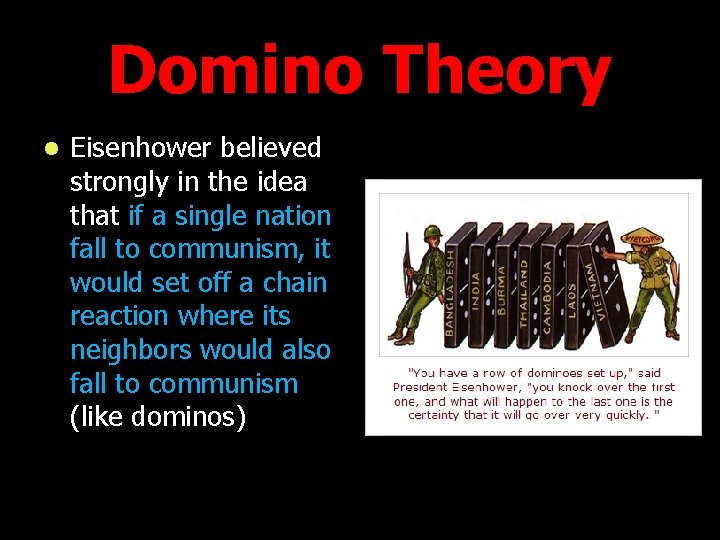
Domino Theory l Eisenhower believed strongly in the idea that if a single nation fall to communism, it would set off a chain reaction where its neighbors would also fall to communism (like dominos)
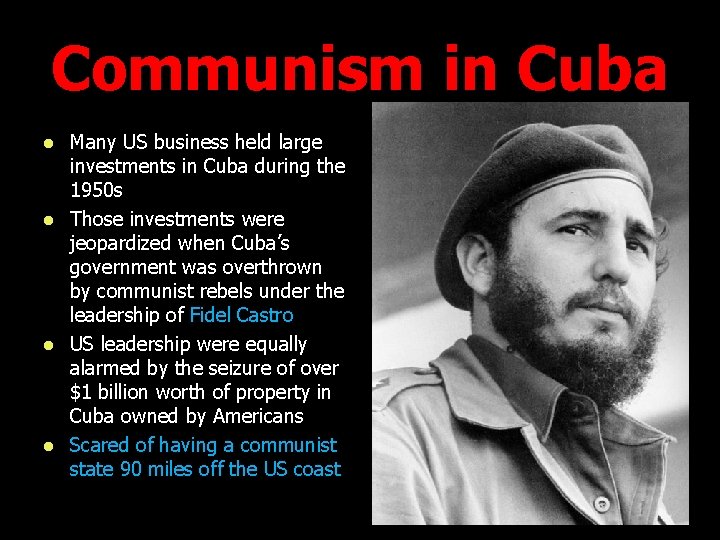
Communism in Cuba Many US business held large investments in Cuba during the 1950 s l Those investments were jeopardized when Cuba’s government was overthrown by communist rebels under the leadership of Fidel Castro l US leadership were equally alarmed by the seizure of over $1 billion worth of property in Cuba owned by Americans l Scared of having a communist state 90 miles off the US coast l
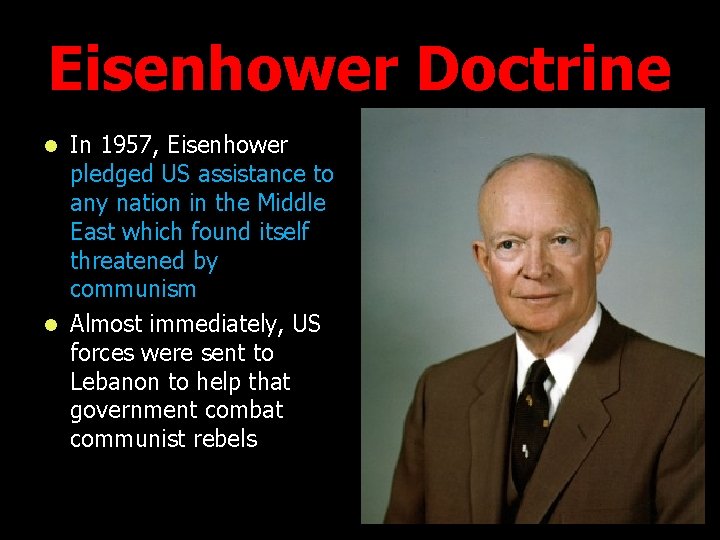
Eisenhower Doctrine In 1957, Eisenhower pledged US assistance to any nation in the Middle East which found itself threatened by communism l Almost immediately, US forces were sent to Lebanon to help that government combat communist rebels l
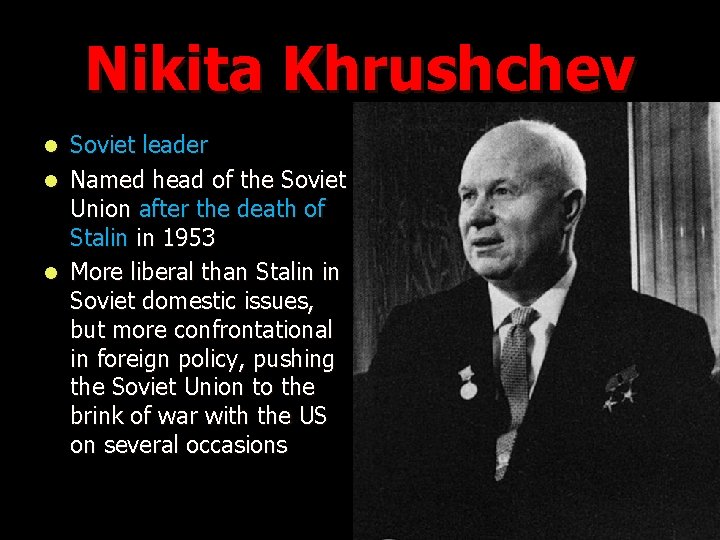
Nikita Khrushchev Soviet leader l Named head of the Soviet Union after the death of Stalin in 1953 l More liberal than Stalin in Soviet domestic issues, but more confrontational in foreign policy, pushing the Soviet Union to the brink of war with the US on several occasions l
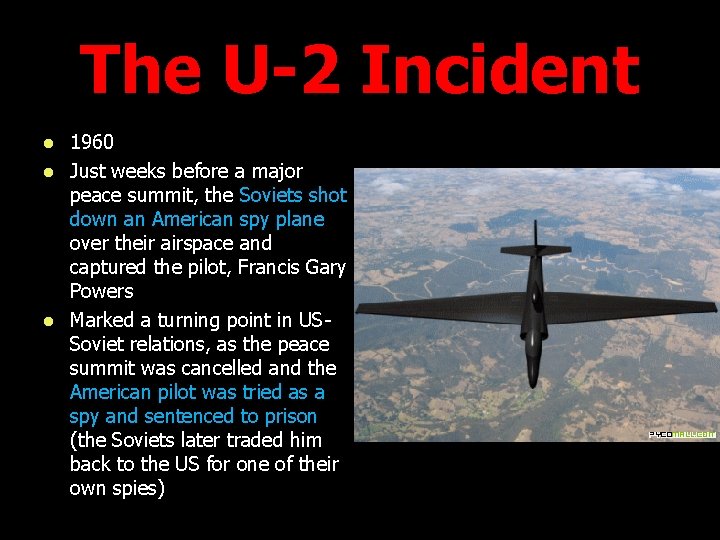
The U-2 Incident 1960 l Just weeks before a major peace summit, the Soviets shot down an American spy plane over their airspace and captured the pilot, Francis Gary Powers l Marked a turning point in USSoviet relations, as the peace summit was cancelled and the American pilot was tried as a spy and sentenced to prison (the Soviets later traded him back to the US for one of their own spies) l
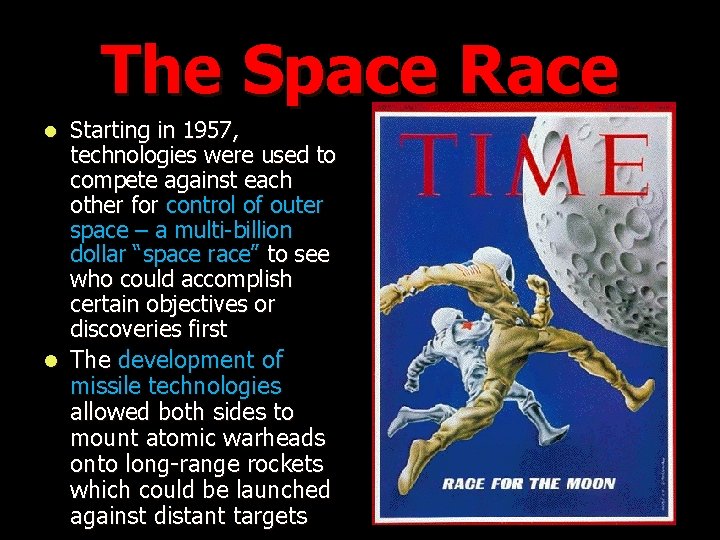
The Space Race Starting in 1957, technologies were used to compete against each other for control of outer space – a multi-billion dollar “space race” to see who could accomplish certain objectives or discoveries first l The development of missile technologies allowed both sides to mount atomic warheads onto long-range rockets which could be launched against distant targets l
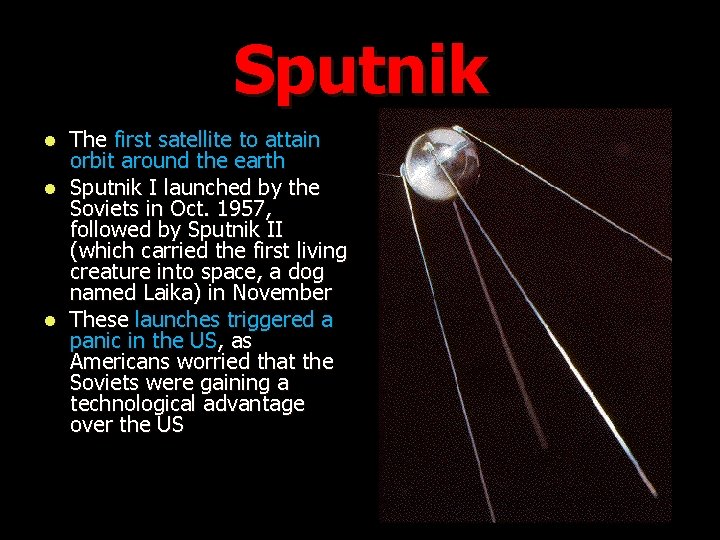
Sputnik The first satellite to attain orbit around the earth l Sputnik I launched by the Soviets in Oct. 1957, followed by Sputnik II (which carried the first living creature into space, a dog named Laika) in November l These launches triggered a panic in the US, as Americans worried that the Soviets were gaining a technological advantage over the US l
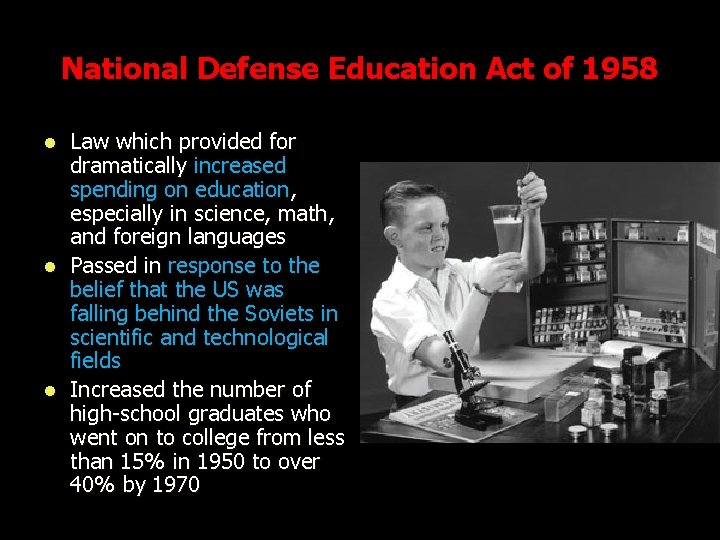
National Defense Education Act of 1958 Law which provided for dramatically increased spending on education, especially in science, math, and foreign languages l Passed in response to the belief that the US was falling behind the Soviets in scientific and technological fields l Increased the number of high-school graduates who went on to college from less than 15% in 1950 to over 40% by 1970 l
NASA National Aeronautics and Space Administration l Created in 1958 l Civilian agency which was created to take over space exploration programs from the various military branches to increase coordination and efficiency l