
Einsteins Theory of Relativity 5 a Experiments to
- Slides: 12
Einstein‘s Theory of Relativity 5. a Experiments to Verify the Principle of Equivalence Ulrich R. M. E. Geppert 2/23/2021 U. R. M. E. Zielona Gora 1
1. universality of free fall (already GG) compares acceleration of two bodies of different composition in an external gravitational field 2. local Lorentz invariance compares c to be independent on lab orientation (MM)and velocity(KT) 3. local position invariance any non-gravitational experiment is independent of where and when it is performed ⇒ constancy of the fundamental constants of non-gravitational physics other experiments: GW, Doppler, „Pioneer anomaly“, …
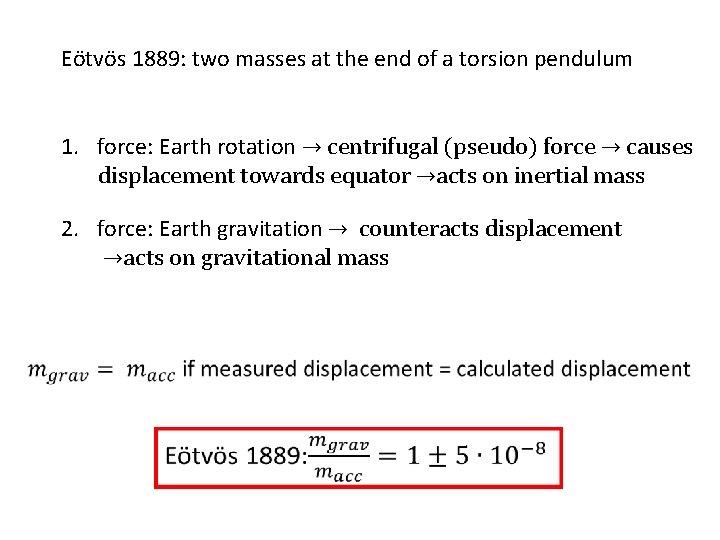
Eötvös 1889: two masses at the end of a torsion pendulum 1. force: Earth rotation → centrifugal (pseudo) force → causes displacement towards equator →acts on inertial mass 2. force: Earth gravitation → counteracts displacement →acts on gravitational mass
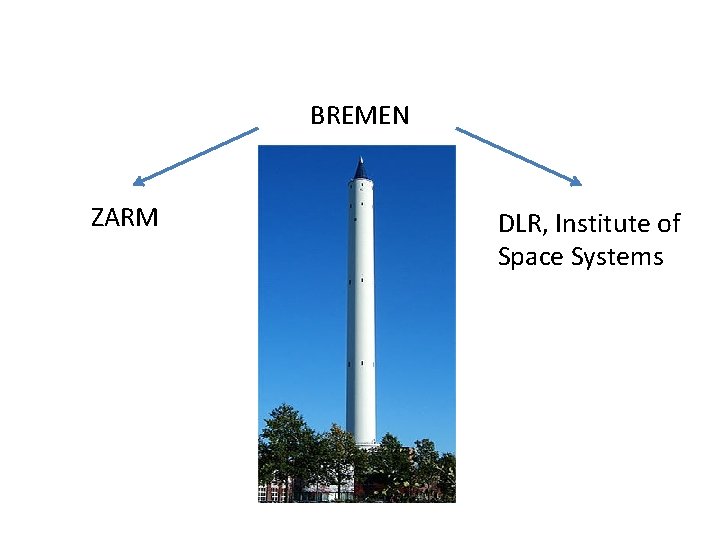
BREMEN ZARM DLR, Institute of Space Systems
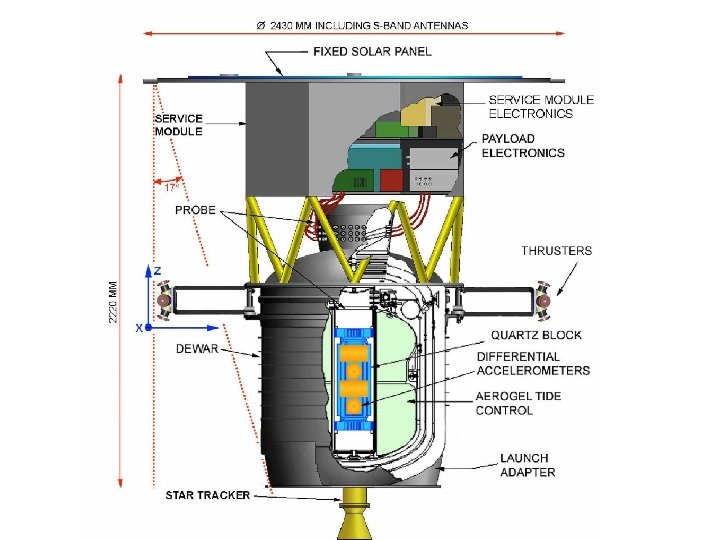
The Satellite Test of the Equivalence Principle (STEP) is a joint European-U. S. space program to investigate one of the most fundamental principles in physics, the Equivalence of inertia and passive gravitational mass. A direct consequence of this Equivalence Principle is the 'universality of free fall' such that all objects fall with exactly the same acceleration in the same gravity field. The Equivalence Principle was reinterpreted by Albert Einstein as a consequence of an even broader equivalence between the laws of physics in different accelerated reference frames, a principle which Einstein made the basis for his general theory of relativity.
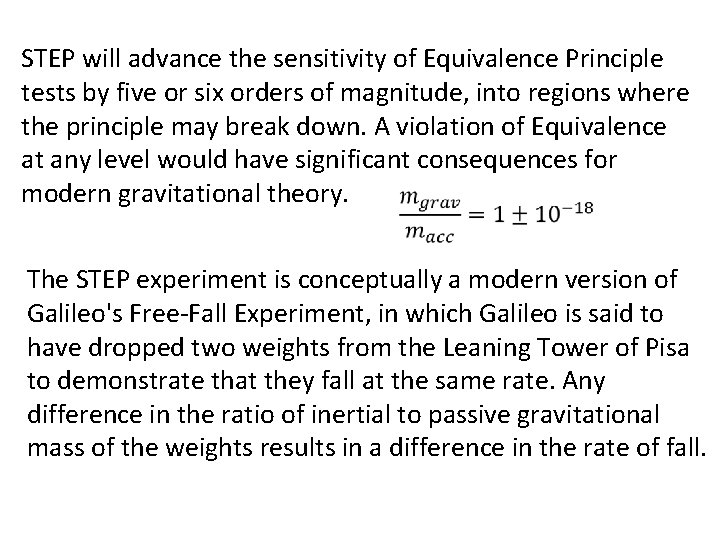
STEP will advance the sensitivity of Equivalence Principle tests by five or six orders of magnitude, into regions where the principle may break down. A violation of Equivalence at any level would have significant consequences for modern gravitational theory. The STEP experiment is conceptually a modern version of Galileo's Free-Fall Experiment, in which Galileo is said to have dropped two weights from the Leaning Tower of Pisa to demonstrate that they fall at the same rate. Any difference in the ratio of inertial to passive gravitational mass of the weights results in a difference in the rate of fall.
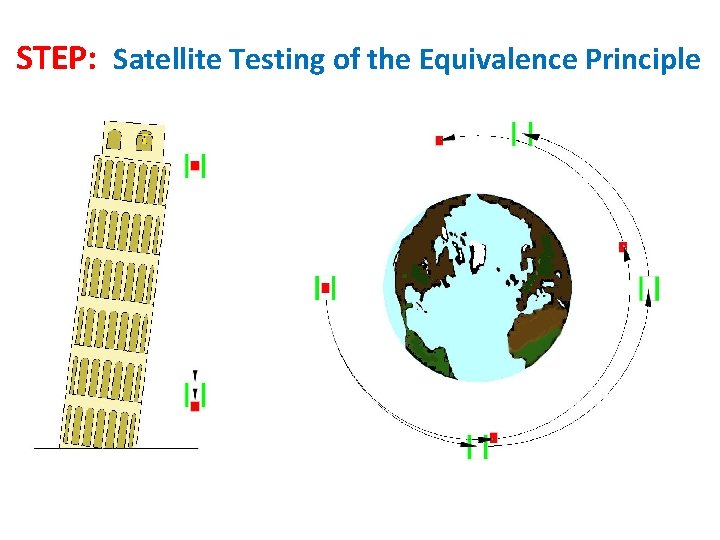
STEP: Satellite Testing of the Equivalence Principle
In STEP, the masses are in free fall in an orbit around the Earth, and if there is a violation of the Equivalence Principle they tend to follow slightly different orbits. The orbiting masses fall the way around the Earth and never strike the ground, so that any small difference in the rate of fall can build a large displacement. SQUID magnetometer circuits are used to measure displacements as small as 10 -13 centimeter. NASA-ESA project, presently on hold
The Satellite Test of the Equivalence Principle (STEP) is a US-European joint program to test one of the most fundamental ideas in all of physics, the equivalence of gravitational and inertial mass. When two bodies fall in a uniform gravitational field free of other forces their measured accelerations are identical regardless of composition. This Universality of Free Fall, a consequence of the Equivalence Principle, discovered by Galileo and popularized in his famous Tower of Pisa experiment has had a continuously unfolding importance in physics, marking off gravity from all other forces in Nature. For other forces mass has only one function, as the measure of inertia. For gravity it also fulfills a second function, as a source of acceleration. . If magnetism had been the driving force in Galileo 's experiment, a glass or stone ball would certainly not have fallen with the same acceleration as an iron ball. Newton, who first made this crucial point, distinguished two quantities that prove to be 'equivalent' in gravitation, the 'weight' of a body and the 'quantity of matter' in it, or as we would say, its gravitational mass mg and inertial mass mi. The Equivalence Principle asserts that the ratio mg / mi is identical for all bodies. The Equivalence Principle is the founding assumption of Einstein 's theory of gravitation, General Relativity. There are good reasons from current models for a unified quantum theory of matter and fields for believing that at levels below the present limits of testing this invariant may break down. STEP will advance the testing of the Equivalence Principle from several parts in 1013 to 1 part in 1018. Whether it confirms Equivalence five to six orders of magnitude more precisely than known today or discovers a violation, it will be a landmark experiment in Fundamental Physics, with consequences extending from gravitation theory to cosmology to theories of the evolution of the Universe. It will probe a large and otherwise inaccessible domain in the parameter space of new interactions. A null result would remain for many years a severe constraint on new theories. A positive result would constitute the discovery of a new force of Nature. STEP will compare the accelerations of four pairs of test masses in orbit. The free-floating test masses will be isolated from disturbances inside a cryogenic dewar with superconducting shielding and ultra-high vacuum, and their accelerations will be measured by a superconducting circuit using a quantum interference device (SQUID) for the best sensitivity. The dewar is part of a "drag-free" satellite, i. e. a satellite compensated for drag by proportional thrusters, using the test masses as reference. This technique reduces low-frequency acceleration disturbances from air drag, magnetic field, and solar pressure to an acceptable level. Gravity gradient disturbances are eliminated by precise placement of the mass centers on each other. The mission will be flown in a near-circular sun-synchronous orbit, to minimize temperature variations, for a period of six months. The best altitude is approximately 550 km. Research on the STEP accelerometers began in 1971 at Stanford University, and has been supported since 1977 with NASA funding. STEP has been studied twice by ESA at the Phase-A level and has led two other space agencies (CNES and ASI) to study projects aimed at testing the Equivalence Principle in space. STEP is currently undergoing a Phase A study for NASA's office of Space Science Small Explorer program. Professor Francis Everitt and Dr. Paul Worden lead the STEP collaboration at Stanford with collaborating institutions including JPL, ESTEC Netherlands, University of Birmingham, UK, University of Strathclyde, UK, Imperial College, UK, Rutherford Appleton Laboratory, UK, ZARM University of Bremen, Germany, PTB Braunschweig, Germany, Friedrich Schiller University Jena, Germany, ONERA, France, and the University of Trento, Italy.
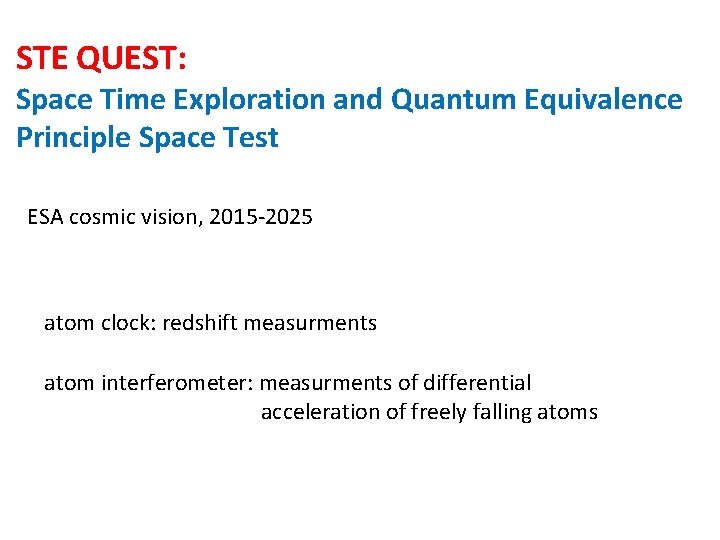
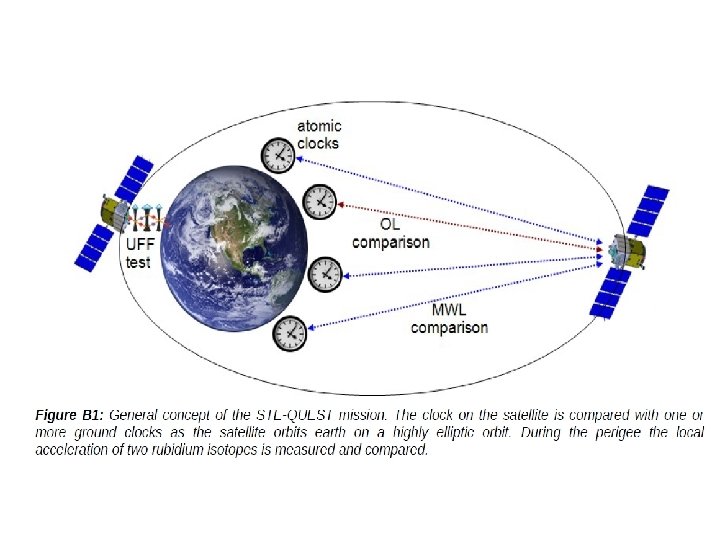
STE QUEST: Space Time Exploration and Quantum Equivalence Principle Space Test ESA cosmic vision, 2015 -2025 atom clock: redshift measurments atom interferometer: measurments of differential acceleration of freely falling atoms