
Einsteins postulate A beam of light can be
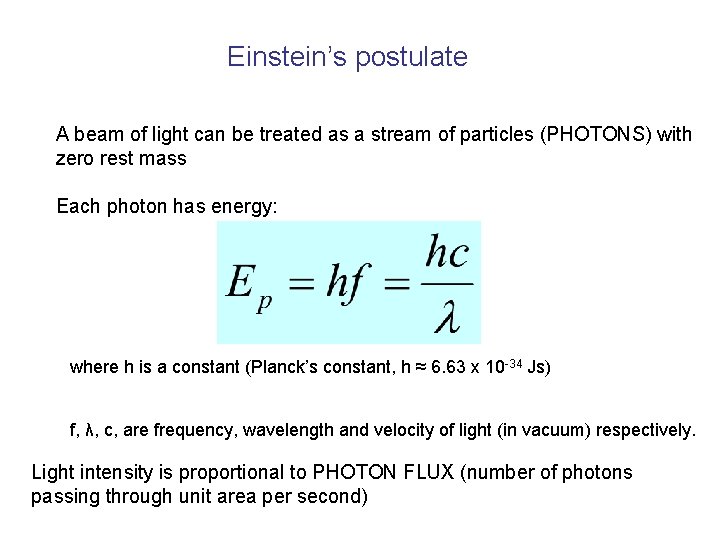
Einstein’s postulate A beam of light can be treated as a stream of particles (PHOTONS) with zero rest mass Each photon has energy: where h is a constant (Planck’s constant, h ≈ 6. 63 x 10 -34 Js) f, λ, c, are frequency, wavelength and velocity of light (in vacuum) respectively. Light intensity is proportional to PHOTON FLUX (number of photons passing through unit area per second)
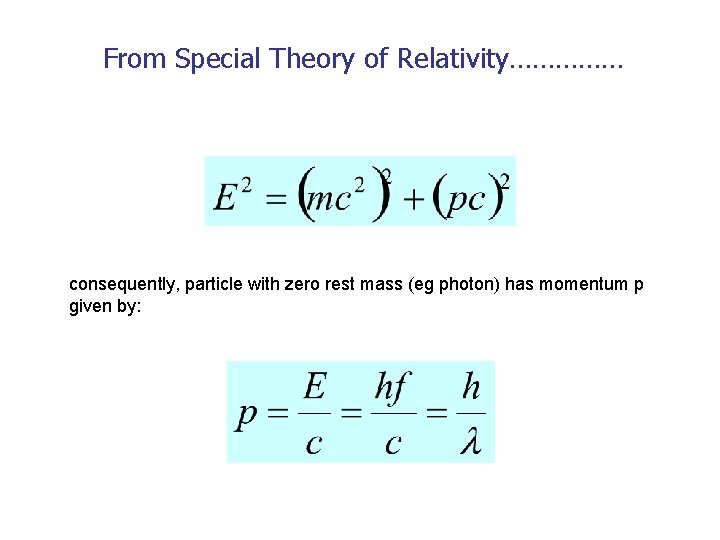
From Special Theory of Relativity…………… consequently, particle with zero rest mass (eg photon) has momentum p given by:
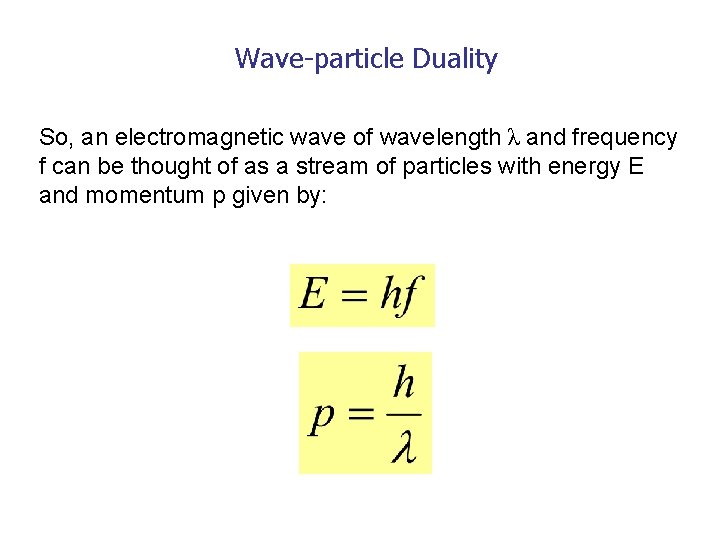
Wave-particle Duality So, an electromagnetic wave of wavelength λ and frequency f can be thought of as a stream of particles with energy E and momentum p given by:
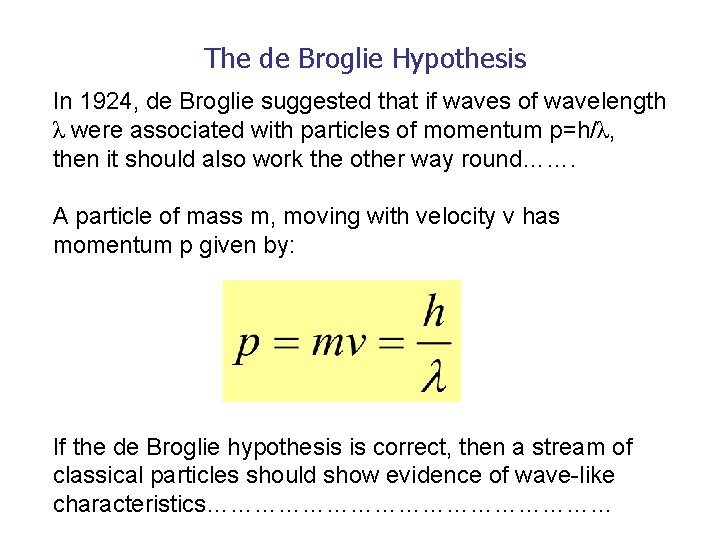
The de Broglie Hypothesis In 1924, de Broglie suggested that if waves of wavelength λ were associated with particles of momentum p=h/λ, then it should also work the other way round……. A particle of mass m, moving with velocity v has momentum p given by: If the de Broglie hypothesis is correct, then a stream of classical particles should show evidence of wave-like characteristics………………………
De Broglie wavelength of everyday objects… Eg. Tennis ball…. Mass ~60 g Velocity ~ 100 mph ≈ 45 m/s Momentum = De Broglie wavelength =
De Broglie wavelength of a 1 ke. V electron. . KE = Momentum = De Broglie wavelength =
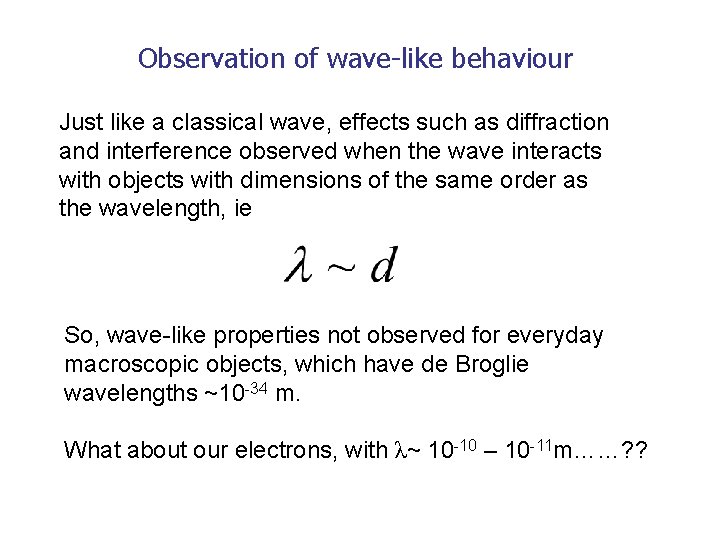
Observation of wave-like behaviour Just like a classical wave, effects such as diffraction and interference observed when the wave interacts with objects with dimensions of the same order as the wavelength, ie So, wave-like properties not observed for everyday macroscopic objects, which have de Broglie wavelengths ~10 -34 m. What about our electrons, with λ~ 10 -10 – 10 -11 m……? ?
- Slides: 7