
Eighth Grade Language Arts Jan Bennitt Lesson Plans
Eighth Grade Language Arts Jan Bennitt Lesson Plans 2010 -2011

First Nine Weeks August 23, 2010 to October 21, 2010

Florida’s Sunshine State Standards for Eighth Grade Language Arts
Fluency Standard: The student demonstrates the ability to read grade level text orally with accuracy, appropriate rate, and expression. LA. 8. 1. 5. 1 The student will adjust reading rate based on purpose, text difficulty, form, and style.
Vocabulary Development Standard: The student uses multiple strategies to develop grade appropriate vocabulary. The student will: � LA. 8. 1. 6. 1 - use new vocabulary that is introduced and taught directly; � LA. 8. 1. 6. 2 - listen to, read, and discuss familiar and conceptually challenging text; � LA. 8. 1. 6. 3 - use context clues to determine meanings of unfamiliar words; � LA. 8. 1. 6. 4 - categorize key vocabulary and identify salient features; � LA. 8. 1. 6. 5 - relate new vocabulary to familiar words; � LA. 8. 1. 6. 6 - distinguish denotative and connotative meanings of words; � LA. 8. 1. 6. 7 - identify and understand the meaning of conceptually advanced prefixes, suffixes, and root words; � LA. 8. 1. 6. 8 - identify advanced word/phrase relationships and their meanings; � LA. 8. 1. 6. 9 - determine the correct meaning of words with multiple meanings in context; � LA. 8. 1. 6. 10 - determine meanings of words, pronunciation, parts of speech, etymologies, and alternate word choices by using a dictionary, thesaurus, and digital tools; and � LA. 8. 1. 6. 11 - identify the meaning of words and phrases derived from Anglo. Saxon, Greek, and Roman mythology.
Reading Comprehension Standard: The student uses a variety of strategies to comprehend grade level text. � � � � � The student will: LA. 8. 1. 7. 1 - use background knowledge of subject and related content areas, prereading strategies, graphic representations, and knowledge of text structure to make and confirm complex predictions of content, purpose, and organization of a reading selection; LA. 8. 1. 7. 2 - analyze the author’s purpose and/or perspective in a variety of texts and understand how they affect meaning; LA. 8. 1. 7. 3 - determine the main idea or essential message in grade-level or higher texts through inferring, paraphrasing, summarizing, and identifying relevant details; LA. 8. 1. 7. 4 - identify cause-and-effect relationships in text; LA. 8. 1. 7. 5 - analyze a variety of text structures (e. g. , comparison/contrast, cause/effect, chronological order, argument/support, lists) and text features (main headings with subheadings) and explain their impact on meaning in text; LA. 8. 1. 7. 6 - analyze and evaluate similar themes or topics by different authors across a variety of fiction and nonfiction selections; LA. 8. 1. 7. 7 - compare and contrast elements in multiple texts (e. g. , setting, characters, problems); and LA. 8. 1. 7. 8 - use strategies to repair comprehension of grade-appropriate text when self-monitoring indicates confusion, including but not limited to rereading, checking context clues, predicting, notemaking, summarizing, using graphic and semantic organizers, questioning, and clarifying by checking other sources.
Grade 8: Literary Analysis Fiction Standard: The student identifies, analyzes, and applies knowledge of the elements of a variety of fiction and literary texts to develop a thoughtful response to a literary selection. The student will: � LA. 8. 2. 1. 1 - identify, analyze, and compare the characteristics of various genres (e. g. , poetry, fiction, short story, dramatic literature) as forms chosen by an author to accomplish a purpose; � LA. 8. 2. 1. 2 - locate and analyze elements of characterization, setting, and plot, including rising action, conflict, resolution, theme, and other literary elements as appropriate in a variety of fiction; � LA. 8. 2. 1. 3 - locate various literary devices (e. g. , sound, meter, figurative and descriptive language), graphics, and structure and analyze how they contribute to mood and meaning in poetry; � LA. 8. 2. 1. 4 - identify and analyze universal themes and symbols across genres and historical periods, and explain their significance; � LA. 8. 2. 1. 5 - develop an interpretation of a selection and support through sustained use of examples and contextual evidence; � LA. 8. 2. 1. 6 - compare literary texts that express a universal theme, providing textual evidence (e. g. , examples, details, quotations) as support for the identified theme; � LA. 8. 2. 1. 7 - locate and analyze an author’s use of allusions and descriptive, idiomatic, and figurative language in a variety of literary text, identifying how word choice is used to appeal to the reader’s senses and emotions, providing evidence from text to support the analysis; � LA. 8. 2. 1. 8 - explain how ideas, values, and themes of a literary work often reflect the historical period in which it was written; � LA. 8. 2. 1. 9 - describe changes in the English language over time, and support these descriptions wit h examples of literary texts; and � LA. 8. 2. 1. 10 - use interest and recommendation of others to select a balance of age and ability appropriate fiction materials to read (e. g. , novels, historical fiction, mythology, poetry) to expand the core foundation of knowledge necessary to function as a fully literate member of a shared culture.
Nonfiction Standard: The student identifies, analyzes, and applies knowledge of the elements of a variety of nonfiction, informational, and expository texts to demonstrate an understanding of the information presented. The student will: � LA. 8. 2. 2. 1 - locate, use, and analyze specific information from organizational text features (e. g. , table of contents, headings, captions, bold print, italics, glossaries, indices, key/guide words); � LA. 8. 2. 2. 2 - synthesize and use information from the text to state the main idea or provide relevant details; � LA. 8. 2. 2. 3 - organize information to show understanding or relationships among facts, ideas, and events (e. g. , representing key points within text through charting, mapping, paraphrasing, summarizing, or comparing/contrasting); � LA. 8. 2. 2. 4 - identify and analyze the characteristics of a variety of types of text (e. g. , reference works, reports, technical manuals, newspapers, magazines, biographies, periodicals, procedures, instructions, practical/functional texts); and � LA. 8. 2. 2. 5 - use interest and recommendation of others to select a variety of age and ability appropriate nonfiction materials (e. g. , biographies and topical areas, such as science, music, art, history, sports, current events) to expand the core knowledge necessary to connect topics and function as a fully literate member of a shared culture.
Grade 8: Writing Process Prewriting Standard: The student will use prewriting strategies to generate ideas and formulate a plan. The student will prewrite by: LA. 8. 3. 1. 1 - generating ideas from multiple sources (e. g. , prior knowledge, discussion with others, writer’s notebook, research materials, or other reliable sources) based upon teacher-directed topics and personal interests; � LA. 8. 3. 1. 2 - making a plan for writing that addresses purpose, audience, main idea, logical sequence, and time frame for completion; and � LA. 8. 3. 1. 3 - using organizational strategies and tools (e. g. , technology, spreadsheet, outline, chart, table, graph, Venn Diagram, web, story map, plot pyramid) to develop a personal organizational style. �
Drafting Standard: The student will write a draft appropriate to the topic, audience, and purpose. The student will draft writing by: LA. 8. 3. 2. 1 - developing ideas from the prewriting plan using primary and secondary sources appropriate to the purpose and audience; � LA. 8. 3. 2. 2 - establishing a logical organizational pattern with supporting details that are substantial, specific, and relevant; and � LA. 8. 3. 2. 3 - analyzing language techniques of professional authors (rhythm, varied sentence structure) to develop a personal style, demonstrating a command of language with freshness of expression. �
Revising Standard: The student will revise and refine the draft for clarity and effectiveness. The student will revise by: LA. 8. 3. 3. 1 - evaluating the draft for development of ideas and content, logical organization, voice, point of view, word choice, and sentence variation; � LA. 8. 3. 3. 2 - creating clarity and logic by maintaining central theme, idea, or unifying point and developing relationships among ideas; � LA. 8. 3. 3. 3 - creating precision and interest by elaborating ideas through supporting details (e. g. , facts, statistics, expert opinions, anecdotes), a variety of sentence structures, creative language devices, and modifying word choices using resources and reference materials (e. g. , dictionary, thesaurus); and � LA. 8. 3. 3. 4 - applying appropriate tools or strategies to evaluate and refine the draft (e. g. , peer review, checklists, rubrics). �
Editing for Language Conventions Standard: The student will edit and correct the draft for standard language conventions. The student will edit for correct use of: � � � LA. 8. 3. 4. 1 - spelling, using spelling rules, orthographic patterns, generalizations, knowledge of root words, prefixes, suffixes, and knowledge of Greek and Latin root words and using a dictionary, thesaurus, or other resources as necessary; LA. 8. 3. 4. 2 - capitalization, including names of academic courses (e. g. , Algebra I) and proper adjectives (e. g. , German shepherd, Italian restaurant); LA. 8. 3. 4. 3 - punctuation, including commas, colons, semicolons, quotation marks, and apostrophes; LA. 8. 3. 4. 4 - the eight parts of speech (noun, pronoun, verb, adjective, conjunction, preposition, interjection), regular and irregular verbs, and pronoun agreement; and LA. 8. 3. 4. 5 - subject/verb agreement, noun/pronoun agreement.
Publishing Standard: The student will write a final product for the intended audience. The student will: LA. 8. 3. 5. 1 - prepare writing using technology in a format appropriate to audience and purpose (e. g. , manuscript, multimedia); � LA. 8. 3. 5. 2 - use elements of spacing and design for graphics (e. g. , tables, drawings, charts, graphs) when applicable to enhance the appearance of the document; and � LA. 8. 3. 5. 3 - share the writing with the intended audience. �
Grade 8: Writing Applications Creative Standard: The student develops and demonstrates creative writing. The student will: LA. 8. 4. 1. 1 - write narrative accounts with an engaging plot (including rising action, conflict, suspense, climax, falling action and resolution), and that use a range of appropriate strategies and specific narrative action (e. g. , dialogue, movement, gestures, expressions) and include well chosen details using both narrative and descriptive strategies (e. g. , relevant dialogue, specific action, physical description, background description, comparison/contrast of characters); and � LA. 8. 4. 1. 2 - write a variety of expressive forms (e. g. , realistic fiction, one-act play, suspense story, poetry) that according to the type of writing employed, incorporate figurative language, rhythm, dialogue, characterization, plot, and appropriate format. �
Informative Standard: The student develops and demonstrates expository writing that provides information related to real-world tasks. The student will: � � � LA. 8. 4. 2. 1 - write in a variety of informational/expository forms (e. g. , summaries, procedures, instructions, experiments, rubrics, how-to manuals, assembly instructions); LA. 8. 4. 2. 2 - record information (e. g. , observations, notes, lists, charts, legends) related to a topic, including visual aids to organize and record information, as appropriate, and attribute sources of information; LA. 8. 4. 2. 3 - write specialized informational/expository essays (e. g. , process, description, explanation, comparison/contrast, problem/solution) that include a thesis statement, supporting details, an organizational structure particular to its type, and introductory, body, and concluding paragraphs; LA. 8. 4. 2. 4 - write a variety of informal communications (e. g. , friendly letters, thank-you notes, messages) and formal communications (e. g. , conventional business letters, invitations) that follow a format and that have a clearly stated purpose and that include the date, proper salutation, body, closing and signature; and LA. 8. 4. 2. 5 - write detailed directions to unfamiliar locations using cardinal and ordinal directions, landmarks, streets, and distances, and create an accompanying map.
Persuasive Standard: The student develops and demonstrates persuasive writing that is used for the purpose of influencing the reader. The student will: LA. 8. 4. 3. 1 - write persuasive text (e. g. , advertisement, speech, essay, public service announcement) that establishes and develops a controlling idea, and supports arguments for the validity of the proposed idea with detailed evidence; and � LA. 8. 4. 3. 2 - include persuasive techniques (e. g. , word choice, repetition, emotional appeal, hyperbole, appeal to authority, celebrity endorsement, rhetorical question, irony, symbols, glittering generalities, card stacking). �
Grade 8: Communication Penmanship Standard: The student engages in the writing process and writes to communicate ideas and experiences. Listening and Speaking Standard: The student effectively applies listening and speaking strategies. The student will: � LA. 8. 5. 2. 1 - demonstrate effective listening skills and behaviors for a variety of purposes, and demonstrate understanding by paraphrasing and/or summarizing; � LA. 8. 5. 2. 2 - use effective listening and speaking strategies for informal and formal discussions, connecting to and building on the ideas of a previous speaker and respecting the viewpoints of others when identifying bias or faulty logic; � LA. 8. 5. 2. 3 - select and use a variety of creative oral language techniques for clarity and effect (e. g. , connotation, denotation, hyperbole, understatement); � LA. 8. 5. 2. 4 - research, organize, and effectively deliver speeches to entertain, inform, and persuade; and � LA. 8. 5. 2. 5 - demonstrate language choices, body language, eye contact, gestures, and appropriate use of graphics and available technology.
Grade 8: Information and Media Literacy Informational Text Standard: The student comprehends the wide array of informational text that is part of our day to day experiences. The student will: � LA. 8. 6. 1. 1 - explain how text features (e. g. , charts, maps, diagrams, sub-headings, captions, illustrations, graphs) aid the reader’s understanding; � LA. 8. 6. 1. 2 - use information from a variety of consumer (e. g. , warranties, instructional manuals), workplace (e. g. , applications, contracts) and other documents to explain a situation and justify a decision; and � LA. 8. 6. 1. 3 - create a technical manual or solve a problem.
Research Process Standard: The student uses a systematic process for the collection, processing, and presentation of information. The student will: LA. 8. 6. 2. 1 - select a topic and develop a search plan with multiple research strategies, and apply evaluative criteria (e. g. , scope and depth of content, authority, reputation of author/ publisher, objectivity, freedom from bias) to assess appropriateness of resources; � LA. 8. 6. 2. 2 - assess, organize, synthesize, and evaluate the validity and reliability of information in text, using a variety of techniques by examining several sources of information, including both primary and secondary sources; � LA. 8. 6. 2. 3 - write an informational report that includes a focused topic, appropriate facts and relevant details, a logical sequence, a concluding statement, and a list of sources used; and � LA. 8. 6. 2. 4 - understand the importance of legal and ethical practices, including laws regarding libel, slander, copyright, and plagiarism in the use of mass media and digital sources, know the associated consequences, and comply with the law. �
Media Literacy Standard: The student develops and demonstrates an understanding of media literacy as a life skill that is integral to informed decision making. Technology Standard: The student develops the essential technology skills for using and understanding conventional and current tools, materials and processes. The student will: � � � LA. 8. 6. 3. 1 - analyze ways that production elements (e. g. , graphics, color, motion, sound, digital technology) affect communication across the media; LA. 8. 6. 3. 2 - demonstrate the ability to select and ethically use print and nonprint media appropriate for the purpose, occasion, and audience to develop into a formal presentation; and LA. 8. 6. 3. 3 - distinguish between propaganda and ethical reasoning strategies in print and nonprint media. LA. 8. 6. 4. 1 - use appropriate available technologies to enhance communication and achieve a purpose (e. g. , video, digital technology); and LA. 8. 6. 4. 2 - evaluate and apply digital tools (e. g. , word, processing, multimedia authoring, web tools, graphic organizers) to publications and presentations.
Mrs. Bennitt’s Classroom Standards �I will contribute to a highly productive classroom that has a pleasant and respectful feeling for everyone in it. �I will be supportive of classmates, teachers, and staff, and welcoming to visitors and guests. �My words and actions will contribute to the positive progress of the class. �I will dress, speak, and behave appropriately for the academic workplace.
Mrs. Bennitt’s Grading Standards � Assessment is a continuous process. Students who achieve mastery after practice over time will earn a final grade that reflects mastery. Practice activities should never contribute more to the final grade than final outcomes. That may mean that the average shown on the electronic gradebook is modified to give greater weight to final performance tasks. � If a student makes a genuine effort, an “F” will receive a grade of 50, and another assessment will be given after further practice. � A zero will be given if a student refuses to perform or has made no effort to successfully complete an assignment. � Missing assignments due to absence must be made up within a week.
Outside Reading Requirements � I highly recommend that you require your child to read at home every day and that you limit television and video gaming to two hours a day or less. Outside reading will not be a grade requirement for my class. � There are not textbooks to issue to each student, and if absences occur for many students at the same time due to field trips, performances, etc. , there may not be books available to take home. In those cases, students may come in before school to make up class activities. � Wednesdays and Thursdays are meeting days for me, so Mondays and Tuesdays are the best days to catch up work or ask for help before school.
Contact Mrs. Bennitt If you email and ask about your child’s work or performance, I may ask you to call me at home after 7: 00. I am usually at school until 6: 00. Email is not the best tool for discussion and problem-solving. Don’t let a small issue get bigger. Call me. �Email: bennittj@leonschools. net �School Phone: 850 -488 -6287 �Home Phone: 850 -668 -5078 (before 9: 00 pm and after 10: 00 am on Saturday and Sunday) �Website: www. inetteacher. com/teacher/102901 �Parent visitation is encouraged. I invite you to visit at least once per semester.
Using this Calendar of Assignments �Fire Drills, surprise concerts, guidance activities, field trips, and all kinds of schoolrelated activities will interrupt, reschedule, and modify this plan. �Different classes move at different paces due to student differences, time of day, and other factors. �Your child should keep a planner or assignment book to record the day’s plan from the board each day.
Classroom Supplies Your child will be provided with a Classroom folder and notebook. Class assignments will be done/stored in these and they do not leave the room without permission. These materials may be viewed by teachers, administrators, and other staff as part of the classroom evaluation process and at scheduled parent conferences. Students are asked not to draw or write on the covers. � A zippered bag with pens, pencils, highlighters, a hand-held pencil sharpener, and, perhaps, a USB drive is a great thing to carry all day. � Many students find it helpful to have one pocket-folder that is carried all day to transport work-in-progress. The left pocket is for assignments needing to be completed, and the right pocket is for work ready to be turned in. Many parents find it helpful to be able to find everything that needs to be completed at home in one place. �
Books we will use � Literature: Florida Treasures Course 3 published by Glencoe 2010 edition If a reading selection on the calendar shows page numbers, but no book title, � � the selection is in this main textbook. Reading Skills: Preparing for FCAT Grade Eight published by Amsco This is referred to as “Orange Book”. Novels: � The Outsiders Killing Mr. Griffin The Glory Field Number the Stars The Chosen* To Kill A Mockingbird* ▪ * Accelerated option for students planning to take honors or AP classes in high school Grammar activities are pulled from a variety of sources. There is not an issued textbook.
Reading Skills � On Wednesdays, students will be usually be assigned to individual materials in two centers. Students will take a pre-test to determine their start point. Reading for Understanding (RFU) develops skills in vocabulary, inference, judgement, conclusion, causeeffect, and evaluation. Multiple Skills Series (MSS) develops word skills, and skills in main idea, cause-effect, sequence, fact-opinion, inference, and conclusion. � Additional information text and academic content vocabulary will be developed through reading in the New York Times Upfront, Current Events, and Science World periodicals

The Voyage Starts Now…
Monday, August 23, 2010 �Welcome �Set up folder and notebook �Distribute parent information sheet and class planning calendar
Tuesday, August 24, 2010 �Discuss bell-ringer word procedures. �Bell Ringer Words From R-1 Literary Handbook: act, alliteration, illusion �Big Idea: Both individually and as groups, we experience feeling like newcomers and outsiders. “Belonging” can seem like a challenge. Text: “Bouncing Back” pg. 750 -756 Journal: When you feel shut out, how do you bounce back?
Wednesday, August 25, 2010 �Bell Ringer Words From R-1 Literary Handbook: analogy, anecdote, antagonist �RFU Placement Test �New York Times Upfront: Page 3 -5 and 23 ▪ Write a one-sentence summary of a News item on page 3 -5 ▪ Write a one-sentence summary of one of the cartoons on page 23
Thursday, August 26, 2010 �Bell Ringer Words From R-1 Literary Handbook: anthropomorphism, aside, assonance �Grammar Introduce “The Nuts and Bolts of Writing” ▪ View Power. Point ▪ Distribute “Fact Sheet” ▪ Discuss the ten rules ▪ Partner Practice: Practice Test #1
Friday, August 27, 2010 �Bell Ringer Words From R-1 Literary Handbook: author’s purpose, autobiography, ballad �Big Idea: Being true to yourself, being loyal to your family, and being part of your community often cause conflicting values. �Define “literary sketch”. Define “values”. �Read “My Name”, Text pages 8 -10 Write about what your name means to you and to your family. Create a new name for yourself. Put that name on your folder. Illustrate it to represent who you are.
Monday, August 30, 2010 �Bell Ringer Words From R-1 Literary Handbook: biography, character, characterization �Complete Friday activities. �Text: “Bums in the Attic” pages 11 -12 �Journal: Describe your perfect future.
Tuesday, August 31, 2010 �Bell Ringer Words From R-1 Literary Handbook: climax, comedy, conflict �New York Times Upfront: September 7, 2009 SSR Pages 3 -5 and 30 -31 ▪ Discuss and interpret political cartoons Power. Point Presentation: Persuasive Writing WOW! ▪ Writing: Pick a cartoon from page 31. Write the first paragraph of a persuasive essay to express your view on that issue. Give it the WOW! factor.
Wednesday, September 1, 2010 �Bell Ringer Words From R-1 Literary Handbook: consonance, description, details �Reading Center: Introduce the Multiple Skills Series. Assign initial book. Complete practice lesson �Introduce “Orange Book” reading text. Review pages 176 -183
Thursday, September 2, 2010 �Bell Ringer Words From R-1 Literary Handbook: dialect, dialogue, drama �Orange Book: pages 183 -192 Create a plot chart for “Angelina”.
Friday, September 3, 2010 Sixth Grade Dance Today. Spirit Day: “Twins Day” No School on Monday! � � � Bell Ringer Words From R-1 Literary Handbook: essay, exposition, extended metaphor Text: “Homeless” pages 452 -456 459: Argument 469: Argument 475: Propaganda Techniques Journal: What stand would these authors take on issues involving homelessness. Where do you stand. Convince me to take some action on the issue. Use one of the propaganda techniques.
Tuesday, September 7, 2010 �Bell Ringer Words From R-1 Literary Handbook: fable, falling action, fantasy �Text: “Raymond’s Run” pages 13 -28 �Journal: Choose one My (relative) makes me really embarrassed when… I put on an act for my “friends” when… Most people would be surprised to know I’m really good at…
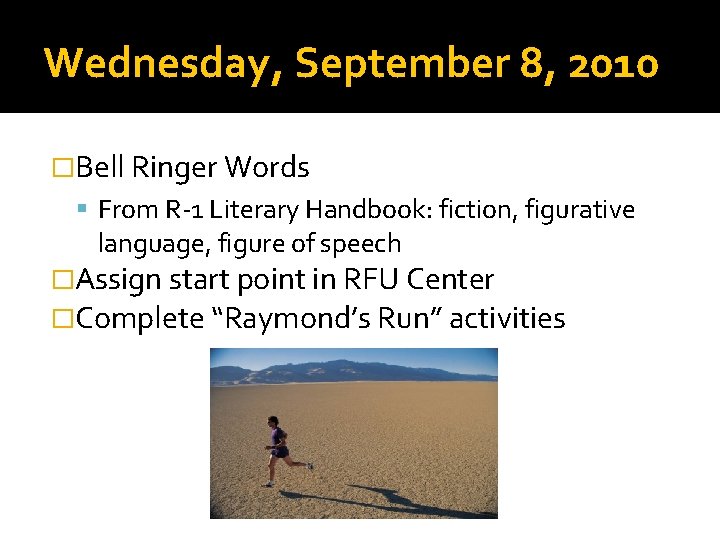
Wednesday, September 8, 2010 �Bell Ringer Words From R-1 Literary Handbook: fiction, figurative language, figure of speech �Assign start point in RFU Center �Complete “Raymond’s Run” activities
Thursday, September 9, 2010 �Bell Ringer Words From R-1 Literary Handbook: first-person narrative, flashback, folklore �Nuts and Bolts: Partner Practice �Orange Book: “After Twenty Years” pages 193 -198
Friday, September 10, 2010 7 th and 8 th Grade Dance Spirit Theme: Fifties Day �Bell Ringer Words From R-1 Literary Handbook: folktale, foreshadowing, free verse �Media Center Orientation
Monday, September 13, 2010 �Bell Ringer Words From R-1 Literary Handbook: genre, haiku, hero �FAIR TESTING
Tuesday, September 14, 2010 �Bell Ringer Words From R-1 Literary Handbook: historical fiction, humor, idiom �FAIR TESTING
Wednesday, September 15, 2010 �Bell Ringer Words From R-1 Literary Handbook: imagery, informational text, irony �Individual students complete FAIR testing in the lab as needed �Reading Center: MSS �Orange Book: pages 199 -206 “Oranges”
Thursday, September 16, 2010 �Bell Ringer Words From R-1 Literary Handbook: legend, limerick, local color �Individual students complete FAIR testing in the lab as needed �Nuts and Bolts: Partner Practice �New York Times: Upfront September 21 Issue SSR: Pages 3 -5 and 30 -31 Pages 24 -27 Homelessness and The Great Depression
Friday, September 17, 2010 �Bell Ringer Words From R-1 Literary Handbook: lyric, lyric poetry, main ideas �Individual students complete FAIR testing in the lab as needed �Text: “The Treasure of Lemon Brown” pages 476 -489 Activities pages 490, 491, 493 Journal: What do you have that is worth fighting for?
Monday, September 20, 2010 �Bell Ringer Words From R-1 Literary Handbook: memoir, metaphor, meter �Complete “Lemon Brown” �Review Persuasive WOW! Text page 540 -541 Persuasive Skills �Text: “Teen Curfew” pages 561 -563 Ten-minute drill: Persuasive Draft Essay: Curfew or other issue
Tuesday, September 21, 2010 �Bell Ringer Words From R-1 Literary Handbook: monologue, mood, myth �Nuts and Bolts: Partner Practice �New York Times: Upfront September 7 Issue Pair/Share pages 16 -17 Would you pass the new citizenship test> Read “America and the Draft” pages 22 -25 ▪ Argue the draft in assigned pairs ▪ Summarize your opponent’s argument ▪ Make a list of rebuttal points

Wednesday, September 22, 2010 Progress Reports Today �Bell Ringer Words From R-1 Literary Handbook: narration, narrative poetry, narrator �Reading Center: RFU �Orange Book: pages 207 -213 “Will Power”
Thursday, September 23, 2010 �Bell Ringer Words From R-1 Literary Handbook: nonfiction, novel, novella �Nuts and Bolts: Partner Practice �Text: pages 588 -589 Persuasive Speaking �Prepare and practice “draft” speech. Each group will select its best speech to complete for class honors. Present to your group on Tuesday.
Friday, September 24, 2010 �Bell Ringer Words From R-1 Literary Handbook: onomatopoeia, oral tradition, parallelism �Text: More about fitting in…”The Question of Popularity” pages 87 -90 �Prepare and practice your speech.
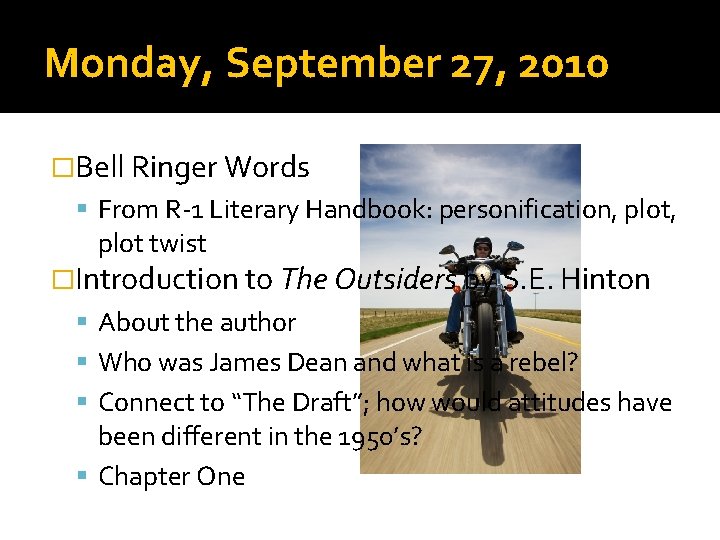
Monday, September 27, 2010 �Bell Ringer Words From R-1 Literary Handbook: personification, plot, plot twist �Introduction to The Outsiders by S. E. Hinton About the author Who was James Dean and what is a rebel? Connect to “The Draft”; how would attitudes have been different in the 1950’s? Chapter One
Tuesday, September 28, 2010 �Bell Ringer Words From R-1 Literary Handbook: poetry, point-of-view, propaganda �Nuts and Bolts: Partner Practice �The New York Times Upfront, November 23, 2009 SSR pages 3 -5 and 23 Read and discuss “Can you believe your eyes? ” Discuss manipulation of media images and bias, pages 10 -13. �Begin speeches to your group.
Wednesday, September 29, 2010 �Bell Ringer Words From R-1 Literary Handbook: props, prose, protagonist �Reading Center: MSS �Group #1 Speech presented to class �Read The Outsiders
Thursday, September 30, 2010 �Bell Ringer Words From R-1 Literary Handbook: pun, refrain, repetition �Group #2 Speech presented to class �Read The Outsiders
Friday, October 1, 2010 �Bell Ringer Words From R-1 Literary Handbook: resolution, rhyme, rhyme scheme �Group #3 Speech presented to class �Read The Outsiders
Monday, October 4, 2010 �Bell Ringer Words From R-1 Literary Handbook: rhythm, rising action, scene �Group #4 Speech presented to class �Read The Outsiders
Tuesday, October 5, 2010 �Writes Upon Request (No Period One) �Group #5 (and 6 if needed) Speech presented to class; Vote for winning speech �The New York Times Upfront, October 5 issue SSR: pages 3 -5, 22 -23 ▪ Review propaganda techniques, text: page 540 ▪ Discuss use of propaganda techniques in the cartoons Read “Fashion Police”, pages 6 -7; Identify propaganda techniques; Discuss dressing to belong…or “not”
Wednesday, October 6, 2010 �Bell Ringer Words From R-1 Literary Handbook: science fiction, screen play, sensory imagery �Reading Center: RFU �Announce winning speech �Read The Outsiders
Thursday, October 7, 2010 �Bell Ringer Words From R-1 Literary Handbook: sequence of events, setting, short story �Nuts and Bolts: Partner Practice �Read The Outsiders Complete reading activities
Friday, October 8, 2010 �Bell Ringer Words From R-1 Literary Handbook: simile, sound devices, speaker �Read The Outsiders Complete reading activities
Monday, October 11, 2010 �Bell Ringer Words From R-1 Literary Handbook: stage directions, stanza, stereotype �Read The Outsiders Complete reading activities
Tuesday, October 12, 2010 �Bell Ringer Words From R-1 Literary Handbook: style, suspense, symbol � The New York Times Upfront, September 21, 2009 SSR: Pages 3 -5 and 31 Read and Discuss Immigrants article pages 8 -11 �Read The Outsiders Complete reading activities
Wednesday, October 13, 2010 �Bell Ringer Words From R-1 Literary Handbook: tall tale, teleplay, theme �Reading Center: MSS (collect) �Orange Book: pages 31 -40 �Read The Outsiders Complete reading activities
Thursday, October 14, 2010 �Bell Ringer Words From R-1 Literary Handbook: third-person narrative, title, tone �Text: “Coming to America” pages 159 -164 �Read The Outsiders Complete reading activities
Friday, October 15, 2010 �Bell Ringer Words From R-1 Literary Handbook: tragedy, visual imagery, voice �Read The Outsiders Complete reading activities
Monday, October 18, 2010 �Bell Ringer Words From R-1 Literary Handbook: Power. Point Review of Literary Terms �Read The Outsiders Complete reading activities
Tuesday, October 19, 2010 �Bell Ringer Words From R-1 Literary Handbook: Power. Point Review of Literary Terms �Read The Outsiders Complete reading activities Review for Final Test
Wednesday, October 20, 2010 �Collect Outsiders Unit Activities �The Outsiders Final Test �Begin: Viewing Workshop: The Outsiders
Thursday, October 21, 2010 No school for students tomorrow! �Literary Terms Test and Persuasive Assessment: Text pages 592 -596 �Continue: Viewing Workshop: The Outsiders
- Slides: 72