
Eighth Edition Vector Mechanics for Engineers Statics CE
- Slides: 62
Eighth Edition Vector Mechanics for Engineers: Statics CE 102 Statics Chapter 4 Equilibrium of Rigid Bodies © 2007 The Mc. Graw-Hill Companies, Inc. All rights reserved. 4 -1
Eighth Edition Vector Mechanics for Engineers: Statics Contents Free-Body Diagram Equilibrium of a Rigid Body in Three Dimensions Reactions at Supports and Connections for a Two-Dimensional Structure Reactions at Supports and Connections for a Three-Dimensional Structure Equilibrium of a Rigid Body in Two Dimensions Sample Problem 4. 5 Introduction Statically Indeterminate Reactions Sample Problem 4. 1 Sample Problem 4. 2 Sample Problem 4. 3 Equilibrium of a Two-Force Body Equilibrium of a Three-Force Body Sample Problem 4. 4 © 2007 The Mc. Graw-Hill Companies, Inc. All rights reserved. 4 -2
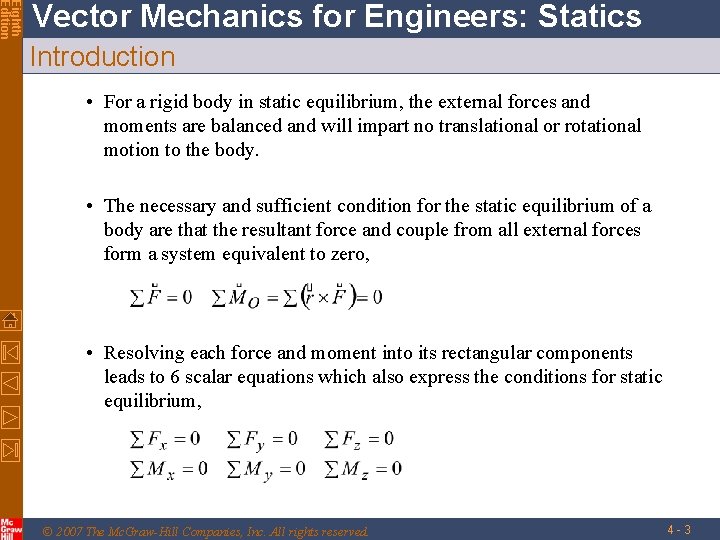
Eighth Edition Vector Mechanics for Engineers: Statics Introduction • For a rigid body in static equilibrium, the external forces and moments are balanced and will impart no translational or rotational motion to the body. • The necessary and sufficient condition for the static equilibrium of a body are that the resultant force and couple from all external forces form a system equivalent to zero, • Resolving each force and moment into its rectangular components leads to 6 scalar equations which also express the conditions for static equilibrium, © 2007 The Mc. Graw-Hill Companies, Inc. All rights reserved. 4 -3
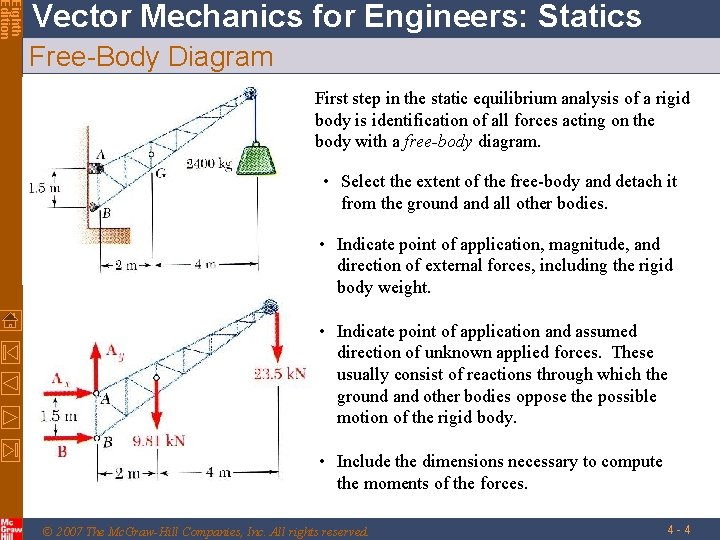
Eighth Edition Vector Mechanics for Engineers: Statics Free-Body Diagram First step in the static equilibrium analysis of a rigid body is identification of all forces acting on the body with a free-body diagram. • Select the extent of the free-body and detach it from the ground all other bodies. • Indicate point of application, magnitude, and direction of external forces, including the rigid body weight. • Indicate point of application and assumed direction of unknown applied forces. These usually consist of reactions through which the ground and other bodies oppose the possible motion of the rigid body. • Include the dimensions necessary to compute the moments of the forces. © 2007 The Mc. Graw-Hill Companies, Inc. All rights reserved. 4 -4
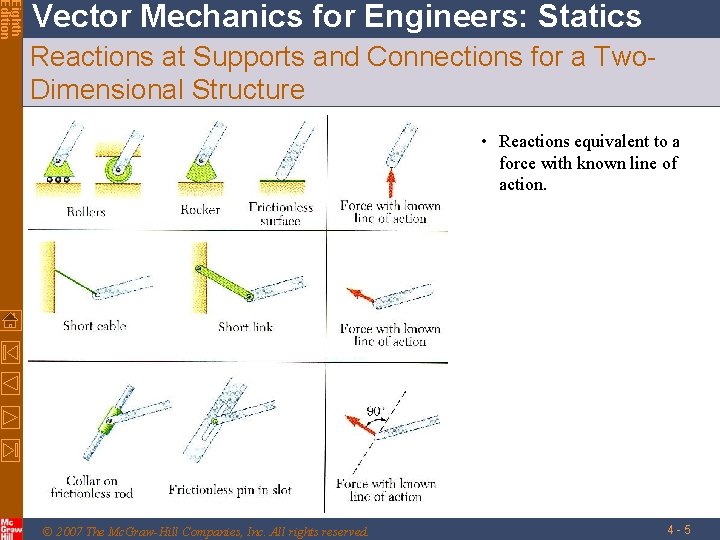
Eighth Edition Vector Mechanics for Engineers: Statics Reactions at Supports and Connections for a Two. Dimensional Structure • Reactions equivalent to a force with known line of action. © 2007 The Mc. Graw-Hill Companies, Inc. All rights reserved. 4 -5
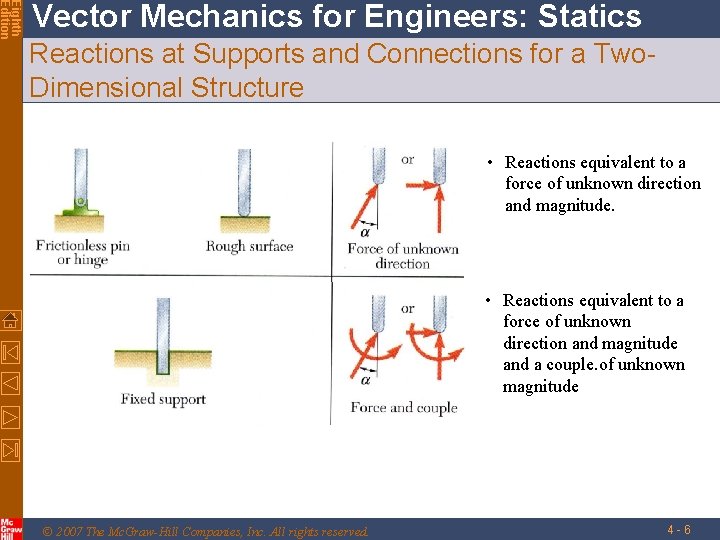
Eighth Edition Vector Mechanics for Engineers: Statics Reactions at Supports and Connections for a Two. Dimensional Structure • Reactions equivalent to a force of unknown direction and magnitude and a couple. of unknown magnitude © 2007 The Mc. Graw-Hill Companies, Inc. All rights reserved. 4 -6
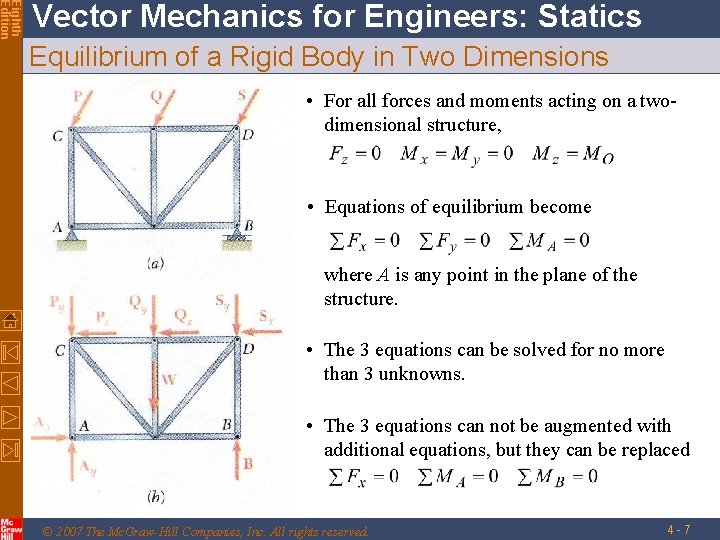
Eighth Edition Vector Mechanics for Engineers: Statics Equilibrium of a Rigid Body in Two Dimensions • For all forces and moments acting on a twodimensional structure, • Equations of equilibrium become where A is any point in the plane of the structure. • The 3 equations can be solved for no more than 3 unknowns. • The 3 equations can not be augmented with additional equations, but they can be replaced © 2007 The Mc. Graw-Hill Companies, Inc. All rights reserved. 4 -7
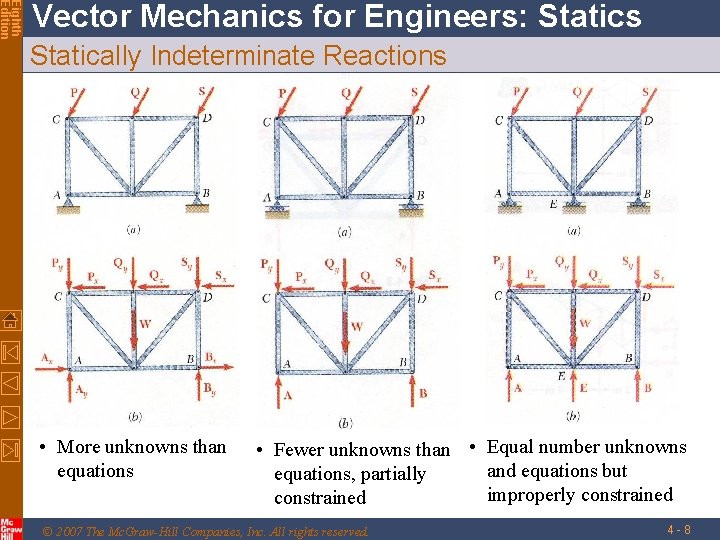
Eighth Edition Vector Mechanics for Engineers: Statics Statically Indeterminate Reactions • More unknowns than equations • Fewer unknowns than • Equal number unknowns and equations but equations, partially improperly constrained © 2007 The Mc. Graw-Hill Companies, Inc. All rights reserved. 4 -8
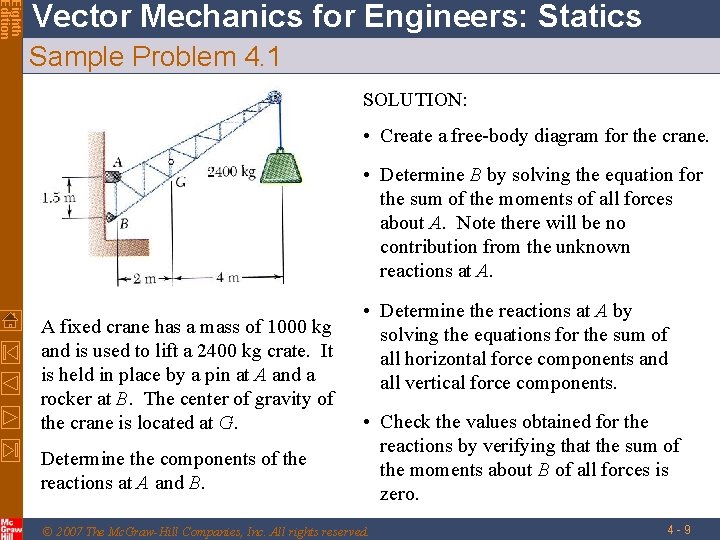
Eighth Edition Vector Mechanics for Engineers: Statics Sample Problem 4. 1 SOLUTION: • Create a free-body diagram for the crane. • Determine B by solving the equation for the sum of the moments of all forces about A. Note there will be no contribution from the unknown reactions at A. A fixed crane has a mass of 1000 kg and is used to lift a 2400 kg crate. It is held in place by a pin at A and a rocker at B. The center of gravity of the crane is located at G. Determine the components of the reactions at A and B. • Determine the reactions at A by solving the equations for the sum of all horizontal force components and all vertical force components. • Check the values obtained for the reactions by verifying that the sum of the moments about B of all forces is zero. © 2007 The Mc. Graw-Hill Companies, Inc. All rights reserved. 4 -9
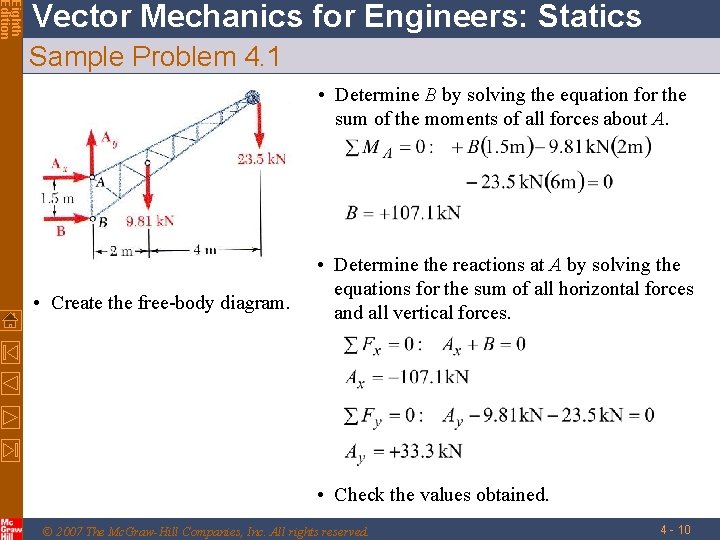
Eighth Edition Vector Mechanics for Engineers: Statics Sample Problem 4. 1 • Determine B by solving the equation for the sum of the moments of all forces about A. • Create the free-body diagram. • Determine the reactions at A by solving the equations for the sum of all horizontal forces and all vertical forces. • Check the values obtained. © 2007 The Mc. Graw-Hill Companies, Inc. All rights reserved. 4 - 10
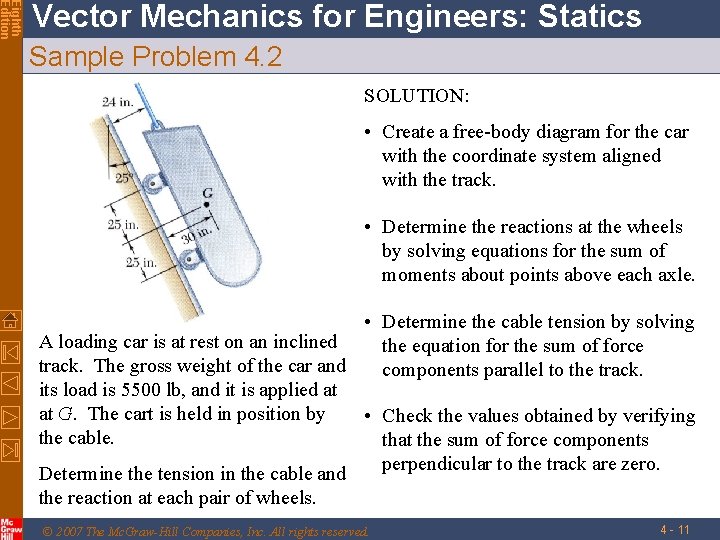
Eighth Edition Vector Mechanics for Engineers: Statics Sample Problem 4. 2 SOLUTION: • Create a free-body diagram for the car with the coordinate system aligned with the track. • Determine the reactions at the wheels by solving equations for the sum of moments about points above each axle. • Determine the cable tension by solving A loading car is at rest on an inclined the equation for the sum of force track. The gross weight of the car and components parallel to the track. its load is 5500 lb, and it is applied at at G. The cart is held in position by • Check the values obtained by verifying the cable. that the sum of force components perpendicular to the track are zero. Determine the tension in the cable and the reaction at each pair of wheels. © 2007 The Mc. Graw-Hill Companies, Inc. All rights reserved. 4 - 11
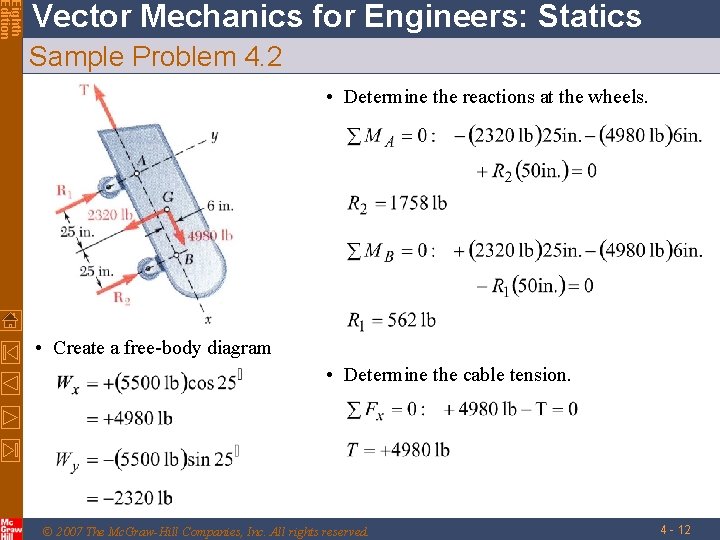
Eighth Edition Vector Mechanics for Engineers: Statics Sample Problem 4. 2 • Determine the reactions at the wheels. • Create a free-body diagram • Determine the cable tension. © 2007 The Mc. Graw-Hill Companies, Inc. All rights reserved. 4 - 12
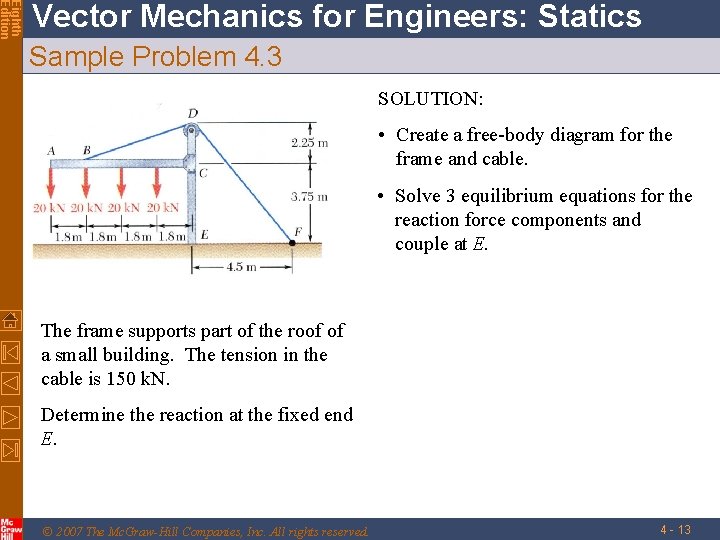
Eighth Edition Vector Mechanics for Engineers: Statics Sample Problem 4. 3 SOLUTION: • Create a free-body diagram for the frame and cable. • Solve 3 equilibrium equations for the reaction force components and couple at E. The frame supports part of the roof of a small building. The tension in the cable is 150 k. N. Determine the reaction at the fixed end E. © 2007 The Mc. Graw-Hill Companies, Inc. All rights reserved. 4 - 13
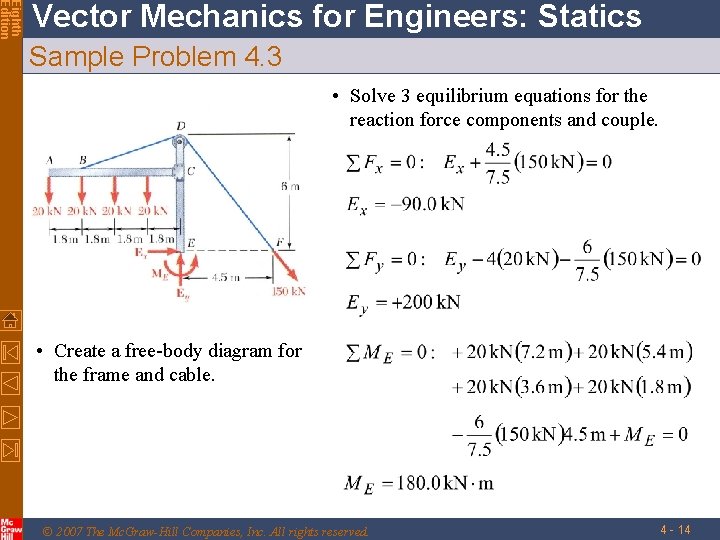
Eighth Edition Vector Mechanics for Engineers: Statics Sample Problem 4. 3 • Solve 3 equilibrium equations for the reaction force components and couple. • Create a free-body diagram for the frame and cable. © 2007 The Mc. Graw-Hill Companies, Inc. All rights reserved. 4 - 14
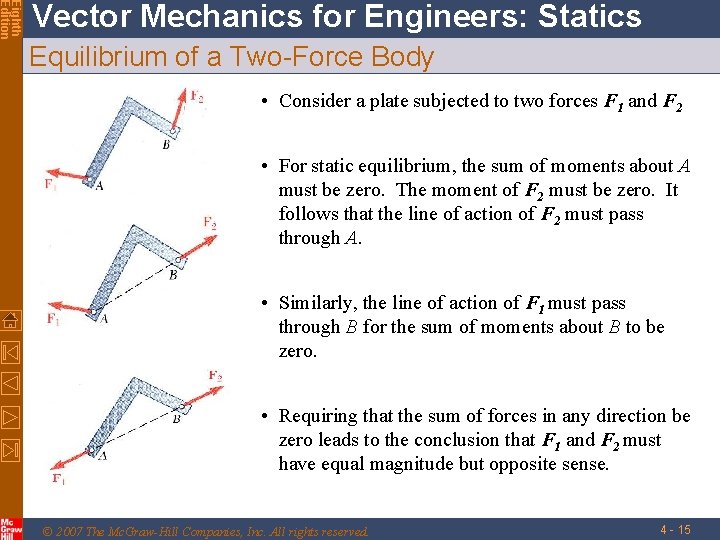
Eighth Edition Vector Mechanics for Engineers: Statics Equilibrium of a Two-Force Body • Consider a plate subjected to two forces F 1 and F 2 • For static equilibrium, the sum of moments about A must be zero. The moment of F 2 must be zero. It follows that the line of action of F 2 must pass through A. • Similarly, the line of action of F 1 must pass through B for the sum of moments about B to be zero. • Requiring that the sum of forces in any direction be zero leads to the conclusion that F 1 and F 2 must have equal magnitude but opposite sense. © 2007 The Mc. Graw-Hill Companies, Inc. All rights reserved. 4 - 15
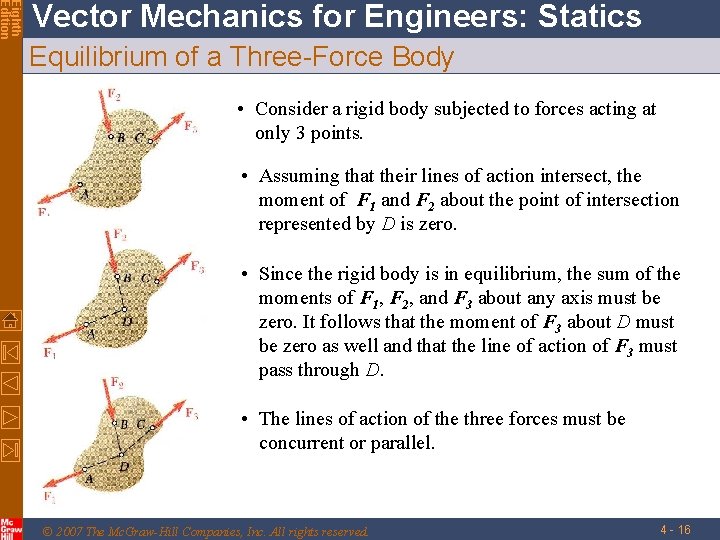
Eighth Edition Vector Mechanics for Engineers: Statics Equilibrium of a Three-Force Body • Consider a rigid body subjected to forces acting at only 3 points. • Assuming that their lines of action intersect, the moment of F 1 and F 2 about the point of intersection represented by D is zero. • Since the rigid body is in equilibrium, the sum of the moments of F 1, F 2, and F 3 about any axis must be zero. It follows that the moment of F 3 about D must be zero as well and that the line of action of F 3 must pass through D. • The lines of action of the three forces must be concurrent or parallel. © 2007 The Mc. Graw-Hill Companies, Inc. All rights reserved. 4 - 16
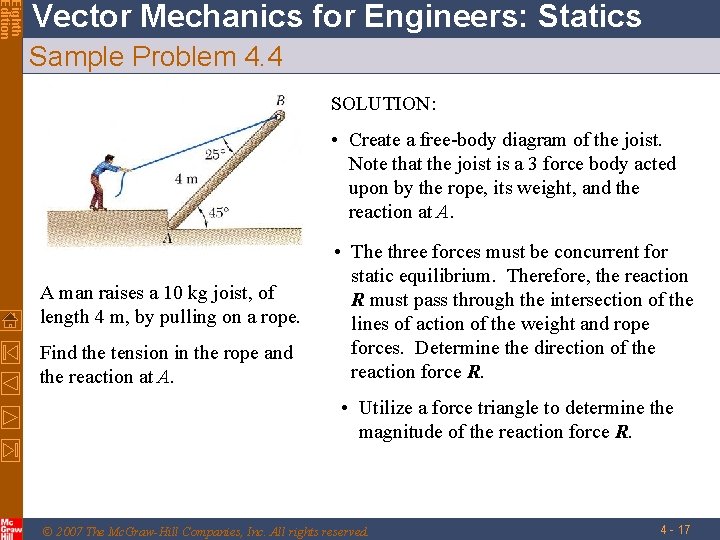
Eighth Edition Vector Mechanics for Engineers: Statics Sample Problem 4. 4 SOLUTION: • Create a free-body diagram of the joist. Note that the joist is a 3 force body acted upon by the rope, its weight, and the reaction at A. A man raises a 10 kg joist, of length 4 m, by pulling on a rope. Find the tension in the rope and the reaction at A. • The three forces must be concurrent for static equilibrium. Therefore, the reaction R must pass through the intersection of the lines of action of the weight and rope forces. Determine the direction of the reaction force R. • Utilize a force triangle to determine the magnitude of the reaction force R. © 2007 The Mc. Graw-Hill Companies, Inc. All rights reserved. 4 - 17
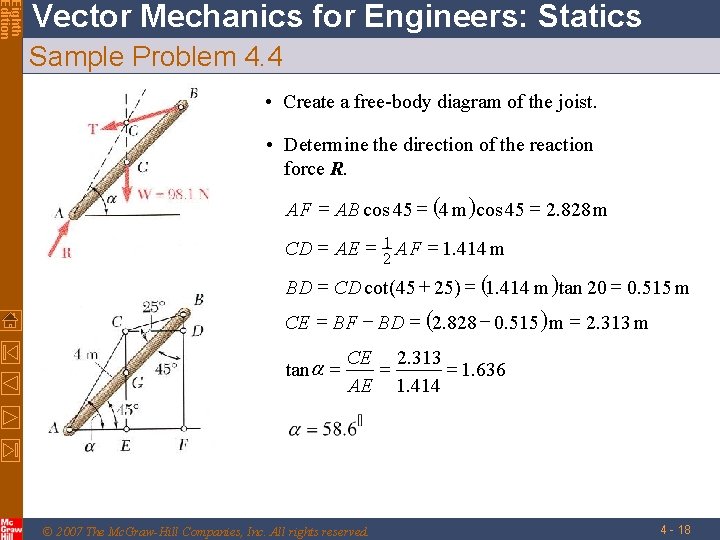
Eighth Edition Vector Mechanics for Engineers: Statics Sample Problem 4. 4 • Create a free-body diagram of the joist. • Determine the direction of the reaction force R. AF = AB cos 45 = (4 m )cos 45 = 2. 828 m CD = AE = 12 AF = 1. 414 m BD = CD cot(45 + 25) = (1. 414 m )tan 20 = 0. 515 m CE = BF - BD = (2. 828 - 0. 515) m = 2. 313 m tana = CE 2. 313 = = 1. 636 AE 1. 414 © 2007 The Mc. Graw-Hill Companies, Inc. All rights reserved. 4 - 18
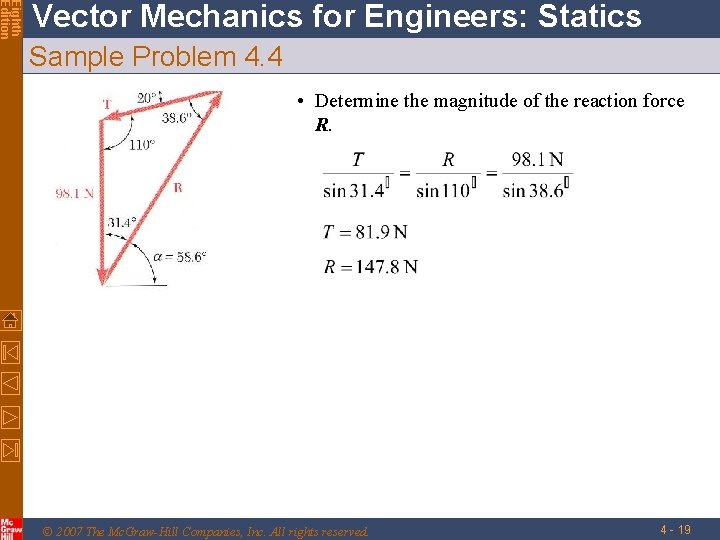
Eighth Edition Vector Mechanics for Engineers: Statics Sample Problem 4. 4 • Determine the magnitude of the reaction force R. © 2007 The Mc. Graw-Hill Companies, Inc. All rights reserved. 4 - 19
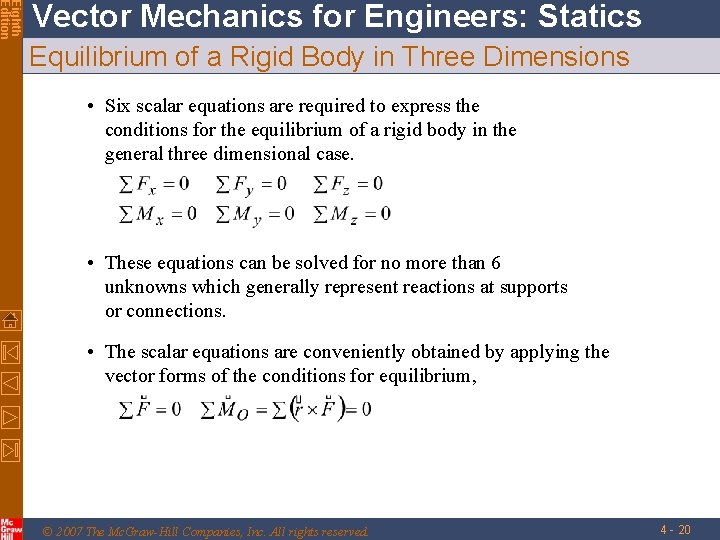
Eighth Edition Vector Mechanics for Engineers: Statics Equilibrium of a Rigid Body in Three Dimensions • Six scalar equations are required to express the conditions for the equilibrium of a rigid body in the general three dimensional case. • These equations can be solved for no more than 6 unknowns which generally represent reactions at supports or connections. • The scalar equations are conveniently obtained by applying the vector forms of the conditions for equilibrium, © 2007 The Mc. Graw-Hill Companies, Inc. All rights reserved. 4 - 20
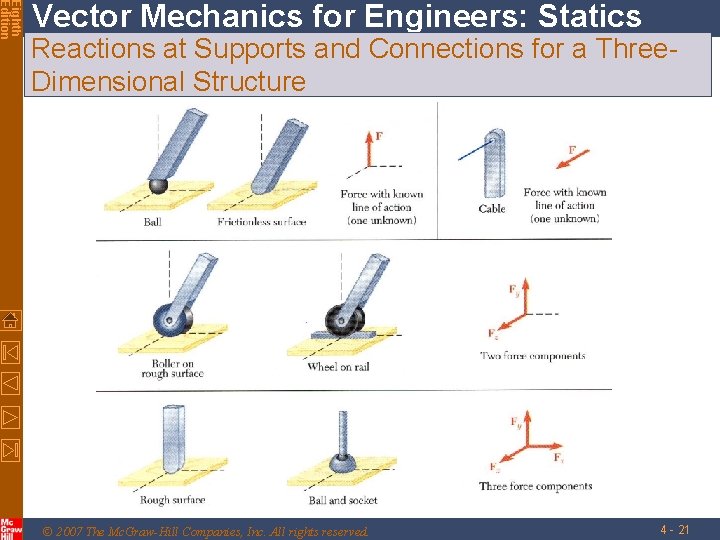
Eighth Edition Vector Mechanics for Engineers: Statics Reactions at Supports and Connections for a Three. Dimensional Structure © 2007 The Mc. Graw-Hill Companies, Inc. All rights reserved. 4 - 21
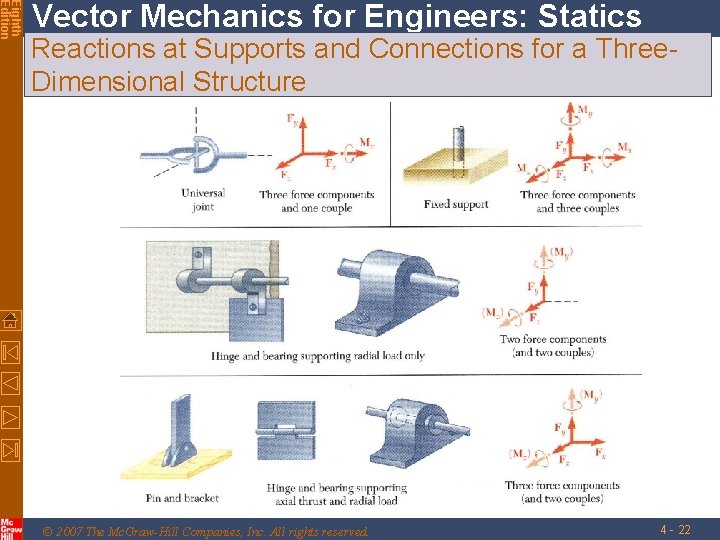
Eighth Edition Vector Mechanics for Engineers: Statics Reactions at Supports and Connections for a Three. Dimensional Structure © 2007 The Mc. Graw-Hill Companies, Inc. All rights reserved. 4 - 22
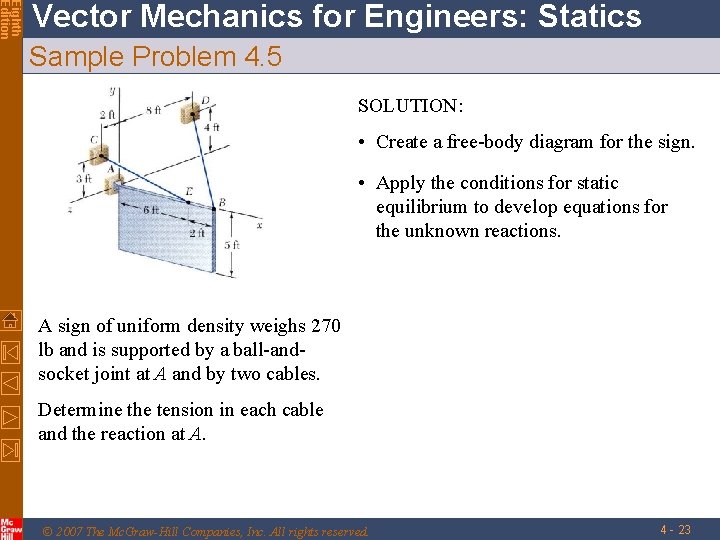
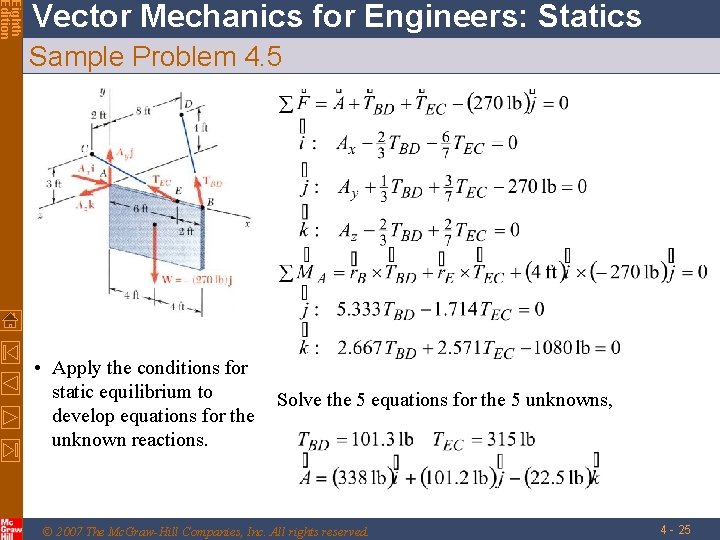
Eighth Edition Vector Mechanics for Engineers: Statics Sample Problem 4. 5 SOLUTION: • Create a free-body diagram for the sign. • Apply the conditions for static equilibrium to develop equations for the unknown reactions. A sign of uniform density weighs 270 lb and is supported by a ball-andsocket joint at A and by two cables. Determine the tension in each cable and the reaction at A. © 2007 The Mc. Graw-Hill Companies, Inc. All rights reserved. 4 - 23
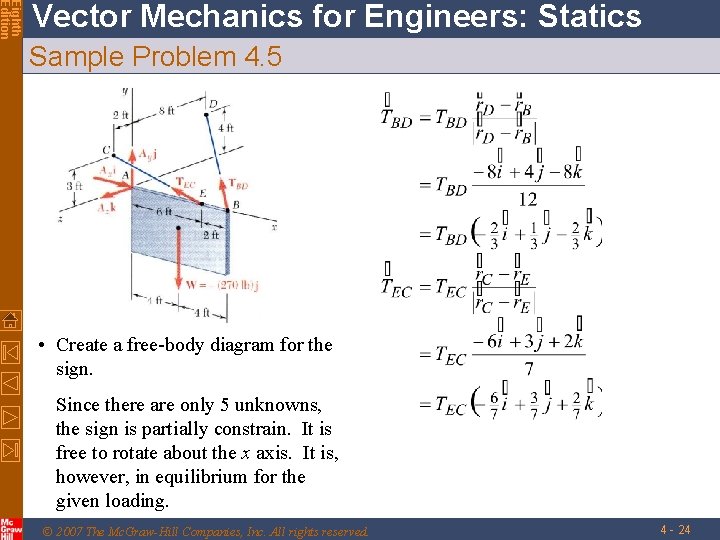
Eighth Edition Vector Mechanics for Engineers: Statics Sample Problem 4. 5 • Create a free-body diagram for the sign. Since there are only 5 unknowns, the sign is partially constrain. It is free to rotate about the x axis. It is, however, in equilibrium for the given loading. © 2007 The Mc. Graw-Hill Companies, Inc. All rights reserved. 4 - 24
Eighth Edition Vector Mechanics for Engineers: Statics Sample Problem 4. 5 • Apply the conditions for static equilibrium to develop equations for the unknown reactions. Solve the 5 equations for the 5 unknowns, © 2007 The Mc. Graw-Hill Companies, Inc. All rights reserved. 4 - 25
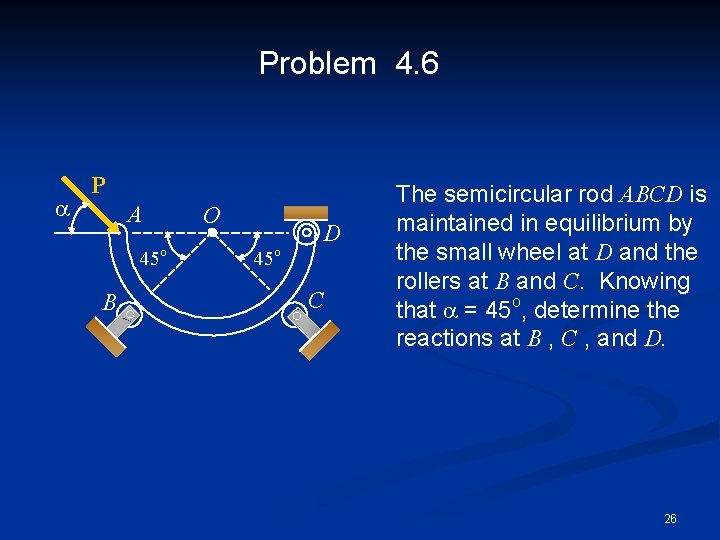
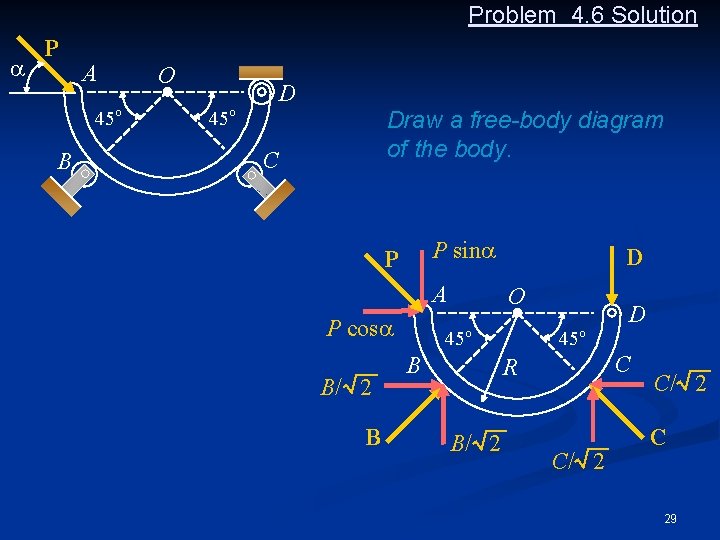
Problem 4. 6 a P A 45 o B O 45 o D C The semicircular rod ABCD is maintained in equilibrium by the small wheel at D and the rollers at B and C. Knowing that a = 45 o, determine the reactions at B , C , and D. 26
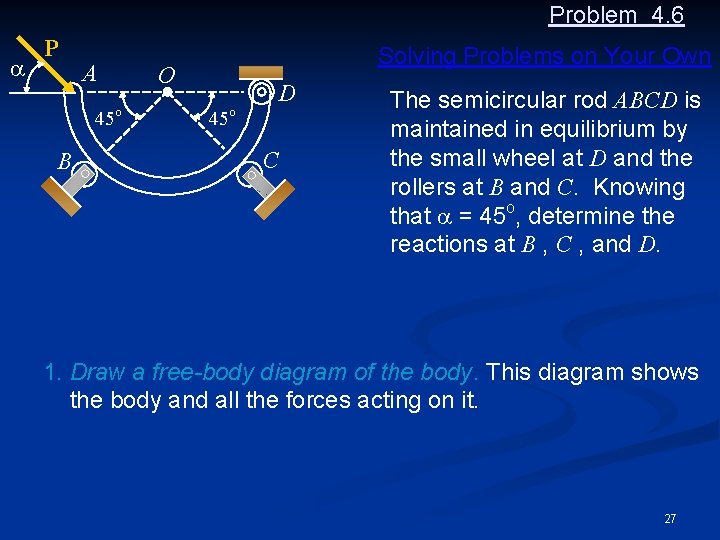
Problem 4. 6 a P A O o 45 B Solving Problems on Your Own o D 45 C The semicircular rod ABCD is maintained in equilibrium by the small wheel at D and the rollers at B and C. Knowing that a = 45 o, determine the reactions at B , C , and D. 1. Draw a free-body diagram of the body. This diagram shows the body and all the forces acting on it. 27
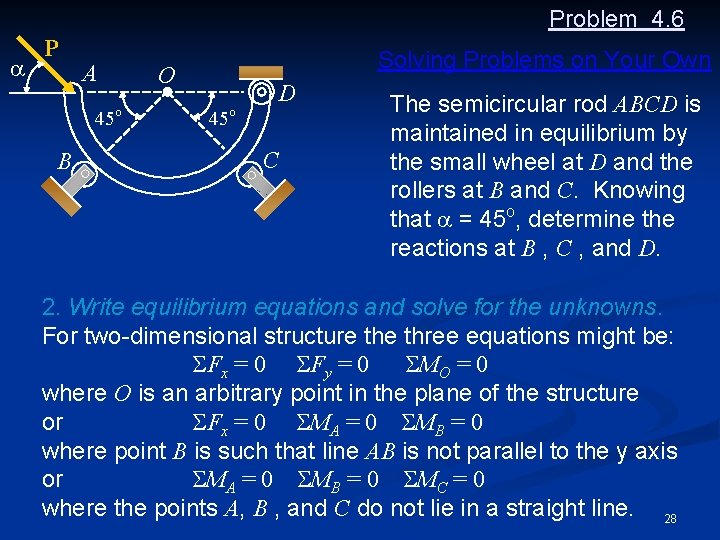
Problem 4. 6 a P A O o 45 B Solving Problems on Your Own o D 45 C The semicircular rod ABCD is maintained in equilibrium by the small wheel at D and the rollers at B and C. Knowing that a = 45 o, determine the reactions at B , C , and D. 2. Write equilibrium equations and solve for the unknowns. For two-dimensional structure three equations might be: SFx = 0 SFy = 0 SMO = 0 where O is an arbitrary point in the plane of the structure or SFx = 0 SMA = 0 SMB = 0 where point B is such that line AB is not parallel to the y axis or SMA = 0 SMB = 0 SMC = 0 where the points A, B , and C do not lie in a straight line. 28
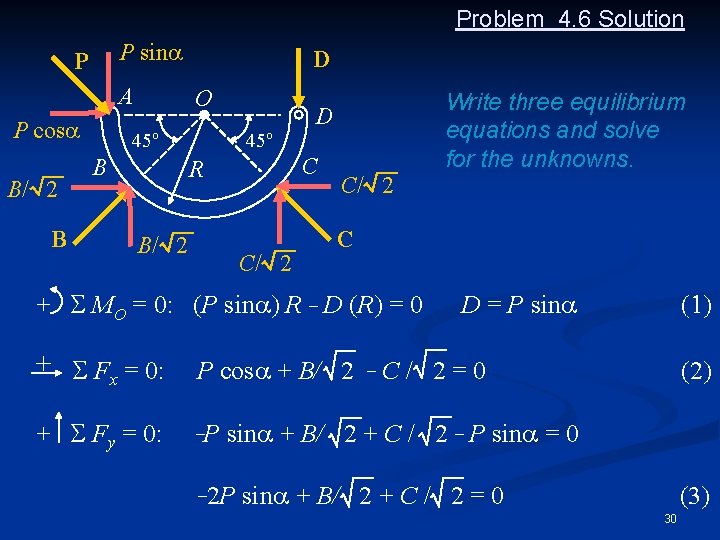
Problem 4. 6 Solution a P A O o 45 B o D Draw a free-body diagram of the body. 45 C P sina P A P cosa B/ 2 B D O 45 o B 45 o C R B/ 2 D C/ 2 C 29
Problem 4. 6 Solution P sina P A P cosa B/ 2 B D O 45 o B 45 o D C R B/ 2 C/ 2 C + S MO = 0: (P sina) R _ D (R) = 0 + S Fx = 0: + S Fy = 0: P cosa + B/ 2 _ Write three equilibrium equations and solve for the unknowns. _ (1) D = P sina C/ 2=0 (2) P sina + B/ 2 + C / 2 _ P sina = 0 _ 2 P sina + B/ 2 + C / 2 = 0 (3) 30
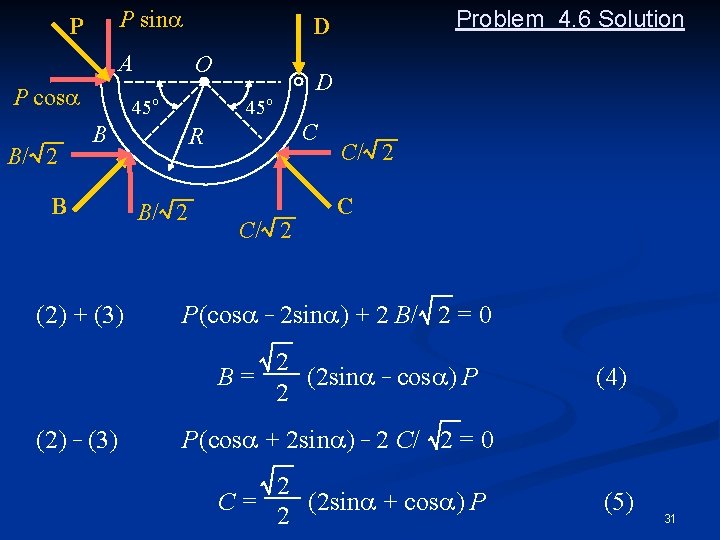
P sina P A P cosa B/ 2 O 45 o B B (2) + (3) Problem 4. 6 Solution D C R B/ 2 D C/ 2 C P(cosa _ 2 sina) + 2 B/ 2 = 0 2 B= (2 sina _ cosa) P 2 (2) _ (3) (4) P(cosa + 2 sina) _ 2 C/ 2 = 0 2 C= (2 sina + cosa) P 2 (5) 31
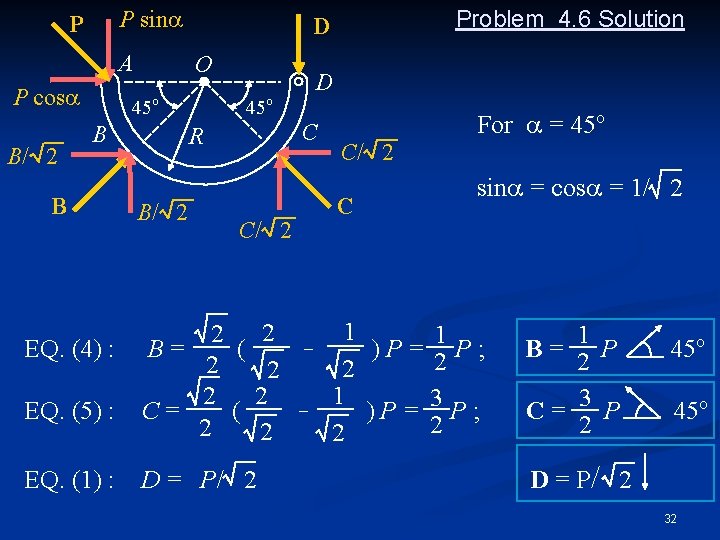
P sina P A P cosa B/ 2 O 45 o B B EQ. (4) : EQ. (5) : EQ. (1) : D 45 o C R B/ 2 Problem 4. 6 Solution D C C/ 2 2 2 B= ( 2 2 C= ( 2 2 D = P/ 2 C/ 2 _ _ For a = 45 o sina = cosa = 1/ 2 1 1 )P= P; 2 2 1 3 )P= P; 2 2 1 B= P 2 C= 3 P 2 45 o D = P/ 2 32
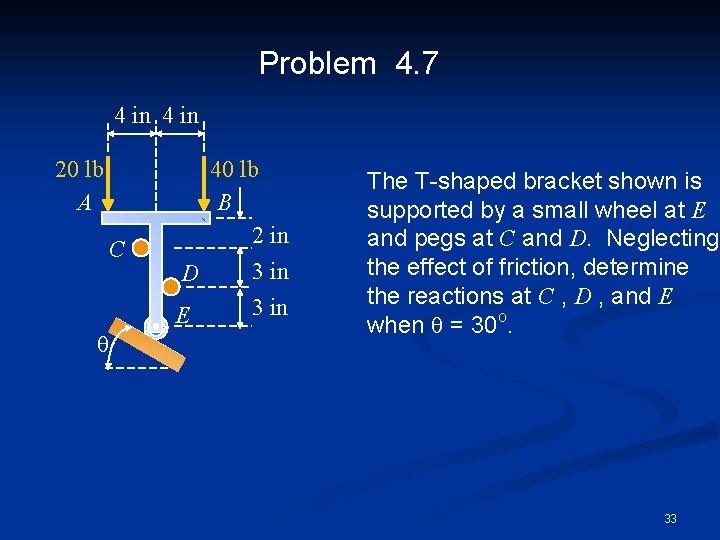
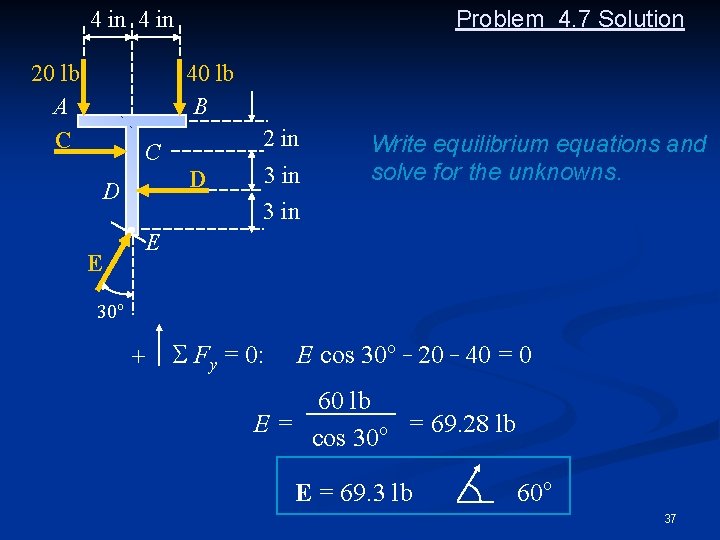
Problem 4. 7 4 in 20 lb A C q 40 lb B 2 in 3 in D 3 in E The T-shaped bracket shown is supported by a small wheel at E and pegs at C and D. Neglecting the effect of friction, determine the reactions at C , D , and E when q = 30 o. 33
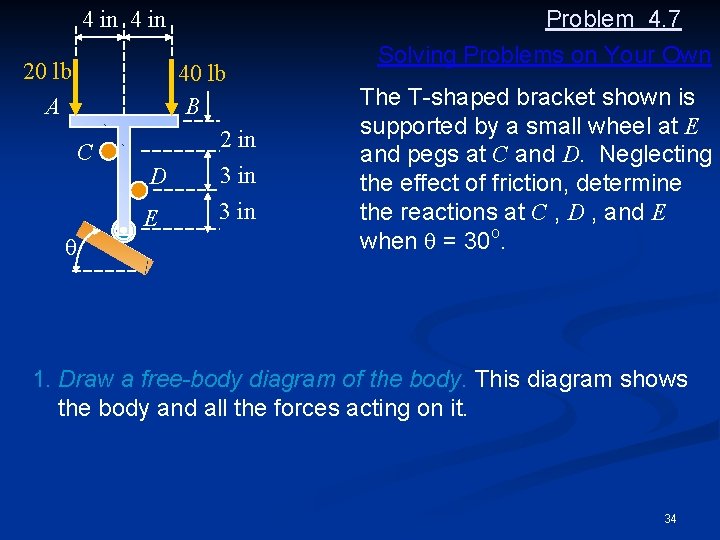
4 in 20 lb A C q 40 lb B 2 in 3 in D 3 in E Problem 4. 7 Solving Problems on Your Own The T-shaped bracket shown is supported by a small wheel at E and pegs at C and D. Neglecting the effect of friction, determine the reactions at C , D , and E when q = 30 o. 1. Draw a free-body diagram of the body. This diagram shows the body and all the forces acting on it. 34
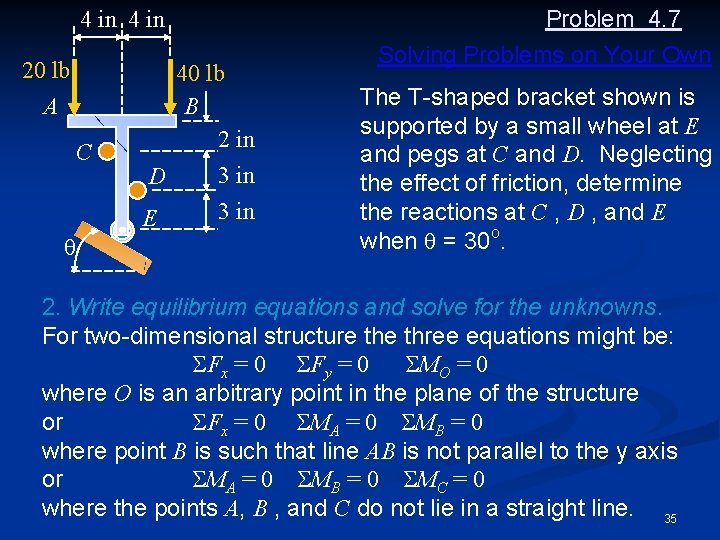
4 in 20 lb A C q 40 lb B 2 in 3 in D 3 in E Problem 4. 7 Solving Problems on Your Own The T-shaped bracket shown is supported by a small wheel at E and pegs at C and D. Neglecting the effect of friction, determine the reactions at C , D , and E when q = 30 o. 2. Write equilibrium equations and solve for the unknowns. For two-dimensional structure three equations might be: SFx = 0 SFy = 0 SMO = 0 where O is an arbitrary point in the plane of the structure or SFx = 0 SMA = 0 SMB = 0 where point B is such that line AB is not parallel to the y axis or SMA = 0 SMB = 0 SMC = 0 where the points A, B , and C do not lie in a straight line. 35
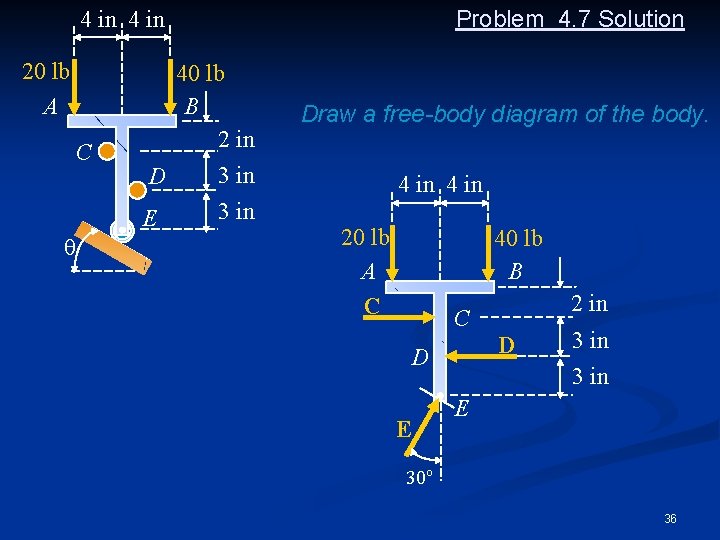
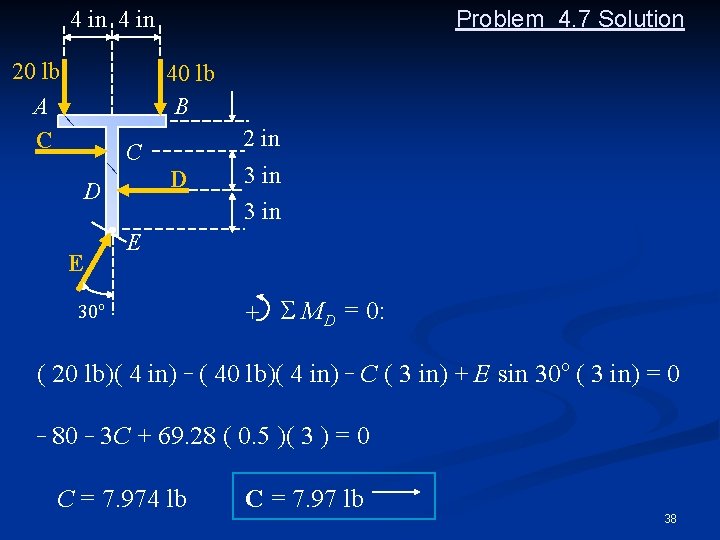
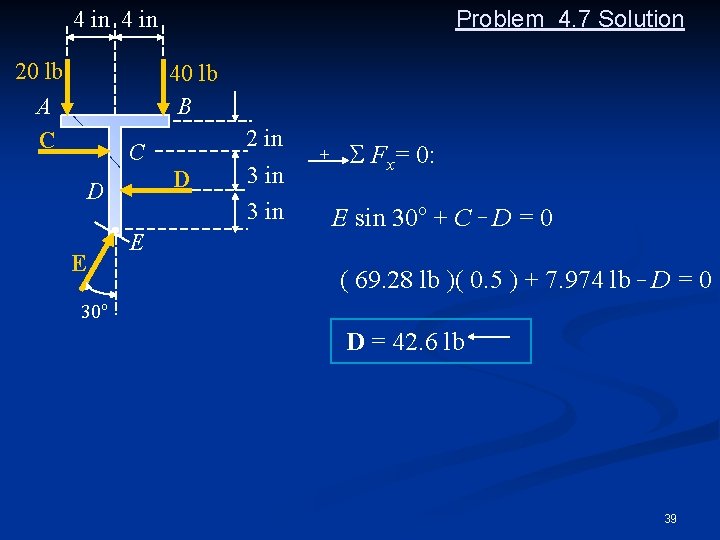
Problem 4. 7 Solution 4 in 20 lb A C q 40 lb B 2 in 3 in D 3 in E Draw a free-body diagram of the body. 4 in 20 lb A C 40 lb B 2 in C D D E 3 in E 30 o 36
Problem 4. 7 Solution 4 in 20 lb A C 40 lb B 2 in C D D E 3 in Write equilibrium equations and solve for the unknowns. E 30 o + S Fy = 0: E cos 30 o _ 20 _ 40 = 0 60 lb E= = 69. 28 lb cos 30 o E = 69. 3 lb 60 o 37
Problem 4. 7 Solution 4 in 20 lb A C 40 lb B 2 in C D D E 3 in E 30 o + S MD = 0: ( 20 lb)( 4 in) _ ( 40 lb)( 4 in) _ C ( 3 in) + E sin 30 o ( 3 in) = 0 _ 80 _ 3 C + 69. 28 ( 0. 5 )( 3 ) = 0 C = 7. 974 lb C = 7. 97 lb 38
Problem 4. 7 Solution 4 in 20 lb A C 40 lb B 2 in C D D E E 3 in + S Fx= 0: E sin 30 o + C _ D = 0 ( 69. 28 lb )( 0. 5 ) + 7. 974 lb _ D = 0 30 o D = 42. 6 lb 39
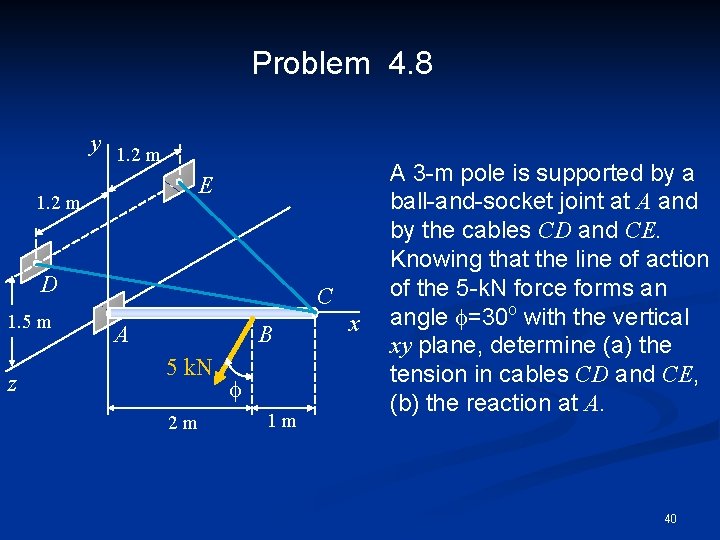
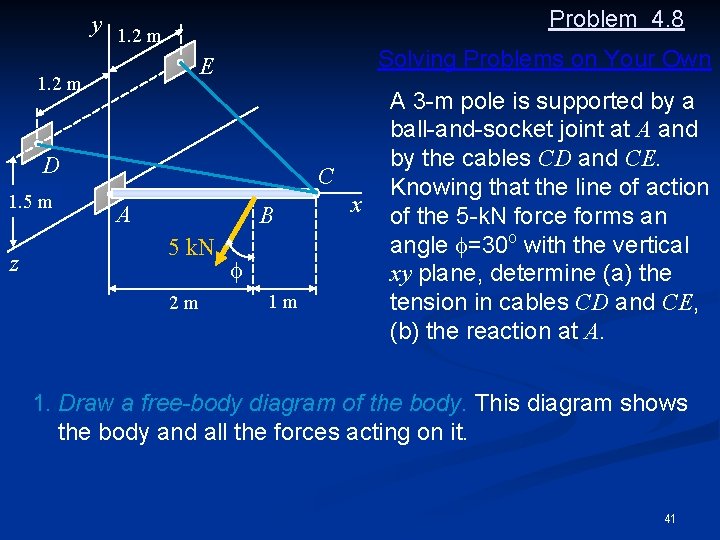
Problem 4. 8 y 1. 2 m E 1. 2 m D 1. 5 m z C A B 5 k. N 2 m f 1 m x A 3 -m pole is supported by a ball-and-socket joint at A and by the cables CD and CE. Knowing that the line of action of the 5 -k. N force forms an angle f=30 o with the vertical xy plane, determine (a) the tension in cables CD and CE, (b) the reaction at A. 40
Problem 4. 8 y 1. 2 m Solving Problems on Your Own E 1. 2 m D 1. 5 m z C A B 5 k. N 2 m f 1 m x A 3 -m pole is supported by a ball-and-socket joint at A and by the cables CD and CE. Knowing that the line of action of the 5 -k. N force forms an angle f=30 o with the vertical xy plane, determine (a) the tension in cables CD and CE, (b) the reaction at A. 1. Draw a free-body diagram of the body. This diagram shows the body and all the forces acting on it. 41
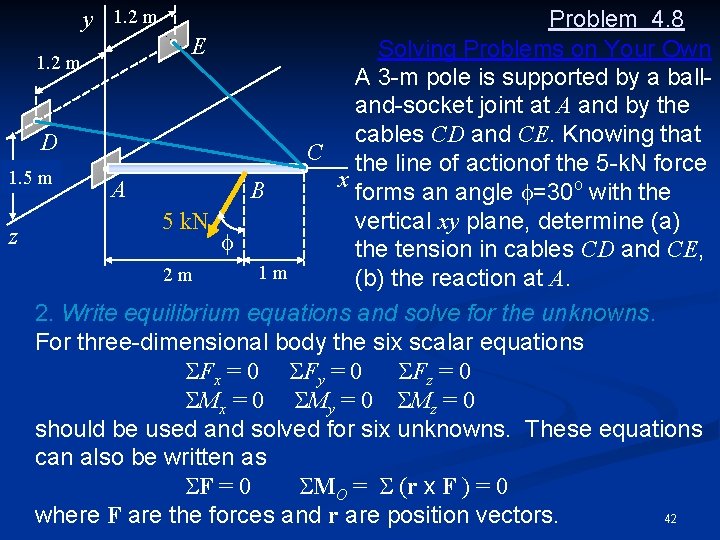
Problem 4. 8 E Solving Problems on Your Own 1. 2 m A 3 -m pole is supported by a balland-socket joint at A and by the cables CD and CE. Knowing that D C the line of actionof the 5 -k. N force 1. 5 m x A B forms an angle f=30 o with the 5 k. N vertical xy plane, determine (a) z f the tension in cables CD and CE, 1 m 2 m (b) the reaction at A. 2. Write equilibrium equations and solve for the unknowns. For three-dimensional body the six scalar equations SFx = 0 SFy = 0 SFz = 0 SMx = 0 SMy = 0 SMz = 0 should be used and solved for six unknowns. These equations can also be written as SF = 0 SMO = S (r x F ) = 0 where F are the forces and r are position vectors. 42 y 1. 2 m
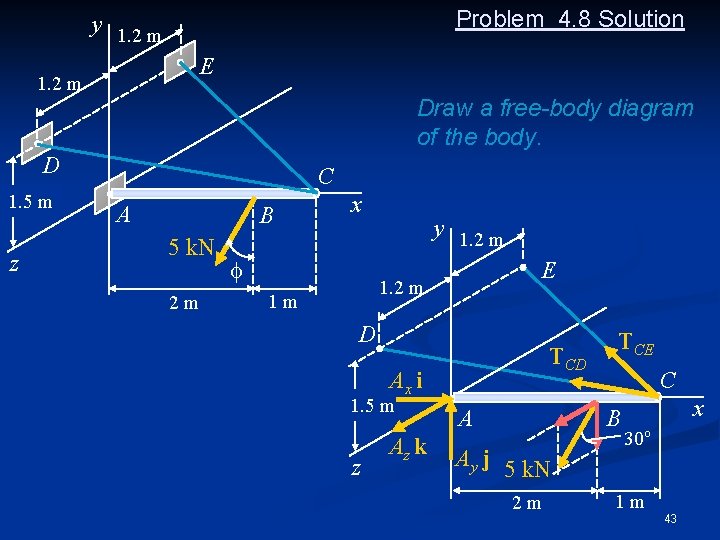
Problem 4. 8 Solution y 1. 2 m E 1. 2 m Draw a free-body diagram of the body. D 1. 5 m z C A B 5 k. N 2 m x f y 1. 2 m E 1. 2 m 1 m D TCD Ax i 1. 5 m z Az k TCE C B A Ay j 5 k. N 2 m x 30 o 1 m 43
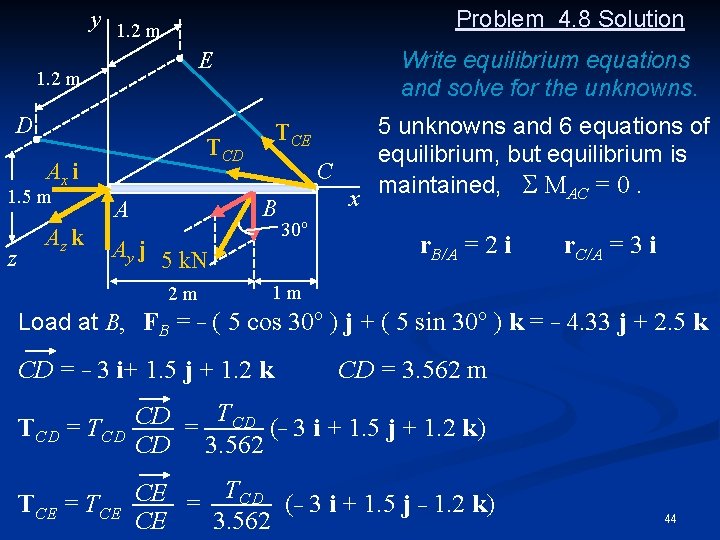
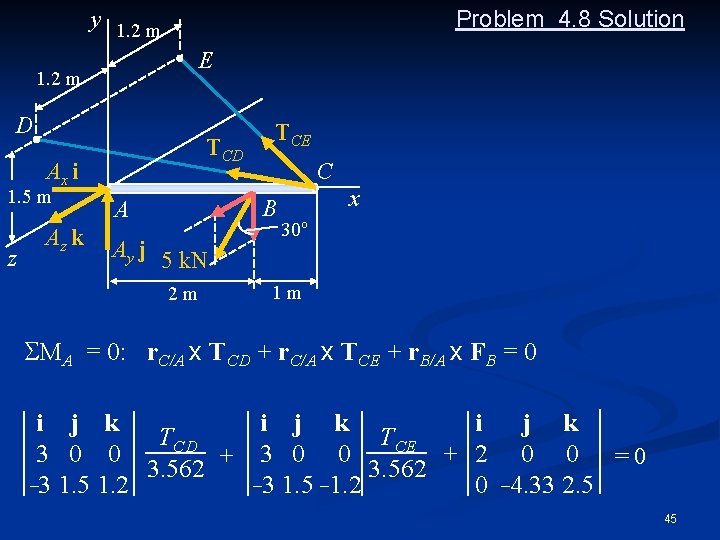
Problem 4. 8 Solution y 1. 2 m D z Az k TCE TCD Ax i 1. 5 m Write equilibrium equations and solve for the unknowns. E C B A Ay j 5 k. N 2 m x 30 o 5 unknowns and 6 equations of equilibrium, but equilibrium is maintained, S MAC = 0. r. B/A = 2 i r. C/A = 3 i 1 m Load at B, FB = _ ( 5 cos 30 o ) j + ( 5 sin 30 o ) k = _ 4. 33 j + 2. 5 k CD = _ 3 i+ 1. 5 j + 1. 2 k CD = 3. 562 m T TCD = TCD CD = CD (_ 3 i + 1. 5 j + 1. 2 k) CD 3. 562 TCE = TCE CE = TCD (_ 3 i + 1. 5 j _ 1. 2 k) CE 3. 562 44
Problem 4. 8 Solution y 1. 2 m E 1. 2 m D TCD Ax i 1. 5 m z Az k TCE C B A Ay j 5 k. N 2 m x 30 o 1 m SMA = 0: r. C/A x TCD + r. C/A x TCE + r. B/A x FB = 0 i j k TCD TCE + 2 0 0 =0 3 0 0 + 3 0 0 3. 562 _ _ _ 3 1. 5 1. 2 0 _4. 33 2. 5 45
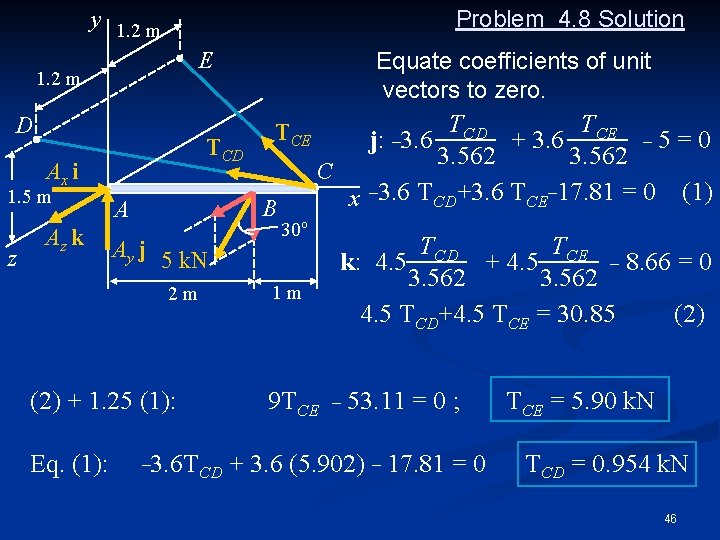
Problem 4. 8 Solution y 1. 2 m E 1. 2 m D TCD Ax i 1. 5 m z Az k TCE B A Ay j 5 k. N 2 m (2) + 1. 25 (1): Eq. (1): Equate coefficients of unit vectors to zero. _ TCD TCE _ j: 3. 6 + 3. 6 5=0 3. 562 C _ _ 3. 6 T +3. 6 T (1) x CD CE 17. 81 = 0 30 o 1 m 9 TCE _ TCD TCE _ k: 4. 5 + 4. 5 8. 66 = 0 3. 562 4. 5 TCD+4. 5 TCE = 30. 85 (2) _ 53. 11 = 0 ; 3. 6 TCD + 3. 6 (5. 902) _ 17. 81 = 0 TCE = 5. 90 k. N TCD = 0. 954 k. N 46
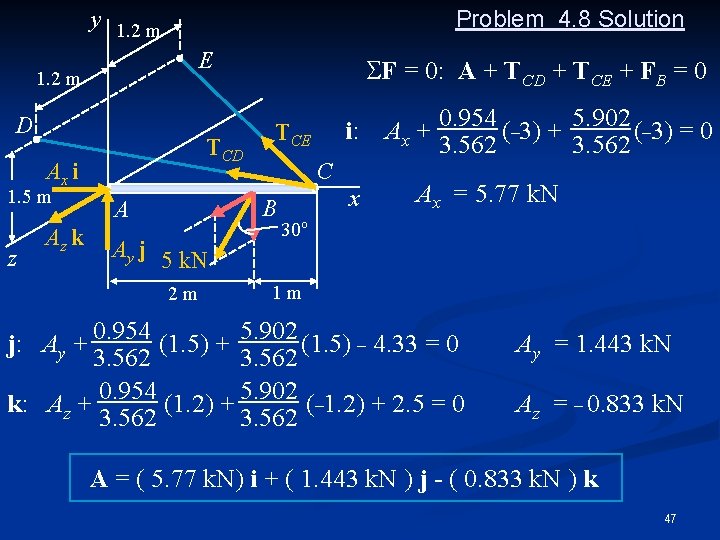
Problem 4. 8 Solution y 1. 2 m E 1. 2 m D TCD Ax i 1. 5 m z Az k SF = 0: A + TCD + TCE + FB = 0 TCE C B A Ay j 5 k. N 2 m i: x Ax + 0. 954 _ 5. 902 _ ( 3) + ( 3) = 0 3. 562 Ax = 5. 77 k. N 30 o 1 m 0. 954 5. 902 j: Ay + (1. 5) _ 4. 33 = 0 3. 562 0. 954 5. 902 _ k: Az + (1. 2) + ( 1. 2) + 2. 5 = 0 3. 562 Ay = 1. 443 k. N Az = _ 0. 833 k. N A = ( 5. 77 k. N) i + ( 1. 443 k. N ) j - ( 0. 833 k. N ) k 47
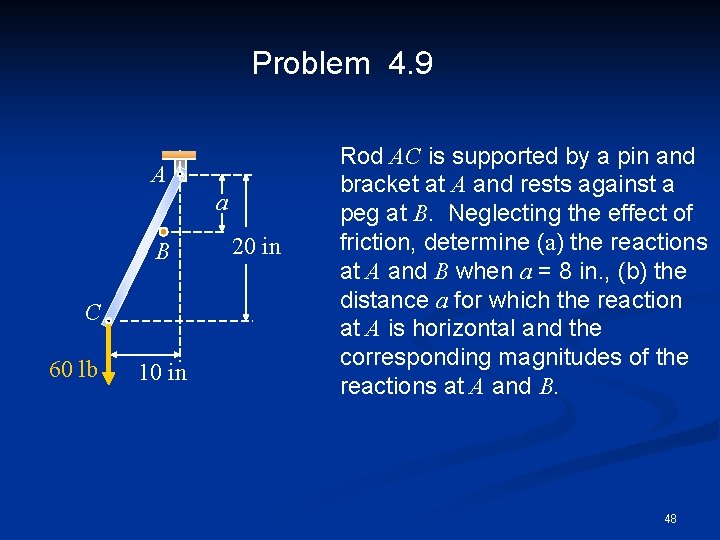
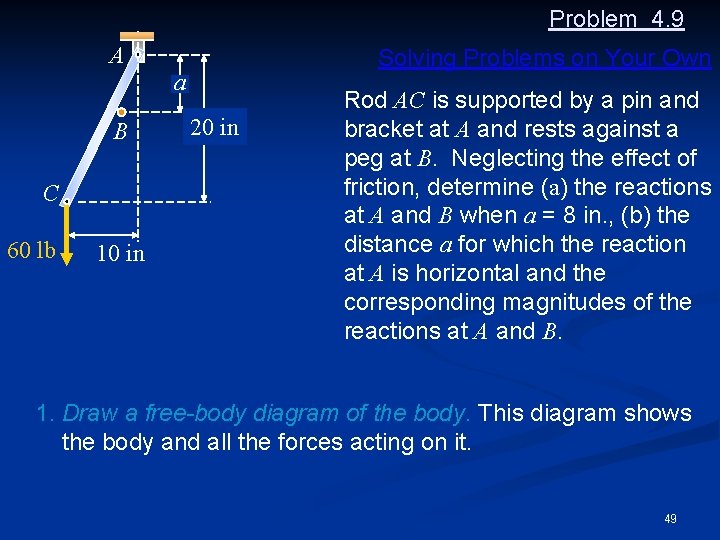
Problem 4. 9 A a B C 60 lb 10 in 20 in Rod AC is supported by a pin and bracket at A and rests against a peg at B. Neglecting the effect of friction, determine (a) the reactions at A and B when a = 8 in. , (b) the distance a for which the reaction at A is horizontal and the corresponding magnitudes of the reactions at A and B. 48
Problem 4. 9 A Solving Problems on Your Own a B C 60 lb 10 in 20 in Rod AC is supported by a pin and bracket at A and rests against a peg at B. Neglecting the effect of friction, determine (a) the reactions at A and B when a = 8 in. , (b) the distance a for which the reaction at A is horizontal and the corresponding magnitudes of the reactions at A and B. 1. Draw a free-body diagram of the body. This diagram shows the body and all the forces acting on it. 49
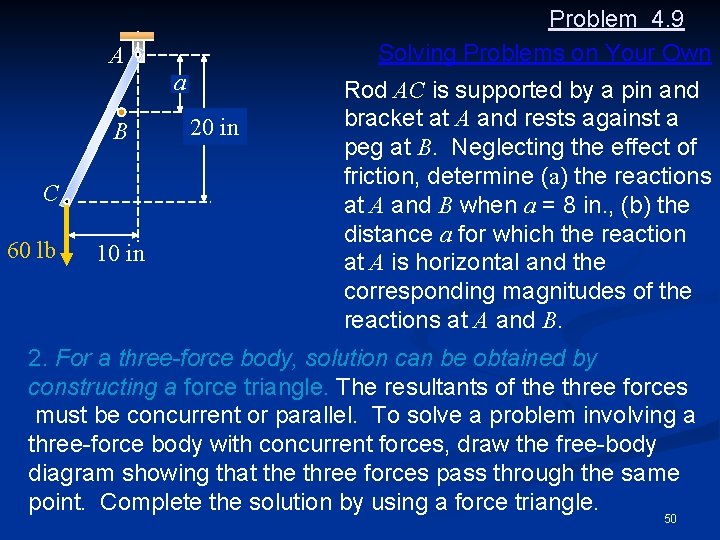
Problem 4. 9 Solving Problems on Your Own A a B C 60 lb 10 in 20 in Rod AC is supported by a pin and bracket at A and rests against a peg at B. Neglecting the effect of friction, determine (a) the reactions at A and B when a = 8 in. , (b) the distance a for which the reaction at A is horizontal and the corresponding magnitudes of the reactions at A and B. 2. For a three-force body, solution can be obtained by constructing a force triangle. The resultants of the three forces must be concurrent or parallel. To solve a problem involving a three-force body with concurrent forces, draw the free-body diagram showing that the three forces pass through the same point. Complete the solution by using a force triangle. 50
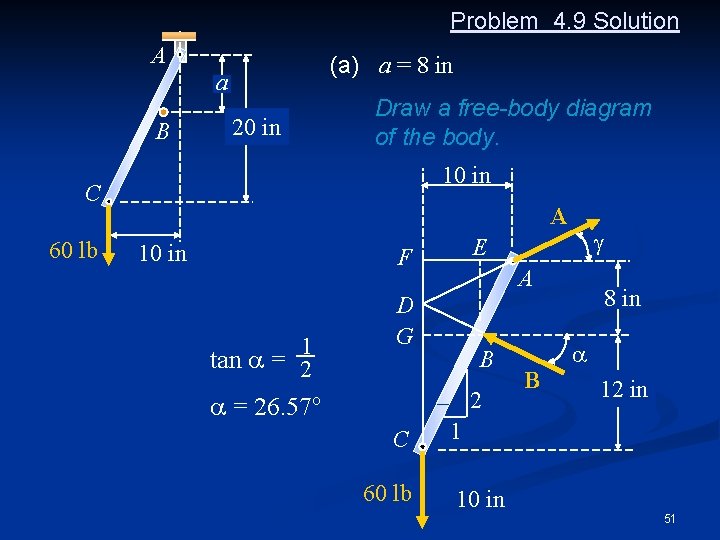
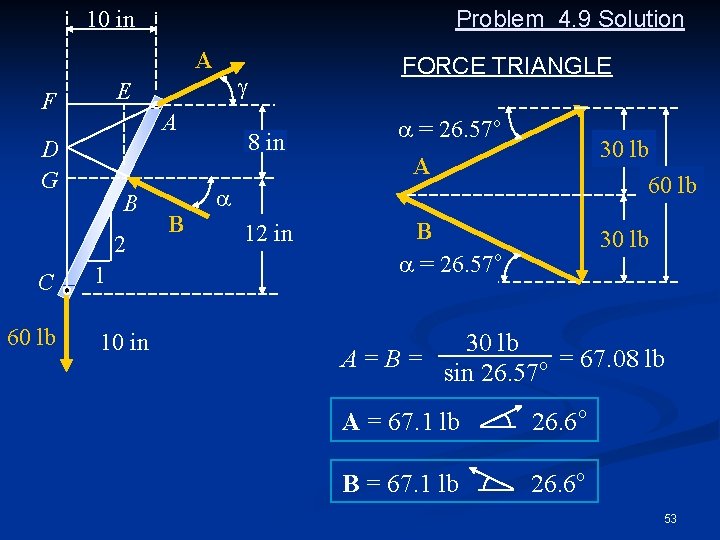
Problem 4. 9 Solution A (a) a = 8 in a B Draw a free-body diagram of the body. 20 in 10 in C 60 lb A 10 in F 1 tan a = 26. 57 A D G B 2 o C 60 lb g E B 8 in a 12 in 1 10 in 51
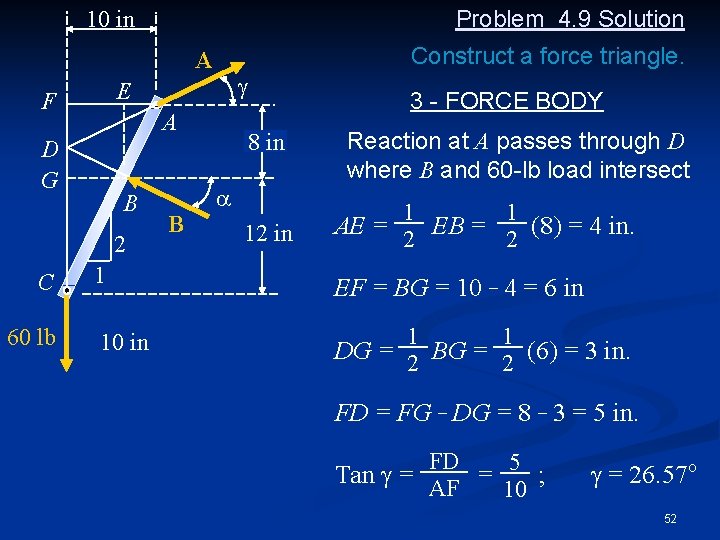
Problem 4. 9 Solution 10 in Construct a force triangle. A F A D G B 2 C 60 lb g E B 3 - FORCE BODY 8 in a 12 in Reaction at A passes through D where B and 60 -lb load intersect AE = 1 1 EB = (8) = 4 in. 2 2 1 EF = BG = 10 _ 4 = 6 in 10 in DG = 2 BG = 2 (6) = 3 in. 1 1 FD = FG _ DG = 8 _ 3 = 5 in. FD 5 Tan g = AF = ; 10 g = 26. 57 o 52
Problem 4. 9 Solution 10 in A A D G B 2 C 60 lb g E F 1 10 in B FORCE TRIANGLE 8 in a = 26. 57 o 30 lb 60 lb A a 12 in B a = 26. 57 o 30 lb A=B= o = 67. 08 lb sin 26. 57 A = 67. 1 lb 26. 6 o B = 67. 1 lb 26. 6 o 53
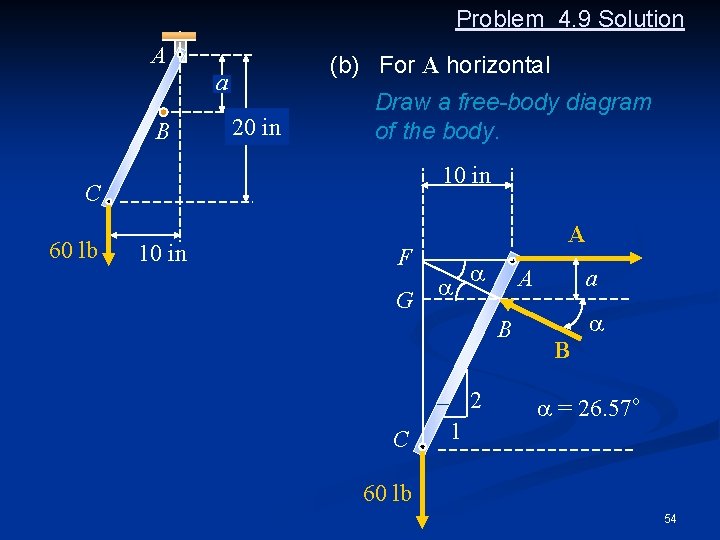
Problem 4. 9 Solution A (b) For A horizontal a B 20 in Draw a free-body diagram of the body. 10 in C 60 lb 10 in A F G a a B 2 C 1 a A a B a = 26. 57 o 60 lb 54
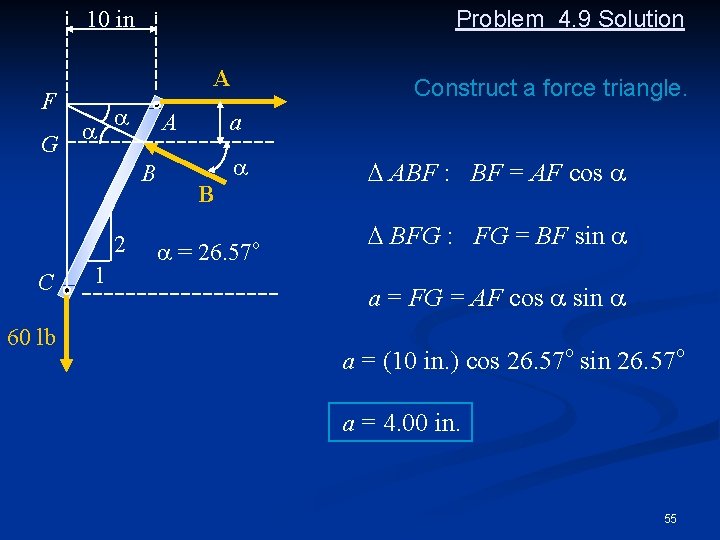
Problem 4. 9 Solution 10 in A F G a a 2 C 60 lb 1 a A B Construct a force triangle. a D ABF : BF = AF cos a B a = 26. 57 o D BFG : FG = BF sin a a = FG = AF cos a sin a a = (10 in. ) cos 26. 57 o sin 26. 57 o a = 4. 00 in. 55
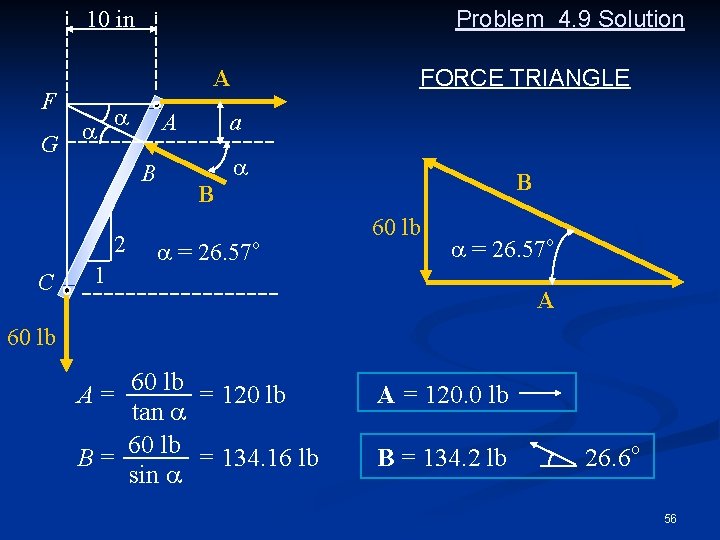
Problem 4. 9 Solution 10 in F G a a 2 1 a A B C FORCE TRIANGLE A a B B a = 26. 57 o 60 lb a = 26. 57 o A 60 lb A = 60 lb = 120 lb tan a B = 60 lb = 134. 16 lb sin a A = 120. 0 lb B = 134. 2 lb 26. 6 o 56
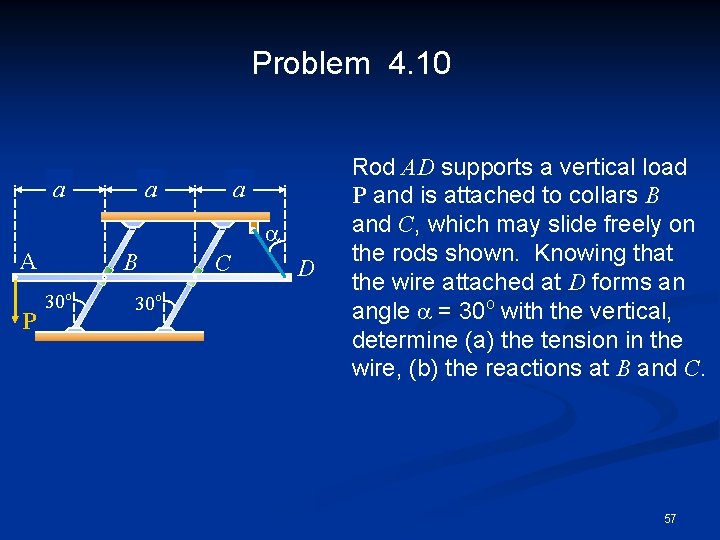
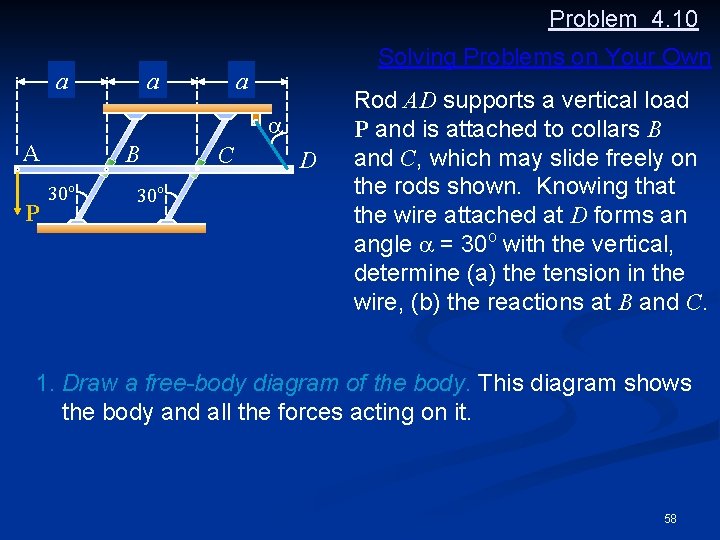
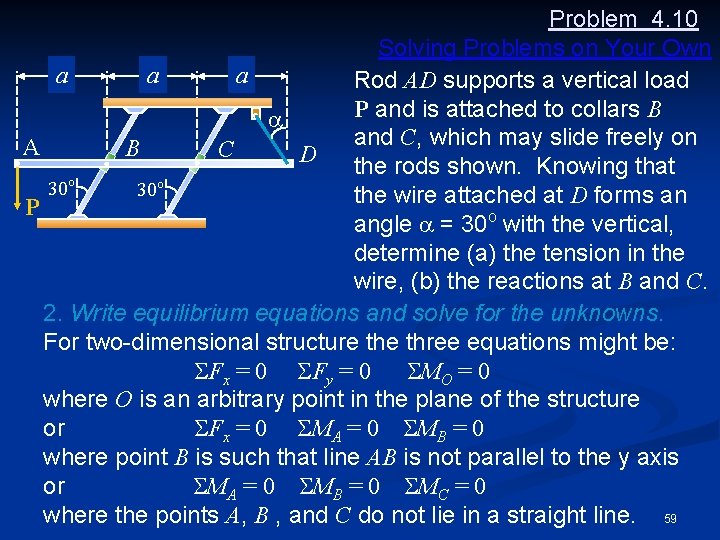
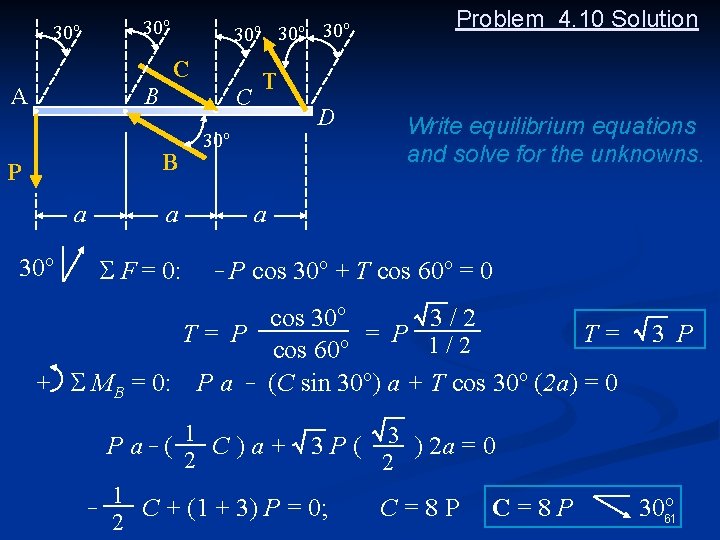
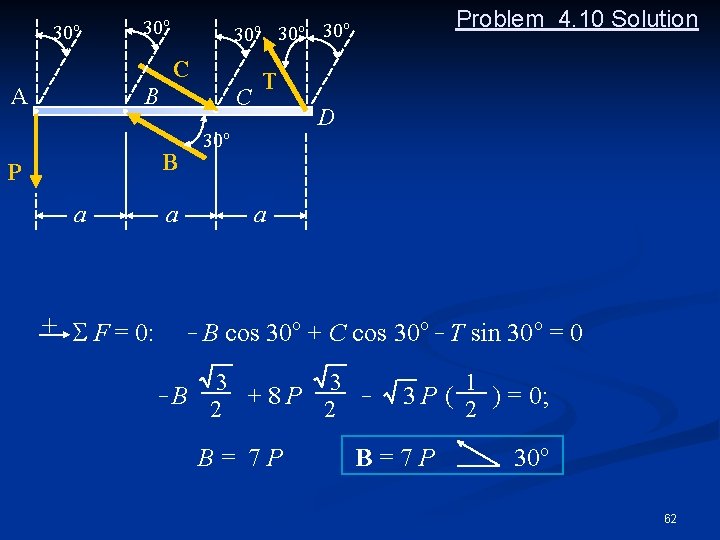
Problem 4. 10 a a A P B 30 o C D Rod AD supports a vertical load P and is attached to collars B and C, which may slide freely on the rods shown. Knowing that the wire attached at D forms an angle a = 30 o with the vertical, determine (a) the tension in the wire, (b) the reactions at B and C. 57
Problem 4. 10 a a Solving Problems on Your Own a a A P B 30 o C D Rod AD supports a vertical load P and is attached to collars B and C, which may slide freely on the rods shown. Knowing that the wire attached at D forms an angle a = 30 o with the vertical, determine (a) the tension in the wire, (b) the reactions at B and C. 1. Draw a free-body diagram of the body. This diagram shows the body and all the forces acting on it. 58
Problem 4. 10 Solving Problems on Your Own a a a Rod AD supports a vertical load P and is attached to collars B a and C, which may slide freely on A B C D the rods shown. Knowing that o o 30 30 the wire attached at D forms an P angle a = 30 o with the vertical, determine (a) the tension in the wire, (b) the reactions at B and C. 2. Write equilibrium equations and solve for the unknowns. For two-dimensional structure three equations might be: SFx = 0 SFy = 0 SMO = 0 where O is an arbitrary point in the plane of the structure or SFx = 0 SMA = 0 SMB = 0 where point B is such that line AB is not parallel to the y axis or SMA = 0 SMB = 0 SMC = 0 where the points A, B , and C do not lie in a straight line. 59
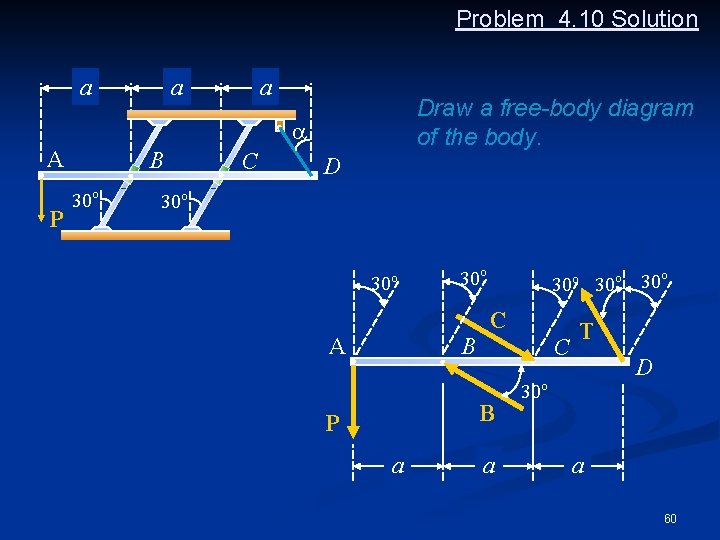
Problem 4. 10 Solution a a a Draw a free-body diagram of the body. a A P B 30 o C D 30 o A 30 o B o 30 o 30 C C B P a a T D 30 o a 60
30 o A B o o 30 30 C C D 30 B a a 30 o Problem 4. 10 Solution T o P 30 o Write equilibrium equations and solve for the unknowns. a _ S F = 0: P cos 30 o + T cos 60 o = 0 cos 30 o 3/2 T= P T= o = P 1/2 cos 60 + S MB = 0: P a _ (C sin 30 o) a + T cos 30 o (2 a) = 0 Pa_( 1 C)a+ 2 _ 3 P( 1 C + (1 + 3) P = 0; 2 3 P 3 ) 2 a = 0 2 C=8 P 3061 o
30 o A 30 o 30 30 C B o o C T D o 30 B P a a + S F = 0: a _ _ Problem 4. 10 Solution 30 o B cos 30 o + C cos 30 o _ T sin 30 o = 0 3 3 B 2 +8 P 2 B= 7 P _ 3 P( B=7 P 1 ) = 0; 2 30 o 62