
Eighth Edition Vector Mechanics for Engineers Statics CE




- Slides: 57
Eighth Edition Vector Mechanics for Engineers: Statics CE 102 Statics Chapter 7 Distributed Forces: Centroids and Centers of Gravity © 2007 The Mc. Graw-Hill Companies, Inc. All rights reserved. 5 -1
Eighth Edition Vector Mechanics for Engineers: Statics Contents Introduction Theorems of Pappus-Guldinus Center of Gravity of a 2 D Body Sample Problem 7. 3 Centroids and First Moments of Areas and Lines Distributed Loads on Beams Centroids of Common Shapes of Areas Centroids of Common Shapes of Lines Center of Gravity of a 3 D Body: Centroid of a Volume Composite Plates and Areas Centroids of Common 3 D Shapes Sample Problem 7. 1 Composite 3 D Bodies Determination of Centroids by Integration Sample Problem 7. 5 Sample Problem 7. 4 Sample Problem 7. 2 © 2007 The Mc. Graw-Hill Companies, Inc. All rights reserved. 5 -2
Eighth Edition Vector Mechanics for Engineers: Statics Introduction • The earth exerts a gravitational force on each of the particles forming a body. These forces can be replace by a single equivalent force equal to the weight of the body and applied at the center of gravity for the body. • The centroid of an area is analogous to the center of gravity of a body. The concept of the first moment of an area is used to locate the centroid. • Determination of the area of a surface of revolution and the volume of a body of revolution are accomplished with the Theorems of Pappus-Guldinus. © 2007 The Mc. Graw-Hill Companies, Inc. All rights reserved. 5 -3
Eighth Edition Vector Mechanics for Engineers: Statics Center of Gravity of a 2 D Body • Center of gravity of a plate © 2007 The Mc. Graw-Hill Companies, Inc. All rights reserved. • Center of gravity of a wire 5 -4
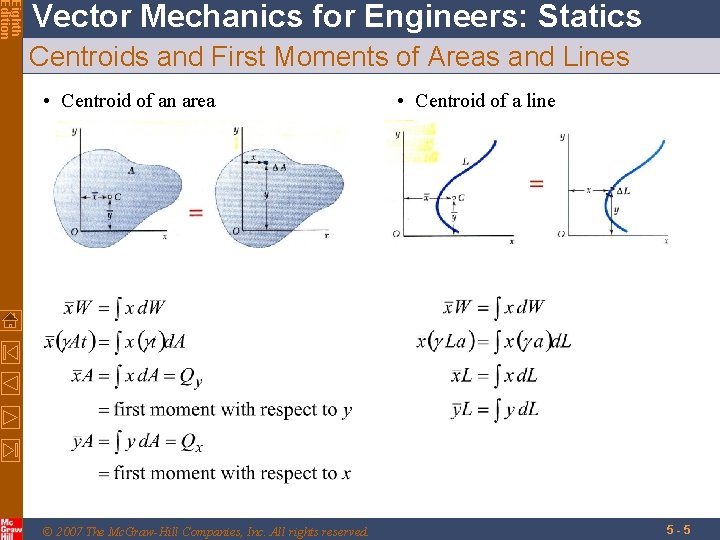
Eighth Edition Vector Mechanics for Engineers: Statics Centroids and First Moments of Areas and Lines • Centroid of an area © 2007 The Mc. Graw-Hill Companies, Inc. All rights reserved. • Centroid of a line 5 -5
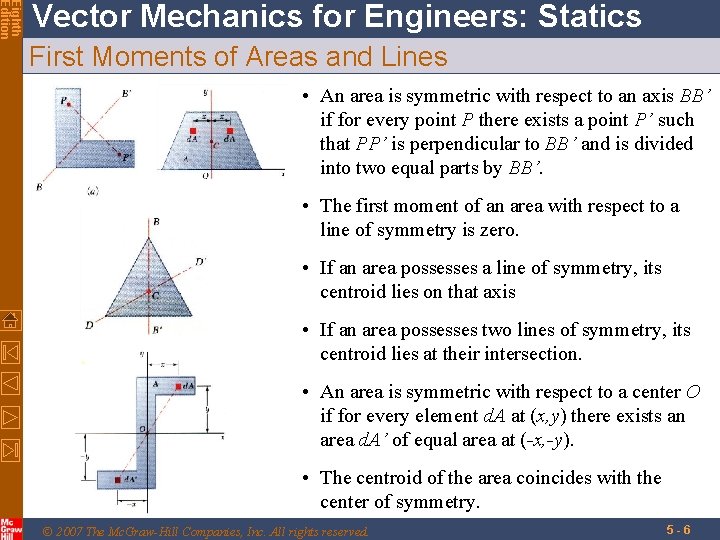
Eighth Edition Vector Mechanics for Engineers: Statics First Moments of Areas and Lines • An area is symmetric with respect to an axis BB’ if for every point P there exists a point P’ such that PP’ is perpendicular to BB’ and is divided into two equal parts by BB’. • The first moment of an area with respect to a line of symmetry is zero. • If an area possesses a line of symmetry, its centroid lies on that axis • If an area possesses two lines of symmetry, its centroid lies at their intersection. • An area is symmetric with respect to a center O if for every element d. A at (x, y) there exists an area d. A’ of equal area at (-x, -y). • The centroid of the area coincides with the center of symmetry. © 2007 The Mc. Graw-Hill Companies, Inc. All rights reserved. 5 -6
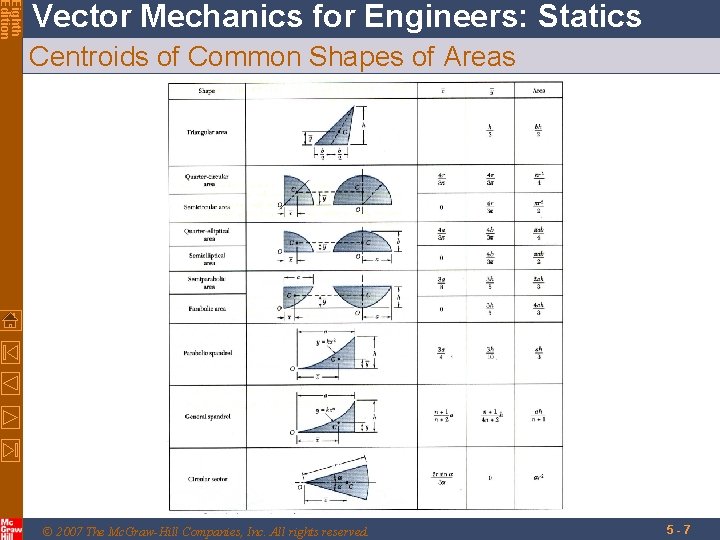
Eighth Edition Vector Mechanics for Engineers: Statics Centroids of Common Shapes of Areas © 2007 The Mc. Graw-Hill Companies, Inc. All rights reserved. 5 -7
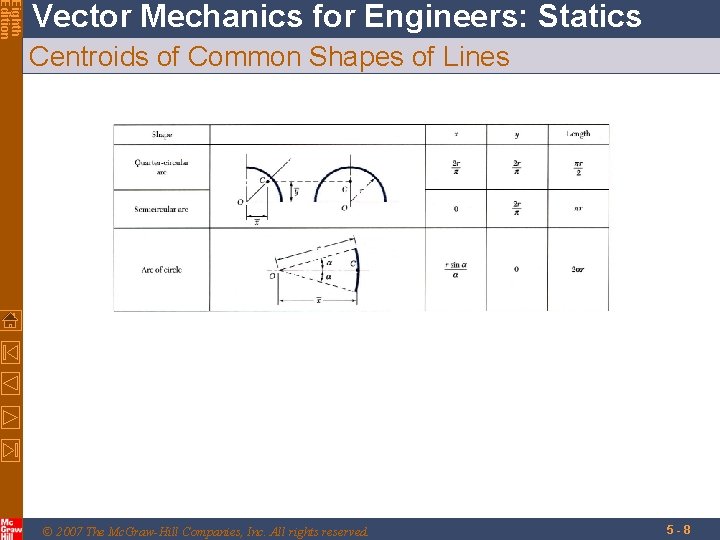
Eighth Edition Vector Mechanics for Engineers: Statics Centroids of Common Shapes of Lines © 2007 The Mc. Graw-Hill Companies, Inc. All rights reserved. 5 -8
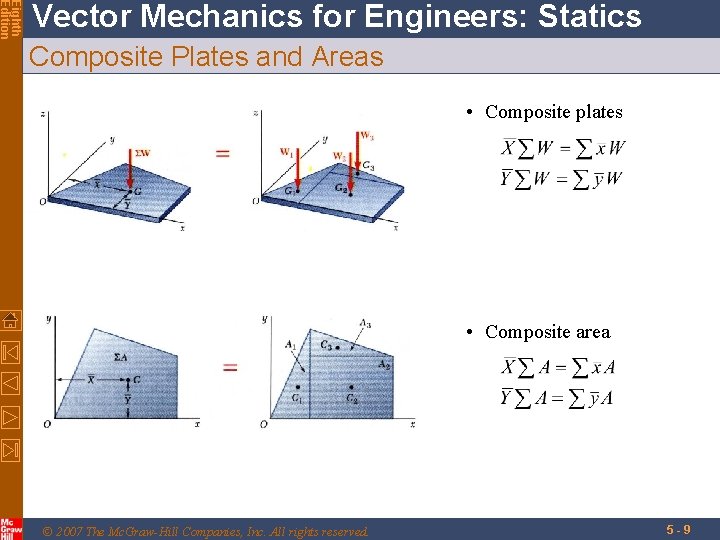
Eighth Edition Vector Mechanics for Engineers: Statics Composite Plates and Areas • Composite plates • Composite area © 2007 The Mc. Graw-Hill Companies, Inc. All rights reserved. 5 -9
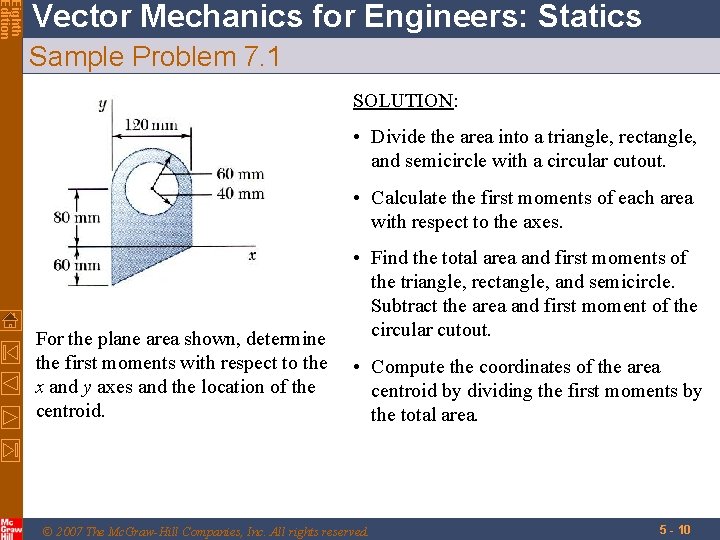
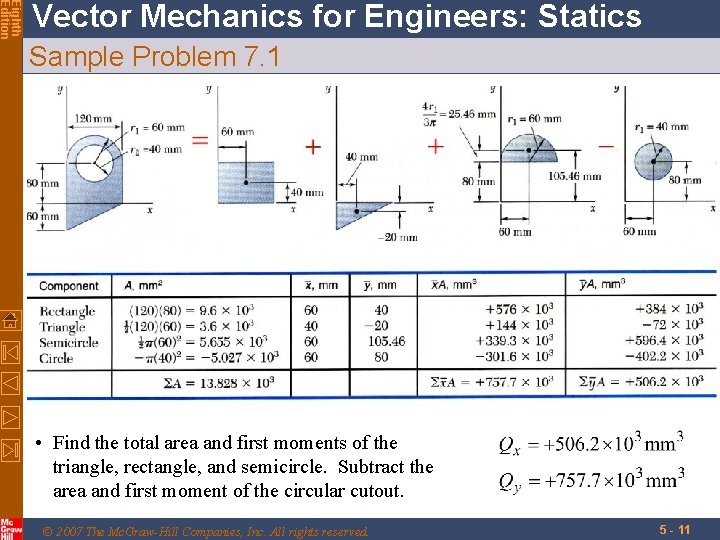
Eighth Edition Vector Mechanics for Engineers: Statics Sample Problem 7. 1 SOLUTION: • Divide the area into a triangle, rectangle, and semicircle with a circular cutout. • Calculate the first moments of each area with respect to the axes. For the plane area shown, determine the first moments with respect to the x and y axes and the location of the centroid. • Find the total area and first moments of the triangle, rectangle, and semicircle. Subtract the area and first moment of the circular cutout. • Compute the coordinates of the area centroid by dividing the first moments by the total area. © 2007 The Mc. Graw-Hill Companies, Inc. All rights reserved. 5 - 10
Eighth Edition Vector Mechanics for Engineers: Statics Sample Problem 7. 1 • Find the total area and first moments of the triangle, rectangle, and semicircle. Subtract the area and first moment of the circular cutout. © 2007 The Mc. Graw-Hill Companies, Inc. All rights reserved. 5 - 11
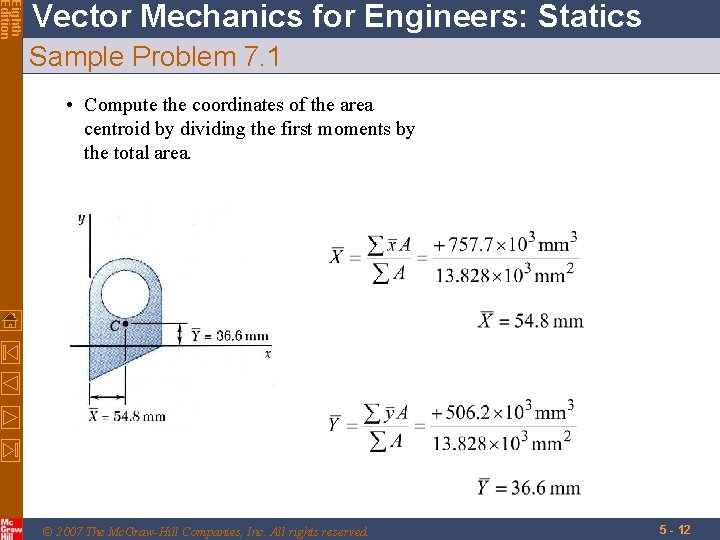
Eighth Edition Vector Mechanics for Engineers: Statics Sample Problem 7. 1 • Compute the coordinates of the area centroid by dividing the first moments by the total area. © 2007 The Mc. Graw-Hill Companies, Inc. All rights reserved. 5 - 12
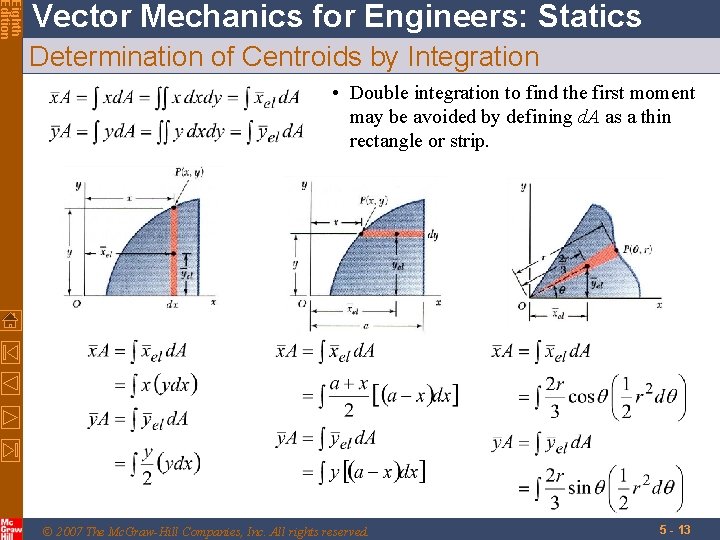
Eighth Edition Vector Mechanics for Engineers: Statics Determination of Centroids by Integration • Double integration to find the first moment may be avoided by defining d. A as a thin rectangle or strip. © 2007 The Mc. Graw-Hill Companies, Inc. All rights reserved. 5 - 13
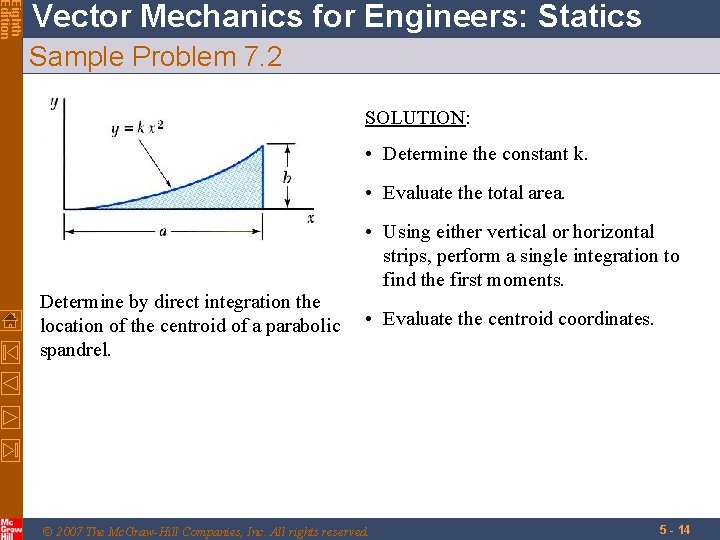
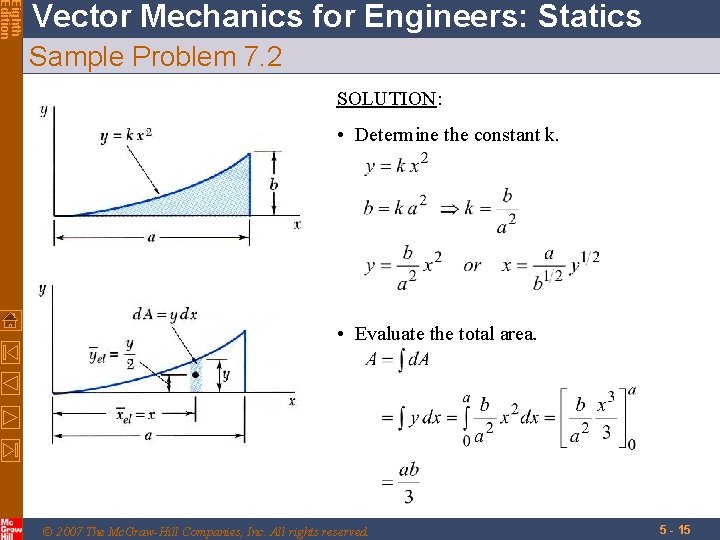
Eighth Edition Vector Mechanics for Engineers: Statics Sample Problem 7. 2 SOLUTION: • Determine the constant k. • Evaluate the total area. Determine by direct integration the location of the centroid of a parabolic spandrel. • Using either vertical or horizontal strips, perform a single integration to find the first moments. • Evaluate the centroid coordinates. © 2007 The Mc. Graw-Hill Companies, Inc. All rights reserved. 5 - 14
Eighth Edition Vector Mechanics for Engineers: Statics Sample Problem 7. 2 SOLUTION: • Determine the constant k. • Evaluate the total area. © 2007 The Mc. Graw-Hill Companies, Inc. All rights reserved. 5 - 15
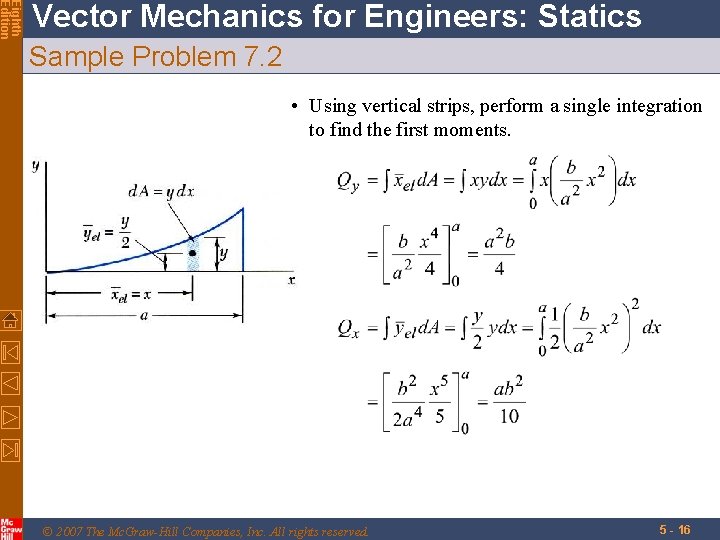
Eighth Edition Vector Mechanics for Engineers: Statics Sample Problem 7. 2 • Using vertical strips, perform a single integration to find the first moments. © 2007 The Mc. Graw-Hill Companies, Inc. All rights reserved. 5 - 16
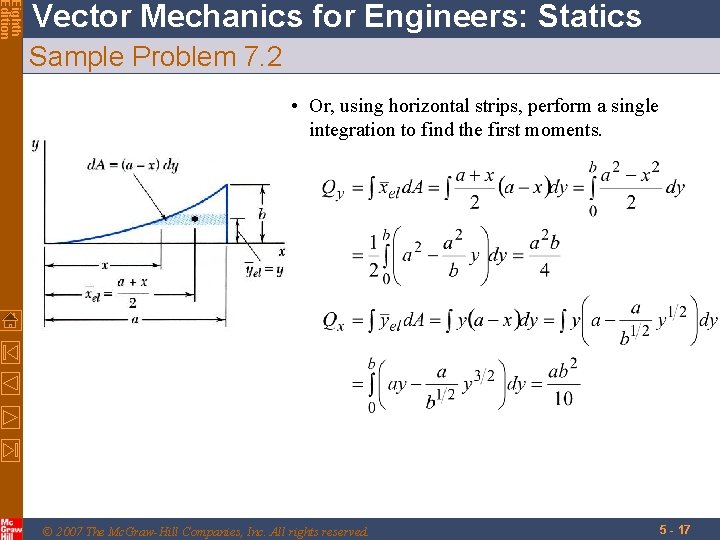
Eighth Edition Vector Mechanics for Engineers: Statics Sample Problem 7. 2 • Or, using horizontal strips, perform a single integration to find the first moments. © 2007 The Mc. Graw-Hill Companies, Inc. All rights reserved. 5 - 17
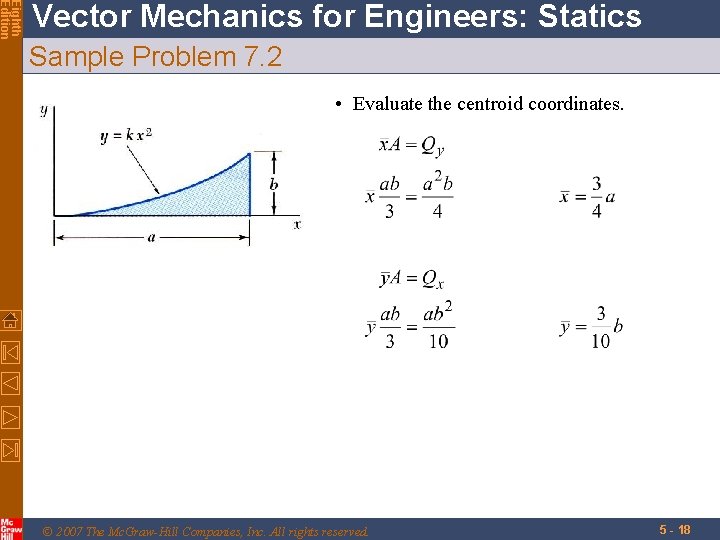
Eighth Edition Vector Mechanics for Engineers: Statics Sample Problem 7. 2 • Evaluate the centroid coordinates. © 2007 The Mc. Graw-Hill Companies, Inc. All rights reserved. 5 - 18
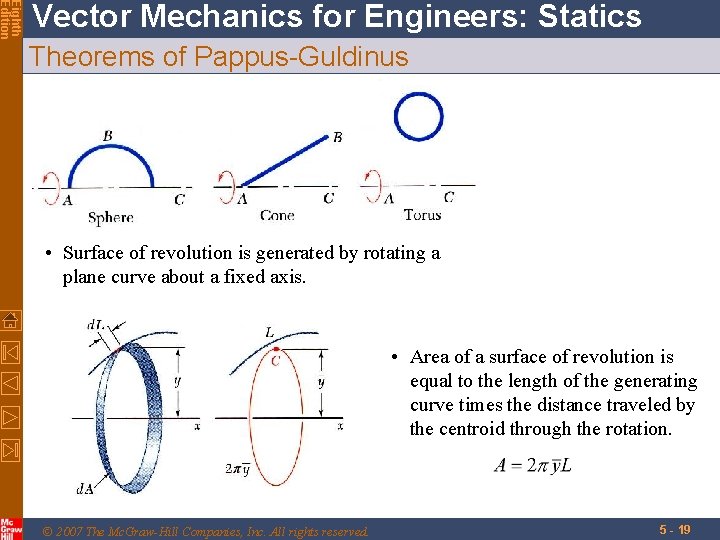
Eighth Edition Vector Mechanics for Engineers: Statics Theorems of Pappus-Guldinus • Surface of revolution is generated by rotating a plane curve about a fixed axis. • Area of a surface of revolution is equal to the length of the generating curve times the distance traveled by the centroid through the rotation. © 2007 The Mc. Graw-Hill Companies, Inc. All rights reserved. 5 - 19
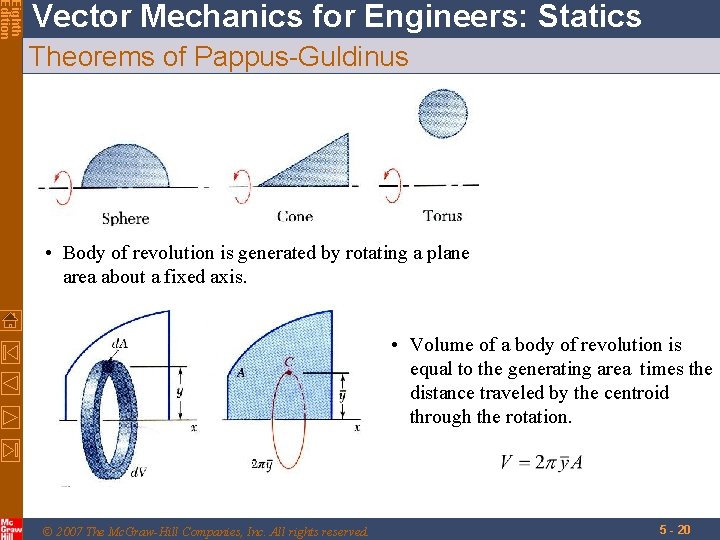
Eighth Edition Vector Mechanics for Engineers: Statics Theorems of Pappus-Guldinus • Body of revolution is generated by rotating a plane area about a fixed axis. • Volume of a body of revolution is equal to the generating area times the distance traveled by the centroid through the rotation. © 2007 The Mc. Graw-Hill Companies, Inc. All rights reserved. 5 - 20
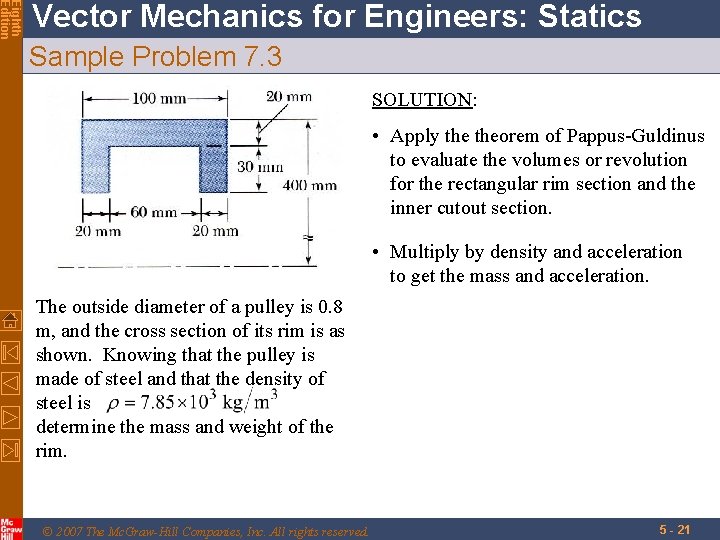
Eighth Edition Vector Mechanics for Engineers: Statics Sample Problem 7. 3 SOLUTION: • Apply theorem of Pappus-Guldinus to evaluate the volumes or revolution for the rectangular rim section and the inner cutout section. • Multiply by density and acceleration to get the mass and acceleration. The outside diameter of a pulley is 0. 8 m, and the cross section of its rim is as shown. Knowing that the pulley is made of steel and that the density of steel is determine the mass and weight of the rim. © 2007 The Mc. Graw-Hill Companies, Inc. All rights reserved. 5 - 21
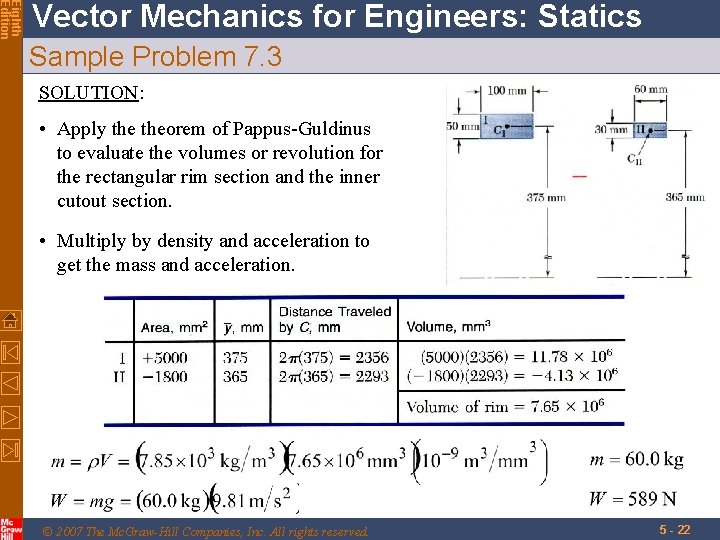
Eighth Edition Vector Mechanics for Engineers: Statics Sample Problem 7. 3 SOLUTION: • Apply theorem of Pappus-Guldinus to evaluate the volumes or revolution for the rectangular rim section and the inner cutout section. • Multiply by density and acceleration to get the mass and acceleration. © 2007 The Mc. Graw-Hill Companies, Inc. All rights reserved. 5 - 22
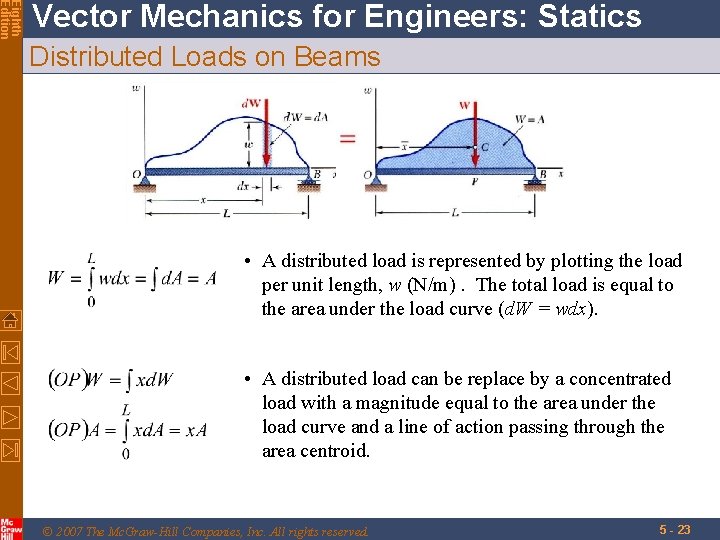
Eighth Edition Vector Mechanics for Engineers: Statics Distributed Loads on Beams • A distributed load is represented by plotting the load per unit length, w (N/m). The total load is equal to the area under the load curve (d. W = wdx). • A distributed load can be replace by a concentrated load with a magnitude equal to the area under the load curve and a line of action passing through the area centroid. © 2007 The Mc. Graw-Hill Companies, Inc. All rights reserved. 5 - 23
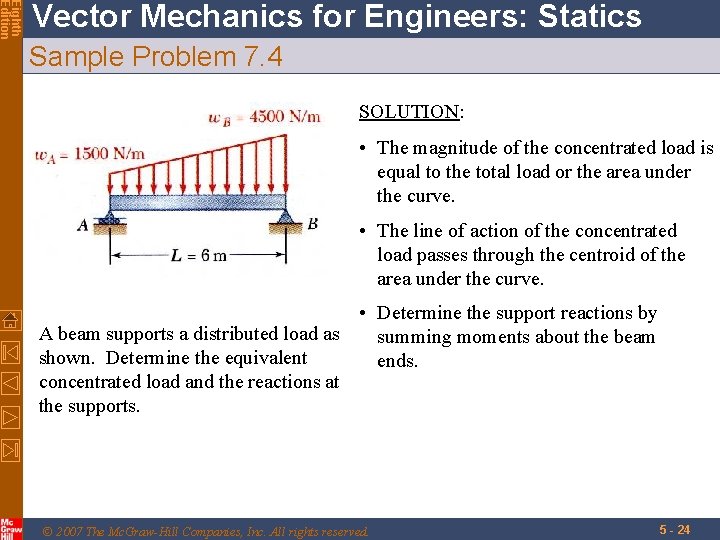
Eighth Edition Vector Mechanics for Engineers: Statics Sample Problem 7. 4 SOLUTION: • The magnitude of the concentrated load is equal to the total load or the area under the curve. • The line of action of the concentrated load passes through the centroid of the area under the curve. • Determine the support reactions by A beam supports a distributed load as summing moments about the beam shown. Determine the equivalent ends. concentrated load and the reactions at the supports. © 2007 The Mc. Graw-Hill Companies, Inc. All rights reserved. 5 - 24
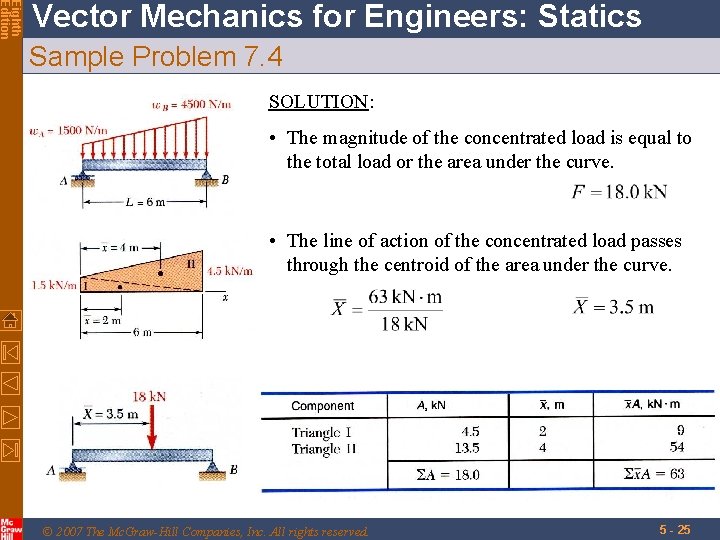
Eighth Edition Vector Mechanics for Engineers: Statics Sample Problem 7. 4 SOLUTION: • The magnitude of the concentrated load is equal to the total load or the area under the curve. • The line of action of the concentrated load passes through the centroid of the area under the curve. © 2007 The Mc. Graw-Hill Companies, Inc. All rights reserved. 5 - 25
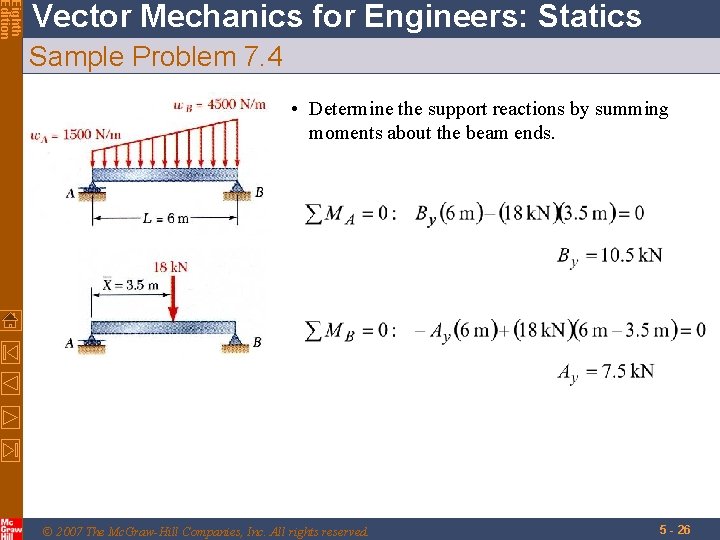
Eighth Edition Vector Mechanics for Engineers: Statics Sample Problem 7. 4 • Determine the support reactions by summing moments about the beam ends. © 2007 The Mc. Graw-Hill Companies, Inc. All rights reserved. 5 - 26
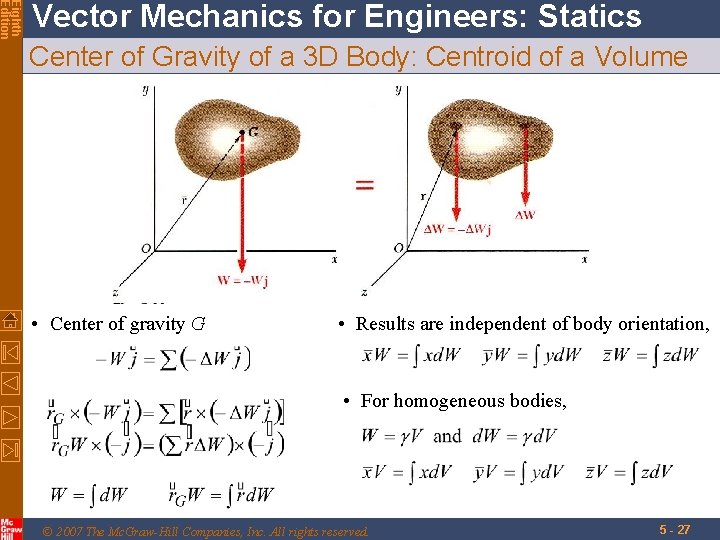
Eighth Edition Vector Mechanics for Engineers: Statics Center of Gravity of a 3 D Body: Centroid of a Volume • Center of gravity G • Results are independent of body orientation, • For homogeneous bodies, © 2007 The Mc. Graw-Hill Companies, Inc. All rights reserved. 5 - 27
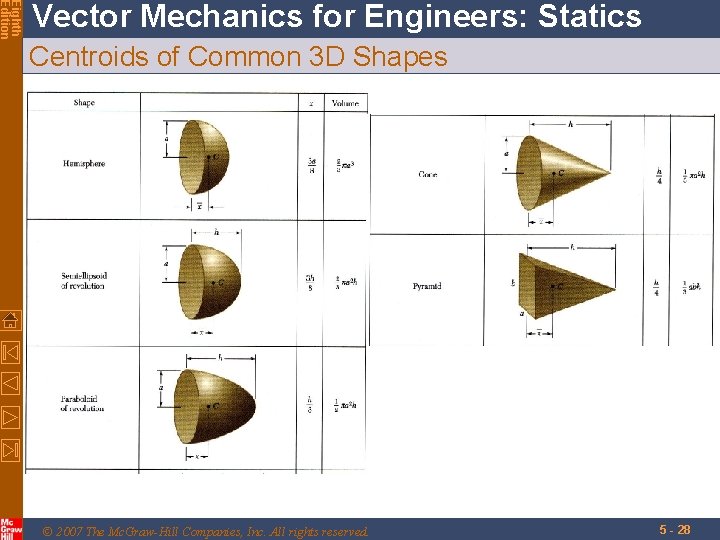
Eighth Edition Vector Mechanics for Engineers: Statics Centroids of Common 3 D Shapes © 2007 The Mc. Graw-Hill Companies, Inc. All rights reserved. 5 - 28
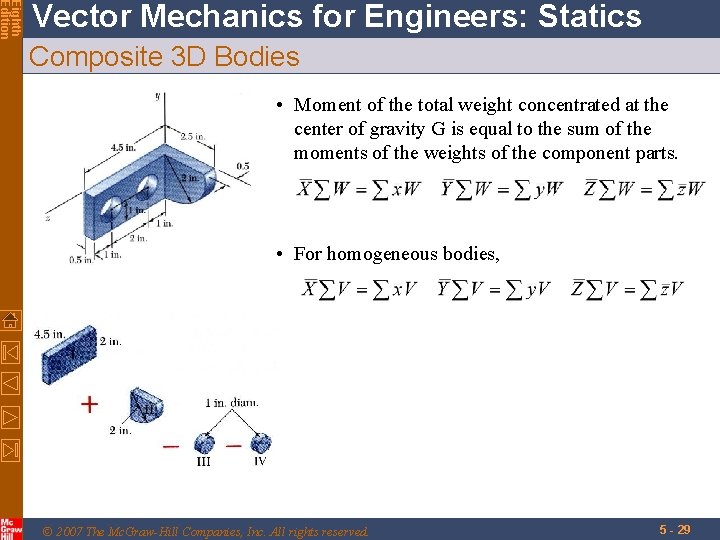
Eighth Edition Vector Mechanics for Engineers: Statics Composite 3 D Bodies • Moment of the total weight concentrated at the center of gravity G is equal to the sum of the moments of the weights of the component parts. • For homogeneous bodies, © 2007 The Mc. Graw-Hill Companies, Inc. All rights reserved. 5 - 29
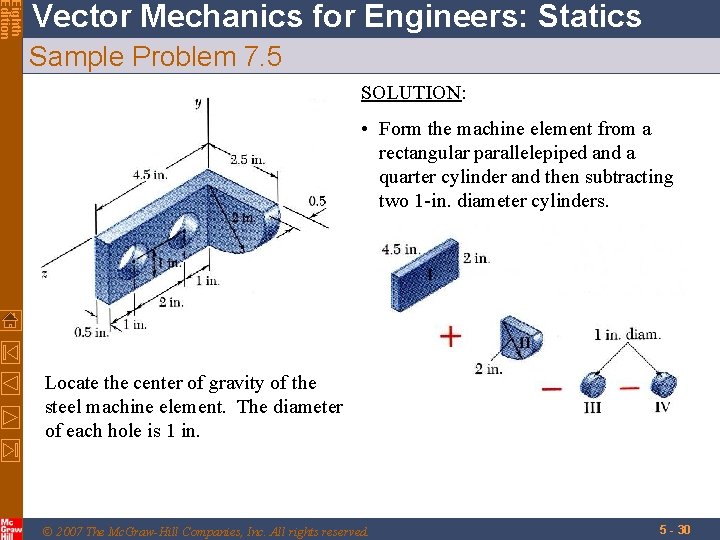
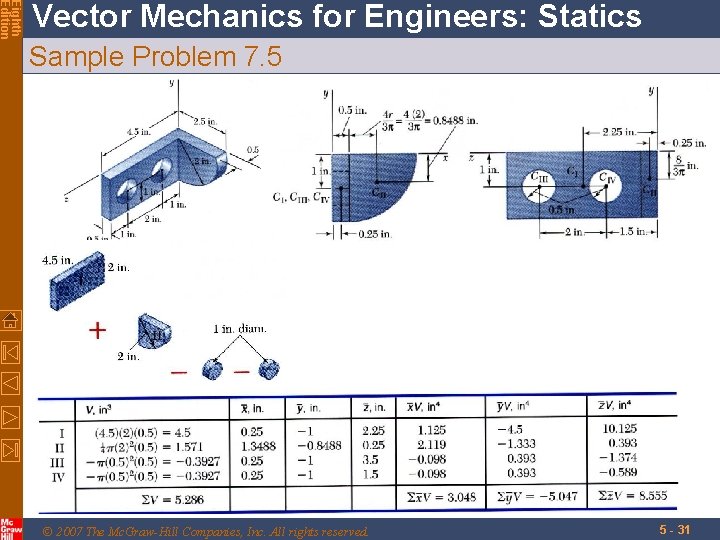
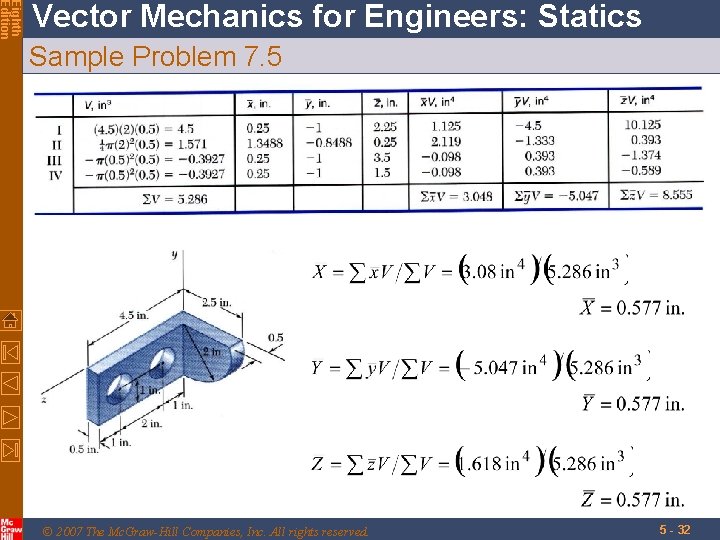
Eighth Edition Vector Mechanics for Engineers: Statics Sample Problem 7. 5 SOLUTION: • Form the machine element from a rectangular parallelepiped and a quarter cylinder and then subtracting two 1 -in. diameter cylinders. Locate the center of gravity of the steel machine element. The diameter of each hole is 1 in. © 2007 The Mc. Graw-Hill Companies, Inc. All rights reserved. 5 - 30
Eighth Edition Vector Mechanics for Engineers: Statics Sample Problem 7. 5 © 2007 The Mc. Graw-Hill Companies, Inc. All rights reserved. 5 - 31
Eighth Edition Vector Mechanics for Engineers: Statics Sample Problem 7. 5 © 2007 The Mc. Graw-Hill Companies, Inc. All rights reserved. 5 - 32
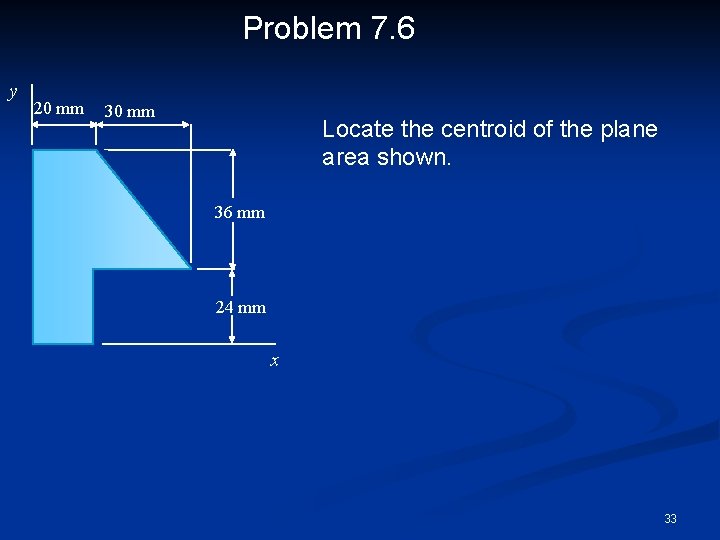
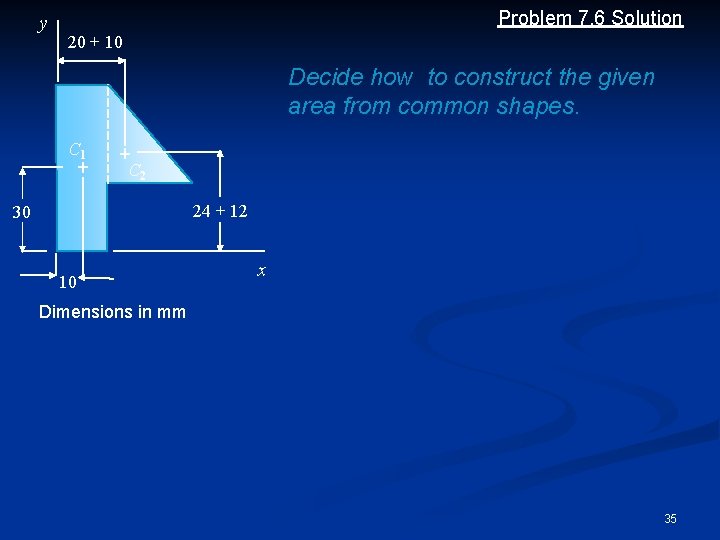
Problem 7. 6 y 20 mm 30 mm Locate the centroid of the plane area shown. 36 mm 24 mm x 33
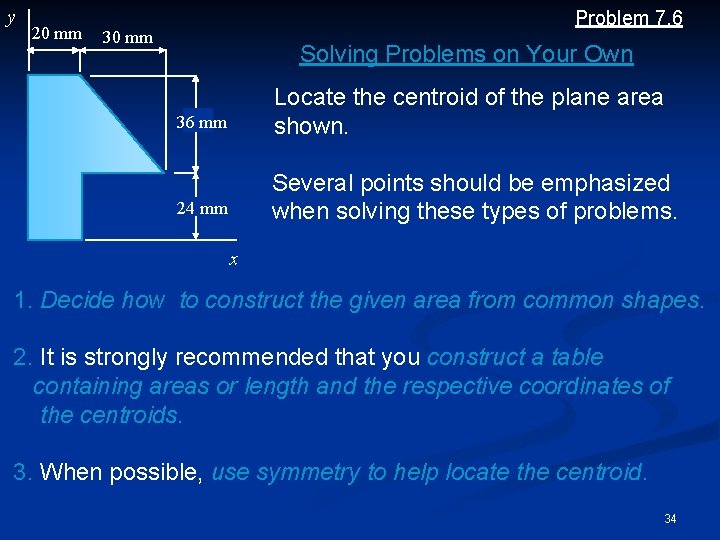
y 20 mm Problem 7. 6 30 mm Solving Problems on Your Own 36 mm Locate the centroid of the plane area shown. 24 mm Several points should be emphasized when solving these types of problems. x 1. Decide how to construct the given area from common shapes. 2. It is strongly recommended that you construct a table containing areas or length and the respective coordinates of the centroids. 3. When possible, use symmetry to help locate the centroid. 34
y Problem 7. 6 Solution 20 + 10 Decide how to construct the given area from common shapes. C 1 C 2 24 + 12 30 10 x Dimensions in mm 35
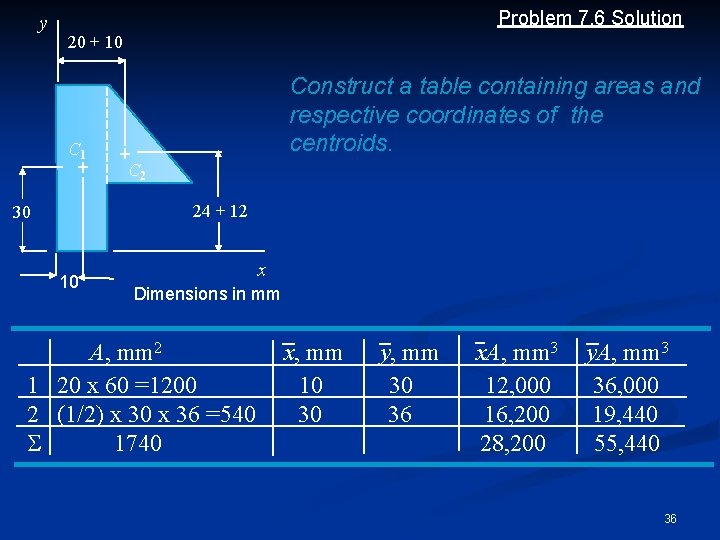
y Problem 7. 6 Solution 20 + 10 C 1 Construct a table containing areas and respective coordinates of the centroids. C 2 24 + 12 30 10 x Dimensions in mm A, mm 2 1 20 x 60 =1200 2 (1/2) x 30 x 36 =540 S 1740 x, mm 10 30 y, mm 30 36 x. A, mm 3 12, 000 16, 200 28, 200 y. A, mm 3 36, 000 19, 440 55, 440 36
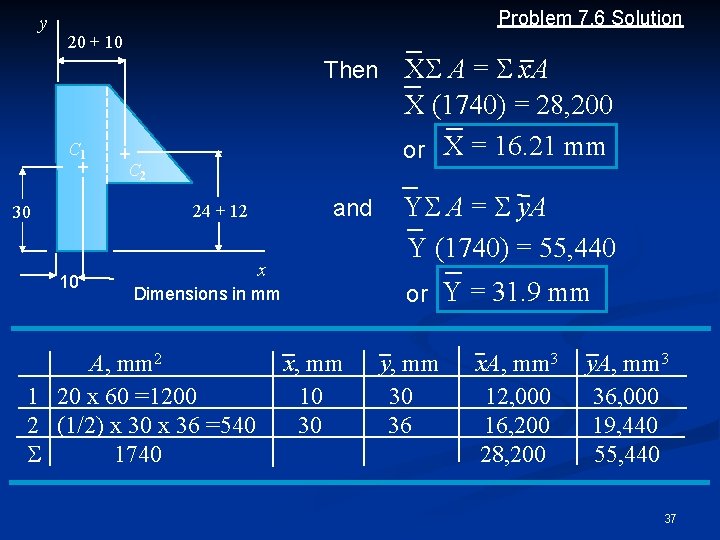
y Problem 7. 6 Solution 20 + 10 C 1 10 XS A = S x. A X (1740) = 28, 200 or X = 16. 21 mm and YS A = S y. A Y (1740) = 55, 440 C 2 24 + 12 30 Then x or Y = 31. 9 mm Dimensions in mm A, mm 2 1 20 x 60 =1200 2 (1/2) x 30 x 36 =540 S 1740 x, mm 10 30 y, mm 30 36 x. A, mm 3 12, 000 16, 200 28, 200 y. A, mm 3 36, 000 19, 440 55, 440 37
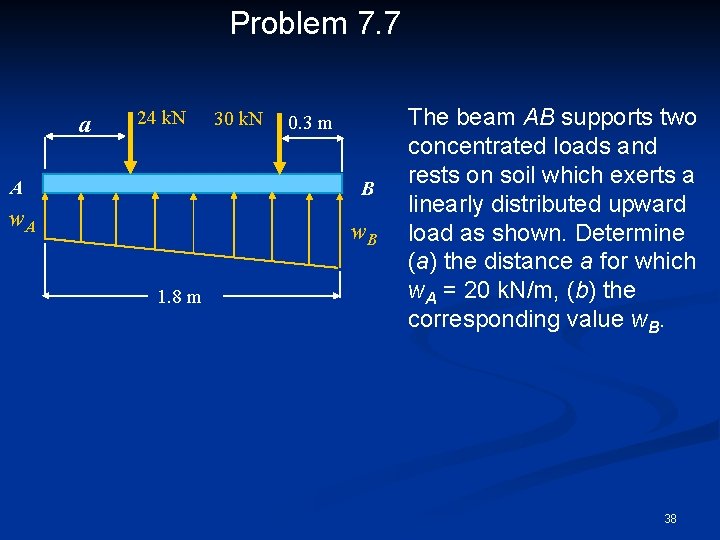
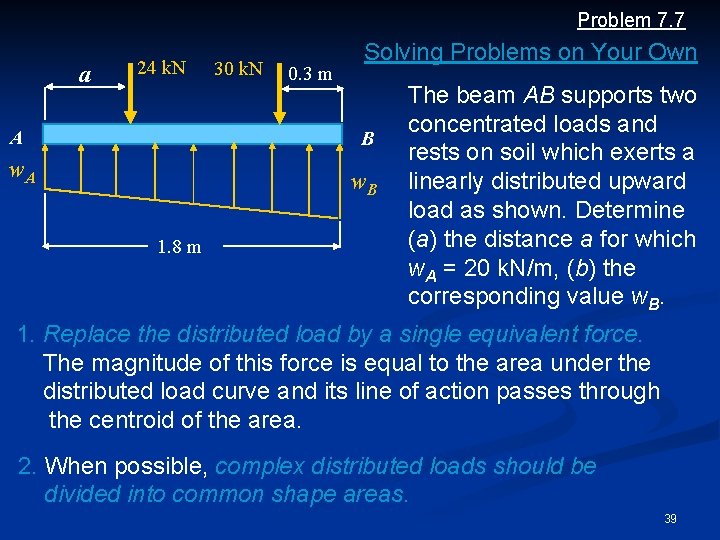
Problem 7. 7 a 24 k. N A 30 k. N 0. 3 m B w. A w. B 1. 8 m The beam AB supports two concentrated loads and rests on soil which exerts a linearly distributed upward load as shown. Determine (a) the distance a for which w. A = 20 k. N/m, (b) the corresponding value w. B. 38
Problem 7. 7 a 24 k. N A 30 k. N 0. 3 m Solving Problems on Your Own B w. A w. B 1. 8 m The beam AB supports two concentrated loads and rests on soil which exerts a linearly distributed upward load as shown. Determine (a) the distance a for which w. A = 20 k. N/m, (b) the corresponding value w. B. 1. Replace the distributed load by a single equivalent force. The magnitude of this force is equal to the area under the distributed load curve and its line of action passes through the centroid of the area. 2. When possible, complex distributed loads should be divided into common shape areas. 39
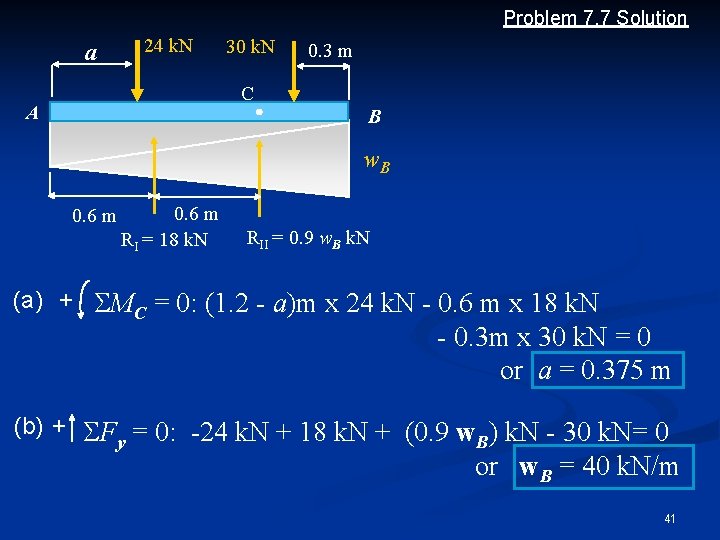
Problem 7. 7 Solution 24 k. N a 30 k. N C A 20 k. N/m Replace the distributed load by a pair of B equivalent forces. w. B 0. 6 m RI We have 0. 3 m RII 1 RI = 2 (1. 8 m)(20 k. N/m) = 18 k. N 1 RII = 2 (1. 8 m)(w. B k. N/m) = 0. 9 w. B k. N 40
Problem 7. 7 Solution a 24 k. N 30 k. N 0. 3 m C A B w. B 0. 6 m RI = 18 k. N RII = 0. 9 w. B k. N (a) + SMC = 0: (1. 2 - a)m x 24 k. N - 0. 6 m x 18 k. N - 0. 3 m x 30 k. N = 0 or a = 0. 375 m (b) + SF = 0: -24 k. N + 18 k. N + (0. 9 w ) k. N - 30 k. N= 0 y B or w. B = 40 k. N/m 41
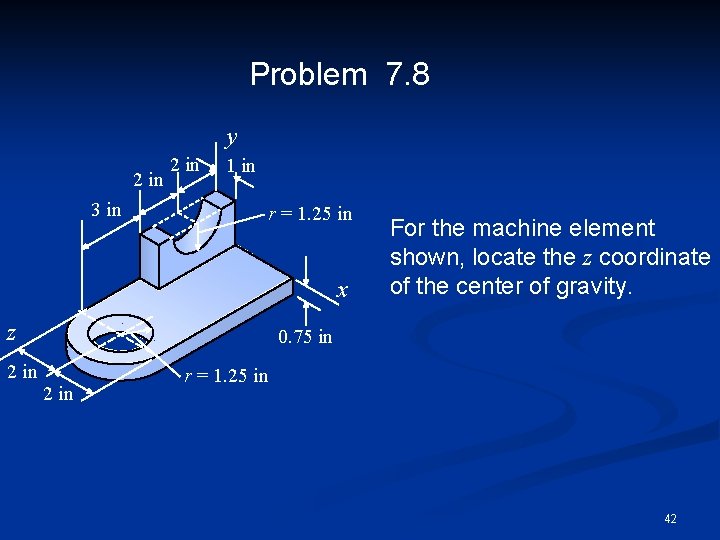
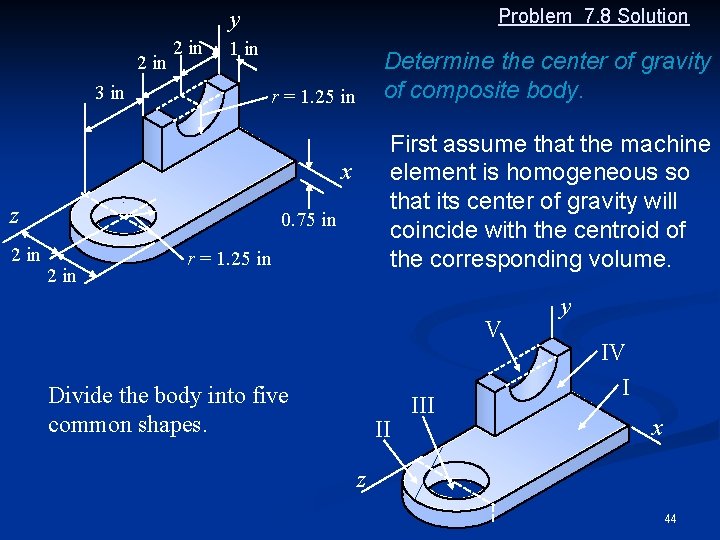
Problem 7. 8 y 2 in 3 in 2 in 1 in r = 1. 25 in x z 2 in For the machine element shown, locate the z coordinate of the center of gravity. 0. 75 in 2 in r = 1. 25 in 42
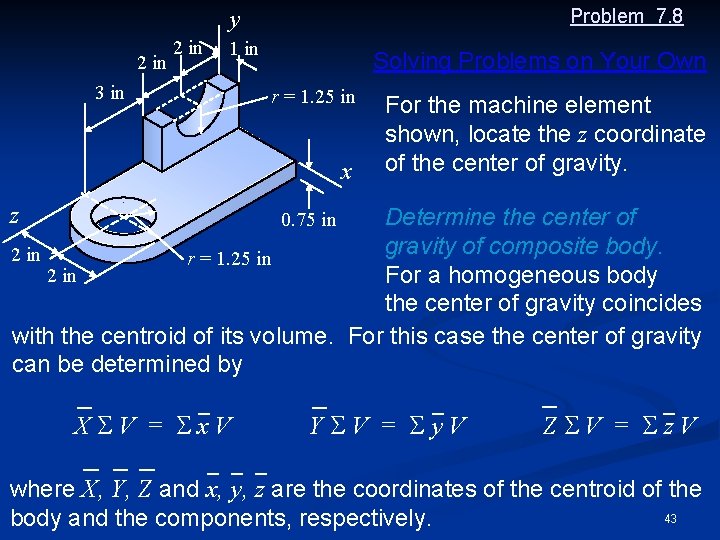
Problem 7. 8 y 2 in 1 in 3 in Solving Problems on Your Own r = 1. 25 in x z For the machine element shown, locate the z coordinate of the center of gravity. Determine the center of gravity of composite body. 2 in r = 1. 25 in 2 in For a homogeneous body the center of gravity coincides with the centroid of its volume. For this case the center of gravity can be determined by 0. 75 in XSV = Sx. V YSV = Sy. V ZSV = Sz. V where X, Y, Z and x, y, z are the coordinates of the centroid of the 43 body and the components, respectively.
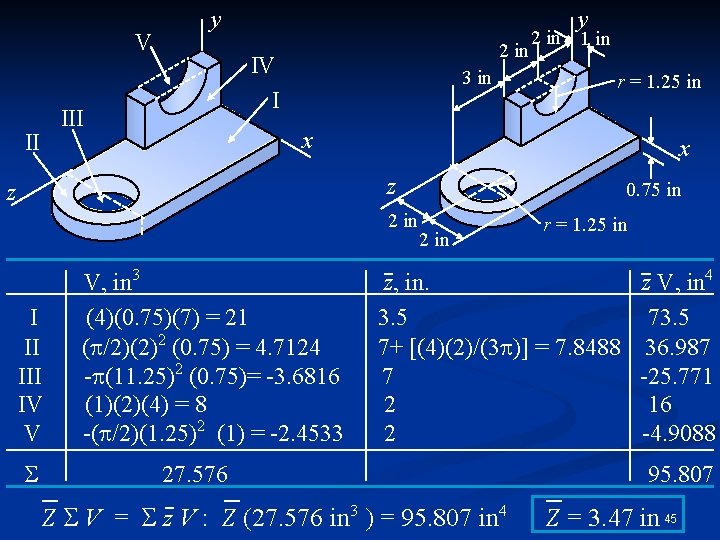
Problem 7. 8 Solution y 2 in 3 in 2 in 1 in Determine the center of gravity of composite body. r = 1. 25 in First assume that the machine element is homogeneous so that its center of gravity will coincide with the centroid of the corresponding volume. x z 2 in 0. 75 in 2 in r = 1. 25 in V Divide the body into five common shapes. II III y IV I x z 44
V y 2 in IV I II y 3 in x z 2 in S r = 1. 25 in x z I II IV V 2 in 1 in V, in 3 (4)(0. 75)(7) = 21 (p/2)(2)2 (0. 75) = 4. 7124 -p(11. 25)2 (0. 75)= -3. 6816 (1)(2)(4) = 8 -(p/2)(1. 25)2 (1) = -2. 4533 0. 75 in 2 in r = 1. 25 in z, in. z V, in 4 3. 5 7+ [(4)(2)/(3 p)] = 7. 8488 36. 987 7 -25. 771 2 16 2 -4. 9088 27. 576 Z S V = S z V : Z (27. 576 in 3 ) = 95. 807 in 4 95. 807 Z = 3. 47 in 45
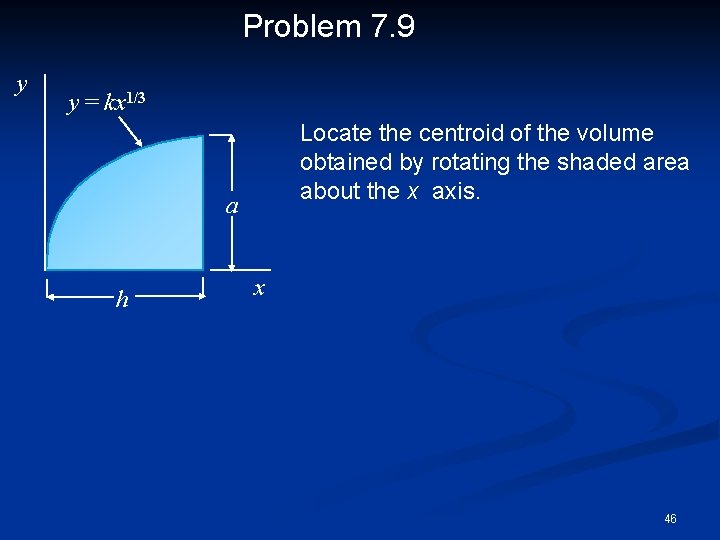
Problem 7. 9 y y = kx 1/3 Locate the centroid of the volume obtained by rotating the shaded area about the x axis. a h x 46
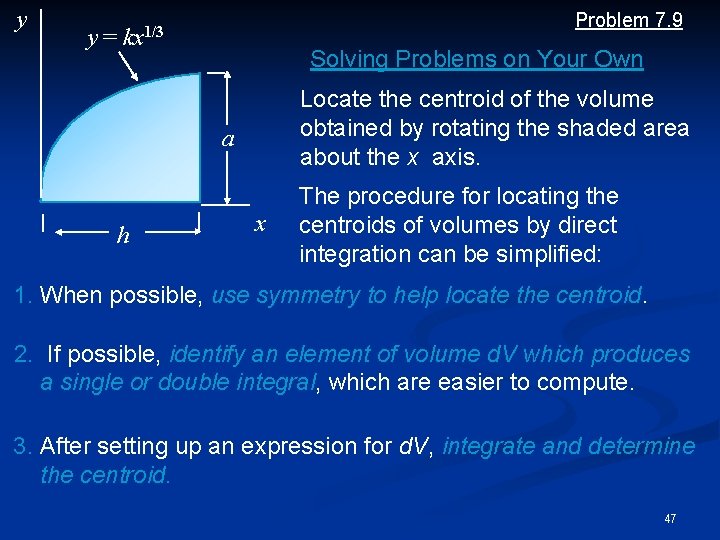
y y= Problem 7. 9 kx 1/3 Solving Problems on Your Own Locate the centroid of the volume obtained by rotating the shaded area about the x axis. a h x The procedure for locating the centroids of volumes by direct integration can be simplified: 1. When possible, use symmetry to help locate the centroid. 2. If possible, identify an element of volume d. V which produces a single or double integral, which are easier to compute. 3. After setting up an expression for d. V, integrate and determine the centroid. 47
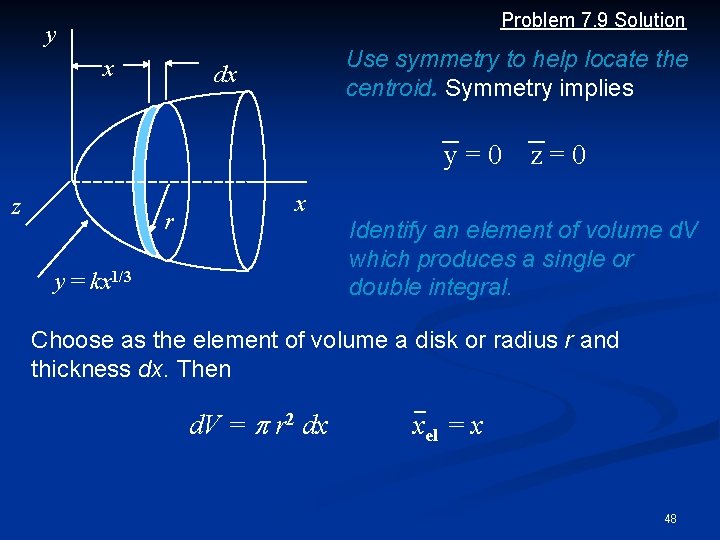
Problem 7. 9 Solution y x Use symmetry to help locate the centroid. Symmetry implies dx y=0 z r z=0 x Identify an element of volume d. V which produces a single or double integral. y = kx 1/3 Choose as the element of volume a disk or radius r and thickness dx. Then d. V = p r 2 dx xel = x 48
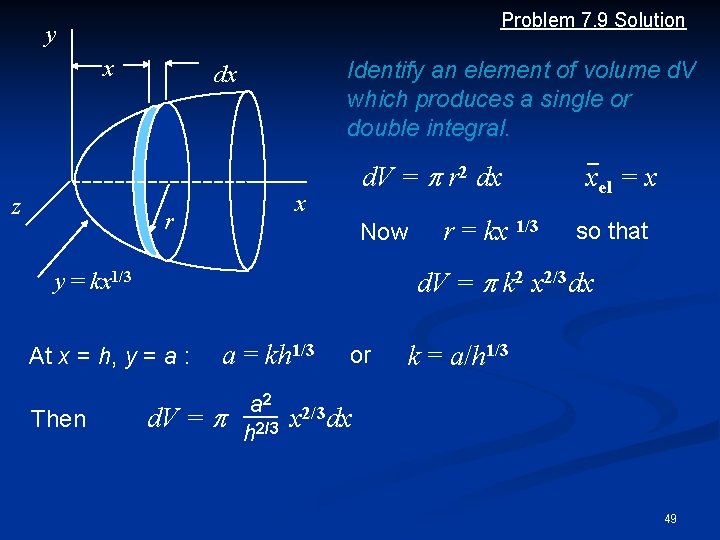
Problem 7. 9 Solution y x z Identify an element of volume d. V which produces a single or double integral. dx d. V = p r 2 dx x r so that d. V = p k 2 x 2/3 dx y = kx 1/3 At x = h, y = a : Then r = kx 1/3 Now xel = x a = kh 1/3 d. V = p or k = a/h 1/3 a 2 2/3 x dx 2/3 h 49
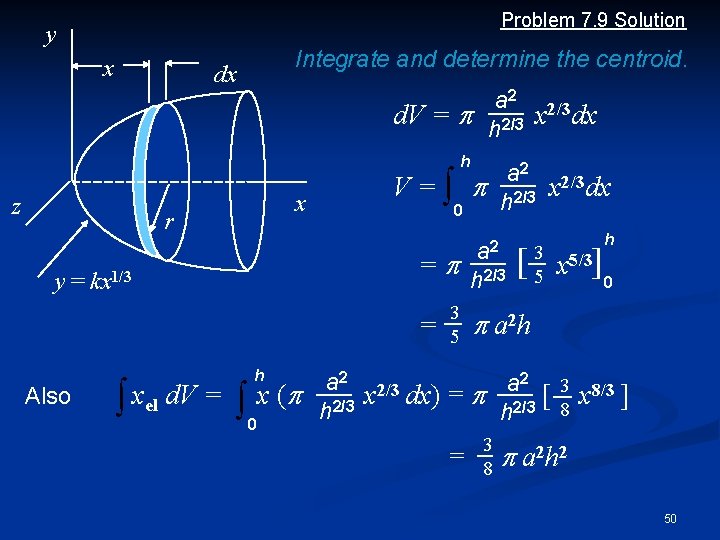
Problem 7. 9 Solution y x Integrate and determine the centroid. dx a 2 2/3 x dx 2/3 h d. V = p h z x r V=ò p 0 =p y = kx 1/3 = Also h ò xel d. V = ò x (p 0 3 5 a 2 2/3 x dx h 2/3 a 2 h 2/3 [ 3 5 h x 5/3] 0 p a 2 h a 2 2/3 a 2 3 8/3 x dx) = p 2/3 [ 8 x ] h 2/3 h = 3 8 p a 2 h 2 50
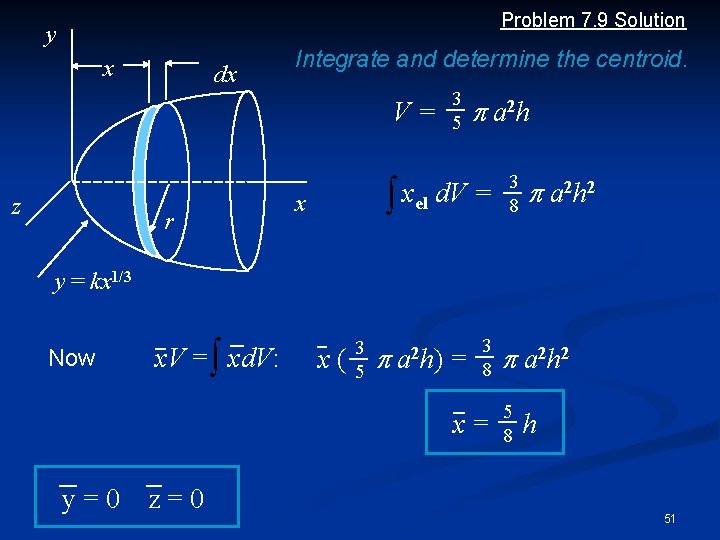
Problem 7. 9 Solution y x dx Integrate and determine the centroid. V= z r 3 5 p a 2 h ò xel d. V = x 3 8 p a 2 h 2 y = kx 1/3 Now x. V = ò xd. V: 3 x ( 5 p a 2 h) = 3 8 x= y=0 z=0 p a 2 h 2 5 8 h 51
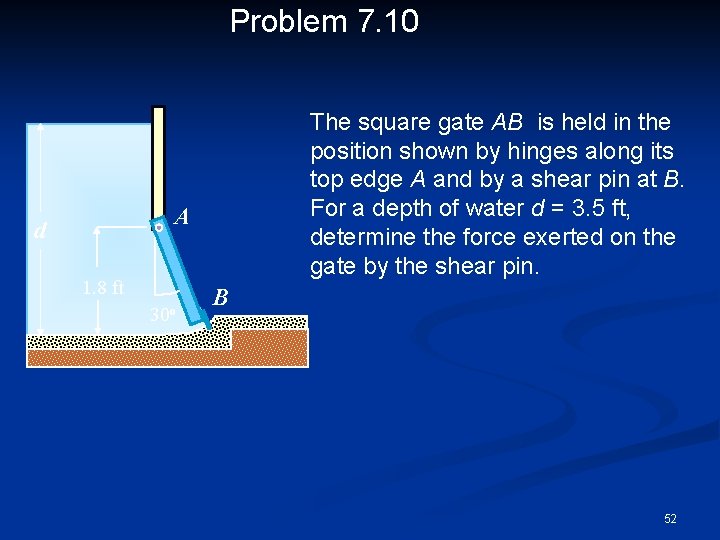
Problem 7. 10 The square gate AB is held in the position shown by hinges along its top edge A and by a shear pin at B. For a depth of water d = 3. 5 ft, determine the force exerted on the gate by the shear pin. A d 1. 8 ft 30 o B 52
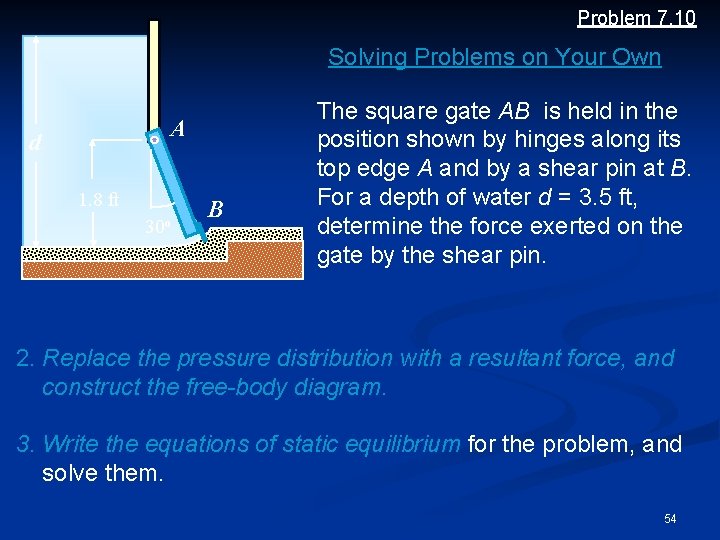
Problem 7. 10 Solving Problems on Your Own A d 1. 8 ft 30 o B The square gate AB is held in the position shown by hinges along its top edge A and by a shear pin at B. For a depth of water d = 3. 5 ft, determine the force exerted on the gate by the shear pin. Assuming the submerged body has a width b, the load per unit length is w = brgh, where h is the distance below the surface of the fluid. 1. First, determine the pressure distribution acting perpendicular the surface of the submerged body. The pressure distribution will be either triangular or trapezoidal. 53
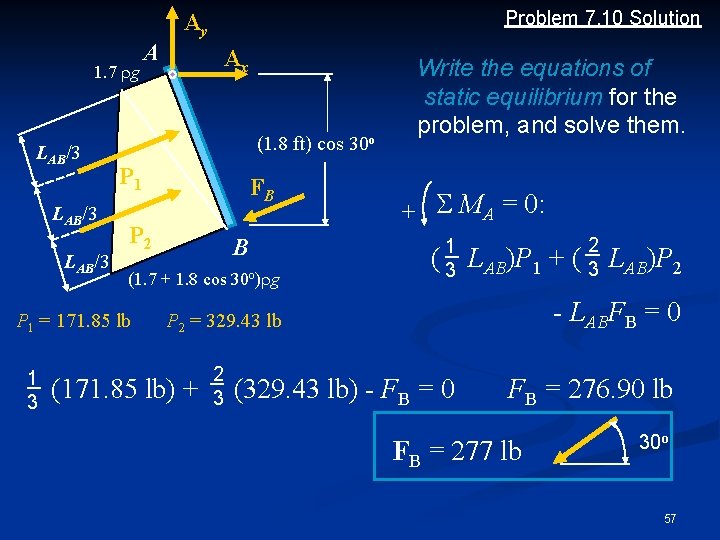
Problem 7. 10 Solving Problems on Your Own A d 1. 8 ft 30 o B The square gate AB is held in the position shown by hinges along its top edge A and by a shear pin at B. For a depth of water d = 3. 5 ft, determine the force exerted on the gate by the shear pin. 2. Replace the pressure distribution with a resultant force, and construct the free-body diagram. 3. Write the equations of static equilibrium for the problem, and solve them. 54
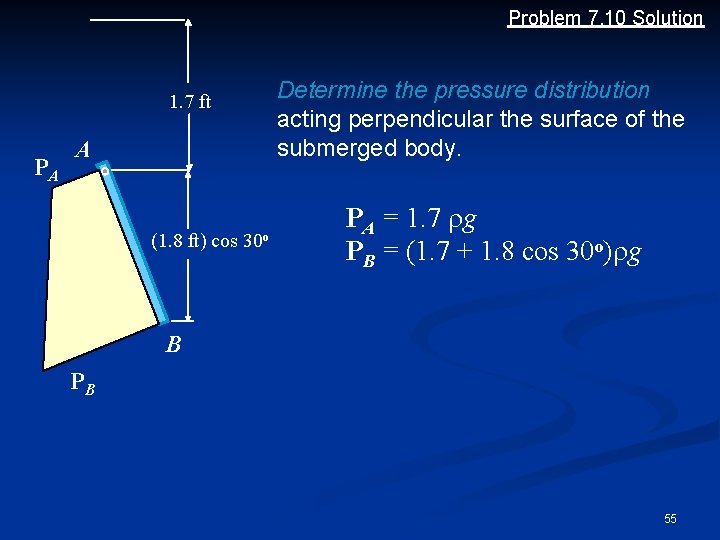
Problem 7. 10 Solution 1. 7 ft PA A (1. 8 ft) cos 30 o Determine the pressure distribution acting perpendicular the surface of the submerged body. PA = 1. 7 rg PB = (1. 7 + 1. 8 cos 30 o)rg B PB 55
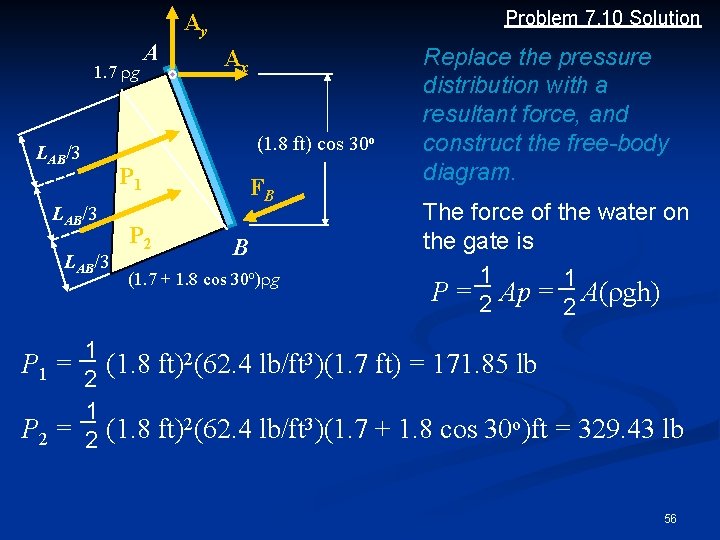
1. 7 rg LAB/3 A Problem 7. 10 Solution Ay Ax (1. 8 ft) cos 30 o P 1 P 2 FB B (1. 7 + 1. 8 cos 30 o)rg Replace the pressure distribution with a resultant force, and construct the free-body diagram. The force of the water on the gate is 1 1 P = 2 Ap = 2 A(rgh) 1 P 1 = 2 (1. 8 ft)2(62. 4 lb/ft 3)(1. 7 ft) = 171. 85 lb 1 P 2 = 2 (1. 8 ft)2(62. 4 lb/ft 3)(1. 7 + 1. 8 cos 30 o)ft = 329. 43 lb 56
1. 7 rg LAB/3 Ax (1. 8 ft) cos 30 o P 1 FB P 2 B (1. 7 + 1. 8 cos 30 o)rg P 1 = 171. 85 lb 1 3 A Problem 7. 10 Solution Ay Write the equations of static equilibrium for the problem, and solve them. + S MA = 0: ( 13 LAB)P 1 + ( (171. 85 lb) + LAB)P 2 - LABFB = 0 P 2 = 329. 43 lb 2 3 (329. 43 lb) - FB = 0 FB = 276. 90 lb FB = 277 lb 30 o 57