
Eigen Rank A ranking oriented approach to collaborative
Eigen. Rank: A ranking oriented approach to collaborative filtering By Nathan N. Liu and Qiang Yang Presented by Zachary 1
Outline • Recommender system • Motivation • Memory-based CF – Similarity measure – User based – Item based • Eigen. Rank – Model – Prediction – Experiments and results 2
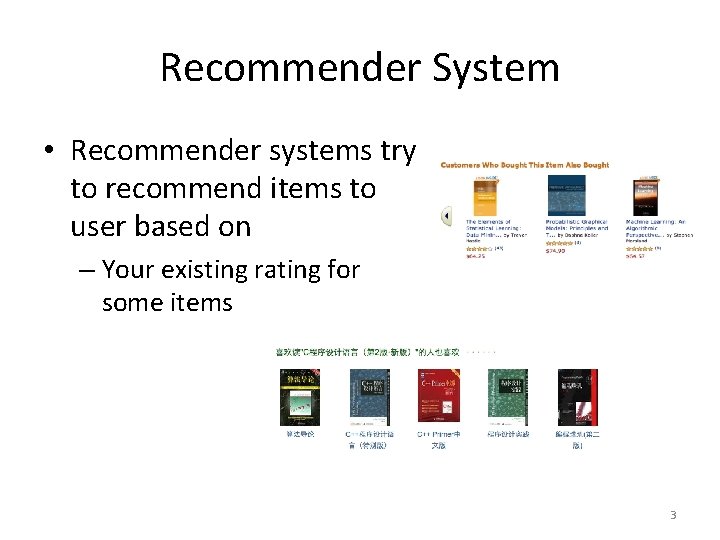
Recommender System • Recommender systems try to recommend items to user based on – Your existing rating for some items 3
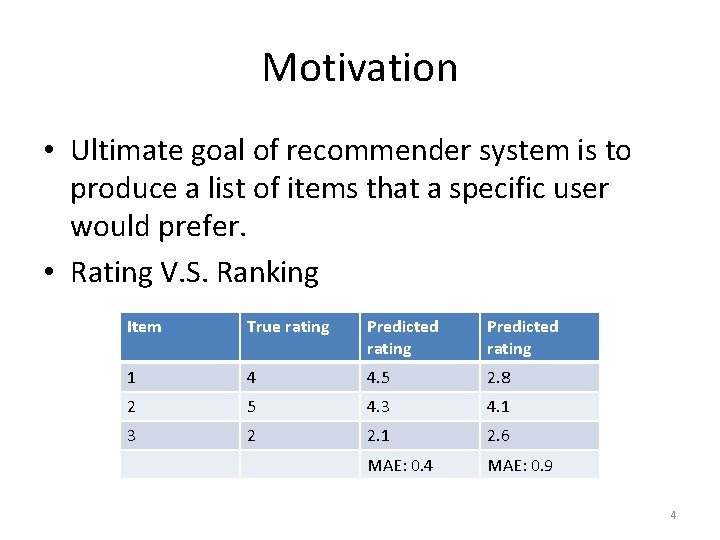
Motivation • Ultimate goal of recommender system is to produce a list of items that a specific user would prefer. • Rating V. S. Ranking Item True rating Predicted rating 1 4 4. 5 2. 8 2 5 4. 3 4. 1 3 2 2. 1 2. 6 MAE: 0. 4 MAE: 0. 9 4
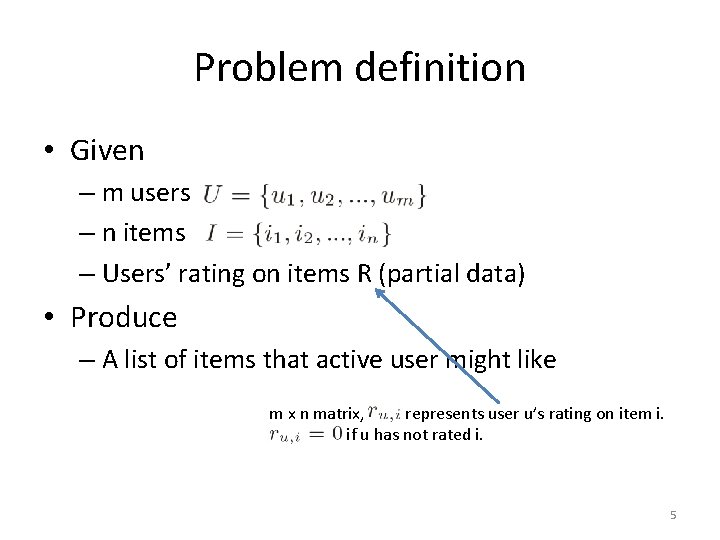
Problem definition • Given – m users – n items – Users’ rating on items R (partial data) • Produce – A list of items that active user might like m x n matrix, represents user u’s rating on item i. if u has not rated i. 5
Memory based CF • We have no information regarding the content of an item • Ratings are the only data we have • For an active user (user based) – Find users similar to active user • For rated items, they tend to give similar ratings – Based on their ratings for an item – Predict the rating that active user would assign 6
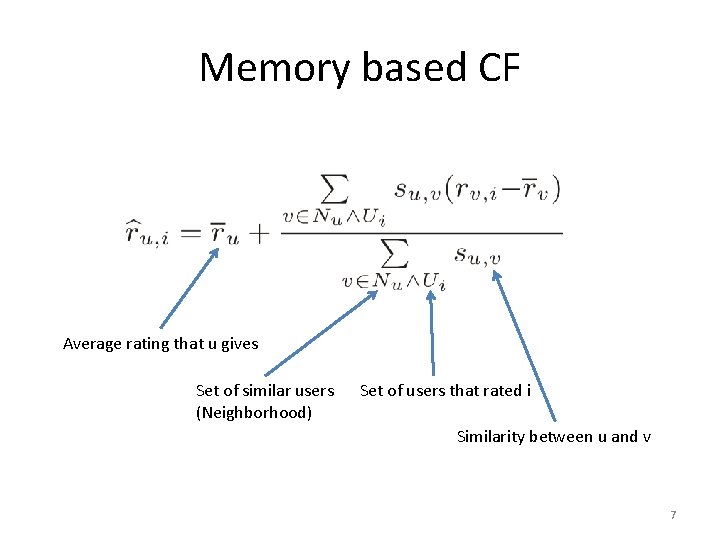
Memory based CF Average rating that u gives Set of similar users (Neighborhood) Set of users that rated i Similarity between u and v 7
Similarity Measure • For the memory based model to work, we need a similarity measure – Pearson Correlation Coefficient – Vector similarity – Adjusted cosine similarity 8
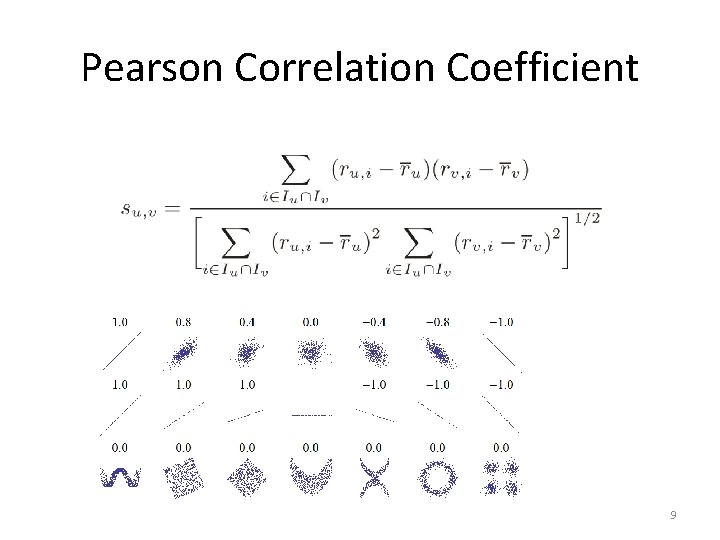
Pearson Correlation Coefficient 9
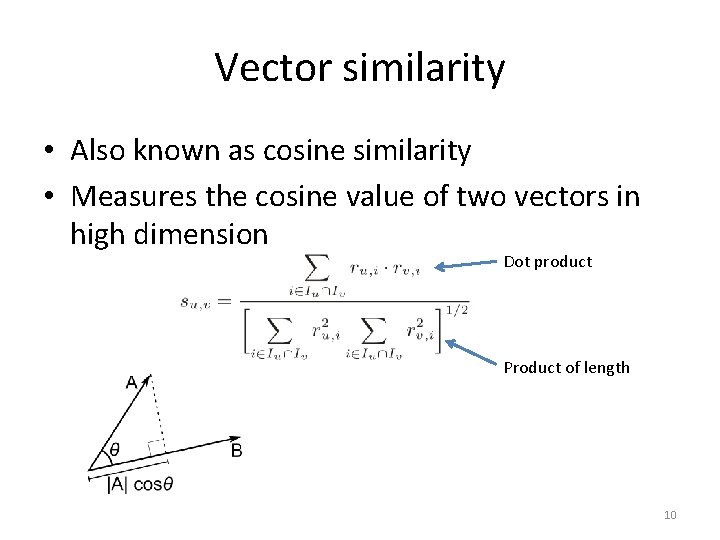
Vector similarity • Also known as cosine similarity • Measures the cosine value of two vectors in high dimension Dot product Product of length 10
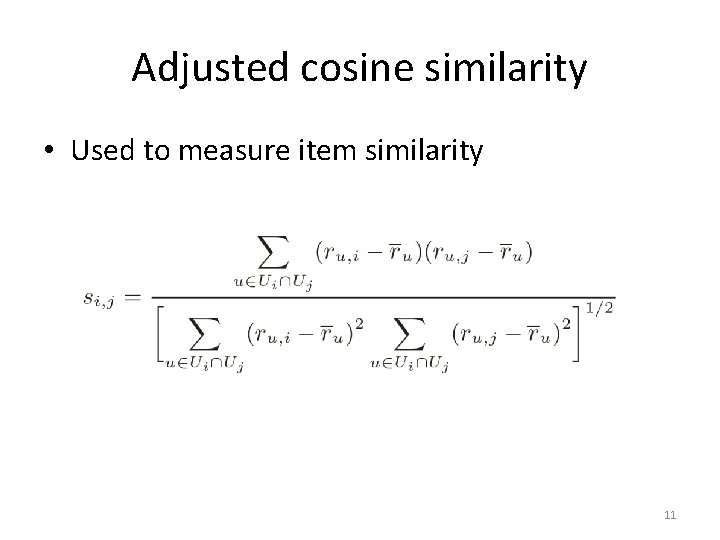
Adjusted cosine similarity • Used to measure item similarity 11
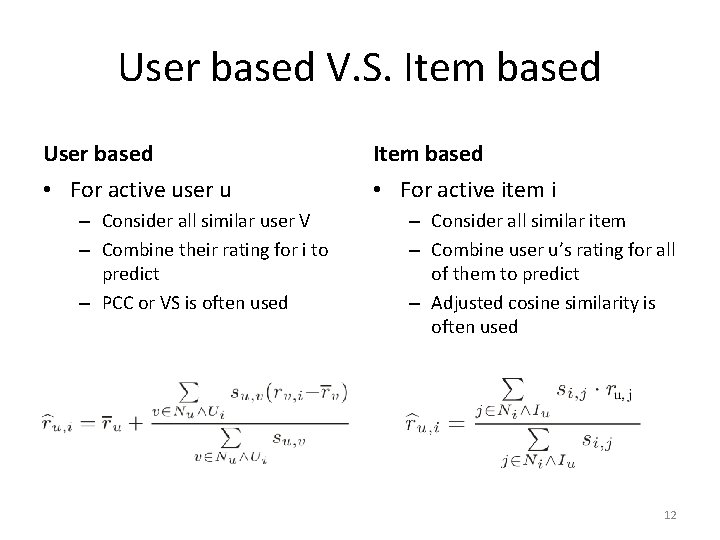
User based V. S. Item based User based Item based • For active user u • For active item i – Consider all similar user V – Combine their rating for i to predict – PCC or VS is often used – Consider all similar item – Combine user u’s rating for all of them to predict – Adjusted cosine similarity is often used 12
Eigen. Rank • Ranking oriented model – No rating prediction – Output a ranking instead 13
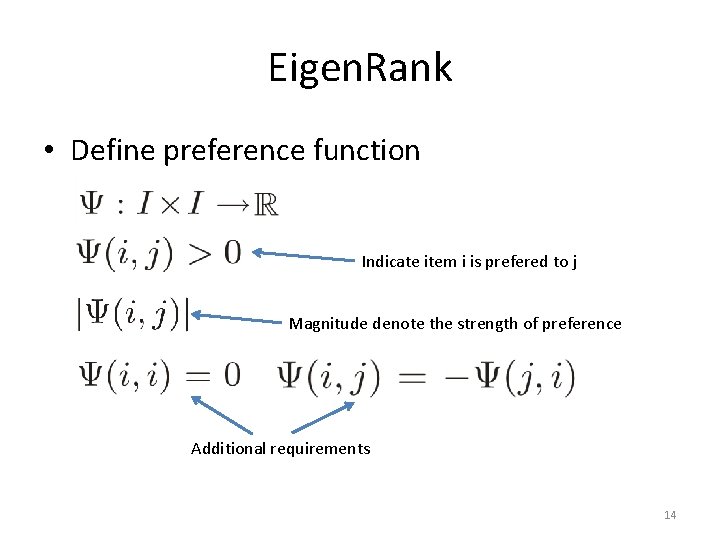
Eigen. Rank • Define preference function Indicate item i is prefered to j Magnitude denote the strength of preference Additional requirements 14
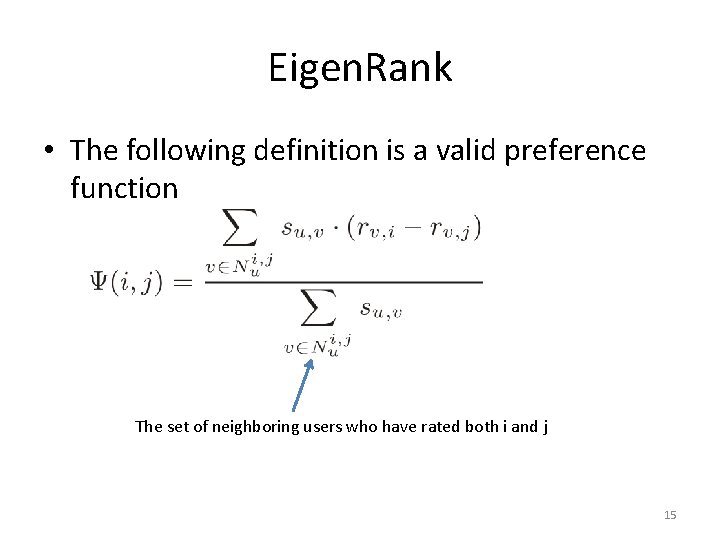
Eigen. Rank • The following definition is a valid preference function The set of neighboring users who have rated both i and j 15
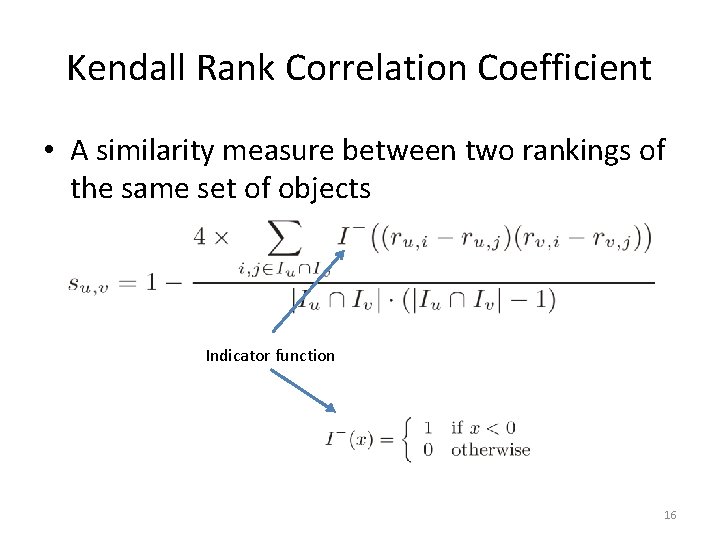
Kendall Rank Correlation Coefficient • A similarity measure between two rankings of the same set of objects Indicator function 16
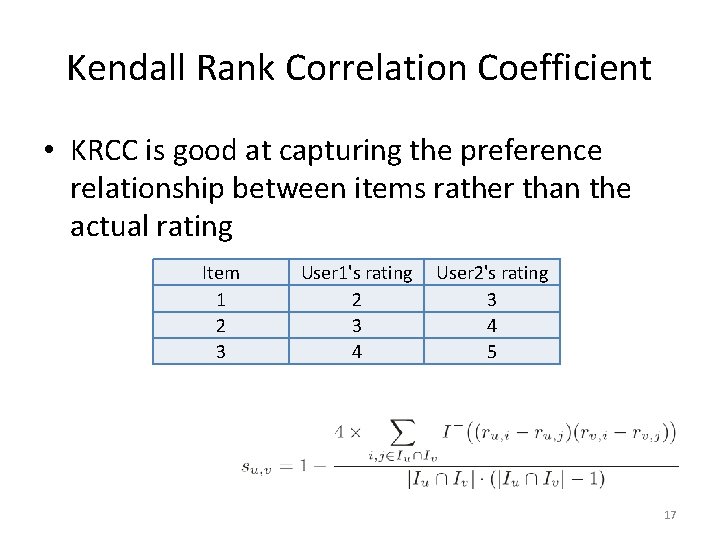
Kendall Rank Correlation Coefficient • KRCC is good at capturing the preference relationship between items rather than the actual rating Item 1 2 3 User 1's rating 2 3 4 User 2's rating 3 4 5 17
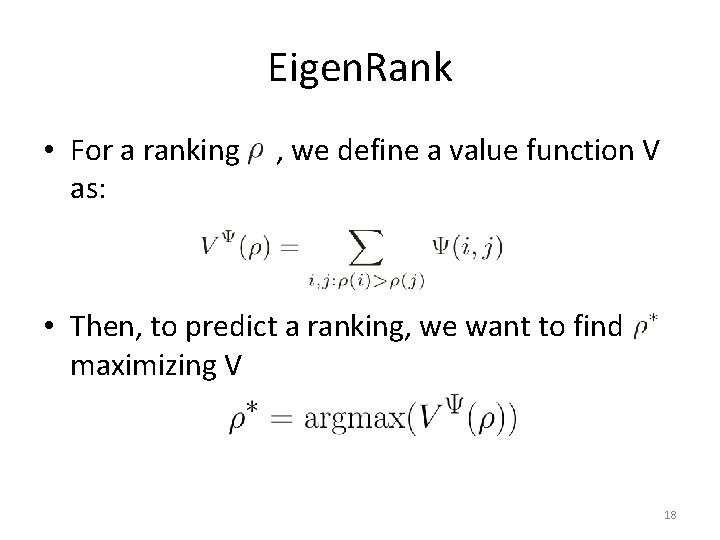
Eigen. Rank • For a ranking as: , we define a value function V • Then, to predict a ranking, we want to find maximizing V 18
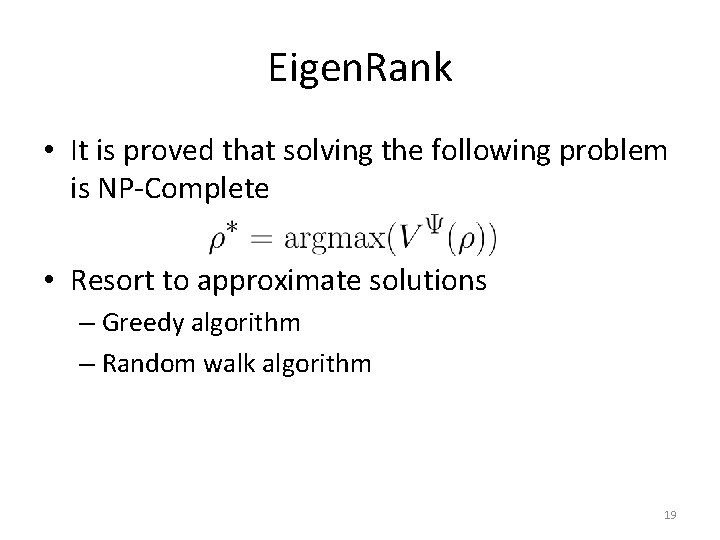
Eigen. Rank • It is proved that solving the following problem is NP-Complete • Resort to approximate solutions – Greedy algorithm – Random walk algorithm 19
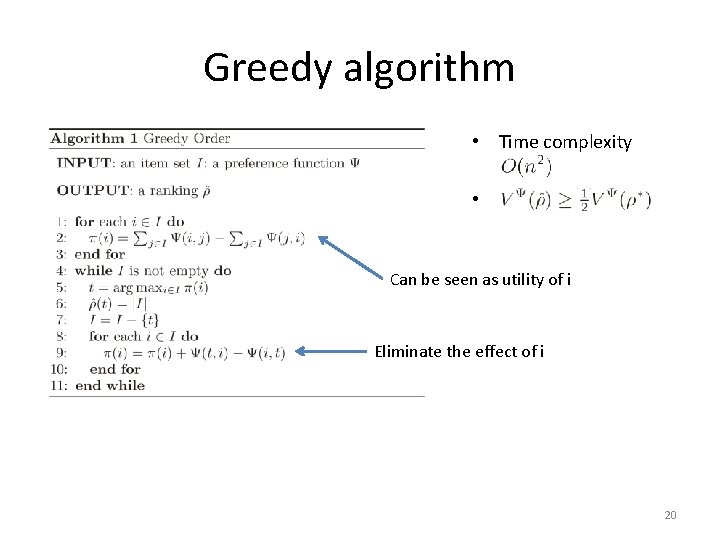
Greedy algorithm • Time complexity • Can be seen as utility of i Eliminate the effect of i 20
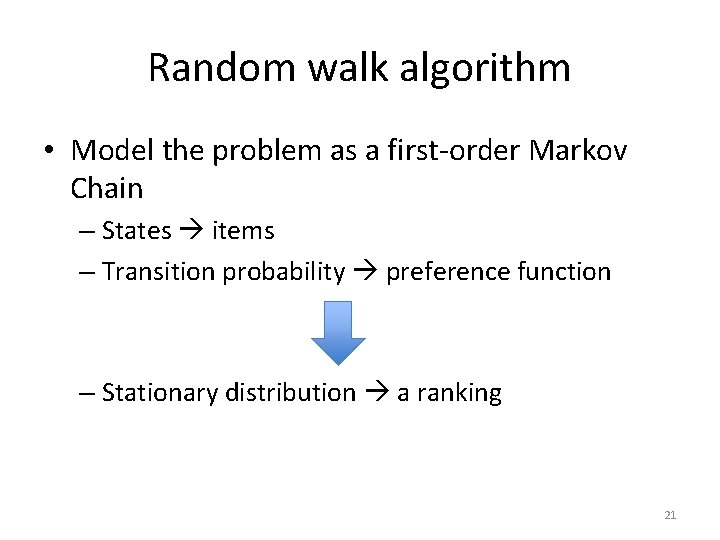
Random walk algorithm • Model the problem as a first-order Markov Chain – States items – Transition probability preference function – Stationary distribution a ranking 21
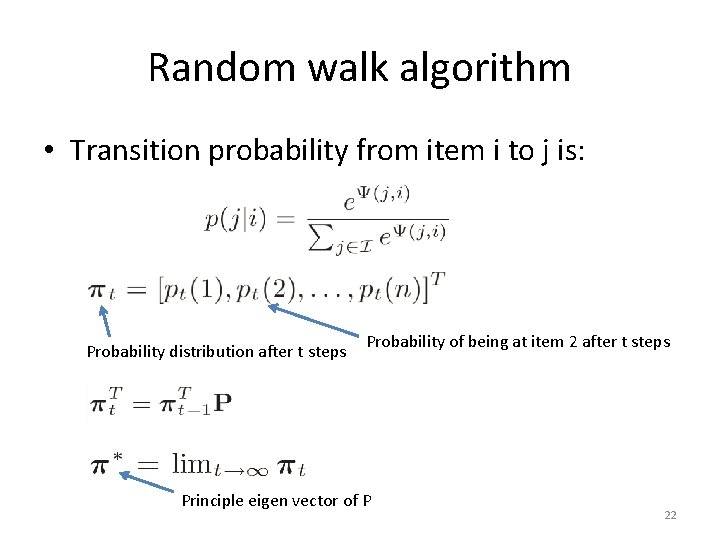
Random walk algorithm • Transition probability from item i to j is: Probability distribution after t steps Probability of being at item 2 after t steps Principle eigen vector of P 22
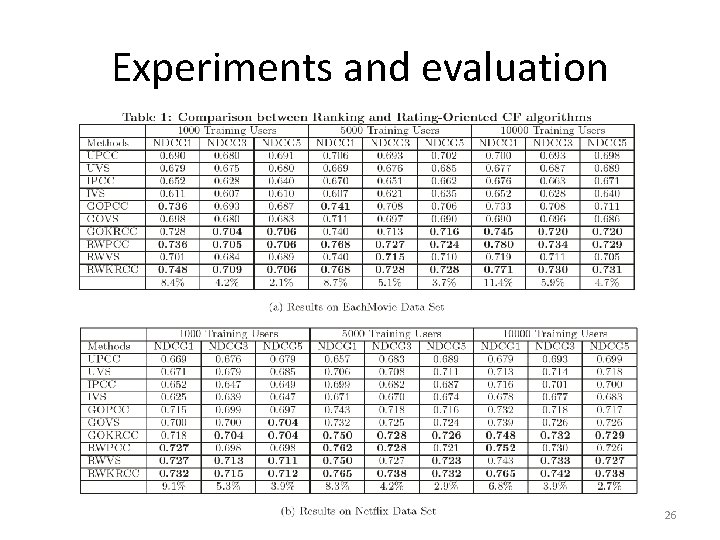
Experiments and Results • Data set – Each. Movie(6. 1% non-zero entries) – Netflix (6. 6% non-zero entries) – Random pick 10600 users who have rated more than 40 movies • 10000 user for training • 100 parameter tuning • 500 active user – 50% training – 50% testing 23
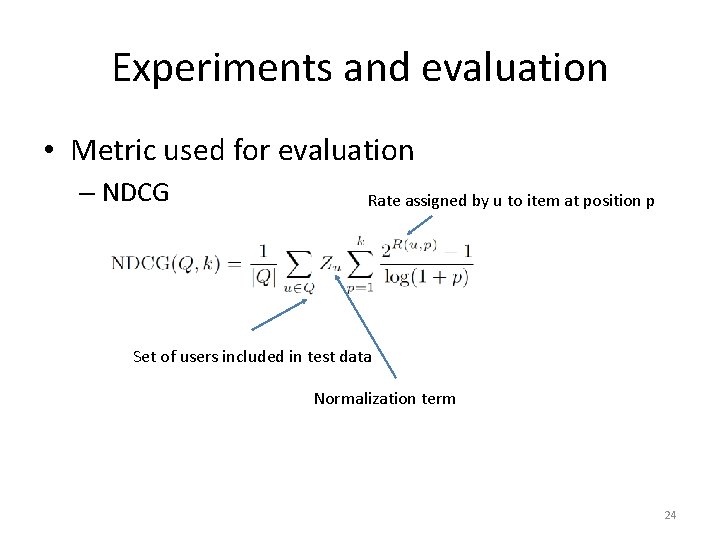
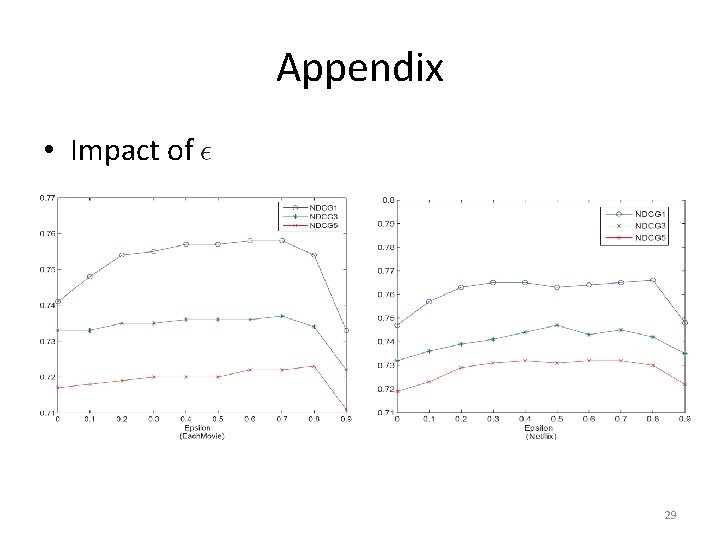
Experiments and evaluation • Metric used for evaluation – NDCG Rate assigned by u to item at position p Set of users included in test data Normalization term 24
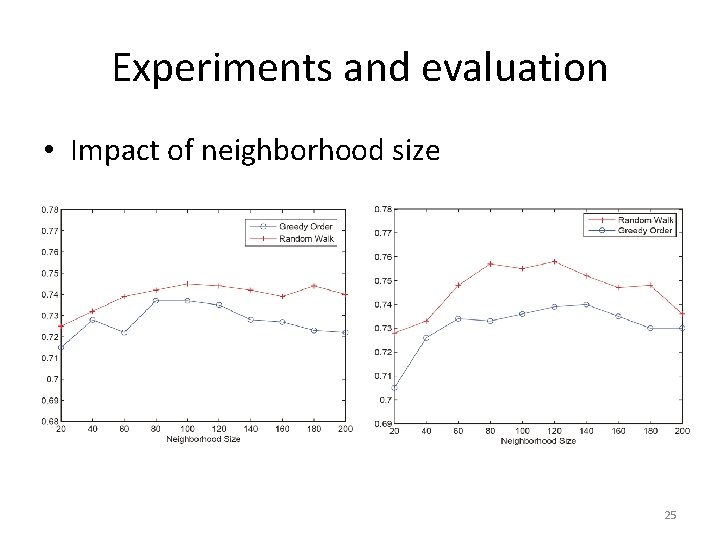
Experiments and evaluation • Impact of neighborhood size 25
Experiments and evaluation 26
Q&A • Any questions? 27
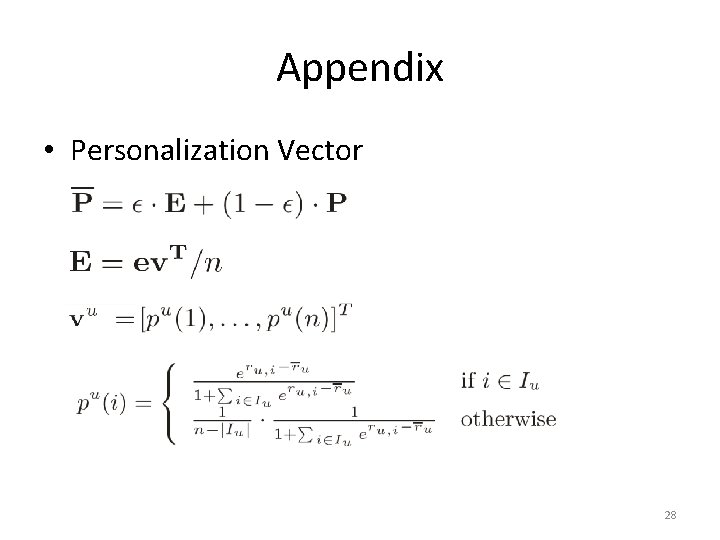
Appendix • Personalization Vector 28
Appendix • Impact of 29
- Slides: 29