
EIE Efficient Inference Engine on Compressed Deep Neural
- Slides: 29
EIE: Efficient Inference Engine on Compressed Deep Neural Network Song Han*, Xingyu Liu*, Huizi Mao*, Jing Pu*, Ardavan Pedram*, Mark A. Horowitz*, William J. Daly*† *Stanford University †NVIDIA rd Published in the Proceedings of ACM/IEEE 43 Annual International Symposium on Computer Architecture (ISCA 2016)
Motivation Deep Neural Networks are BIG. . . and getting BIGGER e. g. Alex. Net (240 MB), VGG-16 (520 MB) Too big to store on-chip SRAM and DRAM accesses use a lot of energy Not suitable for low-power mobile/embedded systems Solution: Deep Compression
Deep Compression Technique to reduce size of neural networks without losing accuracy 1) Pruning to Reduce Number of Weights 1) Quantization to Reduce Bits per Weight 1) Huffman Encoding “Deep Compression: Compressing Deep Neural Networks with Pruning, Trained Quantization and Huffman Coding”, Song Han et al. , ICLR 2016
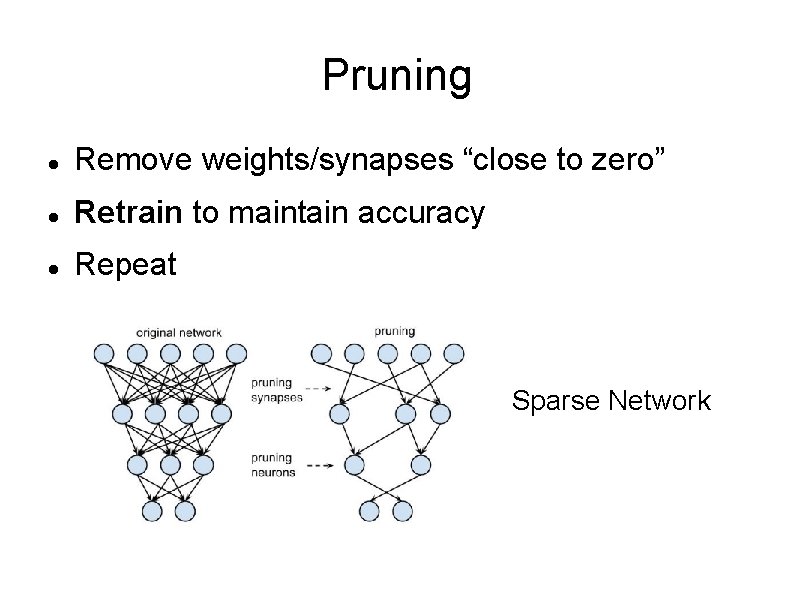
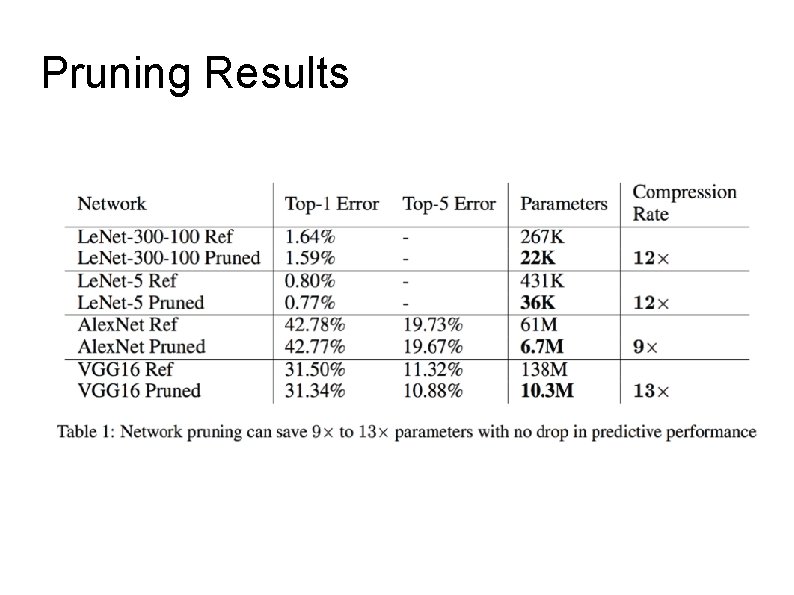
Pruning Remove weights/synapses “close to zero” Retrain to maintain accuracy Repeat Sparse Network
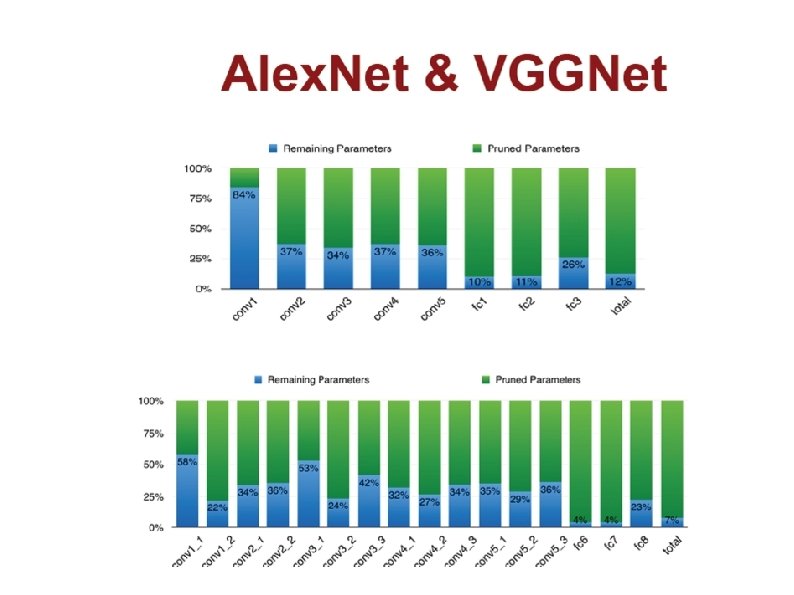
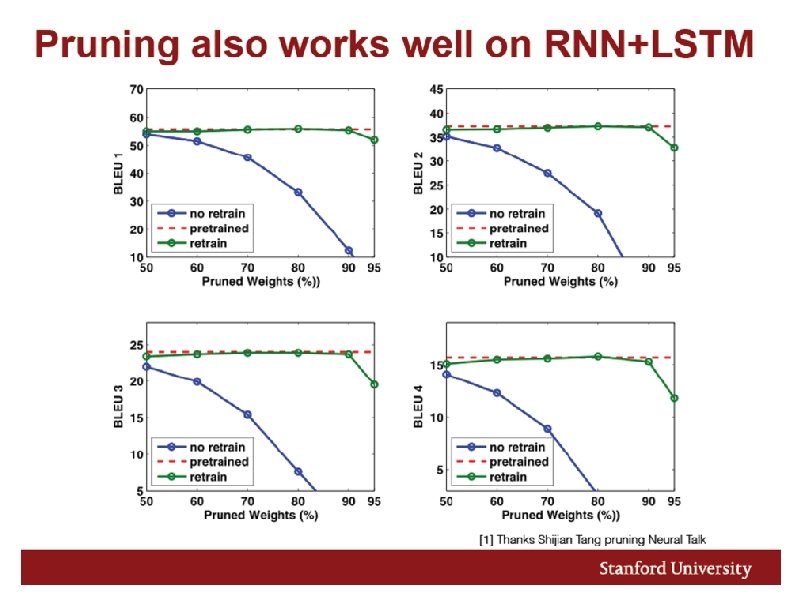
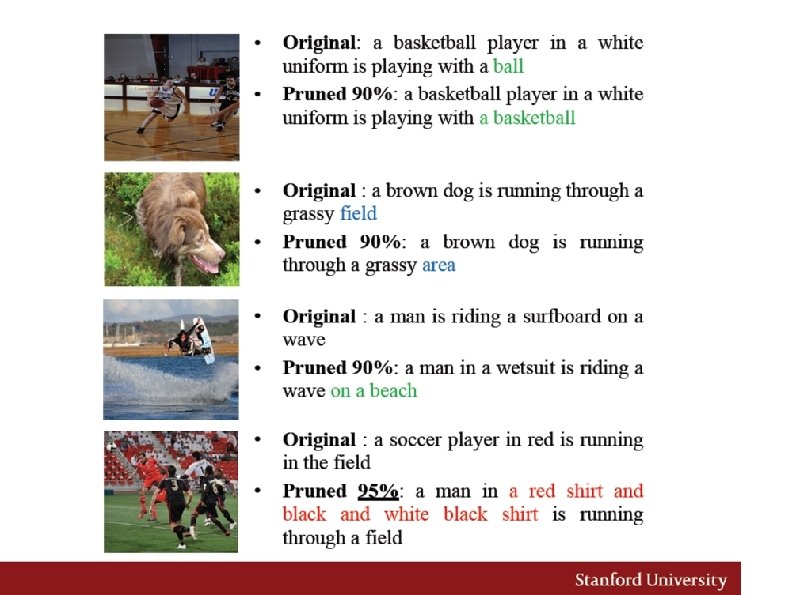
Pruning Results
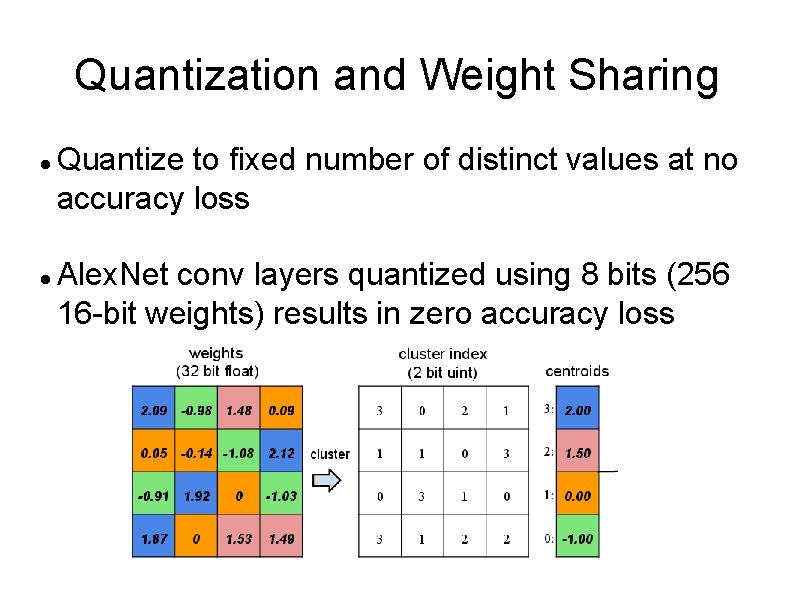
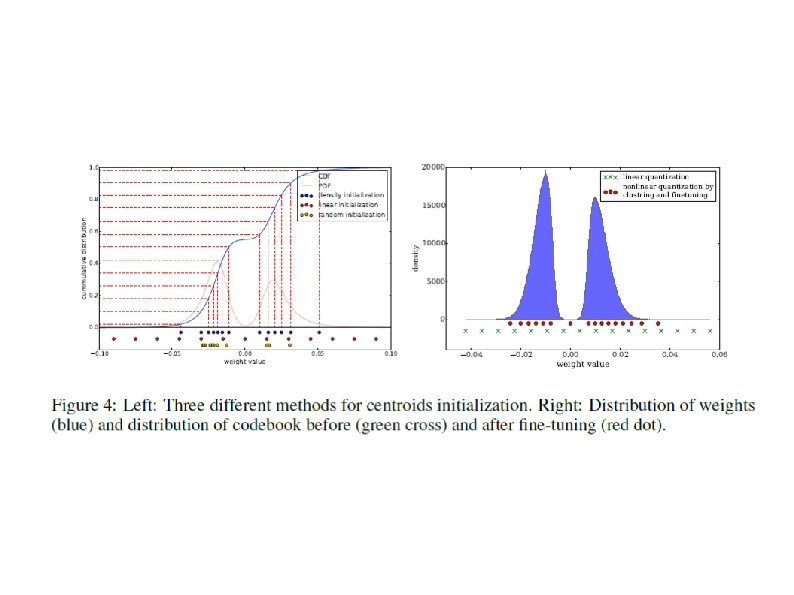
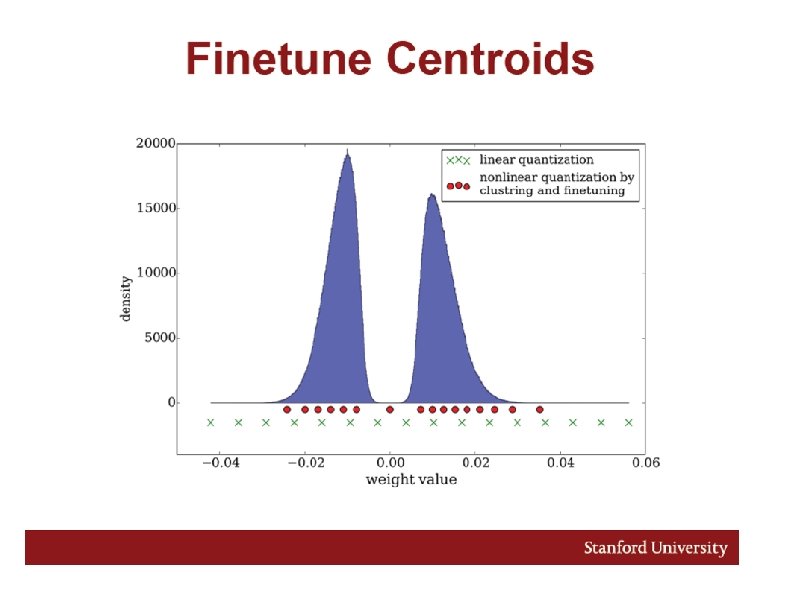
Quantization and Weight Sharing Quantize to fixed number of distinct values at no accuracy loss Alex. Net conv layers quantized using 8 bits (256 16 -bit weights) results in zero accuracy loss
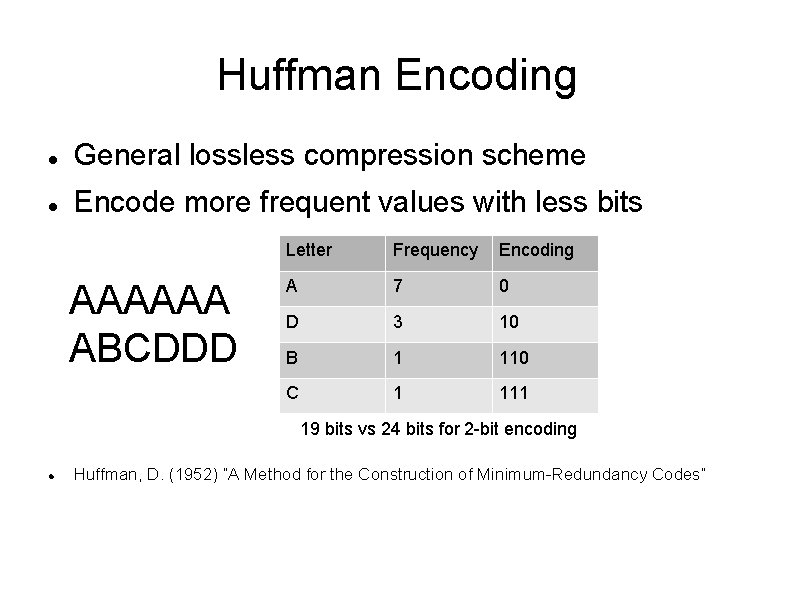
Huffman Encoding General lossless compression scheme Encode more frequent values with less bits AAAAAA ABCDDD Letter Frequency Encoding A 7 0 D 3 10 B 1 110 C 1 111 19 bits vs 24 bits for 2 -bit encoding Huffman, D. (1952) “A Method for the Construction of Minimum-Redundancy Codes”
Results Compression Ratios (same or better accuracy) Le. Net-300 -100 – 40 X Alex. Net – 35 X VGG 16 – 49 X Le. Net-5 – 39 X
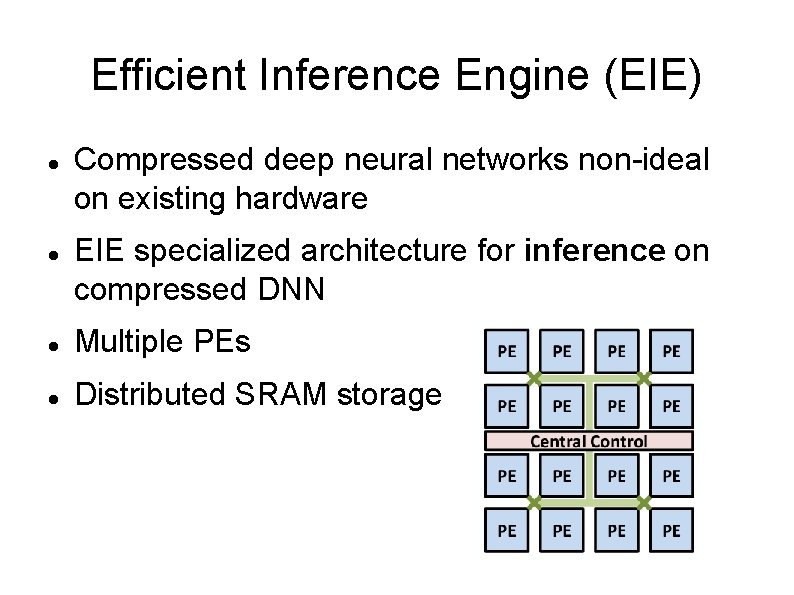
Efficient Inference Engine (EIE) Compressed deep neural networks non-ideal on existing hardware EIE specialized architecture for inference on compressed DNN Multiple PEs Distributed SRAM storage
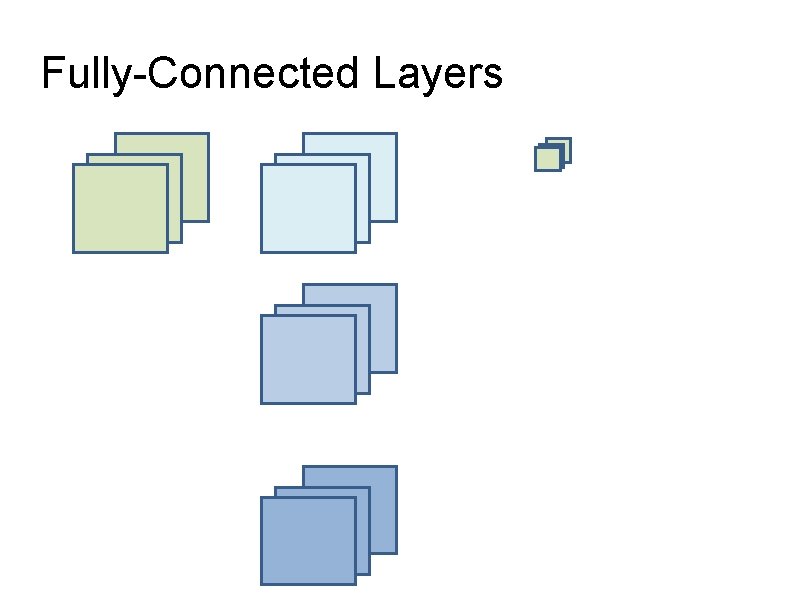
Fully-Connected Layers
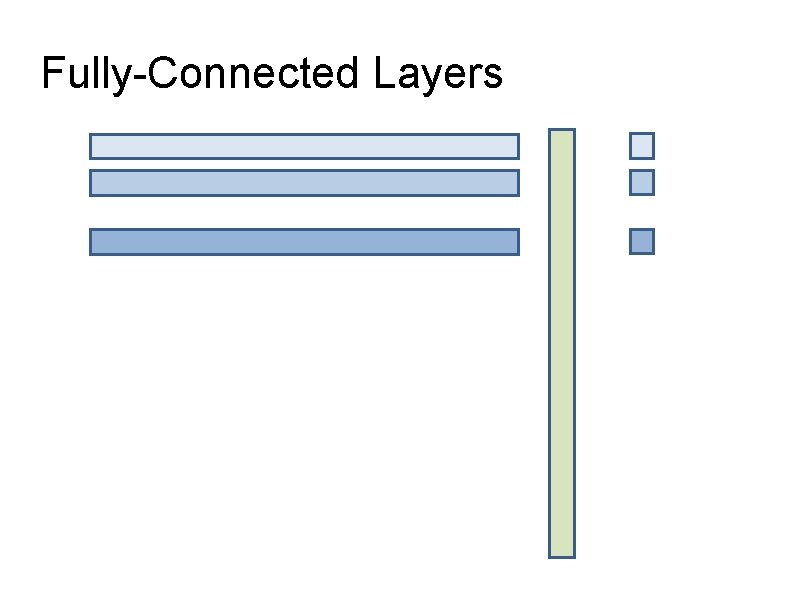
Fully-Connected Layers
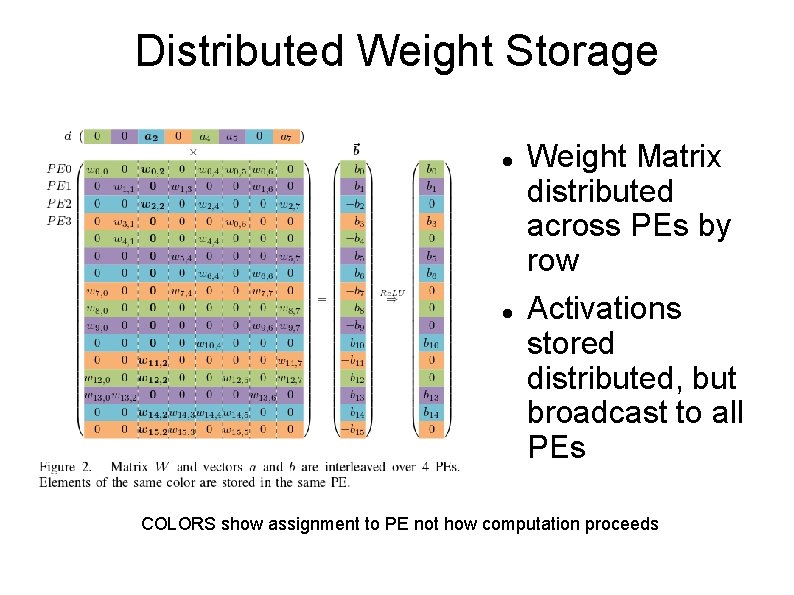
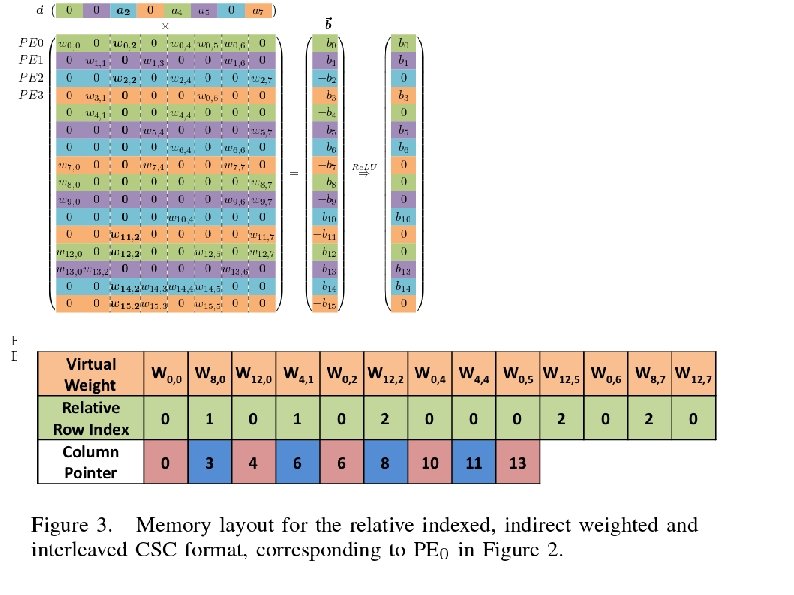
Distributed Weight Storage Weight Matrix distributed across PEs by row Activations stored distributed, but broadcast to all PEs COLORS show assignment to PE not how computation proceeds
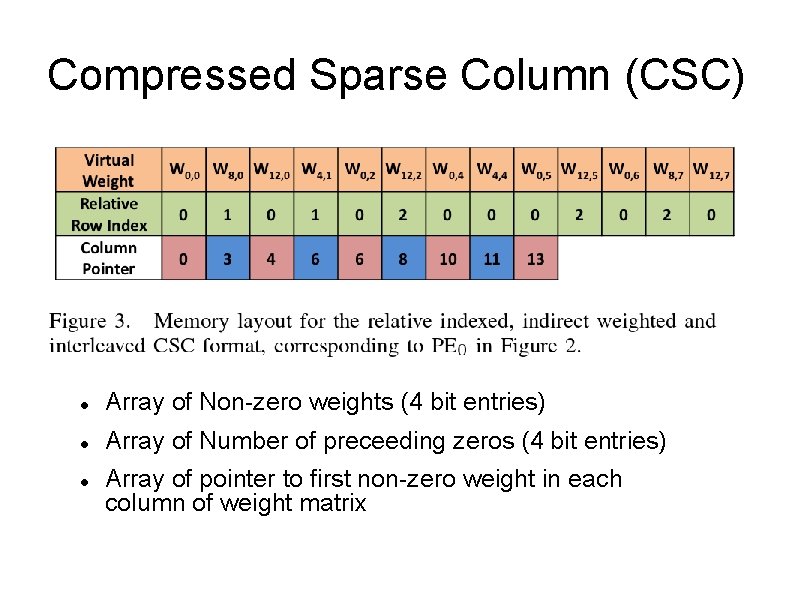
Compressed Sparse Column (CSC) Array of Non-zero weights (4 bit entries) Array of Number of preceeding zeros (4 bit entries) Array of pointer to first non-zero weight in each column of weight matrix
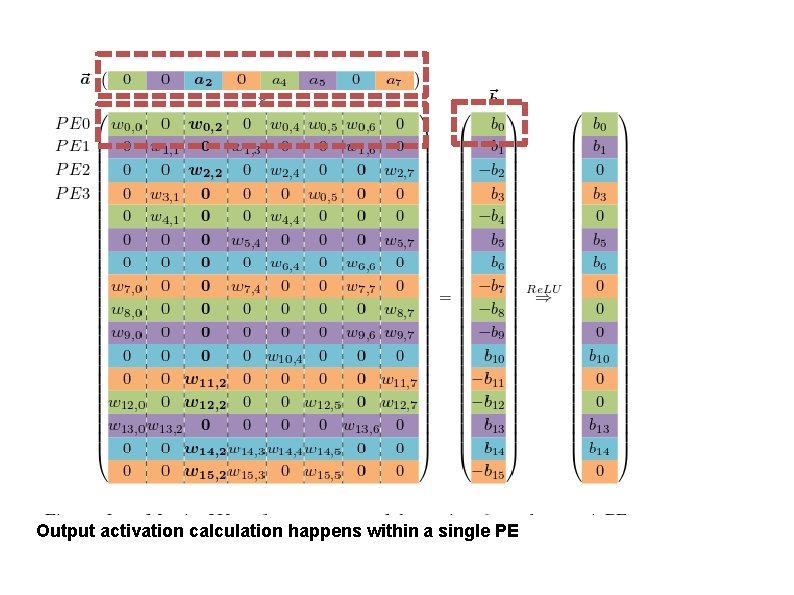
Output activation calculation happens within a single PE
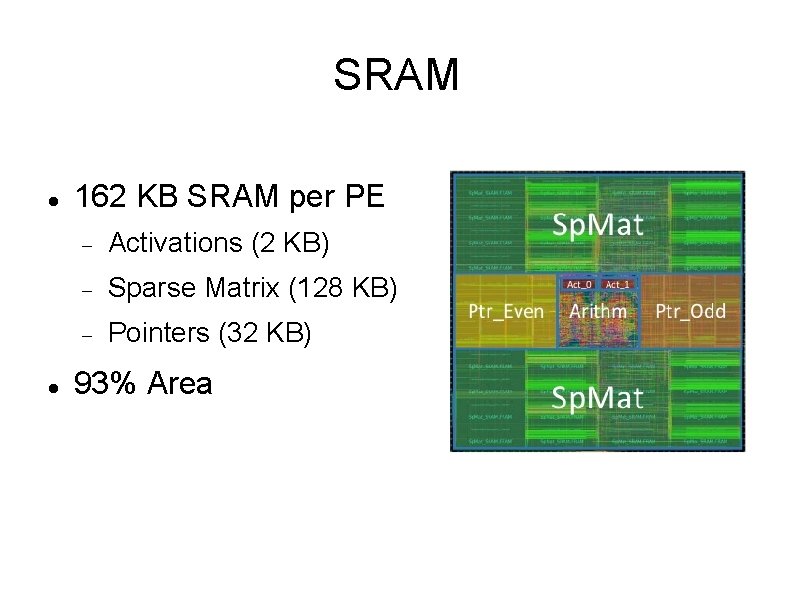
SRAM 162 KB SRAM per PE Activations (2 KB) Sparse Matrix (128 KB) Pointers (32 KB) 93% Area
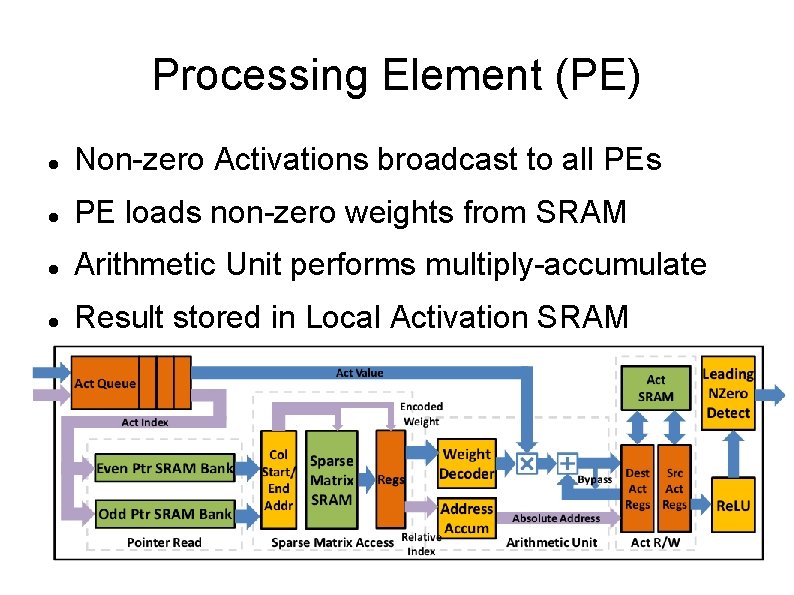
Processing Element (PE) Non-zero Activations broadcast to all PEs PE loads non-zero weights from SRAM Arithmetic Unit performs multiply-accumulate Result stored in Local Activation SRAM
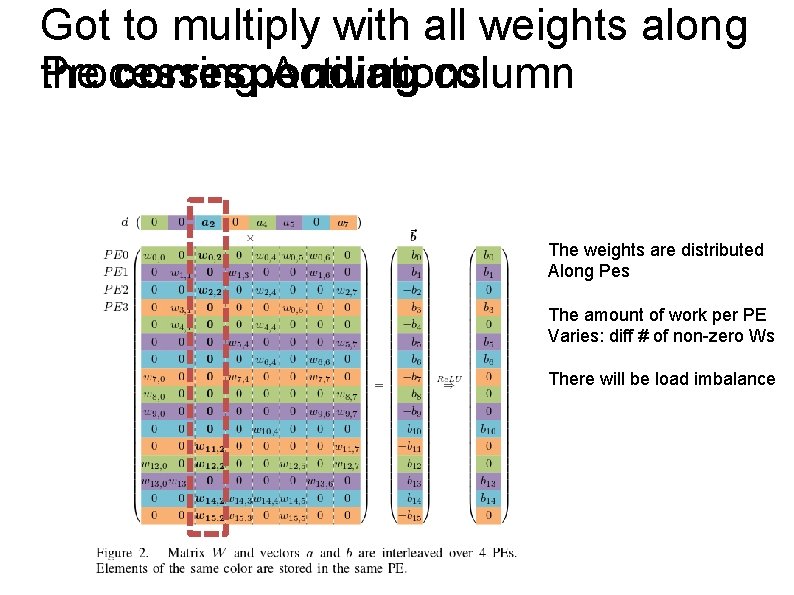
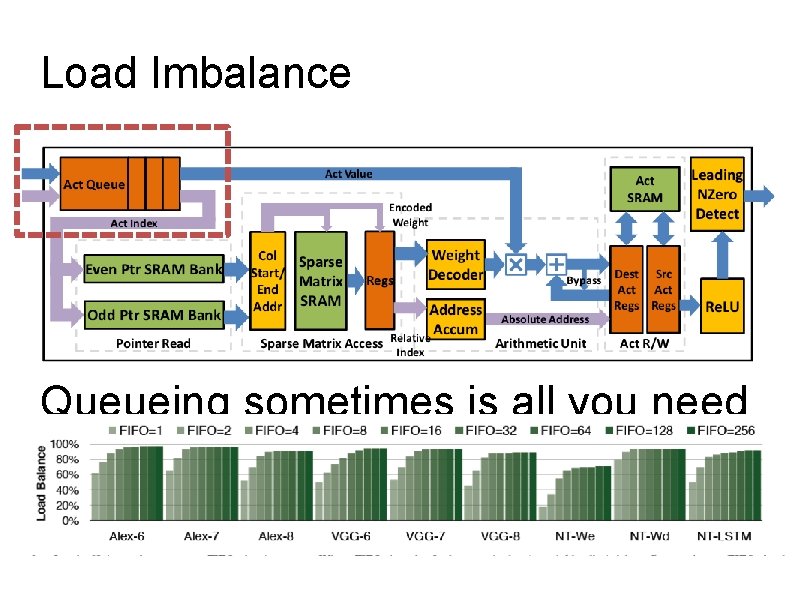
Got to multiply with all weights along Processing Activations the corresponding column The weights are distributed Along Pes The amount of work per PE Varies: diff # of non-zero Ws There will be load imbalance
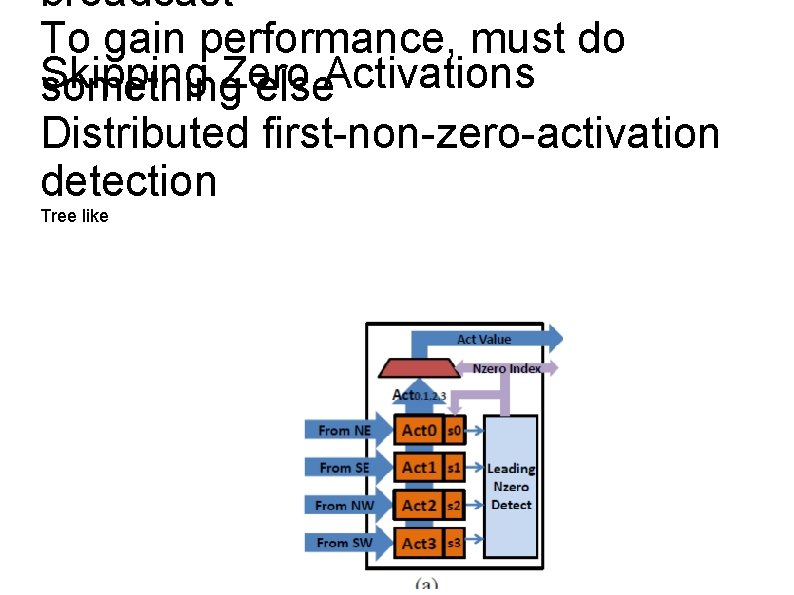
broadcast To gain performance, must do Skipping Zero something else. Activations Distributed first-non-zero-activation detection Tree like
Load Imbalance Queueing sometimes is all you need
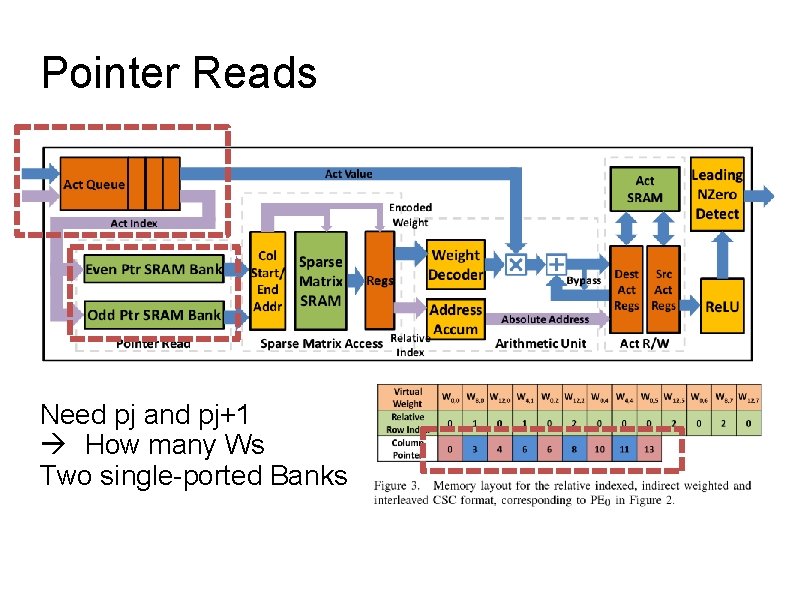
Pointer Reads Need pj and pj+1 How many Ws Two single-ported Banks
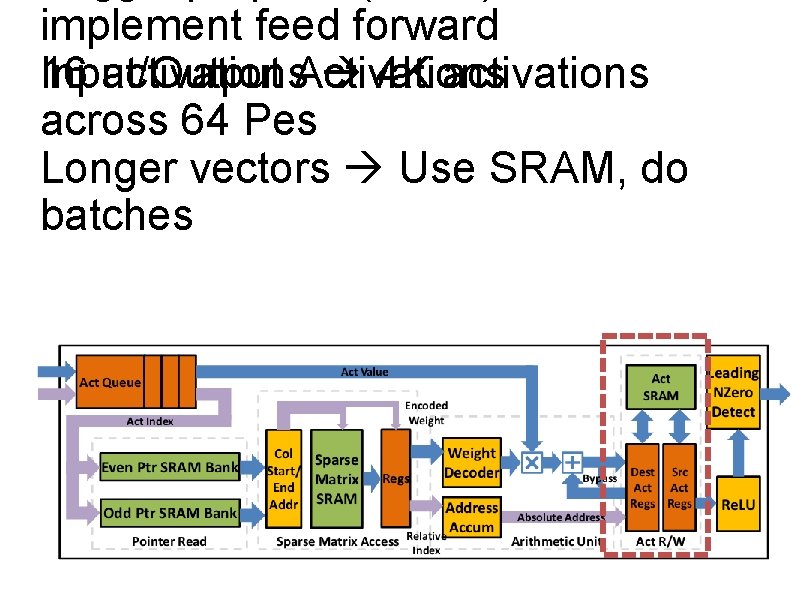
implement feed forward 16 activations. Activations 4 K activations Input/Output across 64 Pes Longer vectors Use SRAM, do batches
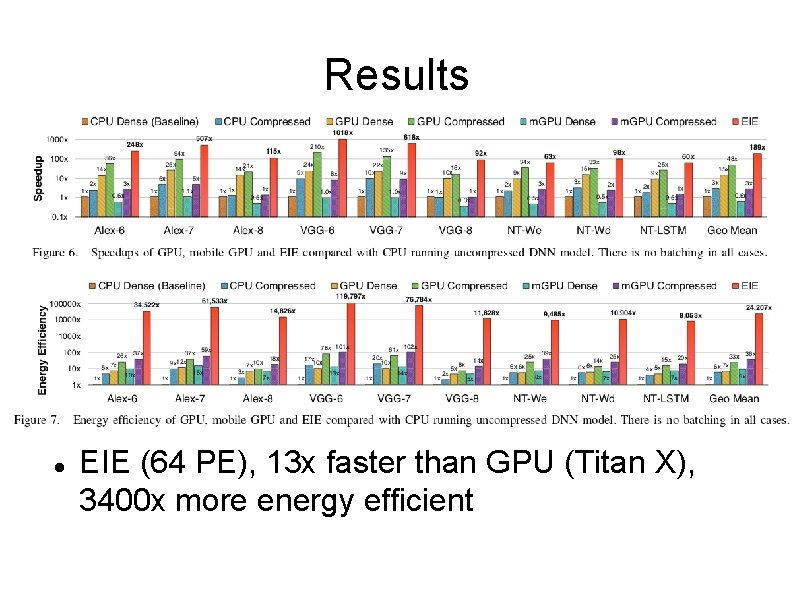
Results EIE (64 PE), 13 x faster than GPU (Titan X), 3400 x more energy efficient
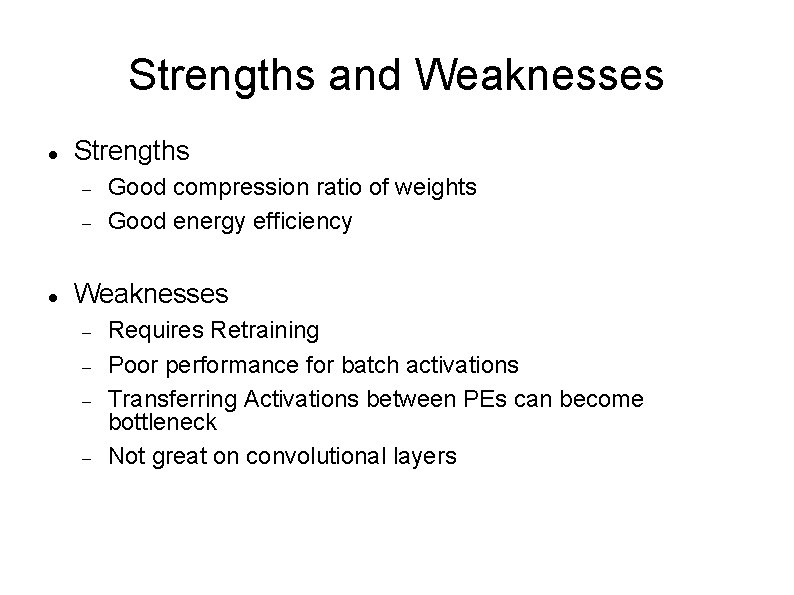
Strengths and Weaknesses Strengths Good compression ratio of weights Good energy efficiency Weaknesses Requires Retraining Poor performance for batch activations Transferring Activations between PEs can become bottleneck Not great on convolutional layers