
EIC Plan at HIAF Xurong Chen The Institute


- Slides: 35
EIC Plan at HIAF Xurong Chen The Institute of Modern Physics (IMP) Chinese Academy of Sciences, China The 8 th Workshop on Hadron Physics in China and Opportunities Worldwide August 8 -11, 2016, Wuhan, China
Outline l Introduction of HIAF l EIC@HIAF Physics Nucleon spin-flavor structure (polarizd sea, Ds) 3 D structure: GPDs (DVMP) and DVCS 3 D structure: TMDs (sea, range in Q 2, PT) Meson (pion/Kaon) structure function at high-x Hadronization/EMC/SRC l Current Status and Summary 2
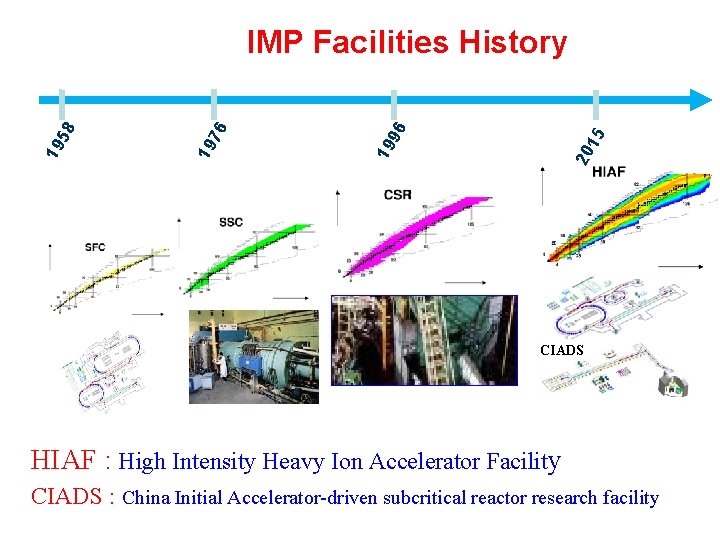
15 96 20 19 76 19 19 58 Summary IMP Facilities History CIADS HIAF : High Intensity Heavy Ion Accelerator Facility CIADS : China Initial Accelerator-driven subcritical reactor research facility
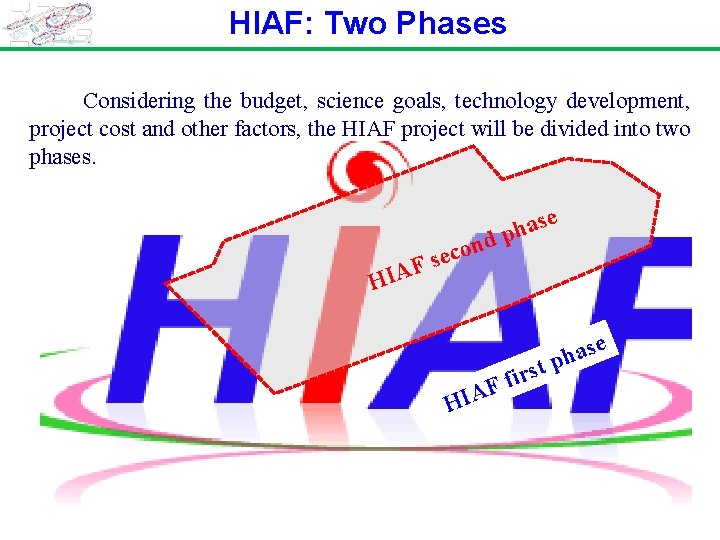
HIAF: Two Phases Considering the budget, science goals, technology development, project cost and other factors, the HIAF project will be divided into two phases. n o c e Fs se a h dp HIA e s a h tp HIA rs i f F
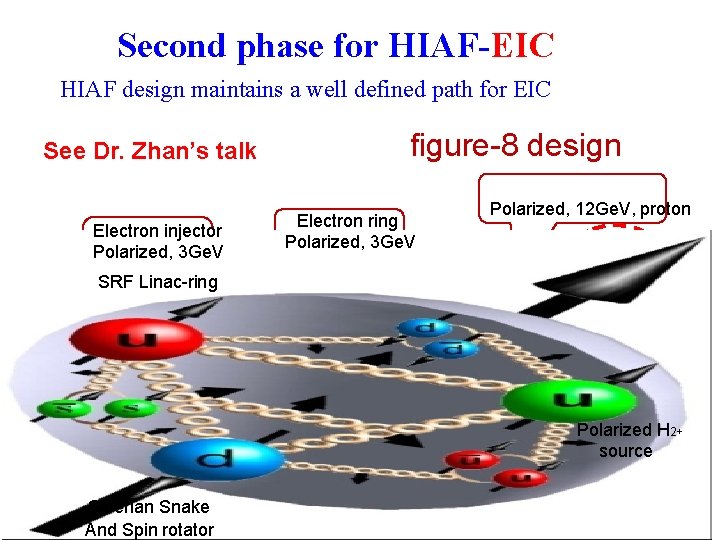
Second phase for HIAF-EIC HIAF design maintains a well defined path for EIC See Dr. Zhan’s talk Electron injector Polarized, 3 Ge. V figure-8 design Electron ring Polarized, 3 Ge. V Polarized, 12 Ge. V, proton SRF Linac-ring Polarized H 2+ source Siberian Snake And Spin rotator
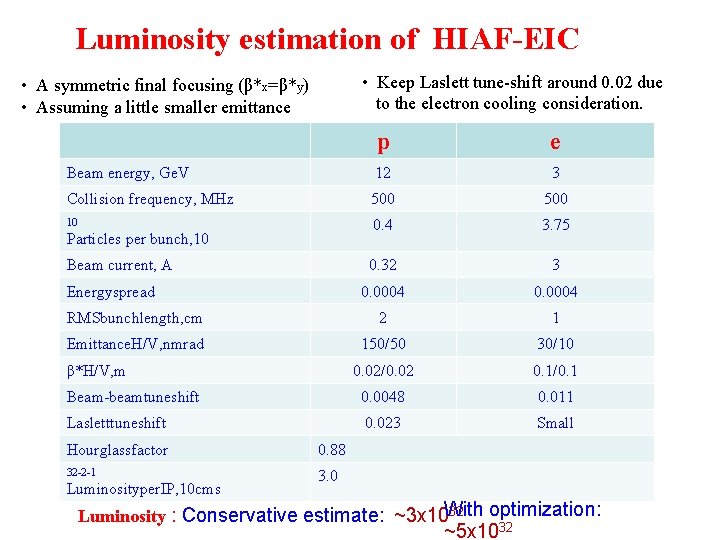
Luminosity estimation of HIAF-EIC • Keep Laslett tune-shift around 0. 02 due to the electron cooling consideration. • A symmetric final focusing (β*x=β*y) • Assuming a little smaller emittance p e Beam energy, Ge. V 12 3 Collision frequency, MHz 500 10 0. 4 3. 75 0. 32 3 0. 0004 RMSbunchlength, cm 2 1 Emittance. H/V, nmrad 150/50 30/10 0. 02/0. 02 0. 1/0. 1 Beam-beamtuneshift 0. 0048 0. 011 Lasletttuneshift 0. 023 Small Particles per bunch, 10 Beam current, A Energyspread β*H/V, m Hourglassfactor 0. 88 32 -2 -1 3. 0 Luminosityper. IP, 10 cms 32 optimization: Luminosity : Conservative estimate: ~3 x 10 With ~5 x 1032
2. EIC@HIAF Physics 7
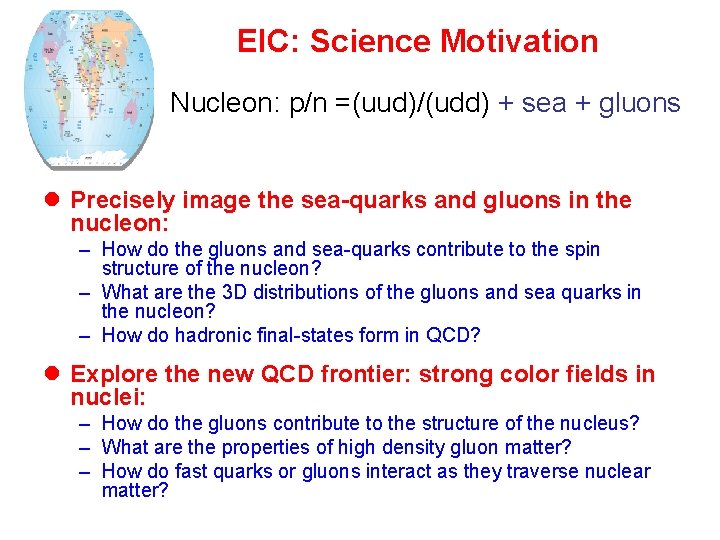
EIC: Science Motivation Nucleon: p/n =(uud)/(udd) + sea + gluons l Precisely image the sea-quarks and gluons in the nucleon: – How do the gluons and sea-quarks contribute to the spin structure of the nucleon? – What are the 3 D distributions of the gluons and sea quarks in the nucleon? – How do hadronic final-states form in QCD? l Explore the new QCD frontier: strong color fields in nuclei: – How do the gluons contribute to the structure of the nucleus? – What are the properties of high density gluon matter? – How do fast quarks or gluons interact as they traverse nuclear matter?
2015 NSAC Long Range Plan Recommendation III We recommend a high-energy high-luminosity polarized EIC as the highest priority for new facility construction following the completion of FRIB.
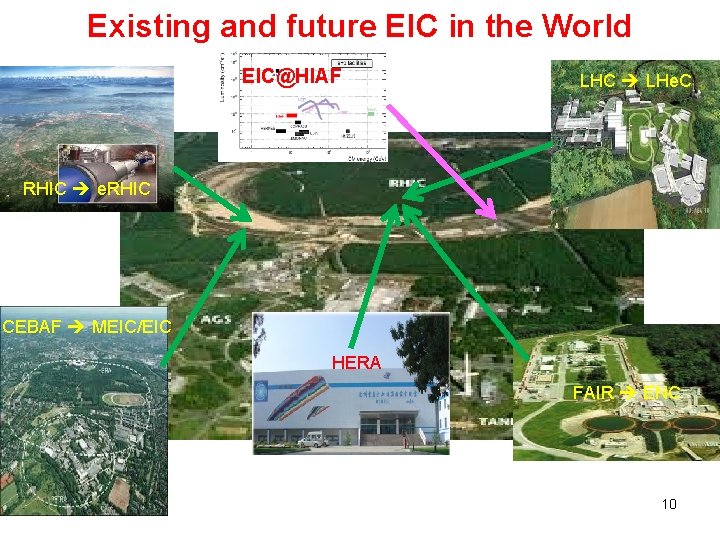
Existing and future EIC in the World EIC@HIAF LHC LHe. C RHIC e. RHIC CEBAF MEIC/EIC HERA FAIR ENC 10
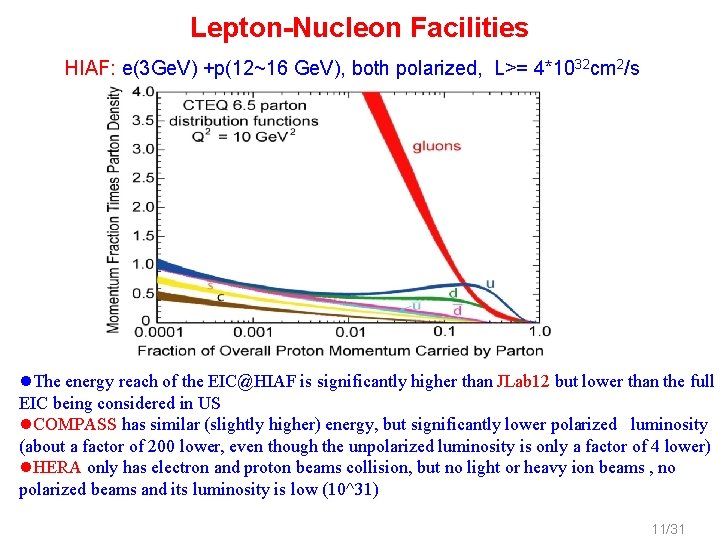
Lepton-Nucleon Facilities HIAF: e(3 Ge. V) +p(12~16 Ge. V), both polarized, L>= 4*1032 cm 2/s l. The energy reach of the EIC@HIAF is significantly higher than JLab 12 but lower than the full EIC being considered in US l. COMPASS has similar (slightly higher) energy, but significantly lower polarized luminosity (about a factor of 200 lower, even though the unpolarized luminosity is only a factor of 4 lower) l. HERA only has electron and proton beams collision, but no light or heavy ion beams , no polarized beams and its luminosity is low (10^31) 11/31
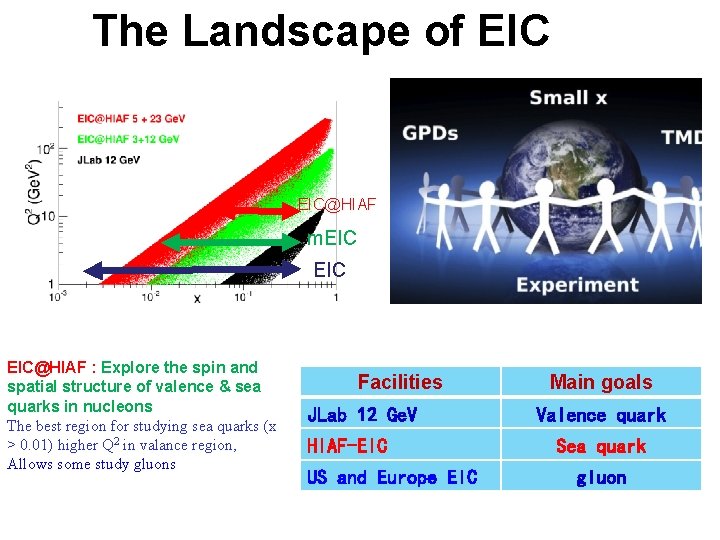
The Landscape of EIC@HIAF m. EIC EIC@HIAF : Explore the spin and spatial structure of valence & sea quarks in nucleons The best region for studying sea quarks (x > 0. 01) higher Q 2 in valance region, Allows some study gluons Facilities JLab 12 Ge. V HIAF-EIC US and Europe EIC Main goals Valence quark Sea quark gluon
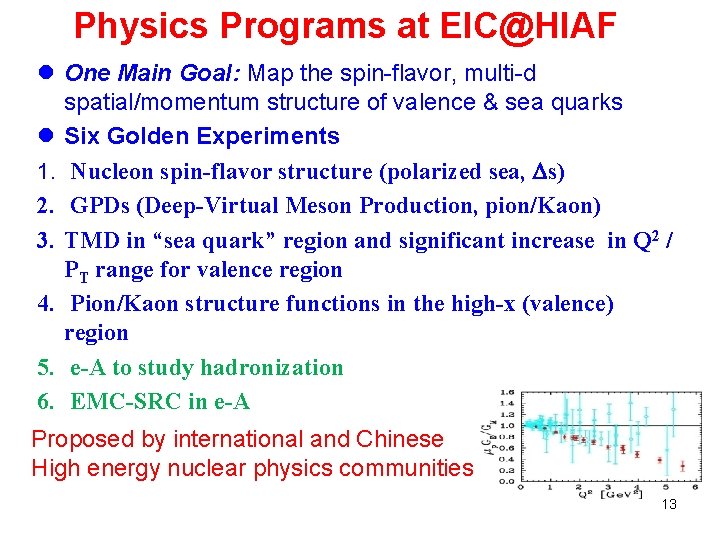
Physics Programs at EIC@HIAF l One Main Goal: Map the spin-flavor, multi-d spatial/momentum structure of valence & sea quarks l Six Golden Experiments 1. Nucleon spin-flavor structure (polarized sea, Ds) 2. GPDs (Deep-Virtual Meson Production, pion/Kaon) 3. TMD in “sea quark” region and significant increase in Q 2 / PT range for valence region 4. Pion/Kaon structure functions in the high-x (valence) region 5. e-A to study hadronization 6. EMC-SRC in e-A Proposed by international and Chinese High energy nuclear physics communities 13
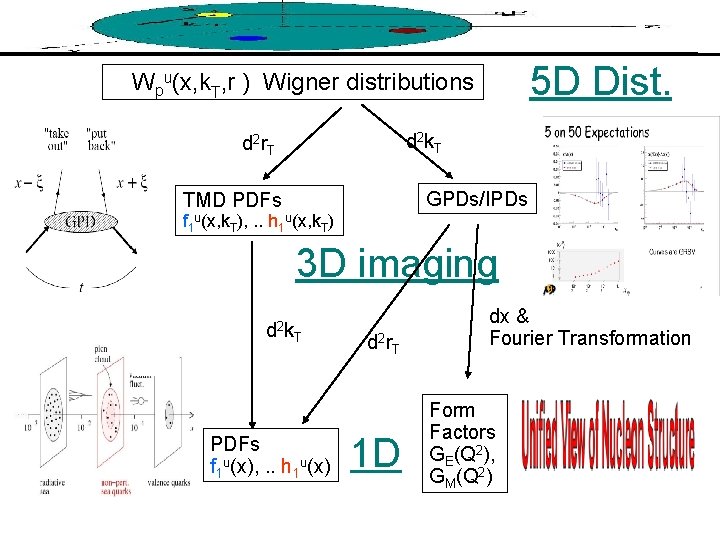
5 D Dist. Wpu(x, k. T, r ) Wigner distributions d 2 k. T d 2 r. T GPDs/IPDs TMD PDFs f 1 u(x, k. T), . . h 1 u(x, k. T) 3 D imaging d 2 k. T PDFs f 1 u(x), . . h 1 u(x) d 2 r. T 1 D dx & Fourier Transformation Form Factors GE(Q 2), GM(Q 2)
1. Spin-Flavor Study at EIC@HIAF l The parton distribution functions (PDF) have been extracted with excellent precision over a large range of x and Q 2 from DIS, Drell-Yan and other processes after several decades of experimental and theoretical efforts l Understanding the spin structure of the nucleon in terms of constituent partons, i. e. quarks and gluons, has been and still is an essential task of subatomic physics l The electron ion collider(EIC) will provide unique opportunities to study the inner structure of the nucleon, especially the polarized distribution functions of sea quarks
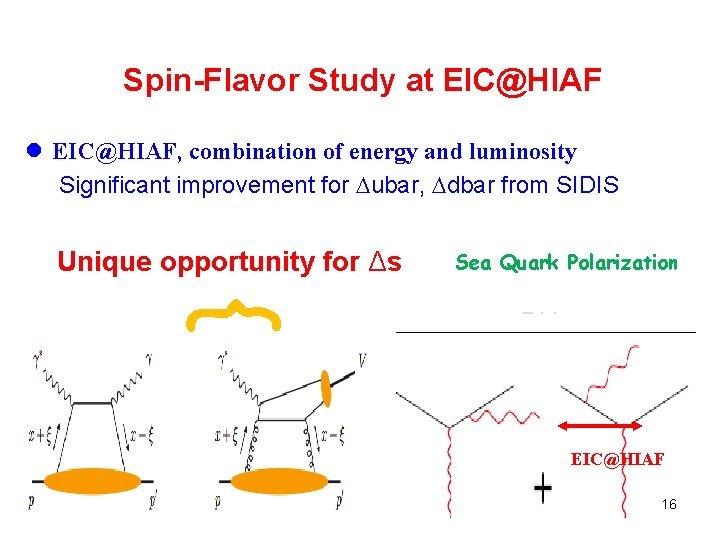
Spin-Flavor Study at EIC@HIAF l EIC@HIAF, combination of energy and luminosity Significant improvement for Dubar, Ddbar from SIDIS Sea Quark Polarization } Unique opportunity for Δs EIC@HIAF 16
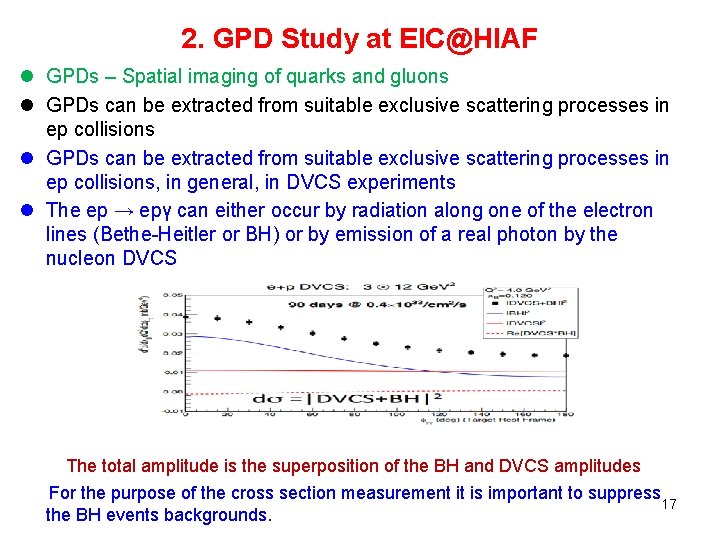
2. GPD Study at EIC@HIAF l GPDs – Spatial imaging of quarks and gluons l GPDs can be extracted from suitable exclusive scattering processes in ep collisions, in general, in DVCS experiments l The ep → epγ can either occur by radiation along one of the electron lines (Bethe-Heitler or BH) or by emission of a real photon by the nucleon DVCS The total amplitude is the superposition of the BH and DVCS amplitudes For the purpose of the cross section measurement it is important to suppress 17 the BH events backgrounds.
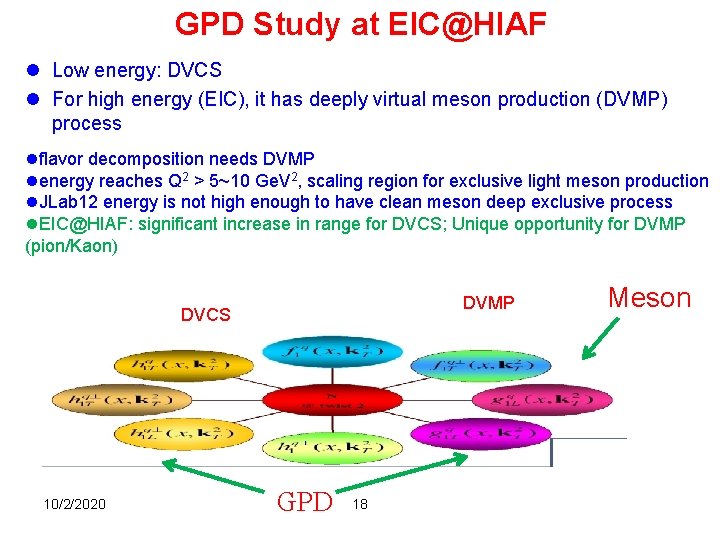
GPD Study at EIC@HIAF l Low energy: DVCS l For high energy (EIC), it has deeply virtual meson production (DVMP) process lflavor decomposition needs DVMP lenergy reaches Q 2 > 5~10 Ge. V 2, scaling region for exclusive light meson production l. JLab 12 energy is not high enough to have clean meson deep exclusive process l. EIC@HIAF: significant increase in range for DVCS; Unique opportunity for DVMP (pion/Kaon) DVMP DVCS 10/2/2020 GPD 18 Meson
GPD Simulation l we mainly use the software MILOU as Monte Carlo generator l MILOU simulates both the DVCS and the BH processes together with their interference term l The BH process is calculable in QED. This allows one to extract the complex phase of the Compton scattering amplitude, which in turn gives more detailed information about GPDs l Further information about the phase of the Compton amplitude can be extracted if both e- and e+ beams are available (even if the latter are unpolarized) l In the absence of a positron beam, some of this information may be obtained by running at different beam energies (using a Rosenbluth-type separation of different contributions to the cross-section) 19
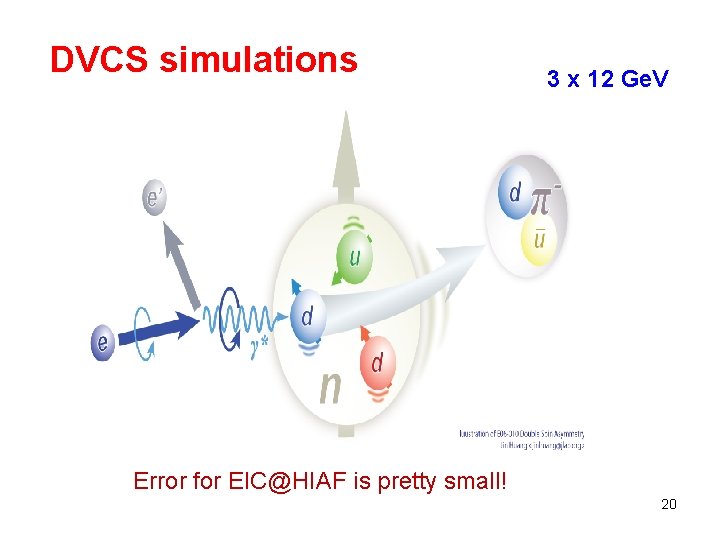
DVCS simulations 3 x 12 Ge. V Error for EIC@HIAF is pretty small! 20
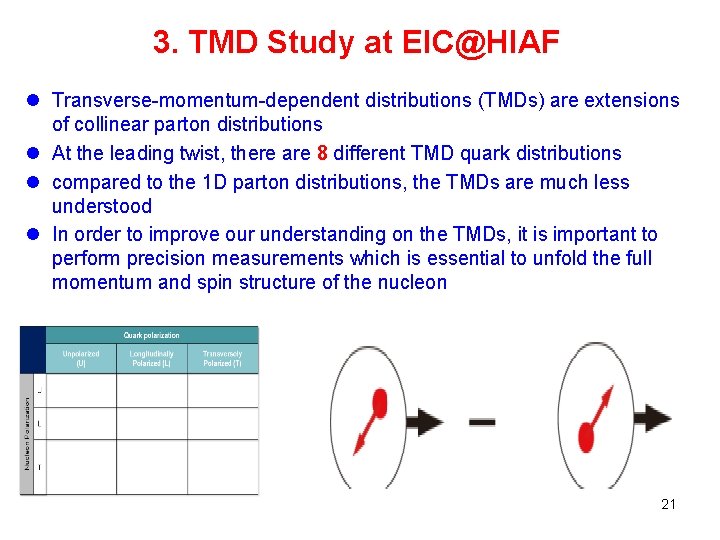
3. TMD Study at EIC@HIAF l Transverse-momentum-dependent distributions (TMDs) are extensions of collinear parton distributions l At the leading twist, there are 8 different TMD quark distributions l compared to the 1 D parton distributions, the TMDs are much less understood l In order to improve our understanding on the TMDs, it is important to perform precision measurements which is essential to unfold the full momentum and spin structure of the nucleon 21
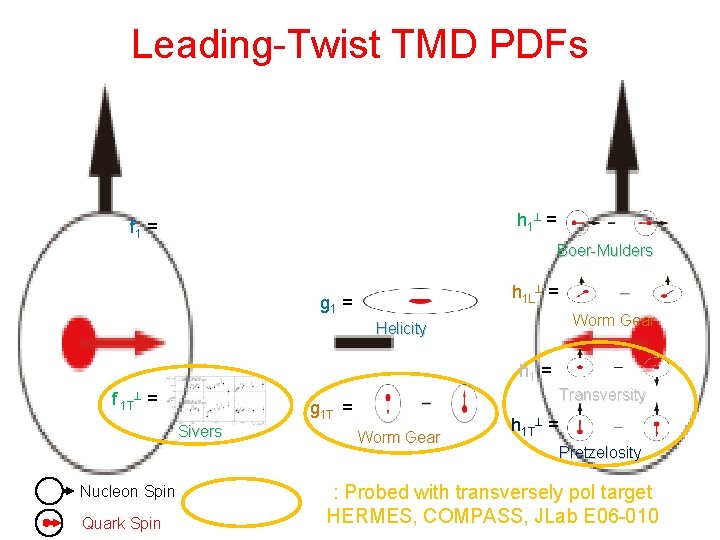
Leading-Twist TMD PDFs h 1 = f 1 = Boer-Mulders h 1 L = g 1 = Worm Gear Helicity h 1 = f 1 T = Sivers Nucleon Spin Quark Spin Transversity g 1 T = Worm Gear h 1 T = Pretzelosity : Probed with transversely pol target HERMES, COMPASS, JLab E 06 -010
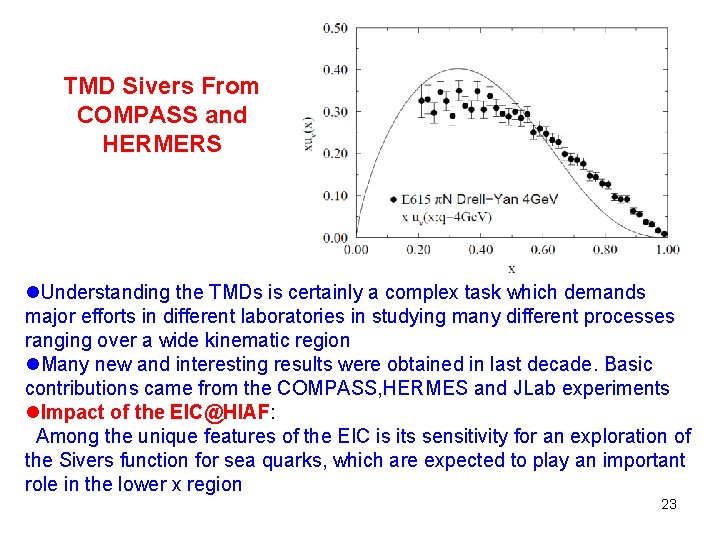
TMD Sivers From COMPASS and HERMERS l. Understanding the TMDs is certainly a complex task which demands major efforts in different laboratories in studying many different processes ranging over a wide kinematic region l. Many new and interesting results were obtained in last decade. Basic contributions came from the COMPASS, HERMES and JLab experiments l. Impact of the EIC@HIAF: Among the unique features of the EIC is its sensitivity for an exploration of the Sivers function for sea quarks, which are expected to play an important role in the lower x region 23
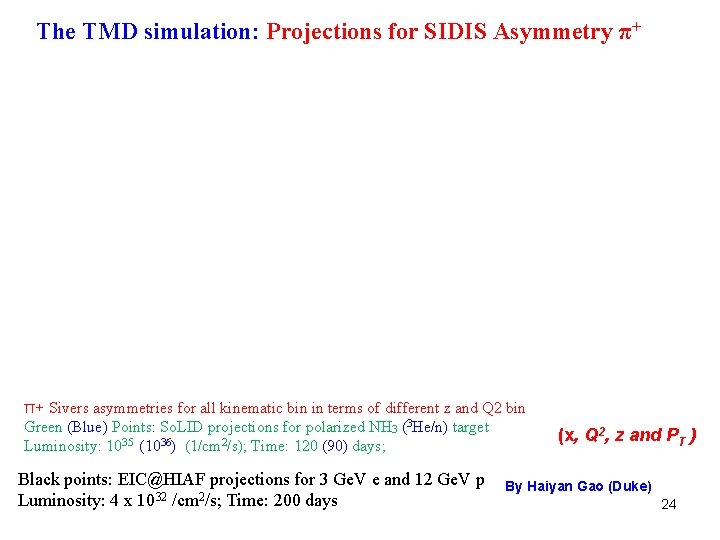
The TMD simulation: Projections for SIDIS Asymmetry π+ π+ Sivers asymmetries for all kinematic bin in terms of different z and Q 2 bin Green (Blue) Points: So. LID projections for polarized NH 3 (3 He/n) target Luminosity: 1035 (1036) (1/cm 2/s); Time: 120 (90) days; Black points: EIC@HIAF projections for 3 Ge. V e and 12 Ge. V p Luminosity: 4 x 1032 /cm 2/s; Time: 200 days (x, Q 2, z and PT ) By Haiyan Gao (Duke) 24
l The EIC@HIAF experiment will provide SSA data with excellent statistical and systematic precisions in 4 D (x, z, PT, and Q 2) over a large kinematic range l Both JLab 12 and EIC can help to map out the TMD in greater details l These data will significantly advance our understanding of TMDs and QCD 25
4. p/K Parton Distribution Function in Valence Quark Region l The parton distributions of the nucleons are now well determined, however, much less is known about the PDFs of other hadrons l The p, being the lightest meson, is particularly interesting not only because of its importance in chiral perturbation theory, but also because of its importance in explaining the quark sea in the nucleon and the nuclear force in nuclei l Pionic sea and gluon densities remains unconstrained in experiment l Theories: Ø Dyson-Schwinger equations Ø Nambu-Jona-Lasinio model Ø Constituent quark model Ø Lattice QCD (lower moments) Ø Instanton model Ø perturbative QCD prediction Ø …… 26 l Experiments: Drell-Yan processes: NA 3, NA 10, E 615
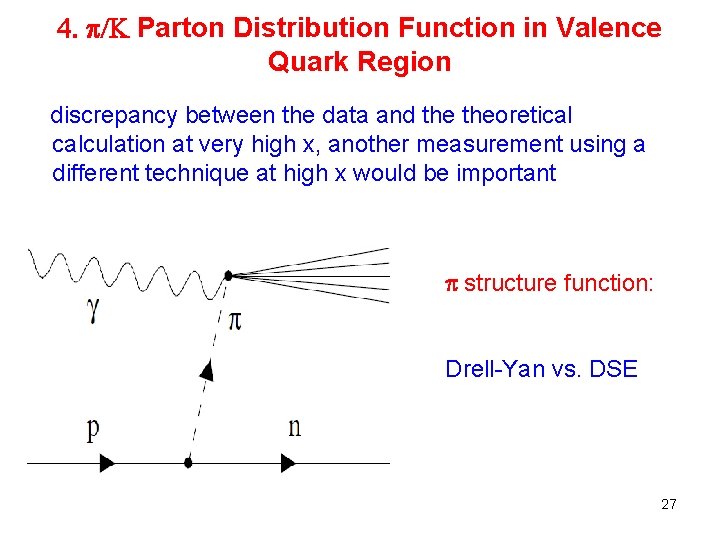
4. p/K Parton Distribution Function in Valence Quark Region discrepancy between the data and theoretical calculation at very high x, another measurement using a different technique at high x would be important p structure function: Drell-Yan vs. DSE 27
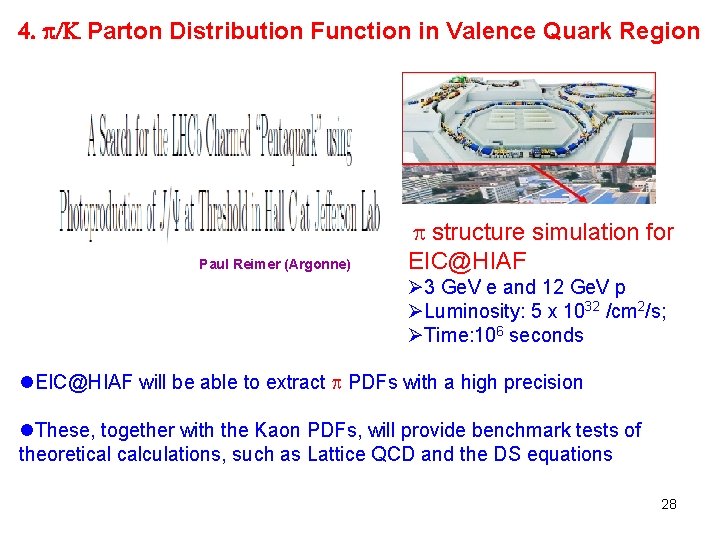
4. p/K Parton Distribution Function in Valence Quark Region Paul Reimer (Argonne) p structure simulation for EIC@HIAF Ø 3 Ge. V e and 12 Ge. V p ØLuminosity: 5 x 1032 /cm 2/s; ØTime: 106 seconds l. EIC@HIAF will be able to extract p PDFs with a high precision l. These, together with the Kaon PDFs, will provide benchmark tests of theoretical calculations, such as Lattice QCD and the DS equations 28
Hadron Physics for EIC@HIAF? l The systematics of the hadron excitation spectrum is important to our understanding of the effective degree of freedom underlying nucleon matter l The e+e- machine, such as Belle, Ba. Bar and BES, search for new states charmonium states: X, Y and Z particles l The JLab 12 Glue. X searches for gluon excitation, as well as Search for new hadron states l The EIC@HIAF, as ep machine, higher CM energy than Jlab 12 Ge. V Upgrade, should have some advantages l the potential of discovery of hidden charm baryon resonances via photoproduction was discussed in 2014 (Yin Huang, Jun He, Hong-Fei Zhang, and Xu -Rong Chen. Discovery potential of hidden charm baryon resonances via photoproduction. J. Phys. , G 41(11): 115004, 2014 )
3. Current Status and Summary 30
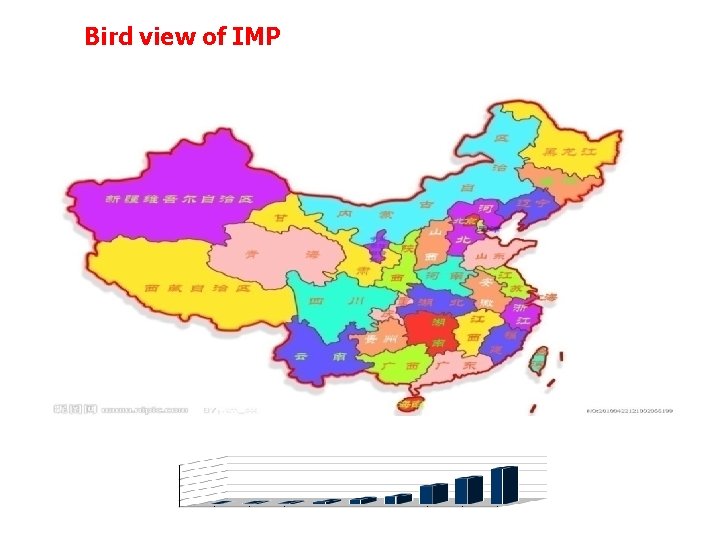
Bird view of IMP
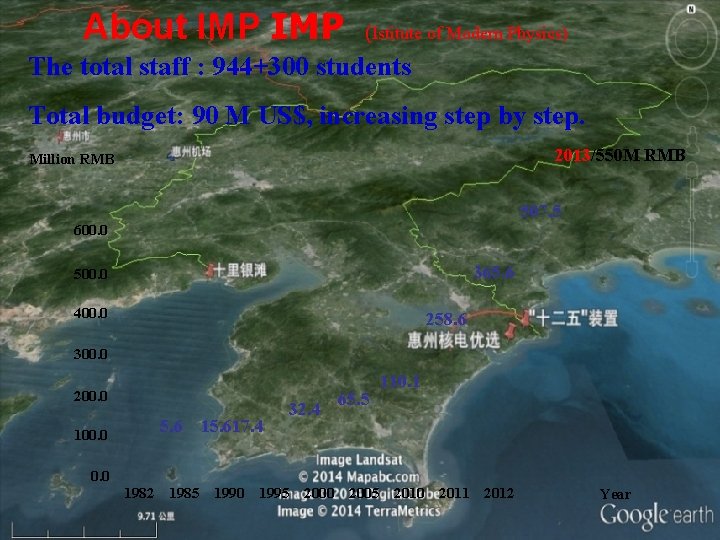
About IMP (Istitute of Modern Physics) The total staff : 944+300 students Total budget: 90 M US$, increasing step by step. 2013/550 M RMB Million RMB 507. 5 600. 0 365. 6 500. 0 400. 0 258. 6 300. 0 200. 0 100. 0 5. 6 15. 617. 4 32. 4 65. 5 110. 1 0. 0 1982 1985 1990 1995 2000 2005 2010 2011 2012 Year
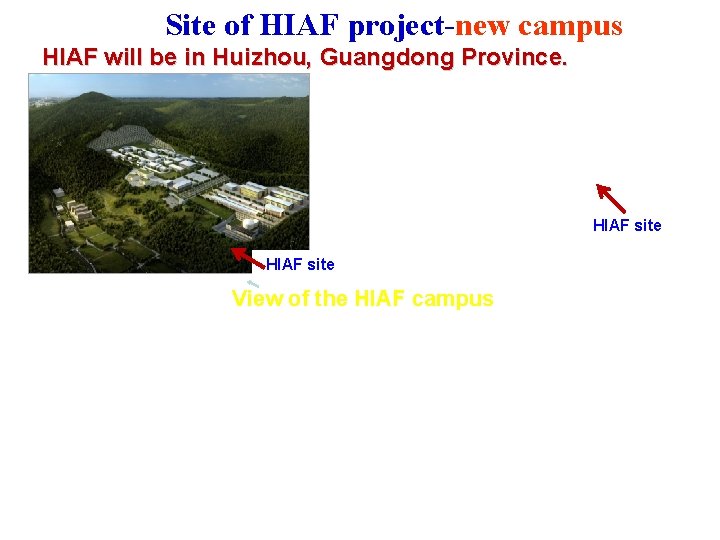
Site of HIAF project-new campus HIAF will be in Huizhou, Guangdong Province. HIAF site View of the HIAF campus
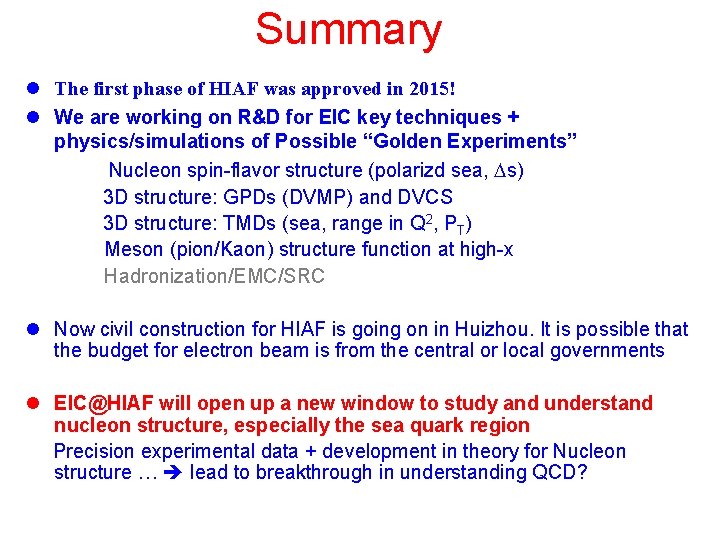
Summary l The first phase of HIAF was approved in 2015! l We are working on R&D for EIC key techniques + physics/simulations of Possible “Golden Experiments” Nucleon spin-flavor structure (polarizd sea, Ds) 3 D structure: GPDs (DVMP) and DVCS 3 D structure: TMDs (sea, range in Q 2, PT) Meson (pion/Kaon) structure function at high-x Hadronization/EMC/SRC l Now civil construction for HIAF is going on in Huizhou. It is possible that the budget for electron beam is from the central or local governments l EIC@HIAF will open up a new window to study and understand nucleon structure, especially the sea quark region Precision experimental data + development in theory for Nucleon structure … lead to breakthrough in understanding QCD?
Thanks for your attention!