
EIC Accelerator Overview Ferdinand Willeke BNL EICUG Annual
EIC Accelerator Overview Ferdinand Willeke, BNL EICUG Annual Meeting, Paris 2019
Outline • • Requirements Design concepts Luminosity Polarization Hadron Cooling Beam Dynamics Consideration R&D Summary 2
Electron Ion Collider (EIC) Physics Questions Nuclear Physics Community compiled an EIC WHITE PAPER*) (2014/5): • How are quarks, gluons & their spins distributed in space & momentum in nucleus? • How do nucleon properties emerge from quarks and gluons and their interactions? • How do color-charged quarks, gluons & colorless jets, interact with a nuclear medium • How do confined hadronic states emerge from quarks & gluons • How do the quark-gluon interactions create nuclear binding? • How does dense nuclear environment affect the quarks-gluons correlations & interactions? • Does gluon density in nuclei saturate @ high energy result in gluonic matter with universal properties? *) A. Accardi et al, Eur. Phys. J. A 529: 268 (2016) 3
Requirements on EIC Performance The EIC is designed to meet the requirements set forth in NSAC Long Range Plan, which was emphasized by the NAS report: • Highly polarized (~70%) electron and nucleon beams • Ion beams from deuterons to the heaviest nuclei (uranium or lead) • Variable center of mass energies from ~20 - ~100 Ge. V, upgradable to ~140 Ge. V • High collision luminosity ~1033 – 1034 cm-2 s-1 • Possibilities of having more than one interaction region 4
There are two proposals: • JLEIC to be constructed at Jefferson Lab • e. RHIC to be constructed at Brookhaven National Lab Both design benefit from existing Nuclear Physics infrastructure and are based on the same accelerator principles: • Electron Storage Rings with frequent injection of fresh polarized beams • Hadron storage rings with strong cooling or alternatively frequent injections 5
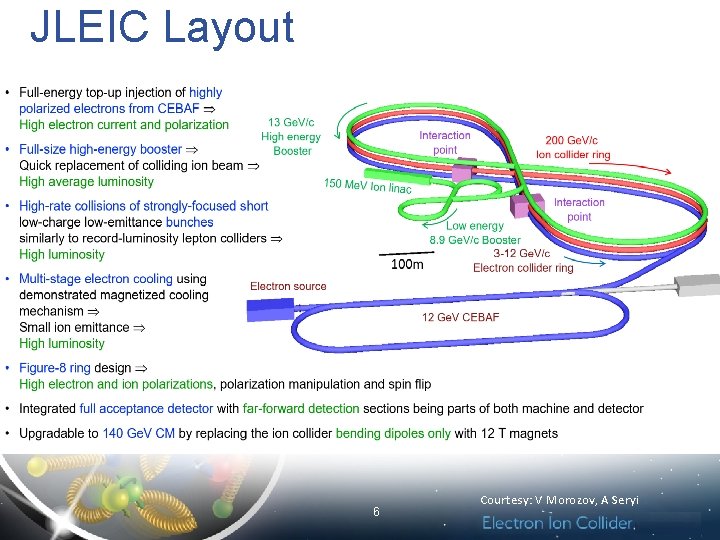
JLEIC Layout 6 Courtesy: V Morozov, A Seryi
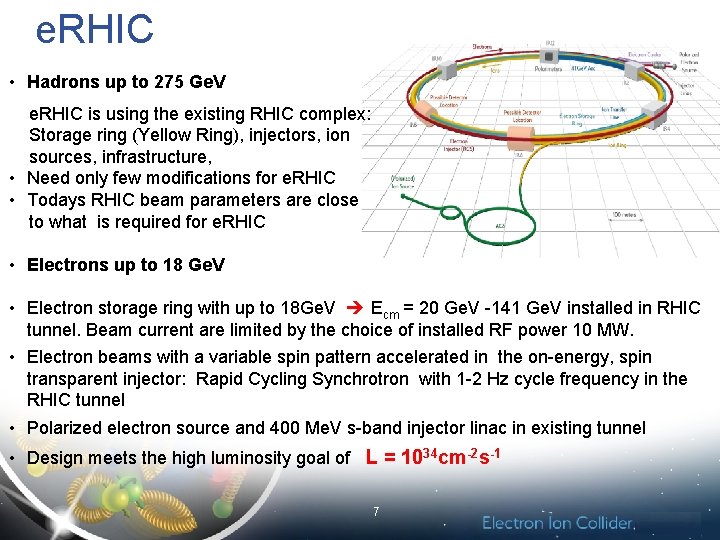
e. RHIC • Hadrons up to 275 Ge. V e. RHIC is using the existing RHIC complex: Storage ring (Yellow Ring), injectors, ion sources, infrastructure, • Need only few modifications for e. RHIC • Todays RHIC beam parameters are close to what is required for e. RHIC • Electrons up to 18 Ge. V • Electron storage ring with up to 18 Ge. V Ecm = 20 Ge. V -141 Ge. V installed in RHIC tunnel. Beam current are limited by the choice of installed RF power 10 MW. • Electron beams with a variable spin pattern accelerated in the on-energy, spin transparent injector: Rapid Cycling Synchrotron with 1 -2 Hz cycle frequency in the RHIC tunnel • Polarized electron source and 400 Me. V s-band injector linac in existing tunnel • Design meets the high luminosity goal of L = 1034 cm-2 s-1 7

Key EIC Machine Parameters as required by the NSAC LRP & NAS 80%-85%f) a) upgradable to 140 Ge. V 8 80% b) c)
High Luminosity Implementation As both designs, JLEIC and e. RHIC are storage ring designs, the same ingredients are required for large luminosity • Large bunch charge • Many bunches large total beam currents crossing angle collision geometry • Small beam size at collision point achieved by * small emittance Small hadron emittance requires strong hadron cooling (or frequent injection) * and strong focusing at IR (small b) required short bunches need strong cooling Beam-Beam Limit: Transverse beam density at collision point limited by the detrimental effect of the corresponding nonlinear lens 9
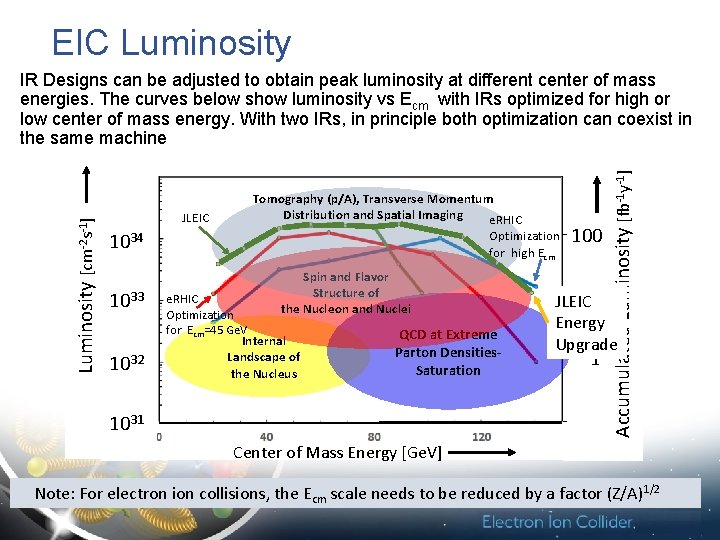
EIC Luminosity Tomography (p/A), Transverse Momentum Distribution and Spatial Imaging e. RHIC JLEIC Optimization - 100 for high Ecm 1034 1033 1032 e. RHIC Optimization for Ecm=45 Ge. V Spin and Flavor Structure of the Nucleon and Nuclei Internal Landscape of the Nucleus QCD at Extreme Parton Densities. Saturation - 10 JLEIC Energy Upgrade - 1 - 1031 Center of Mass Energy [Ge. V] Accumulated Luminosity [fb-1 y-1] Luminosity [cm-2 s-1] IR Designs can be adjusted to obtain peak luminosity at different center of mass energies. The curves below show luminosity vs Ecm with IRs optimized for high or low center of mass energy. With two IRs, in principle both optimization can coexist in the same machine Note: For electron ion collisions, the Ecm scale needs to be reduced by a factor (Z/A)1/2
Strong Hadron Cooling and High Luminosity For high luminosity operation of the EIC strong hadron cooling is desirable if not necessary to avoid rapid decay of the luminosity caused by emittance blow-up due to intrabeam scattering The two proposals operate at different ranges of hadron energy and the cooling systems are optimized accordingly. • JLEIC uses a multi-turn magnetized bunched electron beam cooling ring fed by an energy recovery linac to balance IBS growth time between 15 and 40 minutes. This cooling increases the luminosity at lower energies, however JLEIC is not relying in this cooling for reaching NSAC goals, as it can use short fills with rapid turn arounds for achieving high average luminosity quoted as 1· 1034 cm-2 s 1. • e. RHIC has only modest IBS growth rates of t>2 h for highest luminosity. It uses micro-bunched electron cooling as an option but does not rely on cooling to operate at highest luminosity as there is an on-energy for frequent injections available which results in an average luminosity which is still 90% of the peak luminosity. 11
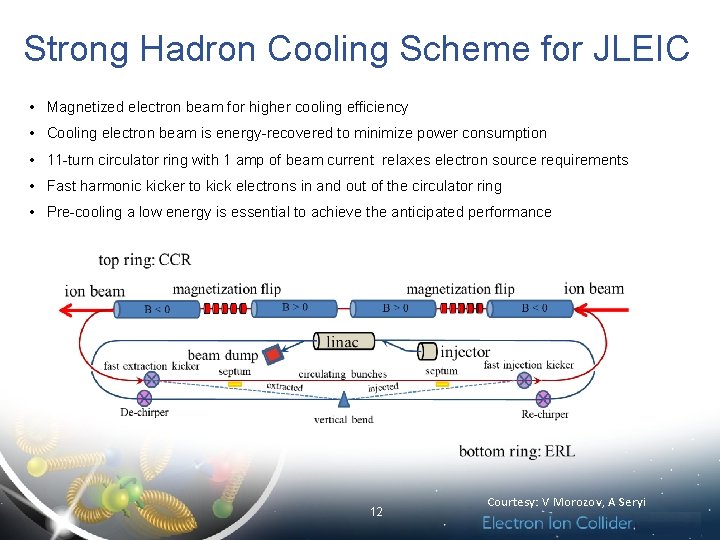
Strong Hadron Cooling Scheme for JLEIC • Magnetized electron beam for higher cooling efficiency • Cooling electron beam is energy-recovered to minimize power consumption • 11 -turn circulator ring with 1 amp of beam current relaxes electron source requirements • Fast harmonic kicker to kick electrons in and out of the circulator ring • Pre-cooling a low energy is essential to achieve the anticipated performance 12 Courtesy: V Morozov, A Seryi
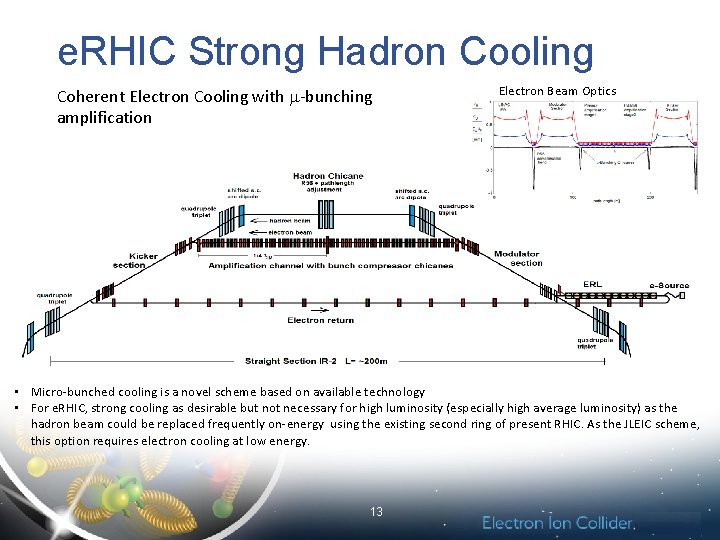
e. RHIC Strong Hadron Cooling Coherent Electron Cooling with m-bunching amplification Electron Beam Optics • Micro-bunched cooling is a novel scheme based on available technology • For e. RHIC, strong cooling as desirable but not necessary for high luminosity (especially high average luminosity) as the hadron beam could be replaced frequently on-energy using the existing second ring of present RHIC. As the JLEIC scheme, this option requires electron cooling at low energy. 13
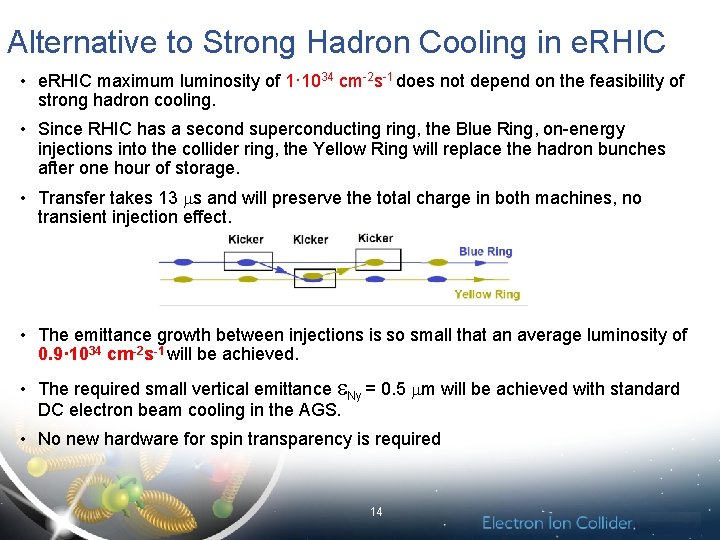
Alternative to Strong Hadron Cooling in e. RHIC • e. RHIC maximum luminosity of 1· 1034 cm-2 s-1 does not depend on the feasibility of strong hadron cooling. • Since RHIC has a second superconducting ring, the Blue Ring, on-energy injections into the collider ring, the Yellow Ring will replace the hadron bunches after one hour of storage. • Transfer takes 13 ms and will preserve the total charge in both machines, no transient injection effect. • The emittance growth between injections is so small that an average luminosity of 0. 9· 1034 cm-2 s-1 will be achieved. • The required small vertical emittance e. Ny = 0. 5 mm will be achieved with standard DC electron beam cooling in the AGS. • No new hardware for spin transparency is required 14
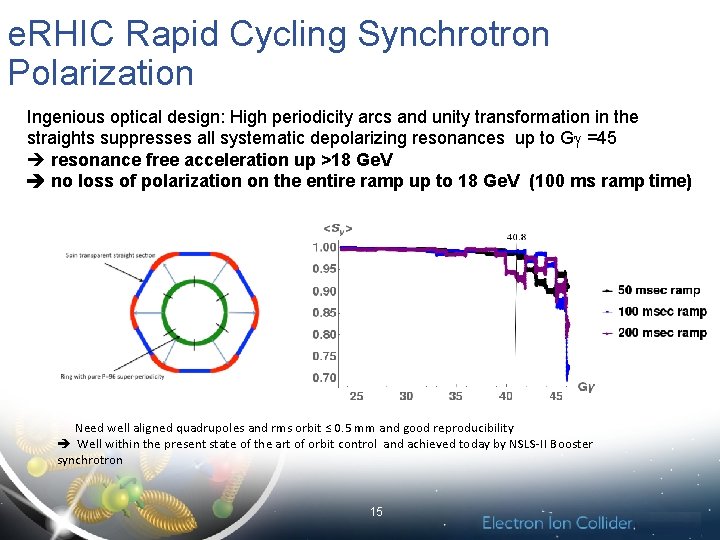
e. RHIC Rapid Cycling Synchrotron Polarization Ingenious optical design: High periodicity arcs and unity transformation in the straights suppresses all systematic depolarizing resonances up to Gg =45 resonance free acceleration up >18 Ge. V no loss of polarization on the entire ramp up to 18 Ge. V (100 ms ramp time) Need well aligned quadrupoles and rms orbit ≤ 0. 5 mm and good reproducibility Well within the present state of the art of orbit control and achieved today by NSLS-II Booster synchrotron 15
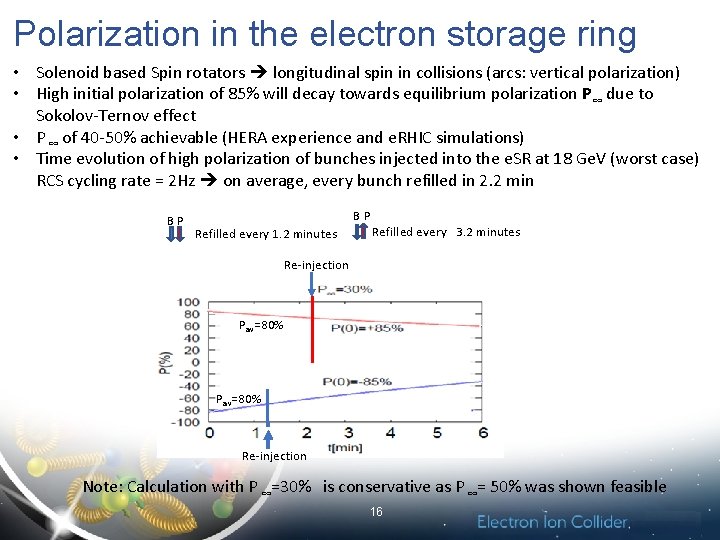
Polarization in the electron storage ring • Solenoid based Spin rotators longitudinal spin in collisions (arcs: vertical polarization) • High initial polarization of 85% will decay towards equilibrium polarization P∞ due to Sokolov-Ternov effect • P ∞ of 40 -50% achievable (HERA experience and e. RHIC simulations) • Time evolution of high polarization of bunches injected into the e. SR at 18 Ge. V (worst case) RCS cycling rate = 2 Hz on average, every bunch refilled in 2. 2 min B P Refilled every 1. 2 minutes Refilled every 3. 2 minutes Re-injection Pav=80% Re-injection Note: Calculation with P ∞=30% is conservative as P ∞= 50% was shown feasible 16
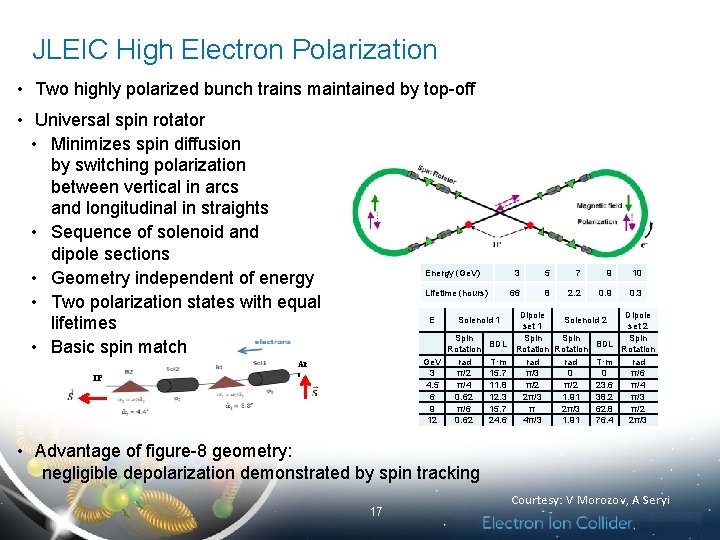
JLEIC High Electron Polarization • Two highly polarized bunch trains maintained by top-off • Universal spin rotator • Minimizes spin diffusion by switching polarization between vertical in arcs and longitudinal in straights • Sequence of solenoid and dipole sections • Geometry independent of energy • Two polarization states with equal lifetimes • Basic spin match IP Energy (Ge. V) Lifetime (hours) E Solenoid 1 Spin Rotation Ge. V rad 3 π/2 4. 5 π/4 6 0. 62 9 π/6 12 0. 62 Ar c BDL T·m 15. 7 11. 8 12. 3 15. 7 24. 6 3 5 7 9 10 66 8 2. 2 0. 9 0. 3 Dipole Solenoid 2 set 1 set 2 Spin BDL Rotation rad T·m rad π/3 0 0 π/6 π/2 23. 6 π/4 2π/3 1. 91 38. 2 π/3 π 2π/3 62. 8 π/2 4π/3 1. 91 76. 4 2π/3 • Advantage of figure-8 geometry: negligible depolarization demonstrated by spin tracking 17 Courtesy: V Morozov, A Seryi
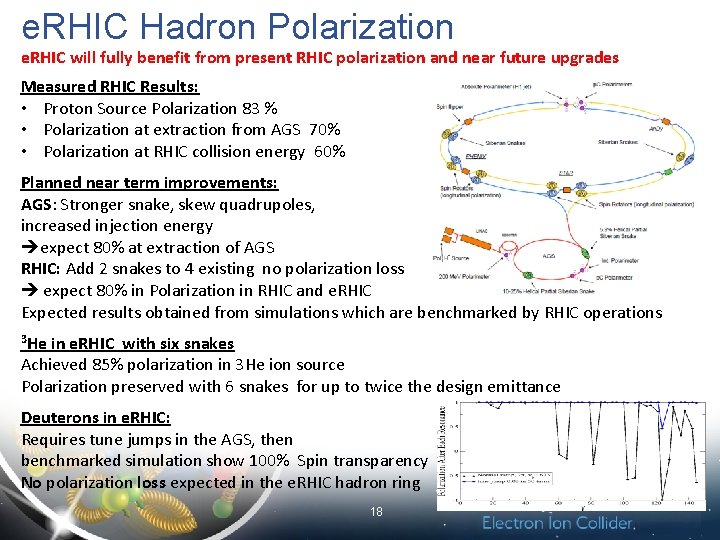
e. RHIC Hadron Polarization e. RHIC will fully benefit from present RHIC polarization and near future upgrades Measured RHIC Results: • Proton Source Polarization 83 % • Polarization at extraction from AGS 70% • Polarization at RHIC collision energy 60% Planned near term improvements: AGS: Stronger snake, skew quadrupoles, increased injection energy expect 80% at extraction of AGS RHIC: Add 2 snakes to 4 existing no polarization loss expect 80% in Polarization in RHIC and e. RHIC Expected results obtained from simulations which are benchmarked by RHIC operations 3 He in e. RHIC with six snakes Achieved 85% polarization in 3 He ion source Polarization preserved with 6 snakes for up to twice the design emittance Deuterons in e. RHIC: Requires tune jumps in the AGS, then benchmarked simulation show 100% Spin transparency No polarization loss expected in the e. RHIC hadron ring 18
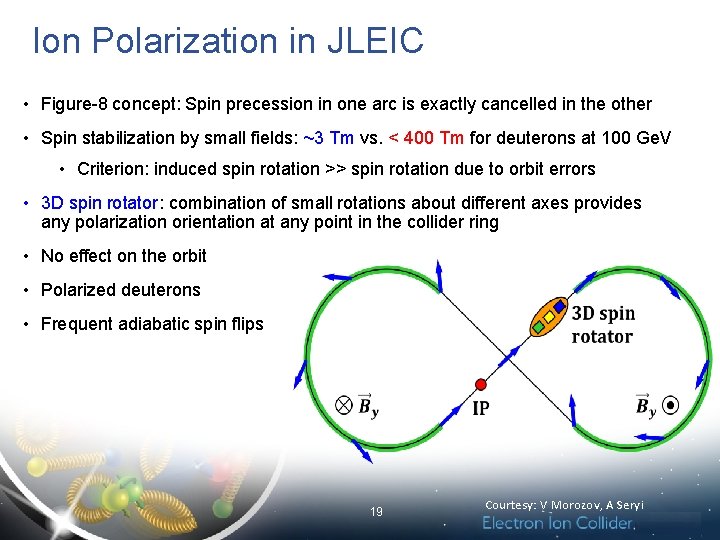
Ion Polarization in JLEIC • Figure-8 concept: Spin precession in one arc is exactly cancelled in the other • Spin stabilization by small fields: ~3 Tm vs. < 400 Tm for deuterons at 100 Ge. V • Criterion: induced spin rotation >> spin rotation due to orbit errors • 3 D spin rotator: combination of small rotations about different axes provides any polarization orientation at any point in the collider ring • No effect on the orbit • Polarized deuterons • Frequent adiabatic spin flips 19 Courtesy: V Morozov, A Seryi
Interaction Region Design The interaction regions are the most challenging part of a EIC design. • It needs to fit several essential components into a relatively small area • Such as: Strong focusing, spin rotators, crab cavities, auxiliary detectors, mask and collimators, diagnostic equipment • The accelerator components should not compromise the detector acceptance • Design has to take into account that there are beam dynamics constraints: IR chromaticity and related dynamic aperture issues, beam-beam tune shift, tight tolerances for magnet errors, residual crab cavity effects, … 20
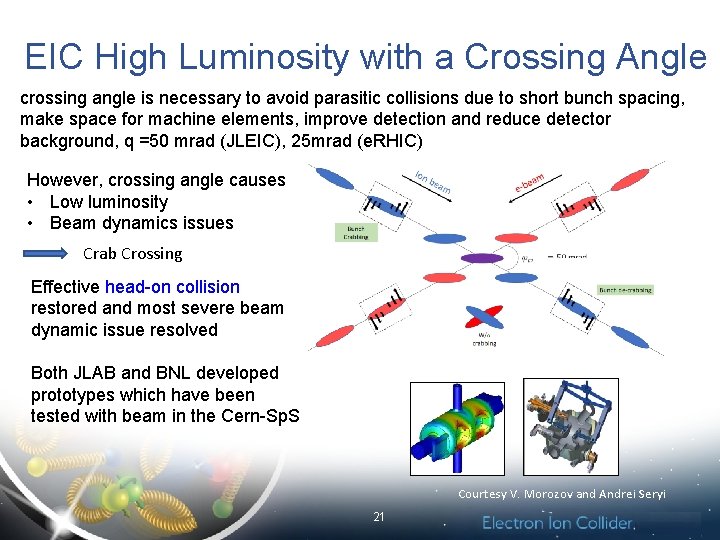
EIC High Luminosity with a Crossing Angle crossing angle is necessary to avoid parasitic collisions due to short bunch spacing, make space for machine elements, improve detection and reduce detector background, q =50 mrad (JLEIC), 25 mrad (e. RHIC) However, crossing angle causes • Low luminosity • Beam dynamics issues Crab Crossing Effective head-on collision restored and most severe beam dynamic issue resolved Both JLAB and BNL developed prototypes which have been tested with beam in the Cern-Sp. S Courtesy V. Morozov and Andrei Seryi 21
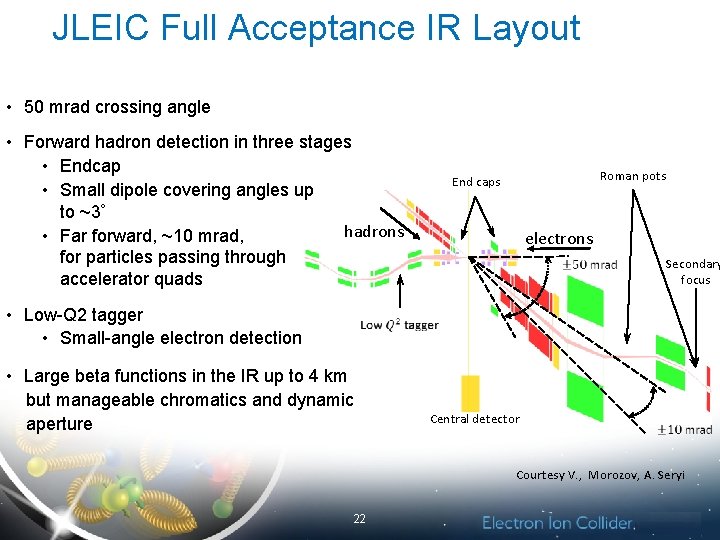
JLEIC Full Acceptance IR Layout • 50 mrad crossing angle • Forward hadron detection in three stages • Endcap • Small dipole covering angles up to ~3 hadrons • Far forward, ~10 mrad, for particles passing through accelerator quads Roman pots End caps electrons Secondary focus • Low-Q 2 tagger • Small-angle electron detection • Large beta functions in the IR up to 4 km but manageable chromatics and dynamic aperture Central detector Courtesy V. , Morozov, A. Seryi 22
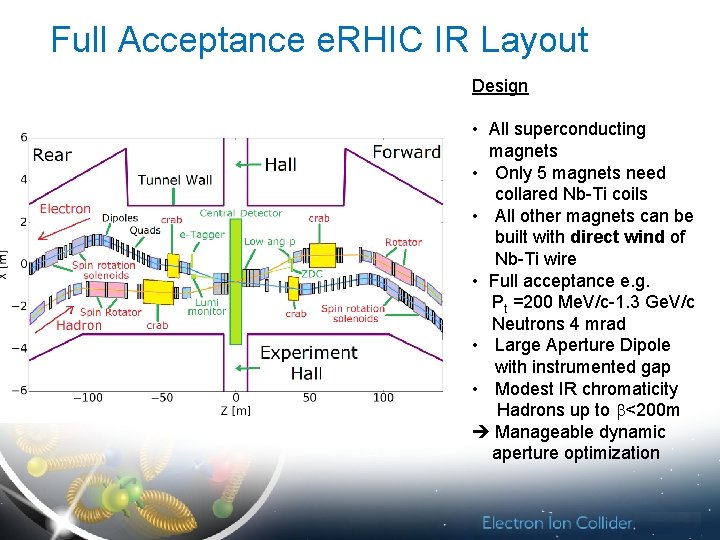
Full Acceptance e. RHIC IR Layout Design e-Tagger LUMI Mon. 23 • All superconducting magnets • Only 5 magnets need collared Nb-Ti coils • All other magnets can be built with direct wind of Nb-Ti wire • Full acceptance e. g. Pt =200 Me. V/c-1. 3 Ge. V/c Neutrons 4 mrad • Large Aperture Dipole with instrumented gap • Modest IR chromaticity Hadrons up to b<200 m Manageable dynamic aperture optimization
EIC Beam Dynamics Challenges • Proton Beam Stability (emittance growth, halo forming) in presence of strong, crab-enhanced beam-beam effects, strong chromatics • Electron cloud in the hadron vacuum, suppression of secondary emission yield • Fast Ion instability for the electron beam • Multi-bunch stability and feedback: Feedback noise and hadron emittance growth • Impedance optimization in the IR • Dynamic aperture with extreme beta in the IR 24
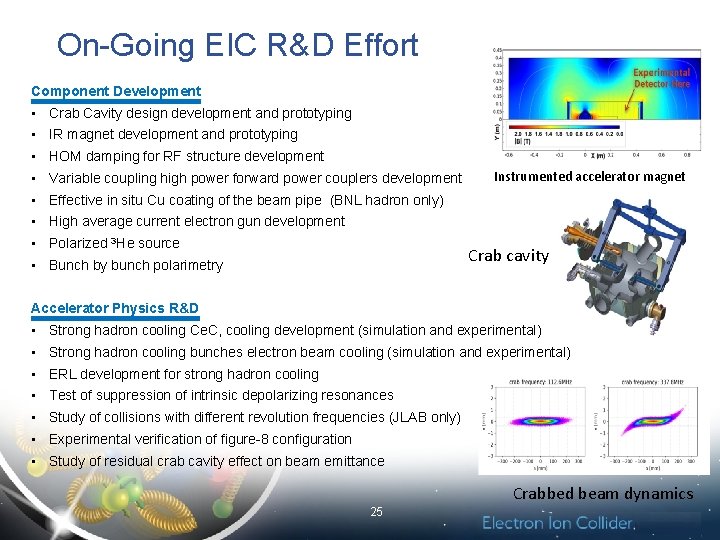
On-Going EIC R&D Effort Component Development • Crab Cavity design development and prototyping • IR magnet development and prototyping • HOM damping for RF structure development • Variable coupling high power forward power couplers development Instrumented accelerator magnet • Effective in situ Cu coating of the beam pipe (BNL hadron only) • High average current electron gun development • Polarized 3 He source Crab cavity • Bunch by bunch polarimetry Accelerator Physics R&D • Strong hadron cooling Ce. C, cooling development (simulation and experimental) • Strong hadron cooling bunches electron beam cooling (simulation and experimental) • ERL development for strong hadron cooling • Test of suppression of intrinsic depolarizing resonances • Study of collisions with different revolution frequencies (JLAB only) • Experimental verification of figure-8 configuration • Study of residual crab cavity effect on beam emittance Crabbed beam dynamics 25
Conclusion • Designs of EIC made significant progress since the last EICUG meeting • There is good collaboration on accelerator physics and accelerator R&D between accelerator laboratories • The two designs rely for the most part on established accelerator technology • Crab cavity, IR magnets, and ERL are close to state of the art strong hadron cooling is beyond, but is well mitigated • BNL and JLab are committed to working together and with the community to advance the EIC. • We welcome further collaboration with our European colleagues 26
- Slides: 26