
EIC 2019 Capacitive Transfer Cable and Its Performance
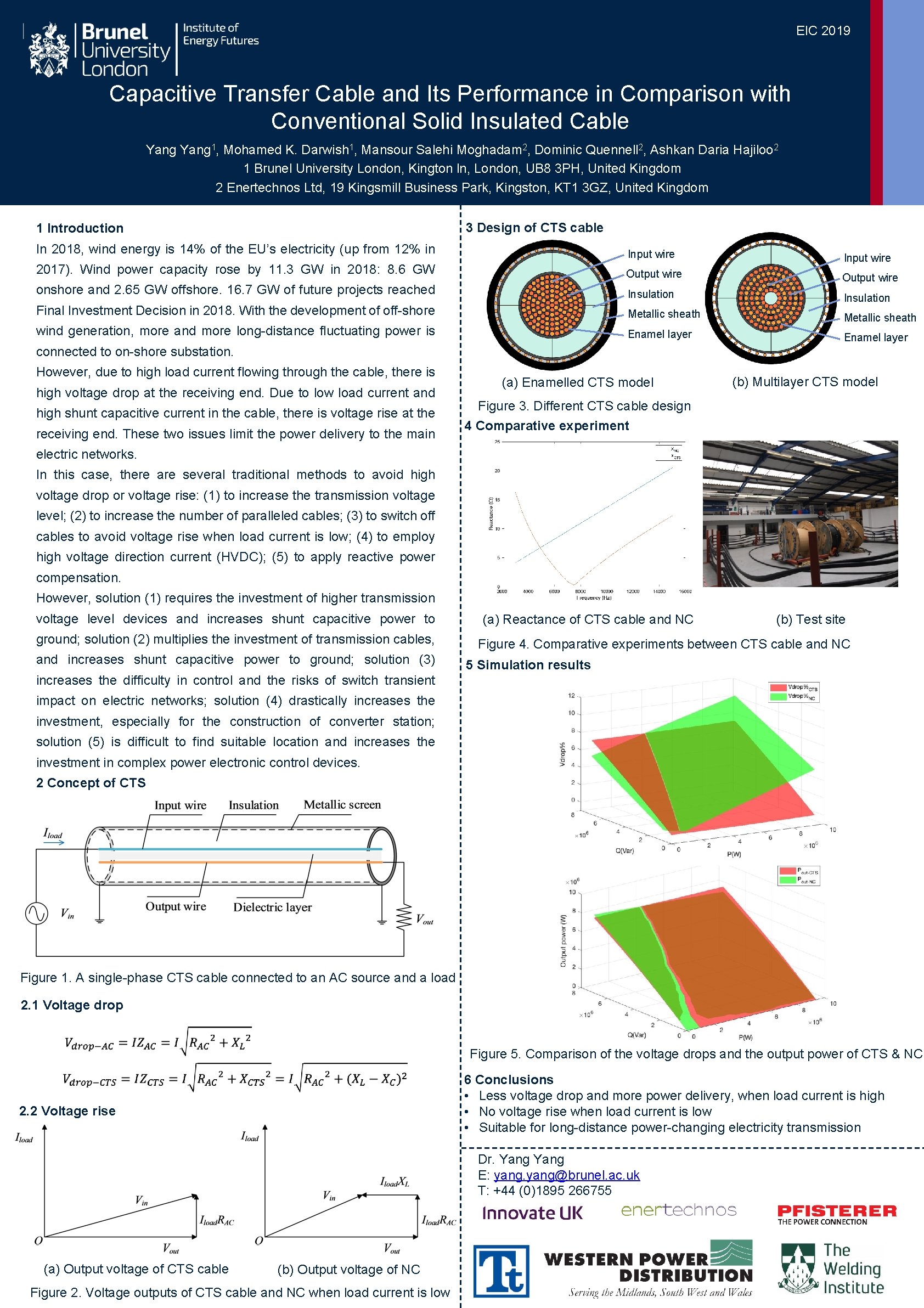
EIC 2019 Capacitive Transfer Cable and Its Performance in Comparison with Conventional Solid Insulated Cable Yang 1, Mohamed K. Darwish 1, Mansour Salehi Moghadam 2, Dominic Quennell 2, Ashkan Daria Hajiloo 2 1 Brunel University London, Kington ln, London, UB 8 3 PH, United Kingdom 2 Enertechnos Ltd, 19 Kingsmill Business Park, Kingston, KT 1 3 GZ, United Kingdom 3 Design of CTS cable 1 Introduction In 2018, wind energy is 14% of the EU’s electricity (up from 12% in Input wire 2017). Wind power capacity rose by 11. 3 GW in 2018: 8. 6 GW Input wire Output wire onshore and 2. 65 GW offshore. 16. 7 GW of future projects reached Output wire Insulation Final Investment Decision in 2018. With the development of off-shore Insulation Metallic sheath wind generation, more and more long-distance fluctuating power is Metallic sheath Enamel layer connected to on-shore substation. However, due to high load current flowing through the cable, there is high voltage drop at the receiving end. Due to low load current and high shunt capacitive current in the cable, there is voltage rise at the receiving end. These two issues limit the power delivery to the main (a) Enamelled CTS model (b) Multilayer CTS model Figure 3. Different CTS cable design 4 Comparative experiment electric networks. In this case, there are several traditional methods to avoid high voltage drop or voltage rise: (1) to increase the transmission voltage level; (2) to increase the number of paralleled cables; (3) to switch off cables to avoid voltage rise when load current is low; (4) to employ high voltage direction current (HVDC); (5) to apply reactive power compensation. However, solution (1) requires the investment of higher transmission voltage level devices and increases shunt capacitive power to ground; solution (2) multiplies the investment of transmission cables, and increases shunt capacitive power to ground; solution (3) (a) Reactance of CTS cable and NC (b) Test site Figure 4. Comparative experiments between CTS cable and NC 5 Simulation results increases the difficulty in control and the risks of switch transient impact on electric networks; solution (4) drastically increases the investment, especially for the construction of converter station; solution (5) is difficult to find suitable location and increases the investment in complex power electronic control devices. 2 Concept of CTS Figure 1. A single-phase CTS cable connected to an AC source and a load 2. 1 Voltage drop Figure 5. Comparison of the voltage drops and the output power of CTS & NC 6 Conclusions • Less voltage drop and more power delivery, when load current is high • No voltage rise when load current is low • Suitable for long-distance power-changing electricity transmission 2. 2 Voltage rise Dr. Yang E: yang@brunel. ac. uk T: +44 (0)1895 266755 (a) Output voltage of CTS cable (b) Output voltage of NC Figure 2. Voltage outputs of CTS cable and NC when load current is low
- Slides: 1