
EIA Framework Guidance on Entry Points for Incorporating

- Slides: 29
EIA Framework: Guidance on Entry Points for Incorporating Ecosystem Services Approach into Assessment Framework Asha Rajvanshi ar@wii. gov. in Professor and Head, EIA Cell, Wildlife Institute of India, Dehradun Pre-meeting training course IAIA ’ 11 Puebla, Mexico
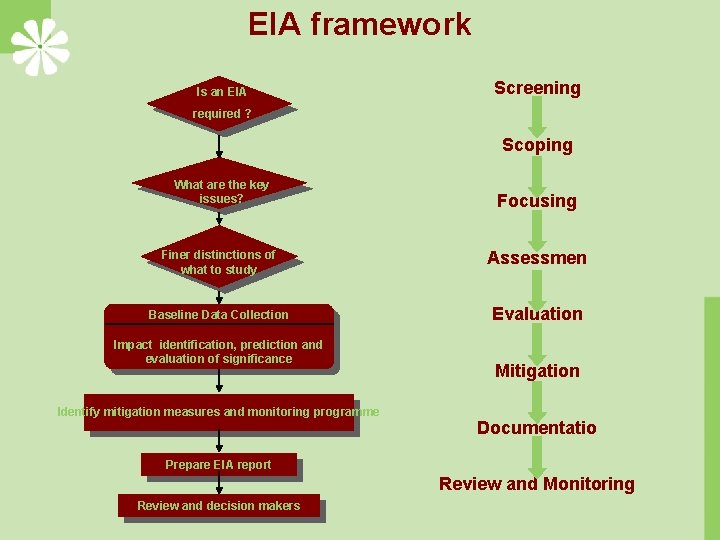
EIA framework Is an EIA Screening required ? Scoping What are the key issues? Focusing Finer distinctions of what to study Assessmen t Baseline Data Collection Evaluation Impact identification, prediction and evaluation of significance Identify mitigation measures and monitoring programme Prepare EIA report Mitigation Documentatio n Review and Monitoring Review and decision makers
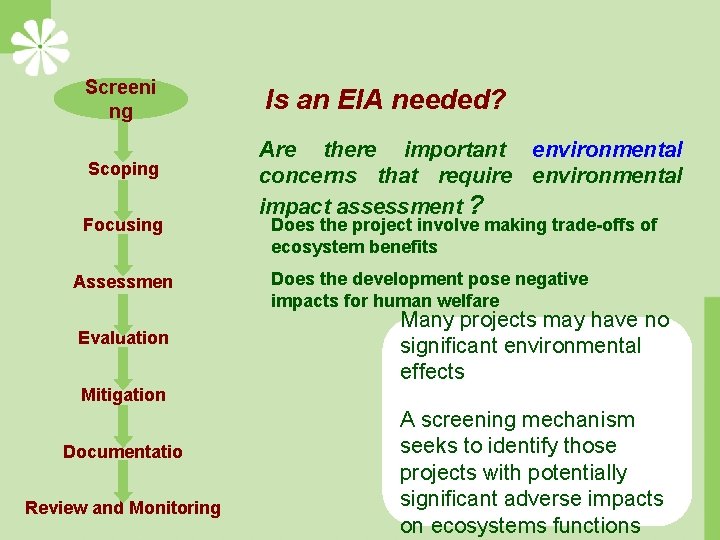
Screeni ng Scoping Focusing Assessmen t Evaluation Is an EIA needed? Are there important environmental concerns that require environmental impact assessment ? Does the project involve making trade-offs of ecosystem benefits Does the development pose negative impacts for human welfare Many projects may have no significant environmental effects Mitigation Documentatio n Review and Monitoring A screening mechanism seeks to identify those projects with potentially significant adverse impacts on ecosystems functions
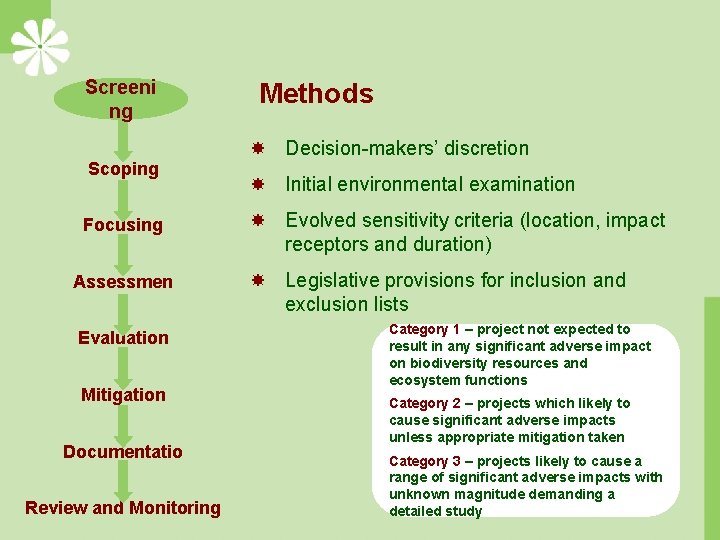
Screeni ng Scoping Focusing Assessmen t Evaluation Mitigation Documentatio n Review and Monitoring Methods Decision-makers’ discretion Initial environmental examination Evolved sensitivity criteria (location, impact receptors and duration) Legislative provisions for inclusion and exclusion lists Category 1 – project not expected to result in any significant adverse impact on biodiversity resources and ecosystem functions Category 2 – projects which likely to cause significant adverse impacts unless appropriate mitigation taken Category 3 – projects likely to cause a range of significant adverse impacts with unknown magnitude demanding a detailed study
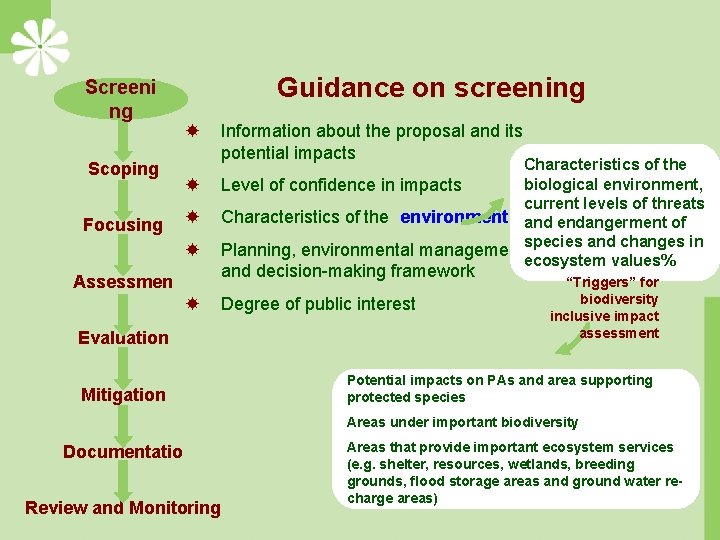
Screeni ng Scoping Focusing Guidance on screening Assessmen t Information about the proposal and its potential impacts Characteristics of the biological environment, Level of confidence in impacts current levels of threats Characteristics of the environment and endangerment of Planning, environmental managementspecies and changes in ecosystem values% and decision-making framework Degree of public interest Evaluation Mitigation “Triggers” for biodiversity inclusive impact assessment Potential impacts on PAs and area supporting protected species Areas under important biodiversity Documentatio n Review and Monitoring Areas that provide important ecosystem services (e. g. shelter, resources, wetlands, breeding grounds, flood storage areas and ground water recharge areas)
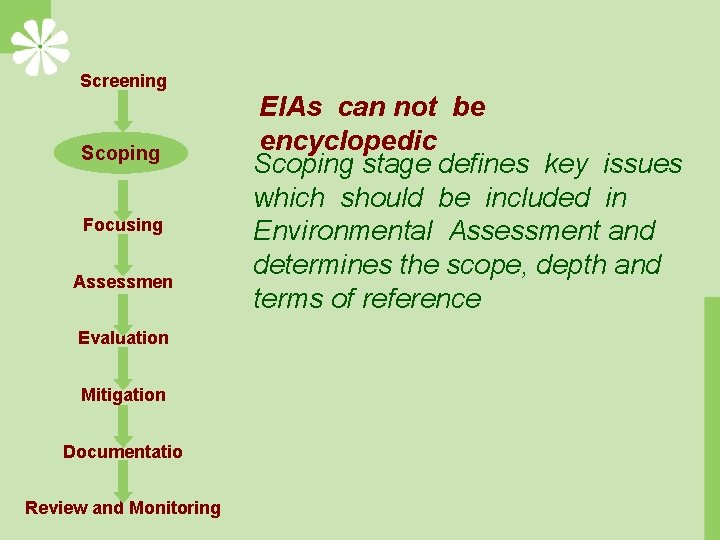
Screening Scoping Focusing Assessmen t Evaluation Mitigation Documentatio n Review and Monitoring EIAs can not be encyclopedic Scoping stage defines key issues which should be included in Environmental Assessment and determines the scope, depth and terms of reference
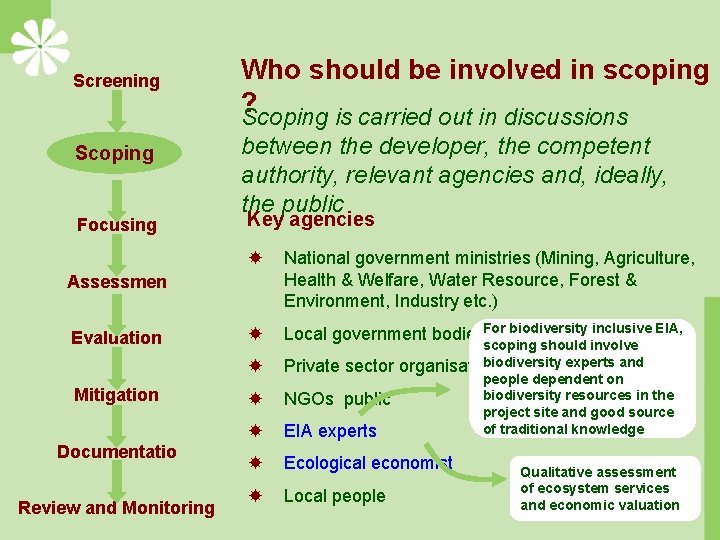
Screening Scoping Focusing Who should be involved in scoping ? Scoping is carried out in discussions between the developer, the competent authority, relevant agencies and, ideally, the public Key agencies National government ministries (Mining, Agriculture, Health & Welfare, Water Resource, Forest & Environment, Industry etc. ) Local government bodies. For biodiversity inclusive EIA, Private sector NGOs public EIA experts Ecological economist Local people Assessmen t Evaluation Mitigation Documentatio n Review and Monitoring scoping should involve biodiversity experts and organisation people dependent on biodiversity resources in the project site and good source of traditional knowledge Qualitative assessment of ecosystem services and economic valuation
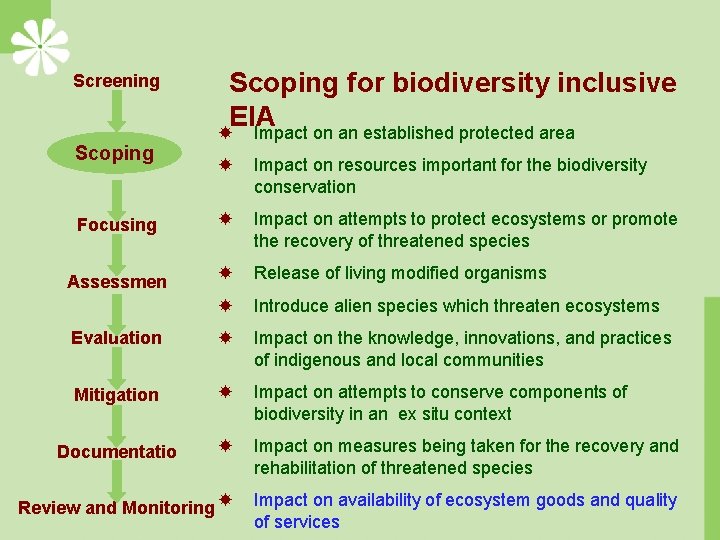
Screening Scoping for biodiversity inclusive EIA Impact on an established protected area Impact on resources important for the biodiversity conservation Focusing Impact on attempts to protect ecosystems or promote the recovery of threatened species Assessmen t Release of living modified organisms Introduce alien species which threaten ecosystems Evaluation Impact on the knowledge, innovations, and practices of indigenous and local communities Mitigation Impact on attempts to conserve components of biodiversity in an ex situ context Documentatio n Impact on measures being taken for the recovery and rehabilitation of threatened species Review and Monitoring Impact on availability of ecosystem goods and quality of services
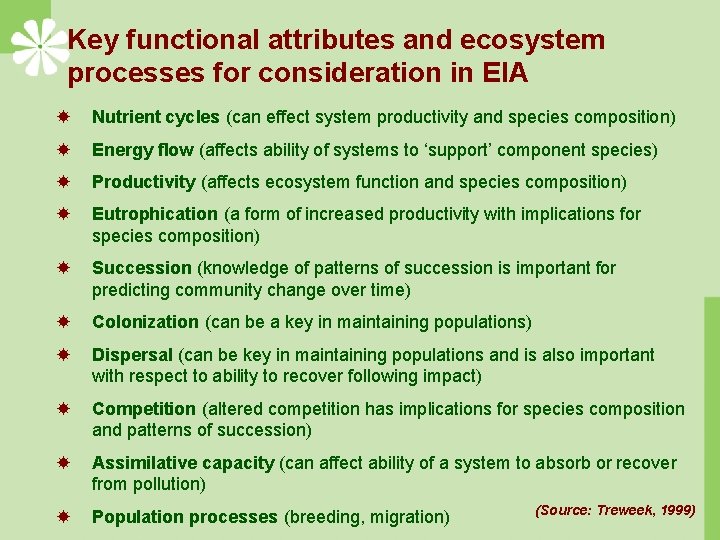
Key functional attributes and ecosystem processes for consideration in EIA Nutrient cycles (can effect system productivity and species composition) Energy flow (affects ability of systems to ‘support’ component species) Productivity (affects ecosystem function and species composition) Eutrophication (a form of increased productivity with implications for species composition) Succession (knowledge of patterns of succession is important for predicting community change over time) Colonization (can be a key in maintaining populations) Dispersal (can be key in maintaining populations and is also important with respect to ability to recover following impact) Competition (altered competition has implications for species composition and patterns of succession) Assimilative capacity (can affect ability of a system to absorb or recover from pollution) Population processes (breeding, migration) (Source: Treweek, 1999)
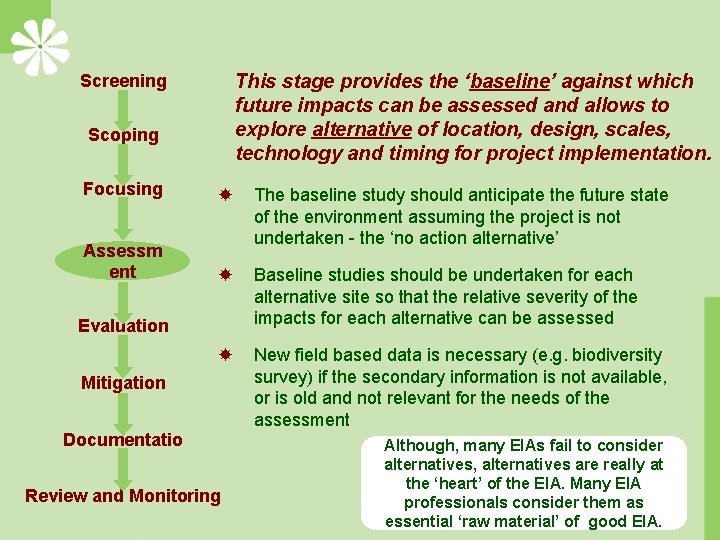
This stage provides the ‘baseline’ against which future impacts can be assessed and allows to explore alternative of location, design, scales, technology and timing for project implementation. Screening Scoping Focusing Assessm ent The baseline study should anticipate the future state of the environment assuming the project is not undertaken - the ‘no action alternative’ Baseline studies should be undertaken for each alternative site so that the relative severity of the impacts for each alternative can be assessed New field based data is necessary (e. g. biodiversity survey) if the secondary information is not available, or is old and not relevant for the needs of the assessment Evaluation Mitigation Documentatio n Review and Monitoring Although, many EIAs fail to consider alternatives, alternatives are really at the ‘heart’ of the EIA. Many EIA professionals consider them as essential ‘raw material’ of good EIA.
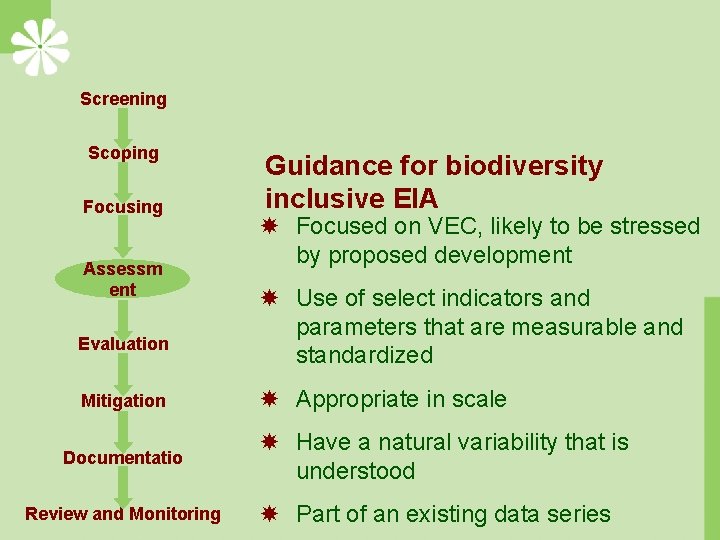
Screening Scoping Focusing Assessm ent Evaluation Mitigation Documentatio n Review and Monitoring Guidance for biodiversity inclusive EIA Focused on VEC, likely to be stressed by proposed development Use of select indicators and parameters that are measurable and standardized Appropriate in scale Have a natural variability that is understood Part of an existing data series
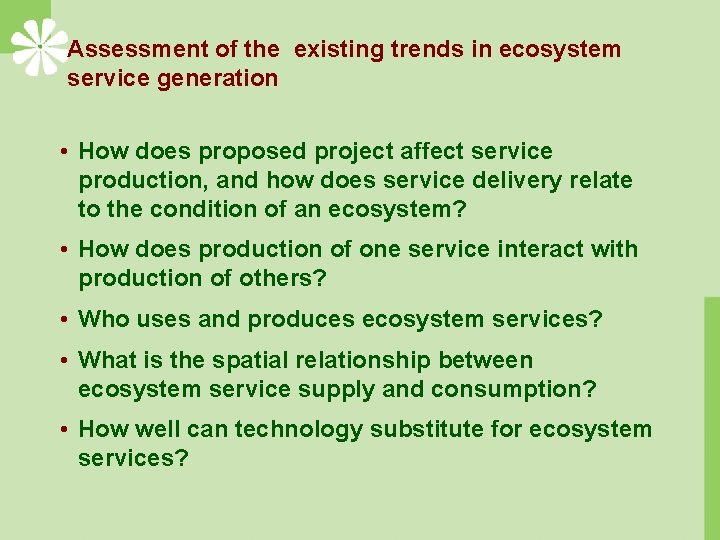
Assessment of the existing trends in ecosystem service generation • How does proposed project affect service production, and how does service delivery relate to the condition of an ecosystem? • How does production of one service interact with production of others? • Who uses and produces ecosystem services? • What is the spatial relationship between ecosystem service supply and consumption? • How well can technology substitute for ecosystem services?
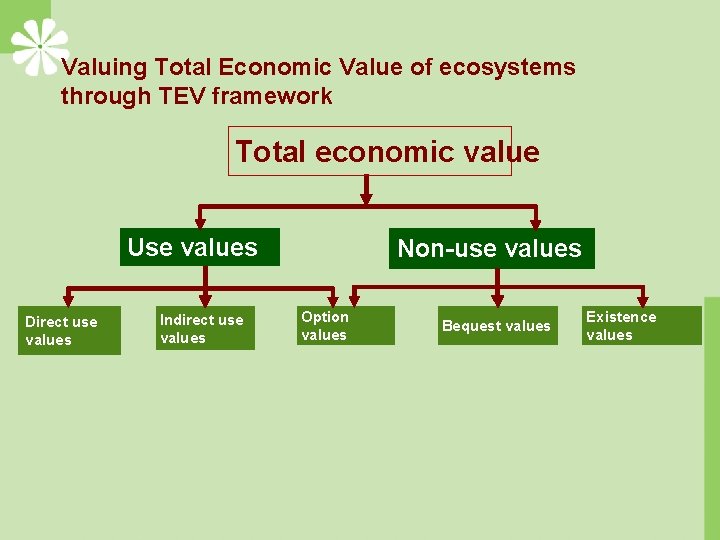
Valuing Total Economic Value of ecosystems through TEV framework Total economic value Use values Direct use values Indirect use values Non-use values Option values Bequest values Existence values
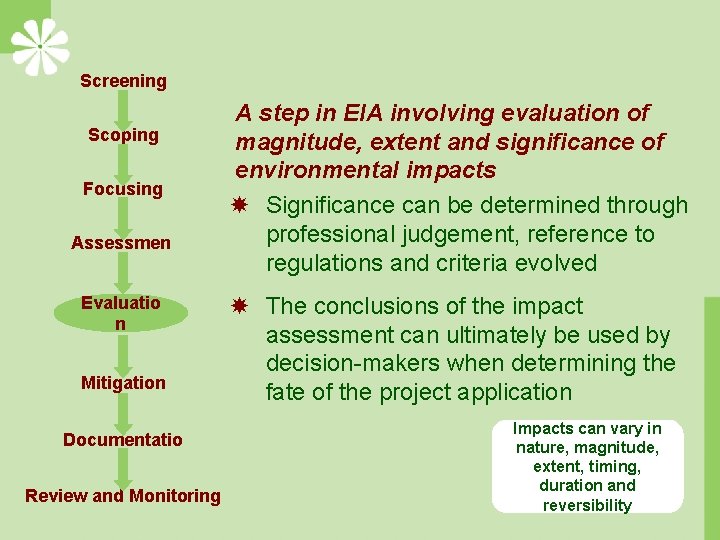
Screening Scoping Focusing Assessmen t Evaluatio n Mitigation Documentatio n Review and Monitoring A step in EIA involving evaluation of magnitude, extent and significance of environmental impacts Significance can be determined through professional judgement, reference to regulations and criteria evolved The conclusions of the impact assessment can ultimately be used by decision-makers when determining the fate of the project application Impacts can vary in nature, magnitude, extent, timing, duration and reversibility
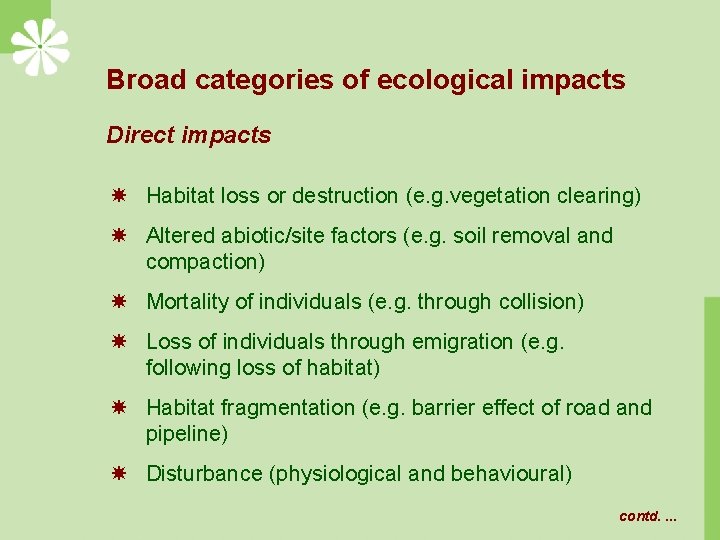
Broad categories of ecological impacts Direct impacts Habitat loss or destruction (e. g. vegetation clearing) Altered abiotic/site factors (e. g. soil removal and compaction) Mortality of individuals (e. g. through collision) Loss of individuals through emigration (e. g. following loss of habitat) Habitat fragmentation (e. g. barrier effect of road and pipeline) Disturbance (physiological and behavioural) contd. .
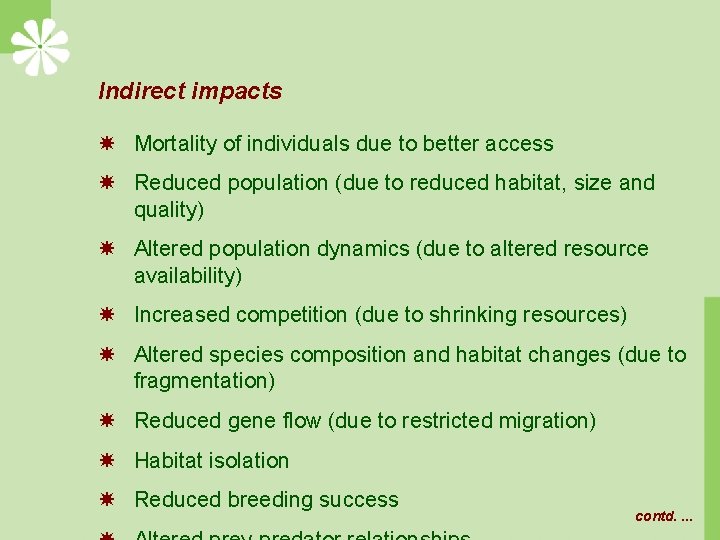
Indirect impacts Mortality of individuals due to better access Reduced population (due to reduced habitat, size and quality) Altered population dynamics (due to altered resource availability) Increased competition (due to shrinking resources) Altered species composition and habitat changes (due to fragmentation) Reduced gene flow (due to restricted migration) Habitat isolation Reduced breeding success contd. .
Cumulative impacts (time- and space-crowded effect ) Habitat 'nibbling' (progressive loss and fragmentation throughout an area) Reduced habitat diversity, e. g. at the landscape level (associated with reduced biological diversity at other levels in organizational hierarchy) Habitat fragmentation over time, resulting in progressive isolation and reduced gene flow Reduced genetic diversity can result in loss of resilience to environmental change and increased risk of extinction Irreversible loss of biological diversity (e. g. through destruction of unique population units) contd. .
Evaluation phase of the study should be able to provide answers to biodiversity concerns What impact will the project have on the genetic composition of each species? Do major systemic or population changes appear to be taking place? How will the proposal affect ecosystem processes? Is this proposal likely to make the ecosystem more vulnerable or susceptible to change? Does the proposal set a precedent for conversion to a more intensive level of use of the area? Is the biological resource in question at the limit of its range? Does the species demonstrate adaptability? What level of confidence or uncertainty can be assigned to interpretations of the effects?
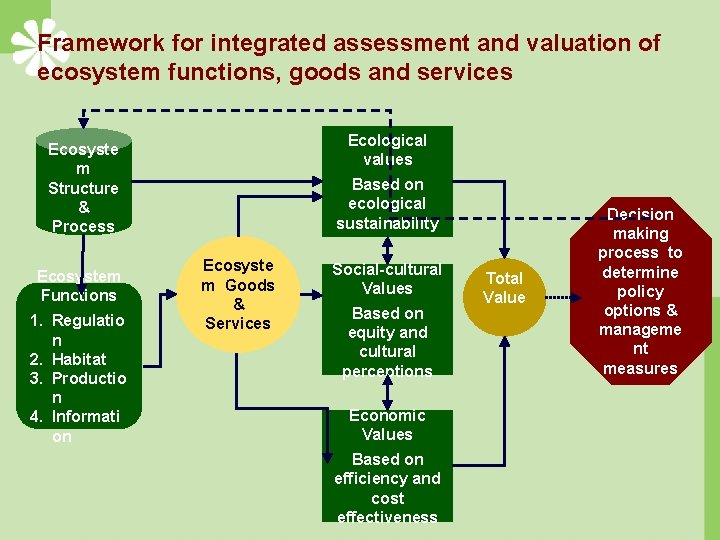
Framework for integrated assessment and valuation of ecosystem functions, goods and services Ecological values Ecosyste m Structure & Process Ecosystem Functions 1. Regulatio n 2. Habitat 3. Productio n 4. Informati on Based on ecological sustainability Ecosyste m Goods & Services Social-cultural Values Based on equity and cultural perceptions Economic Values Based on efficiency and cost effectiveness Total Value Decision making process to determine policy options & manageme nt measures
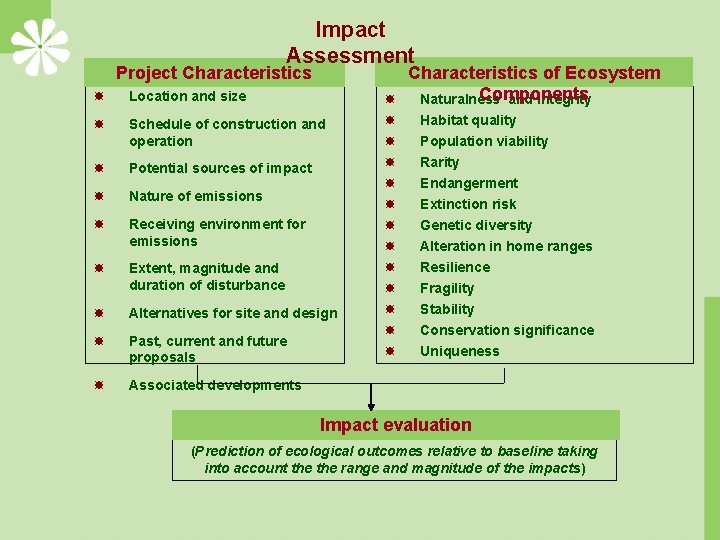
Impact Assessment Characteristics of Ecosystem Components Naturalness and integrity Project Characteristics Location and size Schedule of construction and operation Potential sources of impact Nature of emissions Receiving environment for emissions Extent, magnitude and duration of disturbance Alternatives for site and design Past, current and future proposals Associated developments Habitat quality Population viability Rarity Endangerment Extinction risk Genetic diversity Alteration in home ranges Resilience Fragility Stability Conservation significance Uniqueness Impact evaluation (Prediction of ecological outcomes relative to baseline taking into account the range and magnitude of the impacts)
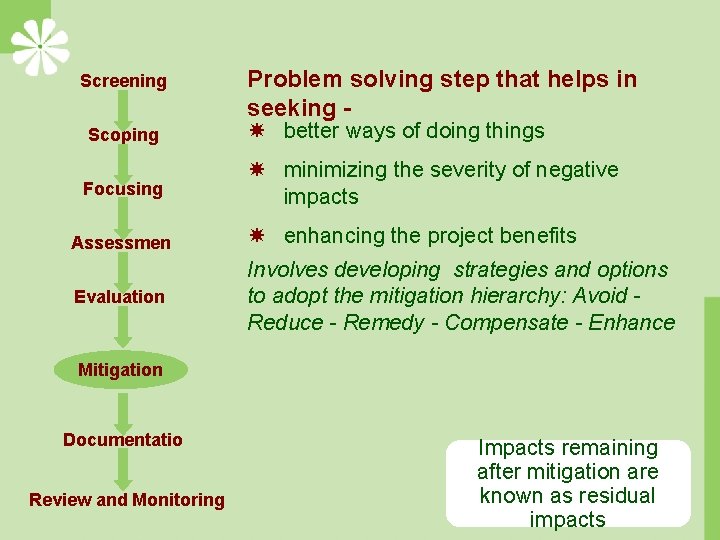
Screening Problem solving step that helps in seeking - Scoping better ways of doing things Focusing minimizing the severity of negative impacts Assessmen t Evaluation enhancing the project benefits Involves developing strategies and options to adopt the mitigation hierarchy: Avoid Reduce - Remedy - Compensate - Enhance Mitigation Documentatio n Review and Monitoring Impacts remaining after mitigation are known as residual impacts
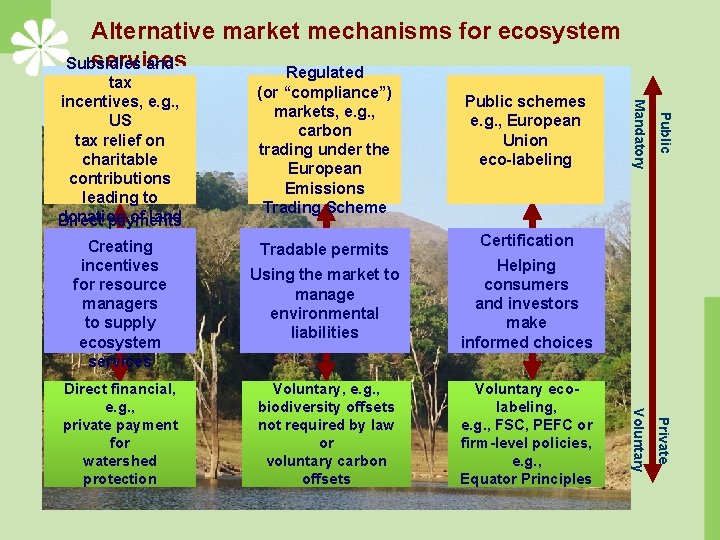
Alternative market mechanisms for ecosystem services Subsidies and Regulated Private Certification Creating incentives for resource managers to supply ecosystem services Using the market to manage environmental liabilities Helping consumers and investors make informed choices Direct financial, e. g. , private payment for watershed protection Voluntary, e. g. , biodiversity offsets not required by law or voluntary carbon offsets Voluntary ecolabeling, e. g. , FSC, PEFC or firm-level policies, e. g. , Equator Principles Tradable permits Public schemes e. g. , European Union eco-labeling Voluntary (or “compliance”) markets, e. g. , carbon trading under the European Emissions Trading Scheme Mandatory tax incentives, e. g. , US tax relief on charitable contributions leading to donation of land Direct payments
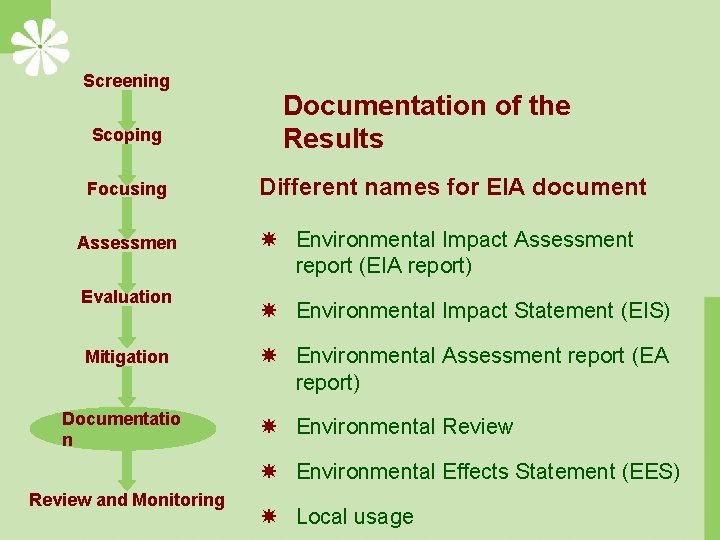
Screening Scoping Focusing Assessmen t Evaluation Mitigation Documentation of the Results Different names for EIA document Environmental Impact Assessment report (EIA report) Environmental Impact Statement (EIS) Environmental Assessment report (EA report) Environmental Review Environmental Effects Statement (EES) Review and Monitoring Local usage
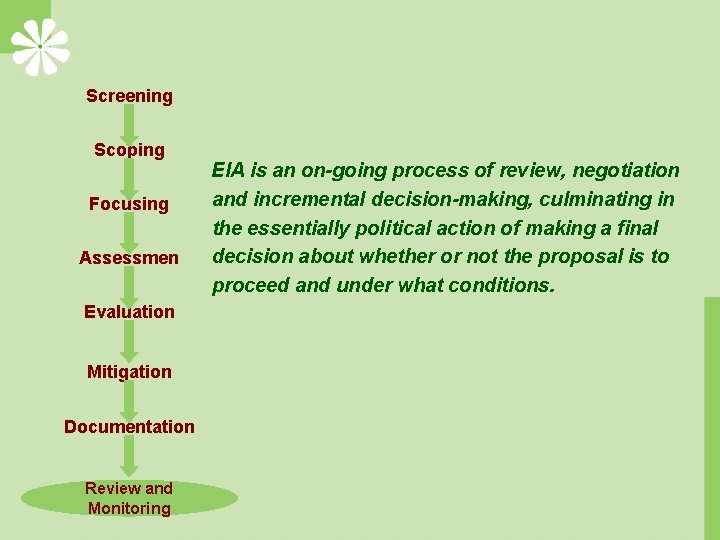
Screening Scoping Focusing Assessmen t Evaluation Mitigation Documentation Review and Monitoring EIA is an on-going process of review, negotiation and incremental decision-making, culminating in the essentially political action of making a final decision about whether or not the proposal is to proceed and under what conditions.
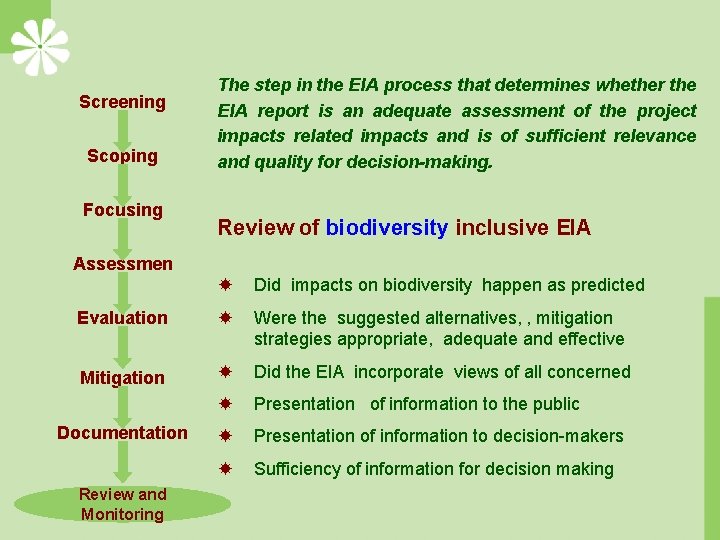
Screening Scoping Focusing The step in the EIA process that determines whether the EIA report is an adequate assessment of the project impacts related impacts and is of sufficient relevance and quality for decision-making. Review of biodiversity inclusive EIA Assessmen t Did impacts on biodiversity happen as predicted Evaluation Were the suggested alternatives, , mitigation strategies appropriate, adequate and effective Mitigation Did the EIA incorporate views of all concerned Presentation of information to the public Presentation of information to decision-makers Sufficiency of information for decision making Documentation Review and Monitoring
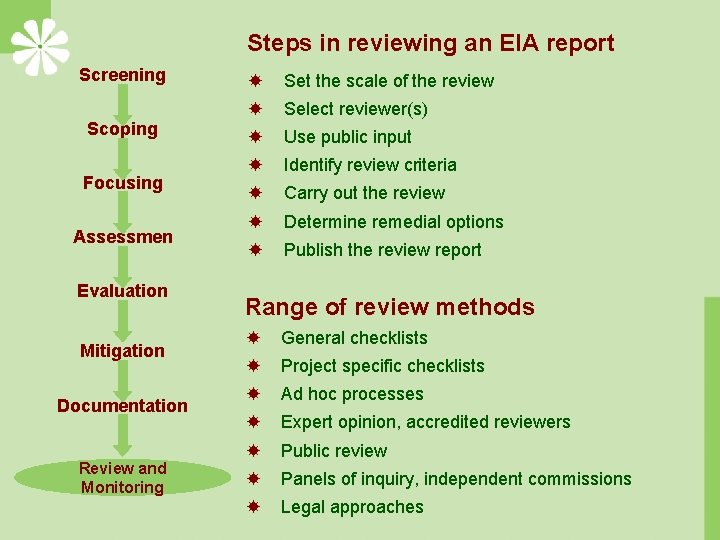
Steps in reviewing an EIA report Screening Scoping Focusing Assessmen t Evaluation Mitigation Documentation Review and Monitoring Set the scale of the review Select reviewer(s) Use public input Identify review criteria Carry out the review Determine remedial options Publish the review report Range of review methods General checklists Project specific checklists Ad hoc processes Expert opinion, accredited reviewers Public review Panels of inquiry, independent commissions Legal approaches
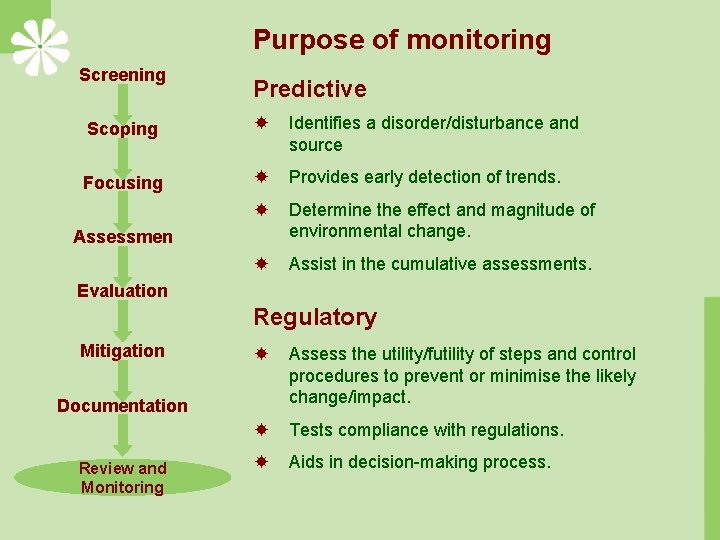
Purpose of monitoring Screening Predictive Scoping Identifies a disorder/disturbance and source Focusing Provides early detection of trends. Determine the effect and magnitude of environmental change. Assist in the cumulative assessments. Assessmen t Evaluation Regulatory Mitigation Assess the utility/futility of steps and control procedures to prevent or minimise the likely change/impact. Tests compliance with regulations. Aids in decision-making process. Documentation Review and Monitoring
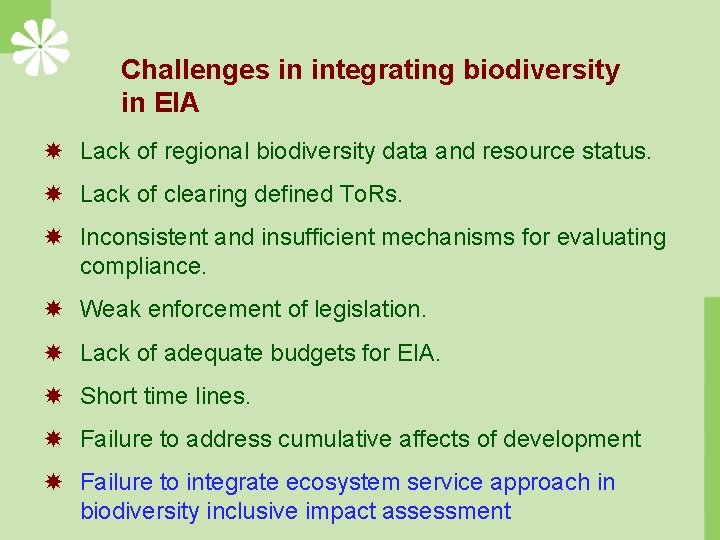
Challenges in integrating biodiversity in EIA Lack of regional biodiversity data and resource status. Lack of clearing defined To. Rs. Inconsistent and insufficient mechanisms for evaluating compliance. Weak enforcement of legislation. Lack of adequate budgets for EIA. Short time lines. Failure to address cumulative affects of development Failure to integrate ecosystem service approach in biodiversity inclusive impact assessment
Thank you…