
Egyptian Rulers of the New Kingdom 18 th




















- Slides: 72
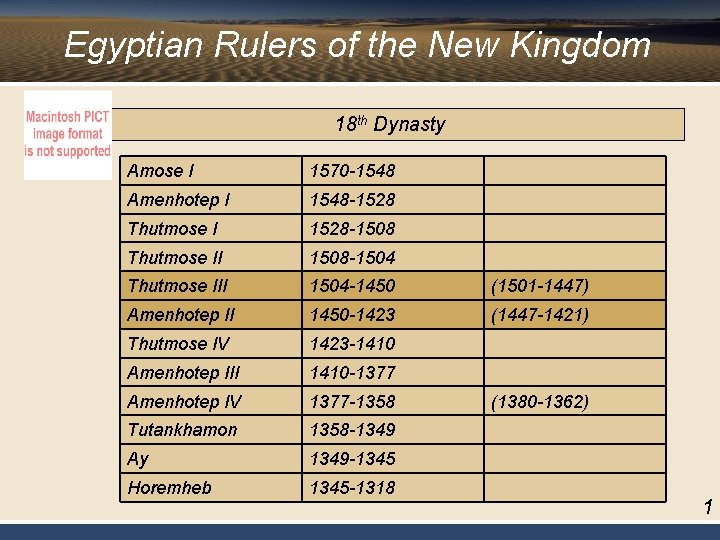
Egyptian Rulers of the New Kingdom 18 th Dynasty Amose I 1570 -1548 Amenhotep I 1548 -1528 Thutmose I 1528 -1508 Thutmose II 1508 -1504 Thutmose III 1504 -1450 (1501 -1447) Amenhotep II 1450 -1423 (1447 -1421) Thutmose IV 1423 -1410 Amenhotep III 1410 -1377 Amenhotep IV 1377 -1358 Tutankhamon 1358 -1349 Ay 1349 -1345 Horemheb 1345 -1318 (1380 -1362) 1
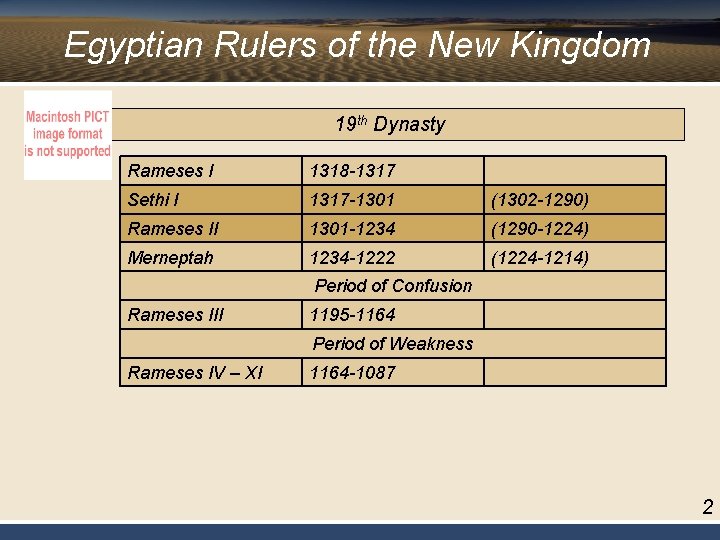
Egyptian Rulers of the New Kingdom 19 th Dynasty Rameses I 1318 -1317 Sethi I 1317 -1301 (1302 -1290) Rameses II 1301 -1234 (1290 -1224) Merneptah 1234 -1222 (1224 -1214) Period of Confusion Rameses III 1195 -1164 Period of Weakness Rameses IV – XI 1164 -1087 2
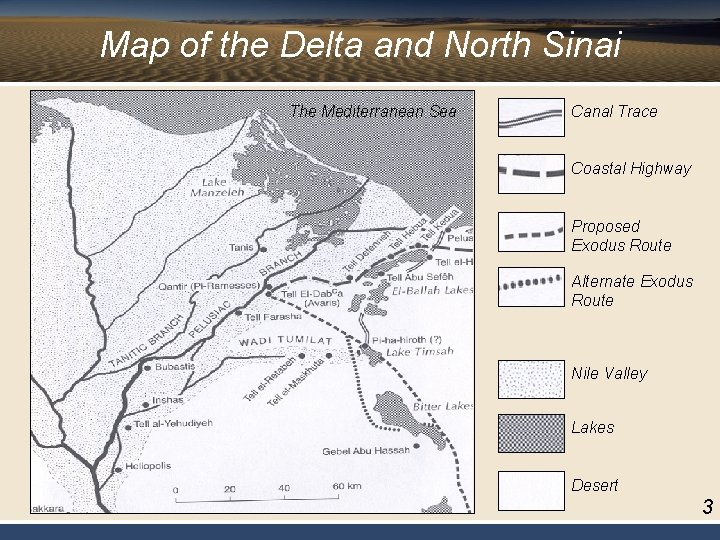
Map of the Delta and North Sinai The Mediterranean Sea Canal Trace Coastal Highway Proposed Exodus Route Alternate Exodus Route Nile Valley Lakes Desert 3
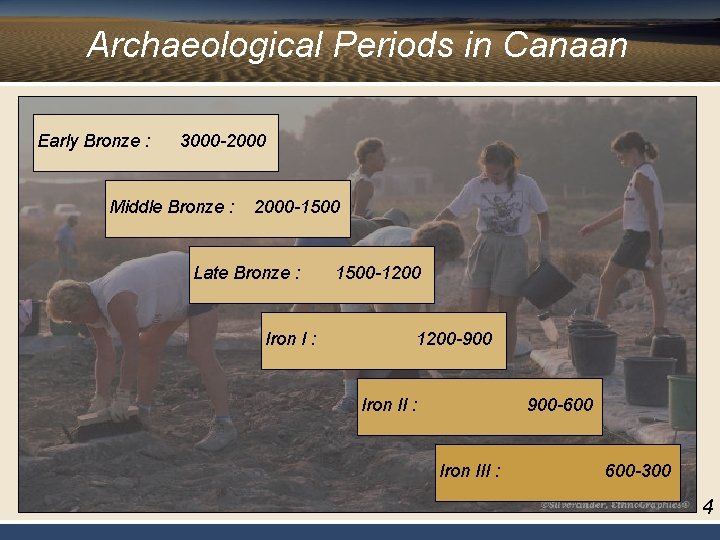
Archaeological Periods in Canaan Early Bronze : 3000 -2000 Middle Bronze : 2000 -1500 Late Bronze : Iron I : 1500 -1200 -900 Iron II : 900 -600 Iron III : 600 -300 4
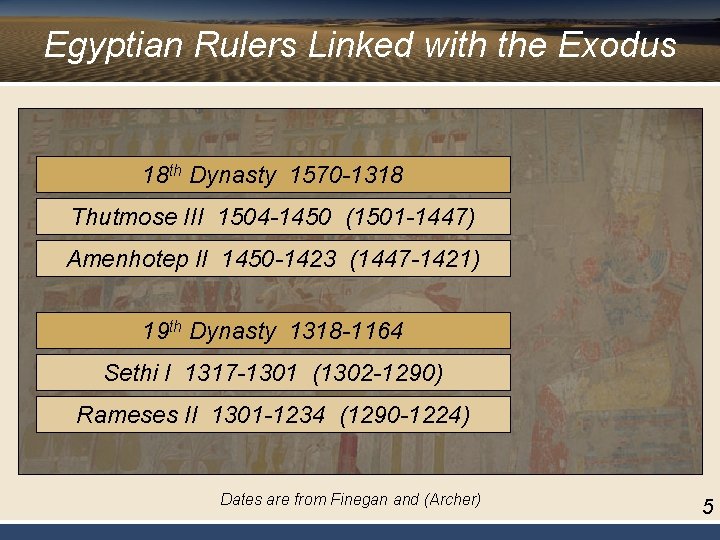
Egyptian Rulers Linked with the Exodus 18 th Dynasty 1570 -1318 Thutmose III 1504 -1450 (1501 -1447) Amenhotep II 1450 -1423 (1447 -1421) 19 th Dynasty 1318 -1164 Sethi I 1317 -1301 (1302 -1290) Rameses II 1301 -1234 (1290 -1224) Dates are from Finegan and (Archer) 5
The Ten Plagues 1 2 3 Water to Blood 7: 14 -25 Frogs 8: 1 -15 Lice 8: 16 -19 Flies 4 8: 20 -32 Plague on Cattle 5 9: 1 -7 Boils on Man and Beast 6 10 9: 8 -12 # 7 8 9 Hail 9: 13 -35 Locusts 10: 1 -20 Darkness 10: 21 -29 Death of Firstborn (men and animals) 11: 1 -10; 12: 12, 29, 30 6
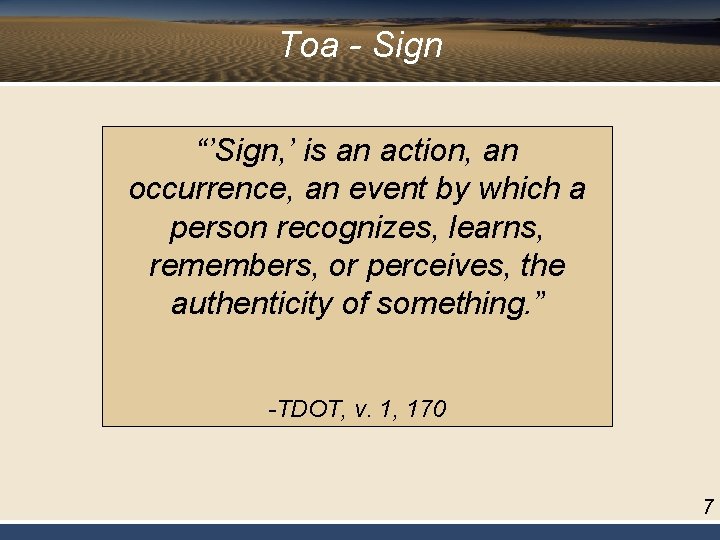
Toa - Sign “’Sign, ’ is an action, an occurrence, an event by which a person recognizes, learns, remembers, or perceives, the authenticity of something. ” -TDOT, v. 1, 170 7
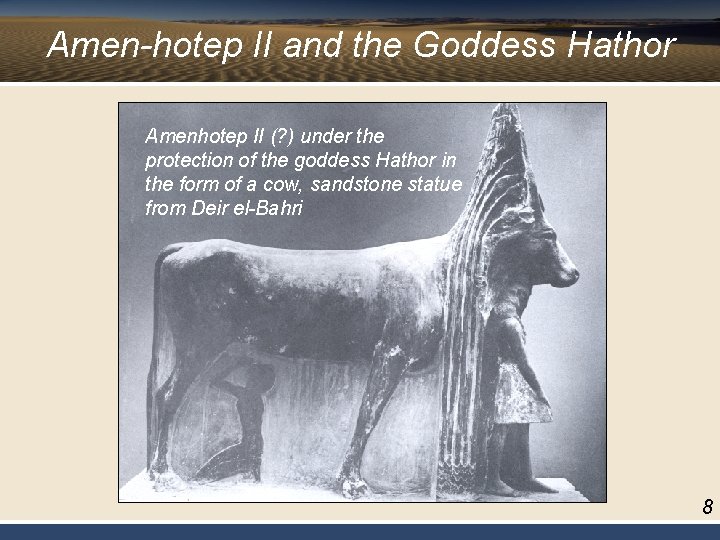
Amen-hotep II and the Goddess Hathor Amenhotep II (? ) under the protection of the goddess Hathor in the form of a cow, sandstone statue from Deir el-Bahri 8
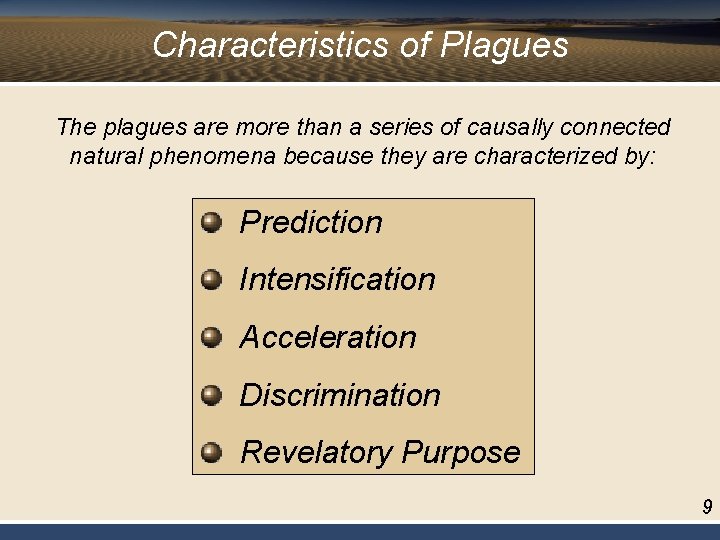
Characteristics of Plagues The plagues are more than a series of causally connected natural phenomena because they are characterized by: Prediction Intensification Acceleration Discrimination Revelatory Purpose 9
The Hardening of Pharaoh’s Heart A Texts where Yahweh is the subject of the verb 4: 21 I will harden his heart 7: 3 I will harden Pharaoh’s heart 9: 12 Yahweh hardened Pharaoh’s heart 10: 1 I have hardened Pharaoh’s heart 10: 20 Yahweh hardened Pharaoh’s heart 10: 27 Yahweh hardened Pharaoh’s heart 11: 10 Yahweh hardened Pharaoh’s heart 14: 4 I will harden Pharaoh’s heart 14: 8 Yahweh hardened Pharaoh’s heart 14: 17 I will harden the Egyptians’ hearts 10
The Hardening of Pharaoh’s Heart B Texts where Pharaoh is the (or a) subject of the verb 8: 15 (Heb 11) He hardened his heart 8: 32 (Heb 28) Pharaoh hardened his heart 9: 34 He and his officials hardened their hearts 11
The Hardening of Pharaoh’s Heart C Texts where no source or agent is mentioned 7: 13 Pharaoh’s heart was hard 7: 14 Pharaoh’s heart was hard 7: 22 Pharaoh’s heart was hard 8: 19 (Heb 15) Pharaoh’s heart was hard 9: 7 Pharaoh’s heart was unyielding 9: 35 Pharaoh’s heart was hard 12
Five Key Words in the Theology of the Passover Propitiation Security or Salvation Substitution Deliverance Pilgrimage J. A. Motyer 13
Exodus and the Route of the Wandering Insert Map here 14
The Route of the Exodus Insert Map here 15
Exodus 19: 5 h. L*g%s= - n. f. possession, property 1. Valued Property, peculiar treasure, which yy has chosen (rjb) and taken to himself; always of people of Israel, first Ex 19: 5 (LXX lao. VVς periouvsioς = Tit 2: 14; 1 Pet 2: 9 lao. Vς eijς peripoivhsin = peripoivhsiς Eph 1: 14) 16
Ancient Near Eastern Law Codes Prior to the Time of Moses Ur-Nammu Code - 2000 BC Laws of Eshunna - 1900 BC Lipit Ishtar Code - 1870 BC Code of Hammurabi - 1700 BC Hittite Laws - 1500 BC 17
Ox Goring: A Comparison Exodus 21: 28 -32, 35 Laws of Eshunna 53 -55 28 If a bull gores a man or a woman to death, the bull must be stoned to death, and its meat must not be eaten. But the owner of the bull will not be held responsible. 29 If, however, the bull has had the habit of goring and the owner has been warned but has not kept it penned up and it kills a man or woman, the bull must be stoned and the owner also must be put to death. 30 However, if payment is demanded of him, he may redeem his life by paying whatever is demanded. 31 This law also applies if the bull gores a son or daughter. 18
Ox Goring: A Comparison Exodus 21: 28 -32, 35 Laws of Eshunna 53 -55 32 If the bull gores a male or female slave, the owner must pay thirty shekels of silver to the master of the slave, and the bull must be stoned. 35 If a man’s bull injures the bull of another and it dies, they are to sell the live one and divide both the money and the dead animal equally. 53 If one ox gores a[nother] ox and causes its death, both ox owners shall divide [between them] the price [realized from the sale] of the live ox and the value of the dead ox 54 If an ox is known to gore habitually and the ward authorities have had [the fact] made known to its owner, but he does not have his ox dehorned (? ), it gores a man and causes [his] death, then the owner of the ox shall pay 2/3 of a mina of silver. 55 If it gores a slave and causes [his] death, he shall pay 15 shekels of silver. 19
Differences Between the Book of the Covenant and Extra-Biblical Law Codes Some specific differences: Idolatry is condemned Life is respected Punishments show restraint, no physical mutilation Class distinctions not prominent Some general differences: Difference in religious spirit High degree of humanitarian concern Legal terminology Order and content Slaves protected against abuses Immorality punished severely, marriage protected Widows, fatherless, strangers are protected 20
Exodus 24: 1 -11 Key elements in the description of the Covenant ratification ceremony: 1. The covenant document (verses 4, 7) 2. Covenant stipulations (verse 3) 3. Covenant oath (verses 3, 7) 4. Religious ceremony including sacrifices and sprinkling of blood (verses 4 -6, 8 -11) 5. Covenant meal (verse 11) 21
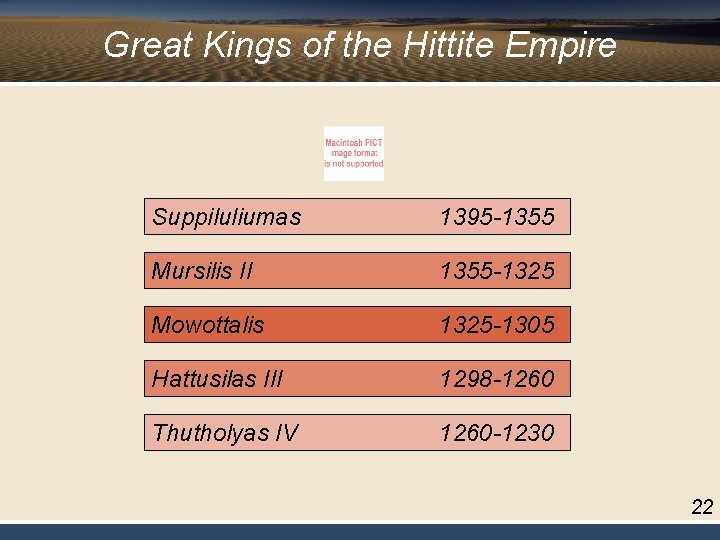
Great Kings of the Hittite Empire Suppiluliumas 1395 -1355 Mursilis II 1355 -1325 Mowottalis 1325 -1305 Hattusilas III 1298 -1260 Thutholyas IV 1260 -1230 22
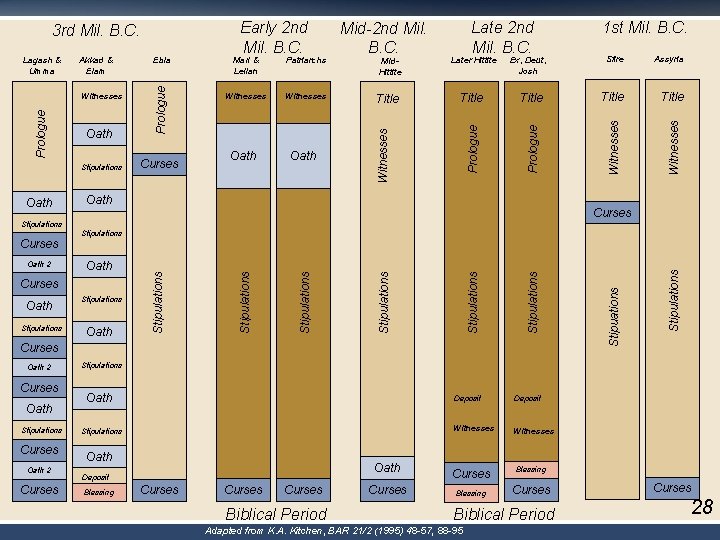
Hittite Treaty Form 1. Preamble 2. Historical Prologue 3. Basic Stipulation / Statement of Substance 4. Detailed Stipulations 5. Witnesses 6. Blessings and Curses 23
Additional Features of the Hittite Treaty 1. Formal oath pledged by vassal 2. Ratification ceremony 3. Form for procedure against a rebellious vassal 4. Provision for deposit of the treaty document in the vassal’s sanctuary / periodic public reading 24
Covenant / Treaty Form Preamble Kitchen Ex 20: 1 Dt 1: 1 -5 Thompson Ex 19: 3; 20: 2 a Josh 24: 2 a Historical Prologue Kitchen Ex 20: 2 Dt 1: 6 -3: 29 Josh 24: 2 -13 Thompson Ex 19: 4; 20: 2 b Dt 1 -4 Josh 24: 2 b-13 Basic Stipulation Kitchen Ex 20: 3 -17, 22 -26 Dt 4 -11 Thompson Ex 19: 5 a; 20: 3 Dt 5 -11 Josh 24: 14 25
Covenant / Treaty Form Detailed Stipulations Kitchen Ex 21 -23 Dt 12 -26 Josh 24: 14 -15 Thompson Ex 20: 4 -17 Dt 12 -26 Josh 24: 25 Witnesses Kitchen Ex 24: 4 Dt 31: 16 -30 (31: 26); 32: 1 -47 Thompson Josh 24: 27 Josh 24: 22, 27 Curses and Blessings Kitchen Thompson Dt 28: 1 -14, 15 -68 Josh 24: 19 -20 Ex 19: 5 b, 6 a; 20: 5 b, 6, 7 b, 12 b Dt 27 -30 26
Outline of Deuteronomy I 1: 1 -5 Preamble: Covenant Mediator II 1: 6 -4: 49 Historical Prologue: Covenant History III 5: 1 -26: 19 Stipulations: Covenant Life A 5: 1 -11: 32 The Great Commandment B 12: 1 -26: 19 Ancillary Commandments IV 27: 1 -30: 20 Sanctions: Covenant Ratification V Dynastic Disposition: Covenant Continuity 31: 1 -34: 12 27
Oath Curses Witnesses Oath Mid. Hittite Title Later Hittite Ex, Deut, Josh Title Oath Sfire Assyria Title Witnesses Stipulations Patriarchs 1 st Mil. B. C. Witnesses Oath Mari & Leilan Late 2 nd Mil. B. C. Prologue Witnesses Ebla Mid-2 nd Mil. B. C. Prologue Akkad & Elam Prologue Lagash & Umma Early 2 nd Mil. B. C. Witnesses 3 rd Mil. B. C. Curses Stipulations Oath 2 Curses Oath Deposit Stipulations Witnesses Curses Oath 2 Curses Stipulations Deposit Curses Stipuations Oath Stipulations Oath Stipulations Curses Stipulations Oath 2 Stipulations Curses Stipulations Oath Deposit Blessing Curses Biblical Period Curses Blessing Curses Biblical Period Adapted from K. A. Kitchen, BAR 21/2 (1995) 48 -57, 88 -95 Curses 28
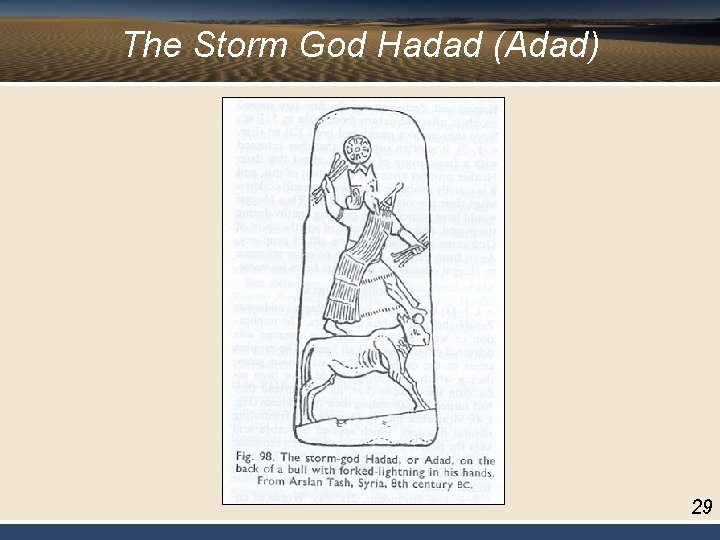
The Storm God Hadad (Adad) 29
Terms Used to Designate the Tabernacle lh#a) tent /K*c=m= dwelling, tabernacle du@om lh#a) tent of meeting t. Wdu@h* /K*c=m testimony tabernacle of the 30
The Tabernacle Holy of Holies Altar of Incense Ark of the Covenant Lampstand Table of Shewbread Outer Court Altar of Burnt Offerings 31
Vos on Typology Symbol Something that portrays a certain fact or principle or relationship of a spiritual nature in visible form. The things it pictures are of present existence and present application. Type A typical thing is prospective – it relates to what will become real or applicable in the future. A type can never be a type independently of its being first a symbol. Only after having discovered what a thing symbolizes can we legitimately proceed to put the question what it typifies for the latter can never be aught else than the former lifted to a higher plane. The bond that holds type and antitype together must be a bond of vital continuity in the progress of redemption. Typology is an effort to understand the unity of the Bible from the standpoint of history rather than allegory. Vos, pp 144 -146 32
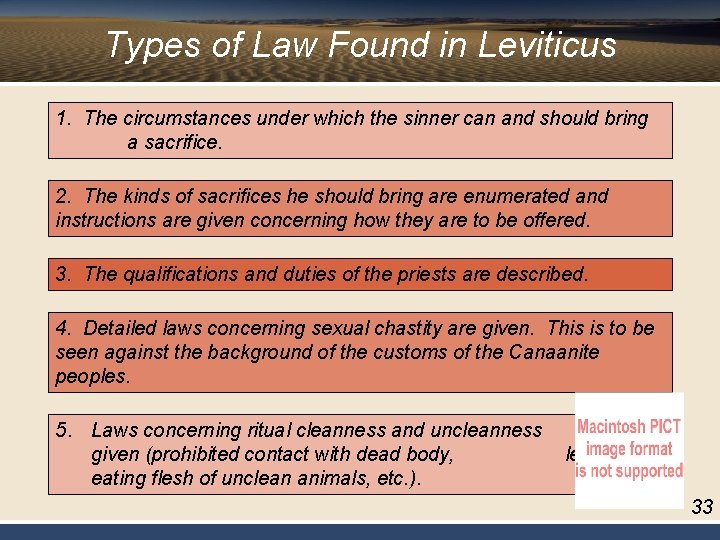
Types of Law Found in Leviticus 1. The circumstances under which the sinner can and should bring a sacrifice. 2. The kinds of sacrifices he should bring are enumerated and instructions are given concerning how they are to be offered. 3. The qualifications and duties of the priests are described. 4. Detailed laws concerning sexual chastity are given. This is to be seen against the background of the customs of the Canaanite peoples. 5. Laws concerning ritual cleanness and uncleanness given (prohibited contact with dead body, eating flesh of unclean animals, etc. ). are leprosy, 33
Significance of Leviticus for Us 1. It provides the background for understanding references to sacrificial offerings, ceremonies of purification, institutions such as the sabbatical year, year of jubilee, etc. in the rest of the Bible. 2. It presents Christ in a typical way in the Old Testament. It is a book of atonement, sanctification and consecration. 3. It is of interest from the viewpoint of the general history of religions – comparison of the worship of Israel with that of other ancient peoples. 4. For Orthodox Jews, much of Leviticus is still observed today, including dietary laws and observance of the Sabbath. Most people when asked what book of the Pentateuch they would like to study would say Genesis. The Orthodox Jew, however, would probably say Leviticus. 34
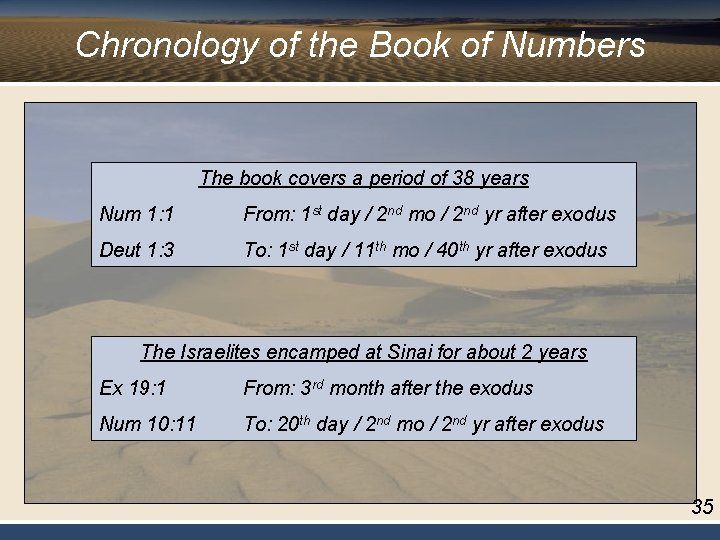
Chronology of the Book of Numbers The book covers a period of 38 years Num 1: 1 From: 1 st day / 2 nd mo / 2 nd yr after exodus Deut 1: 3 To: 1 st day / 11 th mo / 40 th yr after exodus The Israelites encamped at Sinai for about 2 years Ex 19: 1 From: 3 rd month after the exodus Num 10: 11 To: 20 th day / 2 nd mo / 2 nd yr after exodus 35
Chronology of the Book of Numbers Num 1: 1 -10: 10 Covers a period of 19 days at Sinai Num 1: 1 - From: 1 st day / 2 nd mo / 2 nd yr Num 10: 11 - To: 20 th day / 2 nd mo / 2 nd yr Num 13 -14 At Kadesh. Barnea 36
Chronology of the Book of Numbers Num 15 -20 The 38 years of wandering Num 20: 1 -36: 13 The 40 th year after the exodus Num 20: 1, 22 -29 - From ? Day / 1 st mo / ? Yr (Miriam and Aaron die at Kadesh and Mt. Hor) Cf. Num 33: 36 -38 - 1 st day / 5 th mo / 40 th yr 37
Terminology for Census Template Figures in Numbers Flinders Petrie myp!l*a& - tent groups toam@ - number of fighting men in tribe R. E. D. Clark myp!Wla - chiefs, captains toam@ - warriors J. W. Wenham myp!Wla - captains of thousands, hundreds and fifties toam@ - military units 38
How Did Deuteronomy Get Its Name? Deuteronomy 17: 18 hn@v=m!-ta# ol bt^k*w= o. Tk=l^m=m^ a. S@K! lu^ o. Tb=v!k= hy*h*w= 18. <Y!w!l=h^ <yn!h&K)h^ yn@p=L!m! rp#s@-lu^ ta. Z)h^ hr*o. Th^ LXX deuteronovmion touto Deuteronomy 1: 1 rb#u@B= la@r*c=y!-l. K*-la# hv#m r. B#D! rv#a& <yr!b*D=h^ h. L#a@ 1 lp#T)-nyb@W /r*a. P*-ny. B@ [Ws lom hb*r*u&B* r. B*d=M!B^ /D@r=Y^h^ 39
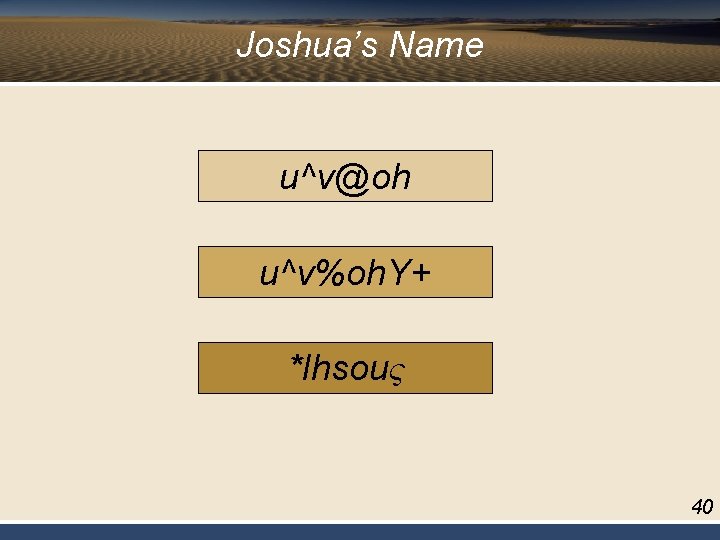
Joshua’s Name u^v@oh u^v%oh. Y+ *Ihsouς 40
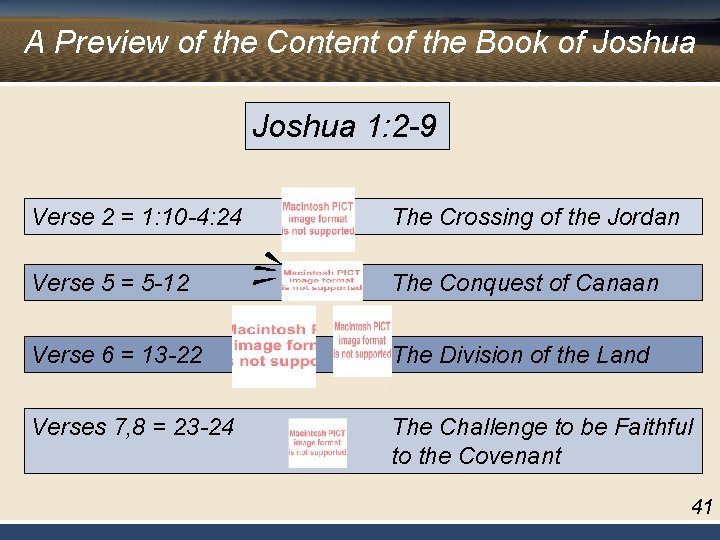
A Preview of the Content of the Book of Joshua 1: 2 -9 Verse 2 = 1: 10 -4: 24 The Crossing of the Jordan Verse 5 = 5 -12 The Conquest of Canaan Verse 6 = 13 -22 The Division of the Land Verses 7, 8 = 23 -24 The Challenge to be Faithful to the Covenant 41
Identification of Bethel and Ai Traditional View Bethel = Beitin Livingston Bethel = Bireh Traditional View Ai = Et-Tell Livingston Ai = Khirbet-Nisya Ai = Khirbet El-Maqatir 42
Identification of Bethel and Ai 43
Joshua 10: 12 -13 Verse 12 “Sun, stand thou still upon Gibeon” 44
Joshua 10: 12 -13 Verse 13 “And the sun stood still” Hebrew is: <o. D – be silent, cease, leave off 45
Joshua 10: 12 -13 Verse 13 “And the moon stayed” Hebrew is: dmu “So the sun stood still in the midst of heaven” Hebrew is: dmu - has sense of “cease” in 2 Kings 4: 6; Jonah 1: 15 46
Joshua 10: 12 -13 Verse 13 “The sun…hastened not to go down about a whole day” Hebrew is: aobl* - come, enter. Normally means “set” or “go down” when applied to the sun. Note: Either axy or jrz are usually used for sunrise. However, in Isa 60: 1 (“Arise, shine; for your light is come [a. B)] and the glory of the Lord has risen [jrz ] upon you”) a. B is parallel to jrz. It is possible then to argue that a)B can apply to the coming of light and the rising of the sun. 47
Joshua 10: 12 -13 Verse 13 “about a whole day” Hebrew is: <ym!T* <wy)K= - <ym!T* - idea of what is complete or finished. Suggested translation: “as when day is done” 48
Joshua 10: 12 -13 Verse 13 b “The sun ceased (shining) in the midst of the sky and did not hasten to come (so that it was) as when day is done. ” 49
The Battle of Gibeon Canaanite Force Israelite Force Gibeonite City 50
The Conquest of the Cities of the Shephelah Canaanite Force Israelite Force 51
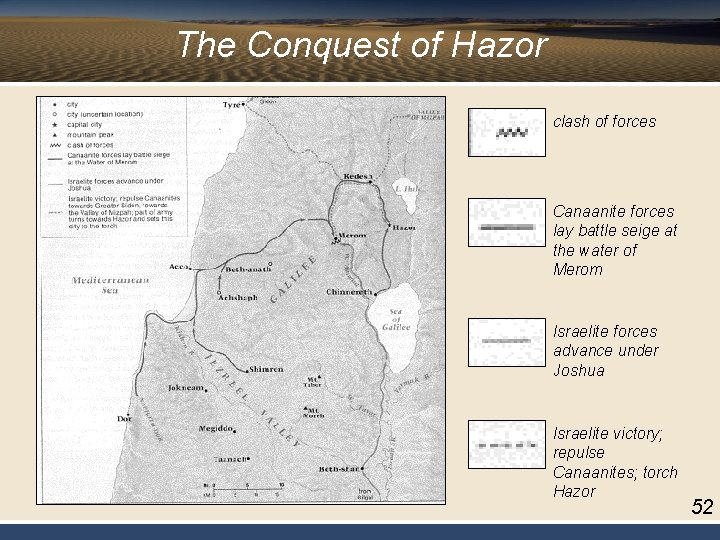
The Conquest of Hazor clash of forces Canaanite forces lay battle seige at the water of Merom Israelite forces advance under Joshua Israelite victory; repulse Canaanites; torch Hazor 52
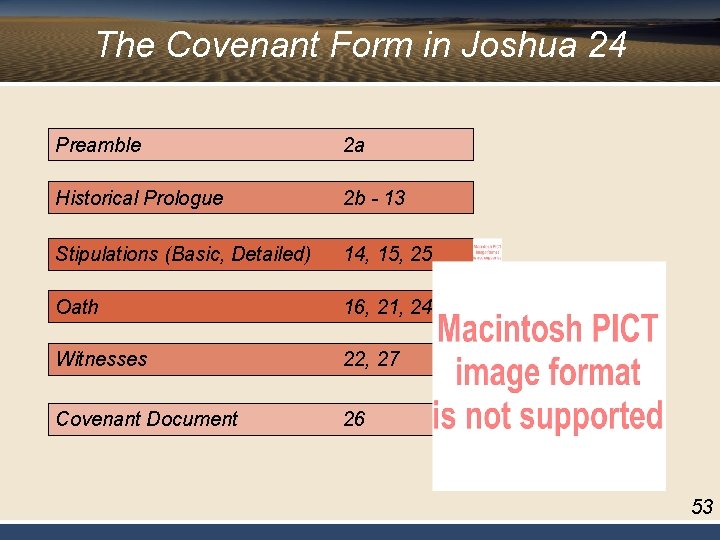
The Covenant Form in Joshua 24 Preamble 2 a Historical Prologue 2 b - 13 Stipulations (Basic, Detailed) 14, 15, 25 Oath 16, 21, 24 Witnesses 22, 27 Covenant Document 26 53
Judges Purpose To depict this period of Israel’s history in such a way that the religious and moral deterioration of Israel, as well as the righteous acts of a covenant keeping God in bringing judgment and deliverance are clearly seen. Emphases Stress on Israel’s inward weakness in turning away from Yahweh and falling under the influence of the heathen religious and moral practices of the Canaanites. Depiction of the chaotic social conditions that led to the desire for a king. Depiction of the gracious and unmerited interventions of a covenant keeping God. 54
Chronology of the Book of Judges Period of Time in Judges # Years Reference Mesopotamian oppression 8 3: 8 Othniel – deliverance and rest 40 3: 11 Moabite oppression 18 3: 14 Ehud – deliverance and rest 80 3: 30 Canaanite oppression – Jabin 20 4: 3 Deborah, Barak – deliverance / rest 40 5: 31 Midianite oppression 7 6: 1 Gideon – deliverance / rest 40 7: 28 Abimelech – puppet king 3 9: 22 Continued… 55
Chronology of the Book of Judges Period of Time in Judges # Years Reference Tola – judgeship 23 10: 2 Jair – judgeship 22 10: 3 Ammonite oppression 18 (319) 10: 8 Jephthah – deliverance / rest 6 12: 7 Ibzan – judgeship 7 12: 9 Elon – judgeship 19 12: 11 Abdon – judgeship 8 12: 14 Philistine oppression 40 13: 1 Samson – exploits and judgeship 20 15: 20 410 yrs total 56
Chronology of the Book of Judges How much or how little must the period be compressed? 1 If the Exodus was ca. 1290 and the conquest was ca. 1250: Conquest 1250 4 th Year of Solomon -966 284 Eli to Solomon, ca. * Joshua to end of Judges 117 167 *Eli 20 Samuel 20 Saul 33 David 40 Solomon 4 117 57
Chronology of the Book of Judges How much or how little must the period be compressed? 2 If the Exodus was 1446 and the conquest was 1406: Conquest 1406 4 th Year of Solomon -966 440 Eli to Solomon, ca. * Joshua to end of Judges 117 323 *Eli 20 Samuel 20 Saul 33 David 40 Solomon 4 117 58
Major and Minor Judges Othniel Mesopotamia 3: 7 -11 Ehud Moab 3: 12 -30 Shamgar Philistia 3: 31 Deborah & Barak Canaan 4: 1 -5: 31 Gideon Midian 6: 1 -8: 35 Tola 10: 1 -2 Jair 10: 3 -5 Jephthah Ammon 10: 6 -12: 7 Ibzan 12: 8 -10 Elon 12: 11 -12 Abdon 12: 13 -15 Samson Philistia 13: 1 -16: 31 59
The Ancestry of David of Judah Great Grandparents Boaz m. Ruth Grandfather Obed Father Jesse Brothers and Sisters Eliab (Elihu) Abinadab Shammah Nethanel Raddai Ozem Zeruiah David (Shimeah)(Nathaniel) Abigail 60
Kingship and Covenant in 1, 2 Samuel 1. Kingship as requested by the people was a denial of the covenant. 2. Kingship as instituted by Samuel was consistent with the covenant. 3. Kingship as practiced by Saul failed to correspond to the covenant ideal. 4. Kingship as practiced by David was an imperfect but true representation of the ideal of the covenantal king. 61
Major Divisions of 1, 2 Samuel 1 -12 Samuel 13 -31 Saul 2 Samuel David 62
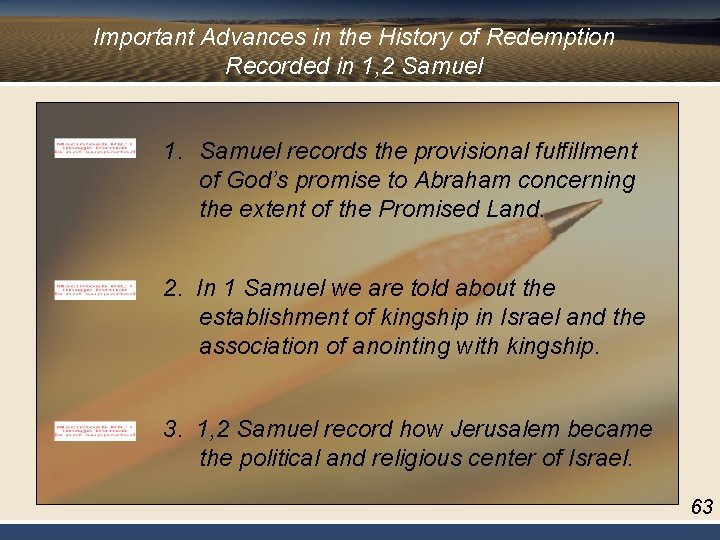
Important Advances in the History of Redemption Recorded in 1, 2 Samuel 1. Samuel records the provisional fulfillment of God’s promise to Abraham concerning the extent of the Promised Land. 2. In 1 Samuel we are told about the establishment of kingship in Israel and the association of anointing with kingship. 3. 1, 2 Samuel record how Jerusalem became the political and religious center of Israel. 63
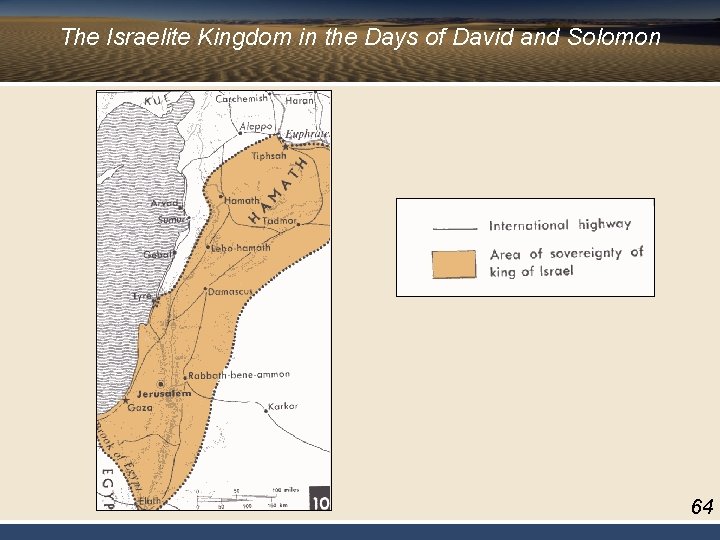
The Israelite Kingdom in the Days of David and Solomon 64
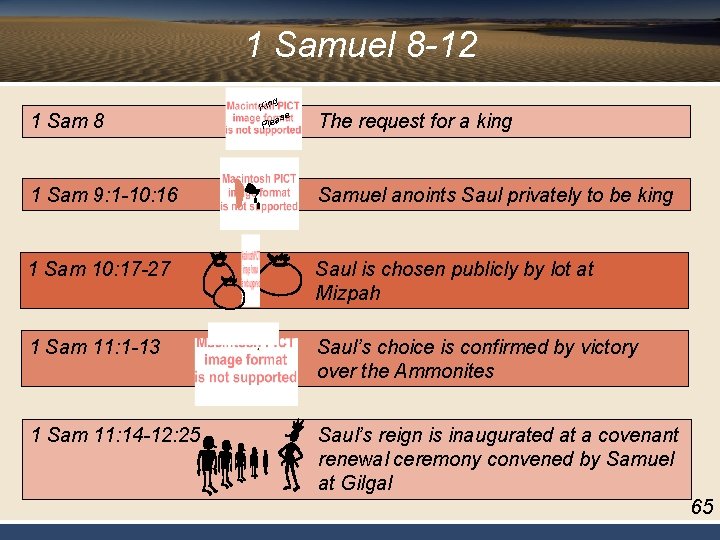
1 Samuel 8 -12 1 Sam 8 g Kin ase Ple The request for a king 1 Sam 9: 1 -10: 16 Samuel anoints Saul privately to be king 1 Sam 10: 17 -27 Saul is chosen publicly by lot at Mizpah 1 Sam 11: 1 -13 Saul’s choice is confirmed by victory over the Ammonites 1 Sam 11: 14 -12: 25 Saul’s reign is inaugurated at a covenant renewal ceremony convened by Samuel at Gilgal 65
The Literary Criticism of 1 Samuel 8 -12 Early Source – “Pro-Monarchy” 1 Samuel 9: 1 -10: 16 *1 Samuel 11: 1 -15 Late Source – “Anti-Monarchy” 1 Samuel 8: 1 -22 *1 Samuel 10: 17 -27 1 Samuel 12: 1 -25 * Two conflicting accounts of the inauguration of Saul 1 Samuel 11: 14 is viewed as a “redactional insertion” to provide a link between the two sources. Thus the use of the term “renew”. 66
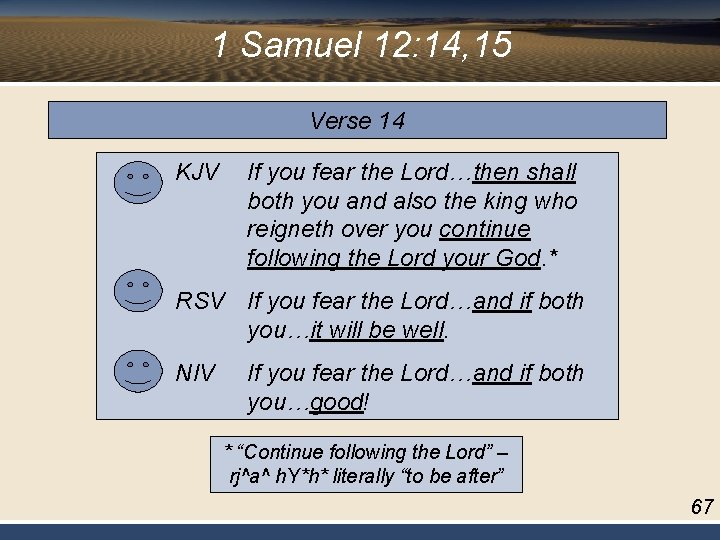
1 Samuel 12: 14, 15 Verse 14 KJV If you fear the Lord…then shall both you and also the king who reigneth over you continue following the Lord your God. * RSV If you fear the Lord…and if both you…it will be well. NIV If you fear the Lord…and if both you…good! * “Continue following the Lord” – rj^a^ h. Y*h* literally “to be after” 67
1 Samuel 12: 14, 15 Verse 15 KJV But if you will not obey…then shall… RSV But if you will not hearken…then the hand… NIV But if you do not obey… ( hand will be… ) his 68
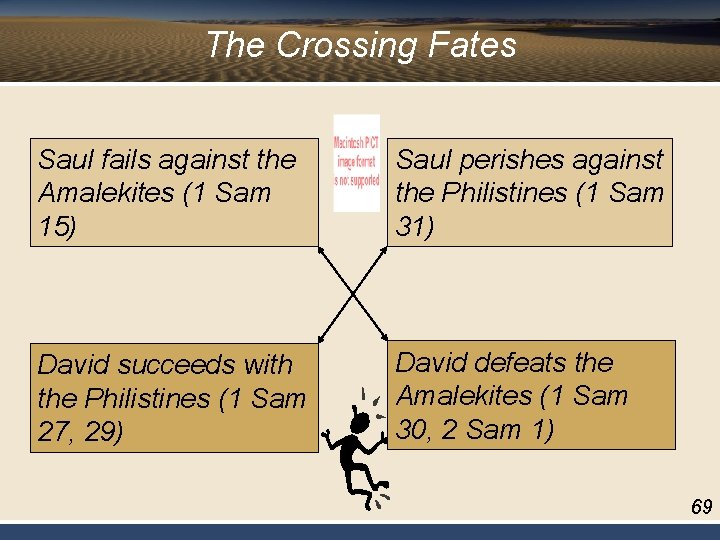
The Crossing Fates Saul fails against the Amalekites (1 Sam 15) Saul perishes against the Philistines (1 Sam 31) David succeeds with the Philistines (1 Sam 27, 29) David defeats the Amalekites (1 Sam 30, 2 Sam 1) 69
Assessment of the Kings of Israel and Judah Approval Hezekiah Josiah 2 Kings 18: 3 -7 2 Kings 22: 2; 23: 8 Qualified Approval Asa Jehoshaphat Jehoash Amaziah Azariah (Uzziah) Jotham 1 Kings 15: 11 -14 1 Kings 22: 43 2 Kings 12: 2, 3 2 Kings 14: 2, 3 2 Kings 15: 3, 4 2 Kings 15: 34, 35 Ahab Manasseh 1 Kings 21: 25 -29 (16: 242 Kings 21 Strongest 34) Disapproval 70
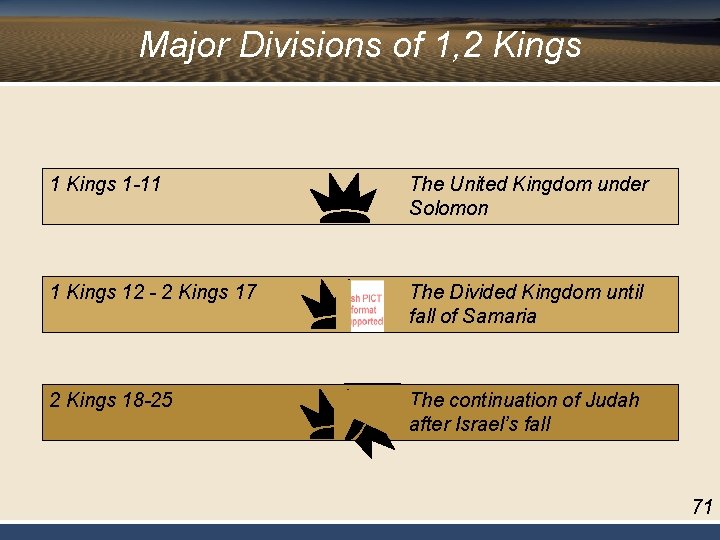
Major Divisions of 1, 2 Kings 1 -11 The United Kingdom under Solomon 1 Kings 12 - 2 Kings 17 The Divided Kingdom until fall of Samaria 2 Kings 18 -25 The continuation of Judah after Israel’s fall 71
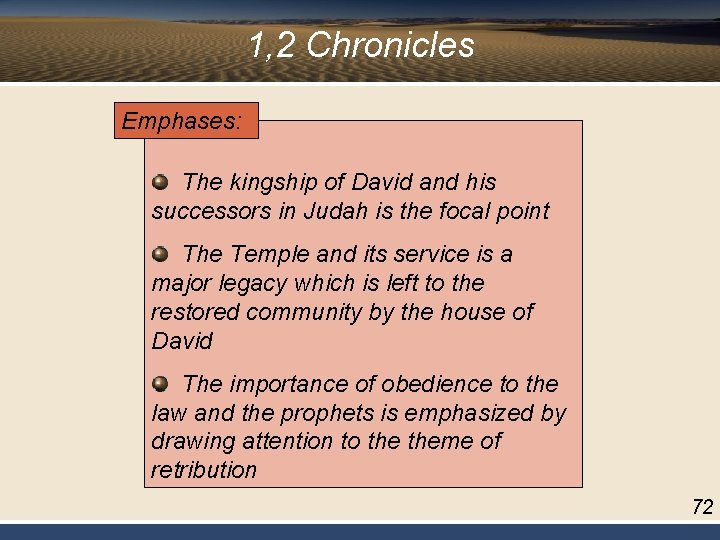
1, 2 Chronicles Emphases: The kingship of David and his successors in Judah is the focal point The Temple and its service is a major legacy which is left to the restored community by the house of David The importance of obedience to the law and the prophets is emphasized by drawing attention to theme of retribution 72