
EGU 2017 PICO presentation spot 5 b on
EGU 2017 PICO presentation spot 5 b on Wednesday, 26 Apr 2017, 15: 40 Environmental effects of a rare rain event in the high Arctic Magnus Lund (1), Jakob Abermann (2), Kirstine Skov (1, 3) (1) Aarhus University, Arctic Research Centre, Department of Bioscience, Roskilde, Denmark (ml@bios. au. dk) (2) Asiaq - Greenland Survey, Nuuk, Greenland (jab@asiaq. gl) (3) University of Copenhagen, Center for Permafrost, Department of Geosciences and Natural Resource Management, Copenhagen, Denmark (ksk@bios. au. dk)
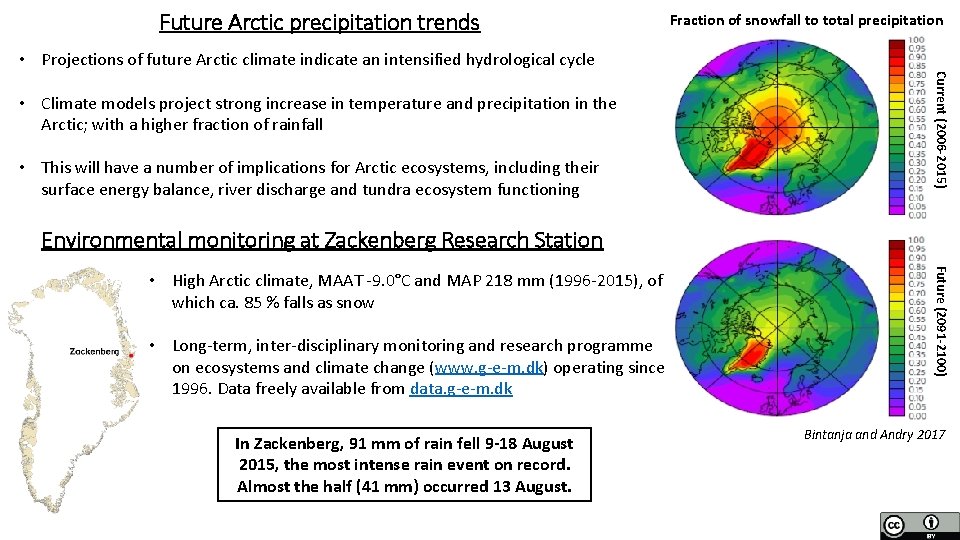
Future Arctic precipitation trends Fraction of snowfall to total precipitation • Projections of future Arctic climate indicate an intensified hydrological cycle • This will have a number of implications for Arctic ecosystems, including their surface energy balance, river discharge and tundra ecosystem functioning Current (2006 -2015) • Climate models project strong increase in temperature and precipitation in the Arctic; with a higher fraction of rainfall Environmental monitoring at Zackenberg Research Station • Long-term, inter-disciplinary monitoring and research programme on ecosystems and climate change (www. g-e-m. dk) operating since 1996. Data freely available from data. g-e-m. dk In Zackenberg, 91 mm of rain fell 9 -18 August 2015, the most intense rain event on record. Almost the half (41 mm) occurred 13 August. Future (2091 -2100) • High Arctic climate, MAAT -9. 0°C and MAP 218 mm (1996 -2015), of which ca. 85 % falls as snow Bintanja and Andry 2017
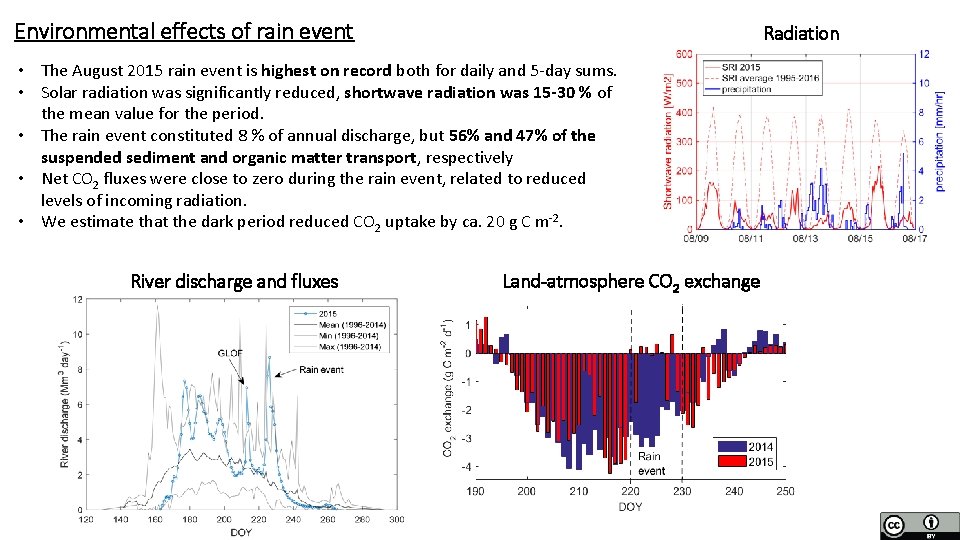
Environmental effects of rain event Radiation • The August 2015 rain event is highest on record both for daily and 5 -day sums. • Solar radiation was significantly reduced, shortwave radiation was 15 -30 % of the mean value for the period. • The rain event constituted 8 % of annual discharge, but 56% and 47% of the suspended sediment and organic matter transport, respectively • Net CO 2 fluxes were close to zero during the rain event, related to reduced levels of incoming radiation. • We estimate that the dark period reduced CO 2 uptake by ca. 20 g C m-2. River discharge and fluxes Land-atmosphere CO 2 exchange
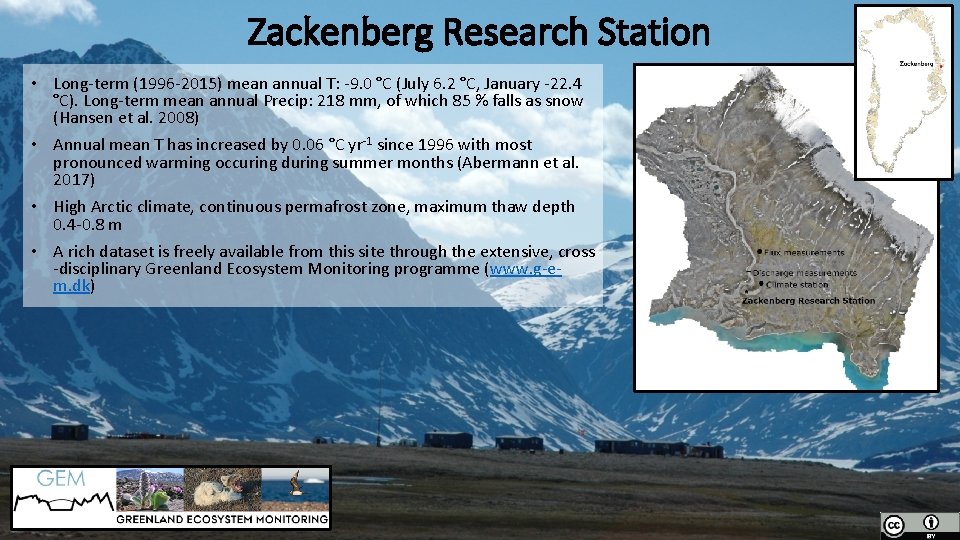
Zackenberg Research Station • Long-term (1996 -2015) mean annual T: -9. 0 °C (July 6. 2 °C, January -22. 4 °C). Long-term mean annual Precip: 218 mm, of which 85 % falls as snow (Hansen et al. 2008) • Annual mean T has increased by 0. 06 °C yr-1 since 1996 with most pronounced warming occuring during summer months (Abermann et al. 2017) • High Arctic climate, continuous permafrost zone, maximum thaw depth 0. 4 -0. 8 m • A rich dataset is freely available from this site through the extensive, cross -disciplinary Greenland Ecosystem Monitoring programme (www. g-em. dk)
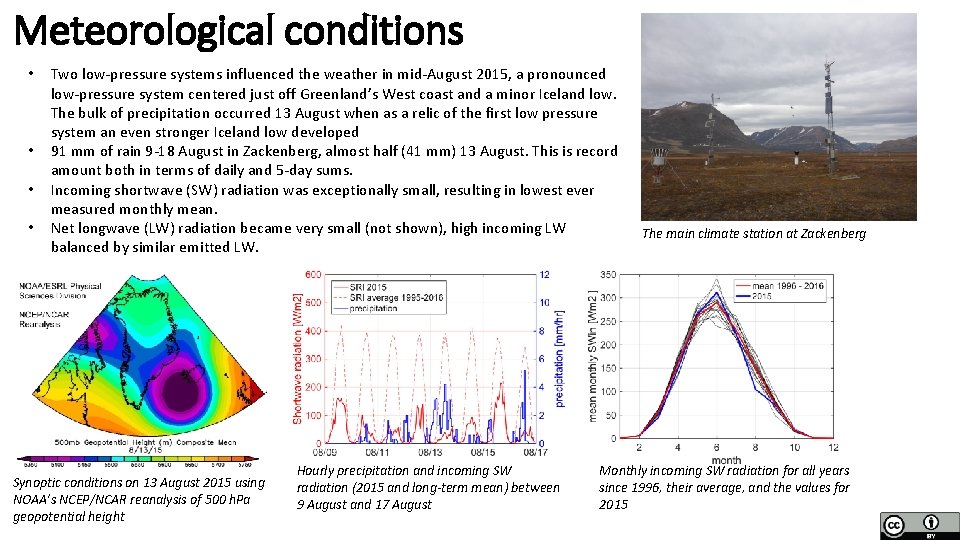
Meteorological conditions • • Two low-pressure systems influenced the weather in mid-August 2015, a pronounced low-pressure system centered just off Greenland’s West coast and a minor Iceland low. The bulk of precipitation occurred 13 August when as a relic of the first low pressure system an even stronger Iceland low developed 91 mm of rain 9 -18 August in Zackenberg, almost half (41 mm) 13 August. This is record amount both in terms of daily and 5 -day sums. Incoming shortwave (SW) radiation was exceptionally small, resulting in lowest ever measured monthly mean. Net longwave (LW) radiation became very small (not shown), high incoming LW balanced by similar emitted LW. Synoptic conditions on 13 August 2015 using NOAA’s NCEP/NCAR reanalysis of 500 h. Pa geopotential height Hourly precipitation and incoming SW radiation (2015 and long-term mean) between 9 August and 17 August The main climate station at Zackenberg Monthly incoming SW radiation for all years since 1996, their average, and the values for 2015
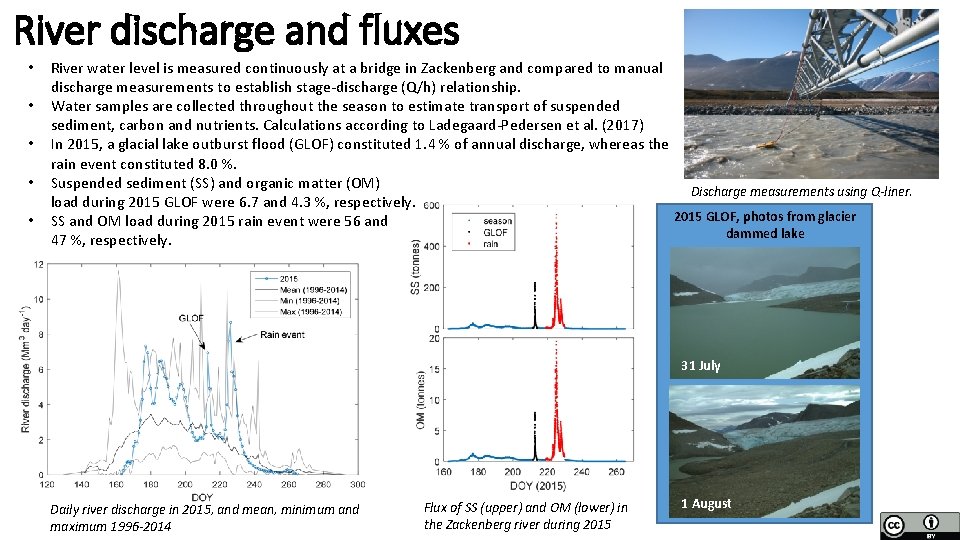
River discharge and fluxes • • • River water level is measured continuously at a bridge in Zackenberg and compared to manual discharge measurements to establish stage-discharge (Q/h) relationship. Water samples are collected throughout the season to estimate transport of suspended sediment, carbon and nutrients. Calculations according to Ladegaard-Pedersen et al. (2017) In 2015, a glacial lake outburst flood (GLOF) constituted 1. 4 % of annual discharge, whereas the rain event constituted 8. 0 %. Suspended sediment (SS) and organic matter (OM) Discharge measurements using Q-liner. load during 2015 GLOF were 6. 7 and 4. 3 %, respectively. 2015 GLOF, photos from glacier SS and OM load during 2015 rain event were 56 and dammed lake 47 %, respectively. 31 July Daily river discharge in 2015, and mean, minimum and maximum 1996 -2014 Flux of SS (upper) and OM (lower) in the Zackenberg river during 2015 1 August
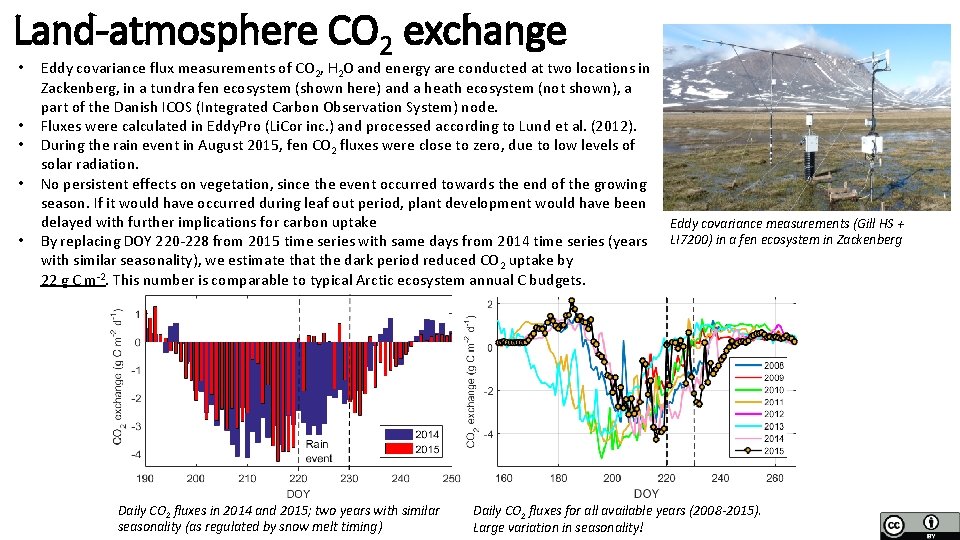
Land-atmosphere CO 2 exchange • • • Eddy covariance flux measurements of CO 2, H 2 O and energy are conducted at two locations in Zackenberg, in a tundra fen ecosystem (shown here) and a heath ecosystem (not shown), a part of the Danish ICOS (Integrated Carbon Observation System) node. Fluxes were calculated in Eddy. Pro (Li. Cor inc. ) and processed according to Lund et al. (2012). During the rain event in August 2015, fen CO 2 fluxes were close to zero, due to low levels of solar radiation. No persistent effects on vegetation, since the event occurred towards the end of the growing season. If it would have occurred during leaf out period, plant development would have been delayed with further implications for carbon uptake By replacing DOY 220 -228 from 2015 time series with same days from 2014 time series (years with similar seasonality), we estimate that the dark period reduced CO 2 uptake by 22 g C m-2. This number is comparable to typical Arctic ecosystem annual C budgets. Daily CO 2 fluxes in 2014 and 2015; two years with similar seasonality (as regulated by snow melt timing) Eddy covariance measurements (Gill HS + LI 7200) in a fen ecosystem in Zackenberg Daily CO 2 fluxes for all available years (2008 -2015). Large variation in seasonality!
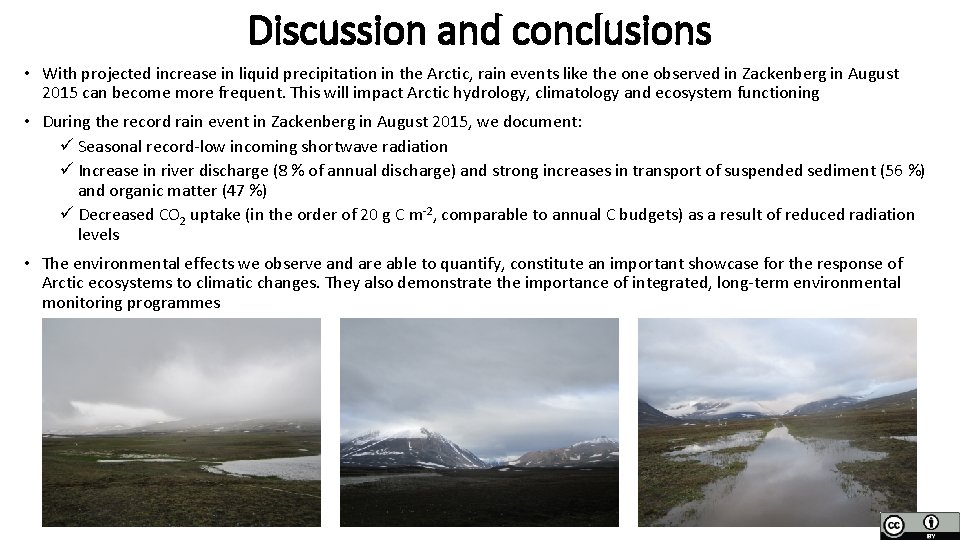
Discussion and conclusions • With projected increase in liquid precipitation in the Arctic, rain events like the one observed in Zackenberg in August 2015 can become more frequent. This will impact Arctic hydrology, climatology and ecosystem functioning • During the record rain event in Zackenberg in August 2015, we document: ü Seasonal record-low incoming shortwave radiation ü Increase in river discharge (8 % of annual discharge) and strong increases in transport of suspended sediment (56 %) and organic matter (47 %) ü Decreased CO 2 uptake (in the order of 20 g C m-2, comparable to annual C budgets) as a result of reduced radiation levels • The environmental effects we observe and are able to quantify, constitute an important showcase for the response of Arctic ecosystems to climatic changes. They also demonstrate the importance of integrated, long-term environmental monitoring programmes
References • Abermann J, Hansen B, Lund M, Wacker S, Karami M & Cappelen J. 2017. Hotspots and key periods of Greenland climate change during the past six decades. Ambio 46: 3 -11 • Bintanja R & Andry O. 2017. Towards a rain-dominated Arctic. Nature Climate Change 7: 263 -268 • Hansen BU, Sigsgaard C, Rasmussen L, Cappelen J, Hinkler J, Mernild SH, Petersen D, Tamstorf MP, Rasch M & Hasholt B. 2008. Present-Day Climate at Zackenberg. Advances in Ecological Research 40: 111 -149 • Ladegaard-Pedersen P, Sigsgaard C, Kroon A, Abermann J, Skov K & Elberling B. 2017. Suspended sediment in a high-Arctic river: An appraisal of flux estimation methods. Science of the Total Environment 580: 582 -592 • Lund M, Falk JM, Friborg T, Njuabe H, Sigsgaard C, Soegaard H & Tamstorf MP. 2012. Trends in CO 2 exchange in a high Arctic tundra heath, 2000 -2010. Journal of Geophysical Research 117: G 2, G 02001
- Slides: 9