
EGR 1101 Unit 13 Lecture 1 SecondOrder Differential
![MATLAB Commands for Example #2 >>fplot('1/(1 -0. 9^2)*(cos(0. 9*t)-cos(t))', [0 200]) ¡ To investigate](https://slidetodoc.com/presentation_image_h/23aaf3f9d550923e0d70cfb1ad0e08f1/image-7.jpg "MATLAB Commands for Example #2 >>fplot('1/(1 -0. 9^2)*(cos(0. 9*t)-cos(t))', [0 200]) ¡ To investigate")
- Slides: 13
EGR 1101: Unit 13 Lecture #1 Second-Order Differential Equations in Mechanical Systems (Section 10. 5 of Rattan/Klingbeil text)
Review: Procedure ¡ Steps in solving a linear ordinary differential equation with constant coefficients: 1. 2. 3. 4. Find the transient solution. Find the steady-state solution. Find the total solution by adding the results of Steps 1 and 2. Apply initial conditions (if given) to evaluate unknown constants that arose in the previous steps.
Forcing Function = 0? ¡ ¡ Recall that if the forcing function (the righthand side of your differential equation) is equal to 0, then the steady-state solution is also 0. In such cases, you get to skip straight from Step 1 to Step 3!
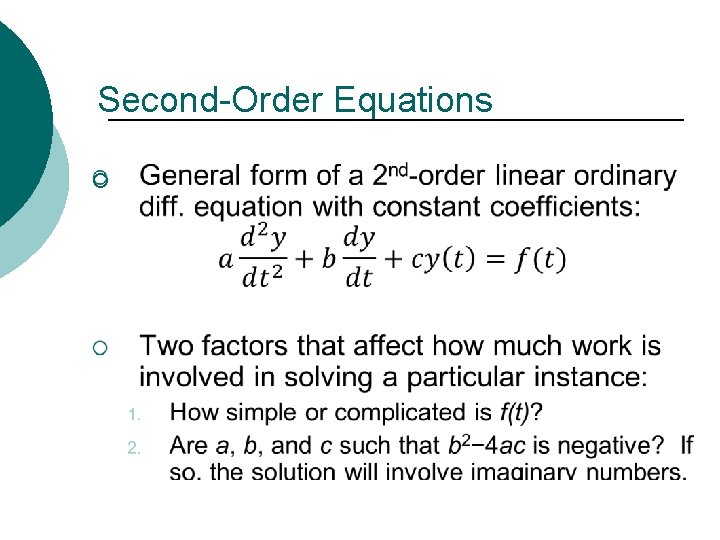
Second-Order Equations ¡
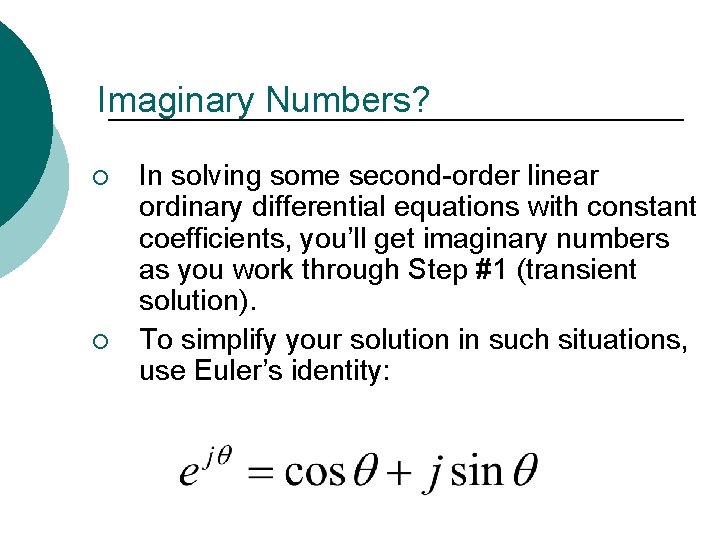
Imaginary Numbers? ¡ ¡ In solving some second-order linear ordinary differential equations with constant coefficients, you’ll get imaginary numbers as you work through Step #1 (transient solution). To simplify your solution in such situations, use Euler’s identity:
Today’s Examples 1. 2. Free vibration of a spring-mass system Forced vibration of a spring-mass system
MATLAB Commands for Example #2 >>fplot('1/(1 -0. 9^2)*(cos(0. 9*t)-cos(t))', [0 200]) ¡ To investigate the system’s behavior as the forcing frequency approaches the system’s natural frequency, change the two occurrences of 0. 9 in this command to 0. 99, and then change to 0. 999.
Resonance at work ¡ Glass shattered by resonance: http: //www. youtube. com/watch? v=17 tq. Xgv. CN 0 E ¡ Tacoma Narrows Bridge collapse: http: //www. youtube. com/watch? v=3 mclp 9 Qm. CGs
EGR 1101: Unit 13 Lecture #2 Second-Order Differential Equations in Electrical Systems (Section 10. 5 of Rattan/Klingbeil text)
Low-Pass and High-Pass Filters ¡ ¡ A low-pass filter is a circuit that passes low-frequency signals and blocks highfrequency signals. A high-pass filter is a circuit that does just the opposite: it blocks low-frequency signals and passes high-frequency signals.
Today’s Examples 1. Second-order low-pass filter
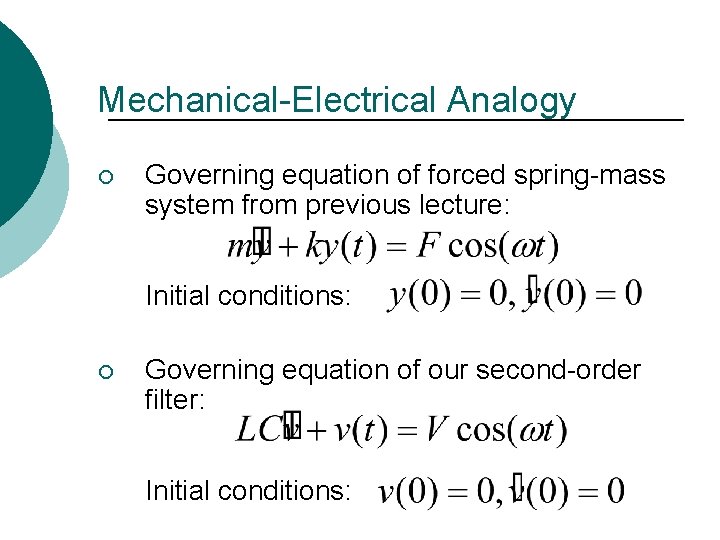
Mechanical-Electrical Analogy ¡ Governing equation of forced spring-mass system from previous lecture: Initial conditions: ¡ Governing equation of our second-order filter: Initial conditions:
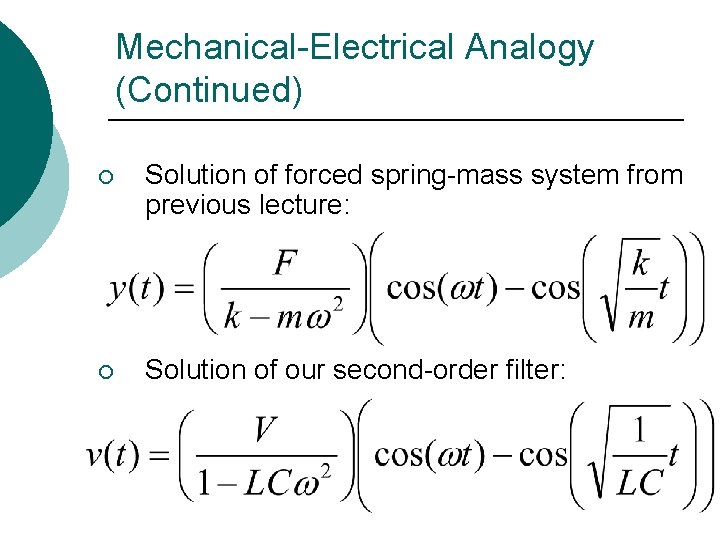
Mechanical-Electrical Analogy (Continued) ¡ Solution of forced spring-mass system from previous lecture: ¡ Solution of our second-order filter: