
EGM 5653 CHAPTER 4 Inelastic Material Behavior EGM
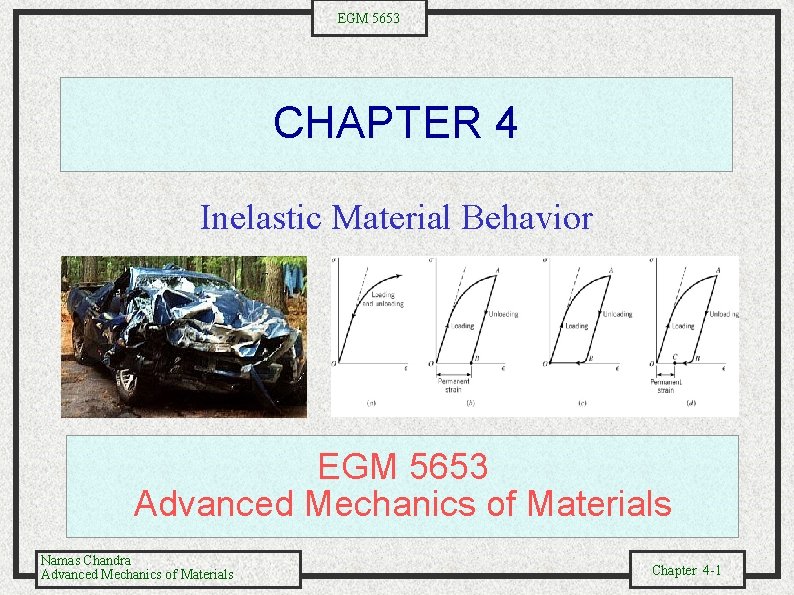
EGM 5653 CHAPTER 4 Inelastic Material Behavior EGM 5653 Advanced Mechanics of Materials Namas Chandra Advanced Mechanics of Materials Chapter 4 -1
EGM 5653 Objectives Nonlinear material behavior Yield criteria Yielding in ductile materials Sections 4. 1 Limitations of Uniaxial Stress- Strain data 4. 2 Nonlinear Material Response 4. 3 Yield Criteria : General Concepts 4. 4 Yielding of Ductile Materials 4. 5 Alternative Yield Criteria 4. 6 General Yielding Namas Chandra Advanced Mechanics of Materials Chapter 4 -2
EGM 5653 Introduction ØWhen a material is elastic, it returns to the same state (at macroscopic, microscopic and atomistic levels) upon removal of all external load ØAny material is not elastic can be assumed to be inelastic E. g. . Viscoelastic, Viscoplastic, and plastic Ø To use the measured quantities like yield strength etc. we need some criteria ØThe criterias are mathematical concepts motivated by strong experimental observations E. g. Ductile materials fail by shear stress on planes of maximum shear stress ØBrittle materials by direct tensile loading without much yielding Ø Other factors affecting material behavior - Temperature - Rate of loading - Loading/ Unloading cycles Namas Chandra Advanced Mechanics of Materials Chapter 4 -3
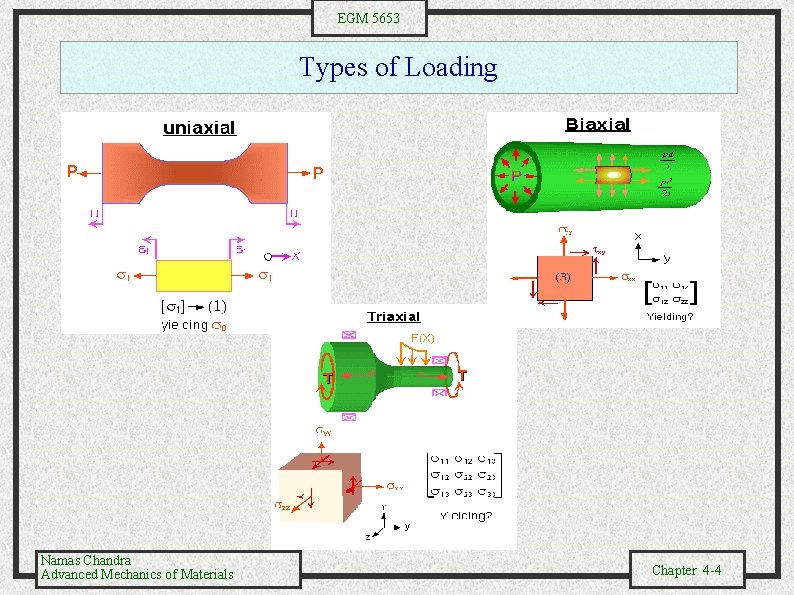
EGM 5653 Types of Loading Namas Chandra Advanced Mechanics of Materials Chapter 4 -4
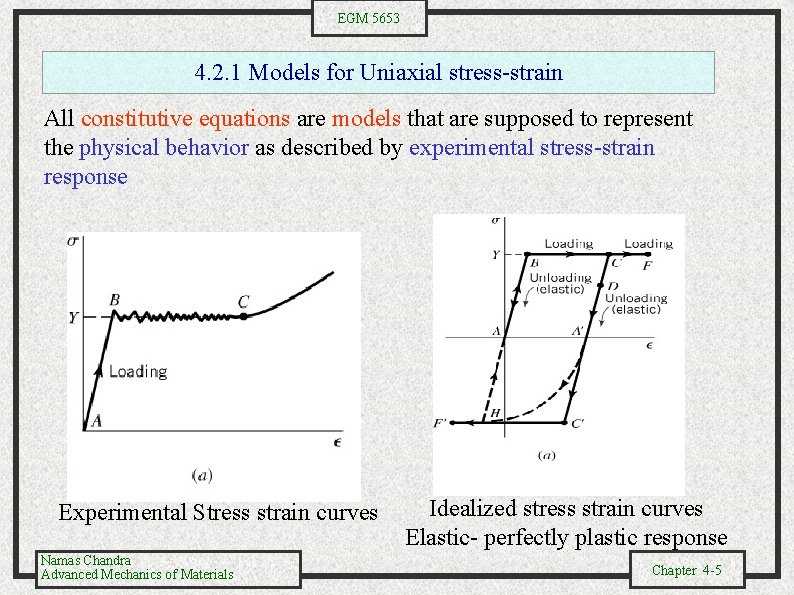
EGM 5653 4. 2. 1 Models for Uniaxial stress-strain All constitutive equations are models that are supposed to represent the physical behavior as described by experimental stress-strain response Experimental Stress strain curves Namas Chandra Advanced Mechanics of Materials Idealized stress strain curves Elastic- perfectly plastic response Chapter 4 -5
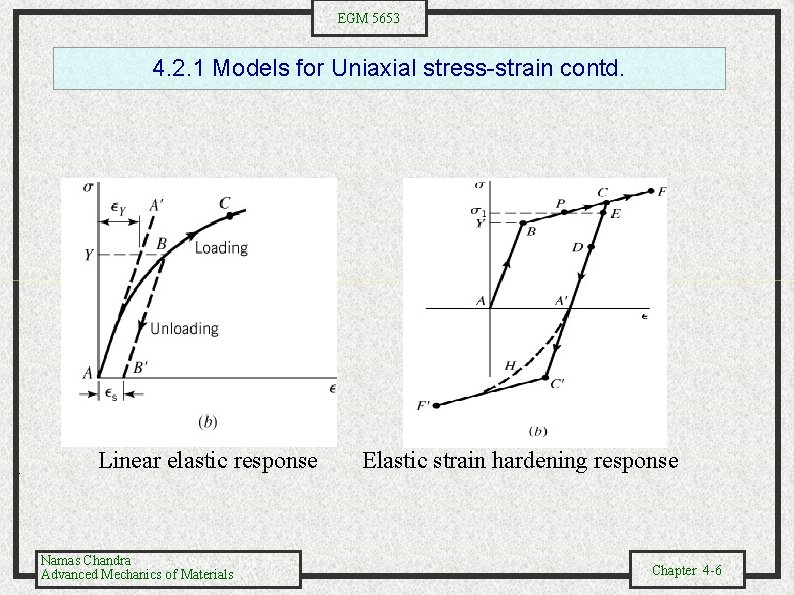
EGM 5653 4. 2. 1 Models for Uniaxial stress-strain contd. . Linear elastic response Namas Chandra Advanced Mechanics of Materials Elastic strain hardening response Chapter 4 -6
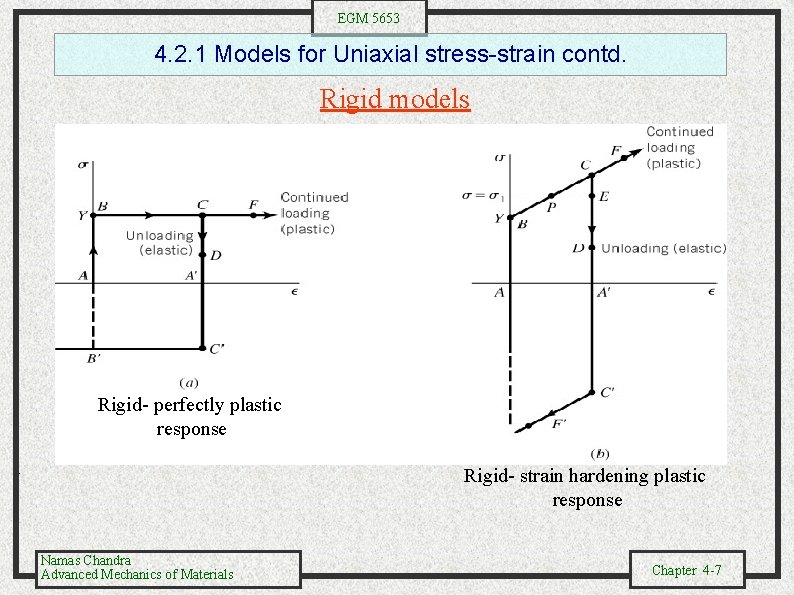
EGM 5653 4. 2. 1 Models for Uniaxial stress-strain contd. Rigid models Rigid- perfectly plastic response. Rigid- strain hardening plastic response Namas Chandra Advanced Mechanics of Materials Chapter 4 -7
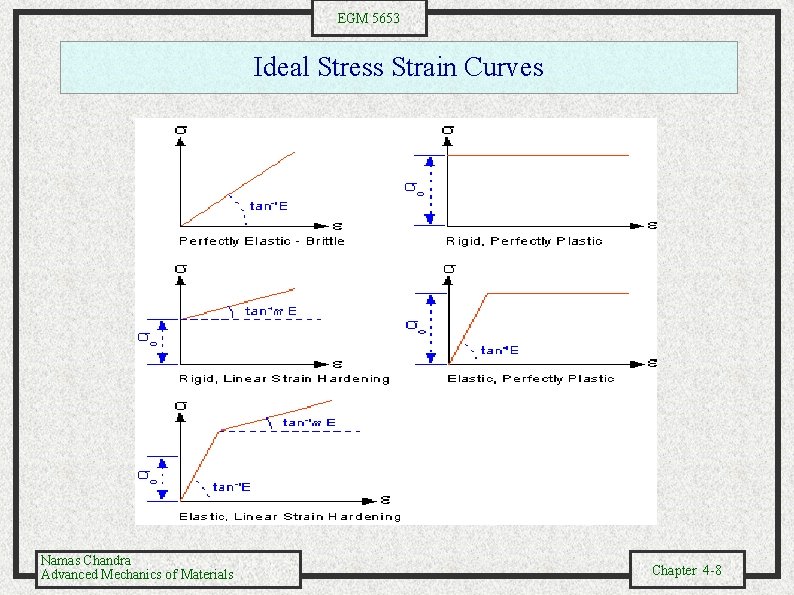
EGM 5653 Ideal Stress Strain Curves Namas Chandra Advanced Mechanics of Materials Chapter 4 -8
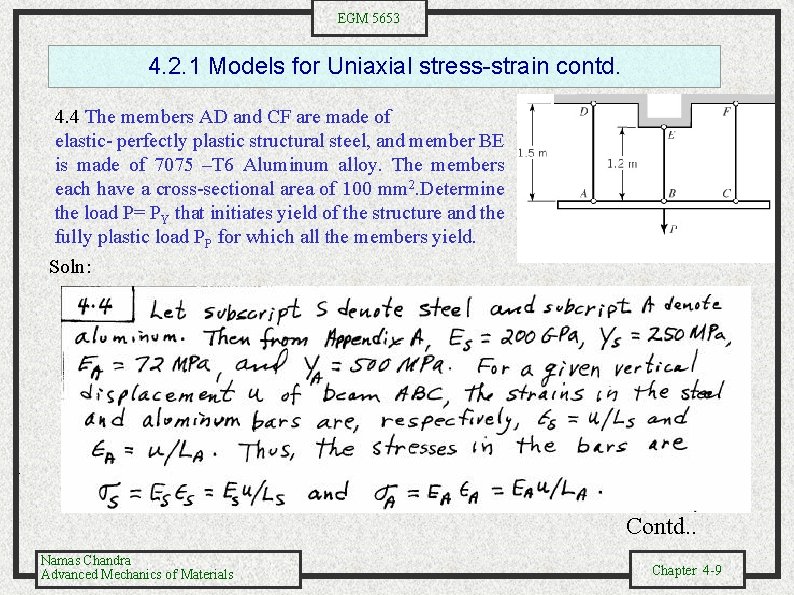
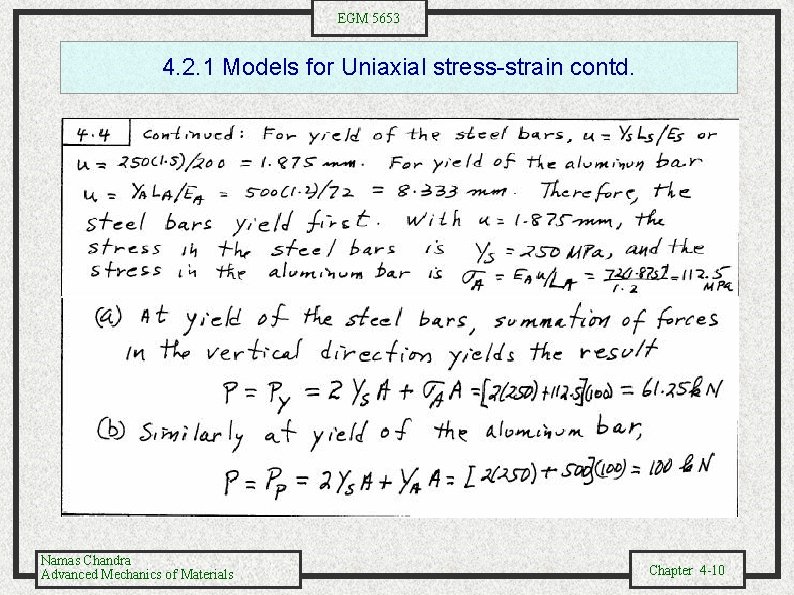
EGM 5653 4. 2. 1 Models for Uniaxial stress-strain contd. 4. 4 The members AD and CF are made of elastic- perfectly plastic structural steel, and member BE is made of 7075 –T 6 Aluminum alloy. The members each have a cross-sectional area of 100 mm 2. Determine the load P= PY that initiates yield of the structure and the fully plastic load PP for which all the members yield. Soln: . Contd. . Namas Chandra Advanced Mechanics of Materials Chapter 4 -9
EGM 5653 4. 2. 1 Models for Uniaxial stress-strain contd. Namas Chandra Advanced Mechanics of Materials Chapter 4 -10
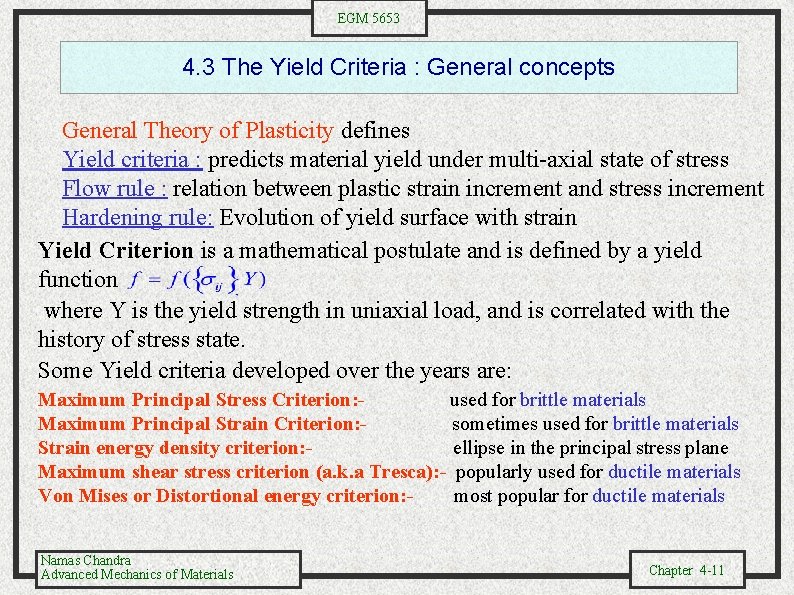
EGM 5653 4. 3 The Yield Criteria : General concepts General Theory of Plasticity defines Yield criteria : predicts material yield under multi-axial state of stress Flow rule : relation between plastic strain increment and stress increment Hardening rule: Evolution of yield surface with strain Yield Criterion is a mathematical postulate and is defined by a yield function where Y is the yield strength in uniaxial load, and is correlated with the history of stress state. Some Yield criteria developed over the years are: Maximum Principal Stress Criterion: used for brittle materials Maximum Principal Strain Criterion: sometimes used for brittle materials Strain energy density criterion: ellipse in the principal stress plane Maximum shear stress criterion (a. k. a Tresca): - popularly used for ductile materials Von Mises or Distortional energy criterion: most popular for ductile materials Namas Chandra Advanced Mechanics of Materials Chapter 4 -11
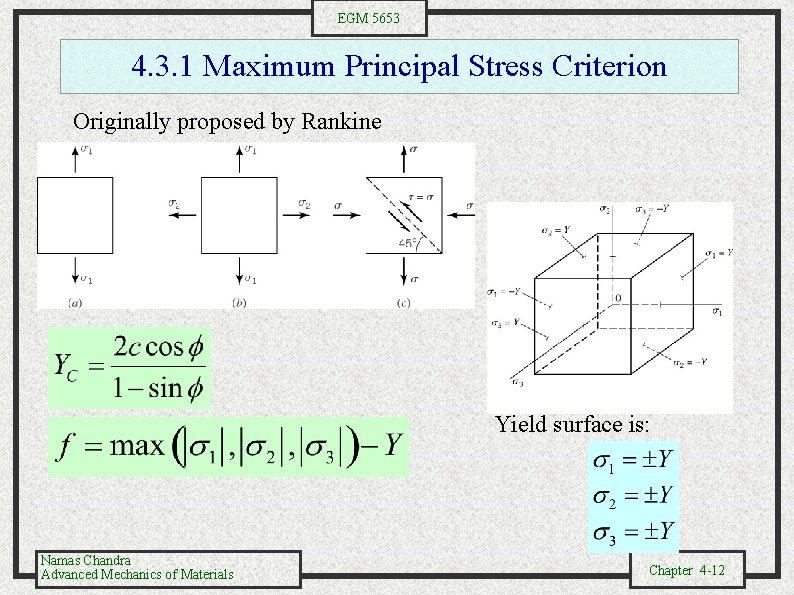
EGM 5653 4. 3. 1 Maximum Principal Stress Criterion Originally proposed by Rankine Yield surface is: Namas Chandra Advanced Mechanics of Materials Chapter 4 -12
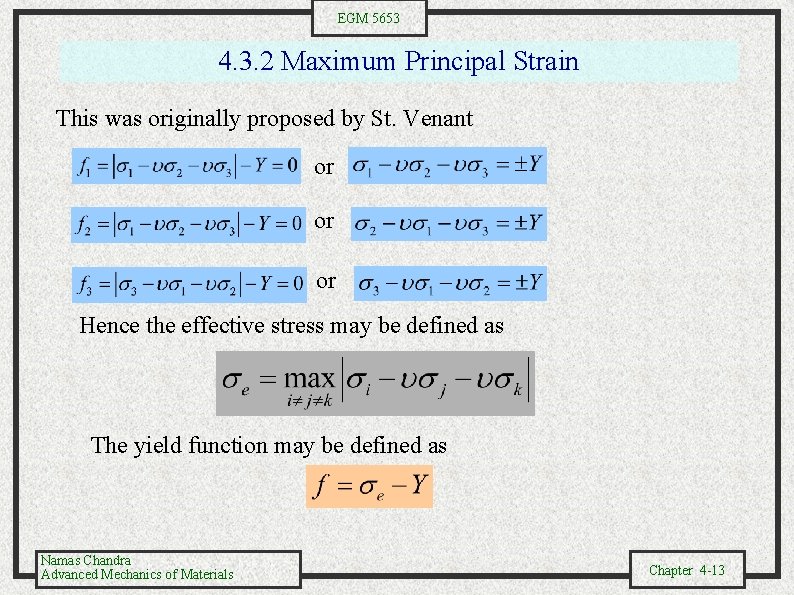
EGM 5653 4. 3. 2 Maximum Principal Strain This was originally proposed by St. Venant or or or Hence the effective stress may be defined as The yield function may be defined as Namas Chandra Advanced Mechanics of Materials Chapter 4 -13
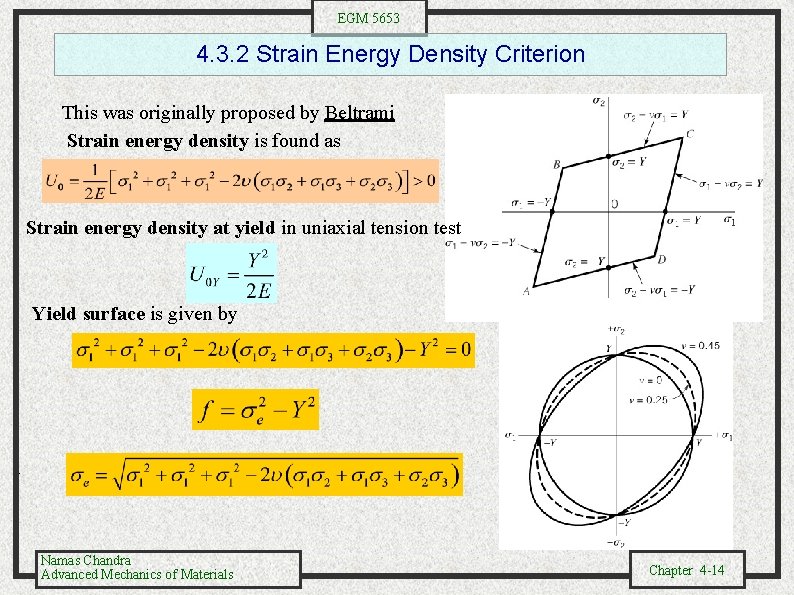
EGM 5653 4. 3. 2 Strain Energy Density Criterion This was originally proposed by Beltrami Strain energy density is found as Strain energy density at yield in uniaxial tension test Yield surface is given by . Namas Chandra Advanced Mechanics of Materials Chapter 4 -14
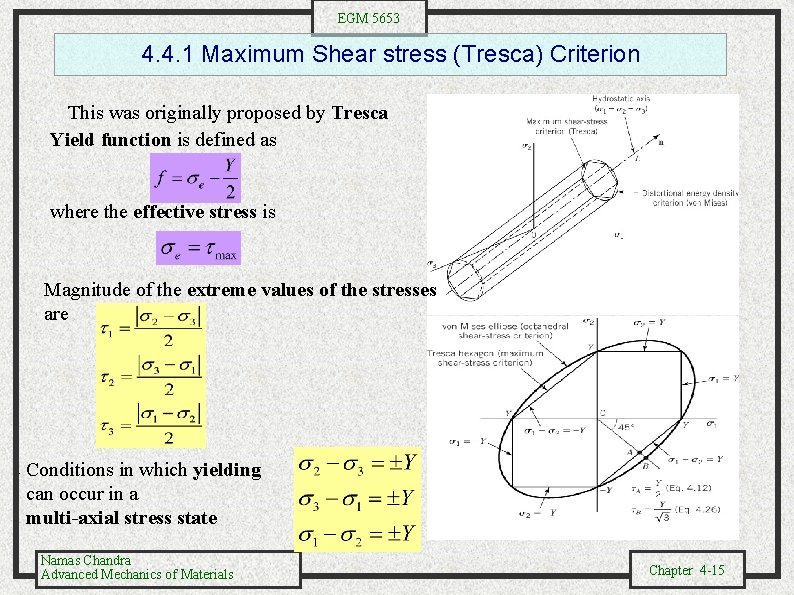
EGM 5653 4. 4. 1 Maximum Shear stress (Tresca) Criterion This was originally proposed by Tresca Yield function is defined as where the effective stress is Magnitude of the extreme values of the stresses are . Conditions in which yielding can occur in a multi-axial stress state Namas Chandra Advanced Mechanics of Materials Chapter 4 -15
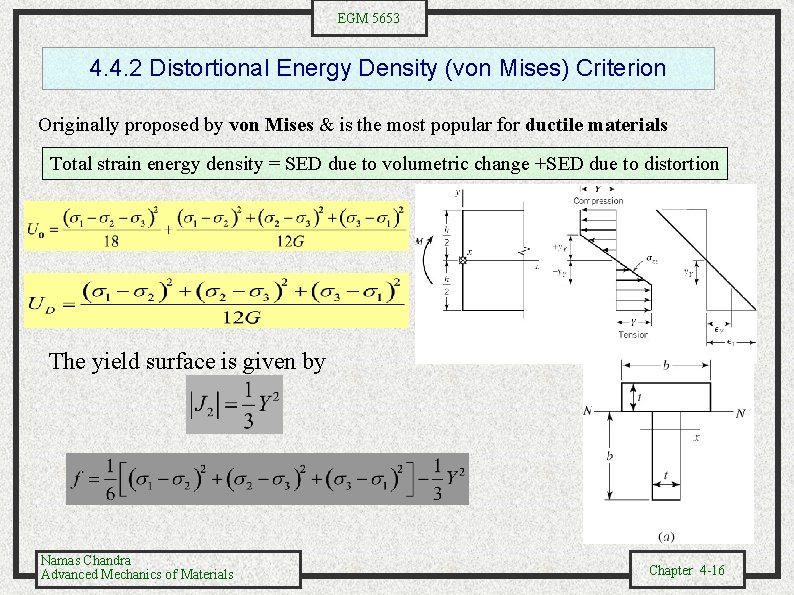
EGM 5653 4. 4. 2 Distortional Energy Density (von Mises) Criterion Originally proposed by von Mises & is the most popular for ductile materials Total strain energy density = SED due to volumetric change +SED due to distortion The yield surface is given by Namas Chandra Advanced Mechanics of Materials Chapter 4 -16
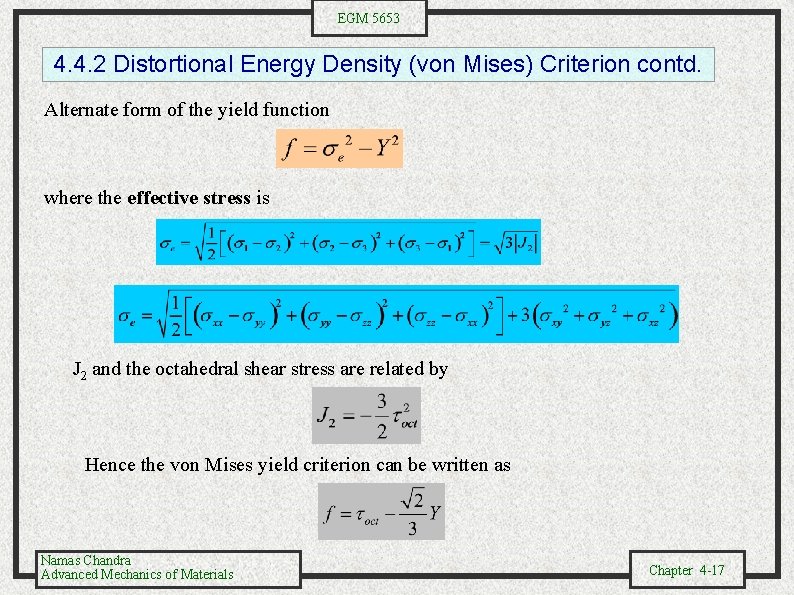
EGM 5653 4. 4. 2 Distortional Energy Density (von Mises) Criterion contd. Alternate form of the yield function where the effective stress is J 2 and the octahedral shear stress are related by Hence the von Mises yield criterion can be written as Namas Chandra Advanced Mechanics of Materials Chapter 4 -17
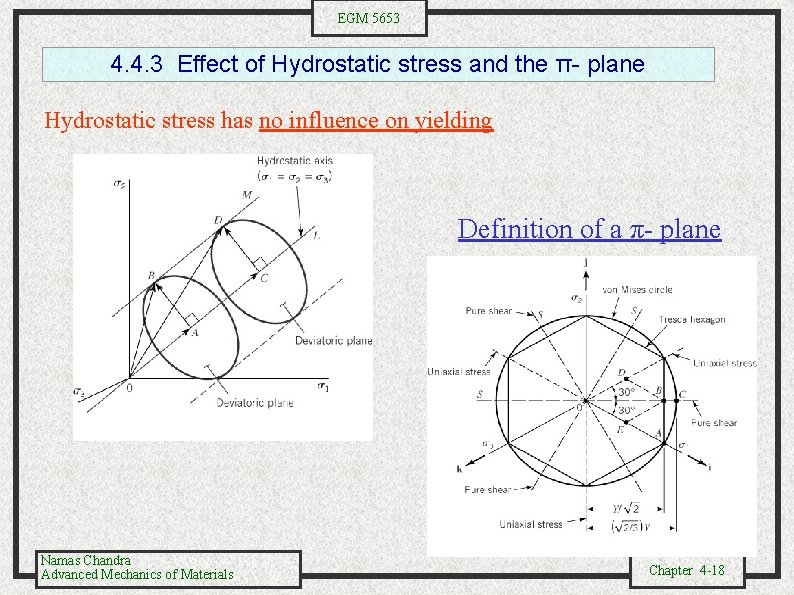
EGM 5653 4. 4. 3 Effect of Hydrostatic stress and the π- plane Hydrostatic stress has no influence on yielding Definition of a π- plane Namas Chandra Advanced Mechanics of Materials Chapter 4 -18
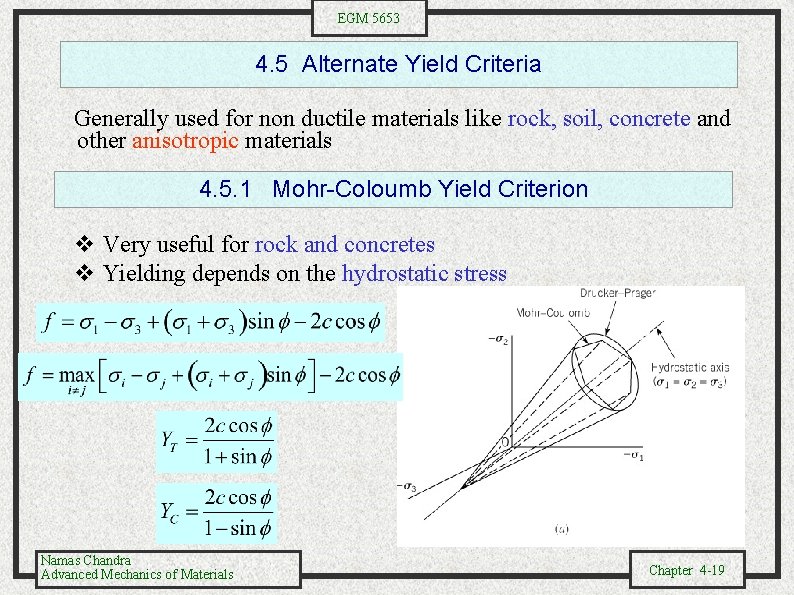
EGM 5653 4. 5 Alternate Yield Criteria Generally used for non ductile materials like rock, soil, concrete and other anisotropic materials 4. 5. 1 Mohr-Coloumb Yield Criterion v Very useful for rock and concretes v Yielding depends on the hydrostatic stress Namas Chandra Advanced Mechanics of Materials Chapter 4 -19
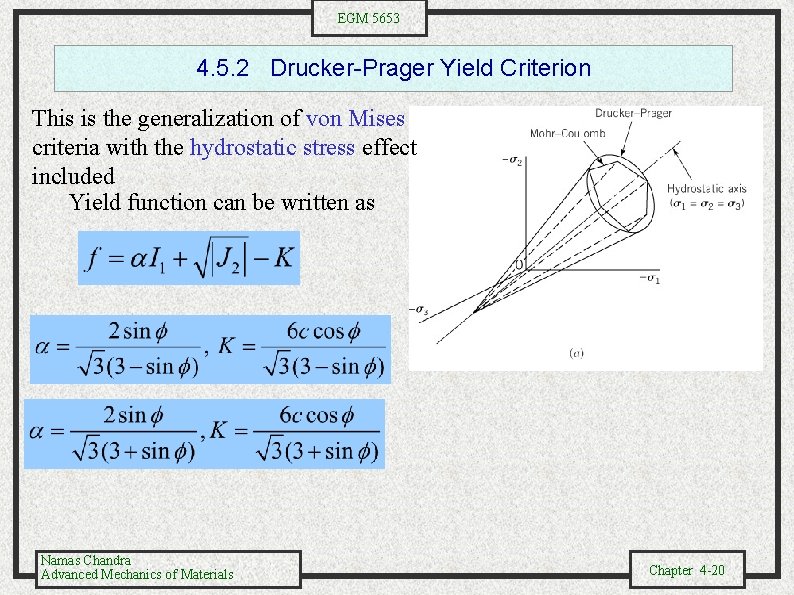
EGM 5653 4. 5. 2 Drucker-Prager Yield Criterion This is the generalization of von Mises criteria with the hydrostatic stress effect included Yield function can be written as Namas Chandra Advanced Mechanics of Materials Chapter 4 -20
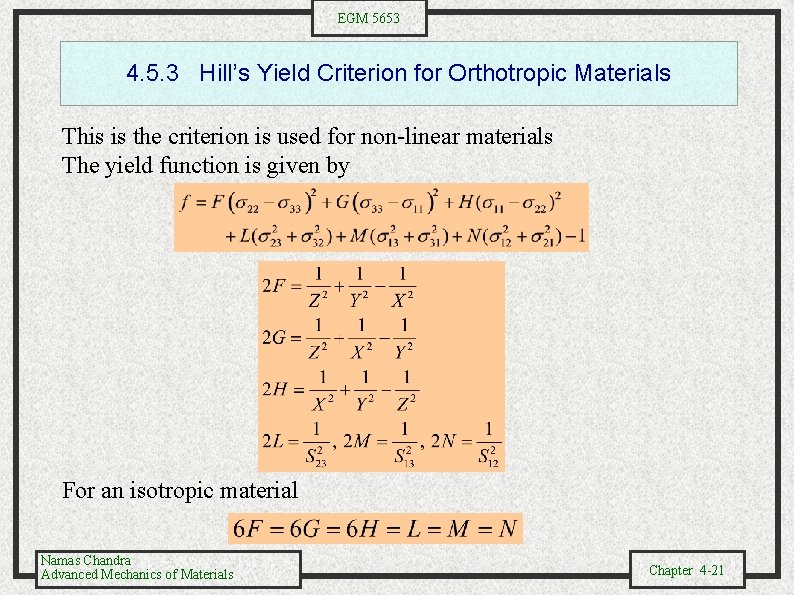
EGM 5653 4. 5. 3 Hill’s Yield Criterion for Orthotropic Materials This is the criterion is used for non-linear materials The yield function is given by For an isotropic material Namas Chandra Advanced Mechanics of Materials Chapter 4 -21
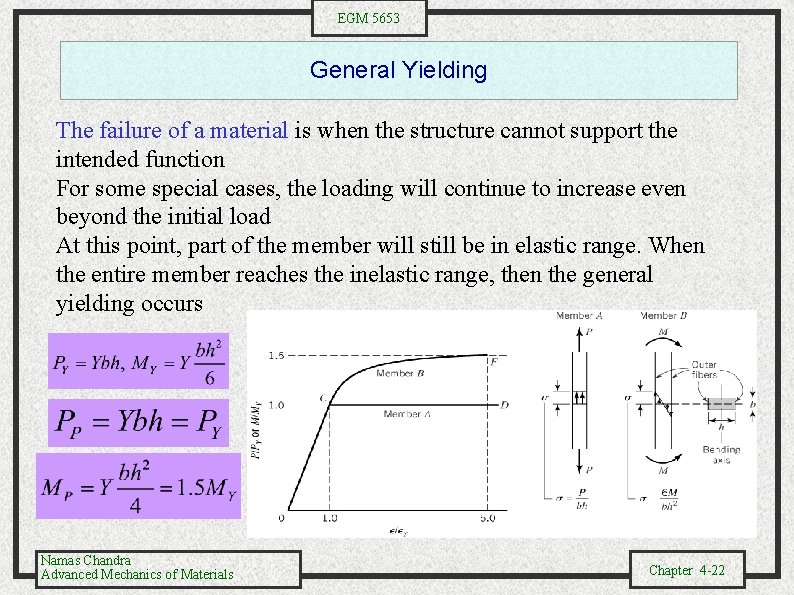
EGM 5653 General Yielding The failure of a material is when the structure cannot support the intended function For some special cases, the loading will continue to increase even beyond the initial load At this point, part of the member will still be in elastic range. When the entire member reaches the inelastic range, then the general yielding occurs Namas Chandra Advanced Mechanics of Materials Chapter 4 -22
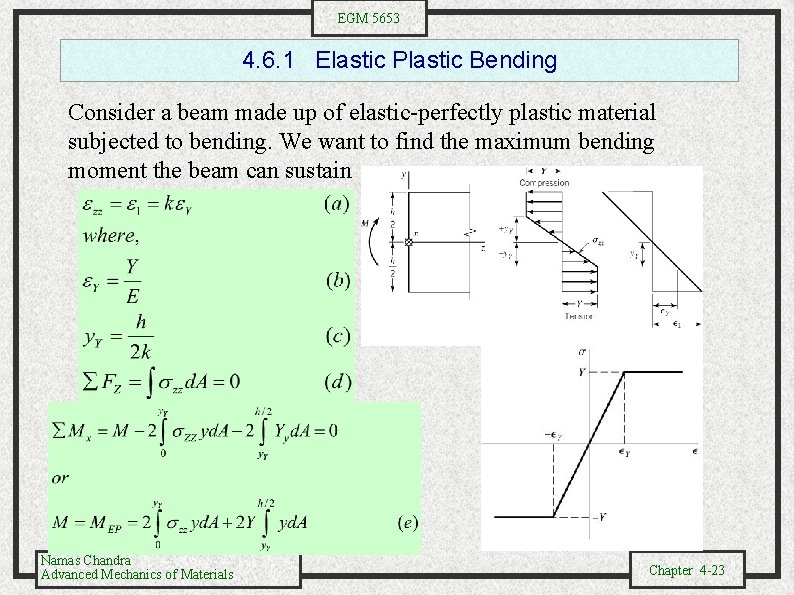
EGM 5653 4. 6. 1 Elastic Plastic Bending Consider a beam made up of elastic-perfectly plastic material subjected to bending. We want to find the maximum bending moment the beam can sustain Namas Chandra Advanced Mechanics of Materials Chapter 4 -23
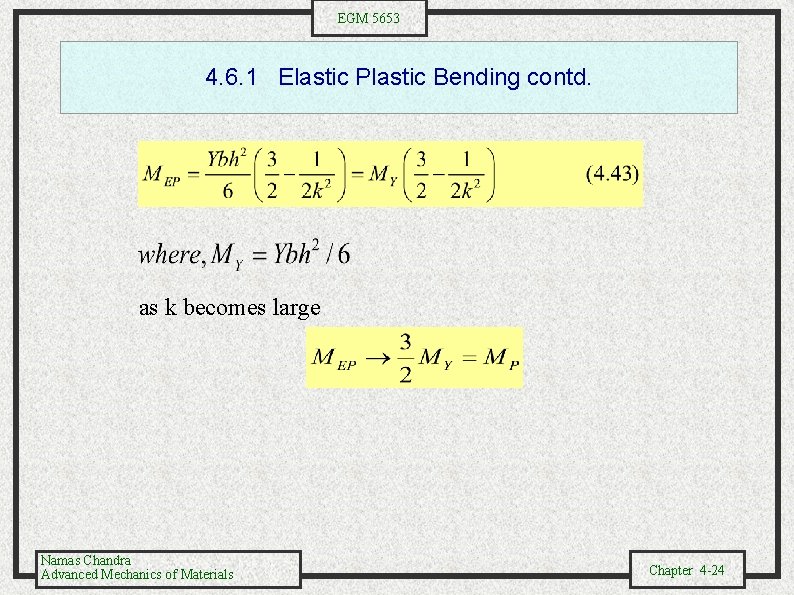
EGM 5653 4. 6. 1 Elastic Plastic Bending contd. as k becomes large Namas Chandra Advanced Mechanics of Materials Chapter 4 -24
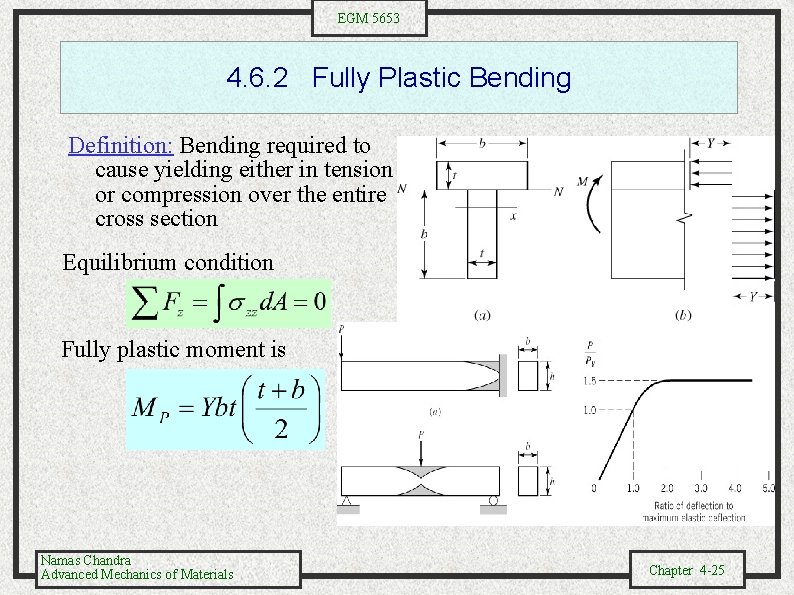
EGM 5653 4. 6. 2 Fully Plastic Bending Definition: Bending required to cause yielding either in tension or compression over the entire cross section Equilibrium condition Fully plastic moment is Namas Chandra Advanced Mechanics of Materials Chapter 4 -25
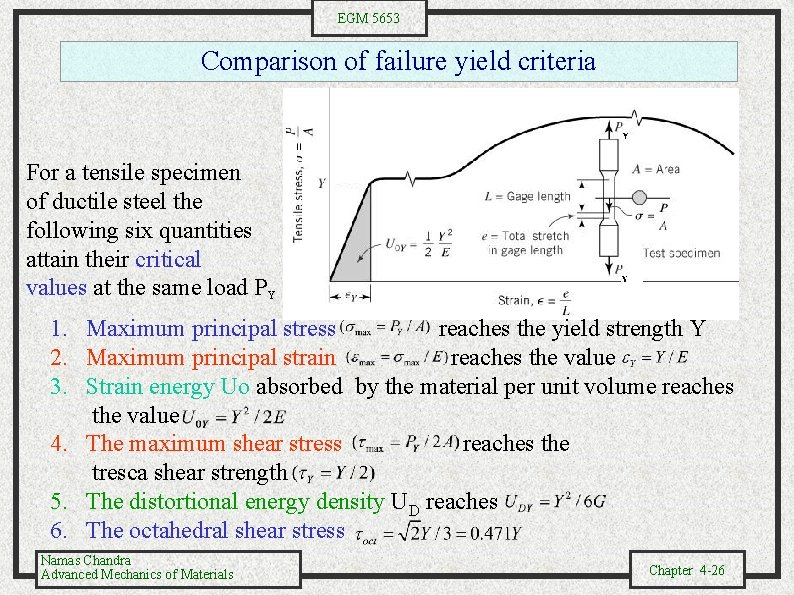
EGM 5653 Comparison of failure yield criteria For a tensile specimen of ductile steel the following six quantities attain their critical values at the same load PY 1. Maximum principal stress reaches the yield strength Y 2. Maximum principal strain reaches the value 3. Strain energy Uo absorbed by the material per unit volume reaches the value 4. The maximum shear stress reaches the tresca shear strength 5. The distortional energy density UD reaches 6. The octahedral shear stress Namas Chandra Advanced Mechanics of Materials Chapter 4 -26
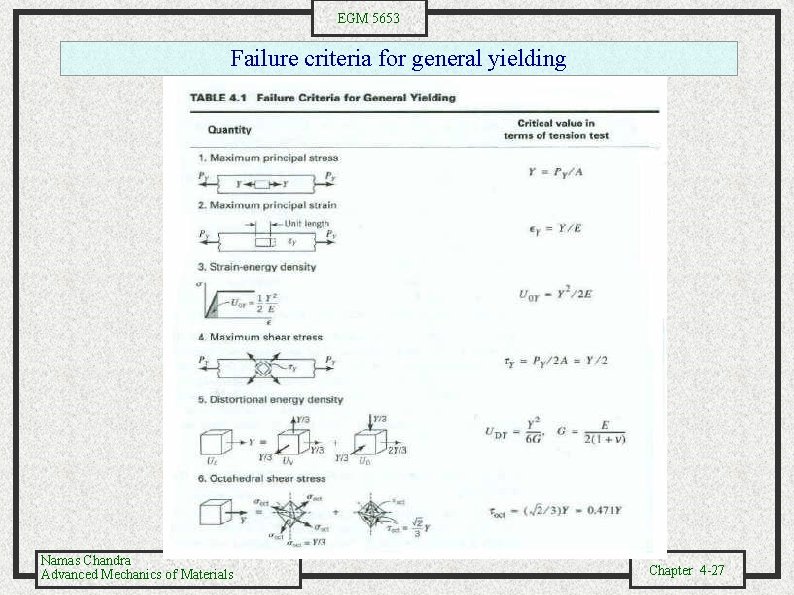
EGM 5653 Failure criteria for general yielding Namas Chandra Advanced Mechanics of Materials Chapter 4 -27
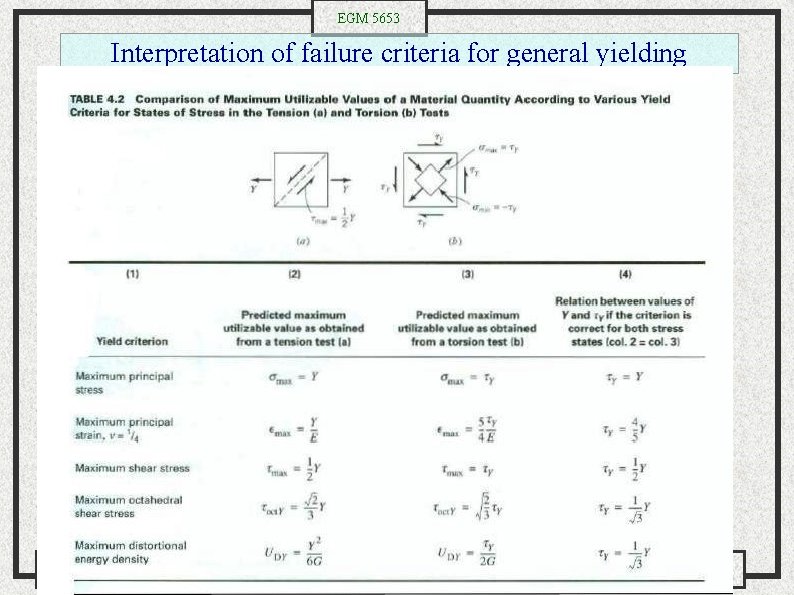
EGM 5653 Interpretation of failure criteria for general yielding Namas Chandra Advanced Mechanics of Materials Chapter 4 -28
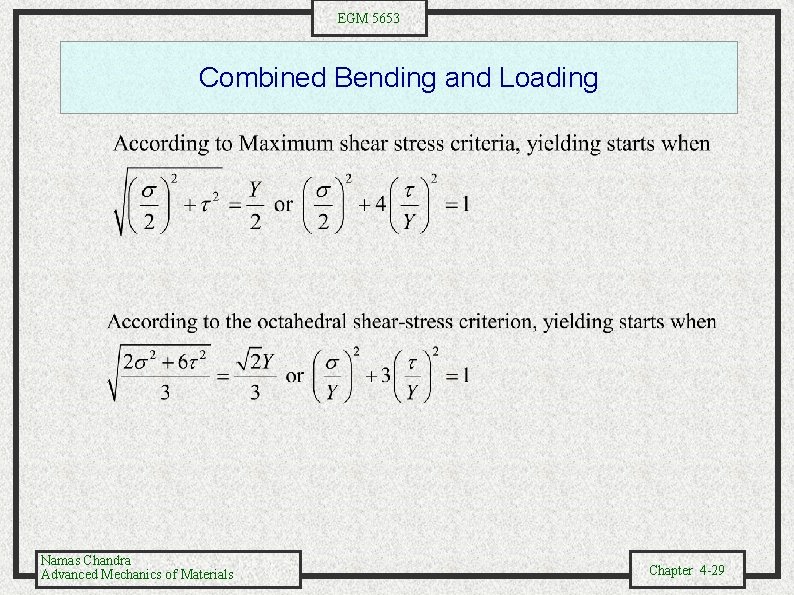
EGM 5653 Combined Bending and Loading Namas Chandra Advanced Mechanics of Materials Chapter 4 -29
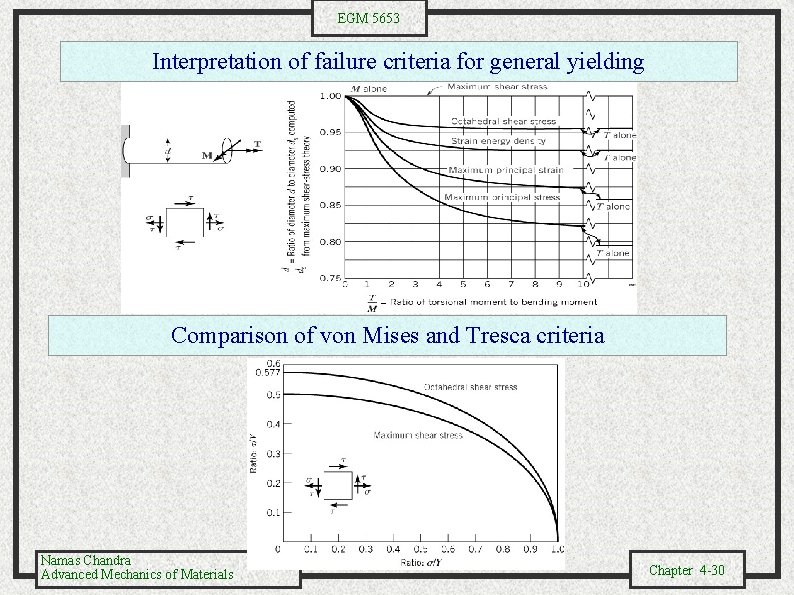
EGM 5653 Interpretation of failure criteria for general yielding Comparison of von Mises and Tresca criteria Namas Chandra Advanced Mechanics of Materials Chapter 4 -30
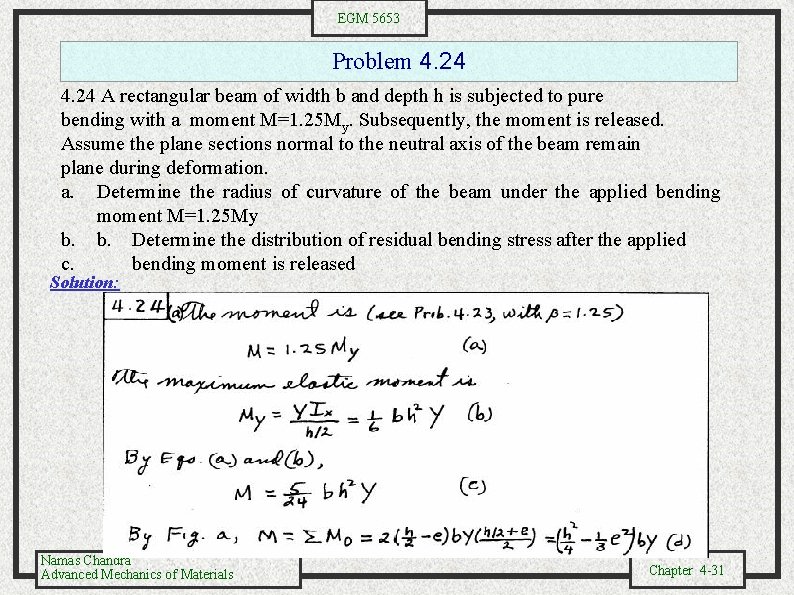
EGM 5653 Problem 4. 24 A rectangular beam of width b and depth h is subjected to pure bending with a moment M=1. 25 My. Subsequently, the moment is released. Assume the plane sections normal to the neutral axis of the beam remain plane during deformation. a. Determine the radius of curvature of the beam under the applied bending moment M=1. 25 My b. b. Determine the distribution of residual bending stress after the applied c. bending moment is released Solution: Namas Chandra Advanced Mechanics of Materials Chapter 4 -31
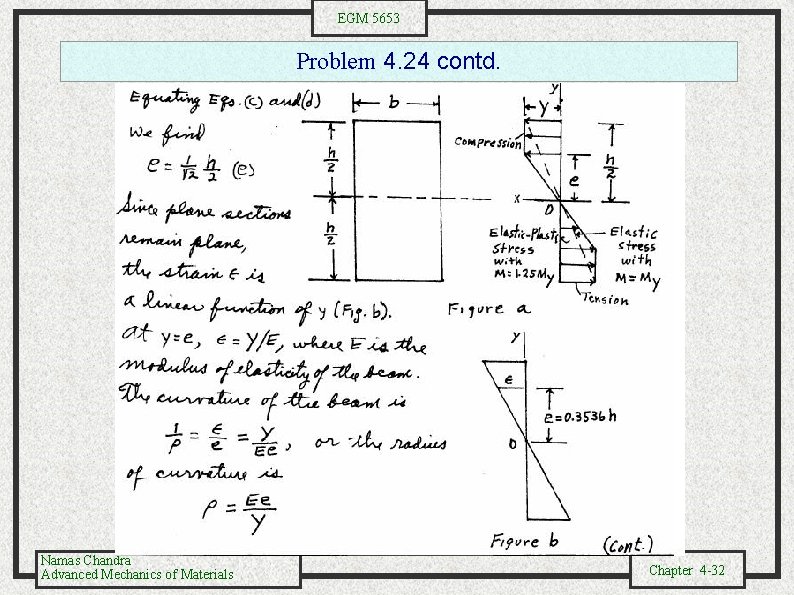
EGM 5653 Problem 4. 24 contd. Namas Chandra Advanced Mechanics of Materials Chapter 4 -32
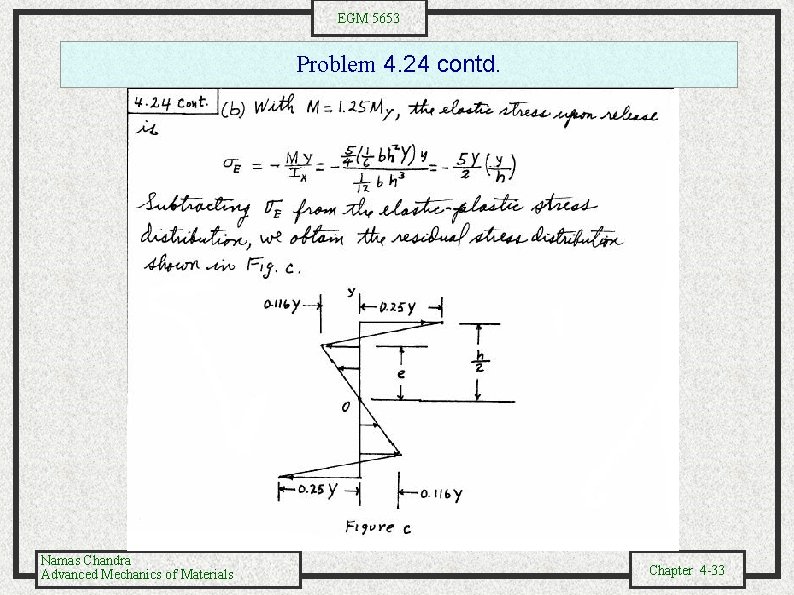
EGM 5653 Problem 4. 24 contd. Namas Chandra Advanced Mechanics of Materials Chapter 4 -33
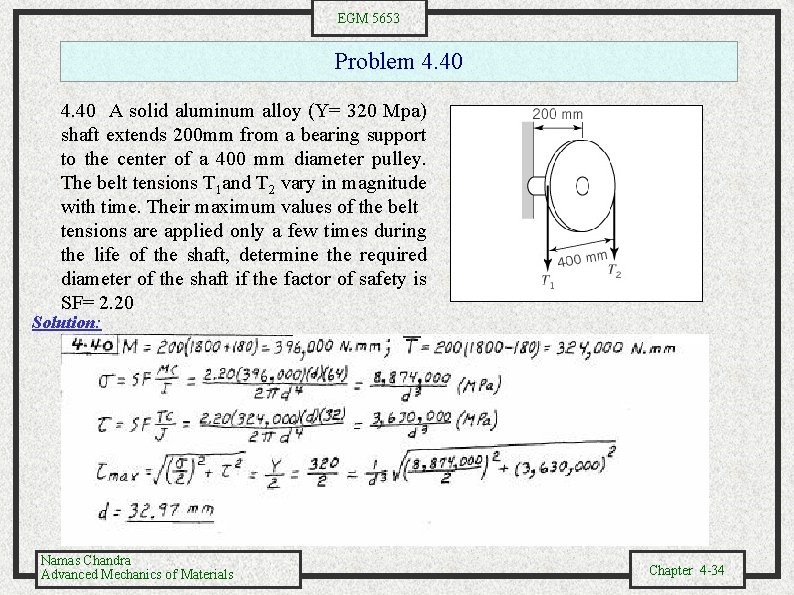
EGM 5653 Problem 4. 40 A solid aluminum alloy (Y= 320 Mpa) shaft extends 200 mm from a bearing support to the center of a 400 mm diameter pulley. The belt tensions T 1 and T 2 vary in magnitude with time. Their maximum values of the belt tensions are applied only a few times during the life of the shaft, determine the required diameter of the shaft if the factor of safety is SF= 2. 20 Solution: Namas Chandra Advanced Mechanics of Materials Chapter 4 -34
- Slides: 34