
Efficient Sampling of Quantum Systems Using Path Integral


- Slides: 13
Efficient Sampling of Quantum Systems Using Path Integral Molecular Dynamics: Application to Weakly Bound Systems Christopher Ing, Konrad Hinsen*, Jing Yang, Tao Zeng, Hui Li, Pierre-Nicholas Roy θ r Department of Chemistry, University of Waterloo *Centre de Biophysique Moleculaire, CNRS
Our Goals We developed our own code to do path integral molecular dynamics (PIMD) in an open-source package, Molecular Modelling Toolkit (http: //dirac. cnrs-orleans. fr/MMTK/). We decided to test this code by simulating a familiar system in our group, the doped helium cluster, (He)N-CO 2 at low temperatures.
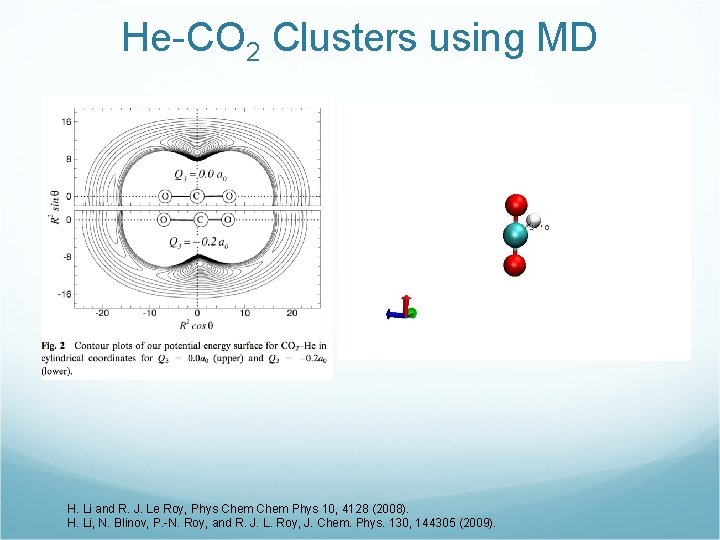
He-CO 2 Clusters using MD H. Li and R. J. Le Roy, Phys Chem Phys 10, 4128 (2008). H. Li, N. Blinov, P. -N. Roy, and R. J. L. Roy, J. Chem. Phys. 130, 144305 (2009).
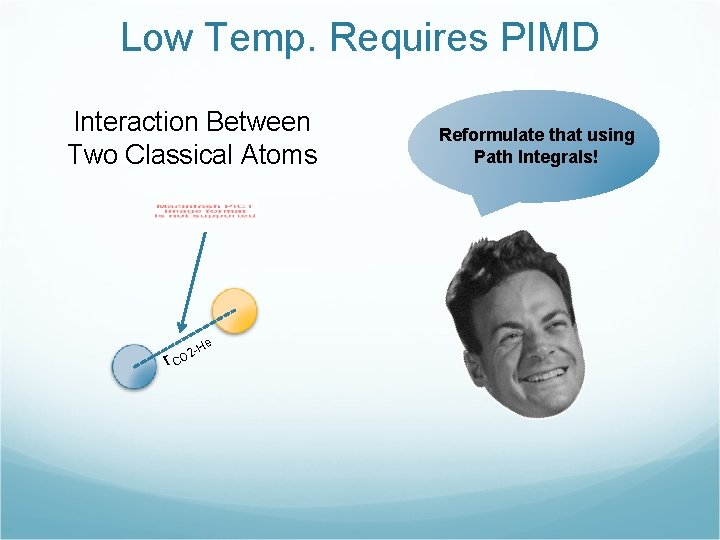
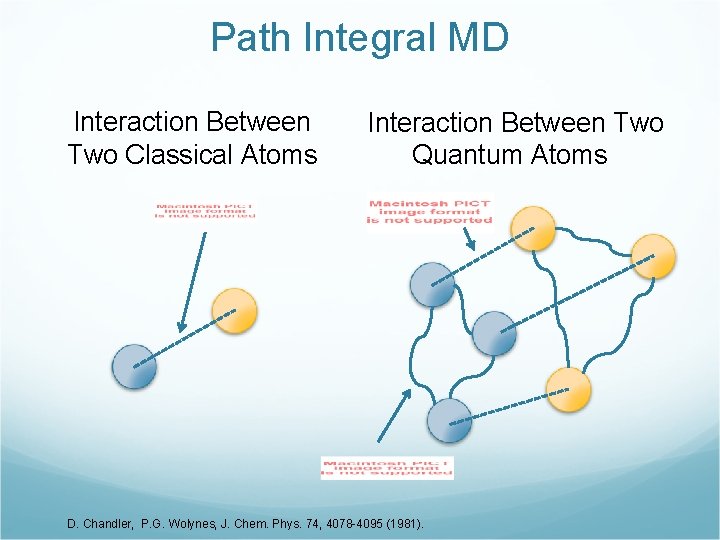
Low Temp. Requires PIMD Interaction Between Two Classical Atoms r CO 2 e -H Reformulate that using Path Integrals!
Path Integral MD Interaction Between Two Classical Atoms Interaction Between Two Quantum Atoms D. Chandler, P. G. Wolynes, J. Chem. Phys. 74, 4078 -4095 (1981).
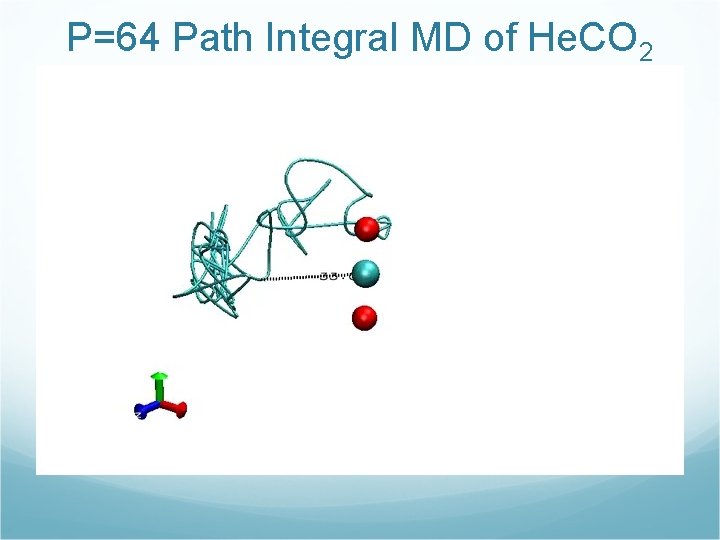
P=64 Path Integral MD of He. CO 2
He. CO 2 Structural Convergence
He-CO 2 Energy Convergence
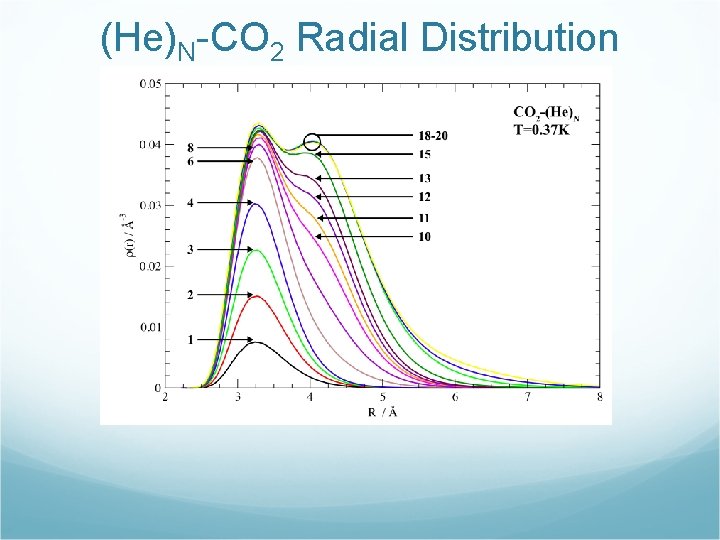
(He)N-CO 2 Radial Distribution
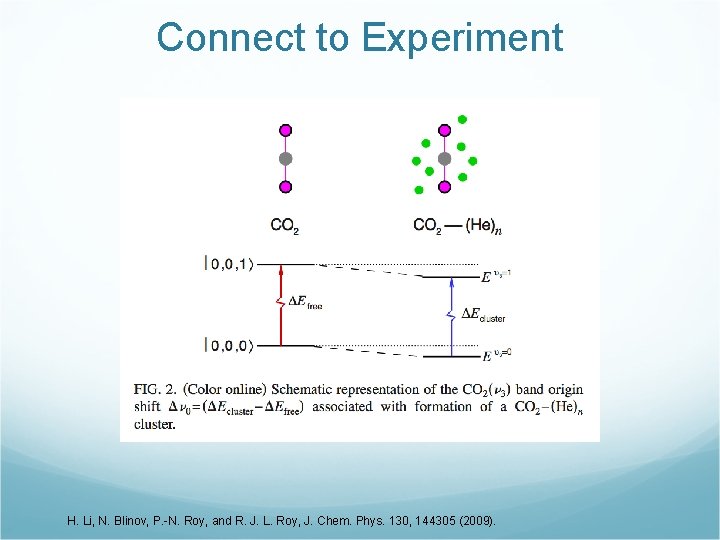
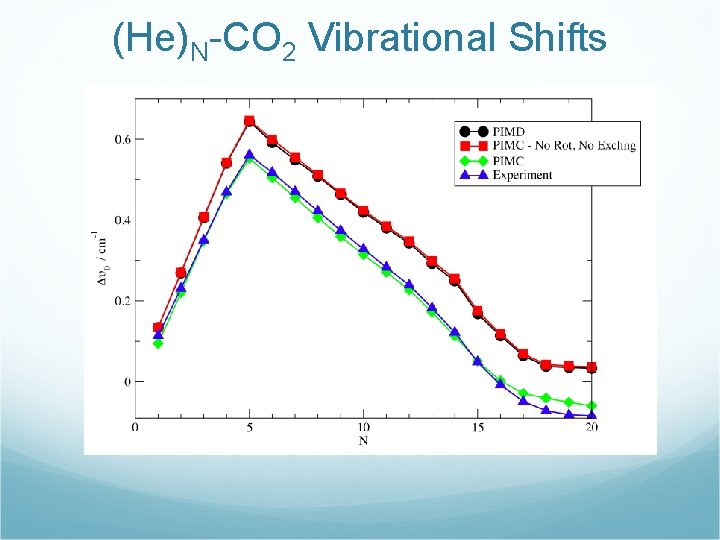
Connect to Experiment H. Li, N. Blinov, P. -N. Roy, and R. J. L. Roy, J. Chem. Phys. 130, 144305 (2009).
(He)N-CO 2 Vibrational Shifts
Conclusion Path Integral Molecular Dynamics is a viable method for quantum sampling neglecting rotation and exchange. PIMD is useful for understanding quantum effects at low temperature in He-CO 2 systems.
Future Studies New and exciting applications, He-CO 2 dynamics using RPMD, Centroid MD Quantifying rotational and exchange effects Confined hydrogen in water cages Sugars with explicit water on GPU Path Integral Ground State MD simulations, Comparison to Path Integral Ground State Monte Carlo