
Efficient Prediction of Dynamic Response for Flexible and
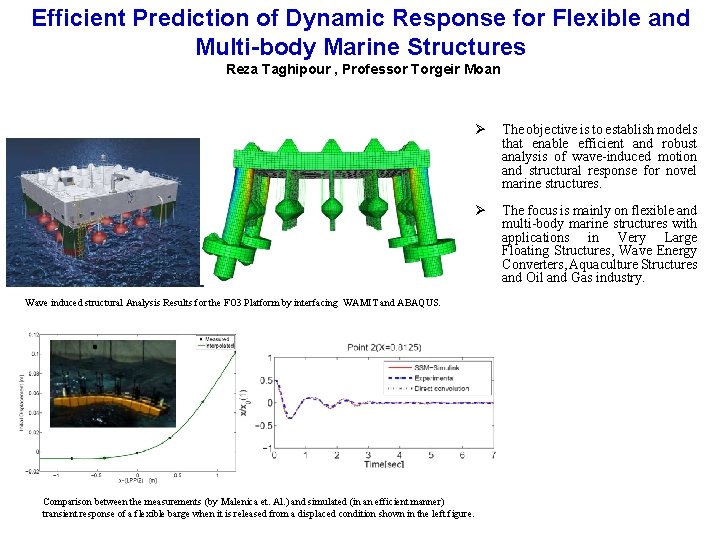
Efficient Prediction of Dynamic Response for Flexible and Multi-body Marine Structures Reza Taghipour , Professor Torgeir Moan Wave induced structural Analysis Results for the FO 3 Platform by interfacing WAMIT and ABAQUS. Comparison between the measurements (by Malenica et. Al. ) and simulated (in an efficient manner) transient response of a flexible barge when it is released from a displaced condition shown in the left figure. The objective is to establish models that enable efficient and robust analysis of wave-induced motion and structural response for novel marine structures. The focus is mainly on flexible and multi-body marine structures with applications in Very Large Floating Structures, Wave Energy Converters, Aquaculture Structures and Oil and Gas industry.
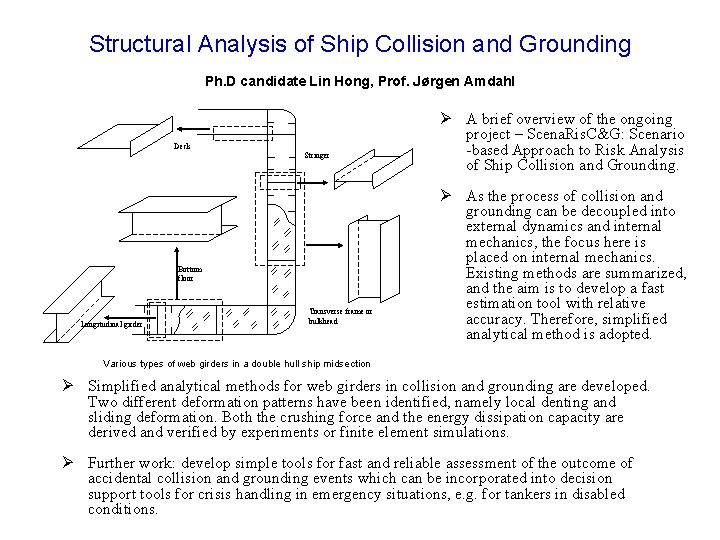
Structural Analysis of Ship Collision and Grounding Ph. D candidate Lin Hong, Prof. Jørgen Amdahl Deck Stringer Bottom floor Longitudinal girder Transverse frame or bulkhead A brief overview of the ongoing project – Scena. Ris. C&G: Scenario -based Approach to Risk Analysis of Ship Collision and Grounding. As the process of collision and grounding can be decoupled into external dynamics and internal mechanics, the focus here is placed on internal mechanics. Existing methods are summarized, and the aim is to develop a fast estimation tool with relative accuracy. Therefore, simplified analytical method is adopted. Various types of web girders in a double hull ship midsection Simplified analytical methods for web girders in collision and grounding are developed. Two different deformation patterns have been identified, namely local denting and sliding deformation. Both the crushing force and the energy dissipation capacity are derived and verified by experiments or finite element simulations. Further work: develop simple tools for fast and reliable assessment of the outcome of accidental collision and grounding events which can be incorporated into decision support tools for crisis handling in emergency situations, e. g. for tankers in disabled conditions.
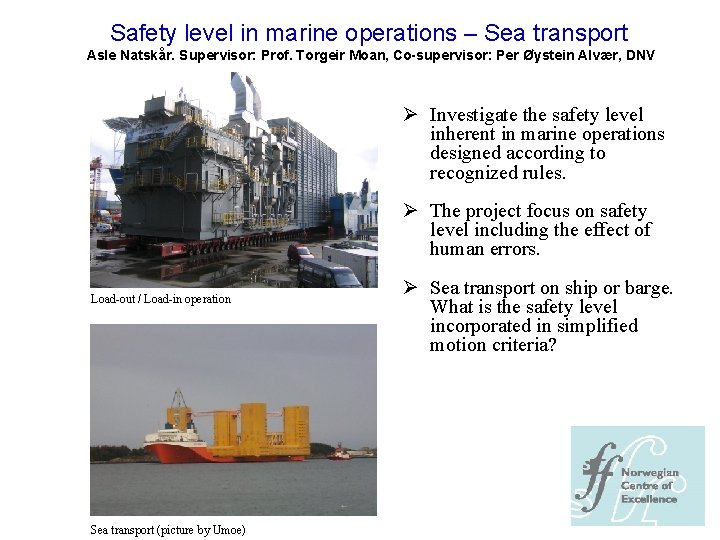
Safety level in marine operations – Sea transport Asle Natskår. Supervisor: Prof. Torgeir Moan, Co-supervisor: Per Øystein Alvær, DNV Investigate the safety level inherent in marine operations designed according to recognized rules. The project focus on safety level including the effect of human errors. Load-out / Load-in operation Sea transport (picture by Umoe) Sea transport on ship or barge. What is the safety level incorporated in simplified motion criteria?
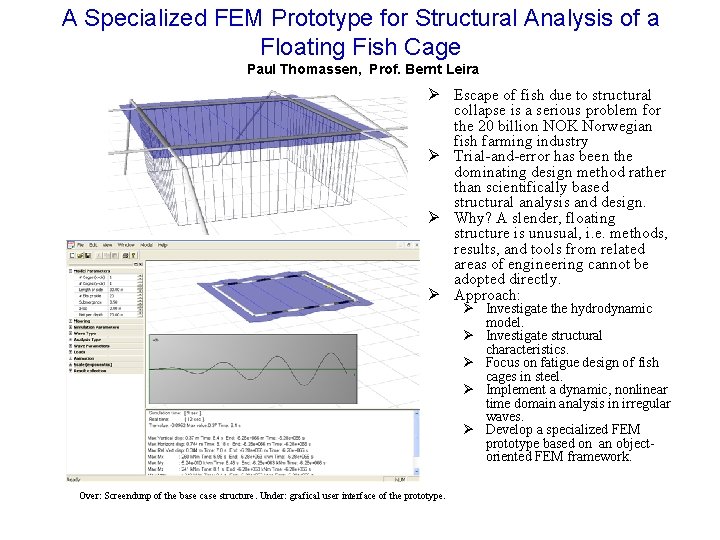
A Specialized FEM Prototype for Structural Analysis of a Floating Fish Cage Paul Thomassen, Prof. Bernt Leira Laboratory measurements (From Sumer, B. M. ) Escape of fish due to structural collapse is a serious problem for the 20 billion NOK Norwegian fish farming industry Trial-and-error has been the dominating design method rather than scientifically based structural analysis and design. Why? A slender, floating structure is unusual, i. e. methods, results, and tools from related areas of engineering cannot be adopted directly. Approach: Investigate the hydrodynamic model. Investigate structural characteristics. Focus on fatigue design of fish cages in steel. Implement a dynamic, nonlinear time domain analysis in irregular waves. Develop a specialized FEM prototype based on an objectoriented FEM framework. Over: Screendunp of the base case structure. Under: grafical user interface of the prototype.
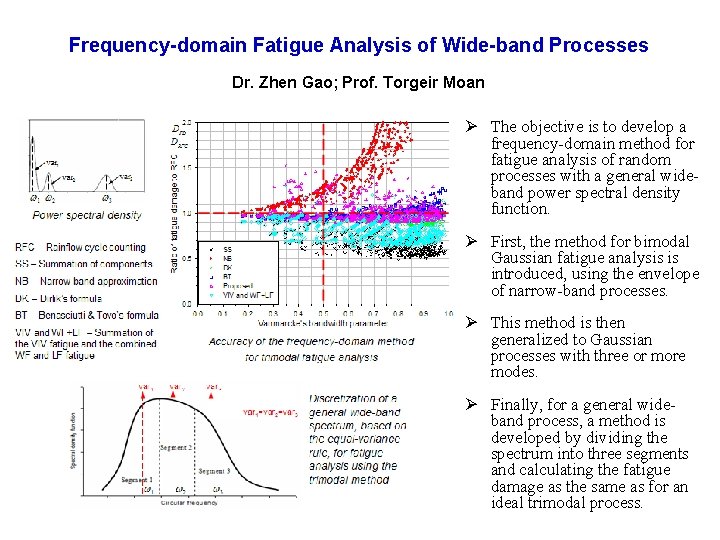
Frequency-domain Fatigue Analysis of Wide-band Processes Dr. Zhen Gao; Prof. Torgeir Moan The objective is to develop a frequency-domain method for fatigue analysis of random processes with a general wideband power spectral density function. First, the method for bimodal Gaussian fatigue analysis is introduced, using the envelope of narrow-band processes. This method is then generalized to Gaussian processes with three or more modes. Finally, for a general wideband process, a method is developed by dividing the spectrum into three segments and calculating the fatigue damage as the same as for an ideal trimodal process.
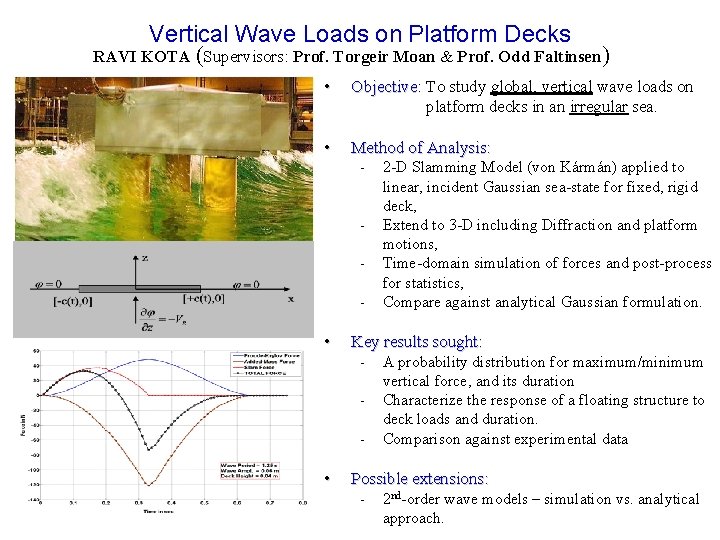
Vertical Wave Loads on Platform Decks RAVI KOTA (Supervisors: Prof. Torgeir Moan & Prof. Odd Faltinsen) • Objective: Objective To study global, vertical wave loads on platform decks in an irregular sea. • Method of Analysis: - - • Key results sought: - • 2 -D Slamming Model (von Kármán) applied to linear, incident Gaussian sea-state for fixed, rigid deck, Extend to 3 -D including Diffraction and platform motions, Time-domain simulation of forces and post-process for statistics, Compare against analytical Gaussian formulation. A probability distribution for maximum/minimum vertical force, and its duration Characterize the response of a floating structure to deck loads and duration. Comparison against experimental data Possible extensions: - 2 nd-order wave models – simulation vs. analytical approach.
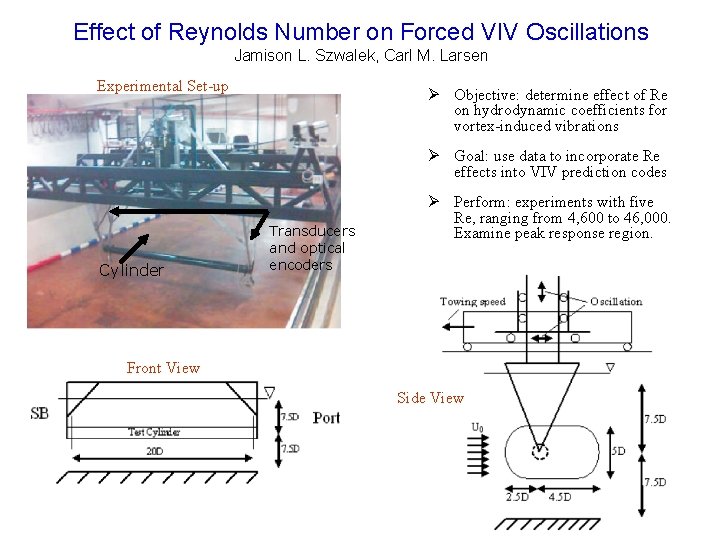
Effect of Reynolds Number on Forced VIV Oscillations Jamison L. Szwalek, Carl M. Larsen Experimental Set-up Objective: determine effect of Re on hydrodynamic coefficients for vortex-induced vibrations Goal: use data to incorporate Re effects into VIV prediction codes Cylinder Transducers and optical encoders Perform: experiments with five Re, ranging from 4, 600 to 46, 000. Examine peak response region. IL Test Matrix. Front View Side View
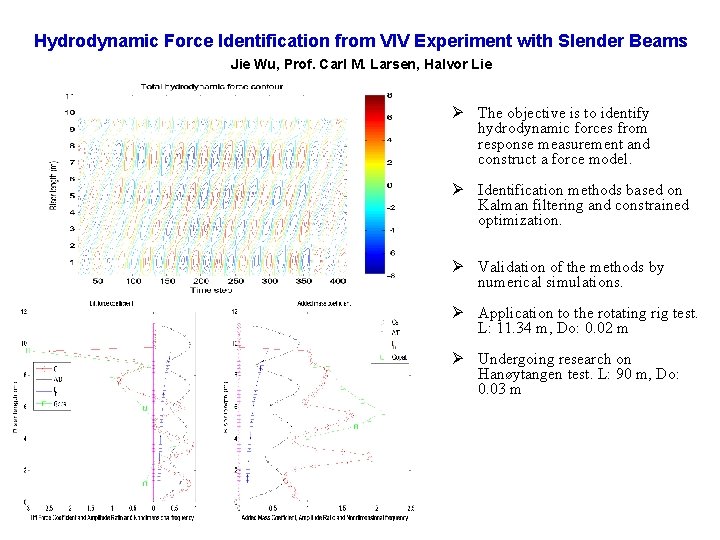
Hydrodynamic Force Identification from VIV Experiment with Slender Beams Jie Wu, Prof. Carl M. Larsen, Halvor Lie The objective is to identify hydrodynamic forces from response measurement and construct a force model. Identification methods based on Kalman filtering and constrained optimization. Laboratory measurements (From Sumer, B. M. ) Validation of the methods by numerical simulations. Application to the rotating rig test. L: 11. 34 m, Do: 0. 02 m Undergoing research on Hanøytangen test. L: 90 m, Do: 0. 03 m
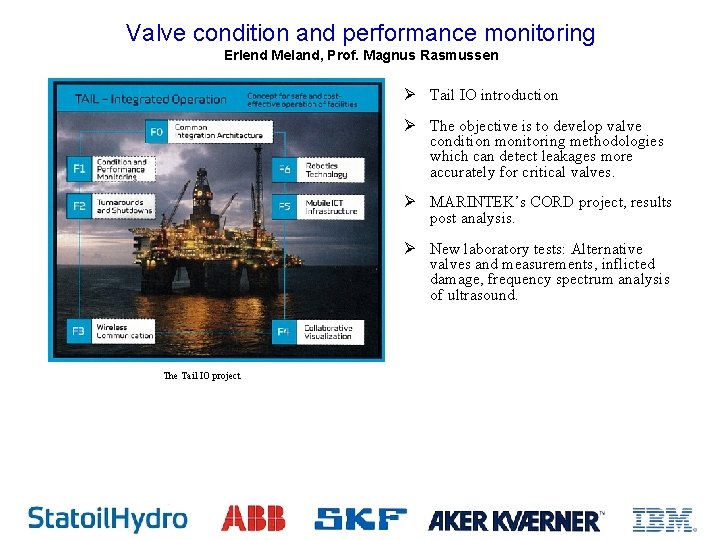
Valve condition and performance monitoring Erlend Meland, Prof. Magnus Rasmussen Tail IO introduction The objective is to develop valve condition monitoring methodologies which can detect leakages more accurately for critical valves. MARINTEK’s CORD project, results post analysis. New laboratory tests: Alternative valves and measurements, inflicted damage, frequency spectrum analysis of ultrasound. The Tail IO project
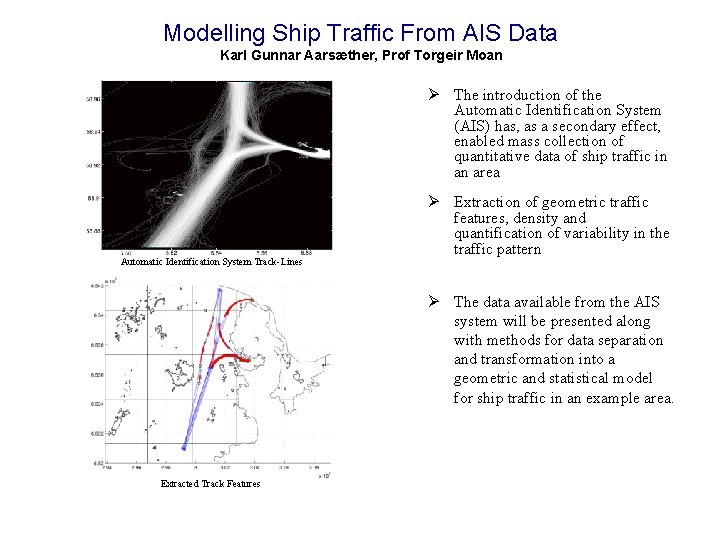
Modelling Ship Traffic From AIS Data Karl Gunnar Aarsæther, Prof Torgeir Moan The introduction of the Automatic Identification System (AIS) has, as a secondary effect, enabled mass collection of quantitative data of ship traffic in an area Automatic Identification System Track-Lines Extraction of geometric traffic features, density and quantification of variability in the traffic pattern The data available from the AIS system will be presented along with methods for data separation and transformation into a geometric and statistical model for ship traffic in an example area. Extracted Track Features
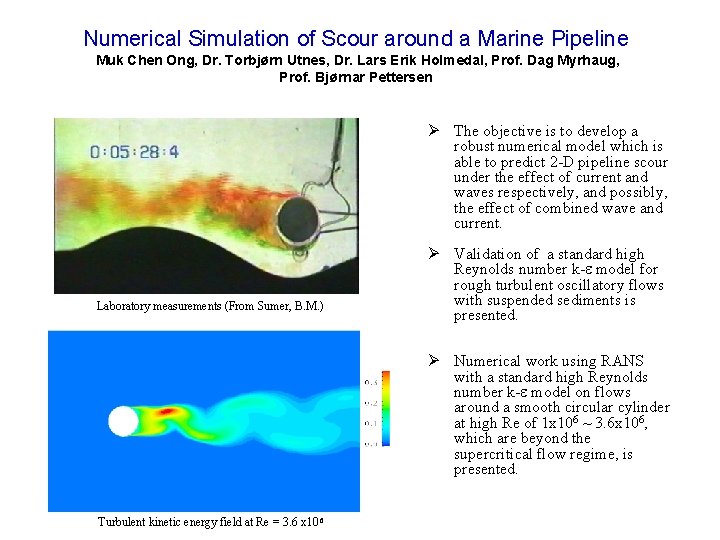
Numerical Simulation of Scour around a Marine Pipeline Muk Chen Ong, Dr. Torbjørn Utnes, Dr. Lars Erik Holmedal, Prof. Dag Myrhaug, Prof. Bjørnar Pettersen The objective is to develop a robust numerical model which is able to predict 2 -D pipeline scour under the effect of current and waves respectively, and possibly, the effect of combined wave and current. Laboratory measurements (From Sumer, B. M. ) Validation of a standard high Reynolds number k-e model for rough turbulent oscillatory flows with suspended sediments is presented. Numerical work using RANS with a standard high Reynolds number k-e model on flows around a smooth circular cylinder at high Re of 1 x 10⁶ ~ 3. 6 x 10⁶, which are beyond the supercritical flow regime, is presented. Turbulent kinetic energy field at Re = 3. 6 x 10 6
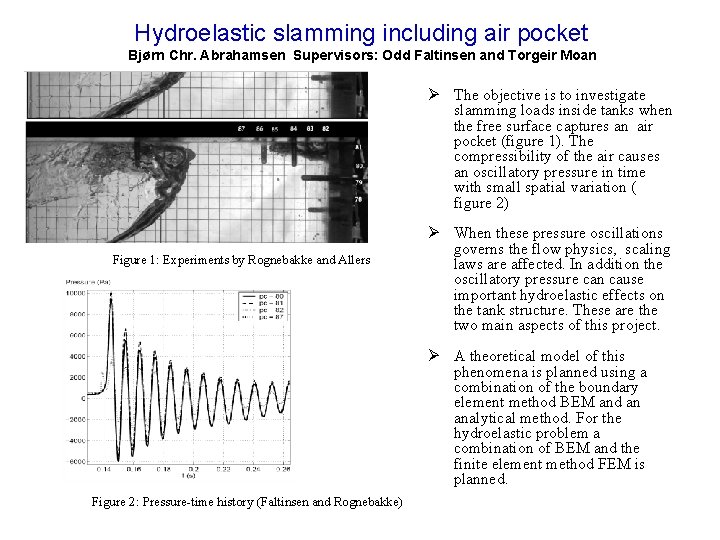
Hydroelastic slamming including air pocket Bjørn Chr. Abrahamsen Supervisors: Odd Faltinsen and Torgeir Moan The objective is to investigate slamming loads inside tanks when the free surface captures an air pocket (figure 1). The compressibility of the air causes an oscillatory pressure in time with small spatial variation ( figure 2) Figure 1: Experiments by Rognebakke and Allers When these pressure oscillations governs the flow physics, scaling laws are affected. In addition the oscillatory pressure can cause important hydroelastic effects on the tank structure. These are the two main aspects of this project. A theoretical model of this phenomena is planned using a combination of the boundary element method BEM and an analytical method. For the hydroelastic problem a combination of BEM and the finite element method FEM is planned. Figure 2: Pressure-time history (Faltinsen and Rognebakke)
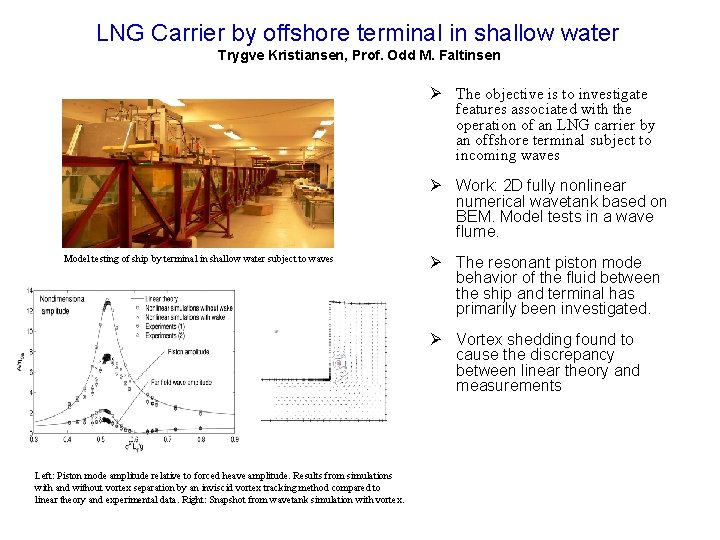
LNG Carrier by offshore terminal in shallow water Trygve Kristiansen, Prof. Odd M. Faltinsen The objective is to investigate features associated with the operation of an LNG carrier by an offshore terminal subject to incoming waves Work: 2 D fully nonlinear numerical wavetank based on BEM. Model tests in a wave flume. Model testing of ship by terminal in shallow water subject to waves The resonant piston mode behavior of the fluid between the ship and terminal has primarily been investigated. Vortex shedding found to cause the discrepancy between linear theory and measurements Left: Piston mode amplitude relative to forced heave amplitude. Results from simulations with and without vortex separation by an inviscid vortex tracking method compared to linear theory and experimental data. Right: Snapshot from wavetank simulation with vortex.
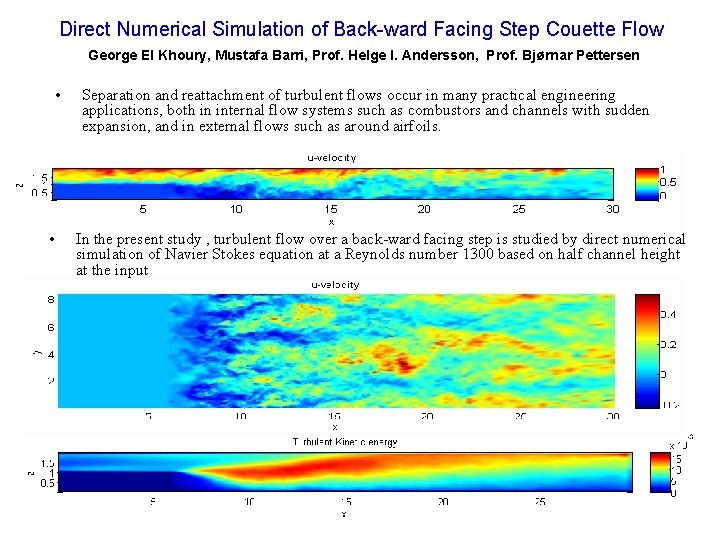
Direct Numerical Simulation of Back-ward Facing Step Couette Flow George El Khoury, Mustafa Barri, Prof. Helge I. Andersson, Prof. Bjørnar Pettersen • • Separation and reattachment of turbulent flows occur in many practical engineering applications, both in internal flow systems such as combustors and channels with sudden expansion, and in external flows such as around airfoils. In the present study , turbulent flow over a back-ward facing step is studied by direct numerical simulation of Navier Stokes equation at a Reynolds number 1300 based on half channel height at the input
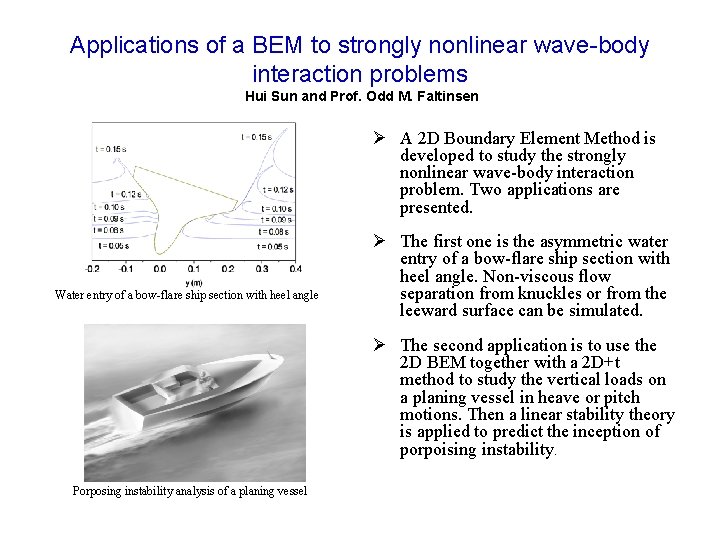
Applications of a BEM to strongly nonlinear wave-body interaction problems Hui Sun and Prof. Odd M. Faltinsen A 2 D Boundary Element Method is developed to study the strongly nonlinear wave-body interaction problem. Two applications are presented. Water entry of a bow-flare ship section with heel angle The first one is the asymmetric water entry of a bow-flare ship section with heel angle. Non-viscous flow separation from knuckles or from the leeward surface can be simulated. The second application is to use the 2 D BEM together with a 2 D+t method to study the vertical loads on a planing vessel in heave or pitch motions. Then a linear stability theory is applied to predict the inception of porpoising instability. Porposing instability analysis of a planing vessel
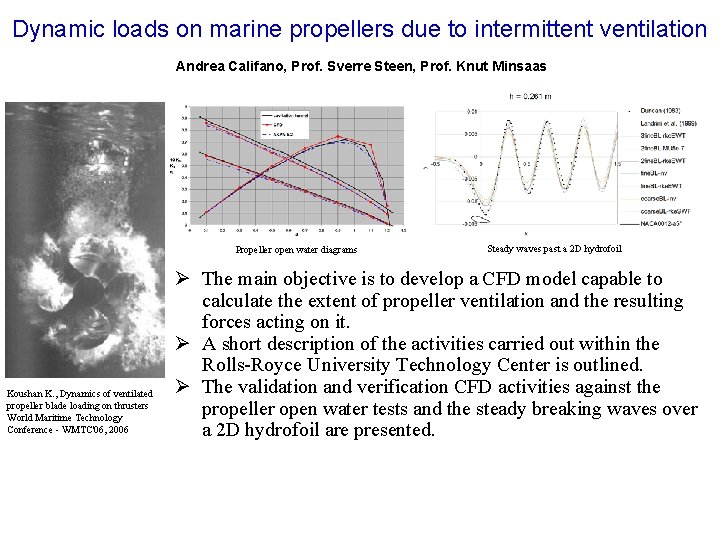
Dynamic loads on marine propellers due to intermittent ventilation Andrea Califano, Prof. Sverre Steen, Prof. Knut Minsaas Propeller open water diagrams Koushan K. , Dynamics of ventilated propeller blade loading on thrusters World Maritime Technology Conference - WMTC'06, 2006 Steady waves past a 2 D hydrofoil The main objective is to develop a CFD model capable to calculate the extent of propeller ventilation and the resulting forces acting on it. A short description of the activities carried out within the Rolls-Royce University Technology Center is outlined. The validation and verification CFD activities against the propeller open water tests and the steady breaking waves over a 2 D hydrofoil are presented.
- Slides: 16