
Efficient MR Image Reconstruction for Compressed MR Imaging
![Introduction: Compressive Sensing MRI [Magnetic Resonance in Medicine, 2007] Key problem of MRI: reducing](https://slidetodoc.com/presentation_image_h2/5d6ed6f10c77912d4403057df87c0b0d/image-4.jpg "Introduction: Compressive Sensing MRI [Magnetic Resonance in Medicine, 2007] Key problem of MRI: reducing")
![FISTA [Beck, SIAM-JIS’ 09] Problem: min{ F(x)=f(x)+g(x) } f(x) convex and smooth g(x) convex](https://slidetodoc.com/presentation_image_h2/5d6ed6f10c77912d4403057df87c0b0d/image-7.jpg "FISTA [Beck, SIAM-JIS’ 09] Problem: min{ F(x)=f(x)+g(x) } f(x) convex and smooth g(x) convex")

- Slides: 18
Efficient MR Image Reconstruction for Compressed MR Imaging JUNZHOU HUANG, SHAOTING ZHANG, DIMITRIS METAXAS CBIM, DEPT. COMPUTER SCIENCE, RUTGERS UNIVERSITY
Outline Introduction Compressed MR Image Reconstruction Related Work Different algorithms for this problem Proposed Algorithms Fast Composite Splitting Algorithm (FCSA) Experimental Results Visual and Statistical Comparisons Conclusions
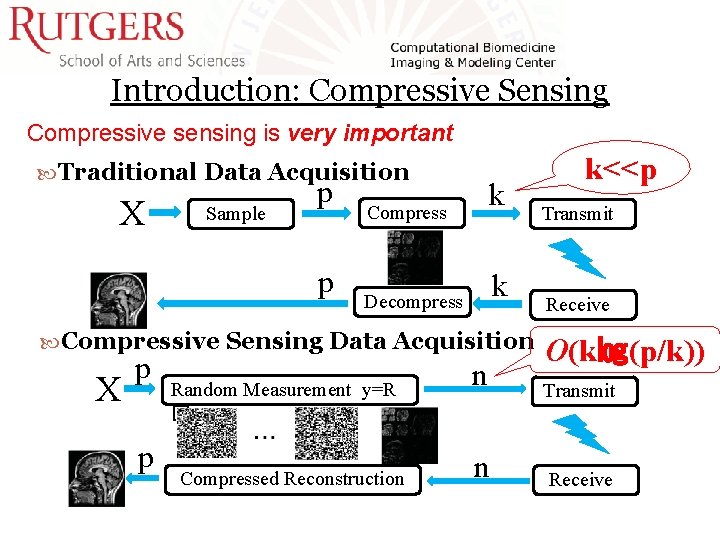
Introduction: Compressive Sensing Compressive sensing is very important Traditional Data Acquisition X Sample p p k Compress k Decompress Compressive Sensing Data Acquisition X p p Random Measurement y=R �x Compressed Reconstruction k<<p Transmit Receive O(k㏒(p/k)) n Transmit n Receive
Introduction: Compressive Sensing MRI [Magnetic Resonance in Medicine, 2007] Key problem of MRI: reducing the imaging & reconstructing time WT If image is Sparsely represented by Wavelet Compressed MRI Reconstruction
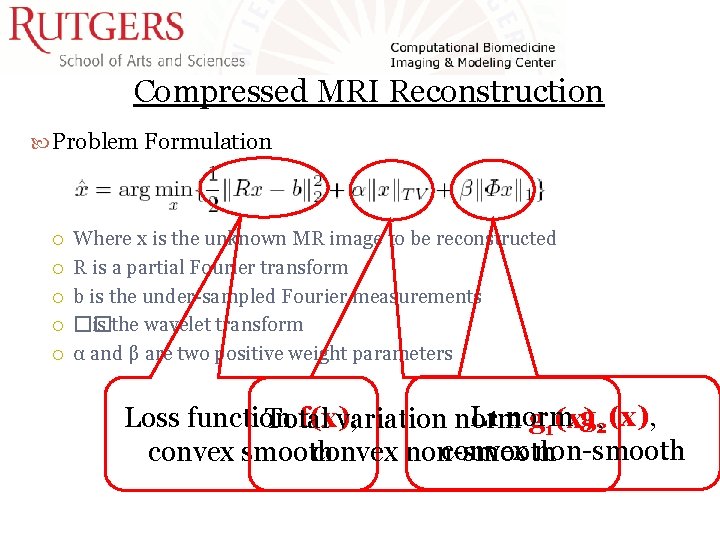
Compressed MRI Reconstruction Problem Formulation Where x is the unknown MR image to be reconstructed R is a partial Fourier transform b is the under-sampled Fourier measurements �� is the wavelet transform α and β are two positive weight parameters L 1 norm g 2(x), Loss function f(x), Total variation norm g 1(x), convex non-smooth
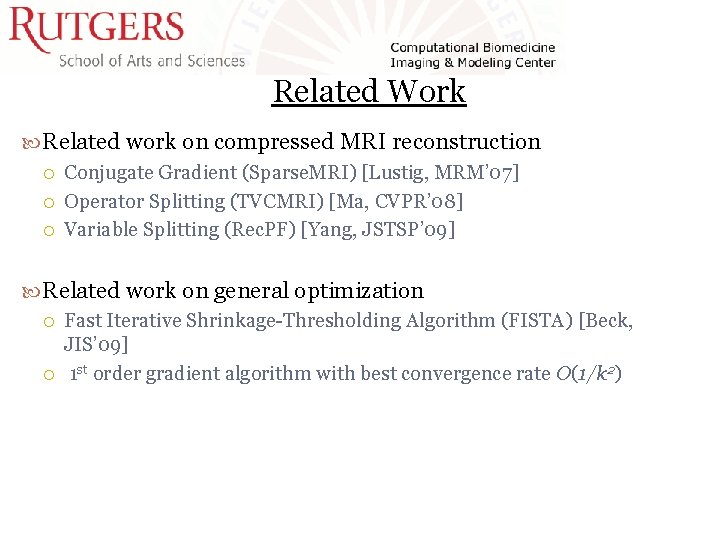
Related Work Related work on compressed MRI reconstruction Conjugate Gradient (Sparse. MRI) [Lustig, MRM’ 07] Operator Splitting (TVCMRI) [Ma, CVPR’ 08] Variable Splitting (Rec. PF) [Yang, JSTSP’ 09] Related work on general optimization Fast Iterative Shrinkage-Thresholding Algorithm (FISTA) [Beck, JIS’ 09] 1 st order gradient algorithm with best convergence rate O(1/k 2)
FISTA [Beck, SIAM-JIS’ 09] Problem: min{ F(x)=f(x)+g(x) } f(x) convex and smooth g(x) convex and non-smooth Theorem 1: Suppose {xk} are obtained by FISTA, Error Bound: �� =F(xk)-F(x*) ~ O(1/k 2) Bottleneck: Step 2 g(x)=�� ||x||TV , [Beck, TIP’ 09] g(x)=�� ||�� x||1 [Beck, JIS’ 09] g(x)=�� ||x||TV+�� ||�� x||1 O(p) O(plog(p)) Proximal gradient descent
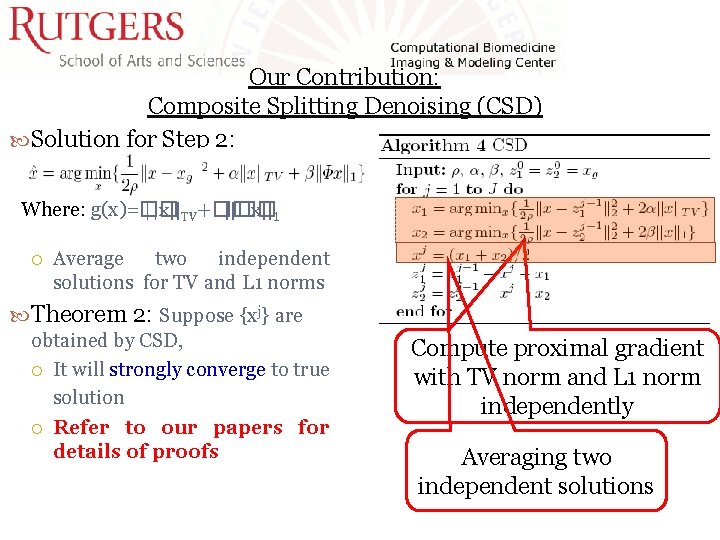
Our Contribution: Composite Splitting Denoising (CSD) Solution for Step 2: Where: g(x)=�� ||x||TV+�� ||�� x||1 Average two independent solutions for TV and L 1 norms Theorem 2: Suppose {xj} are obtained by CSD, It will strongly converge to true solution Refer to our papers for details of proofs Compute proximal gradient with TV norm and L 1 norm independently Averaging two independent solutions
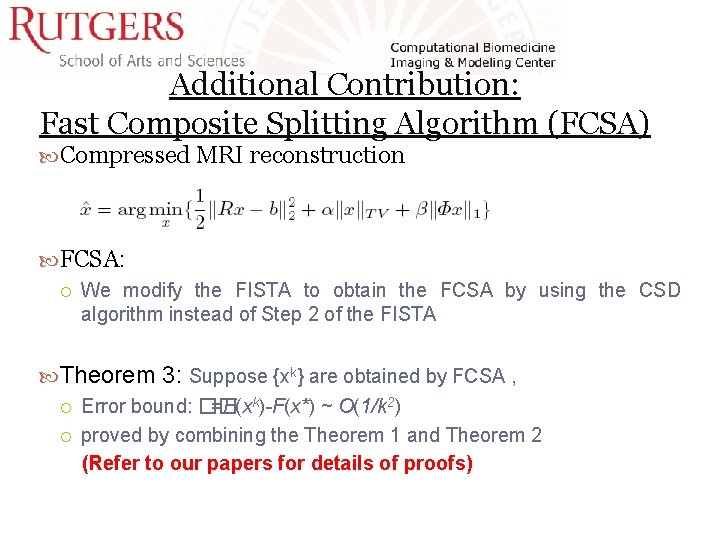
Additional Contribution: Fast Composite Splitting Algorithm (FCSA) Compressed MRI reconstruction FCSA: We modify the FISTA to obtain the FCSA by using the CSD algorithm instead of Step 2 of the FISTA Theorem 3: Suppose {xk} are obtained by FCSA , Error bound: �� =F(xk)-F(x*) ~ O(1/k 2) proved by combining the Theorem 1 and Theorem 2 (Refer to our papers for details of proofs)
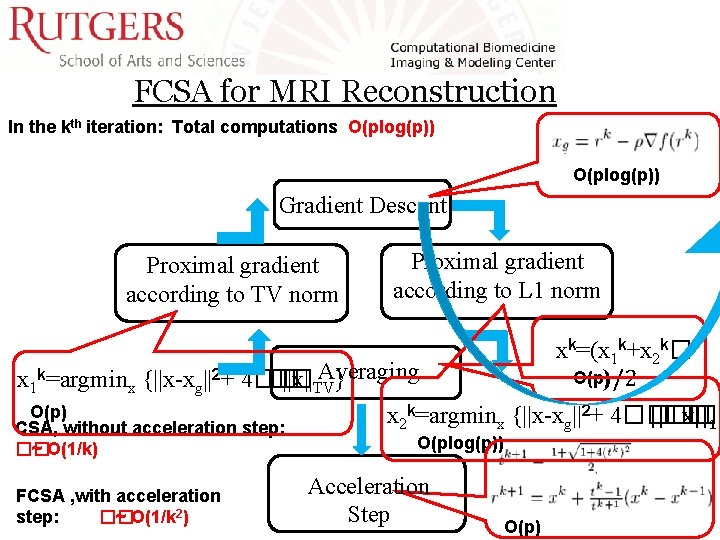
FCSA for MRI Reconstruction In the kth iteration: Total computations O(plog(p)) Gradient Descent Proximal gradient according to TV norm Proximal gradient according to L 1 norm xk=(x 1 k+x 2 k� O(p))/2 Averaging x 1 k=argminx {||x-xg||2+ 4�� �� ||x||TV } k=argmin {||x-x ||2+ 4���� O(p) x ||�� x||1} 2 x g CSA, without acceleration step: �� ~ O(1/k) FCSA , with acceleration step: �� ~ O(1/k 2) O(plog(p)) Acceleration Step O(p)
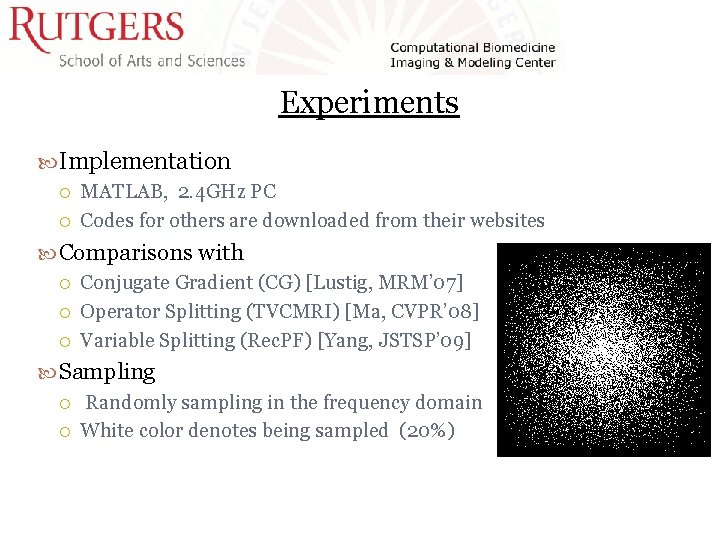
Experiments Implementation MATLAB, 2. 4 GHz PC Codes for others are downloaded from their websites Comparisons with Conjugate Gradient (CG) [Lustig, MRM’ 07] Operator Splitting (TVCMRI) [Ma, CVPR’ 08] Variable Splitting (Rec. PF) [Yang, JSTSP’ 09] Sampling Randomly sampling in the frequency domain White color denotes being sampled (20%)
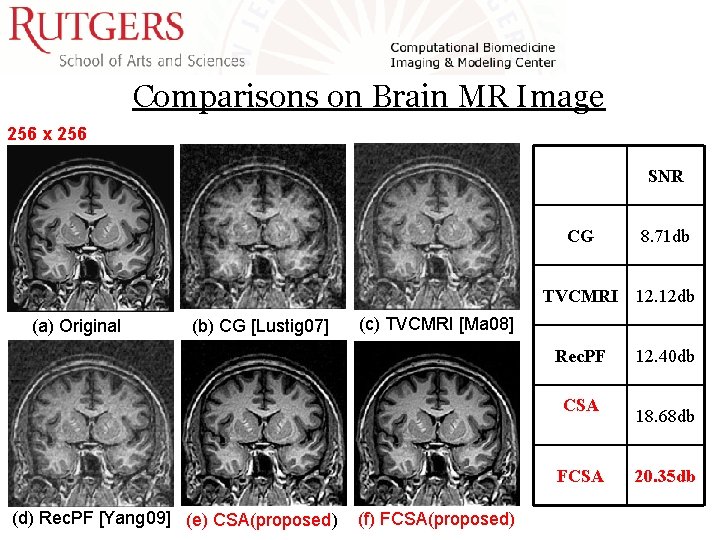
Comparisons on Brain MR Image 256 x 256 SNR (a) Original (b) CG [Lustig 07] CG 8. 71 db TVCMRI 12. 12 db Rec. PF 12. 40 db (c) TVCMRI [Ma 08] CSA FCSA (d) Rec. PF [Yang 09] (e) CSA(proposed) (f) FCSA(proposed) 18. 68 db 20. 35 db
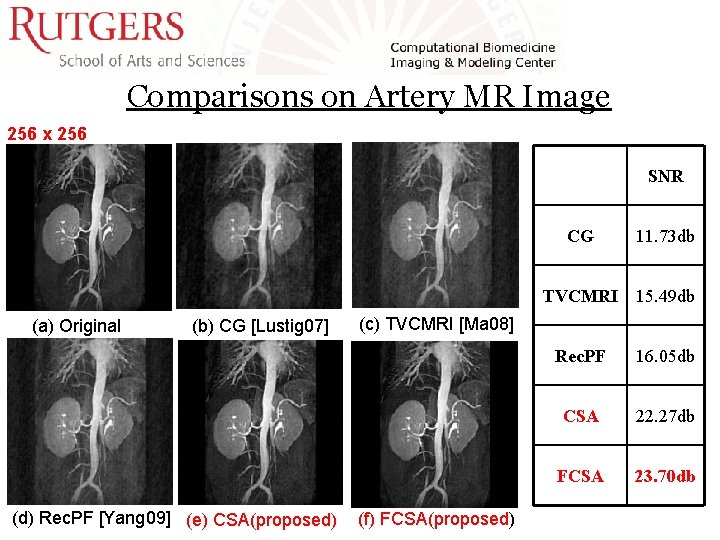
Comparisons on Artery MR Image 256 x 256 SNR (a) Original (b) CG [Lustig 07] (d) Rec. PF [Yang 09] (e) CSA(proposed) CG 11. 73 db TVCMRI 15. 49 db Rec. PF 16. 05 db CSA 22. 27 db FCSA 23. 70 db (c) TVCMRI [Ma 08] (f) FCSA(proposed)
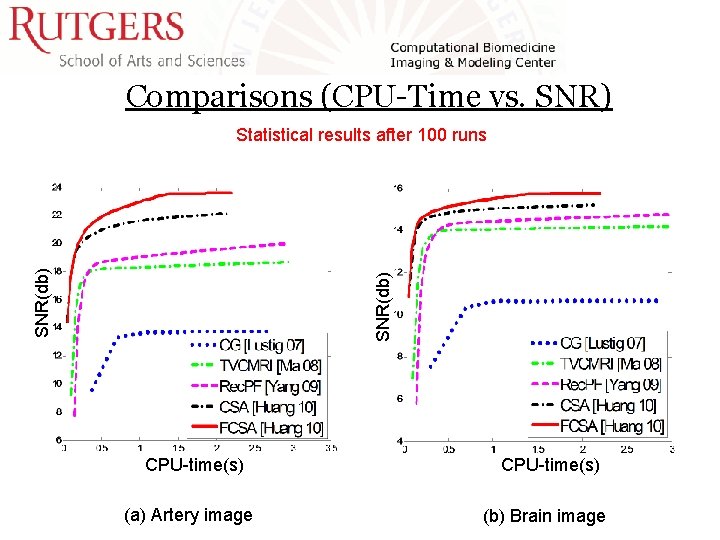
Comparisons (CPU-Time vs. SNR) SNR(db) Statistical results after 100 runs CPU-time(s) (a) Artery image CPU-time(s) (b) Brain image
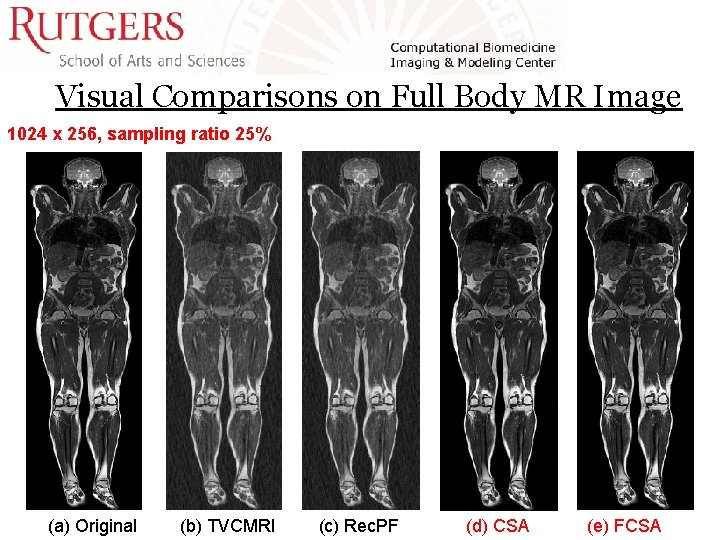
Visual Comparisons on Full Body MR Image 1024 x 256, sampling ratio 25% (a) Original (b) TVCMRI (c) Rec. PF (d) CSA (e) FCSA
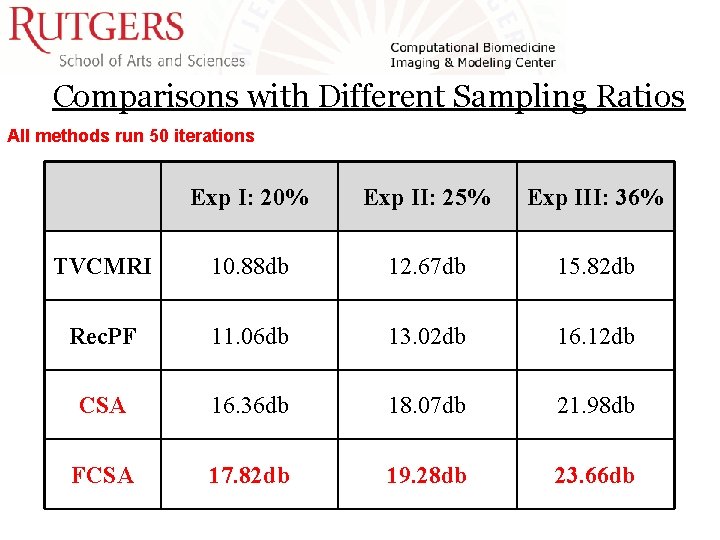
Comparisons with Different Sampling Ratios All methods run 50 iterations Exp I: 20% Exp II: 25% Exp III: 36% TVCMRI 10. 88 db 12. 67 db 15. 82 db Rec. PF 11. 06 db 13. 02 db 16. 12 db CSA 16. 36 db 18. 07 db 21. 98 db FCSA 17. 82 db 19. 28 db 23. 66 db
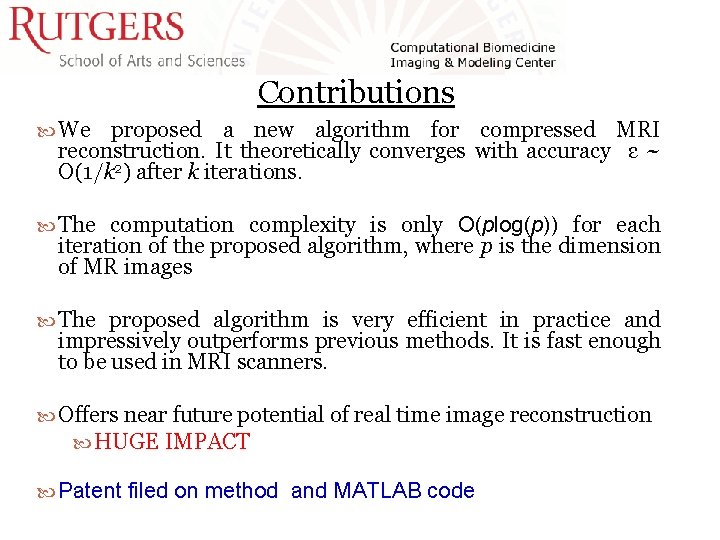
Contributions We proposed a new algorithm for compressed MRI reconstruction. It theoretically converges with accuracy ε ~ O(1/k 2) after k iterations. The computation complexity is only O(plog(p)) for each iteration of the proposed algorithm, where p is the dimension of MR images The proposed algorithm is very efficient in practice and impressively outperforms previous methods. It is fast enough to be used in MRI scanners. Offers near future potential of real time image reconstruction HUGE IMPACT Patent filed on method and MATLAB code
Thank You! Any Questions?