
Efficient Micro Mathematics Multiplication and Division Techniques for

- Slides: 10
Efficient Micro Mathematics Multiplication and Division Techniques for MCUs By Kripasagar Venkat Presented by Adam Wickersham
Introduction There are 2 types of processors fixed and floating point • Fixed point processors only support integers and not factions • • Fixed point suffer from the effects of: • Finite word length • Round-off • Truncation Most low cost microcontrollers do not have a multiplier module
Horner’s Algorithm • • • Several algorithms have been devised for fast multiplication and division using only shifts and adds Horner’s is one of them Attempts to reduce error and improve accuracy Innovative scaling free method to implement integer-real multiplications Based on position of the bits with a value of 1 and their distance to neighboring 1 s Relies on dedicated code
Fractional Multiplier The bits of value 1 are identified in the multiplier then shifted and added • Starting at the rightmost 1 and moving left • 2 -1 is a right shift and 21 is a left shift • Advantages and Disadvantages • Much more accurate (shown in example), suffers less from finite word length • Need defined code for each multiplier •
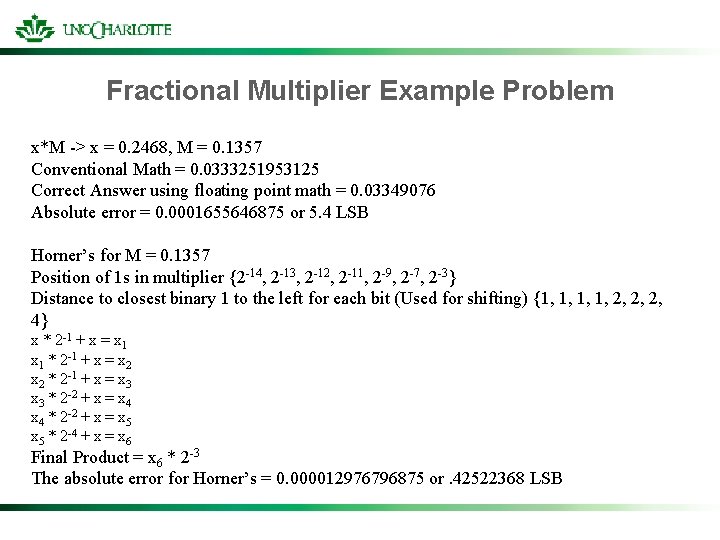
Fractional Multiplier Example Problem x*M -> x = 0. 2468, M = 0. 1357 Conventional Math = 0. 0333251953125 Correct Answer using floating point math = 0. 03349076 Absolute error = 0. 0001655646875 or 5. 4 LSB Horner’s for M = 0. 1357 Position of 1 s in multiplier {2 -14, 2 -13, 2 -12, 2 -11, 2 -9, 2 -7, 2 -3} Distance to closest binary 1 to the left for each bit (Used for shifting) {1, 1, 2, 2, 2, 4} x * 2 -1 + x = x 1 * 2 -1 + x = x 2 * 2 -1 + x = x 3 * 2 -2 + x = x 4 * 2 -2 + x = x 5 * 2 -4 + x = x 6 Final Product = x 6 * 2 -3 The absolute error for Horner’s = 0. 000012976796875 or. 42522368 LSB
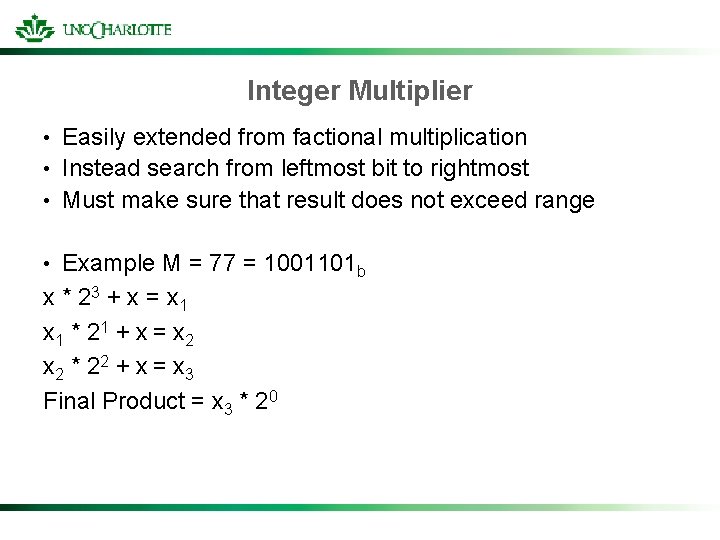
Integer Multiplier Easily extended from factional multiplication • Instead search from leftmost bit to rightmost • Must make sure that result does not exceed range • Example M = 77 = 1001101 b x * 23 + x = x 1 * 21 + x = x 2 * 22 + x = x 3 Final Product = x 3 * 20 •
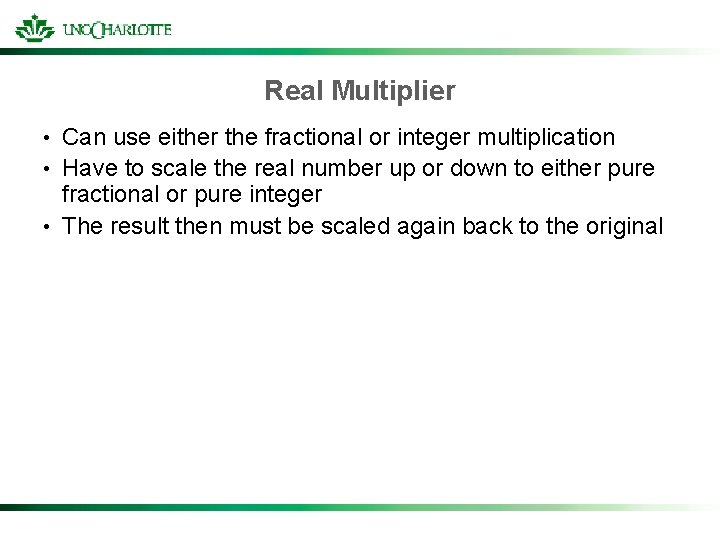
Real Multiplier Can use either the fractional or integer multiplication • Have to scale the real number up or down to either pure fractional or pure integer • The result then must be scaled again back to the original •
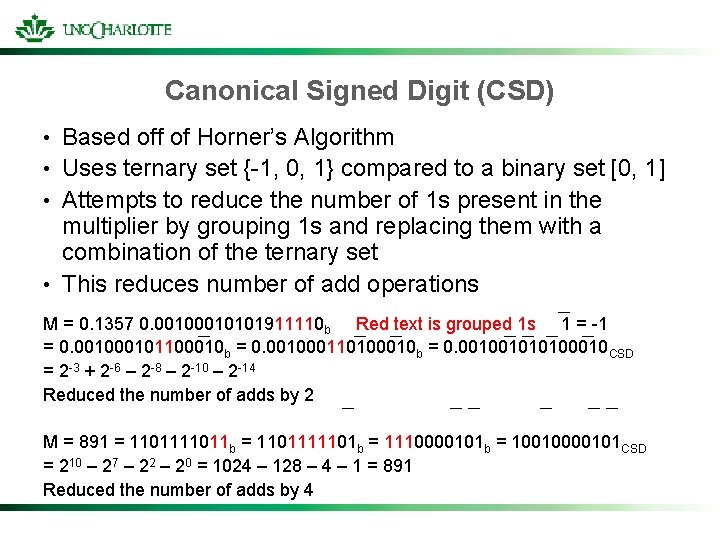
Canonical Signed Digit (CSD) Based off of Horner’s Algorithm • Uses ternary set {-1, 0, 1} compared to a binary set [0, 1] • Attempts to reduce the number of 1 s present in the multiplier by grouping 1 s and replacing them with a combination of the ternary set • This reduces number of add operations • M = 0. 1357 0. 0010101911110 b Red text is grouped 1 s 1 = -1 = 0. 00101100010 b = 0. 001000110100010 b = 0. 001001010100010 CSD = 2 -3 + 2 -6 – 2 -8 – 2 -10 – 2 -14 Reduced the number of adds by 2 M = 891 = 11011 b = 1101111101 b = 1110000101 b = 10010000101 CSD = 210 – 27 – 22 – 20 = 1024 – 128 – 4 – 1 = 891 Reduced the number of adds by 4
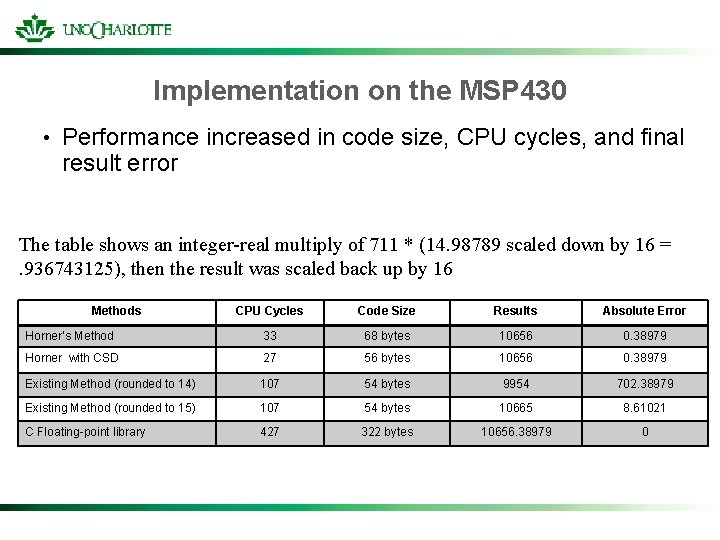
Implementation on the MSP 430 • Performance increased in code size, CPU cycles, and final result error The table shows an integer-real multiply of 711 * (14. 98789 scaled down by 16 =. 936743125), then the result was scaled back up by 16 Methods CPU Cycles Code Size Results Absolute Error Horner’s Method 33 68 bytes 10656 0. 38979 Horner with CSD 27 56 bytes 10656 0. 38979 Existing Method (rounded to 14) 107 54 bytes 9954 702. 38979 Existing Method (rounded to 15) 107 54 bytes 10665 8. 61021 C Floating-point library 427 322 bytes 10656. 38979 0
Conclusion This method shows superior performance in both code size, speed, and error reduction • Do not need hardware multiplier to perform multiplication and division • Can get very good precision with a fixed point processor • And with memory getting cheaper the code size does not pose limitation as much as speed •