
Efficient Maximal Pattern Discovery from Massive Geometric Graphs
![Related works: Graph mining �Frequent subgraph mining: ◦ AGM [Inokuchi, Washio, Motoda, PKDD’ 00]](https://slidetodoc.com/presentation_image_h2/91575bd9cbebd171b4874461a3b6b55e/image-8.jpg "Related works: Graph mining �Frequent subgraph mining: ◦ AGM [Inokuchi, Washio, Motoda, PKDD’ 00]")
- Slides: 32
大規模幾何データからの高速な 極大部分グラフ発見 Efficient Maximal Pattern Discovery from Massive Geometric Graphs 有村博紀 宇野毅明 下薗真一 北海道大学 大学院情報科学研究科 国立情報学研究所 九州 業大学情報 学部 This work is partly supported by MEXT Grant-in-Aid for Scientific Research for Specially Promoted Research on “Semi-structured Data Mining”
Backgrounds �Rapid growth of both the amount and the varieties of nonstandard datasets in scientific, spatial, and relational domains. �There are increasing demands for efficient methods to extract useful patterns and rules from weakly structured datasets. �Graph Mining…
Graph mining �Finding interesting subgraphs appearing in an input collection of labeled graphs. �One of the most promising approaches for knowledge discovery from weakly structured datasets. �A most popular approach is frequent subgraph mining [Inokuchi et al. 2000], but it can often generate a huge number of redundant subgraphs, which degrate the efficiency and the comprehensiveness very much. �How to cope with this proplem. . .
Knowledge Discovery from Geometric Data �Network data with geometric information ◦ Chemical compound with 2 D or 3 D information on their atoms and edges [Kuramochi and Karypis [ICDE’ 02] ◦ CIty map with infrastructure information Geographic Information Systems (GIS) ◦ VLSI layout with chips and wires �Geometric graphs. . .
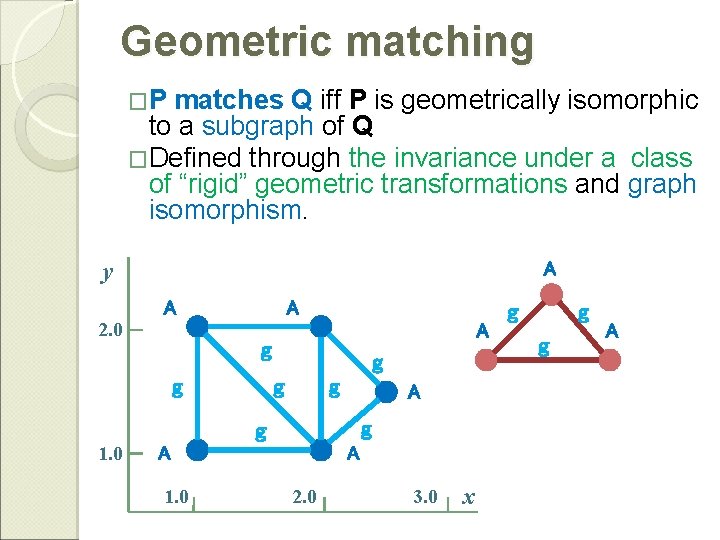
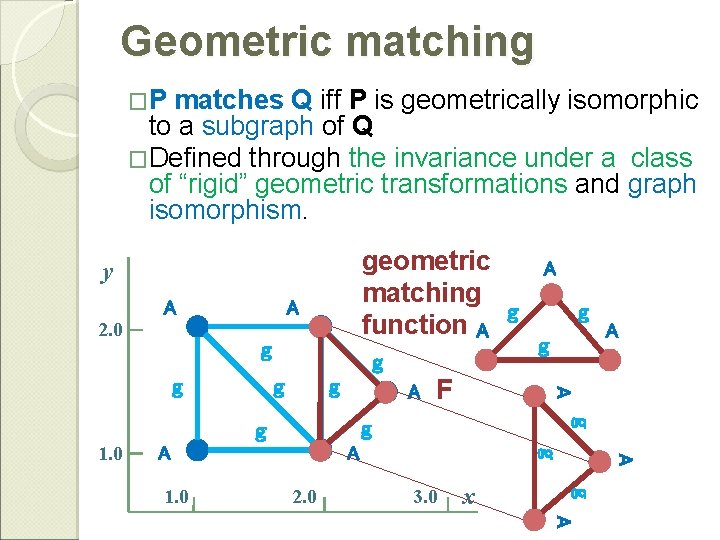
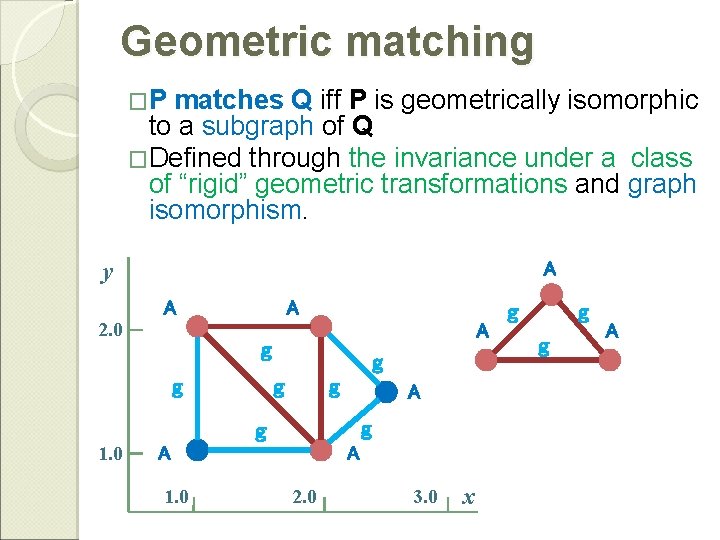
Geometric matching �P matches Q iff P is geometrically isomorphic to a subgraph of Q �Defined through the invariance under a class of “rigid” geometric transformations and graph isomorphism. y A A 2. 0 A A g g g A g g 1. 0 A 2. 0 3. 0 x g g g A
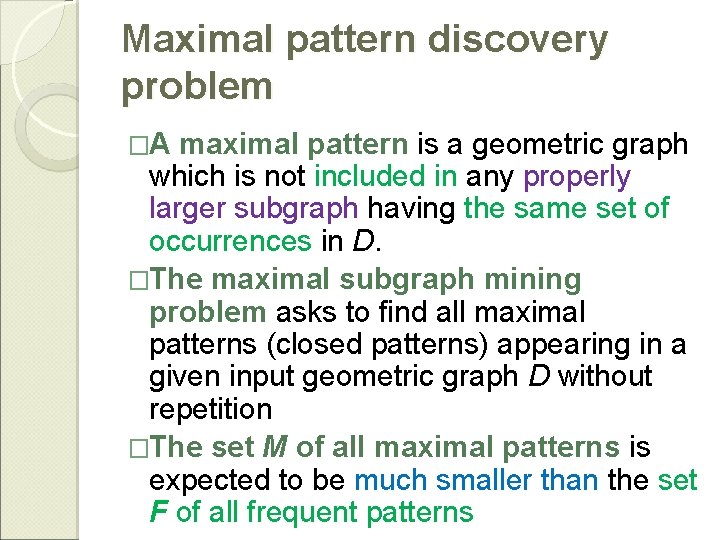
Maximal pattern discovery problem �A maximal pattern is a geometric graph which is not included in any properly larger subgraph having the same set of occurrences in D. �The maximal subgraph mining problem asks to find all maximal patterns (closed patterns) appearing in a given input geometric graph D without repetition �The set M of all maximal patterns is expected to be much smaller than the set F of all frequent patterns
Difficulties in maximal pattern mining �A number of efficient maximal pattern algorithms are proposed for sets, sequences, and graphs [3, 9, 20, 22, 25]. ◦ Some algorithms use explicit duplicate detection and maximality test with a collection of already discovered patterns. ◦ This requires large memory and delay time by these approaches, and introduces difficulties to use efficient search techniques, e. g. , depth-first search. �Open problem: output-polynomial time computability of the maximal pattern problem for the class of geometric graphs.
Related works: Graph mining �Frequent subgraph mining: ◦ AGM [Inokuchi, Washio, Motoda, PKDD’ 00] ◦ Tree. Miner [Zaki, KDD’ 02] ◦ Freqt [Asai et al. , SDM’ 02] ◦ NK [Nijssen & Kok, MGTS’ 03] � Maximal/closed ◦ ◦ subgraph mining Close. Graph [Yan & Han, KDD’ 03] CMTree. Miner [Chi, Yang, Xia, Muntz, PAKDD’ 04] Dryade [Termier, Rousset, Sebag, ICDM’ 04] Clo. Att [Arimura & Uno, ILP’ 05] � Combination with machine learning ◦ XRule [Zaki & Aggrawal, KDD’ 03] ◦ Weighted Substructure Mining [Tsuda & Kudo, ICML’ 06]
Related works: Maximal/Closed pattern mining � 1. The first: Flexible Patterns ◦ Classes of “elastic” or “flexible” patterns ◦ Polynojmial delay and space algoarithms are developed using a very simple “reverse search property” holds ◦ CMTree. Miner [Chi et al. PAKDD’ 04], BIDE [Yan & Han. ICDE’ 04], and Max. Flex [Arimura & Uno, LLLL’ 07] � The second: Rigid patterns ◦ deal with mining of “rigid” patterns which have ◦ Polynojmial delay and space algoarithms based on the existence of least generalization or closure-like operations. ◦ LCM [Uno et al. FIMI’ 03, ’ 04, DS’ 04] proposes ppc-extension for maximal sets, and then Clo. ATT [Arimura & Uno ILP’ 05] and Max. Motif [Arimura & Uno ISAAC’ 05] � The third: others ◦ Heuristic algorithms ◦ Close. Graph [25]: frequent pattern discovery augmented with maximality test and the duplicate detection ◦ Difficult to achieve output-polynomial time computability
Def: Enumeration Algorithms �Efficient data mining algorithm = output-polynomial time algorithms
Algorithm Max. Geo �A time and space efficient algorithm for mining all maximal geometric subgraphs Depth-first search over the space of all maximal geometric subgraphs ◦ To do this. . . �Achieves first time polynomial delay and polynomial space
We develop techniques. . . �A polynomial time computable canonical code for all geometric graphs which is invariant under geometric transformations. �Characterization of M by the intersection operation (the least generalization) and then Polytime computable closure operation for geographs �The tree-shaped search route T for all maximal patterns in G �A new pattern growth technique combining reverse search and closure extension
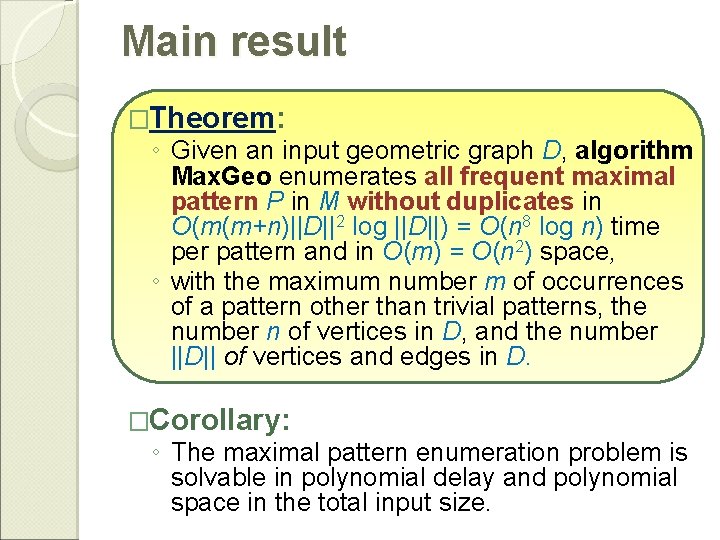
Main result �Theorem: ◦ Given an input geometric graph D, algorithm Max. Geo enumerates all frequent maximal pattern P in M without duplicates in O(m(m+n)||D||2 log ||D||) = O(n 8 log n) time per pattern and in O(m) = O(n 2) space, ◦ with the maximum number m of occurrences of a pattern other than trivial patterns, the number n of vertices in D, and the number ||D|| of vertices and edges in D. �Corollary: ◦ The maximal pattern enumeration problem is solvable in polynomial delay and polynomial space in the total input size.
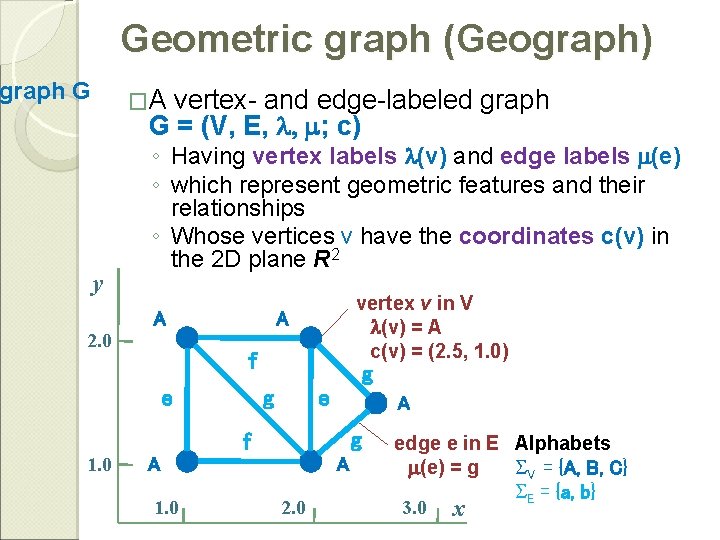
Geometric graph (Geograph) graph G �A vertex- and edge-labeled graph G = (V, E, l, m; c) y ◦ Having vertex labels l(v) and edge labels m(e) ◦ which represent geometric features and their relationships ◦ Whose vertices v have the coordinates c(v) in the 2 D plane R 2 A 2. 0 vertex v in V l(v) = A c(v) = (2. 5, 1. 0) A f e g g e A g f 1. 0 A 2. 0 edge e in E Alphabets m(e) = g SV = {A, B, C} SE = {a, b} 3. 0 x
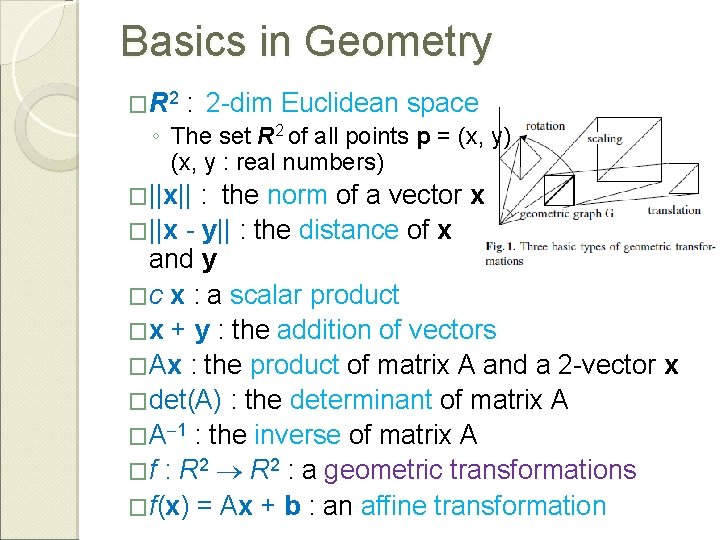
Basics in Geometry � R 2 : 2 -dim Euclidean space ◦ The set R 2 of all points p = (x, y) (x, y : real numbers) �||x|| : the norm of a vector x �||x - y|| : the distance of x and y �c x : a scalar product �x + y : the addition of vectors �Ax : the product of matrix A and a 2 -vector x �det(A) : the determinant of matrix A �A-1 : the inverse of matrix A �f : R 2 : a geometric transformations �f(x) = Ax + b : an affine transformation
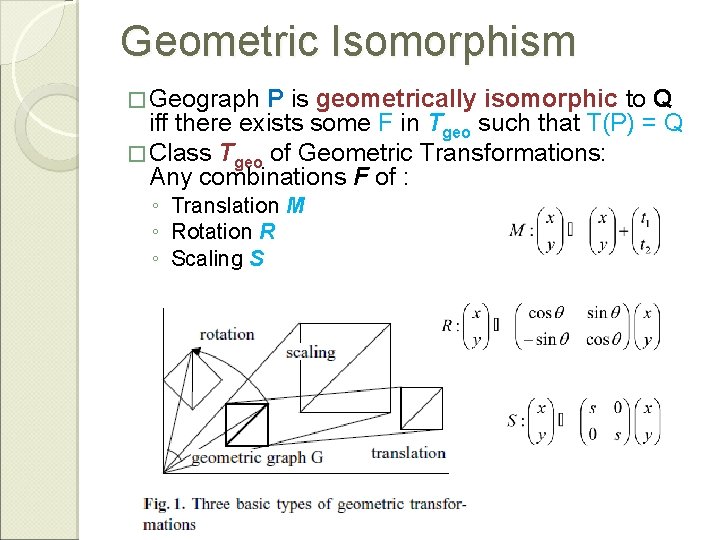
Geometric Isomorphism � Geograph P is geometrically isomorphic to Q iff there exists some F in Tgeo such that T(P) = Q � Class Tgeo of Geometric Transformations: Any combinations F of : ◦ Translation M ◦ Rotation R ◦ Scaling S
Geometric matching �P matches Q iff P is geometrically isomorphic to a subgraph of Q �Defined through the invariance under a class of “rigid” geometric transformations and graph isomorphism. geometric matching g function A y A 2. 0 A g g g A x A 3. 0 g 2. 0 A g A 1. 0 g g g 1. 0 F g A g g A A
Geometric matching �P matches Q iff P is geometrically isomorphic to a subgraph of Q �Defined through the invariance under a class of “rigid” geometric transformations and graph isomorphism. y A A 2. 0 A A g g g A g g 1. 0 A 2. 0 3. 0 x g g g A
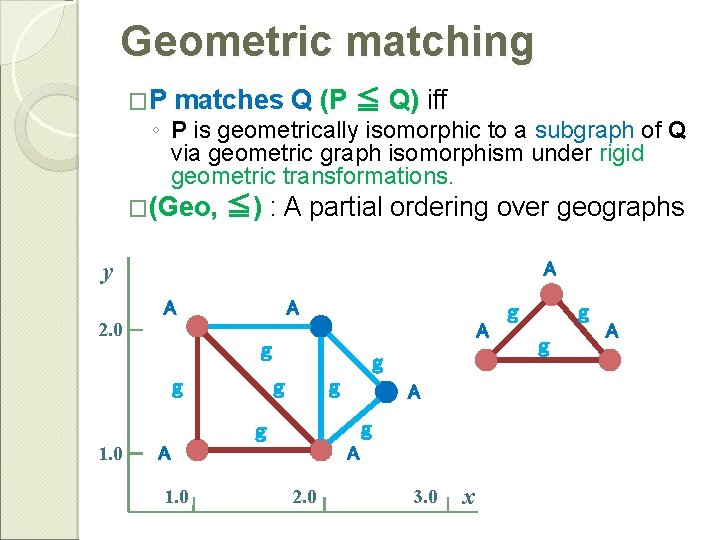
Geometric matching �P matches Q (P ≦ Q) iff ◦ P is geometrically isomorphic to a subgraph of Q via geometric graph isomorphism under rigid geometric transformations. �(Geo, ≦) : A partial ordering over geographs y A A 2. 0 A A g g g A g g 1. 0 A 2. 0 3. 0 x g g g A
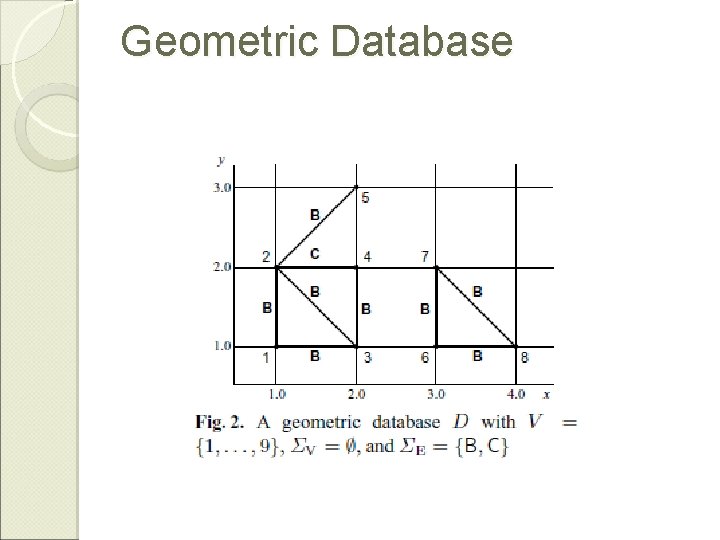
Geometric Database
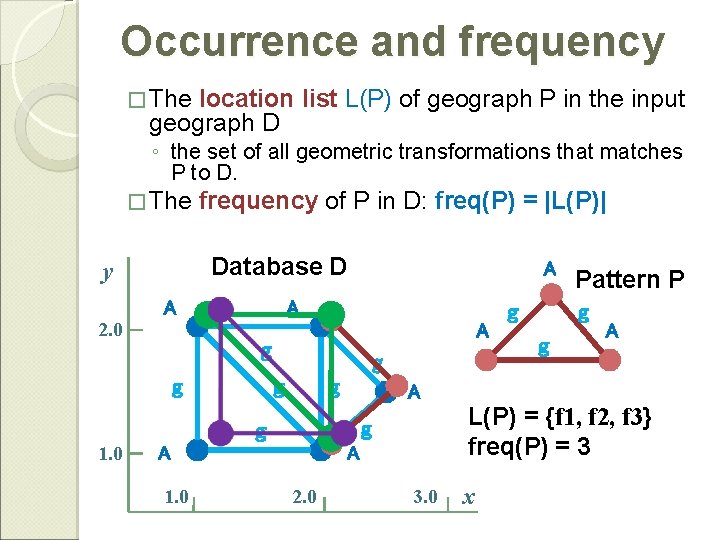
Occurrence and frequency � The location list L(P) of geograph P in the input geograph D ◦ the set of all geometric transformations that matches P to D. � The frequency of P in D: freq(P) = |L(P)| Database D y A 2. 0 A A g g g 1. 0 A 2. 0 g A L(P) = {f 1, f 2, f 3} freq(P) = 3 g A g Pattern P g A g 1. 0 A 3. 0 x
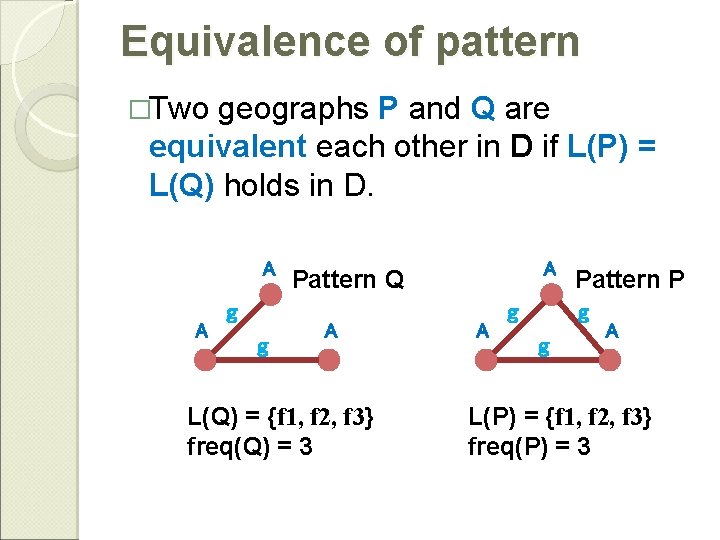
Equivalence of pattern �Two geographs P and Q are equivalent each other in D if L(P) = L(Q) holds in D. A A g g A Pattern Q A L(Q) = {f 1, f 2, f 3} freq(Q) = 3 A g g Pattern P g A L(P) = {f 1, f 2, f 3} freq(P) = 3
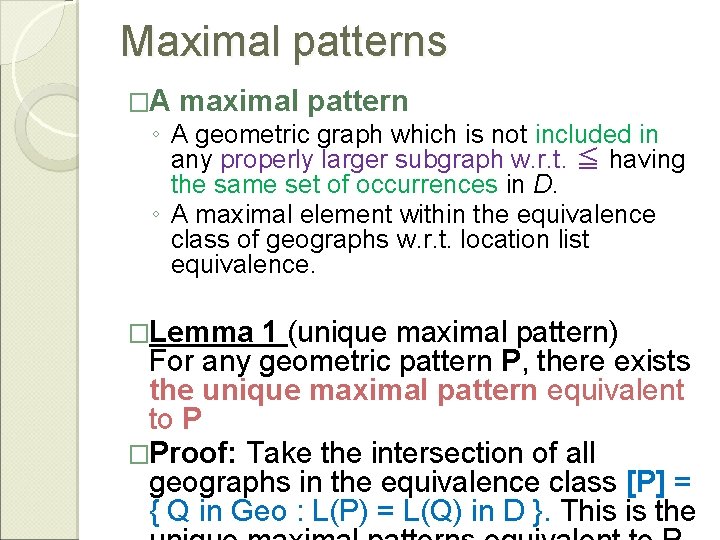
Maximal patterns �A maximal pattern ◦ A geometric graph which is not included in any properly larger subgraph w. r. t. ≦ having the same set of occurrences in D. ◦ A maximal element within the equivalence class of geographs w. r. t. location list equivalence. �Lemma 1 (unique maximal pattern) For any geometric pattern P, there exists the unique maximal pattern equivalent to P �Proof: Take the intersection of all geographs in the equivalence class [P] = { Q in Geo : L(P) = L(Q) in D }. This is the
Maximal pattern mining �A maximal pattern ◦ is a geometric graph which is not included in any properly larger subgraph having the same set of occurrences in D. �The maximal subgraph mining problem ◦ asks to find all maximal patterns (closed patterns) appearing in a given input geometric graph D without repetition �The set M of all maximal patterns ◦ is expected to be much smaller than the set F of all frequent patterns and still contains the complete information of D 要修正!
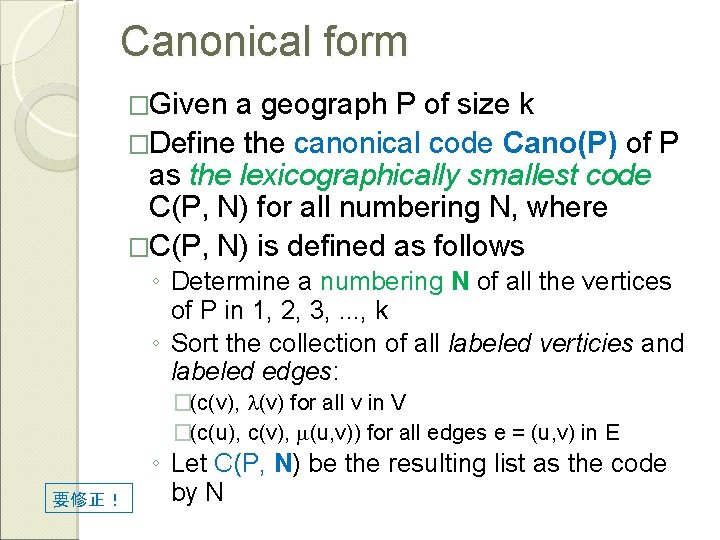
Canonical form �Given a geograph P of size k �Define the canonical code Cano(P) of P as the lexicographically smallest code C(P, N) for all numbering N, where �C(P, N) is defined as follows ◦ Determine a numbering N of all the vertices of P in 1, 2, 3, . . . , k ◦ Sort the collection of all labeled verticies and labeled edges: �(c(v), l(v) for all v in V �(c(u), c(v), m(u, v)) for all edges e = (u, v) in E 要修正! ◦ Let C(P, N) be the resulting list as the code by N
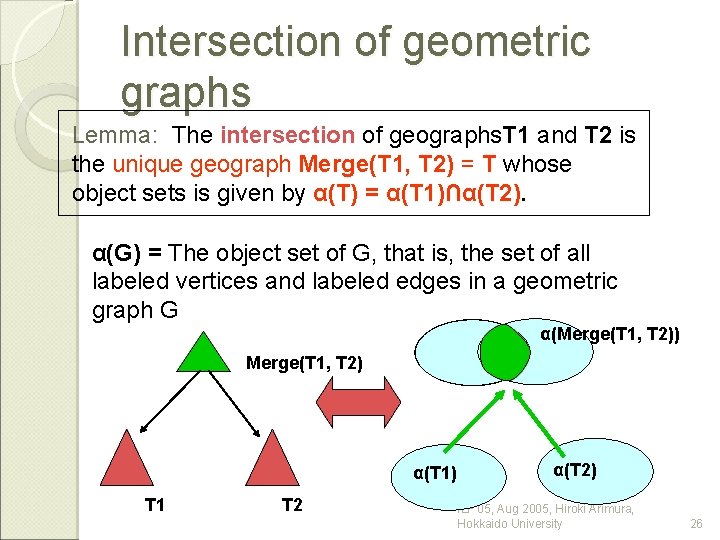
Intersection of geometric graphs Lemma: The intersection of geographs. T 1 and T 2 is the unique geograph Merge(T 1, T 2) = T whose object sets is given by α(T) = α(T 1)∩α(T 2). α(G) = The object set of G, that is, the set of all labeled vertices and labeled edges in a geometric graph G α(Merge(T 1, T 2)) Merge(T 1, T 2) α(T 1) T 1 T 2 α(T 2) ILP'05, Aug 2005, Hiroki Arimura, Hokkaido University 26
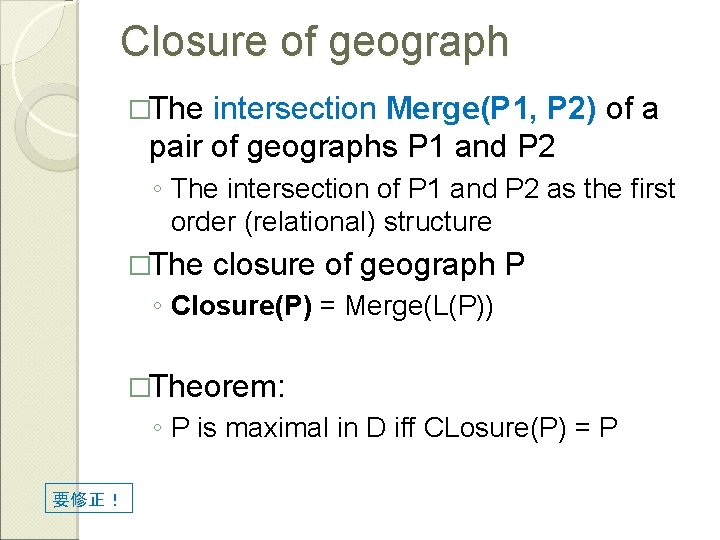
Closure of geograph �The intersection Merge(P 1, P 2) of a pair of geographs P 1 and P 2 ◦ The intersection of P 1 and P 2 as the first order (relational) structure �The closure of geograph P ◦ Closure(P) = Merge(L(P)) �Theorem: ◦ P is maximal in D iff CLosure(P) = P 要修正!
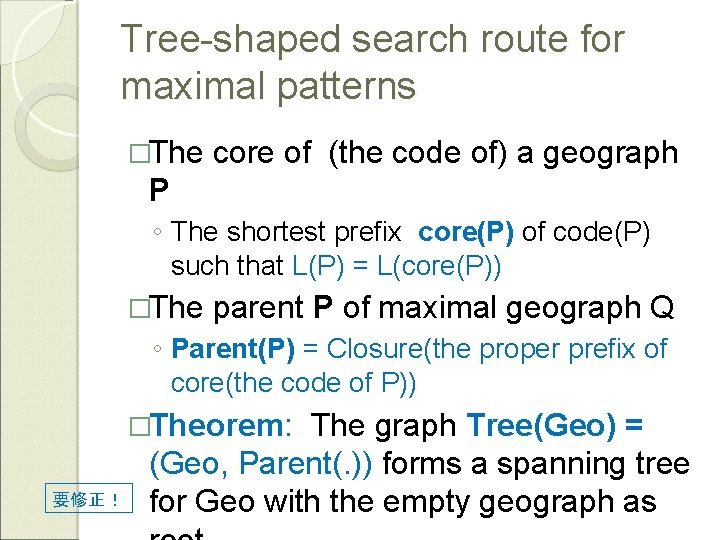
Tree-shaped search route for maximal patterns �The core of (the code of) a geograph P ◦ The shortest prefix core(P) of code(P) such that L(P) = L(core(P)) �The parent P of maximal geograph Q ◦ Parent(P) = Closure(the proper prefix of core(the code of P)) �Theorem: 要修正! The graph Tree(Geo) = (Geo, Parent(. )) forms a spanning tree for Geo with the empty geograph as
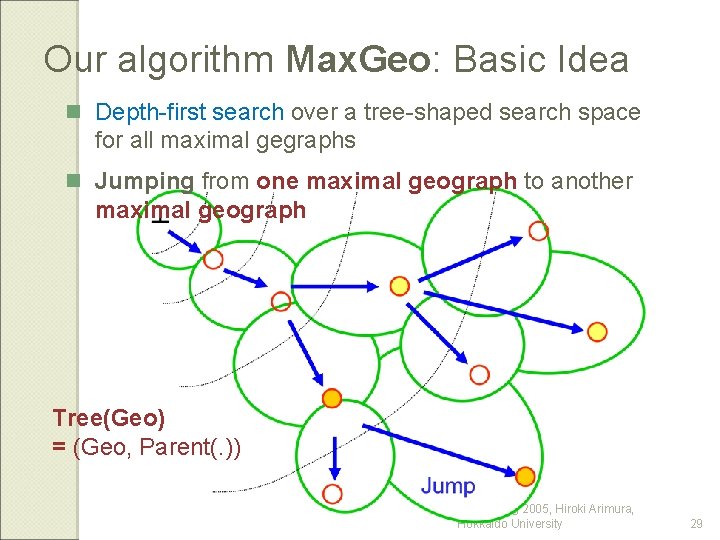
Our algorithm Max. Geo: Basic Idea n Depth-first search over a tree-shaped search space for all maximal gegraphs n Jumping from one maximal geograph to another maximal geograph Tree(Geo) = (Geo, Parent(. )) ILP'05, Aug 2005, Hiroki Arimura, Hokkaido University 29
Main result �Theorem: ◦ Given an input geometric graph D, algorithm Max. Geo enumerates all frequent maximal pattern P in M without duplicates in O(m(m+n)||D||2 log ||D||) = O(n 8 log n) time per pattern and in O(m) = O(n 2) space, ◦ with the maximum number m of occurrences of a pattern other than trivial patterns, the number n of vertices in D, and the number ||D|| of vertices and edges in D. �Corollary: ◦ The maximal pattern enumeration problem is solvable in polynomial delay and polynomial space in the total input size.
Summary: We develop techniques. . . �A polynomial time computable canonical code for all geometric graphs which is invariant under geometric transformations. �Characterization of M by the intersection operation (the least generalization) and then Polytime computable closure operation for geographs �The tree-shaped search route T for all maximal patterns in G �A new pattern growth technique combining reverse search and closure extension
Conclusion �The class of geometric graphs �Maximal pattern discovery problem �A polynomial space and polynomial delay algorithm Max. Geo �Time and space complexity �Techniques