
Efficient Market Theory Efficient Market Theory In an
- Slides: 9
Efficient Market Theory
Efficient Market Theory In an efficient capital market, security prices adjust rapidly to the infusion of new information therefore current stock prices truly reflect all available information. In other words capital market is informationally efficient market. The stock prices are unbiased reflection of all currently available information at a point of time including the risk involved in the security. Therefore in efficient market, the explicit return implicit in the stock prices should reflect its risk. In other words all securities should lie on the SML as expected return in consistent with their
Assumptions of EMT 1. Presence of large number of participants 2. Infusion of information in random order 3. Buy and sell decisions of investors cause change in stock prices to adjust rapidly to reflect new information.
Efficient Market Hypothesis During 1970 s Fama formalize EMT and presented it in terms of a fair game model, contending that investors can be confident that the price of their securities truly reflect all available information and therefore, expected return is based upon this price is consistent with its risk. He presented three sub-hypotheses in 1988. These are: �Weak form EMH �Semi-strong EMH �Strong form EMH
Weak form EMH It assumes that current stock prices fully reflect all security market information, including historical stock prices, rate of return, trading volume and other market related information. As per this EMH there is no relation between historical data and future returns. Thus one can get only a little gain through applying trading rules.
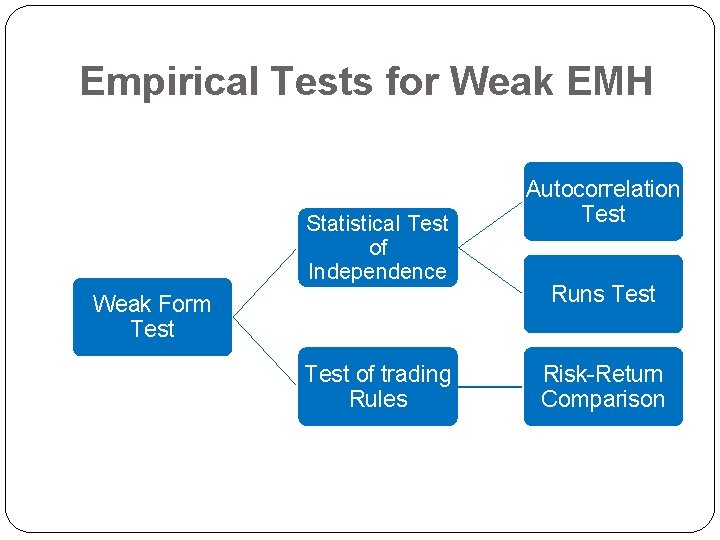
Empirical Tests for Weak EMH Statistical Test of Independence Weak Form Test of trading Rules Autocorrelation Test Runs Test Risk-Return Comparison
Statistical Test of Independence The hypothesis contends that as information is infused to market in a random order therefore security return at a point of time is independent to historical returns. This independence may be verified through following two tests: �Autocorrelation Test �Runs Test
Semi-strong EMH This hypothesis asserts that security prices adjust rapidly to all public information like dividend announcement, P/E ratio, dividend yield, stock splits, economic news, political news etc. It encompasses the weak form of EMH because market information considered in weak form is public. Public information also include non-market information.
Strong form EMH This hypothesis contends that stock prices fully reflect all information from public and private sources. Therefore, no investor can earn above average returns persistently. Strong form EMH encompasses both of the prior EMHs. This market form assumes the presence of perfect market where all information is cost free and available to everyone at the same time.