
Efficient handling of Large Scale insilico Screening Using
- Slides: 1
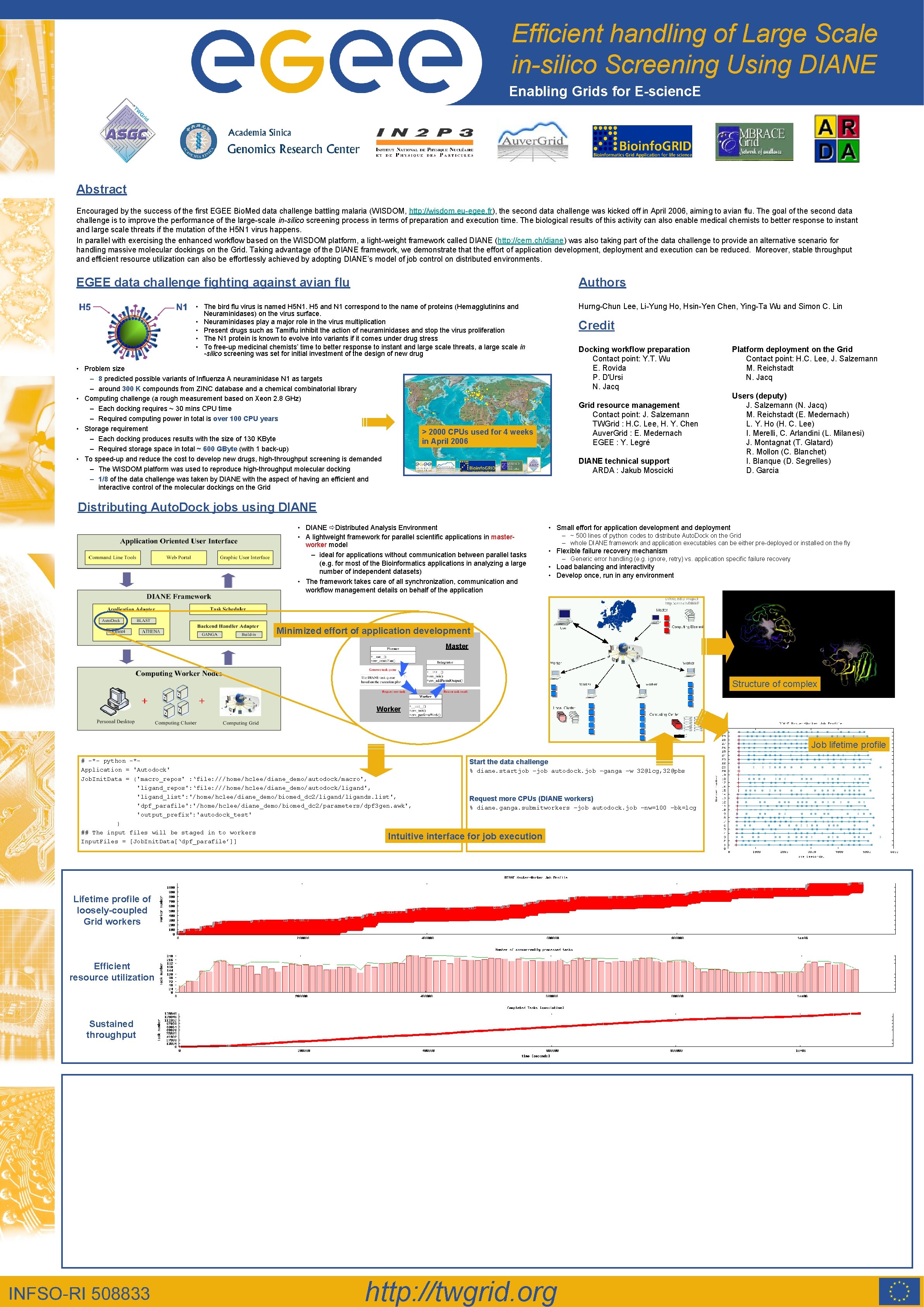
Efficient handling of Large Scale in-silico Screening Using DIANE Enabling Grids for E-scienc. E Abstract Encouraged by the success of the first EGEE Bio. Med data challenge battling malaria (WISDOM, http: //wisdom. eu-egee. fr), the second data challenge was kicked off in April 2006, aiming to avian flu. The goal of the second data challenge is to improve the performance of the large-scale in-silico screening process in terms of preparation and execution time. The biological results of this activity can also enable medical chemists to better response to instant and large scale threats if the mutation of the H 5 N 1 virus happens. In parallel with exercising the enhanced workflow based on the WISDOM platform, a light-weight framework called DIANE (http: //cern. ch/diane) was also taking part of the data challenge to provide an alternative scenario for handling massive molecular dockings on the Grid. Taking advantage of the DIANE framework, we demonstrate that the effort of application development, deployment and execution can be reduced. Moreover, stable throughput and efficient resource utilization can also be effortlessly achieved by adopting DIANE’s model of job control on distributed environments. EGEE data challenge fighting against avian flu Authors Hurng-Chun Lee, Li-Yung Ho, Hsin-Yen Chen, Ying-Ta Wu and Simon C. Lin • The bird flu virus is named H 5 N 1. H 5 and N 1 correspond to the name of proteins (Hemagglutinins and Neuraminidases) on the virus surface. • Neuraminidases play a major role in the virus multiplication • Present drugs such as Tamiflu inhibit the action of neuraminidases and stop the virus proliferation • The N 1 protein is known to evolve into variants if it comes under drug stress • To free-up medicinal chemists’ time to better response to instant and large scale threats, a large scale in -silico screening was set for initial investment of the design of new drug • Problem size – 8 predicted possible variants of Influenza A neuraminidase N 1 as targets – around 300 K compounds from ZINC database and a chemical combinatorial library • Computing challenge (a rough measurement based on Xeon 2. 8 GHz) – Each docking requires ~ 30 mins CPU time – Required computing power in total is over 100 CPU years • Storage requirement – Each docking produces results with the size of 130 KByte – Required storage space in total ~ 600 GByte (with 1 back-up) • To speed-up and reduce the cost to develop new drugs, high-throughput screening is demanded – The WISDOM platform was used to reproduce high-throughput molecular docking – 1/8 of the data challenge was taken by DIANE with the aspect of having an efficient and interactive control of the molecular dockings on the Grid Credit Docking workflow preparation Contact point: Y. T. Wu E. Rovida P. D'Ursi N. Jacq Grid resource management Contact point: J. Salzemann TWGrid : H. C. Lee, H. Y. Chen Auver. Grid : E. Medernach EGEE : Y. Legré > 2000 CPUs used for 4 weeks in April 2006 DIANE technical support ARDA : Jakub Moscicki Platform deployment on the Grid Contact point: H. C. Lee, J. Salzemann M. Reichstadt N. Jacq Users (deputy) J. Salzemann (N. Jacq) M. Reichstadt (E. Medernach) L. Y. Ho (H. C. Lee) I. Merelli, C. Arlandini (L. Milanesi) J. Montagnat (T. Glatard) R. Mollon (C. Blanchet) I. Blanque (D. Segrelles) D. Garcia Distributing Auto. Dock jobs using DIANE • DIANE Distributed Analysis Environment • A lightweight framework for parallel scientific applications in masterworker model – ideal for applications without communication between parallel tasks (e. g. for most of the Bioinformatics applications in analyzing a large number of independent datasets) • The framework takes care of all synchronization, communication and workflow management details on behalf of the application • Small effort for application development and deployment – ~ 500 lines of python codes to distribute Auto. Dock on the Grid – whole DIANE framework and application executables can be either pre-deployed or installed on the fly • Flexible failure recovery mechanism – Generic error handling (e. g. ignore, retry) vs. application specific failure recovery • Load balancing and interactivity • Develop once, run in any environment Minimized effort of application development Master Structure of complex Worker Job lifetime profile # -*- python -*Application = 'Autodock' Job. Init. Data = {'macro_repos' : ‘file: ///home/hclee/diane_demo/autodock/macro', 'ligand_repos': ‘file: ///home/hclee/diane_demo/autodock/ligand', 'ligand_list': '/home/hclee/diane_demo/biomed_dc 2/ligands. list', 'dpf_parafile': '/home/hclee/diane_demo/biomed_dc 2/parameters/dpf 3 gen. awk', 'output_prefix': 'autodock_test' } ## The input files will be staged in to workers Intuitive Input. Files = [Job. Init. Data[‘dpf_parafile’]] Start the data challenge % diane. startjob –job autodock. job –ganga –w 32@lcg, 32@pbs Request more CPUs (DIANE workers) % diane. ganga. submitworkers –job autodock. job –nw=100 –bk=lcg interface for job execution Lifetime profile of loosely-coupled Grid workers Efficient resource utilization Sustained throughput http: //twgrid. org