
Efficient definitive screening designs to optimize the freezedrying

- Slides: 18
Efficient definitive screening designs to optimize the freeze-drying process Olga Yee NCS 2018 Paris, France
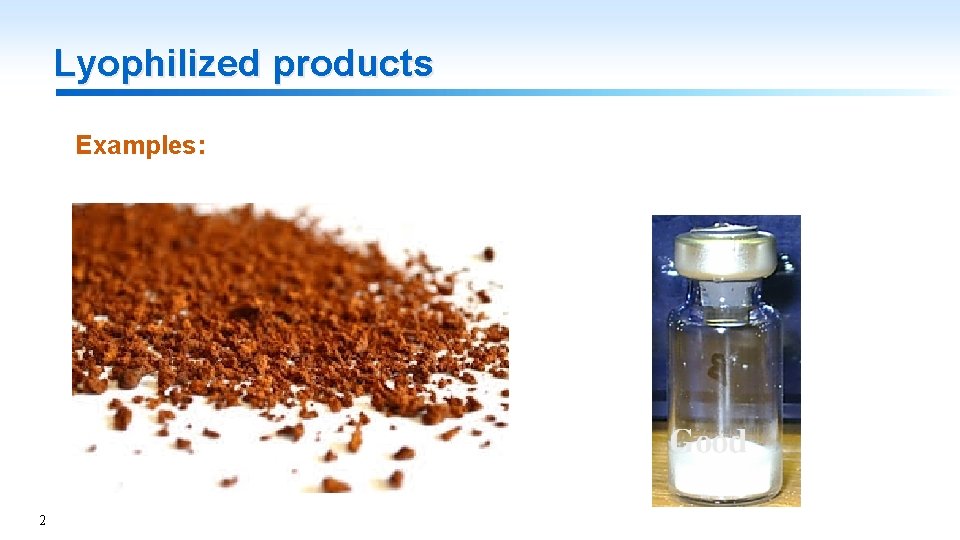
Lyophilized products Examples: 2
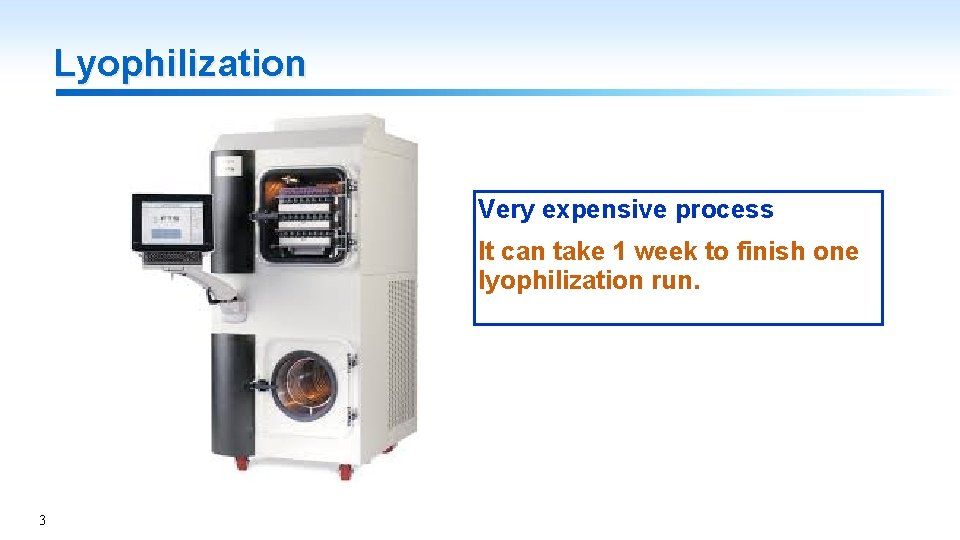
Lyophilization Very expensive process It can take 1 week to finish one lyophilization run. 3
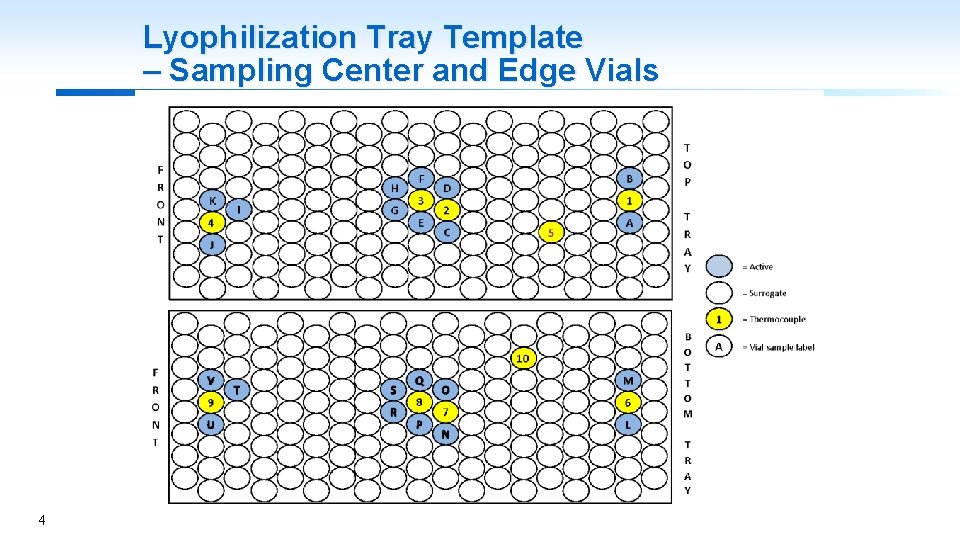
Lyophilization Tray Template – Sampling Center and Edge Vials 4
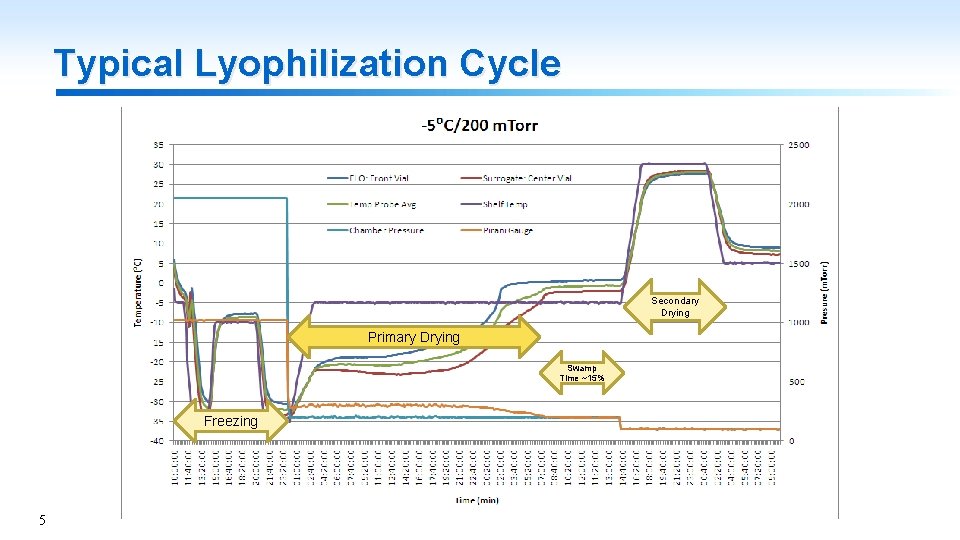
Typical Lyophilization Cycle Secondary Drying Primary Drying Swamp Time ~15% Freezing 5
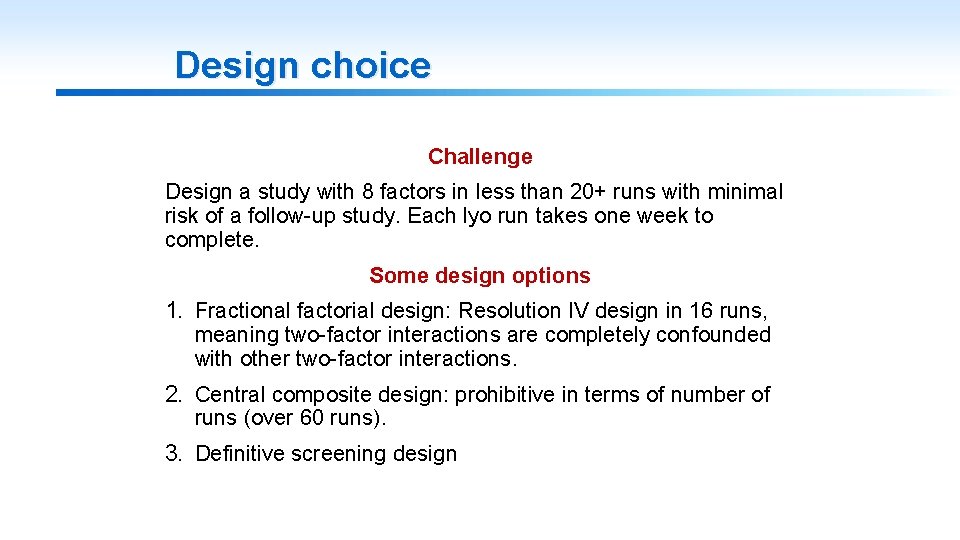
Design choice Challenge Design a study with 8 factors in less than 20+ runs with minimal risk of a follow-up study. Each lyo run takes one week to complete. Some design options 1. Fractional factorial design: Resolution IV design in 16 runs, meaning two-factor interactions are completely confounded with other two-factor interactions. 2. Central composite design: prohibitive in terms of number of runs (over 60 runs). 3. Definitive screening design
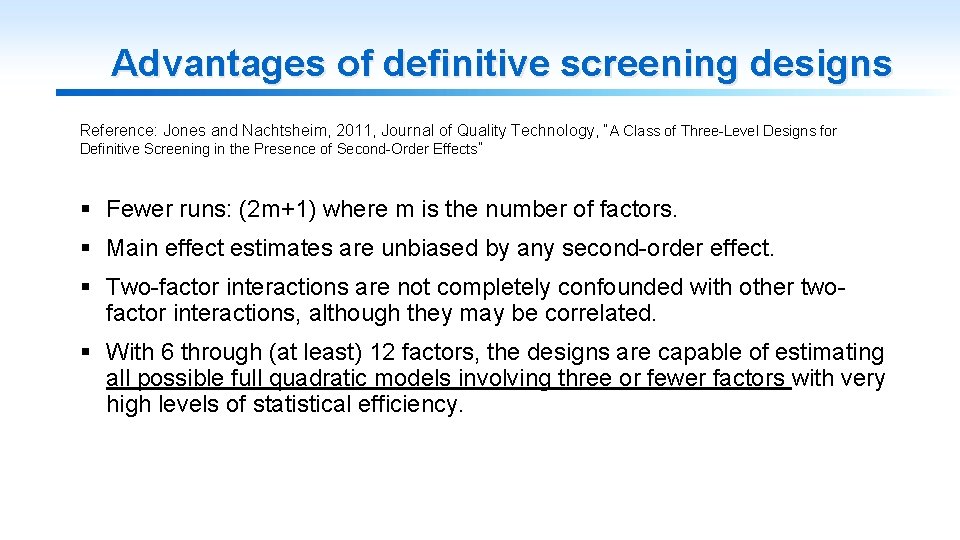
Advantages of definitive screening designs Reference: Jones and Nachtsheim, 2011, Journal of Quality Technology, “A Class of Three-Level Designs for Definitive Screening in the Presence of Second-Order Effects” § Fewer runs: (2 m+1) where m is the number of factors. § Main effect estimates are unbiased by any second-order effect. § Two-factor interactions are not completely confounded with other twofactor interactions, although they may be correlated. § With 6 through (at least) 12 factors, the designs are capable of estimating all possible full quadratic models involving three or fewer factors with very high levels of statistical efficiency.
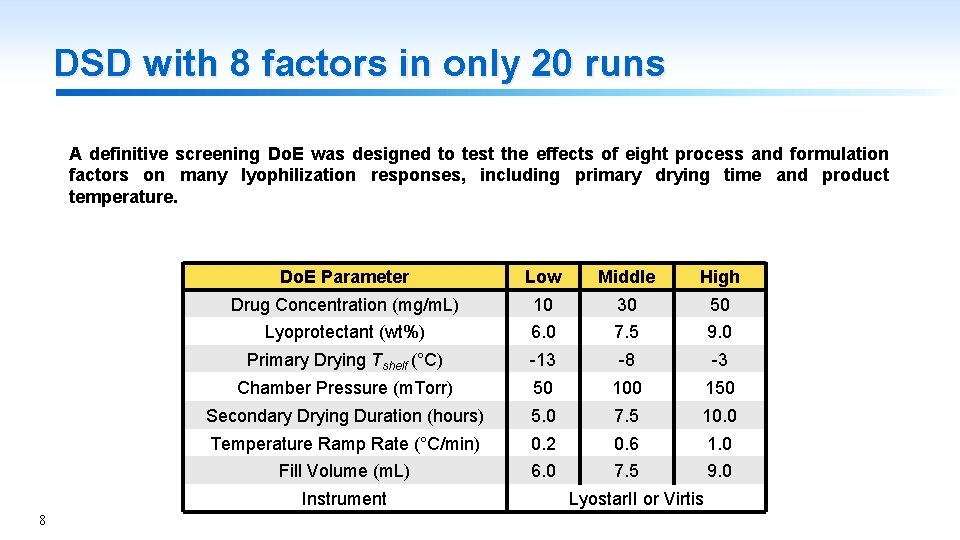
DSD with 8 factors in only 20 runs A definitive screening Do. E was designed to test the effects of eight process and formulation factors on many lyophilization responses, including primary drying time and product temperature. Do. E Parameter Low Middle High Drug Concentration (mg/m. L) 10 30 50 Lyoprotectant (wt%) 6. 0 7. 5 9. 0 Primary Drying Tshelf (°C) -13 -8 -3 Chamber Pressure (m. Torr) 50 100 150 Secondary Drying Duration (hours) 5. 0 7. 5 10. 0 Temperature Ramp Rate (°C/min) 0. 2 0. 6 1. 0 Fill Volume (m. L) 6. 0 7. 5 9. 0 Instrument 8 Lyostar. II or Virtis
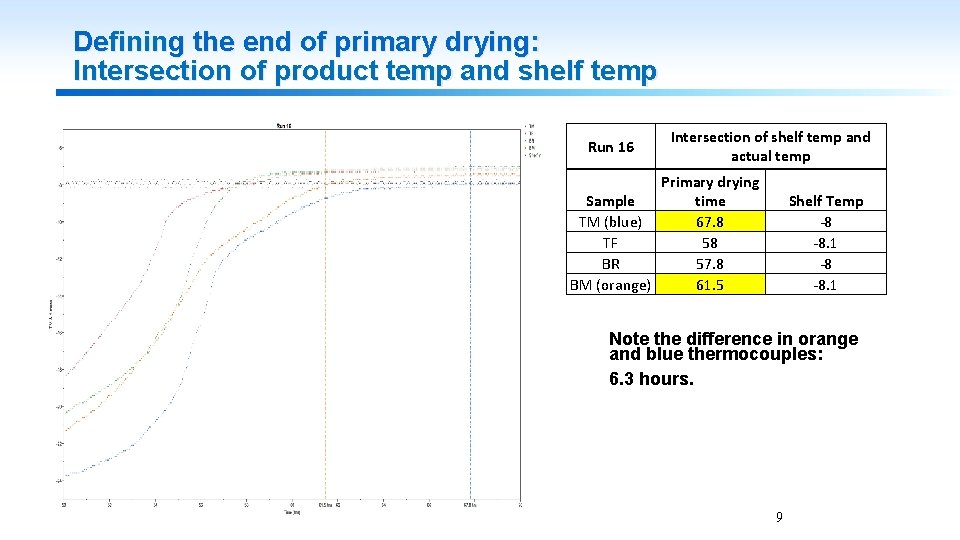
Defining the end of primary drying: Intersection of product temp and shelf temp Run 16 Intersection of shelf temp and actual temp Primary drying Sample time TM (blue) 67. 8 TF 58 BR 57. 8 BM (orange) 61. 5 Shelf Temp -8 -8. 1 Note the difference in orange and blue thermocouples: 6. 3 hours. 9
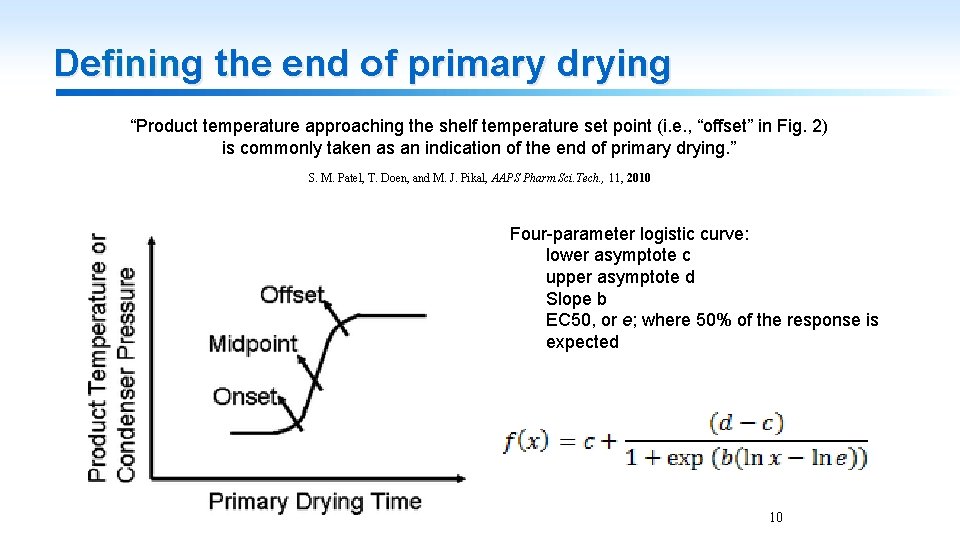
Defining the end of primary drying “Product temperature approaching the shelf temperature set point (i. e. , “offset” in Fig. 2) is commonly taken as an indication of the end of primary drying. ” S. M. Patel, T. Doen, and M. J. Pikal, AAPS Pharm. Sci. Tech. , 11, 2010 Four-parameter logistic curve: lower asymptote c upper asymptote d Slope b EC 50, or e; where 50% of the response is expected 10
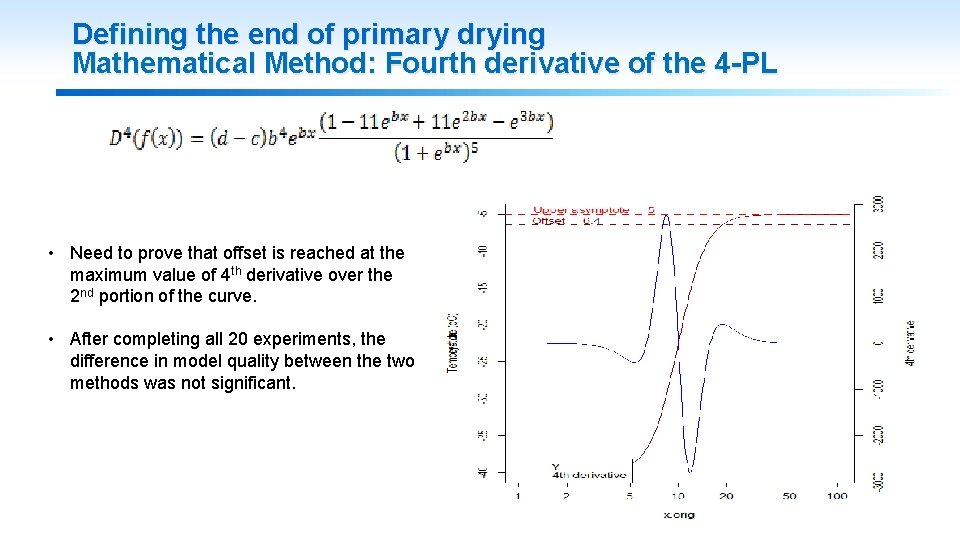
Defining the end of primary drying Mathematical Method: Fourth derivative of the 4 -PL • Need to prove that offset is reached at the maximum value of 4 th derivative over the 2 nd portion of the curve. • After completing all 20 experiments, the difference in model quality between the two methods was not significant. 11
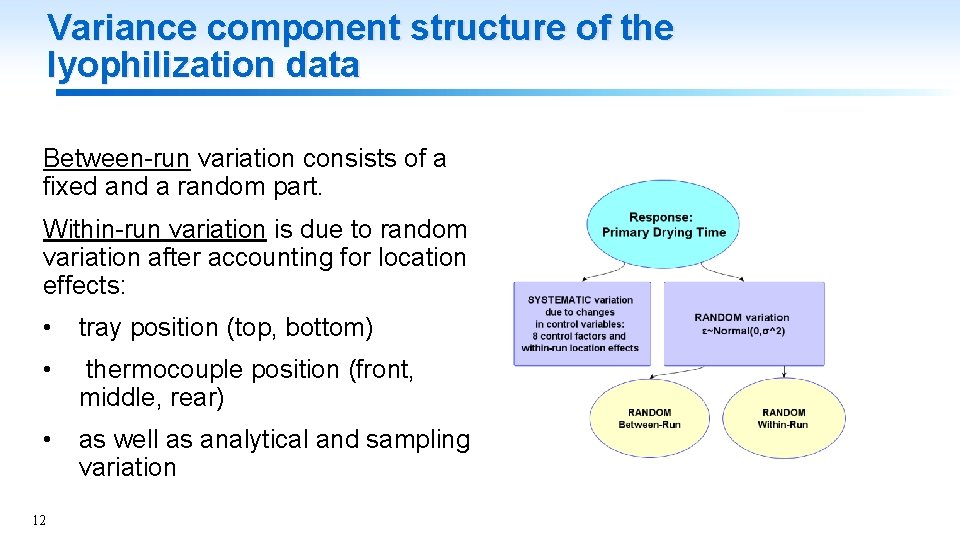
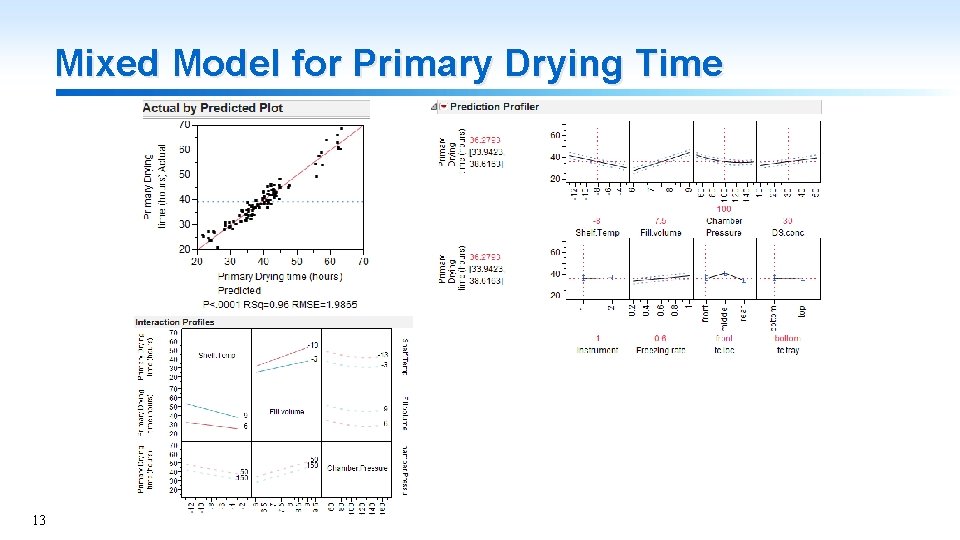
Variance component structure of the lyophilization data Between-run variation consists of a fixed and a random part. Within-run variation is due to random variation after accounting for location effects: • tray position (top, bottom) • thermocouple position (front, middle, rear) • as well as analytical and sampling variation 12
Mixed Model for Primary Drying Time 13
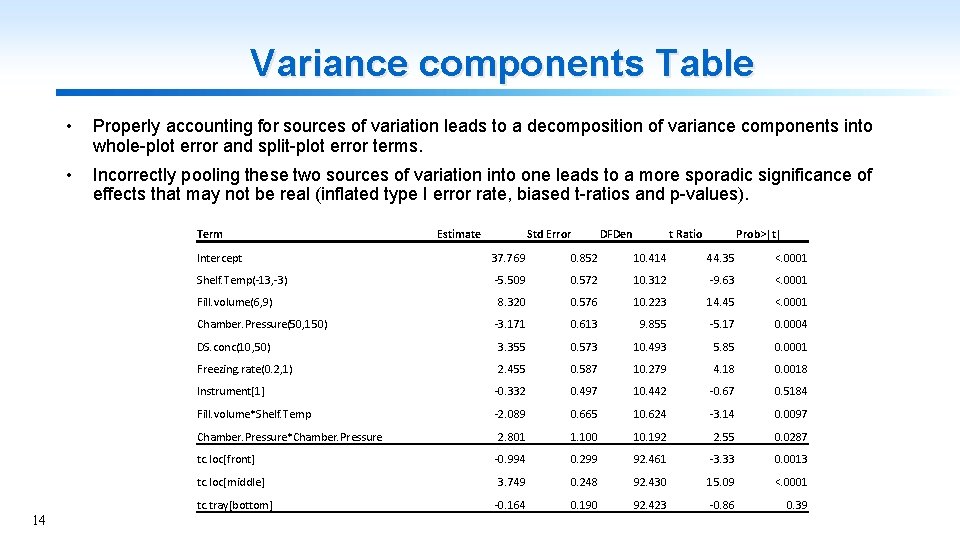
Variance components Table • Properly accounting for sources of variation leads to a decomposition of variance components into whole-plot error and split-plot error terms. • Incorrectly pooling these two sources of variation into one leads to a more sporadic significance of effects that may not be real (inflated type I error rate, biased t-ratios and p-values). Term Std Error DFDen t Ratio Prob>|t| Intercept 37. 769 0. 852 10. 414 44. 35 <. 0001 Shelf. Temp(-13, -3) -5. 509 0. 572 10. 312 -9. 63 <. 0001 8. 320 0. 576 10. 223 14. 45 <. 0001 -3. 171 0. 613 9. 855 -5. 17 0. 0004 DS. conc(10, 50) 3. 355 0. 573 10. 493 5. 85 0. 0001 Freezing. rate(0. 2, 1) 2. 455 0. 587 10. 279 4. 18 0. 0018 Instrument[1] -0. 332 0. 497 10. 442 -0. 67 0. 5184 Fill. volume*Shelf. Temp -2. 089 0. 665 10. 624 -3. 14 0. 0097 2. 801 1. 100 10. 192 2. 55 0. 0287 -0. 994 0. 299 92. 461 -3. 33 0. 0013 3. 749 0. 248 92. 430 15. 09 <. 0001 -0. 164 0. 190 92. 423 -0. 86 0. 39 Fill. volume(6, 9) Chamber. Pressure(50, 150) Chamber. Pressure*Chamber. Pressure tc. loc[front] tc. loc[middle] tc. tray[bottom] 14 Estimate
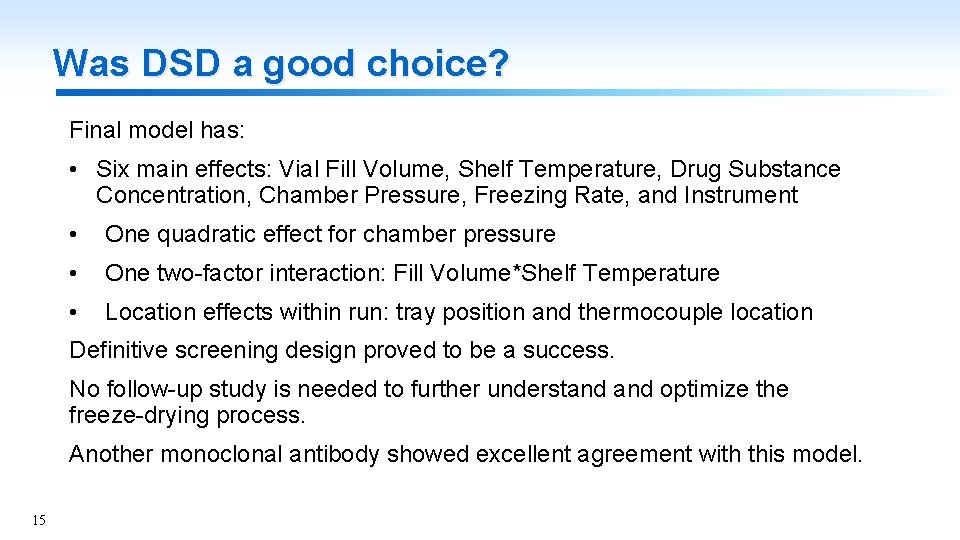
Was DSD a good choice? Final model has: • Six main effects: Vial Fill Volume, Shelf Temperature, Drug Substance Concentration, Chamber Pressure, Freezing Rate, and Instrument • One quadratic effect for chamber pressure • One two-factor interaction: Fill Volume*Shelf Temperature • Location effects within run: tray position and thermocouple location Definitive screening design proved to be a success. No follow-up study is needed to further understand optimize the freeze-drying process. Another monoclonal antibody showed excellent agreement with this model. 15
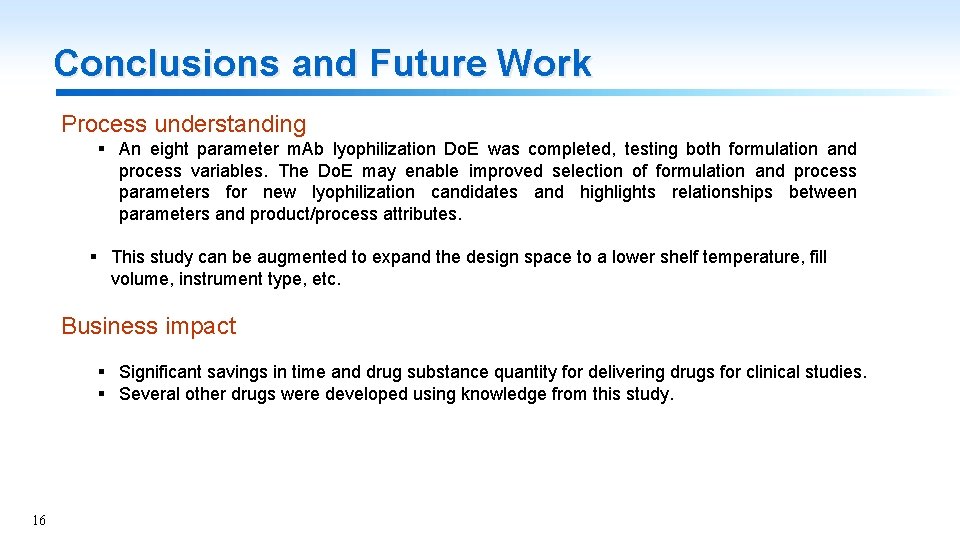
Conclusions and Future Work Process understanding § An eight parameter m. Ab lyophilization Do. E was completed, testing both formulation and process variables. The Do. E may enable improved selection of formulation and process parameters for new lyophilization candidates and highlights relationships between parameters and product/process attributes. § This study can be augmented to expand the design space to a lower shelf temperature, fill volume, instrument type, etc. Business impact § Significant savings in time and drug substance quantity for delivering drugs for clinical studies. § Several other drugs were developed using knowledge from this study. 16
References B. Jones, C. J. Nachtsheim (2011) “A Class of Three-Level Designs for Definitive Screening in the Presence of Second-Order Effects” Journal of Quality Technology, 43: 1, 1 -15 J. Goldman, H. More, O. Yee et al, “Optimization of Primary Drying in Lyophilization During Early-Phase Drug Development Using a Definitive Screening Design With Formulation and Process Factors” J Pharm Sci 2018 Oct 8; 107(10): 2592 -2600 17
Acknowledgements Engineering Technologies Parenterals Science & Technology 18