
Efficient CRTBased RSA Cryptosystems Immune against the Hardware
Efficient CRT-Based RSA Cryptosystems Immune against the Hardware Fault Attack and the FPGA Implementations Yonghong Yang Supervisors: Prof. Z. Abid & Prof. W. Wang Department of Electrical and Computer Engineering the University of Western Ontario, Canada
Ø Introduction Ø Literature Review Ø Proposed Efficient Two-Prime RSA Cryptosystem Ø Proposed Efficient Multi-Prime RSA Cryptosystem Ø FPGA Implementations and Results Ø Conclusions
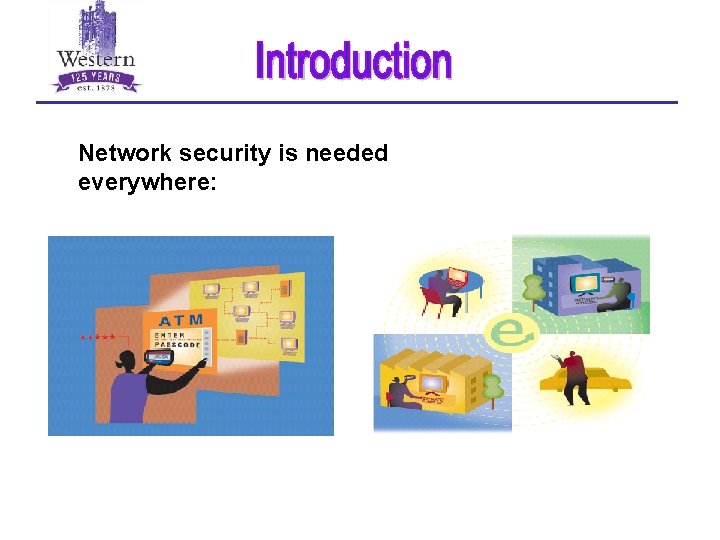
Network security is needed everywhere:
Ø Wide applications need security z Electronic banking and voting z Electronic commerce, such as online bidding z Email, file exchange/submission z Web browsing, etc. 2020 -09 -30 4
Ø Cryptography z The mathematical science to secure the confidentiality/authentication of data by replacing them with a transformed version z Two types: secret-key and public-key Ø Cryptography guarantees the needed security z Privacy or confidentiality z Data integrity z Authentication z Non-repudiation
Ø Secret-Key Cryptography z Traditional method of cryptography z Theoretical basis: “communication theory of secrecy systems” z Single key is used to encrypt and decrypt texts z DES, NSA and IDEA etc. z Disadvantages: F Difficult key management F Keys need to be changed frequently F Cannot yield efficient signature mechanisms
Ø Public-Key Cryptography z Relatively new field – 1975, initiated by the paper “New directions in cryptography ” z Different keys are used for encryption and decryption z RSA, DSS etc. 2020 -09 -30 7
Ø Public-Key Cryptography z Advantages: F Easier key management F Key can remain unchanged for longer time F Yields efficient digital signature mechanisms z Disadvantage: F Slower throughputs since keys have larger wordlengths 2020 -09 -30 8
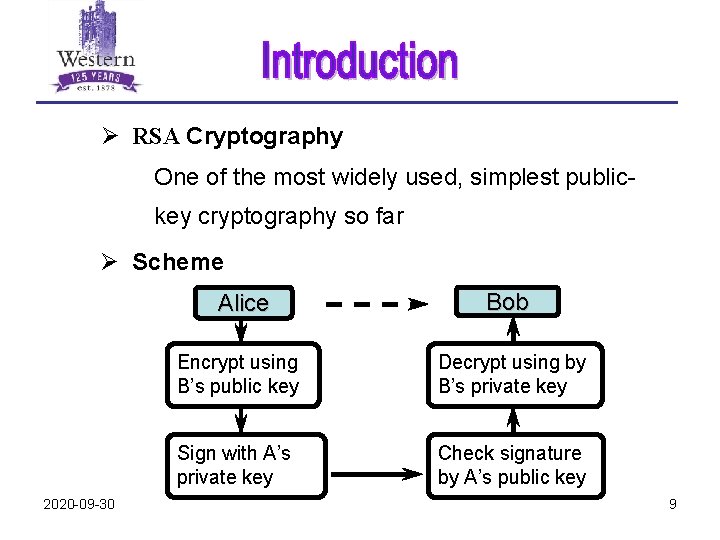
Ø RSA Cryptography One of the most widely used, simplest publickey cryptography so far Ø Scheme Alice 2020 -09 -30 Bob Encrypt using B’s public key Decrypt using by B’s private key Sign with A’s private key Check signature by A’s public key 9
Ø Introduction Ø Literature Review Ø Proposed Efficient Two-Prime RSA Cryptosystem Ø Proposed Efficient Multi-Prime RSA Cryptosystem Ø FPGA Implementations and Results Ø Conclusions 2020 -09 -30 10
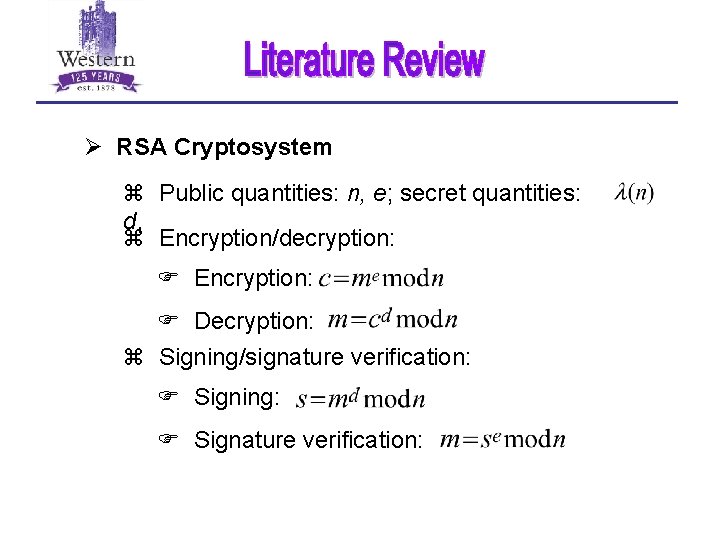
Ø RSA Cryptosystem z Public quantities: n, e; secret quantities: d, z Encryption/decryption: F Encryption: F Decryption: z Signing/signature verification: F Signing: F Signature verification:
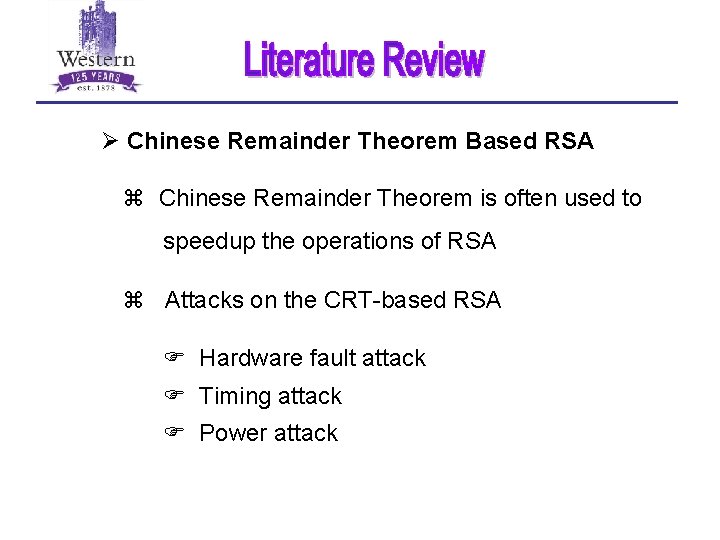
Ø Chinese Remainder Theorem Based RSA z Chinese Remainder Theorem is often used to speedup the operations of RSA z Attacks on the CRT-based RSA F Hardware fault attack F Timing attack F Power attack
Ø Countermeasures to the attack z Padding the message, drawback: collision-free hash function (hard) z Checking the intermediate or final results, drawback: double the operational time and not secure z Revising the signature expression, make sure no secret information is leaked 2020 -09 -30 13
Ø Introduction Ø Literature Review Ø Proposed Efficient Two-Prime RSA Cryptosystem Ø Proposed Efficient Multi-Prime RSA Cryptosystem Ø FPGA Implementations and Results Ø Conclusions 2020 -09 -30 14
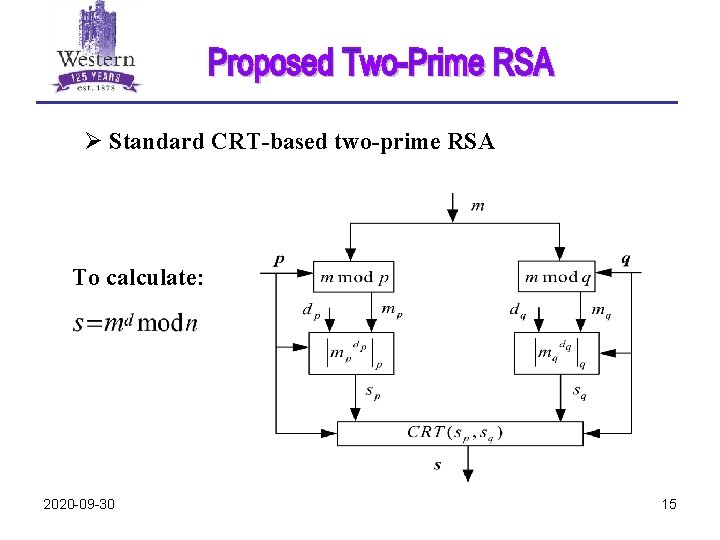
Ø Standard CRT-based two-prime RSA To calculate: 2020 -09 -30 15
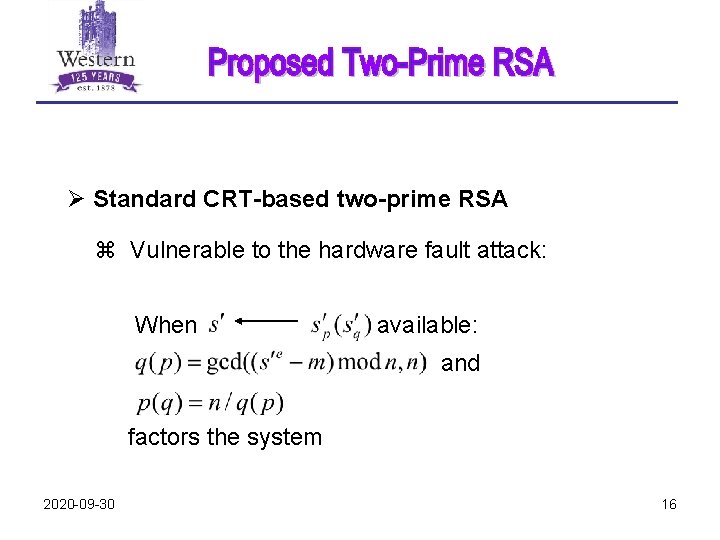
Ø Standard CRT-based two-prime RSA z Vulnerable to the hardware fault attack: When available: and factors the system 2020 -09 -30 16
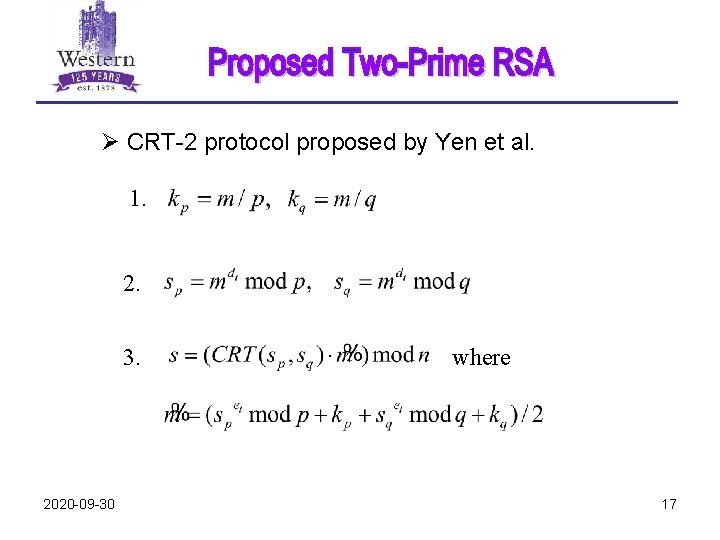
Ø CRT-2 protocol proposed by Yen et al. 1. 2. 3. 2020 -09 -30 where 17
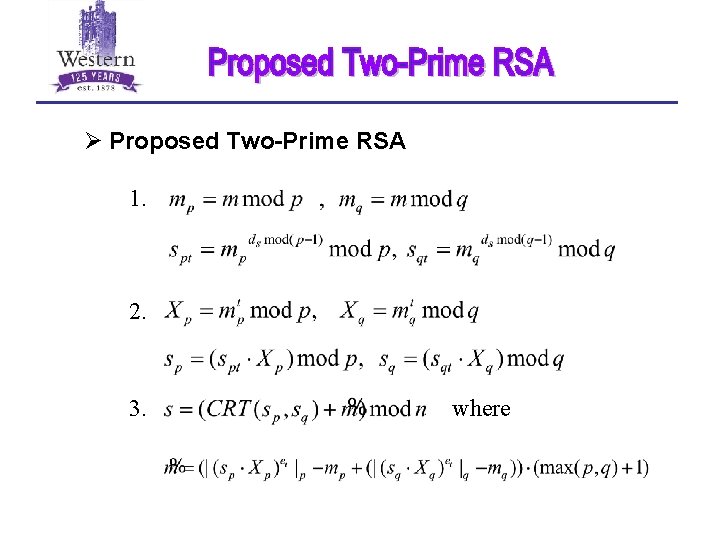
Ø Proposed Two-Prime RSA 1. 2. 3. where
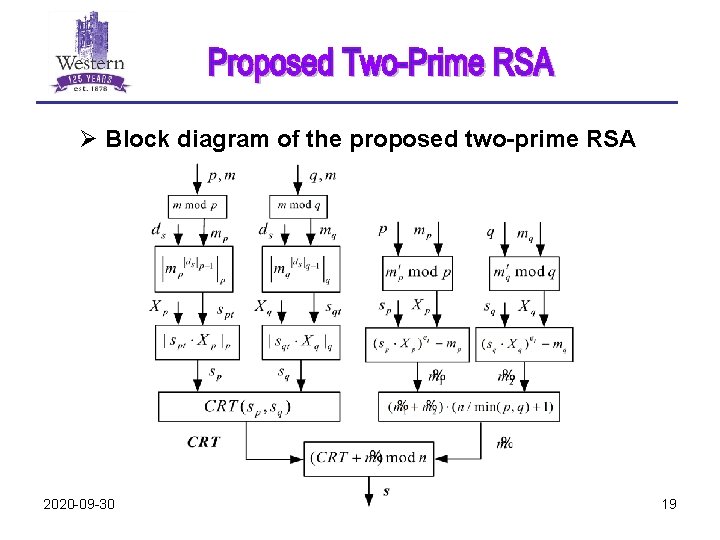
Ø Block diagram of the proposed two-prime RSA 2020 -09 -30 19
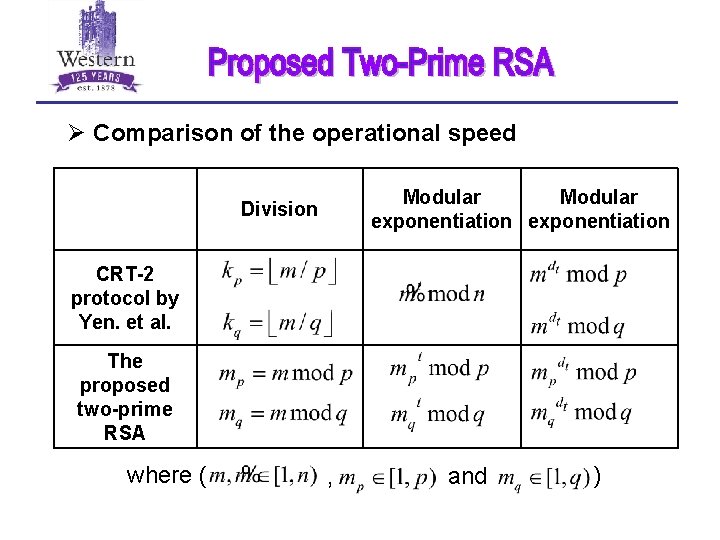
Ø Comparison of the operational speed Modular exponentiation Division CRT-2 protocol by Yen. et al. The proposed two-prime RSA where ( , and )
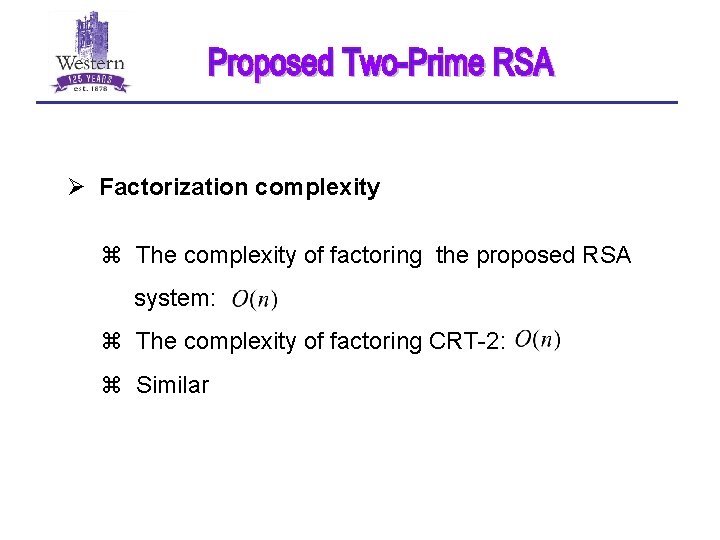
Ø Factorization complexity z The complexity of factoring the proposed RSA system: z The complexity of factoring CRT-2: z Similar
Ø Introduction Ø Literature Review Ø Proposed Efficient Two-Prime RSA Cryptosystem Ø Proposed Efficient Multi-Prime RSA Cryptosystem Ø FPGA Implementations and Results Ø Conclusions 2020 -09 -30 22
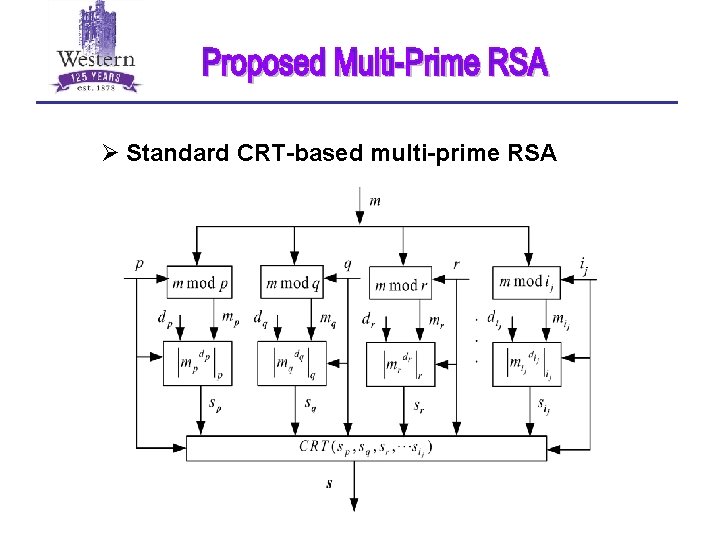
Ø Standard CRT-based multi-prime RSA
Ø Immunity of CRT-based multi-prime RSA: z When (j-1) faulty signatures available, calculations according to these (j-1) faulty signatures factors the multi-prime RSA z Still vulnerable to the hardware fault attack
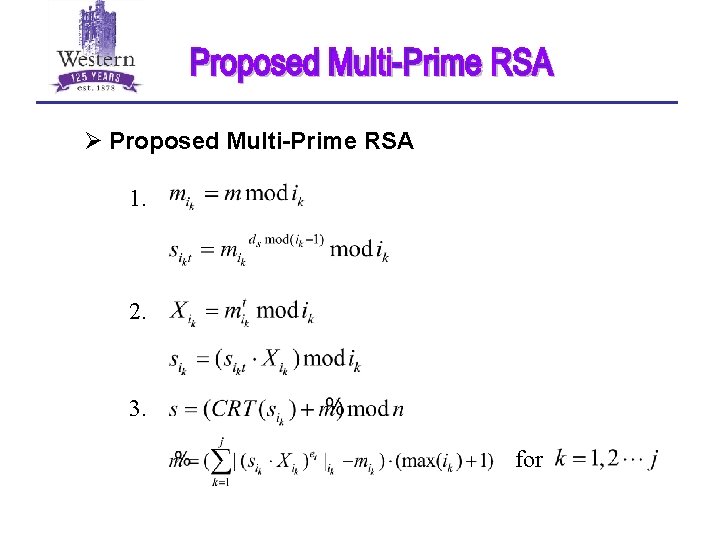
Ø Proposed Multi-Prime RSA 1. 2. 3. for
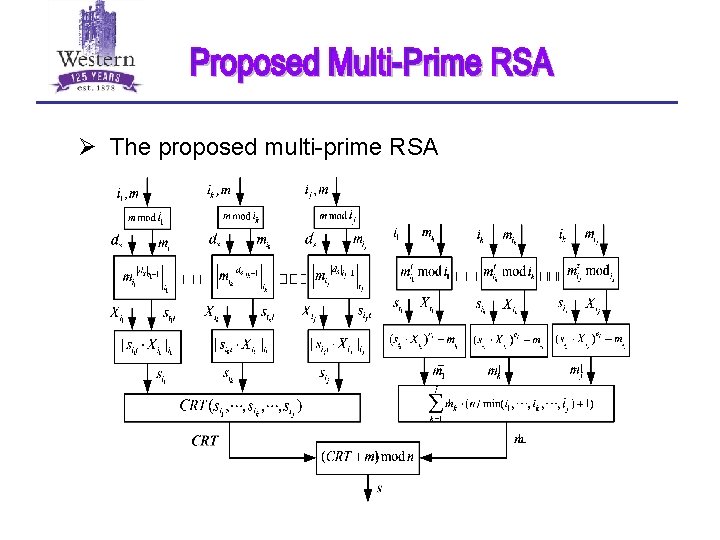
Ø The proposed multi-prime RSA
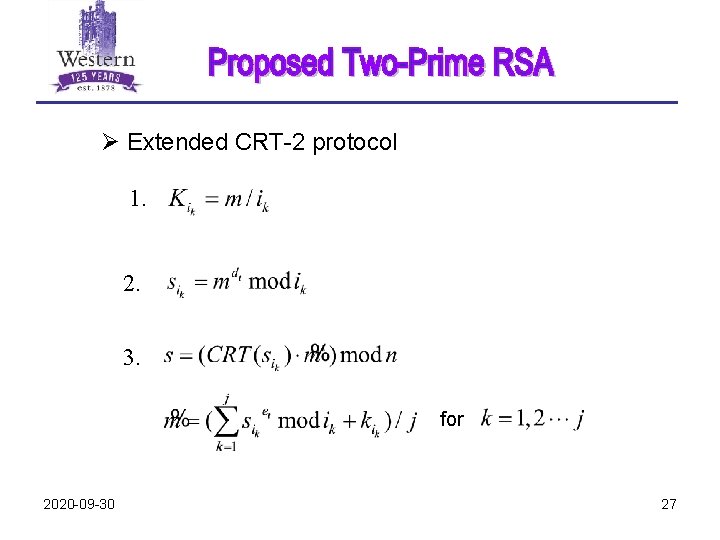
Ø Extended CRT-2 protocol 1. 2. 3. for 2020 -09 -30 27
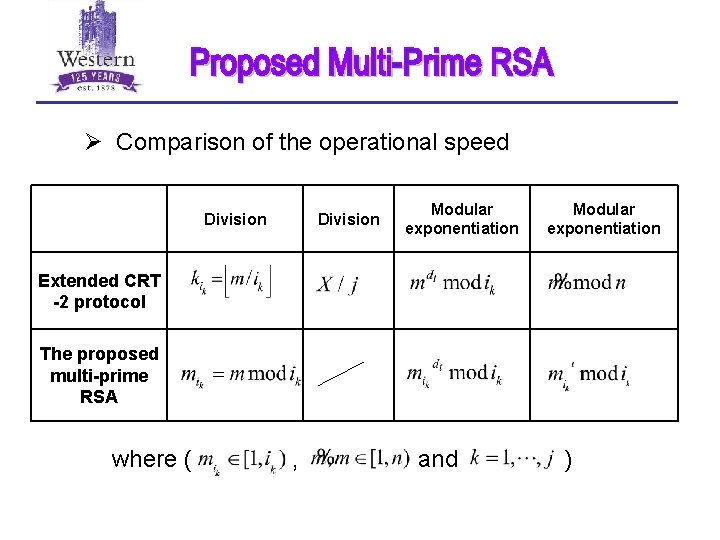
Ø Comparison of the operational speed Division Modular exponentiation Extended CRT -2 protocol The proposed multi-prime RSA where ( , and )
Ø Operational speed improvement has been verified by one example of three-prime RSA Ø Similar factorization complexity z Still for obtaining any factor from the proposed multi-prime RSA Ø Predicted to use fewer hardware resources z Will be verified by Implementation results later
Ø Introduction Ø Literature Review Ø Proposed Efficient Two-Prime RSA Cryptosystem Ø Proposed Efficient Multi-Prime RSA Cryptosystem Ø FPGA Implementations and Results Ø Conclusions 2020 -09 -30 30
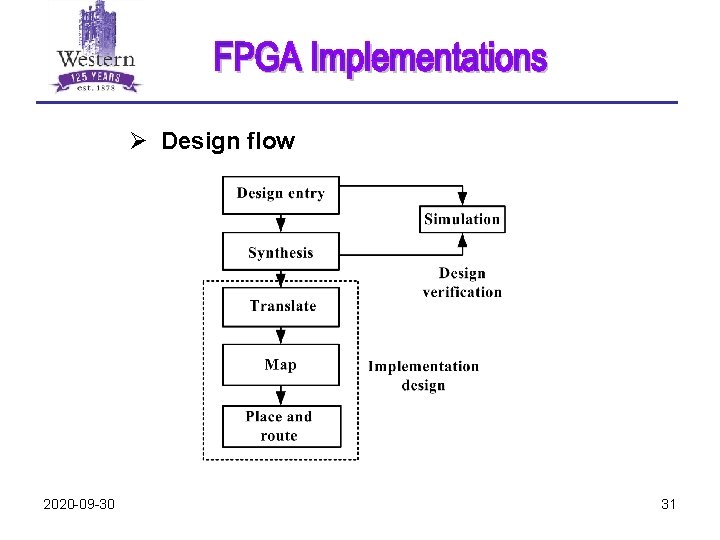
Ø Design flow 2020 -09 -30 31
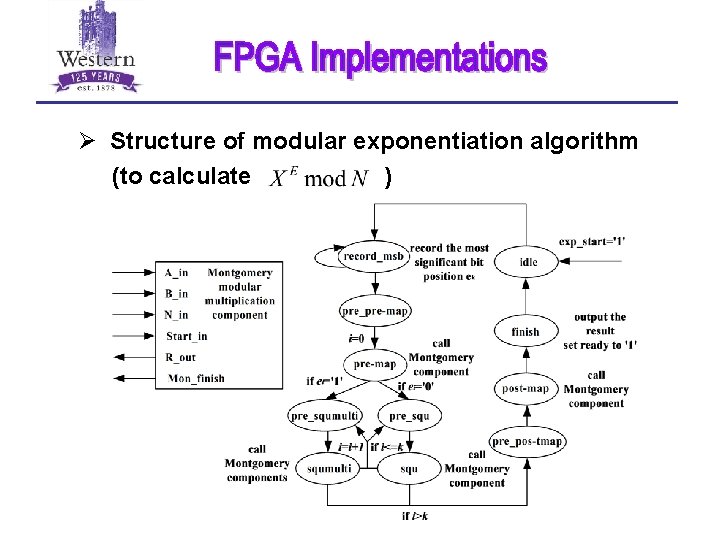
Ø Structure of modular exponentiation algorithm (to calculate )
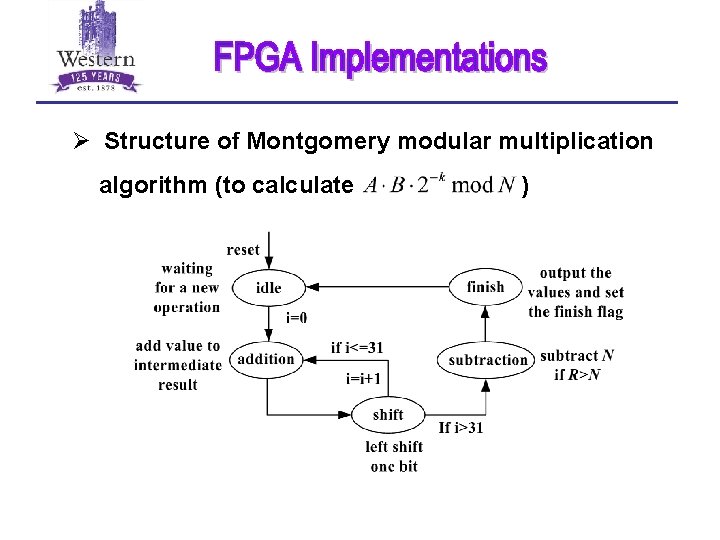
Ø Structure of Montgomery modular multiplication algorithm (to calculate )
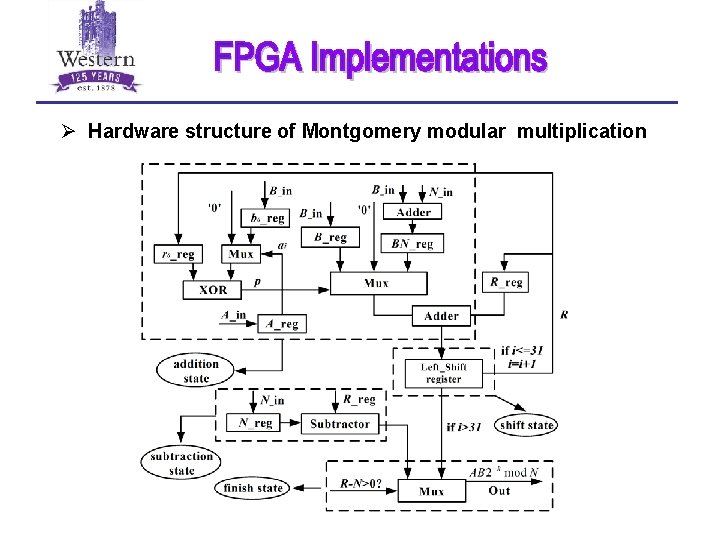
Ø Hardware structure of Montgomery modular multiplication
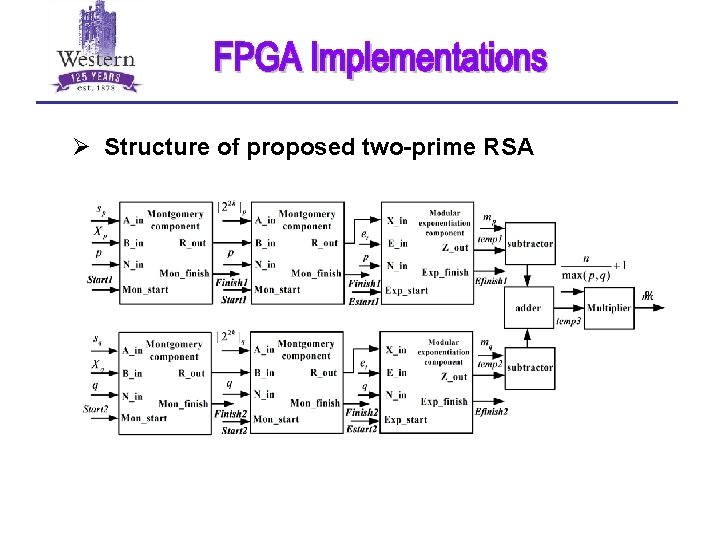
Ø Structure of proposed two-prime RSA
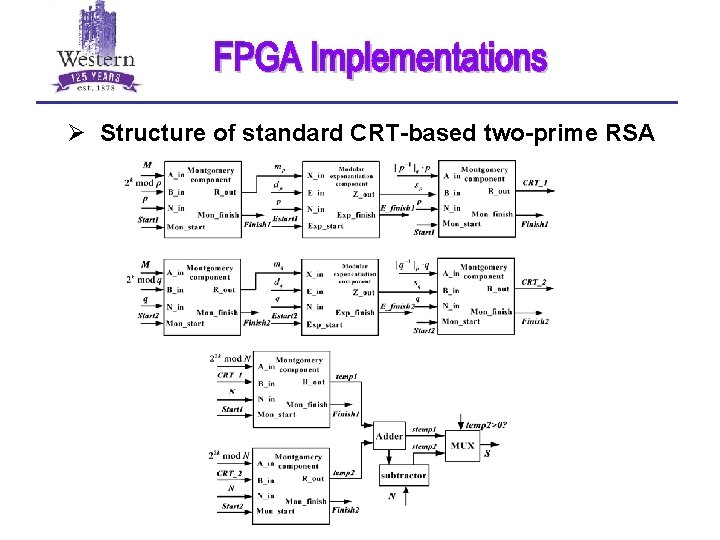
Ø Structure of standard CRT-based two-prime RSA
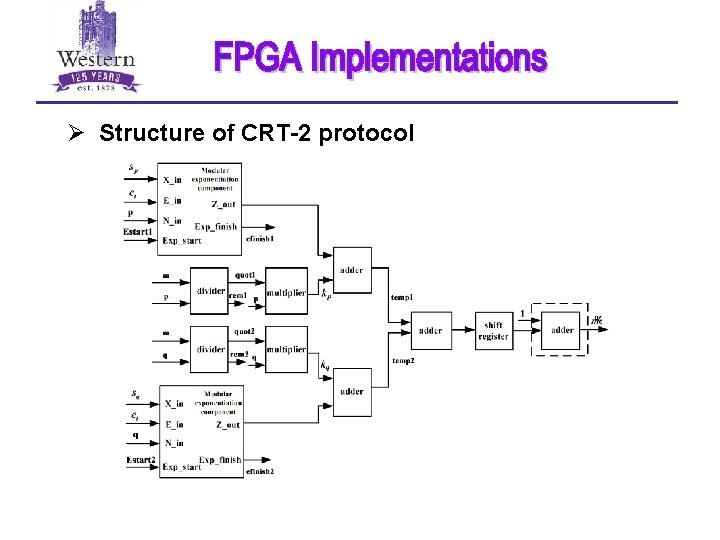
Ø Structure of CRT-2 protocol
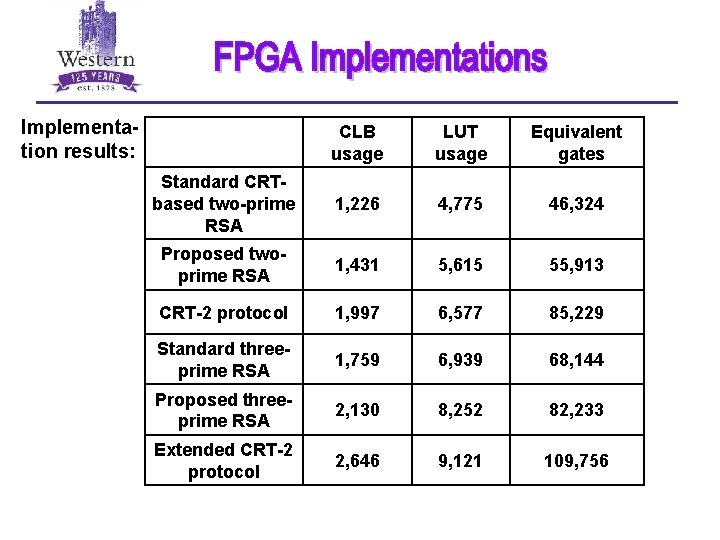
Implementation results: CLB usage LUT usage Equivalent gates Standard CRTbased two-prime RSA 1, 226 4, 775 46, 324 Proposed twoprime RSA 1, 431 5, 615 55, 913 CRT-2 protocol 1, 997 6, 577 85, 229 Standard threeprime RSA 1, 759 6, 939 68, 144 Proposed threeprime RSA 2, 130 8, 252 82, 233 Extended CRT-2 protocol 2, 646 9, 121 109, 756
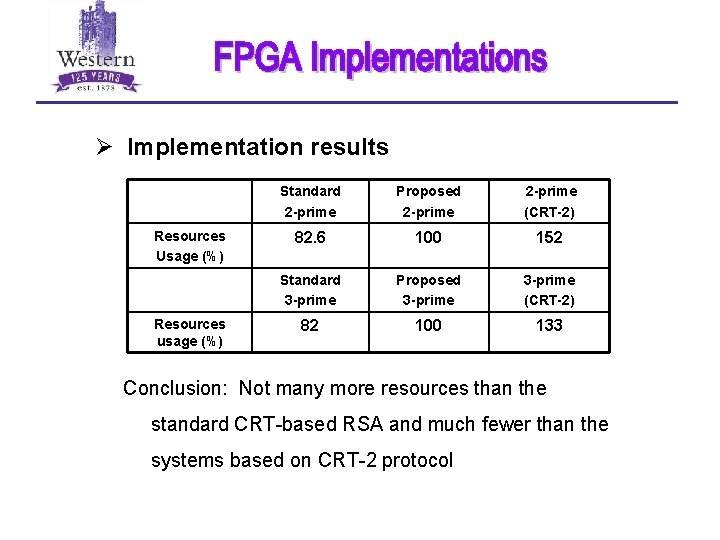
Ø Implementation results Resources Usage (%) Resources usage (%) Standard 2 -prime Proposed 2 -prime (CRT-2) 82. 6 100 152 Standard 3 -prime Proposed 3 -prime (CRT-2) 82 100 133 Conclusion: Not many more resources than the standard CRT-based RSA and much fewer than the systems based on CRT-2 protocol
Ø Introduction Ø Literature Review Ø Proposed Efficient Two-Prime RSA Cryptosystem Ø Proposed Efficient Multi-Prime RSA Cryptosystem Ø FPGA Implementations and Results Ø Conclusions 2020 -09 -30 40
Ø Conclusions z The immunity of the RSA cryptosystems against the hardware fault attack is greatly increased z The proposed RSA cryptosystems provide more efficient operations than previous work, and they bear similar immunity against the hardware fault attack. z The proposed RSA cryptosystems use fewer resources than previous work in hardware implementations z The standard CRT-based RSA cryptosystems with more factors bears more difficult for the hardware fault attack
Ø Future work z Speed up the basic block: modular exponentiation computation z Implement the RSA cryptosystems with enhanced immunity against other implementation attacks z Download the RSA cryptosystems implemented in Chapter 5 to the FPGA chip
Thanks ! and Questions ?
- Slides: 43