
Efficient calculation of empirical pvalues for genome wide





- Slides: 31
Efficient calculation of empirical pvalues for genome wide linkage through weighted mixtures Sarah E Medland, Eric J Schmitt, Bradley T Webb, Po-Hsiu Kuo, Michael C Neale Virginia Institute for Psychiatric and Behavioral Genetics
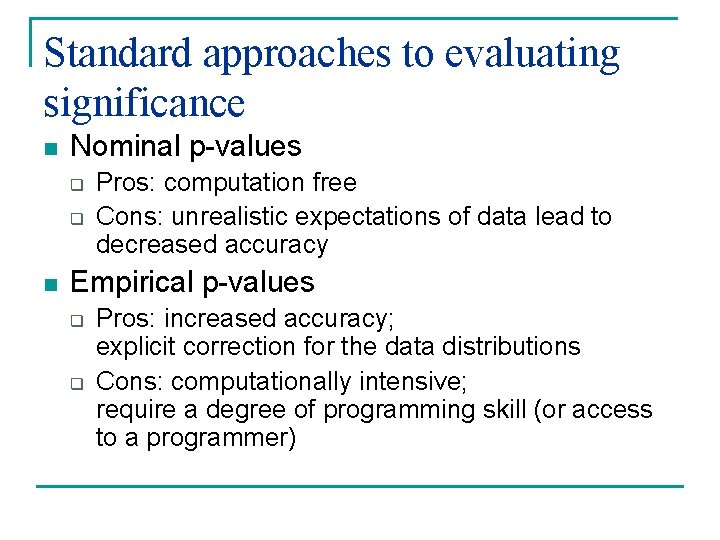
Standard approaches to evaluating significance n Nominal p-values based on (presumed) asymptotic null distributions n Empirical p-values from simulation or ‘genedropping’ n Empirical p-values from permutation
Standard approaches to evaluating significance n Nominal p-values q q n Pros: computation free Cons: unrealistic expectations of data lead to decreased accuracy Empirical p-values q q Pros: increased accuracy; explicit correction for the data distributions Cons: computationally intensive; require a degree of programming skill (or access to a programmer)
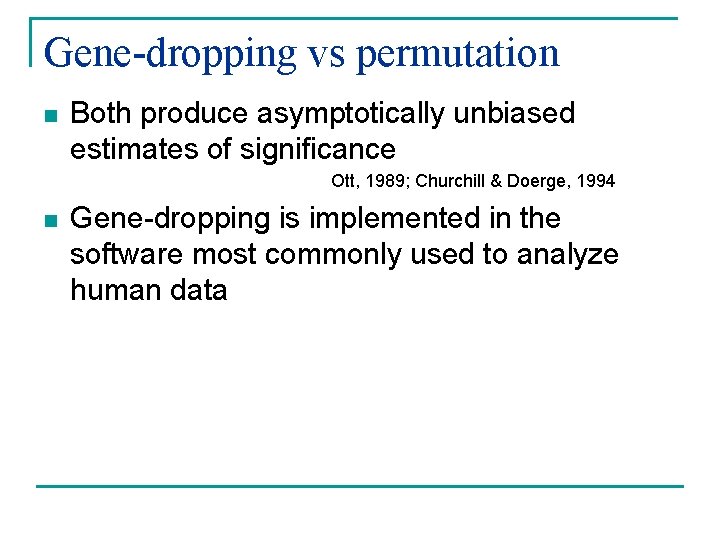
Gene-dropping vs permutation n Both produce asymptotically unbiased estimates of significance Ott, 1989; Churchill & Doerge, 1994 n Gene-dropping is implemented in the software most commonly used to analyze human data
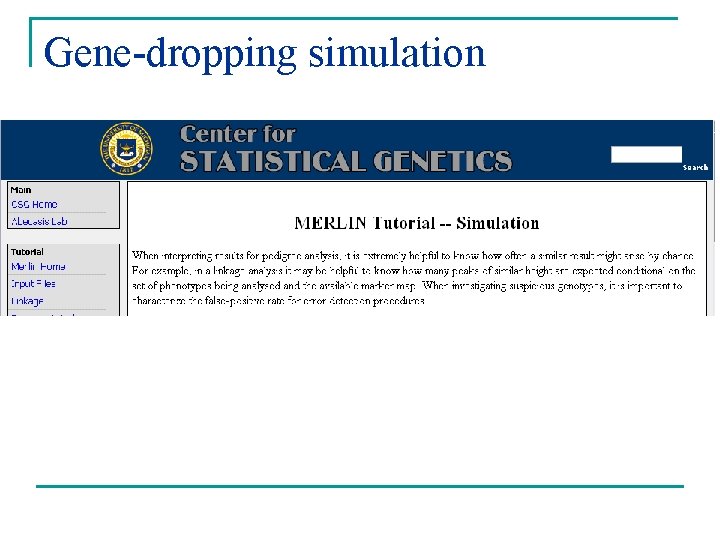
Gene-dropping simulation
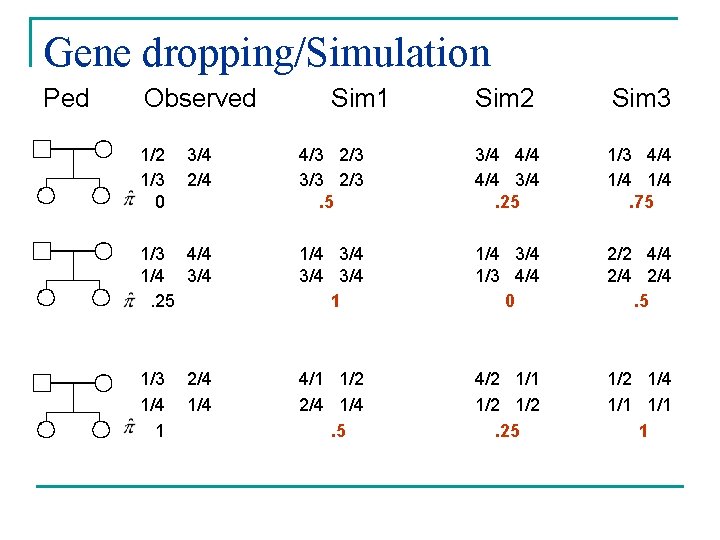
Gene dropping/Simulation Ped Observed 1/2 1/3 0 Sim 1 Sim 2 Sim 3 3/4 2/4 4/3 2/3 3/3 2/3. 5 3/4 4/4 3/4. 25 1/3 4/4 1/4. 75 1/3 4/4 1/4 3/4. 25 1/4 3/4 3/4 1 1/4 3/4 1/3 4/4 0 2/2 4/4 2/4. 5 1/3 1/4 1 4/1 1/2 2/4 1/4. 5 4/2 1/1 1/2. 25 1/2 1/4 1/1 1 2/4 1/4
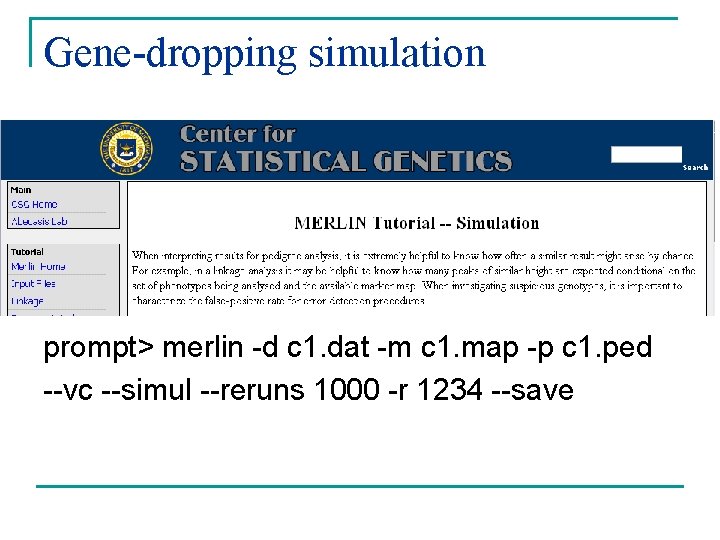
Gene-dropping simulation prompt> merlin -d c 1. dat -m c 1. map -p c 1. ped --vc --simul --reruns 1000 -r 1234 --save
Gene-dropping simulation Extract the LOD or chi-square from the output of these null replicates n Add in your observed LOD or chi-square n Sort the file and calculate the probability of the observed using the simulated null distribution n
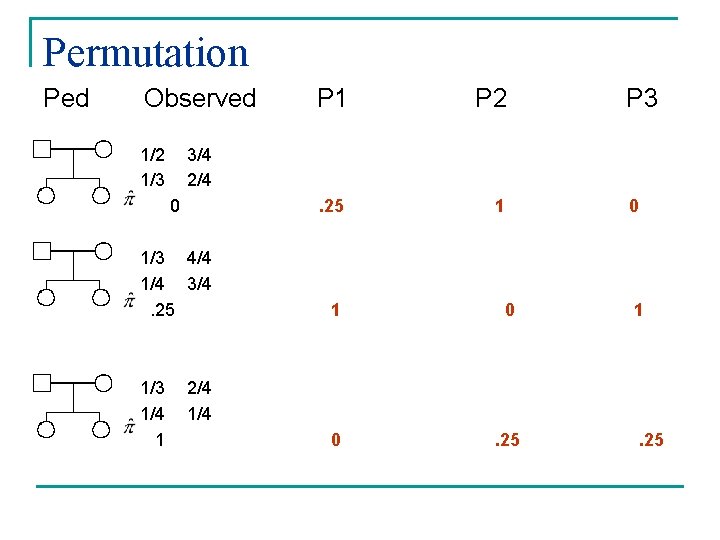
Permutation Ped Observed P 1 P 2 0 . 25 1 1/3 4/4 1/4 3/4. 25 1 0 1/3 1/4 1 0 . 25 1/2 1/3 P 3 3/4 2/4 0 1 2/4 1/4. 25
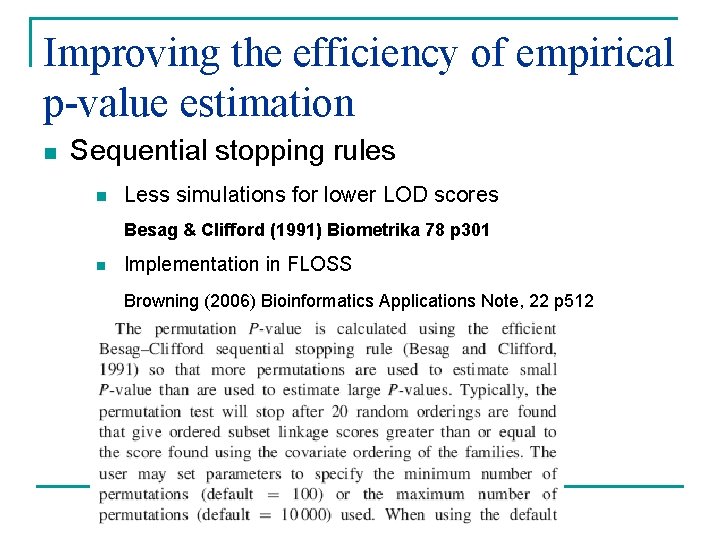
Improving the efficiency of empirical p-value estimation n Sequential stopping rules n Less simulations for lower LOD scores Besag & Clifford (1991) Biometrika 78 p 301 n Implementation in FLOSS Browning (2006) Bioinformatics Applications Note, 22 p 512
Improving the efficiency of empirical p-value estimation n Replicate Pool Method n Run a small number of simulations/permutations saving the per family contributions n Resample from the ‘pool’ of null replicates Terwilliger & Ott, 1992; Song et al, 2004; Zou et al, 1995; Wigginton & Abecais, 2006
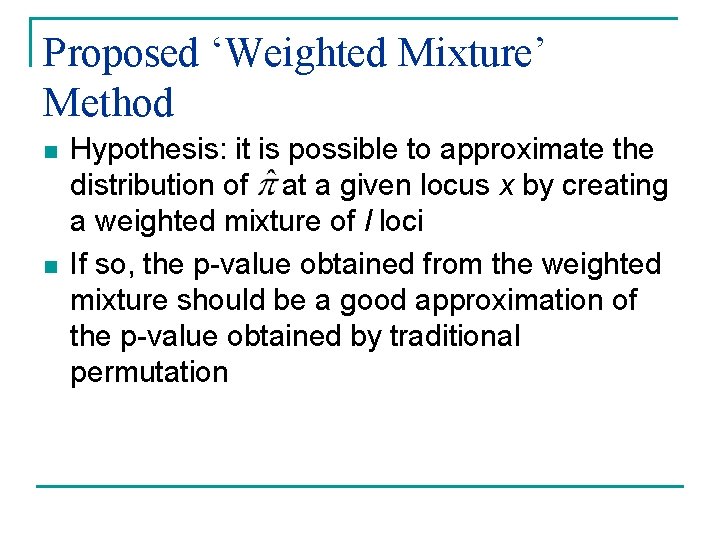
Proposed ‘Weighted Mixture’ Method n Significance values derived by permutation depend on distributions of the allele sharing statistic: q n Any 2 loci with identical distributions will yield identical empirical p-values There is relatively little variation in the distribution of across loci
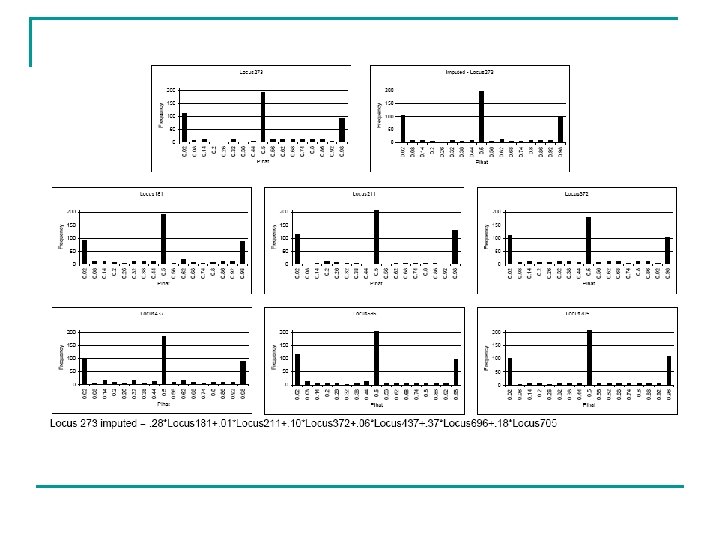
Proposed ‘Weighted Mixture’ Method n n Hypothesis: it is possible to approximate the distribution of at a given locus x by creating a weighted mixture of l loci If so, the p-value obtained from the weighted mixture should be a good approximation of the p-value obtained by traditional permutation
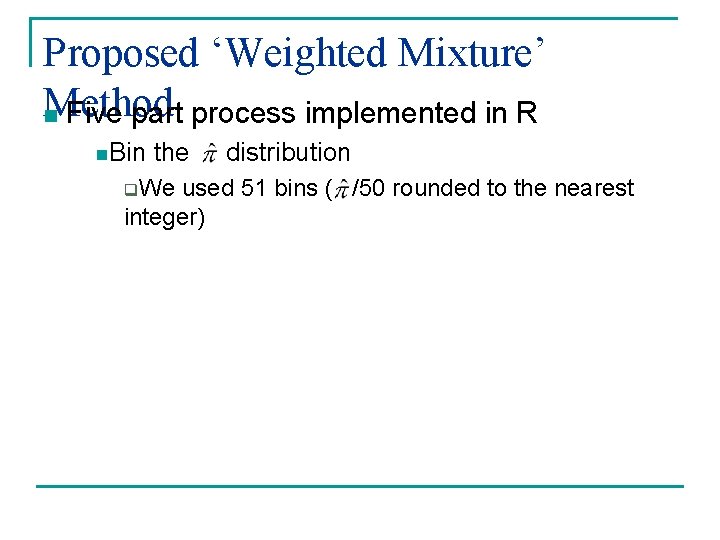
Proposed ‘Weighted Mixture’ Method n Five part process implemented in R n. Bin the q. We distribution used 51 bins ( /50 rounded to the nearest integer)
Proposed ‘Weighted Mixture’ Method n Five part process implemented in R n. Bin the distribution n. Identify a pool of ‘modal’ distributions q. We experimented with systematic and random identification of the distributions q. Best results obtained using the Bioconductor package GENEFINDER q. Bin frequencies were entered as an array and the 5 most similar distributions were identified using a Euclidean distance metric q. We experimented using pools of the 50, 20 and 10 most commonly identified distributions
Proposed ‘Weighted Mixture’ Method n Five part process implemented in R n. Bin the distribution n. Identify a pool of ‘modal’ distributions n. Obtain mixture weights (w) q. Simplified multivariate regression using weighted least squares using modal distributions as predictors q. Estimate the distribution of each locus in turn, recording the regression weights
Proposed ‘Weighted Mixture’ Method n Five part process implemented in R n. Bin the distribution n. Identify a pool of ‘modal’ distributions n. Obtain mixture weights (w) n. Permute the modal loci n=5000 q. Test statistic q retained for each permutation
Proposed ‘Weighted Mixture’ Method n Five part process implemented in R n. Bin the distribution n. Identify a pool of ‘modal’ distributions n. Obtain mixture weights (w) n. Permute the modal loci n. Weighted bootstrapping of the modal test statistics q. Compile composite test statistic distributions q. Weighted drawing of wl*5000 random test statistics from each of the l modal test statistic distributions q. Average significance value from 100 replicates
Simulations n Simulated genotypes for 500 families n n n 2 parents and 2 offspring Map based on the Irish affected sib-pair study of alcohol dependence (Prescott et al, 2006; Kuo, submitted) n 1020 autosomal markers (de. CODE panel) n Average 4 c. M spacing 3 causal and unmeasured bi-allelic loci – on different chromosomes
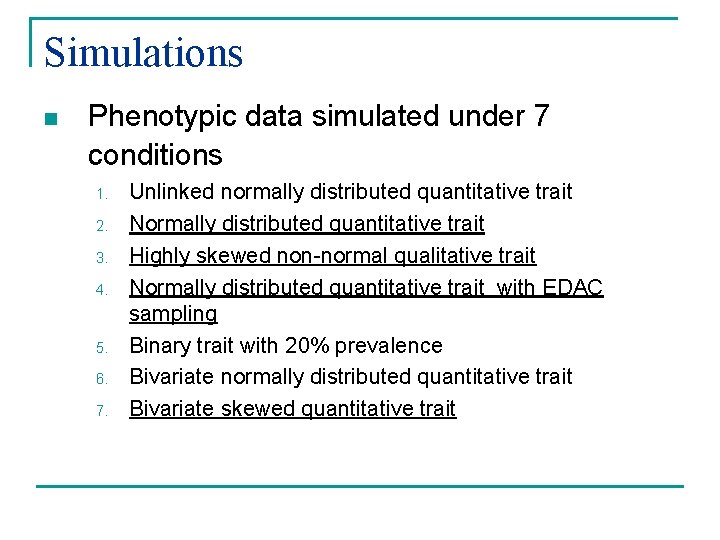
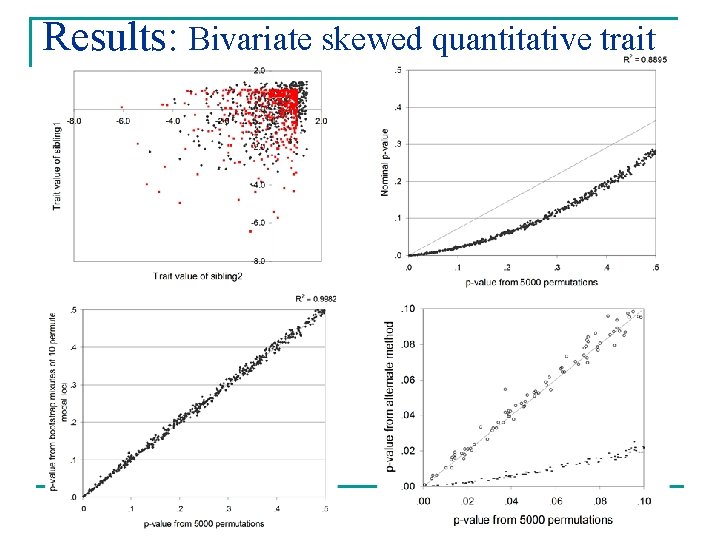
Simulations n Phenotypic data simulated under 7 conditions 1. 2. 3. 4. 5. 6. 7. Unlinked normally distributed quantitative trait Normally distributed quantitative trait Highly skewed non-normal qualitative trait Normally distributed quantitative trait with EDAC sampling Binary trait with 20% prevalence Bivariate normally distributed quantitative trait Bivariate skewed quantitative trait
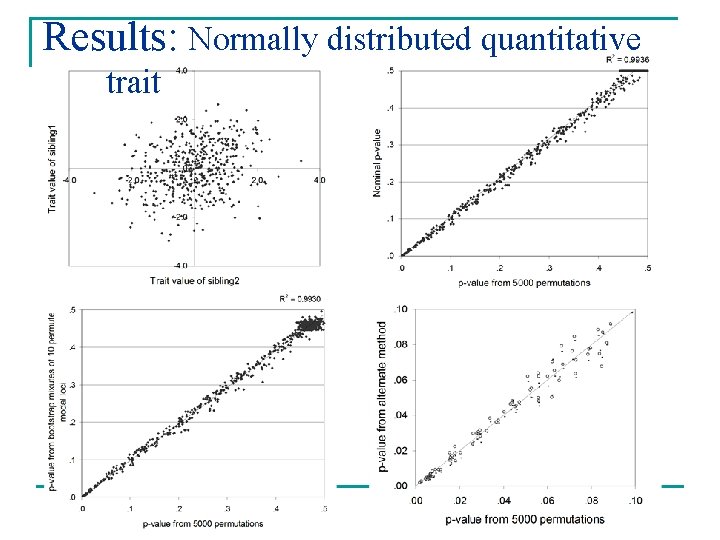
Results: Normally distributed quantitative trait
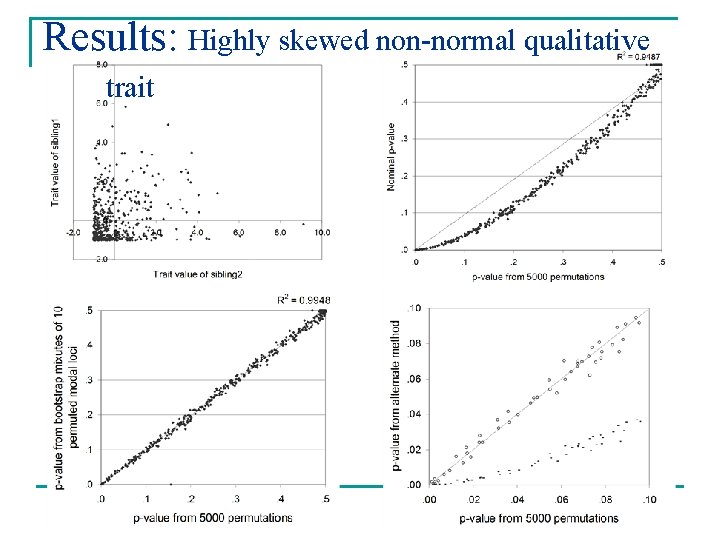
Results: Highly skewed non-normal qualitative trait
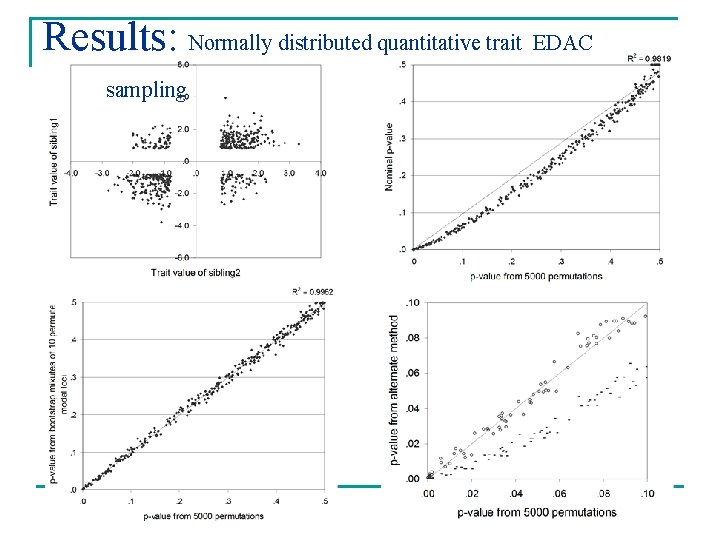
Results: Normally distributed quantitative trait EDAC sampling
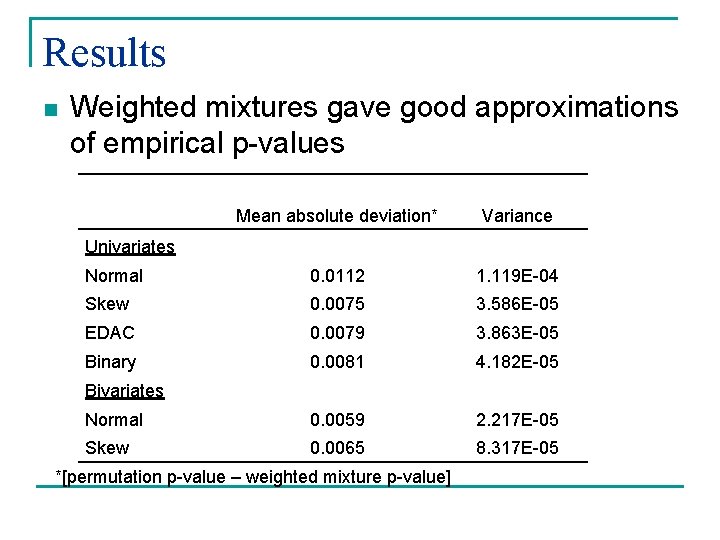
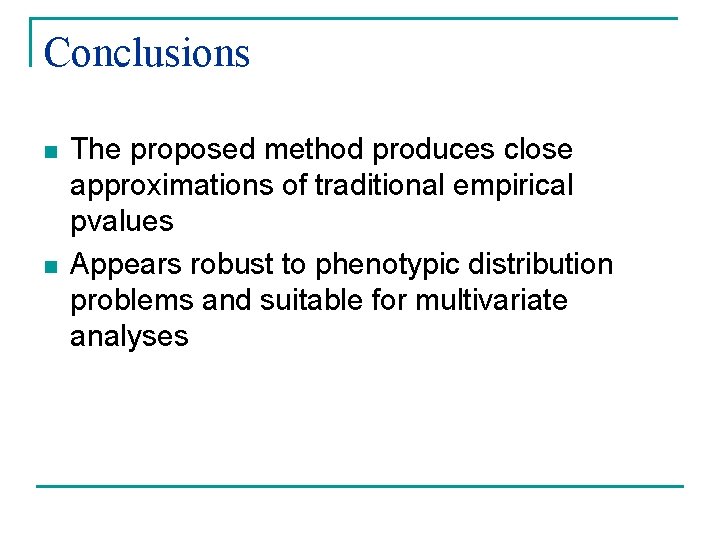
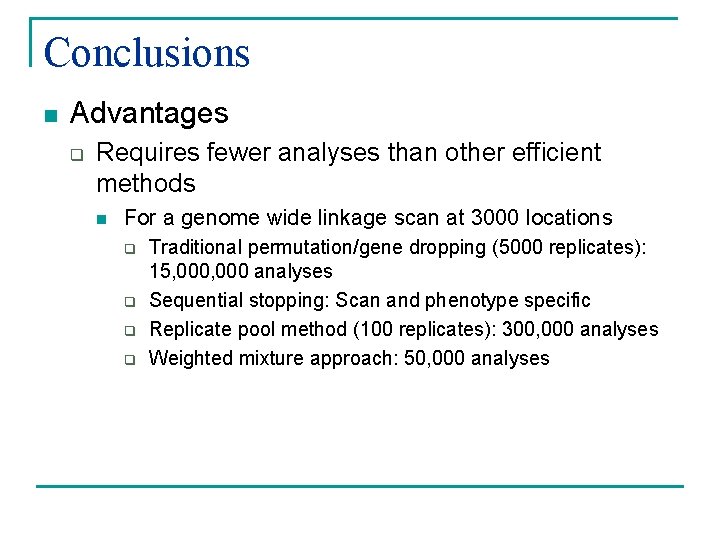
Results: Bivariate skewed quantitative trait
Results n Weighted mixtures gave good approximations of empirical p-values Mean absolute deviation* Variance Normal 0. 0112 1. 119 E-04 Skew 0. 0075 3. 586 E-05 EDAC 0. 0079 3. 863 E-05 Binary 0. 0081 4. 182 E-05 Normal 0. 0059 2. 217 E-05 Skew 0. 0065 8. 317 E-05 Univariates Bivariates *[permutation p-value – weighted mixture p-value]
Conclusions n n The proposed method produces close approximations of traditional empirical pvalues Appears robust to phenotypic distribution problems and suitable for multivariate analyses
Conclusions n Advantages q Requires fewer analyses than other efficient methods n For a genome wide linkage scan at 3000 locations q q Traditional permutation/gene dropping (5000 replicates): 15, 000 analyses Sequential stopping: Scan and phenotype specific Replicate pool method (100 replicates): 300, 000 analyses Weighted mixture approach: 50, 000 analyses
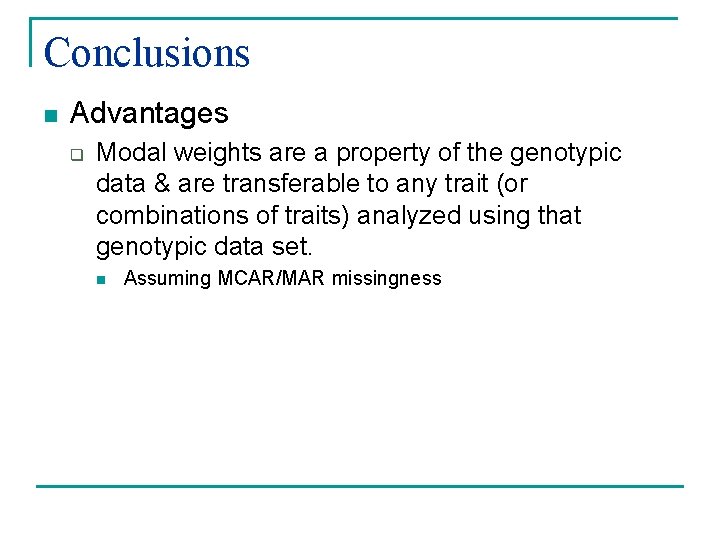
Conclusions n Advantages q Modal weights are a property of the genotypic data & are transferable to any trait (or combinations of traits) analyzed using that genotypic data set. n Assuming MCAR/MAR missingness
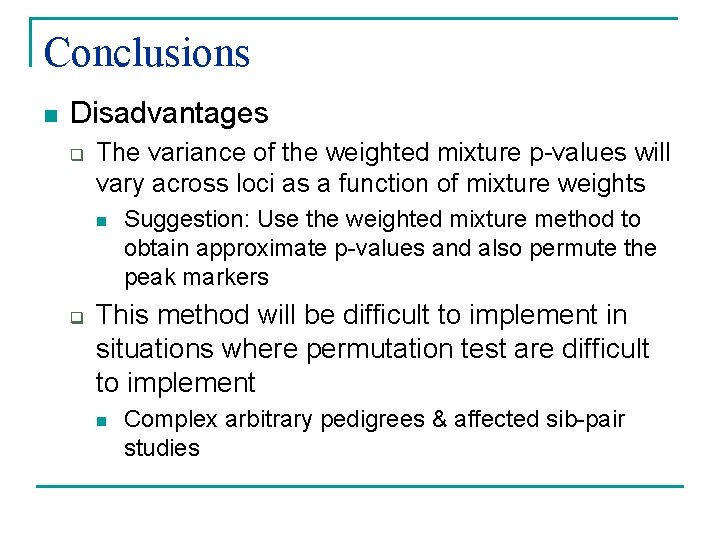
Conclusions n Disadvantages q The variance of the weighted mixture p-values will vary across loci as a function of mixture weights n q Suggestion: Use the weighted mixture method to obtain approximate p-values and also permute the peak markers This method will be difficult to implement in situations where permutation test are difficult to implement n Complex arbitrary pedigrees & affected sib-pair studies
http: //www. vipbg. vcu. edu/~sarahme/permute. html Medland, Schmitt, Webb, Kuo, Neale (submitted) Efficient calculation of empirical pvalues for genome wide linkage analysis through weighted permutation