
Efficient Architectures Oren Ben Kiki Yair Ben Sahel

Efficient Architectures Oren Ben Kiki Yair Ben Sahel
01. Why? 02. Designing Efficient Building Blocks 03. (re-)Measuring Efficiency 04. Guidelines for Efficient Architectures 05. Scaling 2 COVID-19
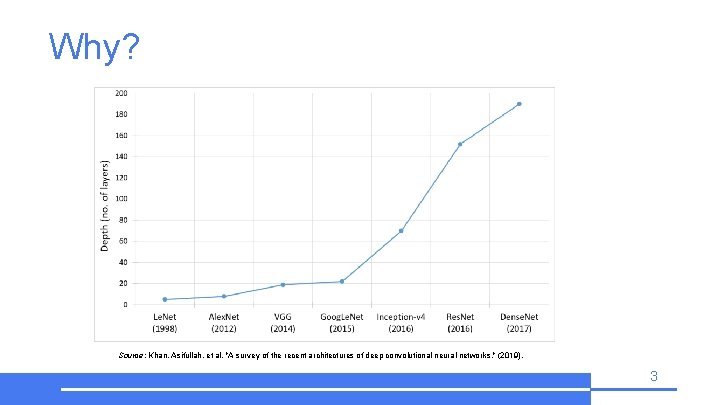
Why? Source: Khan, Asifullah, et al. "A survey of the recent architectures of deep convolutional neural networks. " (2019). 3 COVID-19

Deep Learning - on a budget 4 COVID-19
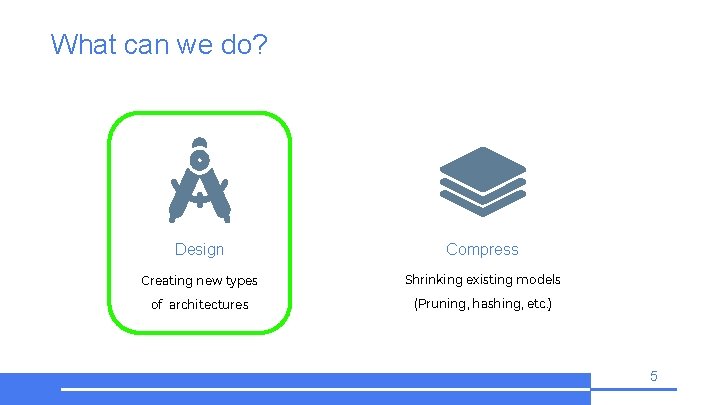
What can we do? Design Compress Creating new types Shrinking existing models of architectures (Pruning, hashing, etc. ) 5 COVID-19
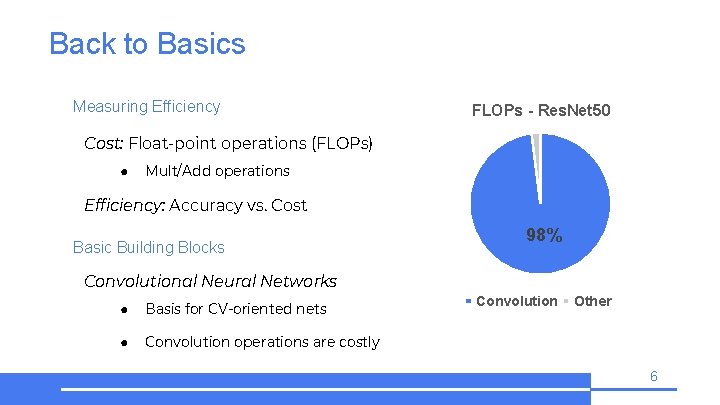
Back to Basics Measuring Efficiency FLOPs - Res. Net 50 Cost: Float-point operations (FLOPs) ● Mult/Add operations Efficiency: Accuracy vs. Cost Basic Building Blocks 98% Convolutional Neural Networks ● Basis for CV-oriented nets ● Convolution operations are costly Convolution Other 6 COVID-19
CONVOLUTION OPERATIONS MINIMUM COST *What about accuracy…?
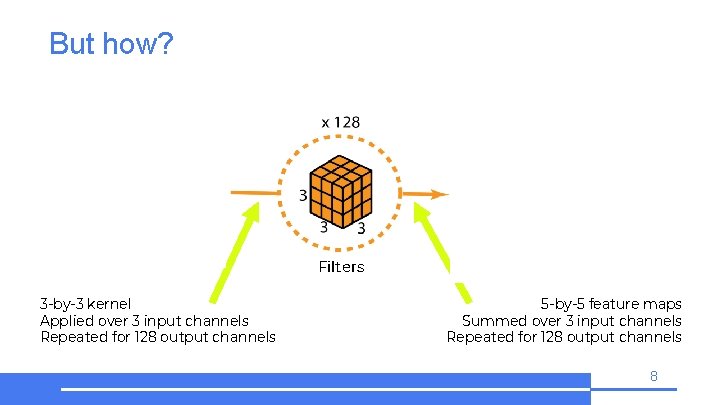
But how? Input Output Filters 3 -by-3 kernel Applied over 3 input channels Repeated for 128 output channels 5 -by-5 feature maps Summed over 3 input channels Repeated for 128 output channels 8 COVID-19
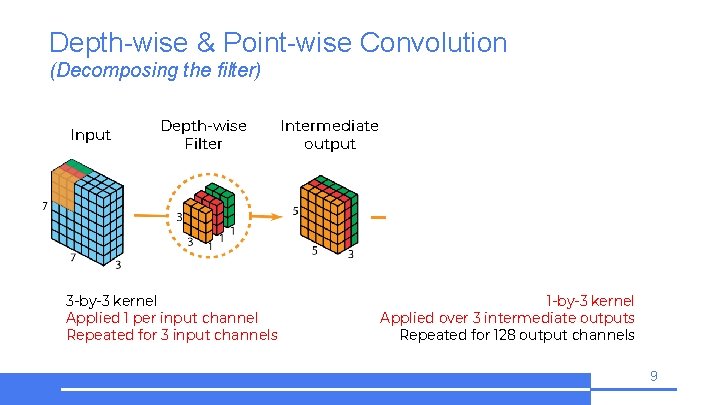
Depth-wise & Point-wise Convolution (Decomposing the filter) Input Depth-wise Filter 3 -by-3 kernel Applied 1 per input channel Repeated for 3 input channels Intermediate output Point-wise Filter Output 1 -by-3 kernel Applied over 3 intermediate outputs Repeated for 128 output channels 9 COVID-19
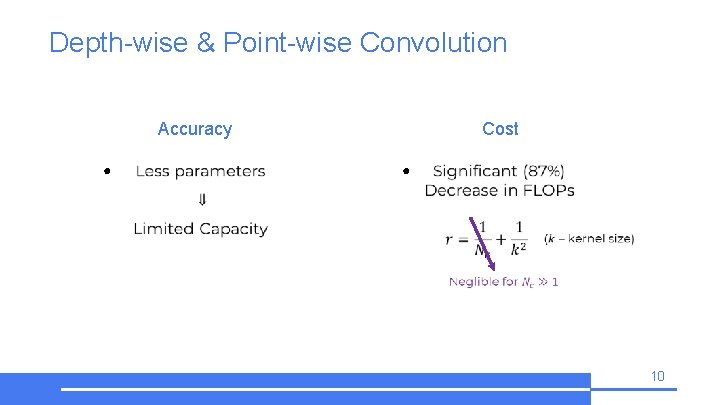
Depth-wise & Point-wise Convolution Accuracy ● Cost ● 10 COVID-19
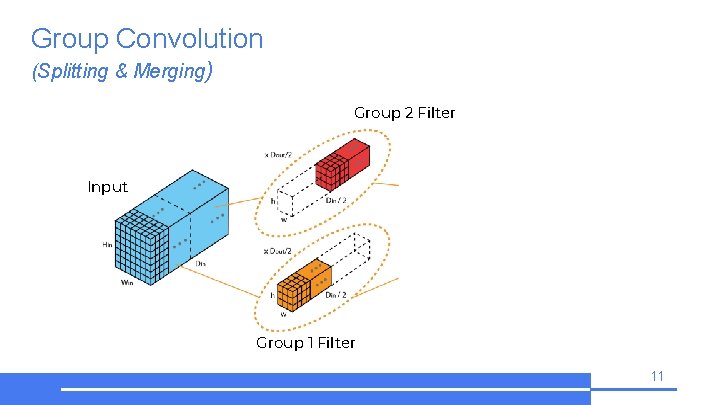
Group Convolution (Splitting & Merging) Group 2 Filter Input Output Group 1 Filter 11 COVID-19
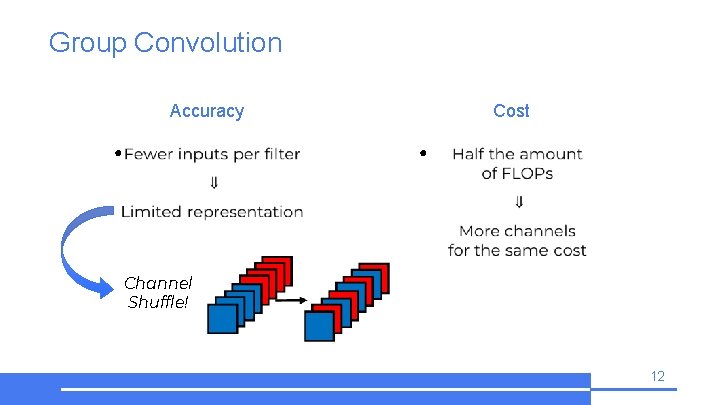
Group Convolution Accuracy ● Cost ● Channel Shuffle! 12 COVID-19
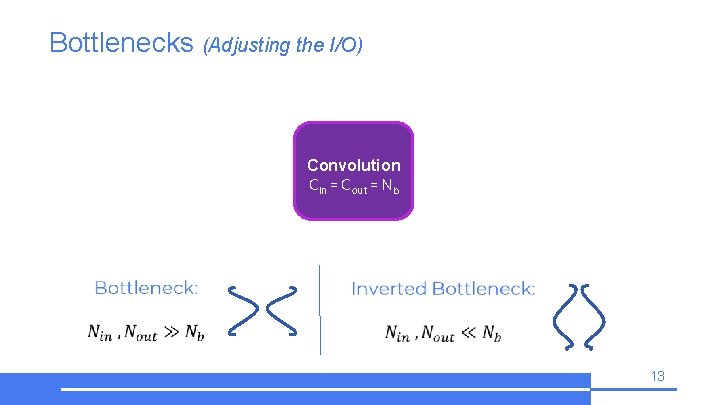
Bottlenecks (Adjusting the I/O) Nin 1 x 1 Conv. filter Convolution x Nb Cin = Cout = Nb x Nout Input Nout Output 13 COVID-19
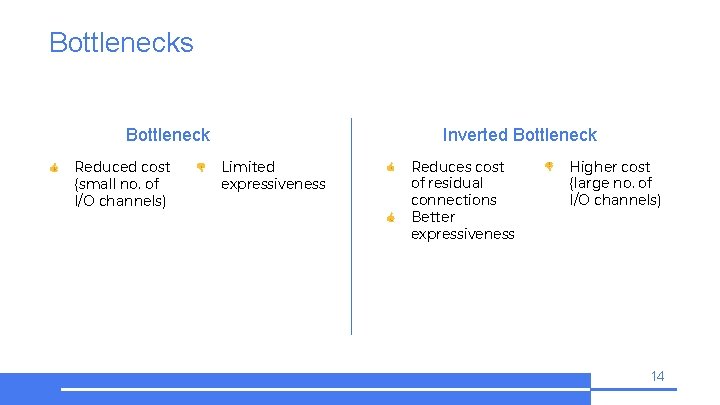
Bottlenecks Bottleneck Reduced cost (small no. of I/O channels) Inverted Bottleneck Limited expressiveness Reduces cost of residual connections Better expressiveness Higher cost (large no. of I/O channels) 14 COVID-19
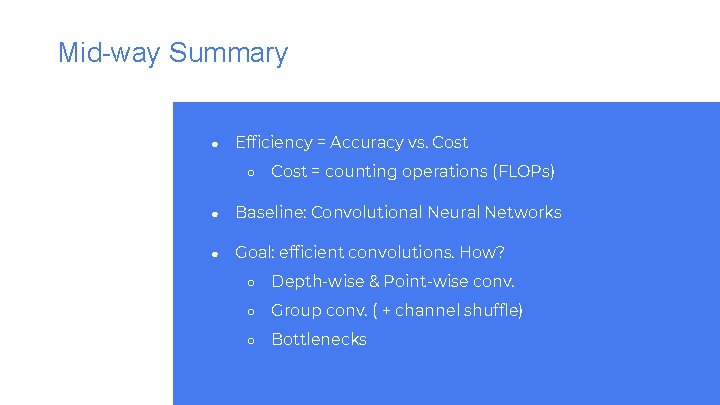
Mid-way Summary ● Efficiency = Accuracy vs. Cost ○ Cost = counting operations (FLOPs) ● Baseline: Convolutional Neural Networks ● Goal: efficient convolutions. How? ○ Depth-wise & Point-wise conv. ○ Group conv. ( + channel shuffle) ○ Bottlenecks

There is no ‘winner-takes-it-all’ solution; Know your needs & Design accordingly
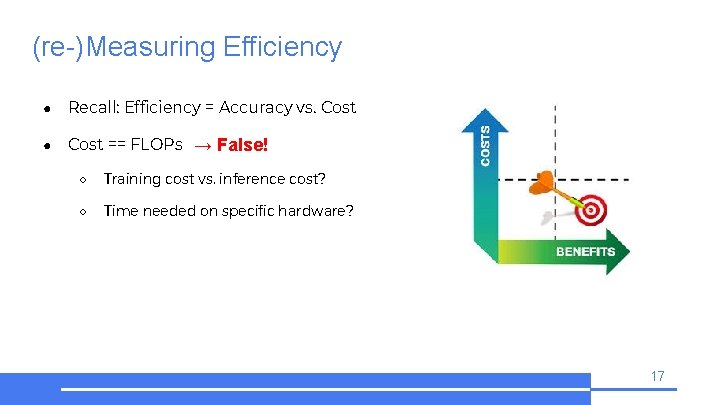
(re-)Measuring Efficiency ● Recall: Efficiency = Accuracy vs. Cost ● Cost == FLOPs → False! ○ Training cost vs. inference cost? ○ Time needed on specific hardware? 17 COVID-19
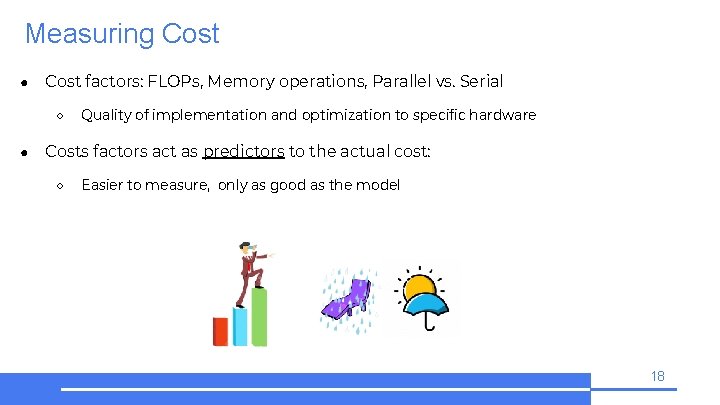
Measuring Cost ● Cost factors: FLOPs, Memory operations, Parallel vs. Serial ○ ● Quality of implementation and optimization to specific hardware Costs factors act as predictors to the actual cost: ○ Easier to measure, only as good as the model 18 COVID-19
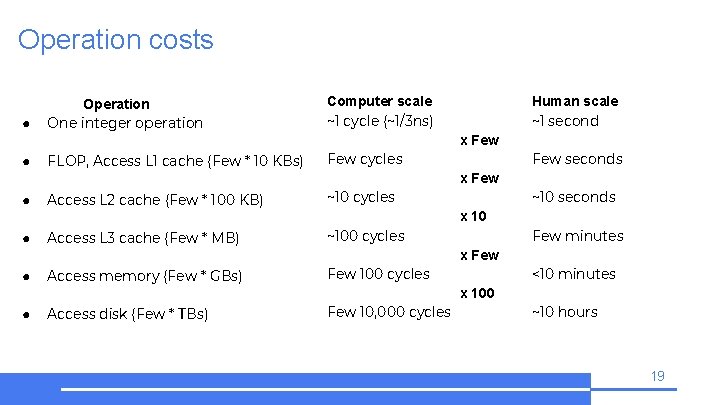
Operation costs ● Operation One integer operation Computer scale ~1 cycle (~1/3 ns) Human scale ~1 second x Few ● FLOP, Access L 1 cache (Few * 10 KBs) Few cycles Few seconds x Few ● Access L 2 cache (Few * 100 KB) ~10 cycles ~10 seconds x 10 ● Access L 3 cache (Few * MB) ~100 cycles Few minutes x Few ● Access memory (Few * GBs) Few 100 cycles <10 minutes x 100 ● Access disk (Few * TBs) Few 10, 000 cycles ~10 hours 19 COVID-19
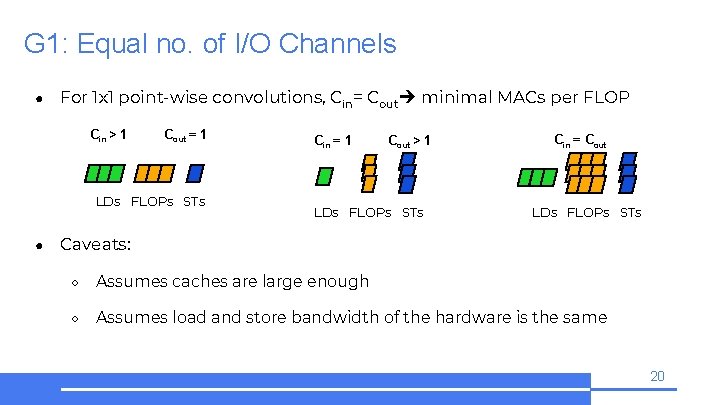
G 1: Equal no. of I/O Channels ● For 1 x 1 point-wise convolutions, Cin= Cout minimal MACs per FLOP Cin > 1 Cout = 1 LDs FLOPs STs ● Cin = 1 Cout > 1 LDs FLOPs STs Cin = Cout LDs FLOPs STs Caveats: ○ Assumes caches are large enough ○ Assumes load and store bandwidth of the hardware is the same 20 COVID-19
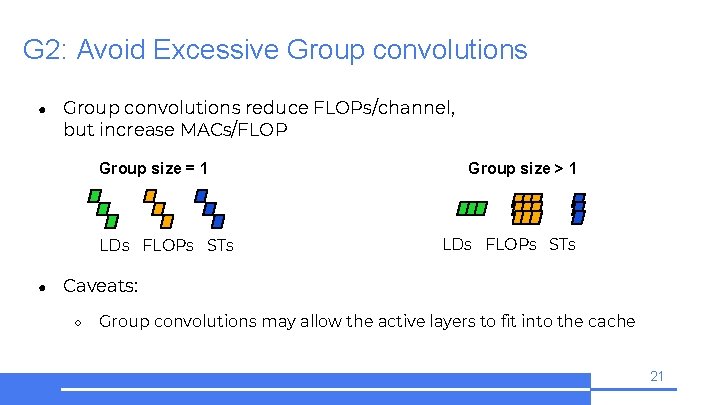
G 2: Avoid Excessive Group convolutions ● Group convolutions reduce FLOPs/channel, but increase MACs/FLOP Group size = 1 LDs FLOPs STs ● Group size > 1 LDs FLOPs STs Caveats: ○ Group convolutions may allow the active layers to fit into the cache 21 COVID-19
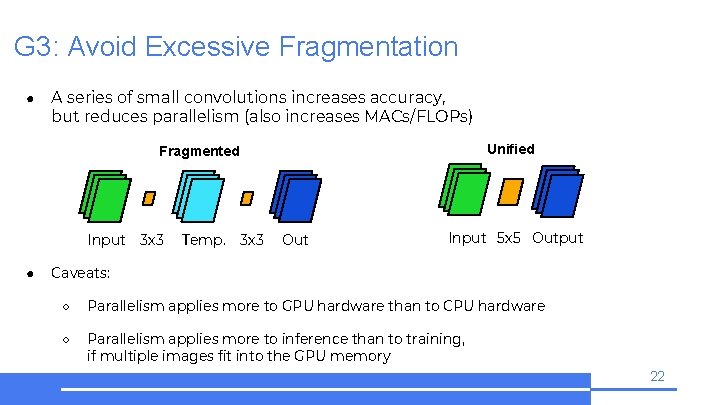
G 3: Avoid Excessive Fragmentation ● A series of small convolutions increases accuracy, but reduces parallelism (also increases MACs/FLOPs) Unified Fragmented Input ● 3 x 3 Temp. 3 x 3 Out Input 5 x 5 Output Caveats: ○ Parallelism applies more to GPU hardware than to CPU hardware ○ Parallelism applies more to inference than to training, if multiple images fit into the GPU memory 22 COVID-19
G 4: Element-wise operations are Important ● ● Element-wise operations (Re. LU, Bias, Batch Normalization, etc. ) can make up a large fraction of the overall runtime ○ (Simple) element-wise operations tend to have ~1 MACs/FLOPs ○ The HW for matrix operations and the HW for element-wise operations “tends” to be “separate” and moving data between them may be costly Caveats: ○ A series of element-wise operations can (and should) be “fused” to minimize MACs/FLOPs 23 COVID-19
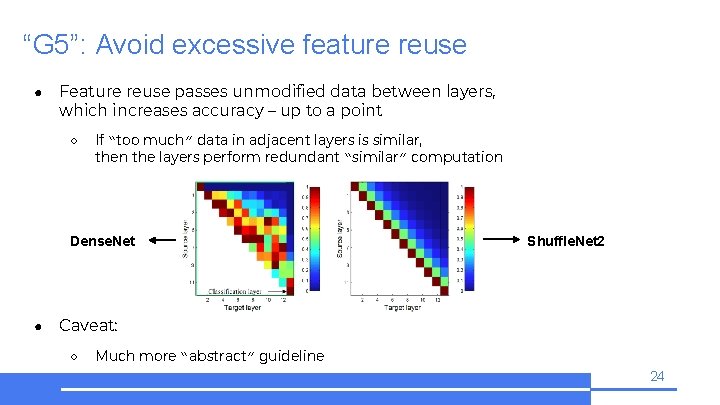
“G 5”: Avoid excessive feature reuse ● Feature reuse passes unmodified data between layers, which increases accuracy – up to a point ○ If “too much” data in adjacent layers is similar, then the layers perform redundant “similar” computation Dense. Net ● Shuffle. Net 2 Caveat: ○ Much more “abstract” guideline 24 COVID-19
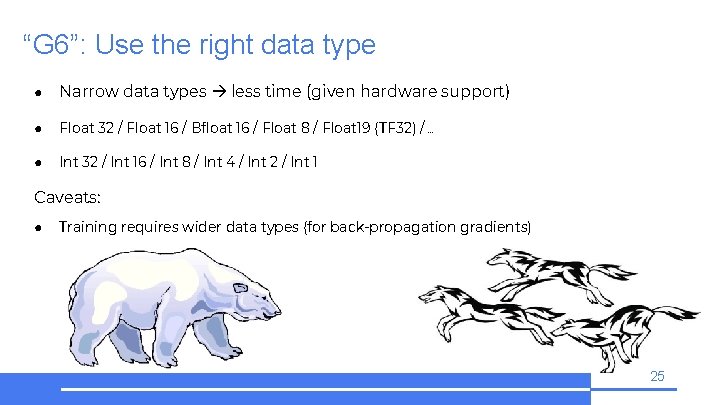
“G 6”: Use the right data type ● Narrow data types less time (given hardware support) ● Float 32 / Float 16 / Bfloat 16 / Float 8 / Float 19 (TF 32) / … ● Int 32 / Int 16 / Int 8 / Int 4 / Int 2 / Int 1 Caveats: ● Training requires wider data types (for back-propagation gradients) 25 COVID-19

What Now?
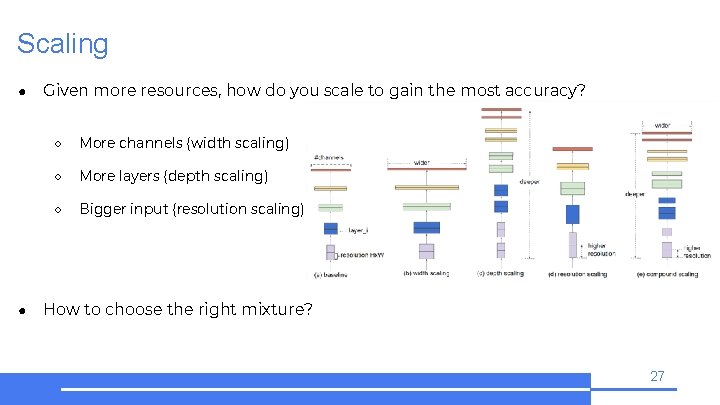
Scaling ● ● Given more resources, how do you scale to gain the most accuracy? ○ More channels (width scaling) ○ More layers (depth scaling) ○ Bigger input (resolution scaling) How to choose the right mixture? 27 COVID-19
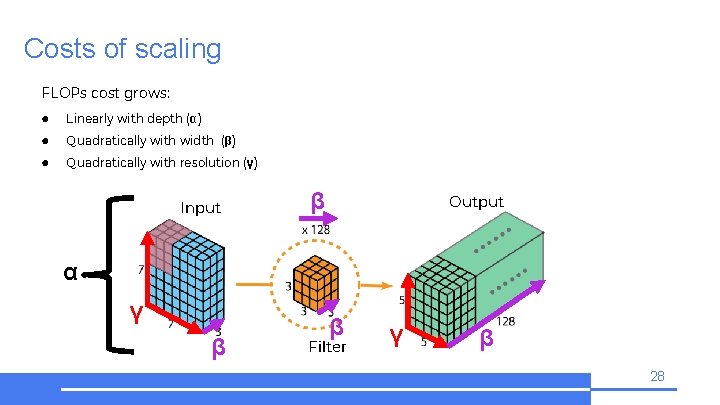
Costs of scaling FLOPs cost grows: ● Linearly with depth (α) ● Quadratically with width (β) ● Quadratically with resolution (γ) Input β Output α γ β β Filter γ β 28 COVID-19
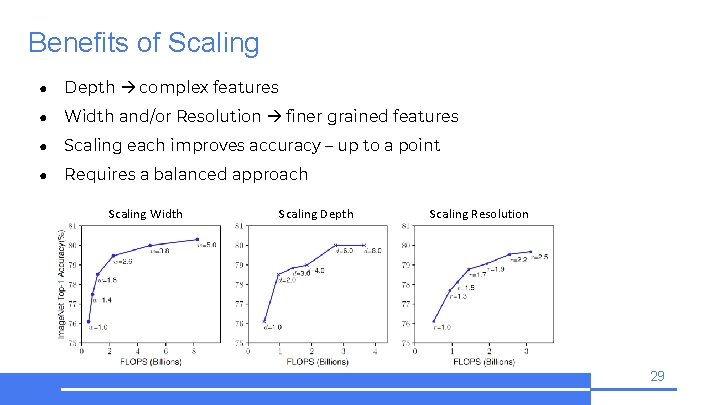
Benefits of Scaling ● Depth complex features ● Width and/or Resolution finer grained features ● Scaling each improves accuracy – up to a point ● Requires a balanced approach Scaling Width Scaling Depth Scaling Resolution 29 COVID-19
Compound Scaling ● Once: ○ Choose “best” α, β, γ ≥ 1 such that α * β 2 * γ 2 = 2 by running a search algorithm maximizing accuracy for doubling baseline cost ● To scale: 1. Pick Φ = log 2 (target cost / baseline cost), scale depth by αΦ, width by βΦ, resolution by γΦ ● Caveats: ○ Does not consider memory accesses, only FLOPs ○ Optimal proportions may vary with scale 30 COVID-19
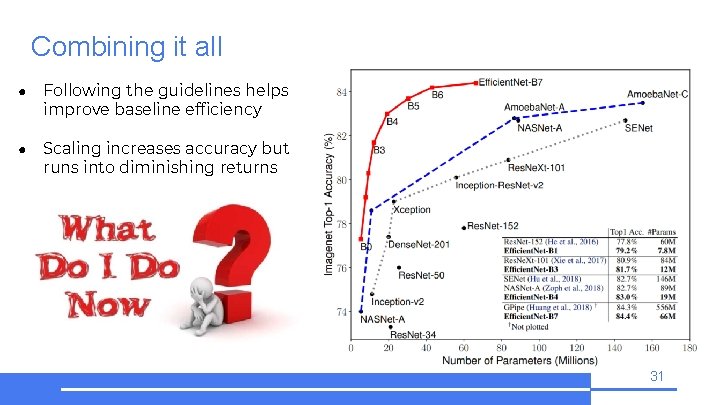
Combining it all ● Following the guidelines helps improve baseline efficiency ● Scaling increases accuracy but runs into diminishing returns 31 COVID-19
Summary ● Architecture determines Efficiency (Accuracy vs. Cost) ● Cost isn’t just counting FLOPs ● There are many ways to design more efficient nets ○ ● Each way has different tradeoffs Given more resources, we can apply scaling Network architecture is still more of an art than science

What Now?
Many directions ● Novel architectures ● Sparse networks ● Spiking networks ● More… 34 COVID-19

Thank you for Listening!
- Slides: 35