
Efficiency Problems of the Fragile States in the
Efficiency Problems of the Fragile States in the Middle East and North Africa By Prof. Dr. Maria Bordas National University of Public Service Faculty of Public Governance and International Studies 2020.
Muslim Empires • • - - 6 -16 th centuries: Mecca: Foundation of Islam (by Mohammed) Medina: Muslim Caliphate (funded by Mohammed) Osman conquest: Arab-peninsula, Middle-East, North-Africa, Asia, Europa, Balkan, coast of Black See Sultanate (loose confederation) Muslim Emperies: Osman Imperia (capital: Constantinople*): developed culture, public administration and architecture, but militant, huge, permanent and well organized fanatic army Persia Mogul Imperia (India, Pakistan and Afghanistan) *from 1453
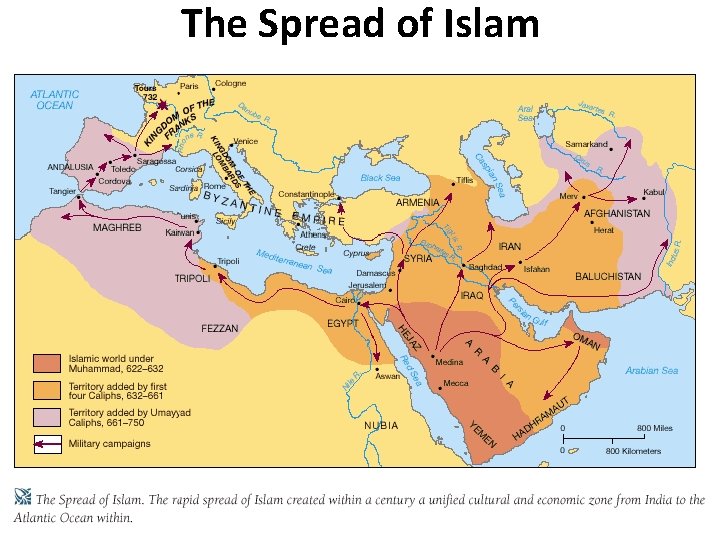
The Spread of Islam
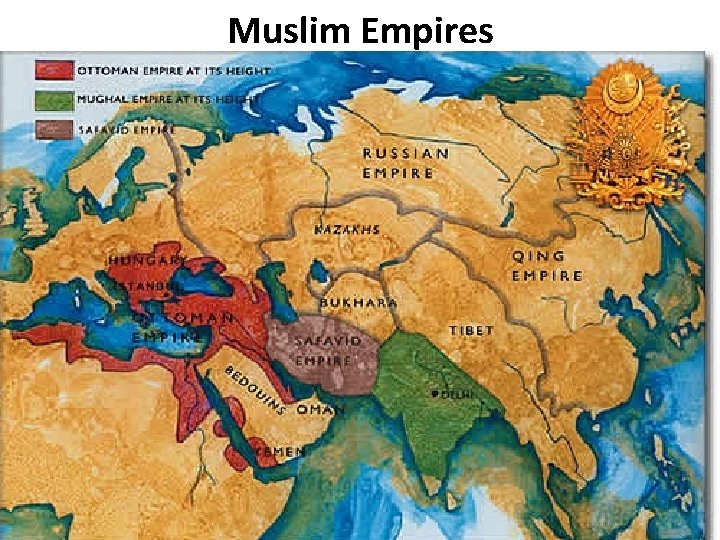
Muslim Empires
The Islam • Muslim: stating Allah is the only God, and Mohhamed is his only prophet – no ceremony – simple • Culture and way of life: regulates everything (praying, zakar, hadzs, marriage (4 wives) sharia (laws) adultry, stoling, killing, interest, prohibition of alcohol, • Politic, religion and social life are not devided • Mosque: place of social life, political debates, imam’s statements, education (Quran) social services • Dzsihad: - Inside fighting against temptation to commit crimes - Outside: against the enemies of the Msulims (many interpretations – Quran is contradictorry in this matter)
The Islam • Rules: Quran (szura), hadisz, szunna • Religious leaders: Ulema (scientests of Islam) and fukaha (scientest of islamic laws) – legitimaze the political power • Fetva: issued by the religious leaders – declaration • Caliphate: Sunni – division of the political and religious leadership • Immamate: Shia – infallible religious leaders – mystic knowledge – bloodline of Mohhamed
Emergence of Feudalism in Muslim States Holy sites: around the religious centres Owner of land is Allah Under direction of Caliph Lands can be given to nobles, soldiers as a honorarium for services provided (later property) • Occupied territories: - The owner of land remained Allah - Landowners pay tax to Caliph 10 th century: emergence of feudal grand land properties, but the slavery was still present • -
Emergence of African States 1. Egypt: Upper and Lower Egypt: unification in B. C. 4000 B. C. 30: Roman province – later part of Osman Imperia North-Africa: B. C. 9 th century: Greek, later Roman colonies Commercial areas of South-Arabia and Phoenicia Empires: Maghreb, Sudan, Mali, Ghana, Songhai, Hausaland, Senegal, Kanuri, Faluni (North- Africa, Sahara, Sahel, Horn of Africa) – well developed public administration, trade, culture - To 19 th century: Islam is dominating (trade and violent dissemination) • • -
Emergence of African States 2. • South from Sahel: - 10 th century: tribal-clan relations - 15 -19 th century: slave-keeping kingdoms (Niger delta, Lake Victoria, Lake Tanganyika, Congo, Katanga, Ruanda, Zimbabwe) • Commonalities: - Emperor: centralized power - Clans: supporters of Emperor - Feudalism: not formed – clan system - Colonisation: 16 -18 th centuries (source of raw materials, new markets, local trade) – capitalist relations - Local states disintegrated: immigrations (wars) - Beginning of the 20 th century: the colonial power divided the African continent - After WWII. : movements for independence
Africa and the Middle-East after the WWII By the end of the 1960 -s - independent states: Elected governments – then military putsches One-party system or military putsh Fragile states Social-economic problems: ethnic conflicts, growing population, under-developed economy, poverty, corruption • Second part of 21 th century: crisis of modernisation - Influence of USA and Soviet Union – Western and Socialistoriented states - Arab – Israeli conflict - Spread of Political Islam • -

Emergence of Political Islam - After Mohammed's death (632): debates on the issue of succession - Practice: person from the Prophet's family who is the most prestigious • Election of 4 Caliphs, but Mohammed's bloodline is interrupted (Ali's death) Story: conflict of Muávija and Ali - Break between Muslims: - Kharijite: separation and the assassination against Ali (Oman) - Sunni: the Caliph elected by community – the most deserving (Omajjad dynasty) - Shia: only blood relative of Mohamed could be the leader of the imamate (their infallibility derives from the bloodline of Mohammed ("Shia crescent") (Hasajn: son of Ali was killed) 15% - Persian – Arab rivalry
Origin of Political Islam Tradition: Mohammed is military, state and religious leader - a charismatic leader who is a soldier - politics, religion and the state are not divided Currently: - A variety of government: from medieval caliphate to constitutional and parliamentary democracies - Common: Islam is dominant, but in accordance with various political interpretations - Interpretation of Islam: it is determining the modernization processes
The Roots of Islamic Fundamentalism • Kharijites: 7 th century (religious sect) - Puritanism and religious fanaticism - Interpretation of Quran literally - Apostate (criminals): who have announced the wealth and the enjoyment of life (music, dance, games, concubines) - severe punishment for this • Wahhabits: 17 th century (Arabian Peninsula) • Interpretation of Quran literally – wanted to return the original teachings of Islam - Today: it is the state religion of Saudi Arabia - orthodox trend • Shia imamate: mystical knowledge - without control
The Modern Islamic fundamentalism The Islamic fundamentalism: - To return to the original Islamic customs, and moral rules of conduct - even by using force and violence - Middle of the 20 th century: finding a way out from the crisis of modernization - Anti-Western attitudes: rejection of Western culture and state organization (it is not superior) - They criticized dictatorships (orthodox Islam, socialist, Western-oriented) - ideology of the political opposition - There is no definite idea of the state organization - the Islamic caliphate is not applicable to modern conditions
Major Islamic Trends • Orthodox Islam: return to the Islamic traditions of government organization (caliphate) and law (Sharia) – in the Gulf monarchies • Reformist Islam: (minority) political pluralism, multi-party system, secularism, parliamentary system, political rights and freedoms - Western values (Turkey, Morocco, Jordan, Lebanon, Tunisia, Algeria) • Radical Islam: - It is based on Islamic fundamentalism - The violence is based on: global terrorism, militant Islam, "Caliphate„ - Goal: the expulsion of the West from the Islamic holy land - It rejects the political rules of the games and the international law
Impact of the West on the Islamic World • Western culture and state organization is a strange body: no Renaissance, Enlightenment and capitalist modernization • Forcibly created Western and communist models – entered to crisis in the second part of the 20 th century • Independent states: the lower layers are replacing the colonial aristocracy, but could not show alternatives • One-party dictatorships: military putsch and brutal police actions, monopolisation of political power, nationalization, expropriation, corruption, social division (poor - rich) • Political, ideological and identity vacuum: this is a hotbad and the breeding ground for Islamic fundamentalism
The Establishment of Independent Islamic States After WWI: - National Identity: Morocco (Berbers), Afghanistan (Pashtuns) Iran (Persian), Egypt, Turkey, Kurds - Arab identity - strengthened in the 19 th century the centre of Caliphate should be Mecca and the leader from Mohammed’s tribal descendants - Religious divisions: Sunni, Shia (Alevites and Druses) Christians (Maronite, Coptic, Yezidis)
The Social, Religious and Ethnic Divisions in the Islamic States Complex: - Industrialization: large farms, industrial plants, city workers, free peasants, intellectuals - Country side: tribal-clan relations - take part in local governance - Islamic traditions (Sharia, mosques, Quran schools, Islamic judicial organs) - State: artificial - regional, local bodies, but there is no identity - different ethnic and religious groups - Divisions: e. g. Iraq, Syria, North Africa, Turkey, Lebanon
The Islamic form of government After the disintegration of the Ottoman Empire: As European colony As absolut monarchy (later overthrown by popular movements) After WWII. : No change: Saudi Arabia, Kuwait, Qatar, UAE, Oman Constitutional monarchy: Jordan and Morocco (after the Arab Spring multi-party system) homogeneous - stable states; Afghanistan – under-developed, tribal conflicts - Instead of tilting systems: secular republic (Turkey); parliamentary democracy on the basis of religion (confessional) Republic (Lebanon); one-party system - Socialist orientated (Syria, Yemen, Egypt, Libya, Algeria, Somalia) Iran (constitutional monarchy and immamate) strong presidential system (Tunisia • -
Saudi Arabia 1. Wahhabism: (main obstacle to modernization) 17 th century: established by Muhammed ibn Abd Wahhab - Goal: forcing the Arabian peninsula tribes into united and organized country under the common law, - Ideology: religious leadership has deviated from its original purpose in Islam, the analogy is widely used – should be return back to the original and pure form of Quran - interpretation literally - stiffened interpretation of Islam
Saudi Arabia 2 - the creation of the state in 1932 The legal system: - Constitution: the Quran - King: he is governing by decrees, but deviation from the principles of the Quran is NOT ALLOWED - Local tribal laws and traditions - Sharia courts: its applies the Quran and Sunna's rules literally - there is no case law - severely punish the violation of the religious rules - Criminal procedure: inquisitorial, the accused has no right to know the charges, evidences, to receive protection from a lawyer - Penalties: public beheading, hand catting, flogging, stoning
Saudi Arabia 3. Organization of state: • King: Absolut power, exclusive right to legislation, inherited from the male line, and the family decides (Szalmán bin Abd al-Aziz Al Szaud) • Ulema: Wahhabi council composed of religious leaders - Controls the King in order to keep the traditional principles of Islam - Participation in the political decision making - Prevents any modernization effort - Members of the influential Saudi families - family relationships, and pacts are interwoven with the royal family - SURAT Council: the King's advisory body, with members chosen by the king, but weightless - Tribal leaders: local administrations, the King consults with them - Central and regional administration: members of the royal family - Businesses: rights for consultation with the king
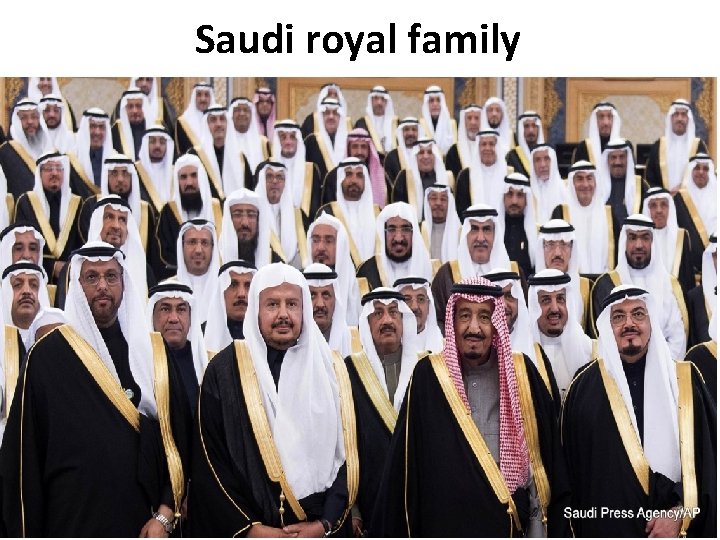
Saudi royal family
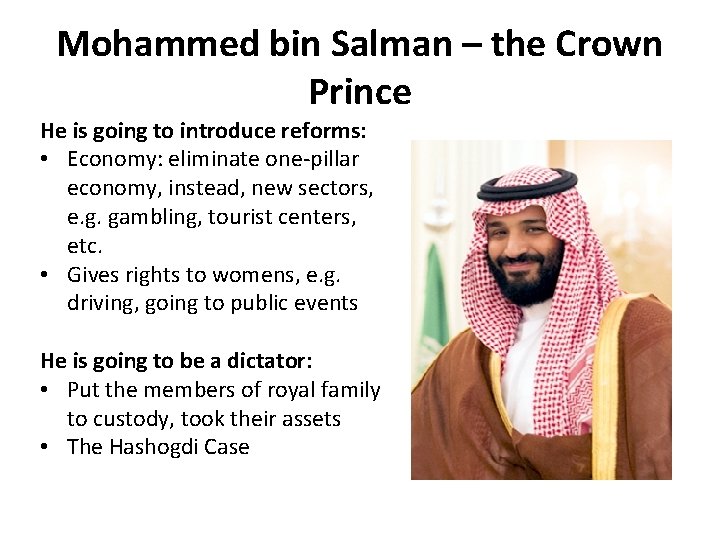
Mohammed bin Salman – the Crown Prince He is going to introduce reforms: • Economy: eliminate one-pillar economy, instead, new sectors, e. g. gambling, tourist centers, etc. • Gives rights to womens, e. g. driving, going to public events He is going to be a dictator: • Put the members of royal family to custody, took their assets • The Hashogdi Case
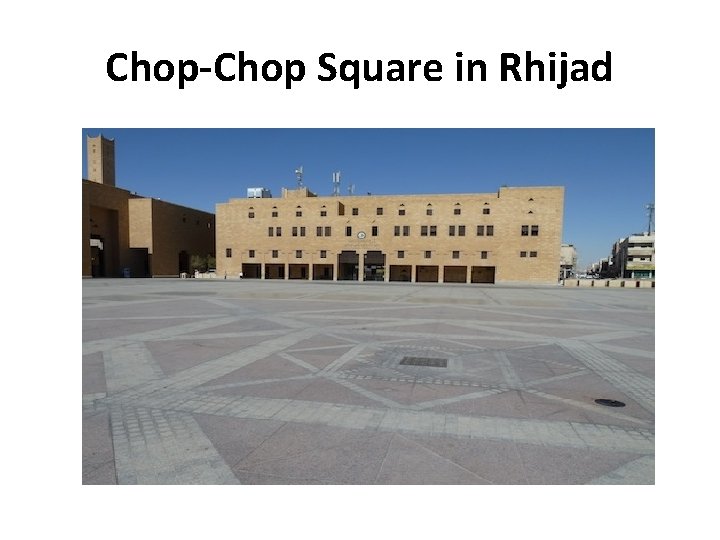
Chop-Chop Square in Rhijad
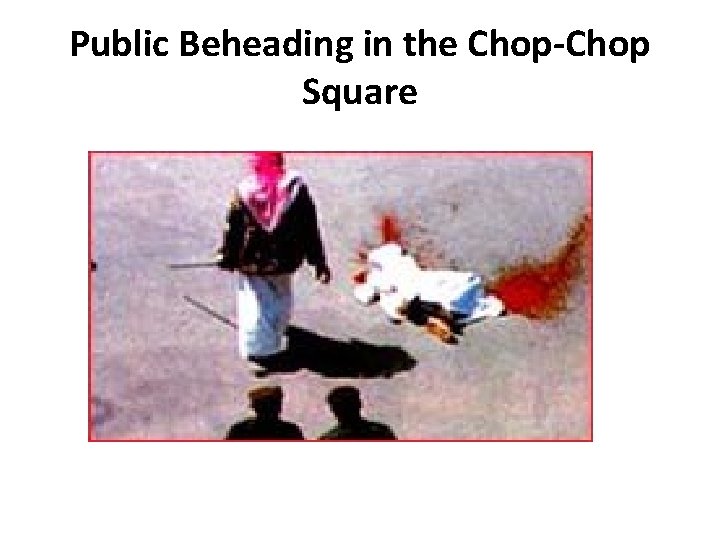
Public Beheading in the Chop-Chop Square
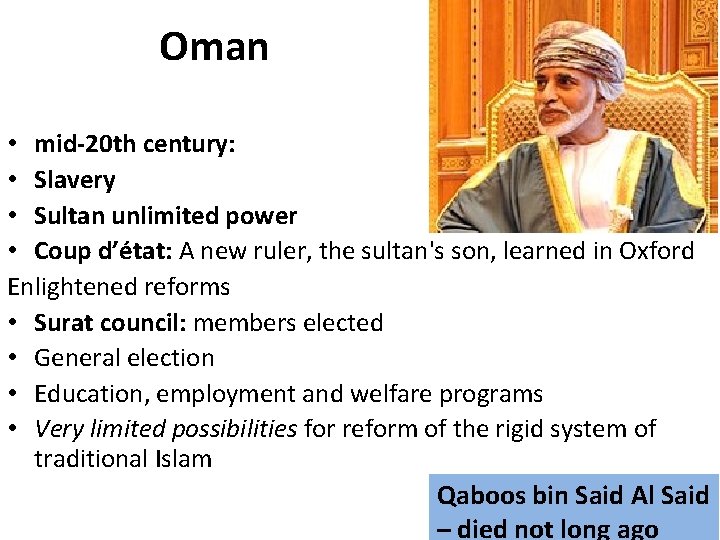
Oman • mid-20 th century: • Slavery • Sultan unlimited power • Coup d’état: A new ruler, the sultan's son, learned in Oxford Enlightened reforms • Surat council: members elected • General election • Education, employment and welfare programs • Very limited possibilities for reform of the rigid system of traditional Islam Qaboos bin Said Al Said – died not long ago
The common characteristics of Gulf monarchies Stability: - High social standards: incomes from selling crude oil and natural gas - Autocratic systems: gives security instead of anarchy and chaos – killing all political movements – ability to apply sharia by using force Inefficient states: - One pillar economy (oil) the other sectors are not developing - Unfashioned state structure - Legal system: very strict, interpretation of Quran letter by letter - Legal service: medieval
Iran 1. • After the death of Mohammed independent Shia state • Able to keep its independence • 1906: constitutional revolution – first State Assembly took place – weak state • 1921: Reza Pahlavi came to power – 1925: he became shah • Constitutional monarchy – secular state • Western type reforms: not always with success, because they did not take into account the traditions and harmed the interest of religious elite (i. e. after state privatisation of lands badly organized agriculture – no farmers – unemployment) • Successes: social, welfare and education reforms
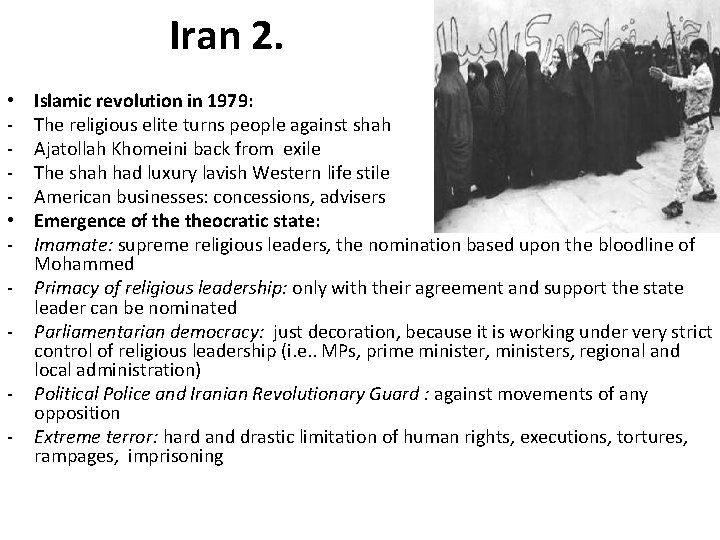
Iran 2. • • - Islamic revolution in 1979: The religious elite turns people against shah Ajatollah Khomeini back from exile The shah had luxury lavish Western life stile American businesses: concessions, advisers Emergence of theocratic state: Imamate: supreme religious leaders, the nomination based upon the bloodline of Mohammed Primacy of religious leadership: only with their agreement and support the state leader can be nominated Parliamentarian democracy: just decoration, because it is working under very strict control of religious leadership (i. e. . MPs, prime minister, ministers, regional and local administration) Political Police and Iranian Revolutionary Guard : against movements of any opposition Extreme terror: hard and drastic limitation of human rights, executions, tortures, rampages, imprisoning
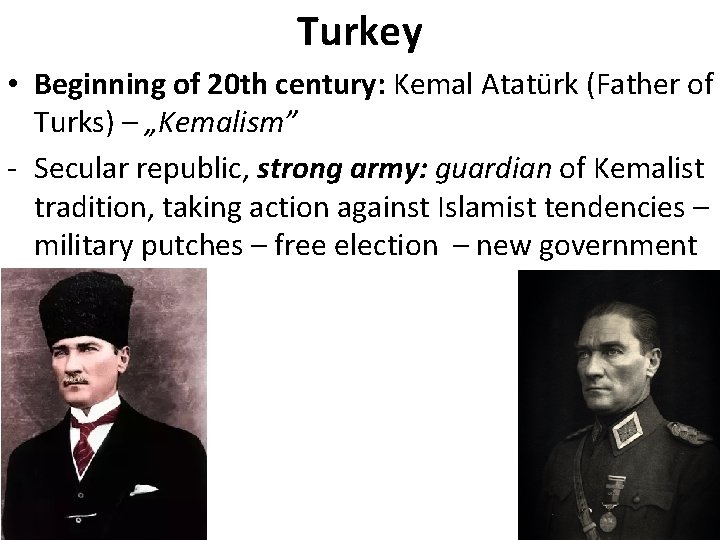
Turkey • Beginning of 20 th century: Kemal Atatürk (Father of Turks) – „Kemalism” - Secular republic, strong army: guardian of Kemalist tradition, taking action against Islamist tendencies – military putches – free election – new government
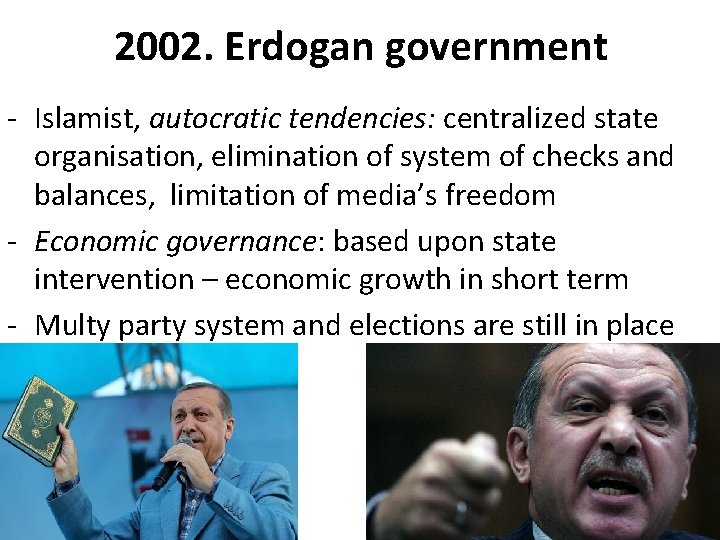
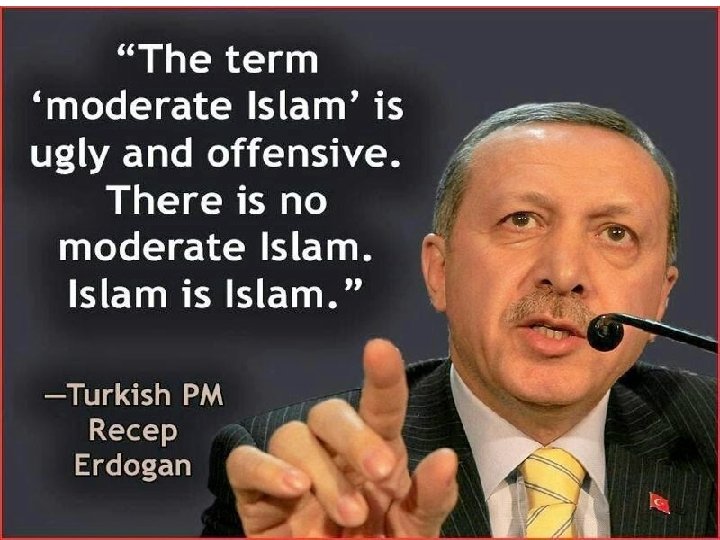
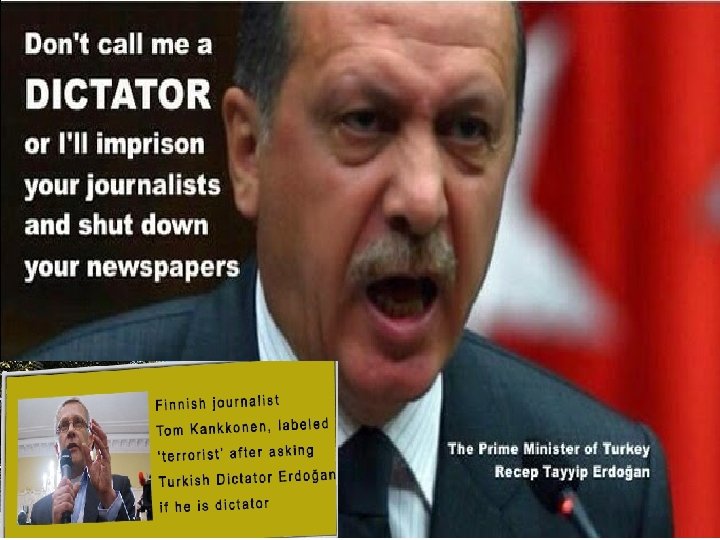
2002. Erdogan government - Islamist, autocratic tendencies: centralized state organisation, elimination of system of checks and balances, limitation of media’s freedom - Economic governance: based upon state intervention – economic growth in short term - Multy party system and elections are still in place
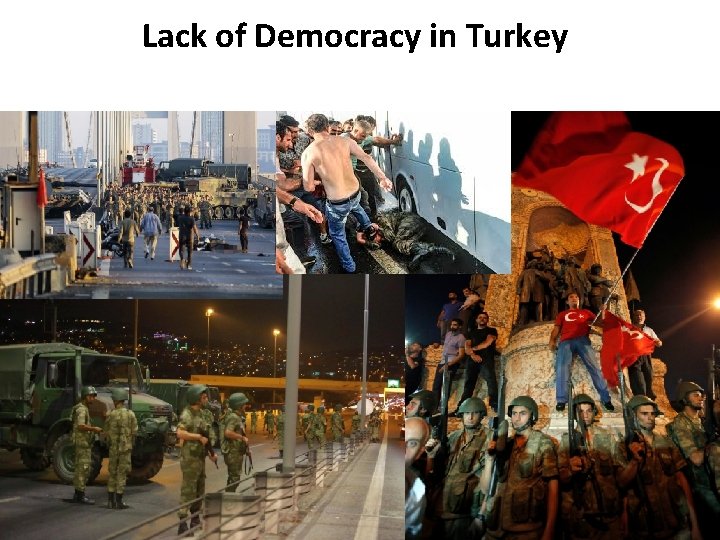
Lack of Democracymilitary in Turkeythen 2016: Unsuccessful Erdogan’s revenge
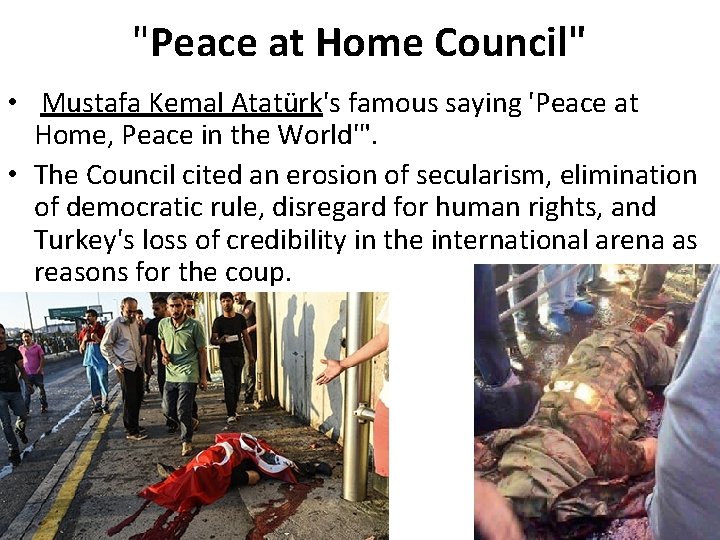
"Peace at Home Council" • Mustafa Kemal Atatürk's famous saying 'Peace at Home, Peace in the World'". • The Council cited an erosion of secularism, elimination of democratic rule, disregard for human rights, and Turkey's loss of credibility in the international arena as reasons for the coup.
Outcome of coup - During the coup, over 300 people were killed and more than 2, 100 were injured. - Eliminating all forms of opposition, State Emergency, - Death sentence? - Mass arrests followed, with at least 40, 000 detained, including at least 10, 000 soldiers and, for reasons that remain unclear, 2, 745 judges. - 15, 000 education staff were also suspended and the licenses of 21, 000 teachers working at private institutions were revoked as well after the government alleged they were loyal to Gülen. The state education council demanded the resignation of over 1, 500 university deans. - More than 100, 000 people have been purged
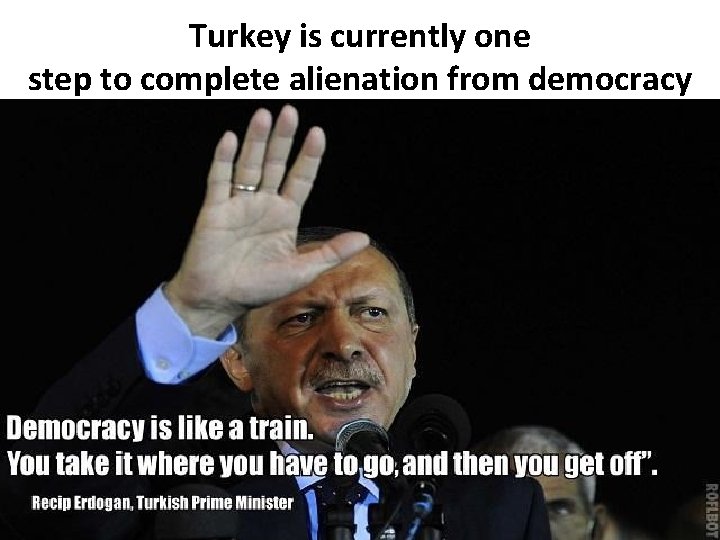
Turkey is currently one step to complete alienation from democracy
Referendum - 2017 • Presiental system: prime minister position is eliminated – cetralized political power to the president • Reason: - Official: cetrain social problems to be resolved – terrorism, Kurdish, immigrants – a strong state is required, but it is democratic - In the practical reality: to keep the political power – AKK has simple majority in the Parliament (2014. elections: CHP, HDP) – military putsh (2016. ) lack of checks and balances • Support: Islamist population in the country (Anatolia), but not the secularized intelligency in the big cities
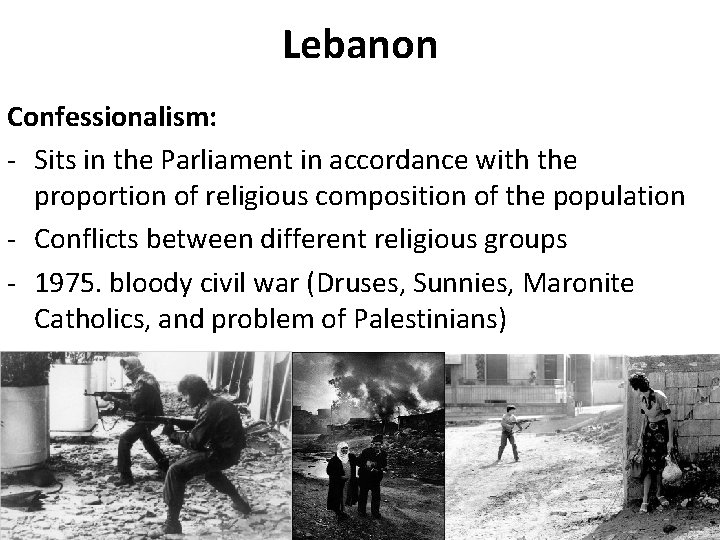
Lebanon Confessionalism: - Sits in the Parliament in accordance with the proportion of religious composition of the population - Conflicts between different religious groups - 1975. bloody civil war (Druses, Sunnies, Maronite Catholics, and problem of Palestinians)
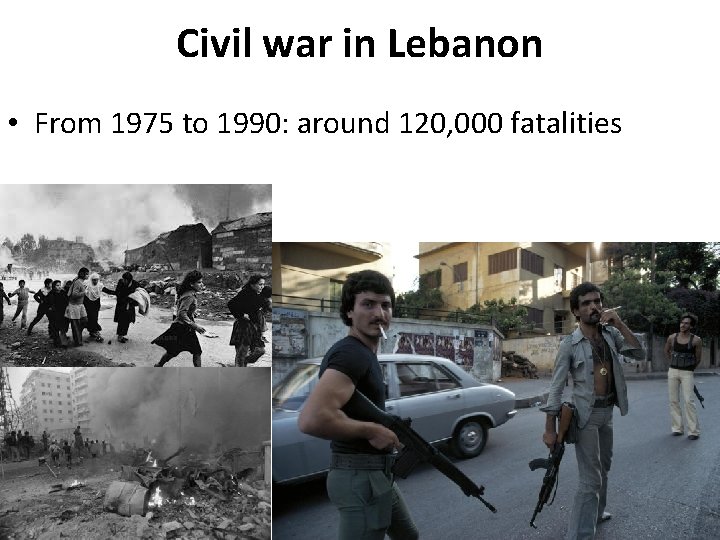
Civil war in Lebanon • From 1975 to 1990: around 120, 000 fatalities
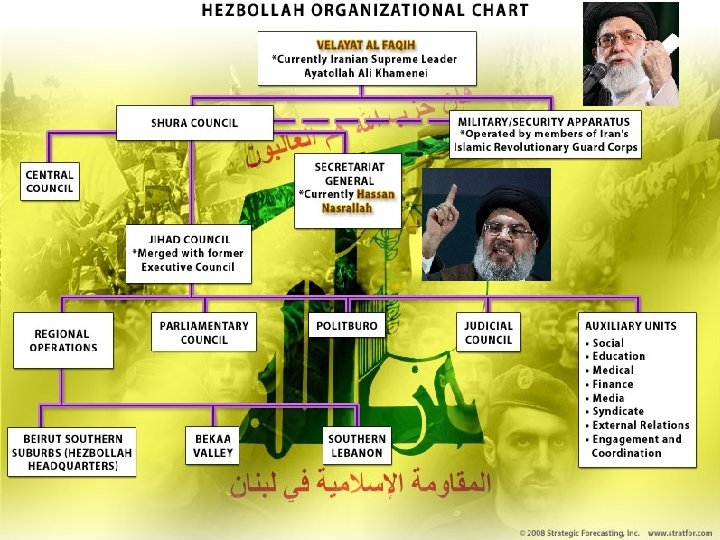
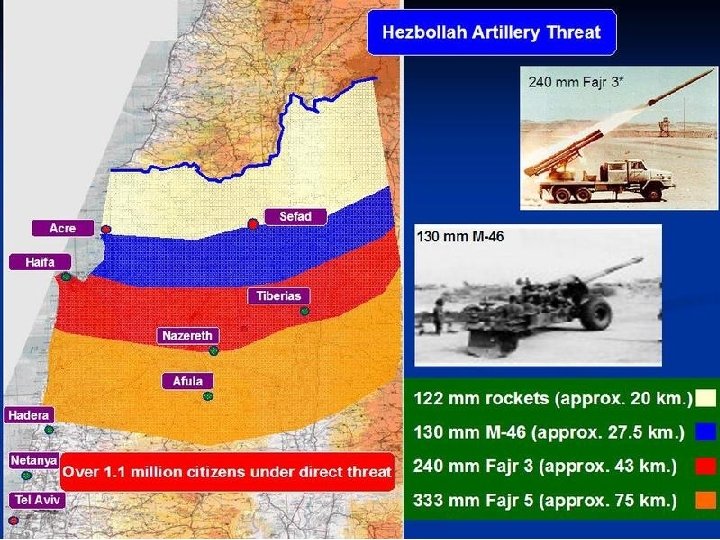
Emergence of Hezbollah - Political vacuum: creation of Shia Hezbollah with strong Iranian support (withdrawal PLO – withdrawal of Israeli Defence Forces from South Lebanon) - Hezbollah: a terrorist organisation, meanwhile local administrative power in South Lebanon and part of central government having MPs in Parliament and members in the central government
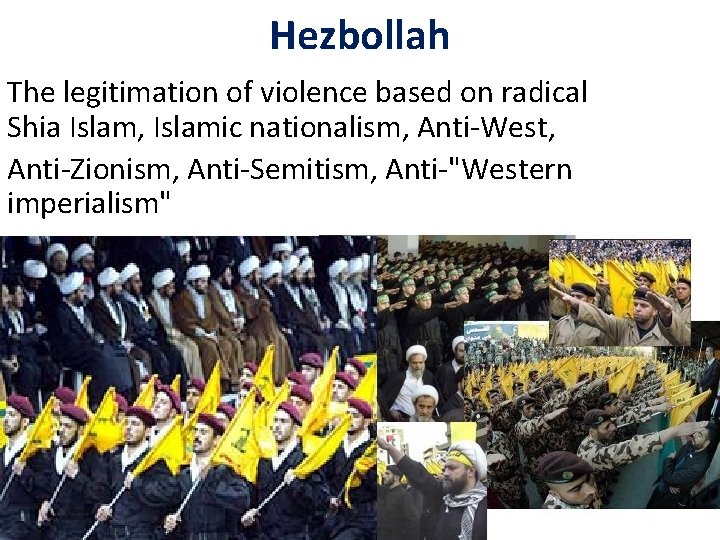
Hezbollah The legitimation of violence based on radical Shia Islam, Islamic nationalism, Anti-West, Anti-Zionism, Anti-Semitism, Anti-"Western imperialism"
What is Hezbollah? • Militant Shia terrorist network based in Southern Lebanon and funded by Iran • Cited aim is to destroy Israel while turning Lebanon into a Muslim state • Call themselves the “Party of God, ” and provide social services to the local population to garner support • Active political organization in Lebanon
Manifesto of Hezbollah We are the sons of the umma (Muslim community). . . We are an umma linked to the Muslims of the whole world by the solid doctrinal and religious connection of Islam, whose message God wanted to be fulfilled by the Seal of the Prophets, i. e. , Prophet Muhammad. . As for our culture, it is based on the Holy Quran, the Sunna and the legal rulings of the faqih (Islamic jurist) who is our source of imitation. .
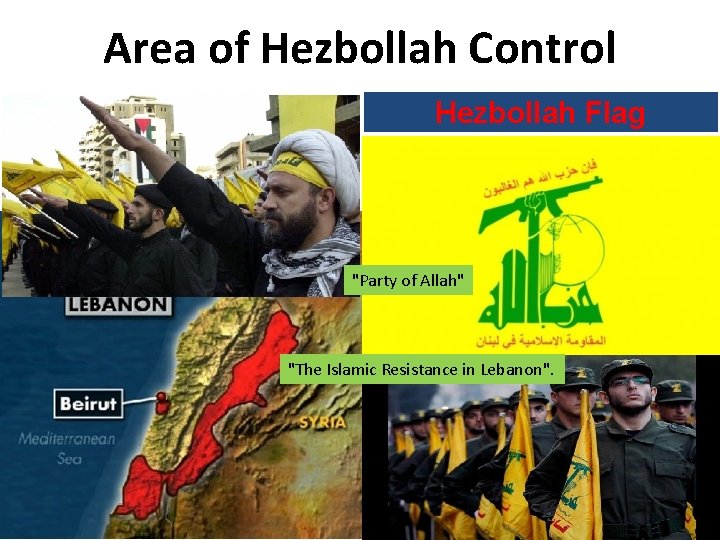
Area of Hezbollah Control Hezbollah Flag "Party of Allah" "The Islamic Resistance in Lebanon".
Socialist-oriented countries in the Middle East Iraq: Baath party – socialist oriented – Saddam Hussein – American intervention – dislocation of state – state building – radical Islam (al Qaida) – Islamic State (ISIS) – ambitions for Kurd autonomy – Iranian Revolutionary Guard in South Syria: Baath party, socialist oriented – Assad regime – Arab Spring – civil war – al Qaida (al-Nusra) - Islamic State – ambitions for Kurd autonomy – religious tensions Yemen: socialist oriented – Arab Spring – state failed – terrorist group: AQAP as al-Qaeda affiliate – religious tensions (sunni and shia) – Saudi and Iranian interventions
Other Islamic countries in the Middle. East and in Asia - Jordan: constitutional monarchy (Hussein, later his son, Abdullah II. ) – pularism, freedom of religion, multy -party system, - Palestine: British colony, Jewish communities, zionism, ethnic conflicts – Israel – wars with the Arabs - Afganistan: monarchy, English influence, pasthu tribes: without state control – Terrorist group: Taliban as follower of the primitive Islam - Pakistan: part of India, pasthu tribes – no border in fact – FATA: place of terrorirst, uncontrolled by the government
Egypt (Middle East country, but on the African continent) Part of the Osman imperia, but fairly independent • Independency: from the 18 th century, in fact in 1914 (but French and British influence) • Monarchy: 1805 -1952 • National identity: (from the ancient times) nationalism • Divided elite: Western-type or Islamist state? • Muslim Brotherhood: Islamist organization, most popular in the Islamic World • Military: strong, modernized, independent branch of state power
Egypt 2. - 1952: popular movement – group of „liberal officers” took over power from monarchy - King Faruk – Nasser president - 1950 -s: Socialist-oriented: state-monopolization, social justice, - 1970 -s: Western-type autocratic presidental system (Sadat and Mubarak) – reforms: liberalization, economic development, education - Muslim Brotherhood: (from the beginning of the 20 th century) at the beginning co-operation with the Nasser government - than assassination-attempt against Nasser (killed Sadat)- strong repression – dominating role, net over all country in the Middle East, supporting terrorist organisations, mother of several terrorist organisation - Divided society: conflict of the Westerner and traditional Islamic values – spread of radical Islam - Strong army: protector of Westerner values and parliamentarian democracy - 2012: Morsi government elected – military putsh – new elections
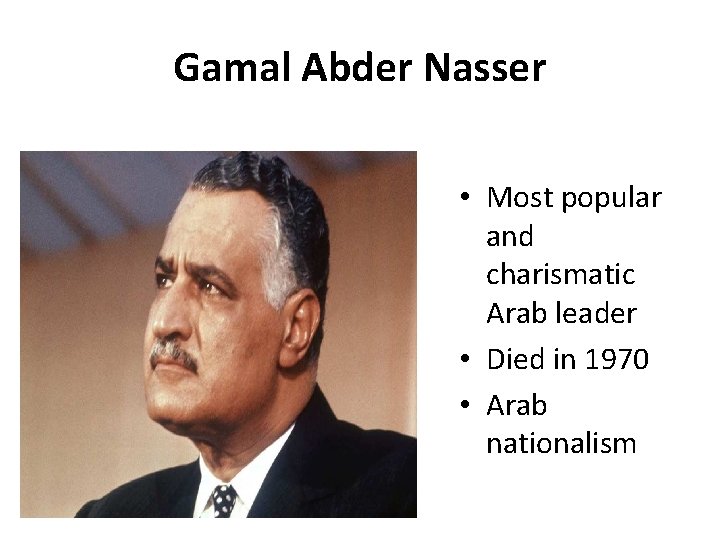
Gamal Abder Nasser • Most popular and charismatic Arab leader • Died in 1970 • Arab nationalism
North Africa: Maghreb • Morocco: not part of Osman Imperia – independent until the beginning of the 20 th century - monarchy • North Africa: part of Osman Imperia – smaller colonist influence - Tunisia: Western oriented, autocratic presidential system – low efficient - Algeria: strong army against radical Islamic tendencies (1990: elimination of results of election by the military, emergency state – civil war) – socialist oriented system – Maoist one-party system (FLN) – monopolisation by state – centralized economic governance – against radical Islamic tendencies
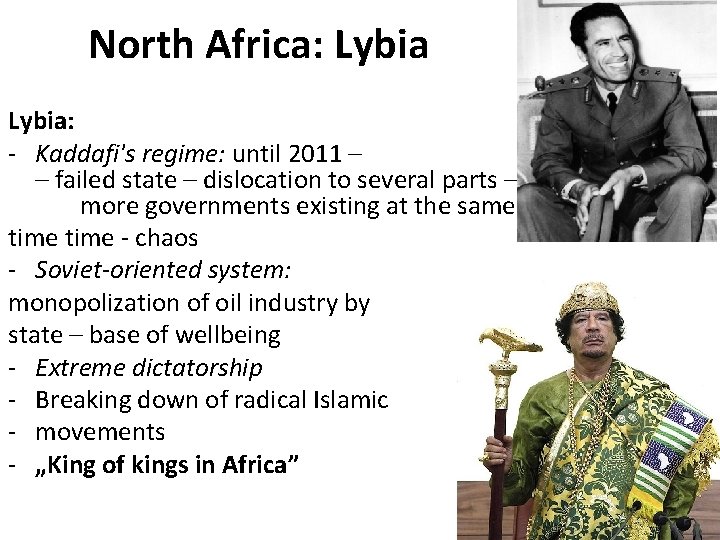
North Africa: Lybia: - Kaddafi's regime: until 2011 – – failed state – dislocation to several parts – more governments existing at the same time - chaos - Soviet-oriented system: monopolization of oil industry by state – base of wellbeing - Extreme dictatorship - Breaking down of radical Islamic - movements - „King of kings in Africa” revolution
North Africa: Sahel and Horn of Africa Sahel: (West-Sahara, Mali, Niger, Chad, Sudan) - Colonies – economy fitted to colonizers' interest, low level of economic growth and public administration – this tradition remained after the independence: the local Westerner elite is corrupt and autocratic - Scenario: military putsches – autocratic presidental systems – legitimized by unfair elections – new constitution referendum - Fragile states – civil wars - Deviation: whites (Berbers)- blacks, Christians-Muslims, tribal conflicts (Mali: Tuareg tribes) - States have no identity – artificial borderlines Horn of Africa: (Somalia, Ethiopia, Djibouti, Eritrea) socialist oriented – Somalia failed into chaos from the 1990 -s – terrorist organisations

ANY QUESTIONS?
- Slides: 57