
Efficiency Assessment of Transit Transfer Stations using Data

- Slides: 2
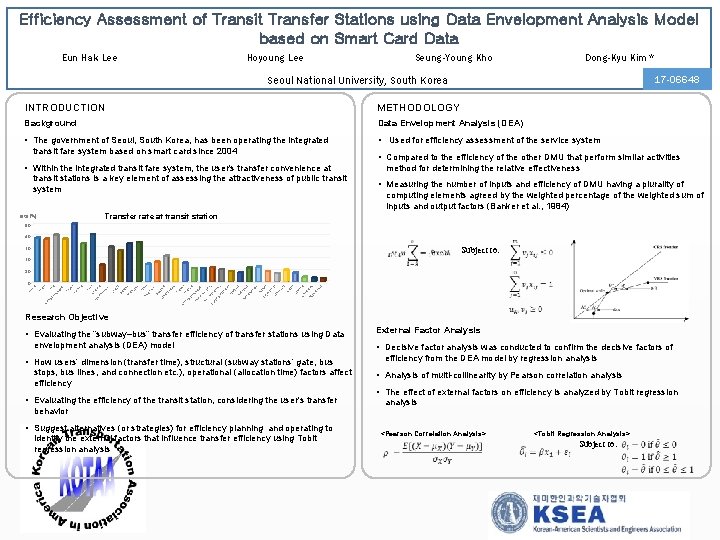
Efficiency Assessment of Transit Transfer Stations using Data Envelopment Analysis Model based on Smart Card Data Eun Hak Lee Hoyoung Lee Seung-Young Kho Dong-Kyu Kim* 17 -06648 Seoul National University, South Korea INTRODUCTION METHODOLOGY Background Data Envelopment Analysis (DEA) • The government of Seoul, South Korea, has been operating the integrated • Used for efficiency assessment of the service system transit fare system based on smart card since 2004 • Compared to the efficiency of the other DMU that perform similar activities • Within the integrated transit fare system, the user's transfer convenience at transit stations is a key element of assessing the attractiveness of public transit system method for determining the relative effectiveness • Measuring the number of inputs and efficiency of DMU having a plurality of computing elements agreed by the weighted percentage of the weighted sum of inputs and output factors (Banker et al. , 1984) Transfer rate at transit station rate(%) 50 40 30 Subject to. 20 10 m gd on g ur o sa gm un on Ch ye M e ga k ok na ng Jo Ye a w -g a il) sin 1( o on ljir Ye Eu g un am w gh Hy eh g un on je oll e gu Ap an Gw n al io rm at in Se Te s. B us x ity rs ive uc Ed of iv. es Un Ex pr ng ple Un uk nk on su l. C om Dig ita Ko po ch m ng eu Sin Sa n sa Ga iv. ng eo py Bu gd on Ye n ou l Un ik eo by Se Ho ng e eo n ng ng ja ch Ya Bu Ga m iv. Un yu na ng t'l Ga Na ou l Se rim Su do x on ple w Su Sin sil im Sil Gu ro Dig ita l. C om m da Sa Ja ng 0 Research Objective • Evaluating the “subway–bus” transfer efficiency of transfer stations using Data envelopment analysis (DEA) model • How users’ dimension (transfer time), structural (subway stations’ gate, bus stops, bus lines, and connection etc. ), operational (allocation time) factors affect efficiency • Evaluating the efficiency of the transit station, considering the user's transfer behavior • Suggest alternatives (or strategies) for efficiency planning and operating to identify the external factors that influence transfer efficiency using Tobit regression analysis External Factor Analysis • Decisive factor analysis was conducted to confirm the decisive factors of efficiency from the DEA model by regression analysis • Analysis of multi-collinearity by Pearson correlation analysis • The effect of external factors on efficiency is analyzed by Tobit regression analysis <Pearson Correlation Analysis> <Tobit Regression Analysis> Subject to.
APPLICATION Dataset • The smart card data of Seoul consists of 15 million instances of individual transit information per day. • Each of the bits of information is classified in 38 indices and provides more specific data. Smart card data could provide 99% of transit users’ trip information • we extracted Card ID, boarding location ID, Alight location ID, number of Transfer, Date, alighting time, Vehicle ID, and Boarding time Application of DEA model • The average efficiency score of 32 transfer stations was estimated to be 0. 597 which means that their average input should be reduced by 40. 3% • The efficiency score was estimated higher at stations where the number of trips and rates are larger • Even if the trips and ratio of transit stations are high, the efficiency was estimated to be low because of the over investment in facilities, such as Gangnam station • Considering the scale of the transfer stations, larger station could disperse the transit facilities. The smaller transfer station could attract transfer trips External Factor Analysis • Transfer efficiency was evaluated for 32 transfer stations • 32 transfer stations were regarded as the major stations based on the total number of transfer trips made • The data information extracted from the smart card data was processed into two output variables and eight input variables for DEA model • Regression analysis was performed with the Tobit model considering the correlation of external factor variables with Pearson correlation analysis • Six socioeconomic indicators are used for external factors which are transit accessibility, land use type, population density, number of companies, number of households, and number of cars in station area less than 150 m radius • All independent variables were statistically significant at the 95% confidence level and the signs for all variables were suitable • By the results, It is possible to increase the efficiency by dispersing public transportation facilities, and attracting users to transit in areas with high density or commercial districts CONCLUSION • This paper evaluates the transit transfer efficiencies in 32 transit stations using DEA model based on smart card data in Seoul, Korea • By the results of DEA model, larger station could disperse the transit facilities, considering the scale of the transfer stations and the smaller transfer station could attract transfer trips to improve efficiency • With the socioeconomic indicators, transfer efficiency was explained in relation to the external environmental of transfer station • This paper proposed to expand or reduce the transfer facility in station planning, considering the transfer efficiency of transfer station