
Efficiant polynomial interpolation algorithms Federico Tessmann Ferienakademie TUM















- Slides: 57
Efficiant polynomial interpolation algorithms Federico Tessmann, Ferienakademie TUM
Overview l Introduction to Vandermonde Matrices and its utilities l Univariate Interpolation l Multivariate Interpolation Federico Tessmann, Ferienakademie TUM
Properties of Vandermonde Matrices l Easy to ensure that they are non-singular l Systems of linear equations whose coefficients form Vandermonde matrices are easy to solve exactly Federico Tessmann, Ferienakademie TUM
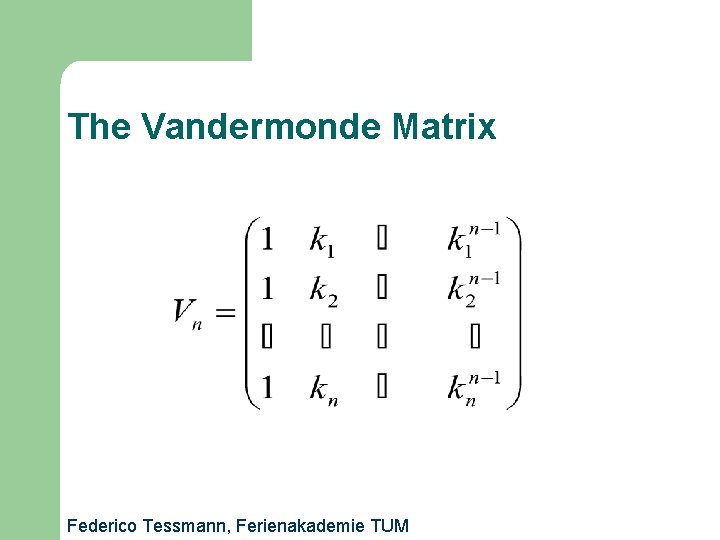
The Vandermonde Matrix Federico Tessmann, Ferienakademie TUM
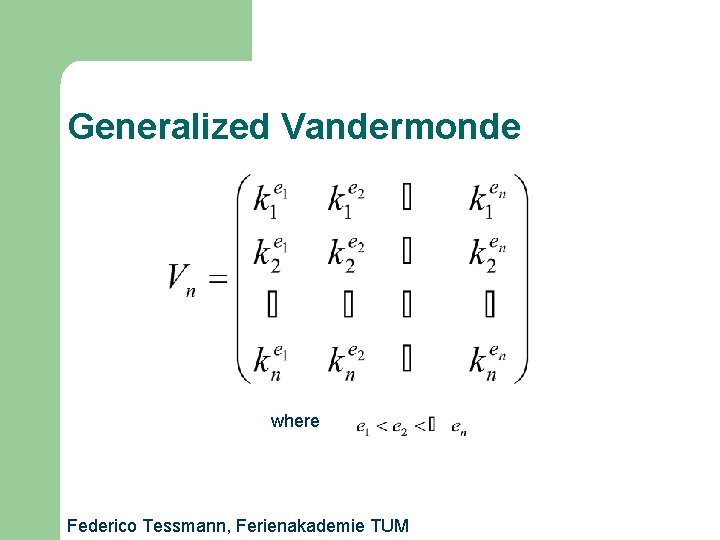
Generalized Vandermonde where Federico Tessmann, Ferienakademie TUM
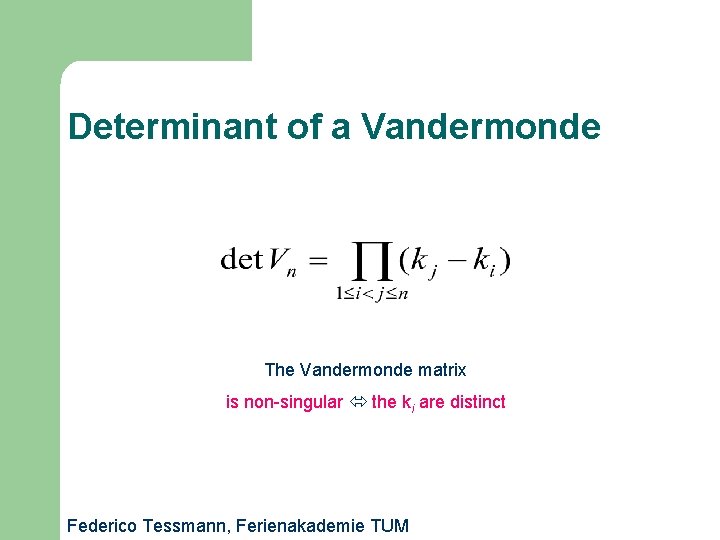
Determinant of a Vandermonde Federico Tessmann, Ferienakademie TUM
Determinant of a Vandermonde Federico Tessmann, Ferienakademie TUM
Determinant of a Vandermonde The Vandermonde matrix is non-singular the ki are distinct Federico Tessmann, Ferienakademie TUM
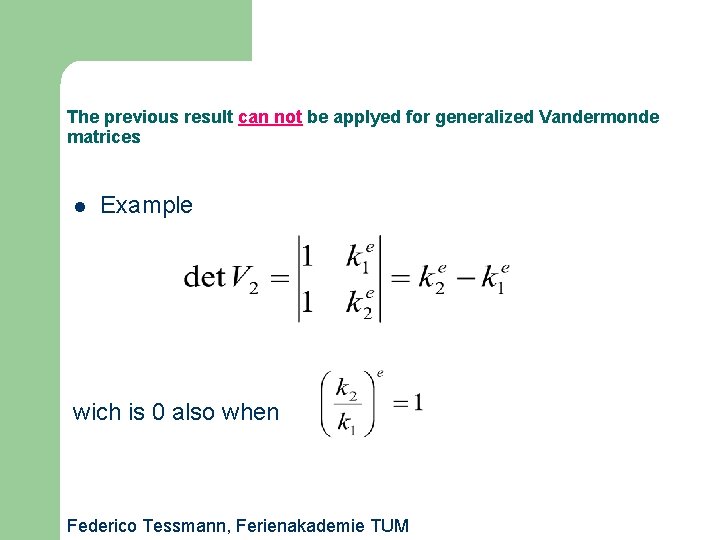
The previous result can not be applyed for generalized Vandermonde matrices l Example wich is 0 also when Federico Tessmann, Ferienakademie TUM
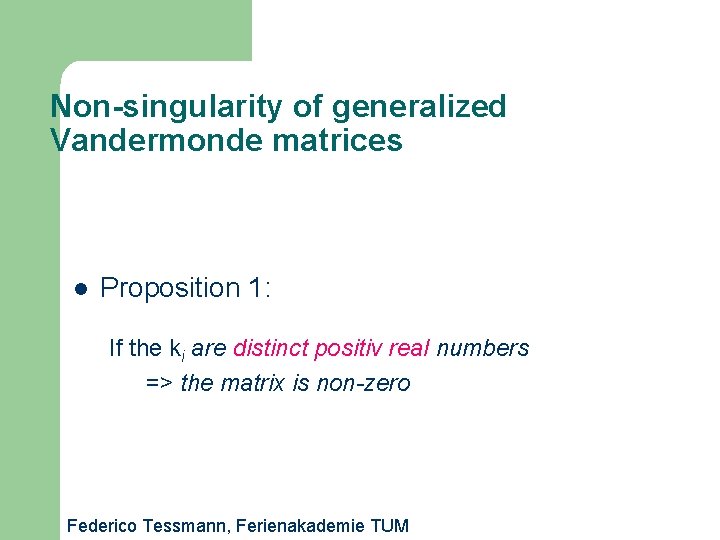
Non-singularity of generalized Vandermonde matrices l Proposition 1: If the ki are distinct positiv real numbers => the matrix is non-zero Federico Tessmann, Ferienakademie TUM
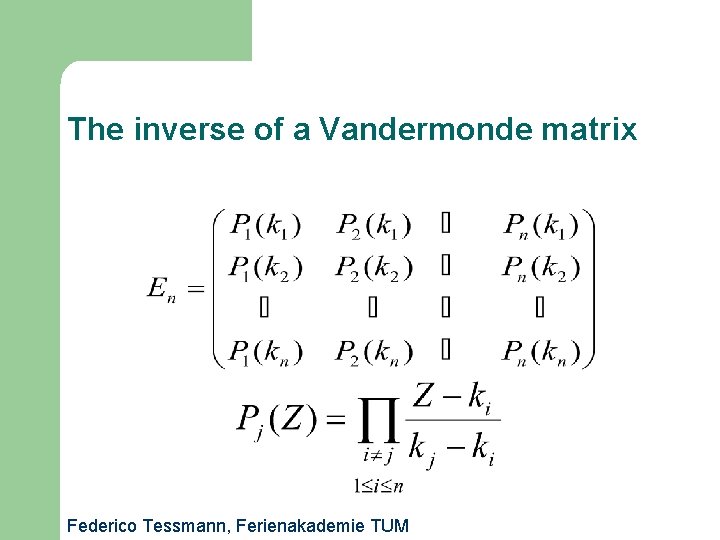
The inverse of a Vandermonde matrix Federico Tessmann, Ferienakademie TUM
The inverse of a Vandermonde matrix Federico Tessmann, Ferienakademie TUM
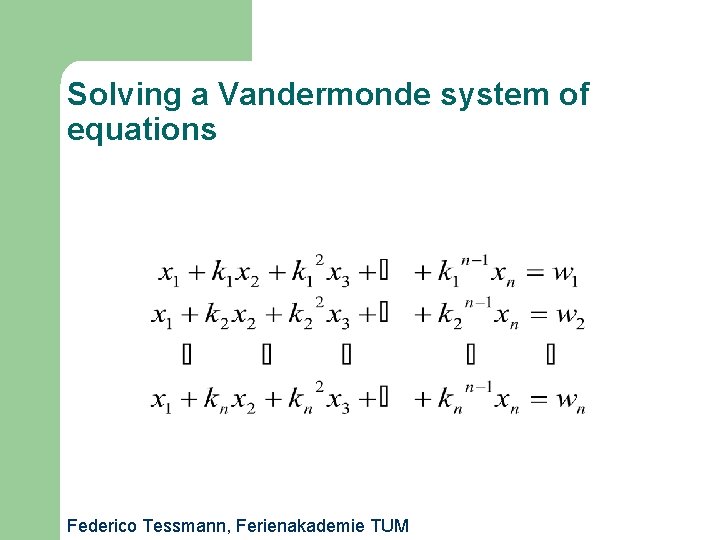
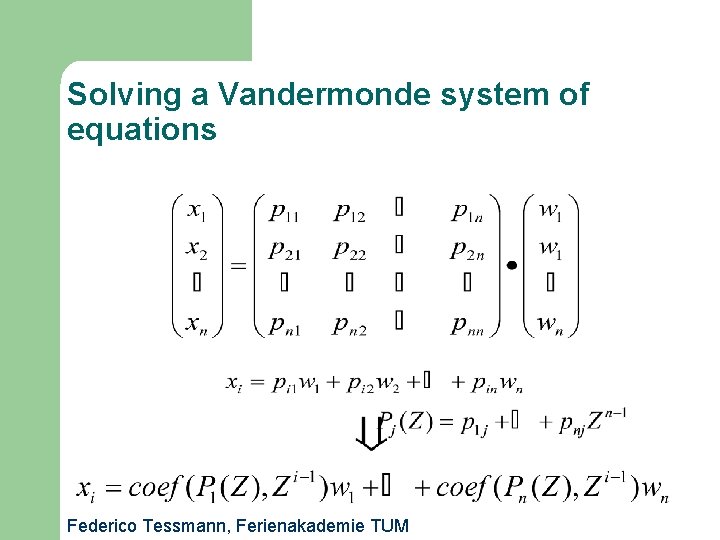
Solving a Vandermonde system of equations Federico Tessmann, Ferienakademie TUM
Solving a Vandermonde system of equations Federico Tessmann, Ferienakademie TUM
Solving a Vandermonde system of equations Federico Tessmann, Ferienakademie TUM
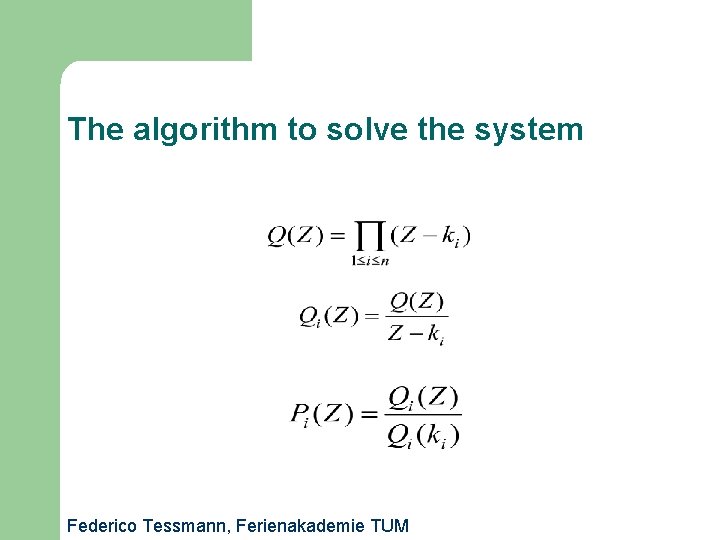
The algorithm to solve the system Federico Tessmann, Ferienakademie TUM
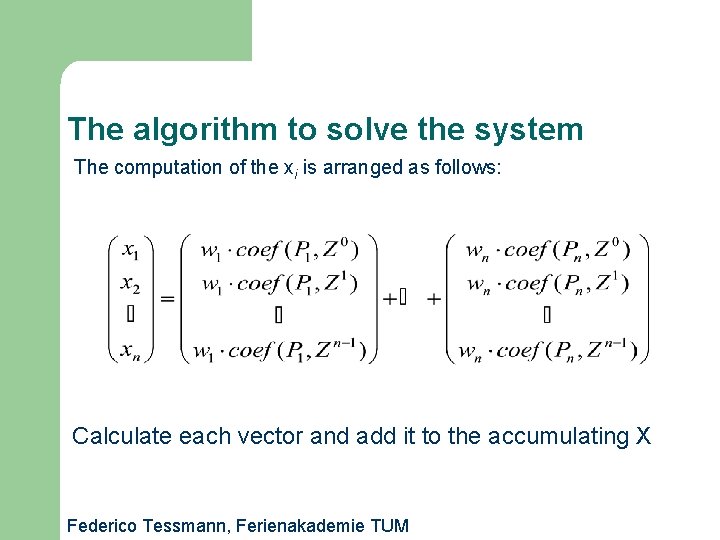
The algorithm to solve the system The computation of the xi is arranged as follows: Calculate each vector and add it to the accumulating X Federico Tessmann, Ferienakademie TUM
Analysis of the algorithm 1. By calculating the vectors one after the other we only need to compute one Pi(Z) at the time 2. Each Pi(Z) only needs O(n) time and since we have n polinoms to compute, the complexity is O(n 2) and the space needed is O(n) 3. Because the inverse of the transposed matrix is the transpose of the inverse of the matrix, the algorithm only need a little adjustment to solve a transposed Vandermonde system of equations On the Appendix there is an example of this alorithm taken from Zippel Federico Tessmann, Ferienakademie TUM
Univariate Interpolation l Lagrange Interpolation l Newton Interpolation l Abstract Interpolation Federico Tessmann, Ferienakademie TUM
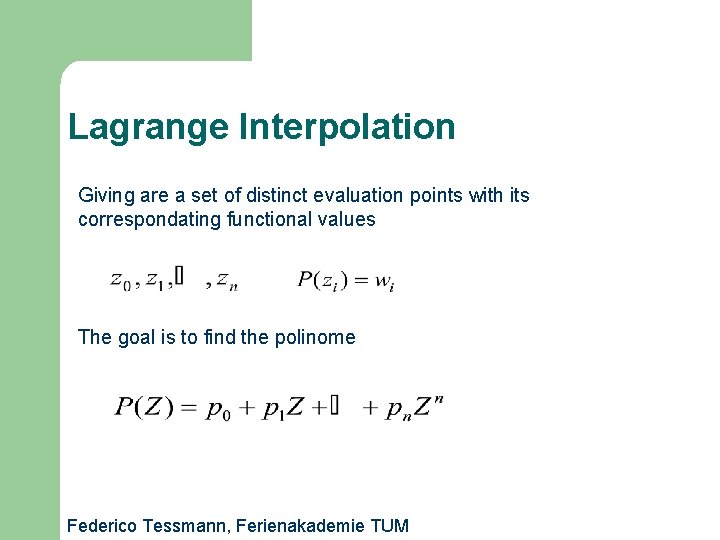
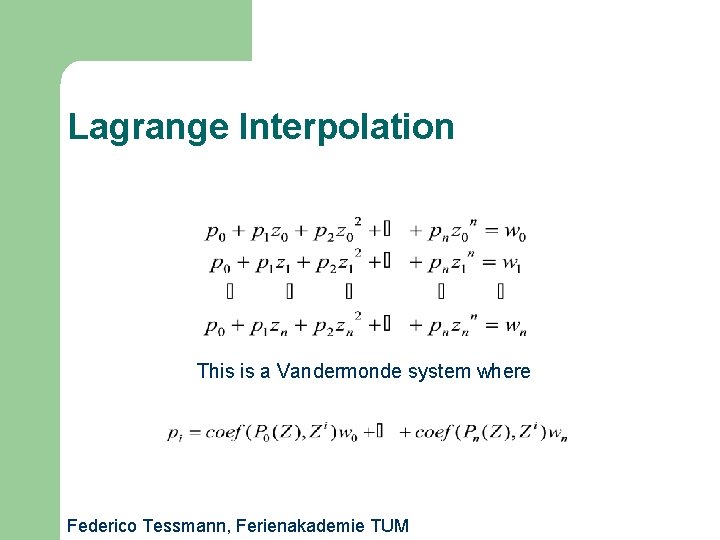
Lagrange Interpolation Giving are a set of distinct evaluation points with its correspondating functional values The goal is to find the polinome Federico Tessmann, Ferienakademie TUM
Lagrange Interpolation This is a Vandermonde system where Federico Tessmann, Ferienakademie TUM
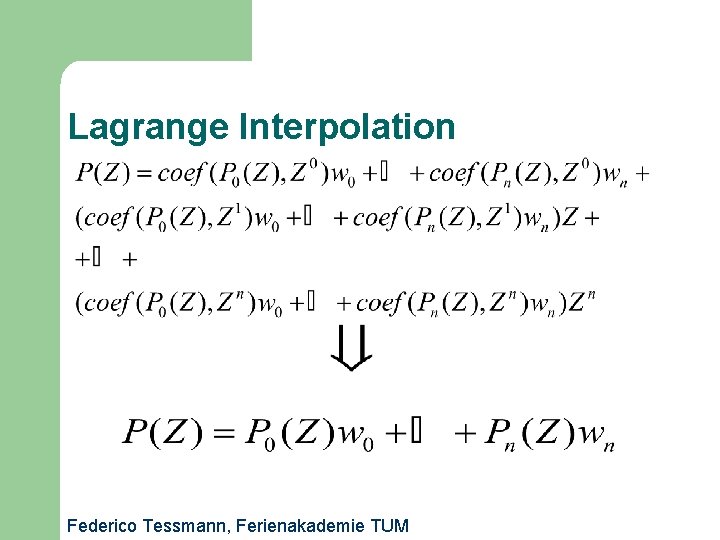
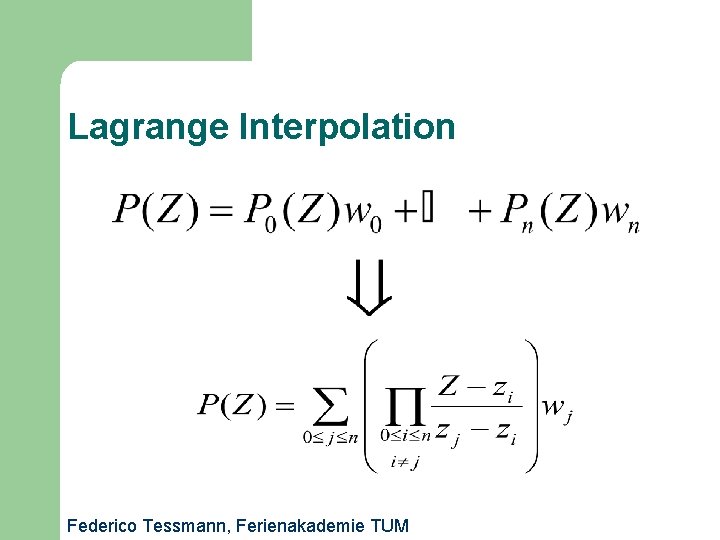
Lagrange Interpolation Federico Tessmann, Ferienakademie TUM
Lagrange Interpolation Federico Tessmann, Ferienakademie TUM
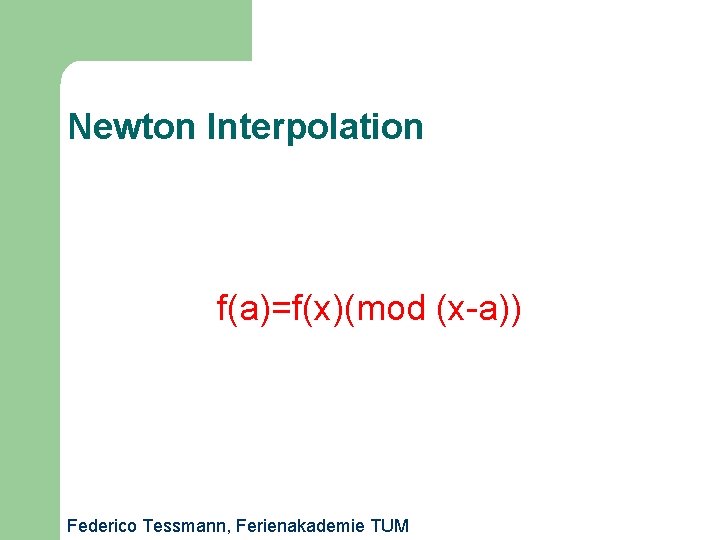
Newton Interpolation f(a)=f(x)(mod (x-a)) Federico Tessmann, Ferienakademie TUM
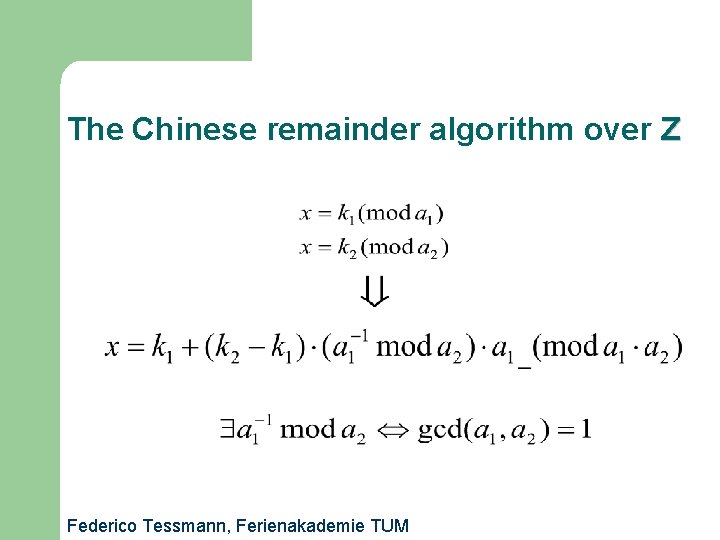
The Chinese remainder algorithm over Z Federico Tessmann, Ferienakademie TUM
Chinese remainder with polinoms When given and Then we change it to the following situation: Given Compute Federico Tessmann, Ferienakademie TUM
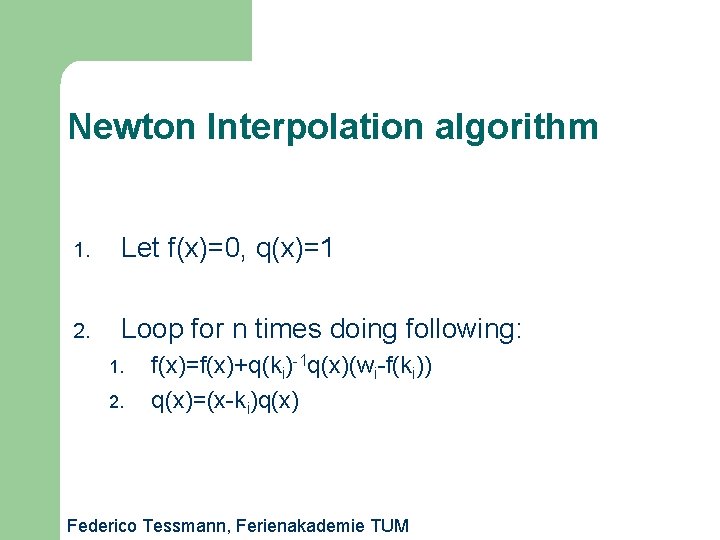
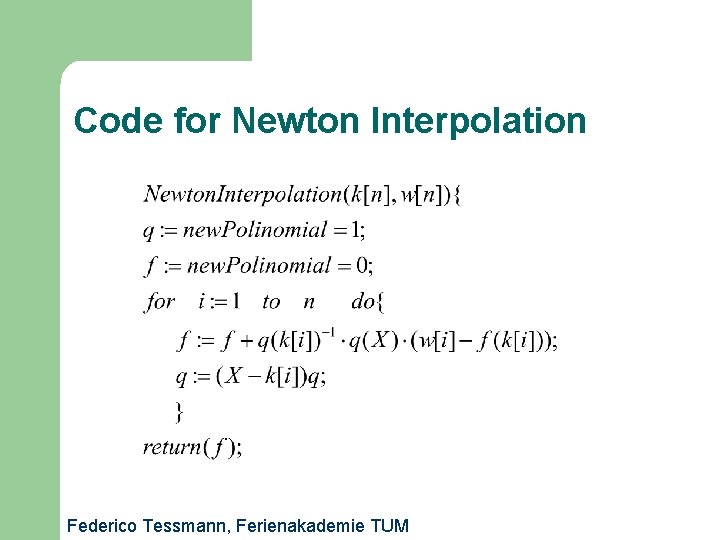
Newton Interpolation algorithm 1. Let f(x)=0, q(x)=1 2. Loop for n times doing following: 1. 2. f(x)=f(x)+q(ki)-1 q(x)(wi-f(ki)) q(x)=(x-ki)q(x) Federico Tessmann, Ferienakademie TUM
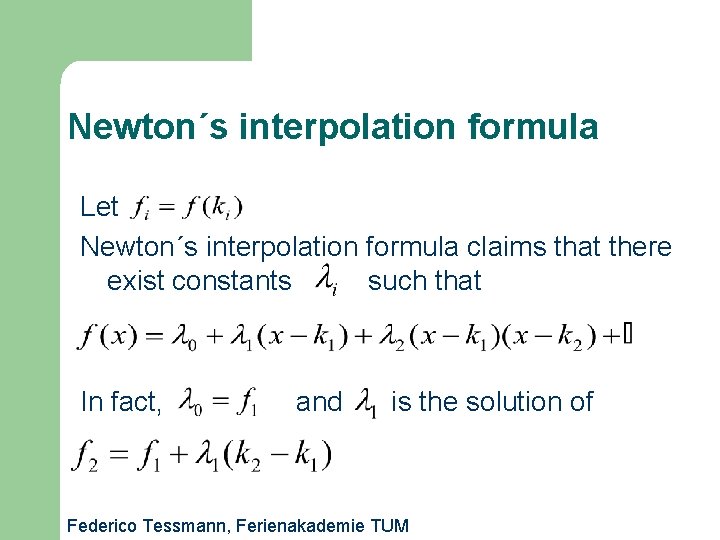
Newton´s interpolation formula Let Newton´s interpolation formula claims that there exist constants such that In fact, and is the solution of Federico Tessmann, Ferienakademie TUM
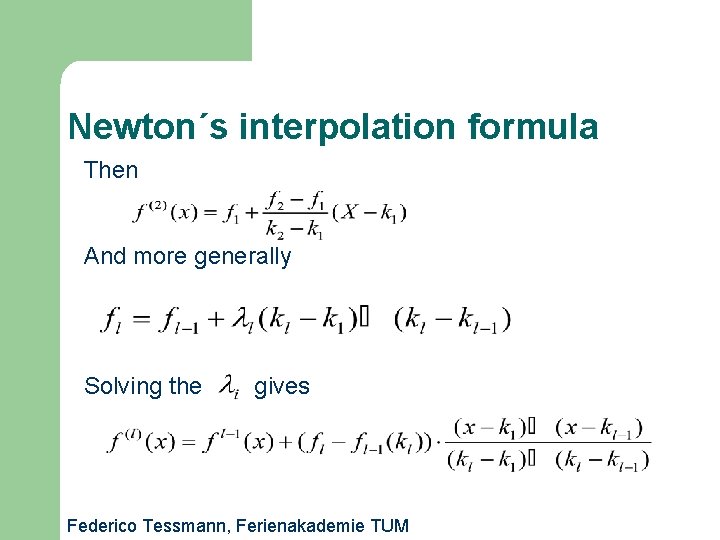
Newton´s interpolation formula Then And more generally Solving the gives Federico Tessmann, Ferienakademie TUM
Multivariate Interpolation l Dense Interpolation l Probabilistic Sparse Interpolation l Deterministic Sparse Interpolation without degree bounds Federico Tessmann, Ferienakademie TUM
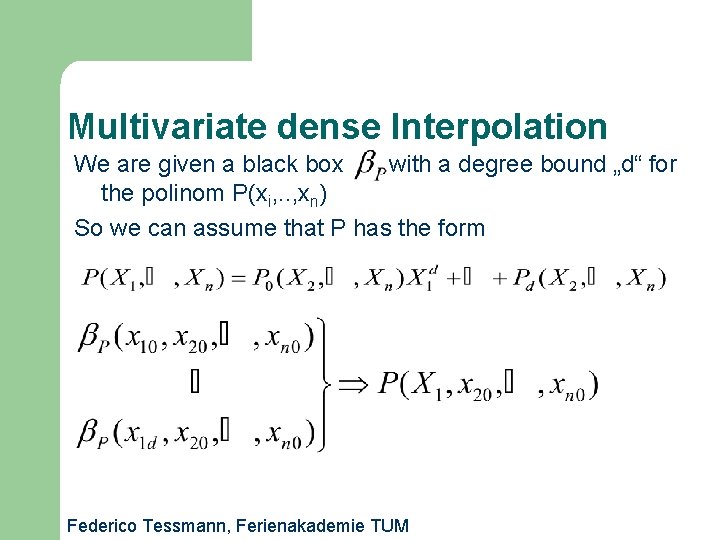
Multivariate dense Interpolation We are given a black box with a degree bound „d“ for the polinom P(xi, . . , xn) So we can assume that P has the form Federico Tessmann, Ferienakademie TUM
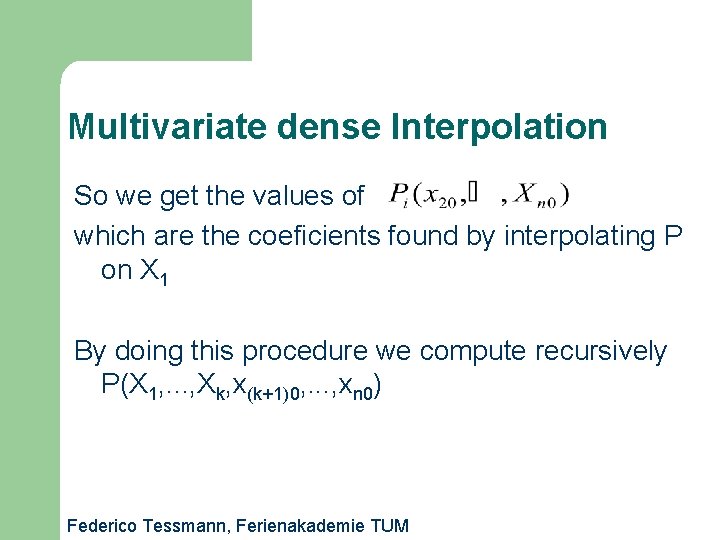
Multivariate dense Interpolation So we get the values of which are the coeficients found by interpolating P on X 1 By doing this procedure we compute recursively P(X 1, . . . , Xk, x(k+1)0, . . . , xn 0) Federico Tessmann, Ferienakademie TUM
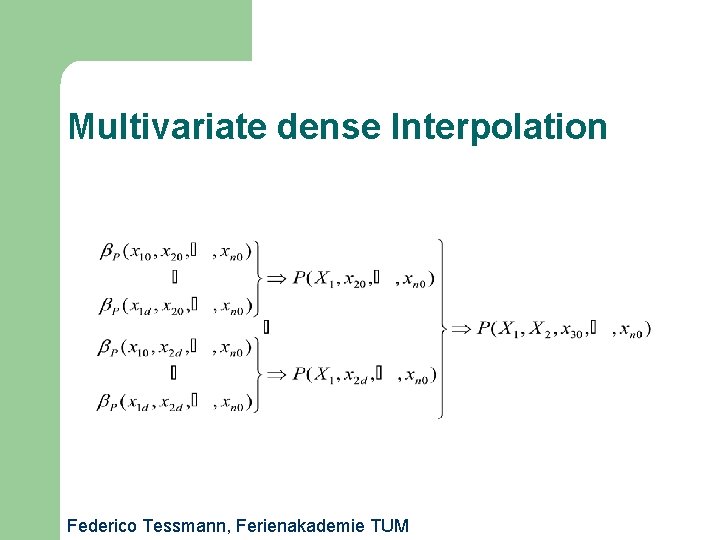
Multivariate dense Interpolation Federico Tessmann, Ferienakademie TUM
The complexity of the dense interpolation Let I(d) be the complexity of interpolating d+1 values to produce a univariate plynomial of degree „d“ and Nk the complexity for the first k variables Federico Tessmann, Ferienakademie TUM
Probabilistic Sparse Interpolation l Formal Presentation l Example l Analysis Federico Tessmann, Ferienakademie TUM
Probabilistic Sparse Interpolation Assume we want to dermine P(X 1, . . . , Xn) which is an element of L[X] where L is a field of cardinal q and the degree of each Xi is bounded by „d“ and there are no more than T non-zero monomials Federico Tessmann, Ferienakademie TUM
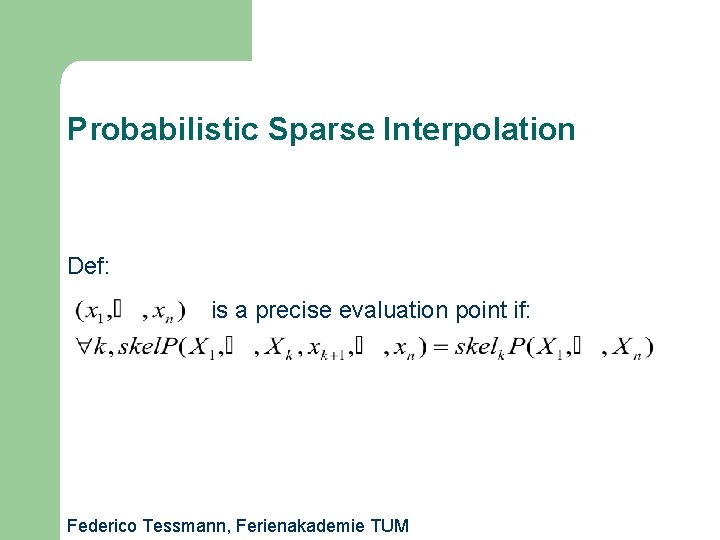
Probabilistic Sparse Interpolation Def: is a precise evaluation point if: Federico Tessmann, Ferienakademie TUM
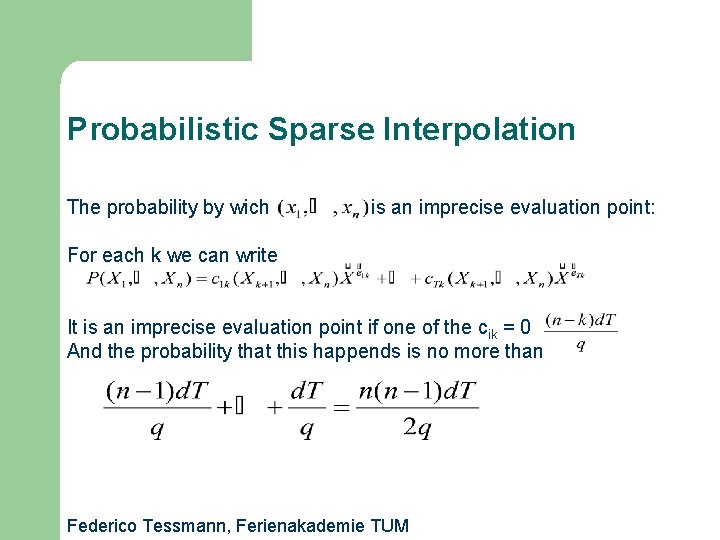
Probabilistic Sparse Interpolation The probability by wich is an imprecise evaluation point: For each k we can write It is an imprecise evaluation point if one of the cik = 0 And the probability that this happends is no more than Federico Tessmann, Ferienakademie TUM
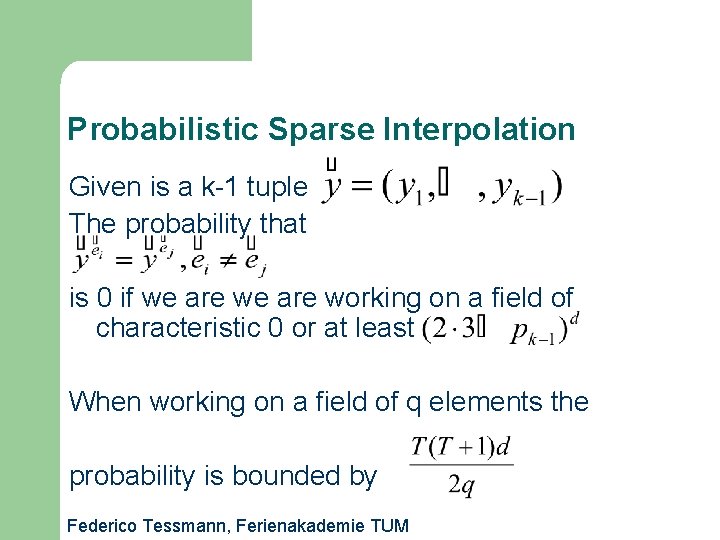
Probabilistic Sparse Interpolation Given is a k-1 tuple The probability that is 0 if we are working on a field of characteristic 0 or at least When working on a field of q elements the probability is bounded by Federico Tessmann, Ferienakademie TUM
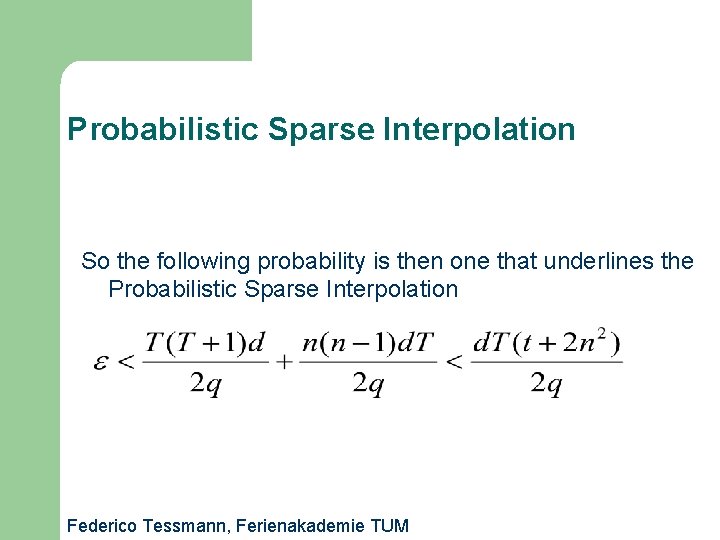
Probabilistic Sparse Interpolation So the following probability is then one that underlines the Probabilistic Sparse Interpolation Federico Tessmann, Ferienakademie TUM
Probabilistic Sparse Interpolation Assume we want to dermine P(X 1, . . . , Xn) which is an element of L[X] where L is a field of cardinal q and the degree of each Xi is bounded by „d“ and there are no more than T non-zero monomials As in the dense interpolation we Interpolate Federico Tessmann, Ferienakademie TUM
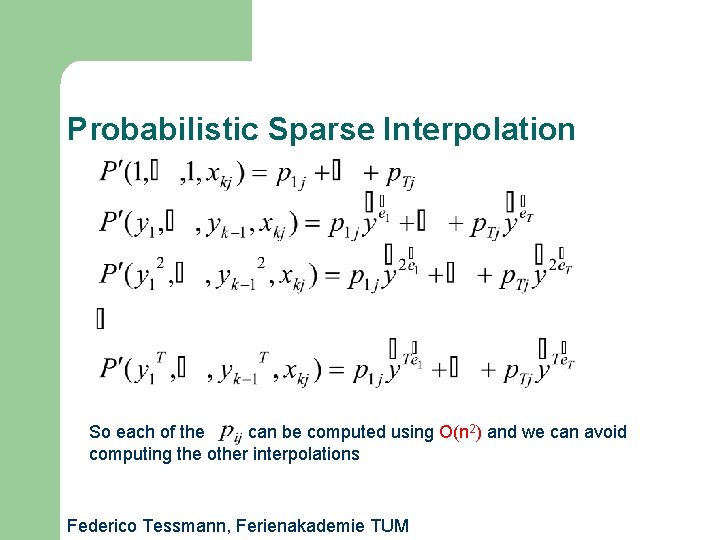
Probabilistic Sparse Interpolation At the kth stage the first computation gives us: We then assume that The probability of that being the right skeleton is We then pick a (k-1) tuple And we set up the following transposed Vandermonde system of linear ecuations Federico Tessmann, Ferienakademie TUM
Probabilistic Sparse Interpolation So each of the can be computed using O(n 2) and we can avoid computing the other interpolations Federico Tessmann, Ferienakademie TUM
Probabilistic Sparse Interpolation The probability that the Vandermonde system of equation is non-singular is bounded by Federico Tessmann, Ferienakademie TUM
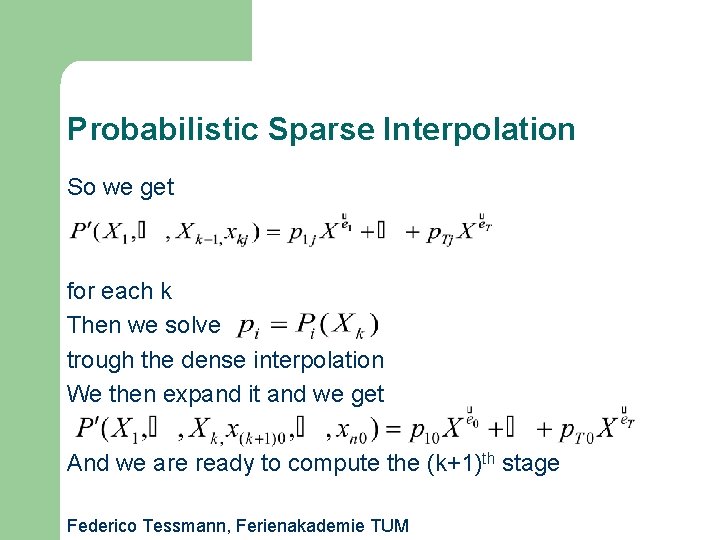
Probabilistic Sparse Interpolation So we get for each k Then we solve trough the dense interpolation We then expand it and we get And we are ready to compute the (k+1)th stage Federico Tessmann, Ferienakademie TUM
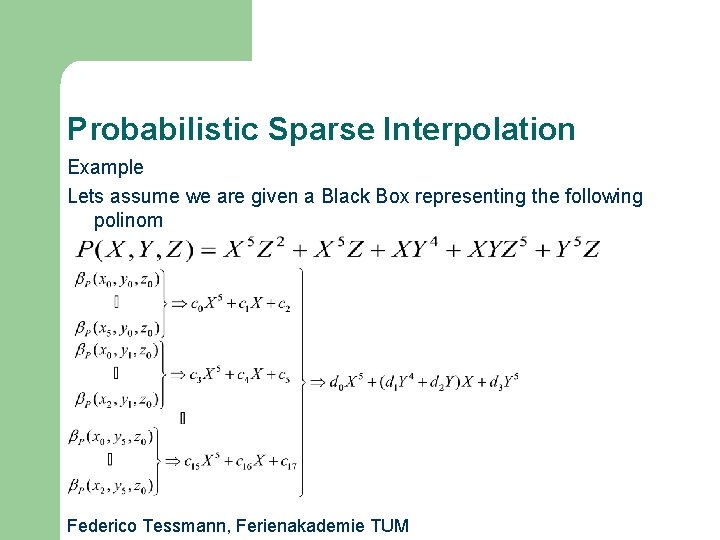
Probabilistic Sparse Interpolation Example Lets assume we are given a Black Box representing the following polinom Federico Tessmann, Ferienakademie TUM
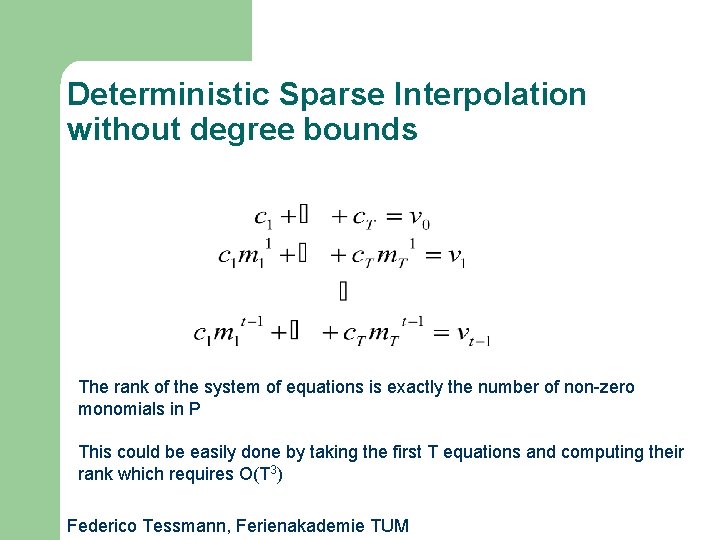
Deterministic Sparse Interpolation without degree bounds Given are a bound on the number of non-zero terms „T“ and the number of variables „n“ We want to compute By choosing a distinct prime for each Xi then the quantities will all be distinct. Let Then we get: Federico Tessmann, Ferienakademie TUM
Deterministic Sparse Interpolation without degree bounds The rank of the system of equations is exactly the number of non-zero monomials in P This could be easily done by taking the first T equations and computing their rank which requires O(T 3) Federico Tessmann, Ferienakademie TUM
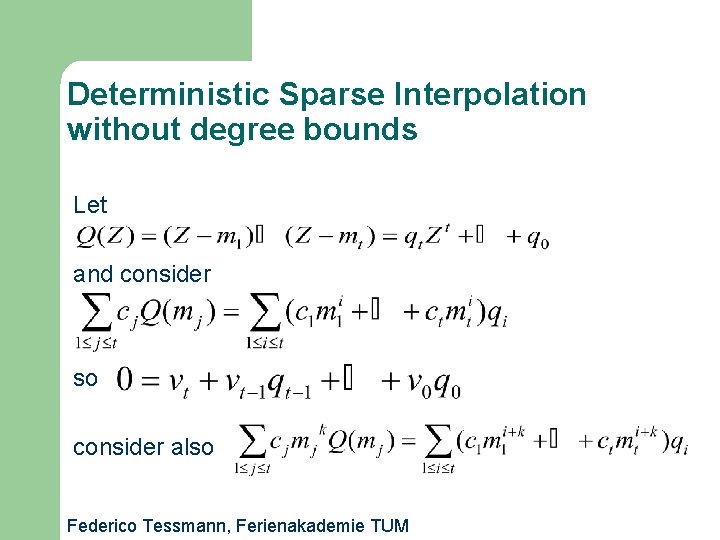
Deterministic Sparse Interpolation without degree bounds Let and consider so consider also Federico Tessmann, Ferienakademie TUM
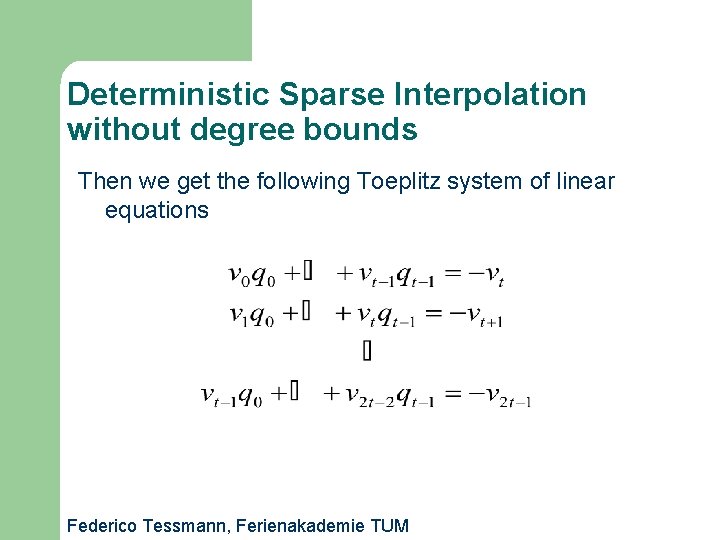
Deterministic Sparse Interpolation without degree bounds Then we get the following Toeplitz system of linear equations Federico Tessmann, Ferienakademie TUM
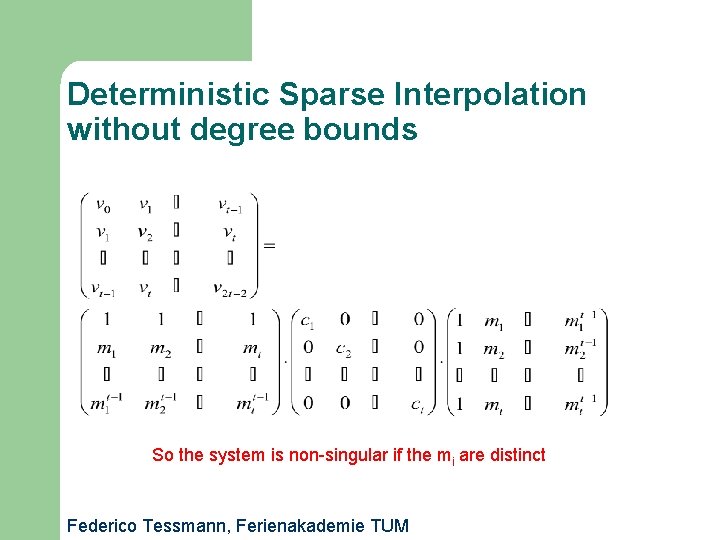
Deterministic Sparse Interpolation without degree bounds So the system is non-singular if the mi are distinct Federico Tessmann, Ferienakademie TUM
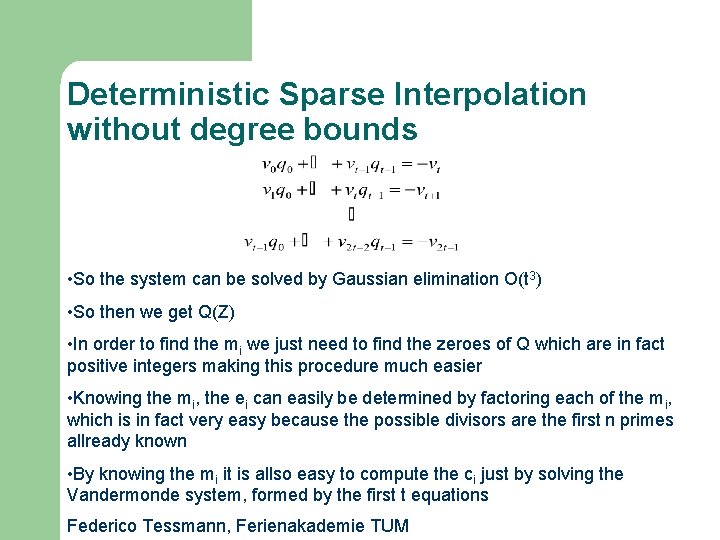
Deterministic Sparse Interpolation without degree bounds • So the system can be solved by Gaussian elimination O(t 3) • So then we get Q(Z) • In order to find the mi we just need to find the zeroes of Q which are in fact positive integers making this procedure much easier • Knowing the mi, the ei can easily be determined by factoring each of the mi, which is in fact very easy because the possible divisors are the first n primes allready known • By knowing the mi it is allso easy to compute the ci just by solving the Vandermonde system, formed by the first t equations Federico Tessmann, Ferienakademie TUM
The End Questions? Bibliography: Richard Zippel Federico Tessmann, Ferienakademie TUM
Appendix pseudo-codes for the interpolation algorithms Federico Tessmann, Ferienakademie TUM
Code for Vandermonde Matrices Federico Tessmann, Ferienakademie TUM
Code for Lagrange Interpolation Federico Tessmann, Ferienakademie TUM
Code for Newton Interpolation Federico Tessmann, Ferienakademie TUM