
Efficacy of Revital Vision technology in improving vision
- Slides: 15
Efficacy of Revital. Vision technology in improving vision in Adult Amblyopia FP-674 Dr. Damaris Magdalene M 13311, Assam Pediatric Services Sri Sankaradeva Nethralaya, Guwahati, Assam , India. No Financial interest
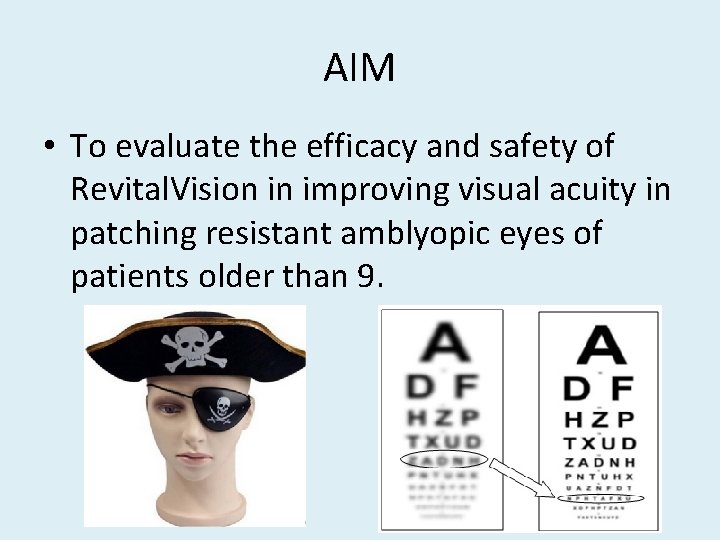
AIM • To evaluate the efficacy and safety of Revital. Vision in improving visual acuity in patching resistant amblyopic eyes of patients older than 9.
Study Methods • The study and protocol conformed to the tenets of the Declaration of Helsinki. Informed consent was obtained from all the patients. • All patients underwent at least 6 months of patching therapy with no visual improvement prior to starting the Revital. Vision therapy.
Study Criteria • Exclusion criteria consisted of any other ocular condition or cause for reduced visual acuity other than anisometropia, amblyopia due to strabismus and visual deprivation and nystagmus.
Examinations • Baseline examination included subjective and objective refractions, cycloplegic subjective and objective refractions, uncorrected and bestcorrected distance visual acuities (BCVA) were tested using an ETDRS Log. MAR visual acuity chart. • The baseline contrast sensitivity was also documented. The patients then underwent slitlamp biomicroscopy and fundus evaluation by binocular indirect ophthalmoscopy. • All the cases in the study then underwent an orientation guided by the trainer.
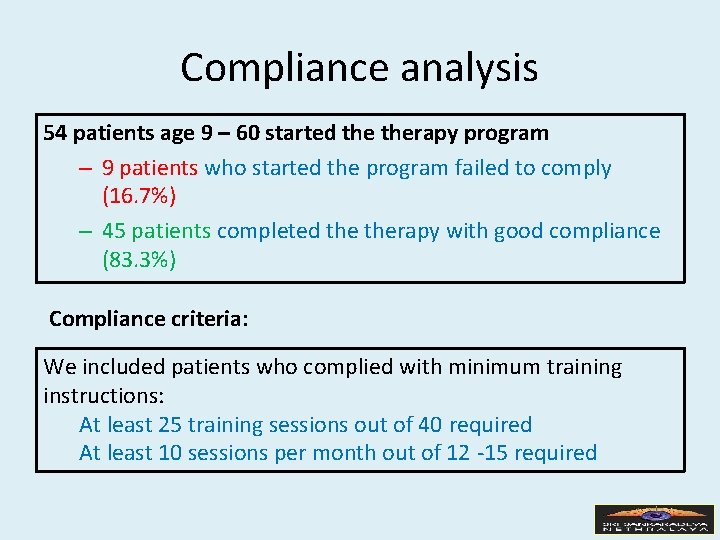
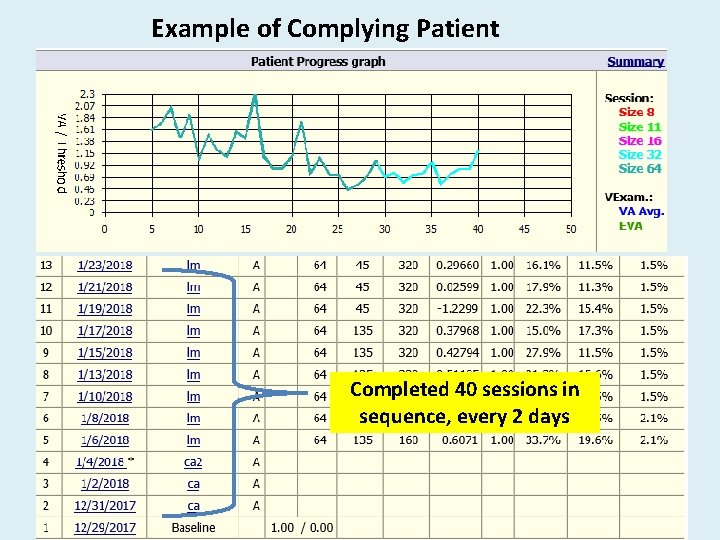
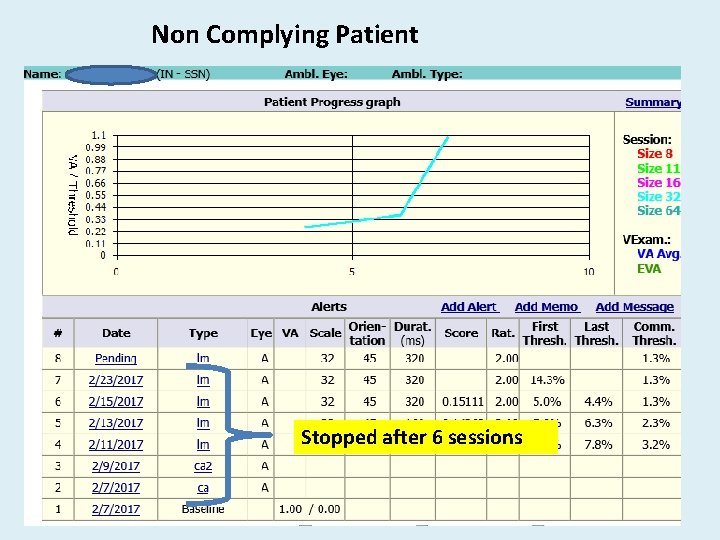
Compliance analysis 54 patients age 9 – 60 started therapy program – 9 patients who started the program failed to comply (16. 7%) – 45 patients completed therapy with good compliance (83. 3%) Compliance criteria: We included patients who complied with minimum training instructions: At least 25 training sessions out of 40 required At least 10 sessions per month out of 12 -15 required
Example of Complying Patient Completed 40 sessions in sequence, every 2 days
Non Complying Patient Stopped after 6 sessions
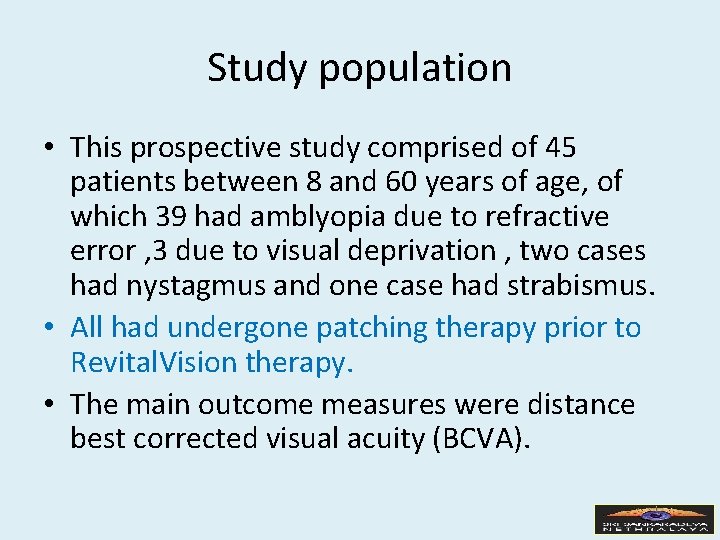
Study population • This prospective study comprised of 45 patients between 8 and 60 years of age, of which 39 had amblyopia due to refractive error , 3 due to visual deprivation , two cases had nystagmus and one case had strabismus. • All had undergone patching therapy prior to Revital. Vision therapy. • The main outcome measures were distance best corrected visual acuity (BCVA).
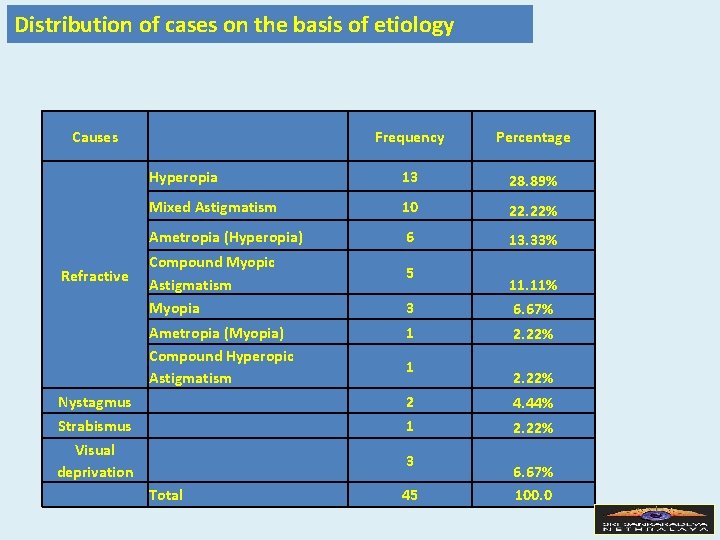
Distribution of cases on the basis of etiology Causes Refractive Frequency Percentage Hyperopia 13 28. 89% Mixed Astigmatism 10 22. 22% Ametropia (Hyperopia) 6 13. 33% Compound Myopic Astigmatism Myopia Ametropia (Myopia) Compound Hyperopic Astigmatism 5 11. 11% 3 6. 67% 1 2. 22% Nystagmus 2 4. 44% Strabismus Visual deprivation 1 2. 22% 3 Total 45 6. 67% 100. 0
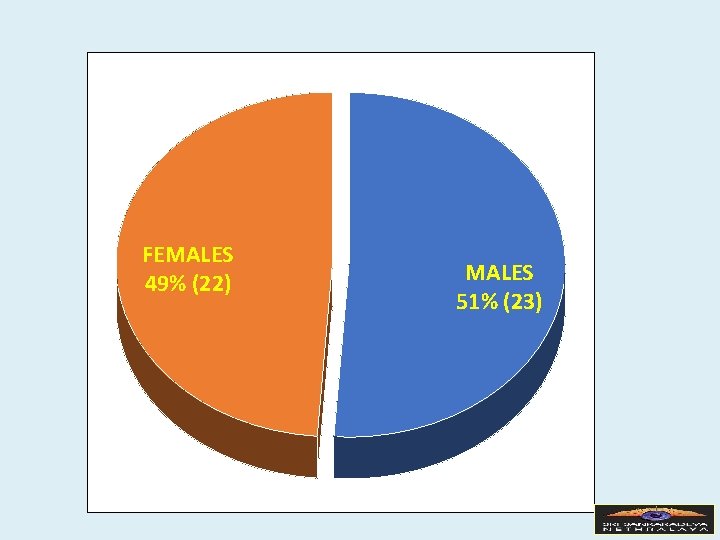
FEMALES 49% (22) MALES 51% (23)
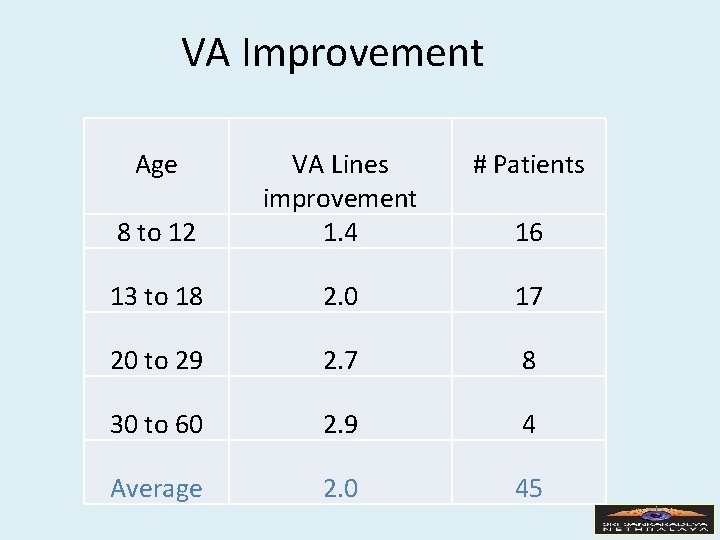
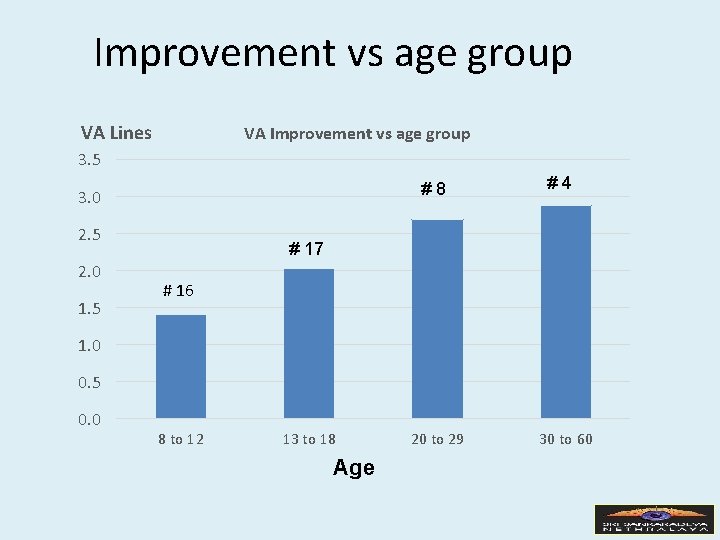
VA Improvement Age # Patients 8 to 12 VA Lines improvement 1. 4 13 to 18 2. 0 17 20 to 29 2. 7 8 30 to 60 2. 9 4 Average 2. 0 45 16
Improvement vs age group VA Lines VA Improvement vs age group 3. 5 #8 3. 0 2. 5 2. 0 1. 5 #4 # 17 # 16 1. 0 0. 5 0. 0 8 to 12 13 to 18 Age 20 to 29 30 to 60
Conclusion • Our study is the first prospective study in India to report the efficacy and safety of this novel non-invasive perceptual learning computerized program called Revital. Vision. • Our study confirms current published data of enhanced BCVA of 2 + lines in adult amblyopic individuals not responding to the traditional patching therapy.
Limitations • Limitations of this study include the absence of a comparative control group and a small sample size • Preliminary evidence suggests Revital. Vision PL treatment is safe and improves BCVA in adult amblyopic patients who do not respond to the traditional patching therapy. Thank you!