
Effects of Vertical Wind Shear on the Predictability
Effects of Vertical Wind Shear on the Predictability of Tropical Cyclones: Practical versus Intrinsic Limit Dandan Tao Department of Meteorology The Pennsylvania State University Group Meeting Friday 1 st May, 2015 1

How Does Shear Impact RI Onset Predictability? Initial upright vortex Vertical Wind Shear Vortex tilting Tilt forces ascent on the downtilt side and descent on the uptilt direction Downtilt convection Asymmetry in Moist Convection Precession Alignment Tropical Cyclone Rapid Intensification Onset ? Predictability of Tropical Cyclone Rapid Intensification Onset 2
Experimental Design • Idealized TC simulation Rankine vortex Vmax=15 m/s at R=135 km Under constant shear Using point-downscaling method (Nolan, 2011) • Add random moisture perturbation ( ± 0. 5 g/kg under 950 h. Pa) to initial condition 20 ensemble members • Ensemble forecast evaluate intrinsic predictability under different shear conditions Experimental Design: • 5 m/s, sensitivity simulations • 6 m/s, perturb shear magnitude with normal distribution std=0. 1 m/s and std=0. 5 m/s 3
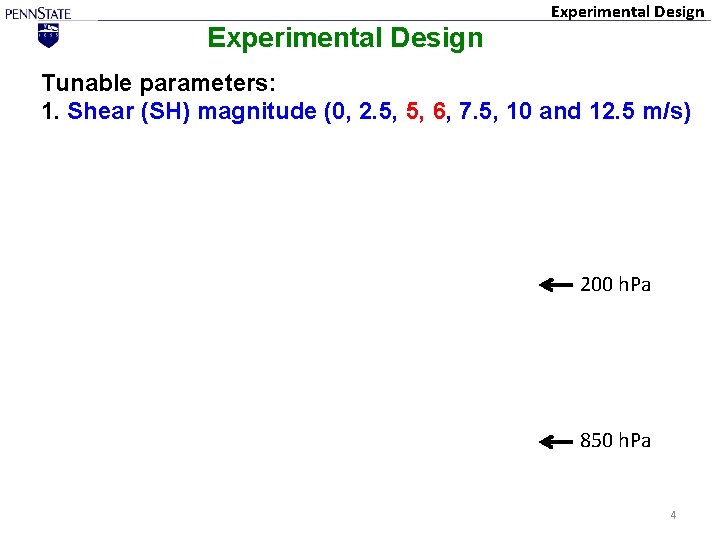
Experimental Design Tunable parameters: 1. Shear (SH) magnitude (0, 2. 5, 5, 6, 7. 5, 10 and 12. 5 m/s) 200 h. Pa 850 h. Pa 4
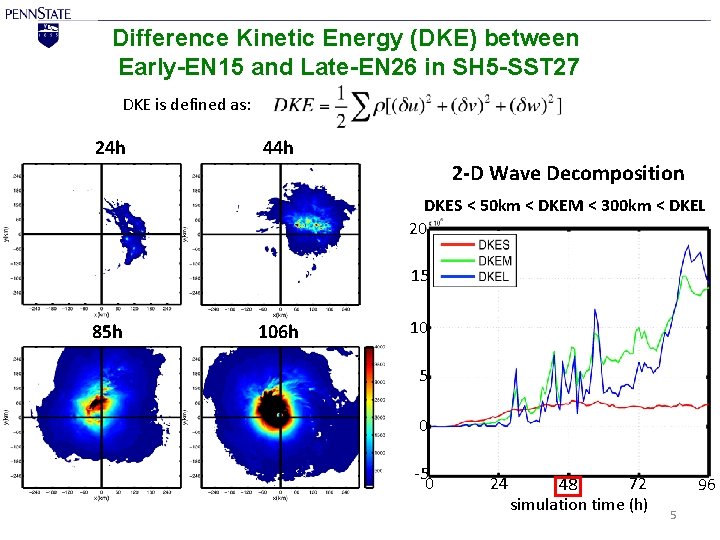
Difference Kinetic Energy (DKE) between Early-EN 15 and Late-EN 26 in SH 5 -SST 27 DKE is defined as: 24 h 44 h 2 -D Wave Decomposition DKES < 50 km < DKEM < 300 km < DKEL 20 15 85 h 106 h 10 5 0 -5 0 24 72 48 simulation time (h) 96 5
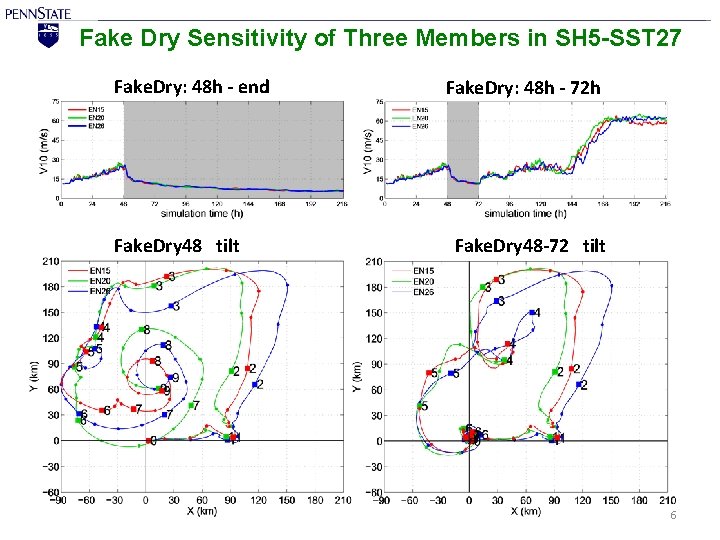
Fake Dry Sensitivity of Three Members in SH 5 -SST 27 Fake. Dry: 48 h - end Fake. Dry 48 tilt Fake. Dry: 48 h - 72 h Fake. Dry 48 -72 tilt 6
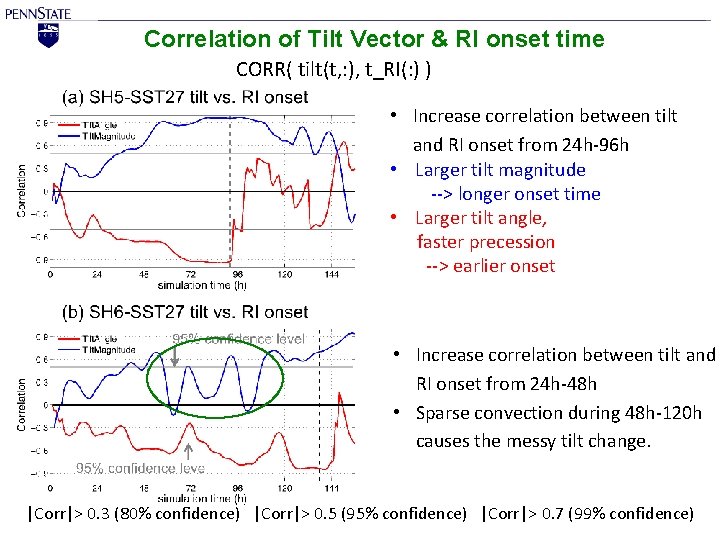
Correlation of Tilt Vector & RI onset time CORR( tilt(t, : ), t_RI(: ) ) • Increase correlation between tilt and RI onset from 24 h-96 h • Larger tilt magnitude --> longer onset time • Larger tilt angle, faster precession --> earlier onset • Increase correlation between tilt and RI onset from 24 h-48 h • Sparse convection during 48 h-120 h causes the messy tilt change. |Corr|> 0. 3 (80% confidence) |Corr|> 0. 5 (95% confidence) |Corr|> 0. 7 (99% confidence)
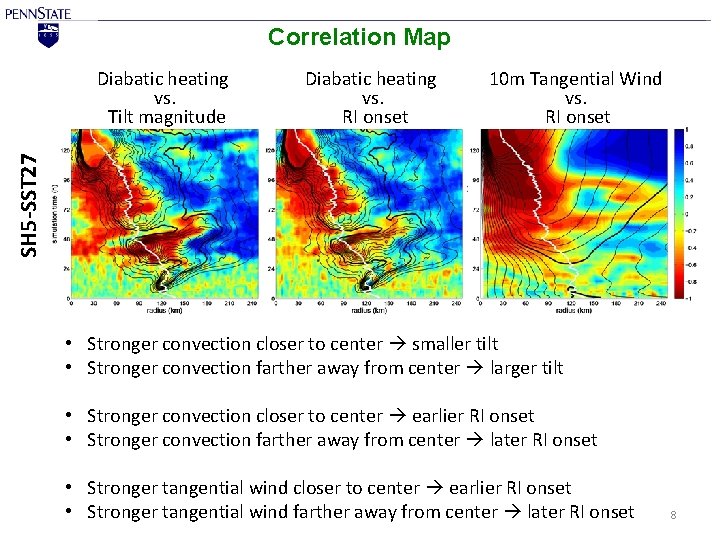
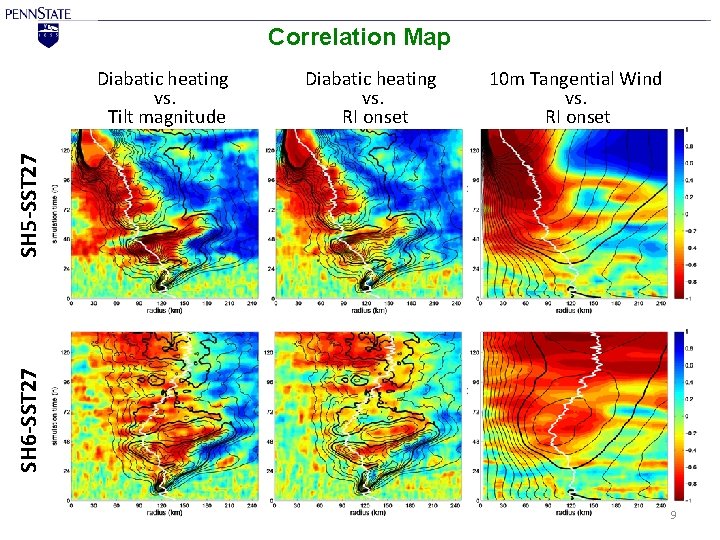
Correlation Map Diabatic heating vs. RI onset 10 m Tangential Wind vs. RI onset SH 5 -SST 27 Diabatic heating vs. Tilt magnitude • Stronger convection closer to center smaller tilt • Stronger convection farther away from center larger tilt • Stronger convection closer to center earlier RI onset • Stronger convection farther away from center later RI onset • Stronger tangential wind closer to center earlier RI onset • Stronger tangential wind farther away from center later RI onset 8
Correlation Map Diabatic heating vs. RI onset 10 m Tangential Wind vs. RI onset SH 6 -SST 27 SH 5 -SST 27 Diabatic heating vs. Tilt magnitude 9
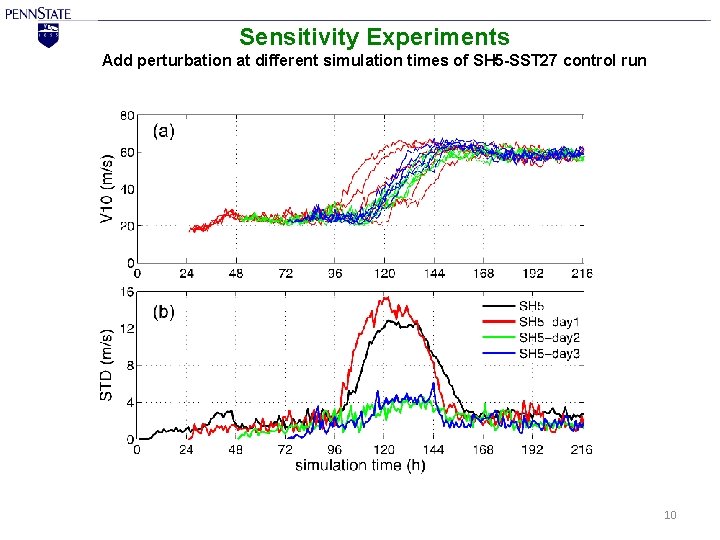
Sensitivity Experiments Add perturbation at different simulation times of SH 5 -SST 27 control run 10
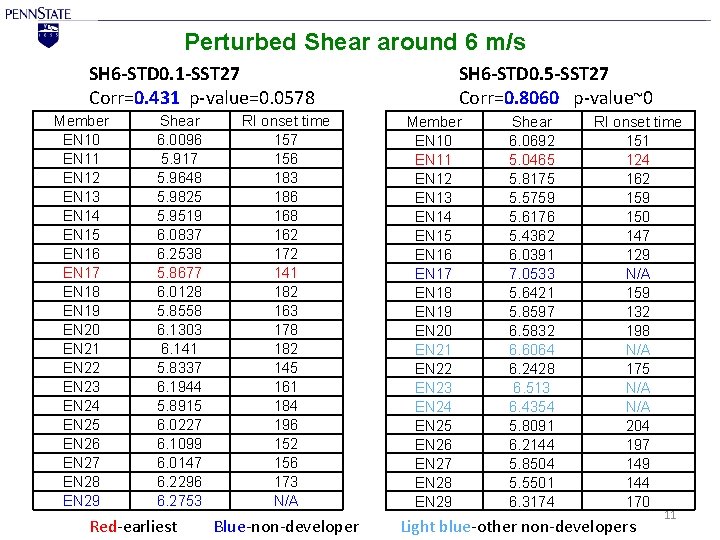
Perturbed Shear around 6 m/s SH 6 -STD 0. 1 -SST 27 Corr=0. 431 p-value=0. 0578 Member EN 10 EN 11 EN 12 EN 13 EN 14 EN 15 EN 16 EN 17 EN 18 EN 19 EN 20 EN 21 EN 22 EN 23 EN 24 EN 25 EN 26 EN 27 EN 28 EN 29 Shear 6. 0096 5. 917 5. 9648 5. 9825 5. 9519 6. 0837 6. 2538 5. 8677 6. 0128 5. 8558 6. 1303 6. 141 5. 8337 6. 1944 5. 8915 6. 0227 6. 1099 6. 0147 6. 2296 6. 2753 Red-earliest RI onset time 157 156 183 186 168 162 172 141 182 163 178 182 145 161 184 196 152 156 173 N/A Blue-non-developer SH 6 -STD 0. 5 -SST 27 Corr=0. 8060 p-value~0 Member EN 10 EN 11 EN 12 EN 13 EN 14 EN 15 EN 16 EN 17 EN 18 EN 19 EN 20 EN 21 EN 22 EN 23 EN 24 EN 25 EN 26 EN 27 EN 28 EN 29 Shear 6. 0692 5. 0465 5. 8175 5. 5759 5. 6176 5. 4362 6. 0391 7. 0533 5. 6421 5. 8597 6. 5832 6. 6064 6. 2428 6. 513 6. 4354 5. 8091 6. 2144 5. 8504 5. 5501 6. 3174 RI onset time 151 124 162 159 150 147 129 N/A 159 132 198 N/A 175 N/A 204 197 149 144 170 Light blue-other non-developers 11
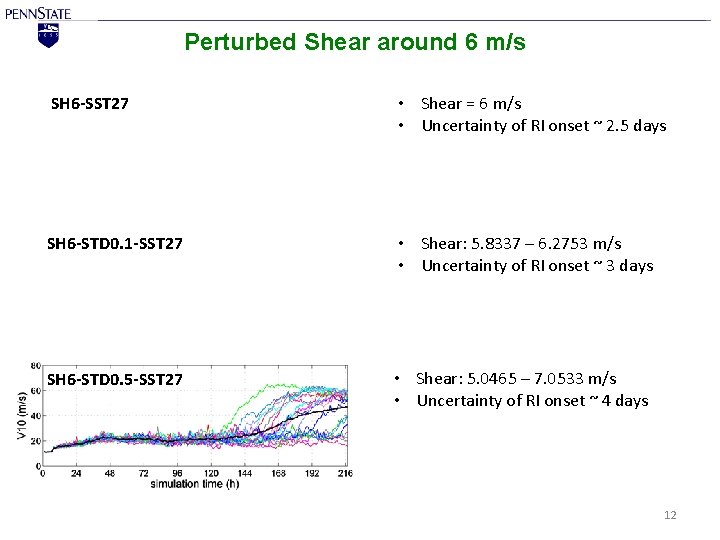
Perturbed Shear around 6 m/s SH 6 -SST 27 • Shear = 6 m/s • Uncertainty of RI onset ~ 2. 5 days SH 6 -STD 0. 1 -SST 27 • Shear: 5. 8337 – 6. 2753 m/s • Uncertainty of RI onset ~ 3 days SH 6 -STD 0. 5 -SST 27 • Shear: 5. 0465 – 7. 0533 m/s • Uncertainty of RI onset ~ 4 days 12
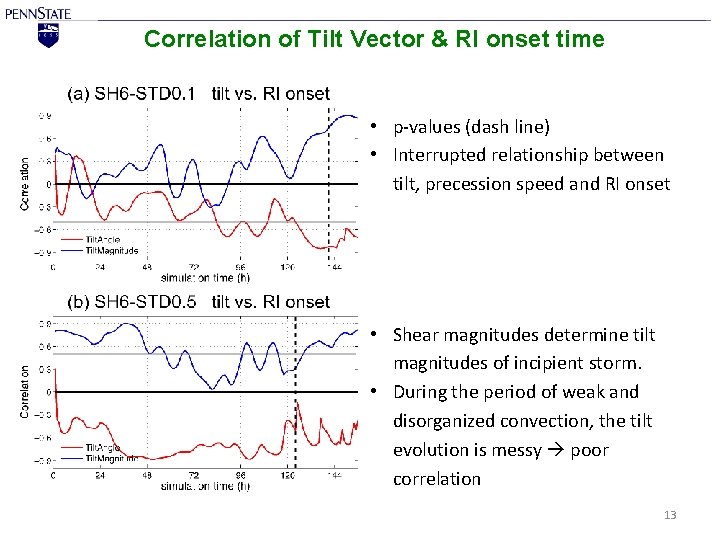
Correlation of Tilt Vector & RI onset time • p-values (dash line) • Interrupted relationship between tilt, precession speed and RI onset • Shear magnitudes determine tilt magnitudes of incipient storm. • During the period of weak and disorganized convection, the tilt evolution is messy poor correlation 13
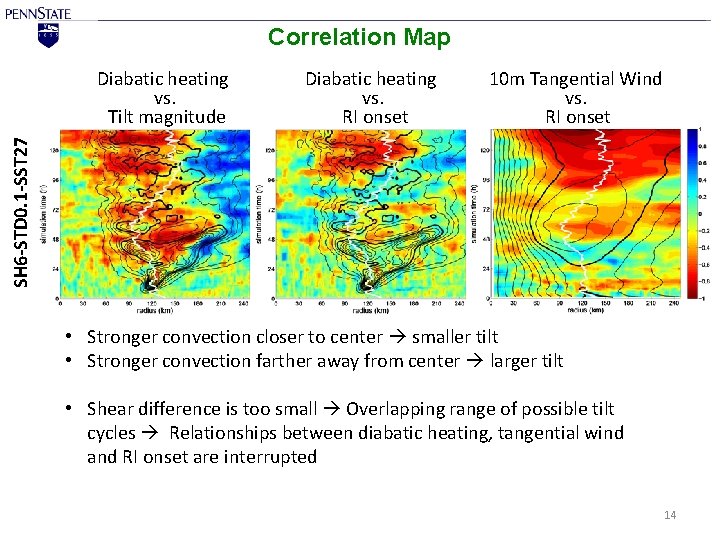
Correlation Map Diabatic heating vs. RI onset 10 m Tangential Wind vs. RI onset SH 6 -STD 0. 1 -SST 27 Diabatic heating vs. Tilt magnitude • Stronger convection closer to center smaller tilt • Stronger convection farther away from center larger tilt • Shear difference is too small Overlapping range of possible tilt cycles Relationships between diabatic heating, tangential wind and RI onset are interrupted 14
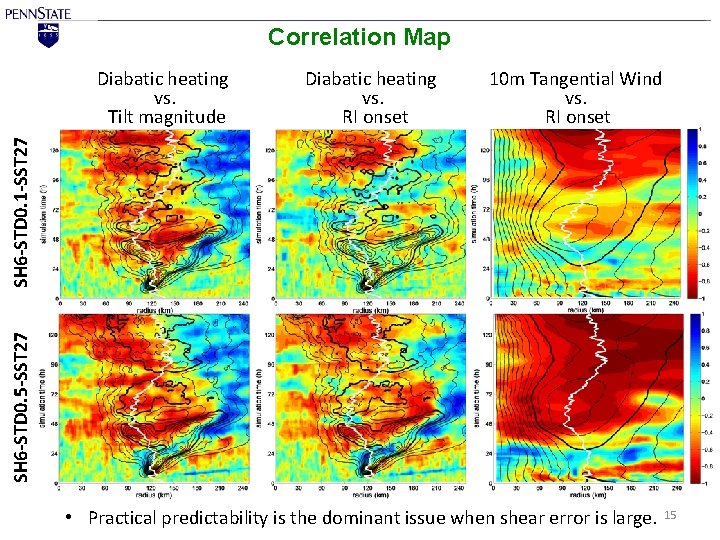
Correlation Map Diabatic heating vs. RI onset 10 m Tangential Wind vs. RI onset SH 6 -STD 0. 5 -SST 27 SH 6 -STD 0. 1 -SST 27 Diabatic heating vs. Tilt magnitude • Practical predictability is the dominant issue when shear error is large. 15
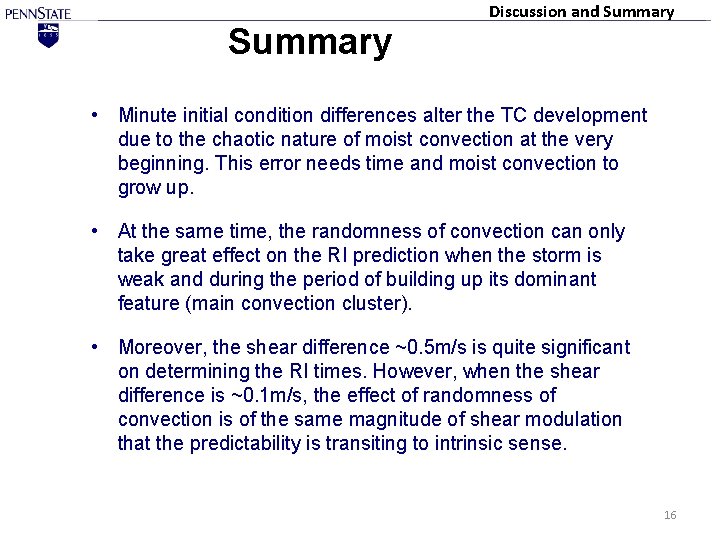
Summary Discussion and Summary • Minute initial condition differences alter the TC development due to the chaotic nature of moist convection at the very beginning. This error needs time and moist convection to grow up. • At the same time, the randomness of convection can only take great effect on the RI prediction when the storm is weak and during the period of building up its dominant feature (main convection cluster). • Moreover, the shear difference ~0. 5 m/s is quite significant on determining the RI times. However, when the shear difference is ~0. 1 m/s, the effect of randomness of convection is of the same magnitude of shear modulation that the predictability is transiting to intrinsic sense. 16
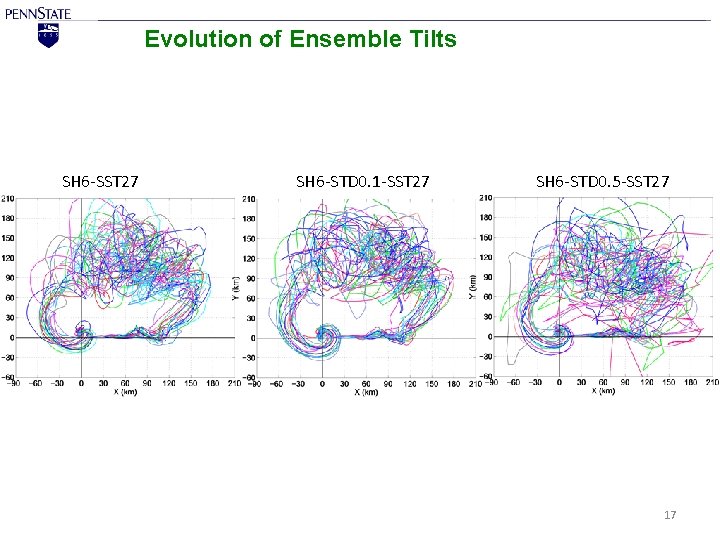
Evolution of Ensemble Tilts SH 6 -SST 27 SH 6 -STD 0. 1 -SST 27 SH 6 -STD 0. 5 -SST 27 17
- Slides: 17