
Effects of SWH Classroom on Critical Thinking Consultants

- Slides: 19
Effects of SWH Classroom on Critical Thinking Consultants: Suwiwat Witchakool, Hyung Jin Kim
SWH (Science Writing Heuristic) �Science-inquiry approach �Integrating literacy into science classroom �Focusing on claim and evidence, and argumentation * Cornell Critical Thinking Test - Score ranges from 0 to 76 - Has five subscales: Induction, Deduction, Observation, Credibility, Assumption
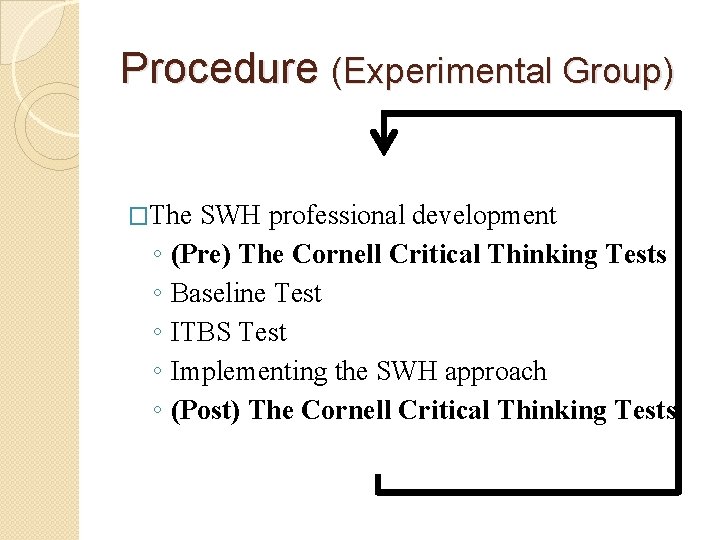
Procedure (Experimental Group) �The ◦ ◦ ◦ SWH professional development (Pre) The Cornell Critical Thinking Tests Baseline Test ITBS Test Implementing the SWH approach (Post) The Cornell Critical Thinking Tests
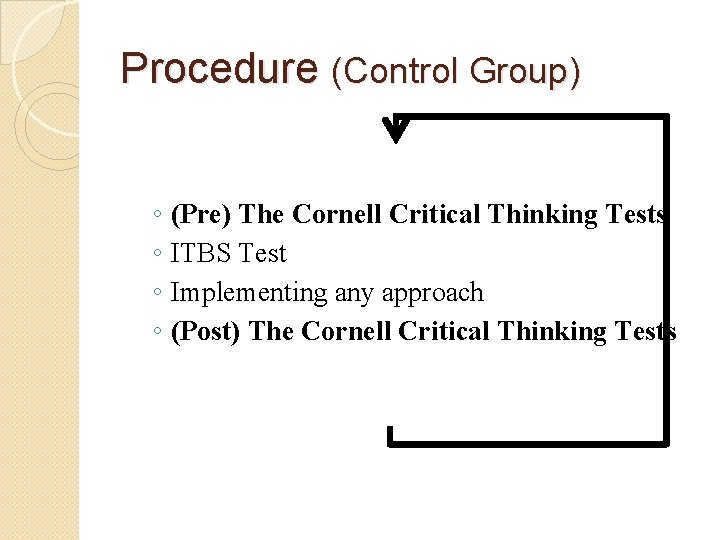
Procedure (Control Group) ◦ ◦ (Pre) The Cornell Critical Thinking Tests ITBS Test Implementing any approach (Post) The Cornell Critical Thinking Tests
Goal of Study �Observe whether or not the science writing heuristic (SWH) approach increase the critical thinking skills significantly
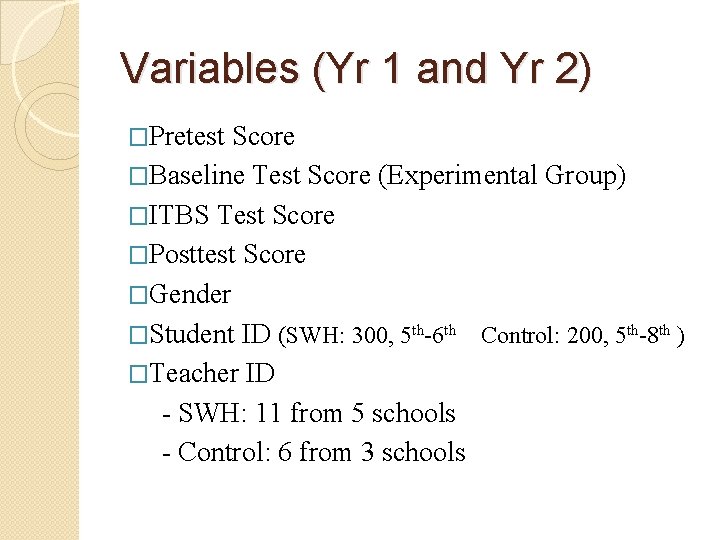
Variables (Yr 1 and Yr 2) �Pretest Score �Baseline Test Score (Experimental Group) �ITBS Test Score �Posttest Score �Gender �Student ID (SWH: 300, 5 th-6 th Control: 200, 5 th-8 th ) �Teacher ID - SWH: 11 from 5 schools - Control: 6 from 3 schools
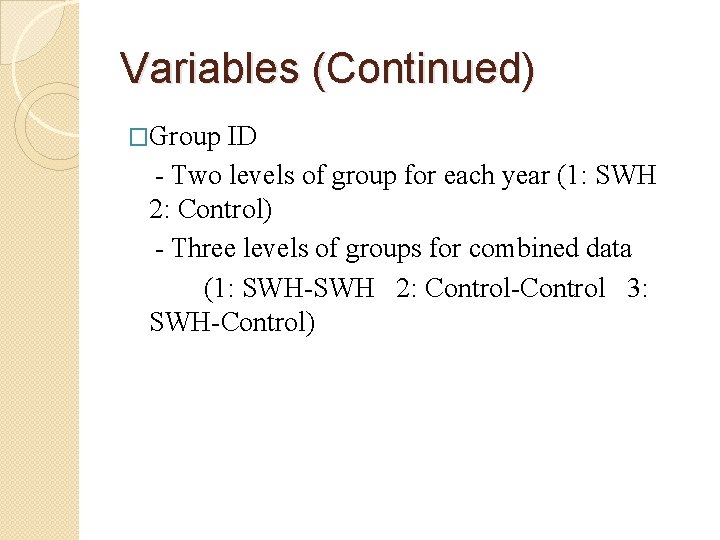
Variables (Continued) �Group ID - Two levels of group for each year (1: SWH 2: Control) - Three levels of groups for combined data (1: SWH-SWH 2: Control-Control 3: SWH-Control)
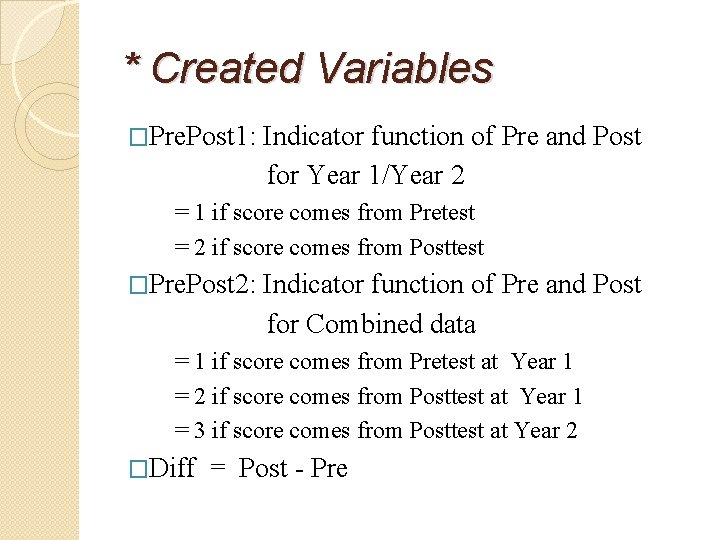
* Created Variables �Pre. Post 1: Indicator function of Pre and Post for Year 1/Year 2 = 1 if score comes from Pretest = 2 if score comes from Posttest �Pre. Post 2: Indicator function of Pre and Post for Combined data = 1 if score comes from Pretest at Year 1 = 2 if score comes from Posttest at Year 1 = 3 if score comes from Posttest at Year 2 �Diff = Post - Pre
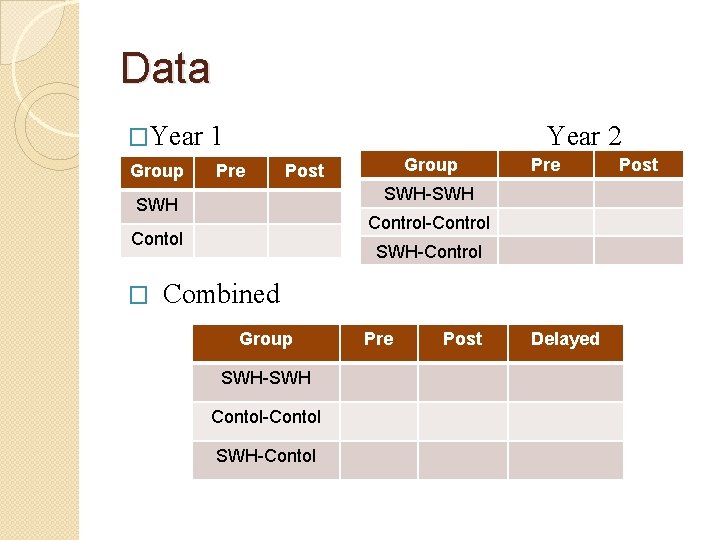
Data �Year Group 1 Year 2 Pre SWH-SWH Control-Control Contol � Group Post SWH-Control Combined Group SWH-SWH Contol-Contol SWH-Contol Pre Post Delayed Post
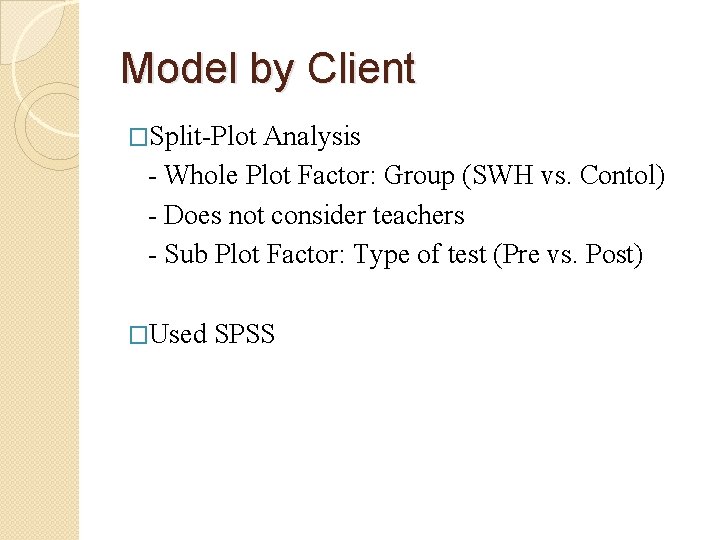
Model by Client �Split-Plot Analysis - Whole Plot Factor: Group (SWH vs. Contol) - Does not consider teachers - Sub Plot Factor: Type of test (Pre vs. Post) �Used SPSS
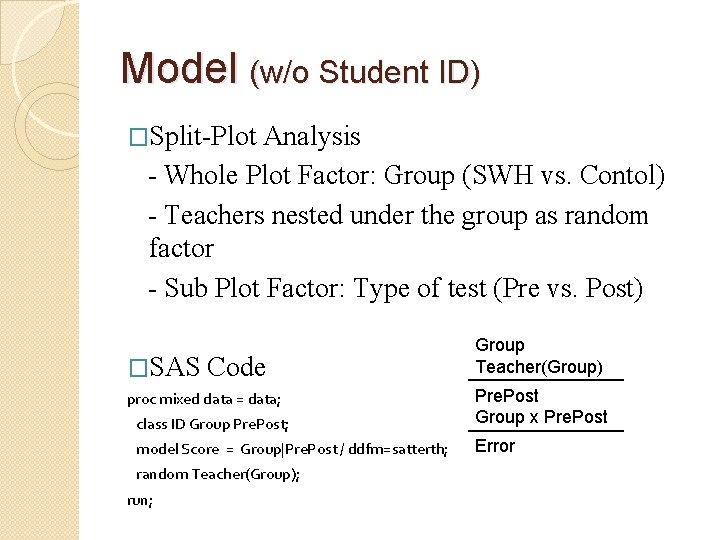
Model (w/o Student ID) �Split-Plot Analysis - Whole Plot Factor: Group (SWH vs. Contol) - Teachers nested under the group as random factor - Sub Plot Factor: Type of test (Pre vs. Post) �SAS Code Group Teacher(Group) class ID Group Pre. Post; Pre. Post Group x Pre. Post model Score = Group|Pre. Post / ddfm=satterth; Error proc mixed data = data; random Teacher(Group); run;
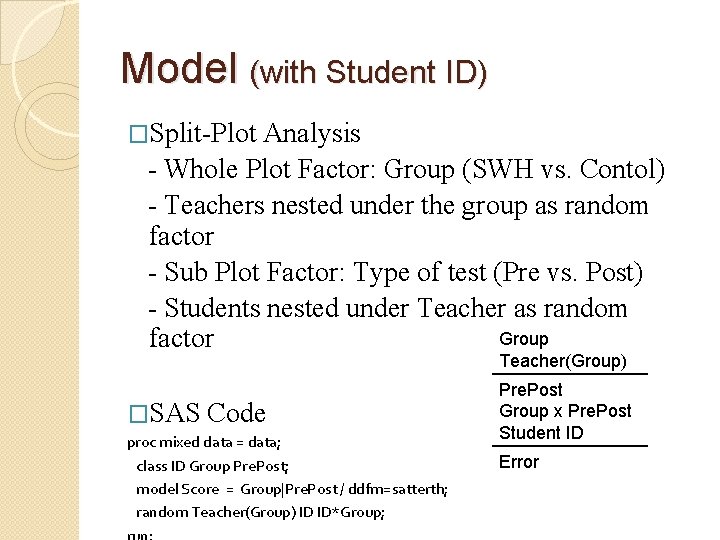
Model (with Student ID) �Split-Plot Analysis - Whole Plot Factor: Group (SWH vs. Contol) - Teachers nested under the group as random factor - Sub Plot Factor: Type of test (Pre vs. Post) - Students nested under Teacher as random Group factor Teacher(Group) �SAS Code proc mixed data = data; class ID Group Pre. Post; model Score = Group|Pre. Post / ddfm=satterth; random Teacher(Group) ID ID*Group; Pre. Post Group x Pre. Post Student ID Error
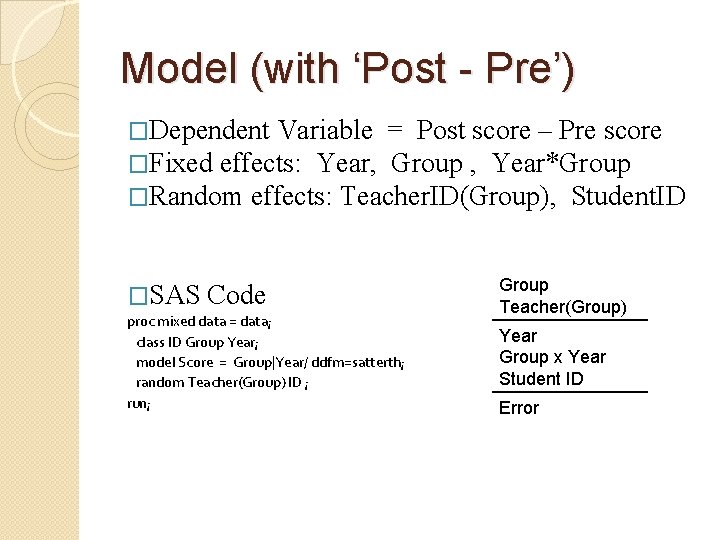
Model (with ‘Post - Pre’) �Dependent Variable = Post score – Pre score �Fixed effects: Year, Group , Year*Group �Random effects: Teacher. ID(Group), Student. ID �SAS Code proc mixed data = data; class ID Group Year; model Score = Group|Year/ ddfm=satterth; random Teacher(Group) ID ; run; Group Teacher(Group) Year Group x Year Student ID Error
Conclusions �For all models fitted, all variables except ‘Group’ turn out to be significant. �Year 1 only - The increase in score from pretest to posttest for the treatment group is significantly higher than the increase in score for the control group. : SWH seems to increase the critical thinking skills.
Conclusions (continued) �Year 2 only - The increase in score from pretest to posttest for the SWH is significantly higher than the increase in score for the Follow-up group. - The increase in score from pretest to posttest for the SWH is significantly higher than the increase in score for the control group. - The increase in score from pretest to posttest for the Follow-up is significantly lower than the increase in
Conclusions (continued) ÞWhen students are exposed to the SWH, their critical thinking skill tends to increase. Þ However, when they return to the control group, the regular method, their critical thinking skill comes down again, even lower than those who have stayed in control groups. (Interpretation: change in group might confuse students. ) Þ The continuous exposure to the SWH seems to be important to increase the critical thinking skills.
Conclusions (continued) �Combined Year 1 and Year 2 - Increase = posttest in Yr 2 – pretest in Yr 1 - The increase for the SWH is significantly higher than the increase for the Follow-up group. - The increase for the Follow-up is significantly lower than the increase for the Control group - However, the increase for the SWH is not significantly different from the increase for the Control group.
Conclusions (continued) The SWH method tends to increase the critical thinking skills tentatively during the year when students are exposed to the method. ÞHowever, in general over two years, it turns out that the SWH method does not increase the critical thinking skills significantly compared to the regular method. ÞMoreover, when students are exposed to both methods, SWH and then regular, their scores go down significantly compared to those who have been in the regular classes. (Change of Schools) Þ
Conclusions (continued) �The last model with ‘Post-Pre’ as dependent - During Yr 1, the increase in scores for the SWH is significantly higher than that for the control group. - During Yr 2, the increase in scores for the SWH is not significantly higher than that for the control group. - The increase in scores for students who have been in the SWH for two years is not significantly higher than the that for those in the control for two years. : The SWH method does not increase scores significantly compared to the regular classes.